


ETSI GR NFV-EVE 021 V5.1.1 (2023-09)
Network Functions Virtualisation (NFV) Release 5; Evolution and Ecosystem; Report on energy efficiency aspects for NFV
Network Functions Virtualisation (NFV) Release 5; Evolution and Ecosystem; Report on energy efficiency aspects for NFV
DGR/NFV-EVE021
General Information

Standards Content (Sample)
GROUP REPORT
Network Functions Virtualisation (NFV) Release 5;
Evolution and Ecosystem;
Report on energy efficiency aspects for NFV
Disclaimer
The present document has been produced and approved by the Network Functions Virtualisation (NFV) ETSI Industry
Specification Group (ISG) and represents the views of those members who participated in this ISG.
It does not necessarily represent the views of the entire ETSI membership.
2 ETSI GR NFV-EVE 021 V5.1.1 (2023-09)
Reference
DGR/NFV-EVE021
Keywords
energy efficiency, management, NFV
ETSI
650 Route des Lucioles
F-06921 Sophia Antipolis Cedex - FRANCE
Tel.: +33 4 92 94 42 00 Fax: +33 4 93 65 47 16
Siret N° 348 623 562 00017 - APE 7112B
Association à but non lucratif enregistrée à la
Sous-Préfecture de Grasse (06) N° w061004871
Important notice
The present document can be downloaded from:
https://www.etsi.org/standards-search
The present document may be made available in electronic versions and/or in print. The content of any electronic and/or
print versions of the present document shall not be modified without the prior written authorization of ETSI. In case of any
existing or perceived difference in contents between such versions and/or in print, the prevailing version of an ETSI
deliverable is the one made publicly available in PDF format at www.etsi.org/deliver.
Users of the present document should be aware that the document may be subject to revision or change of status.
Information on the current status of this and other ETSI documents is available at
https://portal.etsi.org/TB/ETSIDeliverableStatus.aspx
If you find errors in the present document, please send your comment to one of the following services:
https://portal.etsi.org/People/CommiteeSupportStaff.aspx
If you find a security vulnerability in the present document, please report it through our
Coordinated Vulnerability Disclosure Program:
https://www.etsi.org/standards/coordinated-vulnerability-disclosure
Notice of disclaimer & limitation of liability
The information provided in the present deliverable is directed solely to professionals who have the appropriate degree of
experience to understand and interpret its content in accordance with generally accepted engineering or
other professional standard and applicable regulations.
No recommendation as to products and services or vendors is made or should be implied.
No representation or warranty is made that this deliverable is technically accurate or sufficient or conforms to any law
rule and/or regulation and further, no representation or warranty is made of merchantability or fitness
and/or governmental
for any particular purpose or against infringement of intellectual property rights.
In no event shall ETSI be held liable for loss of profits or any other incidental or consequential damages.
Any software contained in this deliverable is provided "AS IS" with no warranties, express or implied, including but not
limited to, the warranties of merchantability, fitness for a particular purpose and non-infringement of intellectual property
rights and ETSI shall not be held liable in any event for any damages whatsoever (including, without limitation, damages
for loss of profits, business interruption, loss of information, or any other pecuniary loss) arising out of or related to the use
of or inability to use the software.
Copyright Notification
No part may be reproduced or utilized in any form or by any means, electronic or mechanical, including photocopying and
microfilm except as authorized by written permission of ETSI.
The content of the PDF version shall not be modified without the written authorization of ETSI.
The copyright and the foregoing restriction extend to reproduction in all media.
© ETSI 2023.
All rights reserved.
ETSI
3 ETSI GR NFV-EVE 021 V5.1.1 (2023-09)
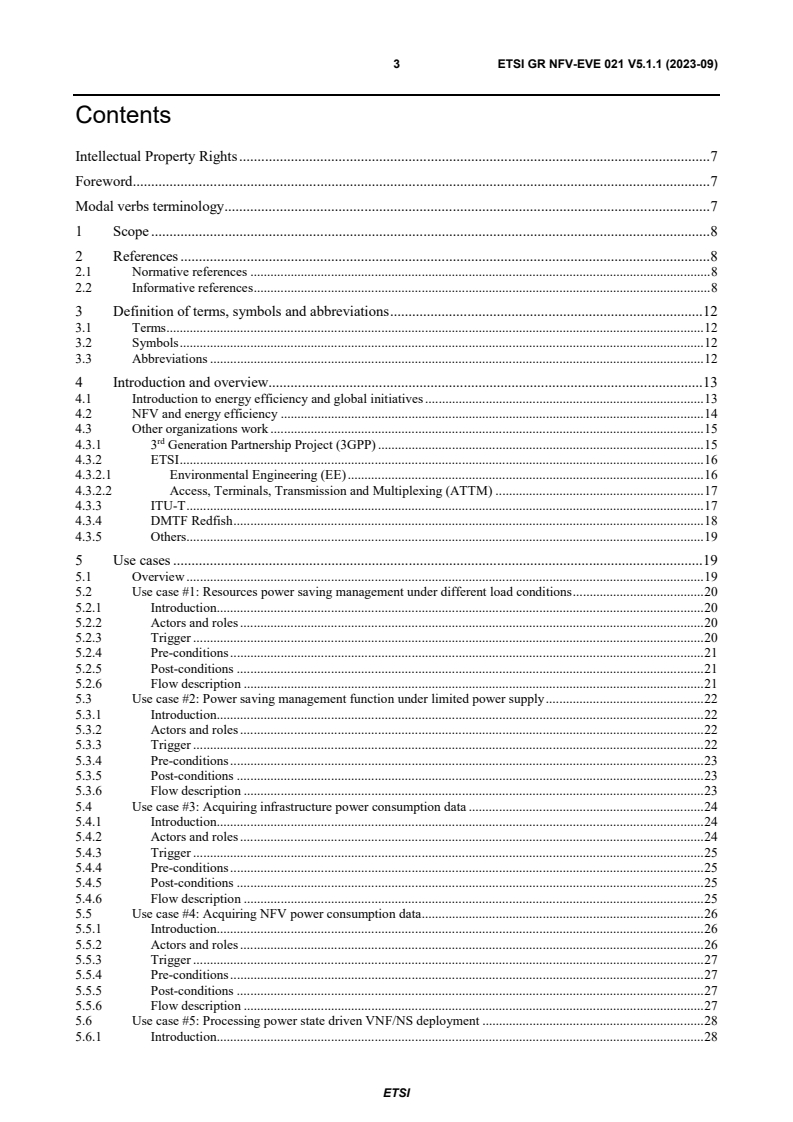
Contents
Intellectual Property Rights . 7
Foreword . 7
Modal verbs terminology . 7
1 Scope . 8
2 References . 8
2.1 Normative references . 8
2.2 Informative references . 8
3 Definition of terms, symbols and abbreviations . 12
3.1 Terms . 12
3.2 Symbols . 12
3.3 Abbreviations . 12
4 Introduction and overview . 13
4.1 Introduction to energy efficiency and global initiatives . 13
4.2 NFV and energy efficiency . 14
4.3 Other organizations work . 15
rd
4.3.1 3 Generation Partnership Project (3GPP) . 15
4.3.2 ETSI . 16
4.3.2.1 Environmental Engineering (EE) . 16
4.3.2.2 Access, Terminals, Transmission and Multiplexing (ATTM) . 17
4.3.3 ITU-T . 17
4.3.4 DMTF Redfish . 18
4.3.5 Others . 19
5 Use cases . 19
5.1 Overview . 19
5.2 Use case #1: Resources power saving management under different load conditions . 20
5.2.1 Introduction. 20
5.2.2 Actors and roles . 20
5.2.3 Trigger . 20
5.2.4 Pre-conditions . 21
5.2.5 Post-conditions . 21
5.2.6 Flow description . 21
5.3 Use case #2: Power saving management function under limited power supply . 22
5.3.1 Introduction. 22
5.3.2 Actors and roles . 22
5.3.3 Trigger . 22
5.3.4 Pre-conditions . 23
5.3.5 Post-conditions . 23
5.3.6 Flow description . 23
5.4 Use case #3: Acquiring infrastructure power consumption data . 24
5.4.1 Introduction. 24
5.4.2 Actors and roles . 24
5.4.3 Trigger . 25
5.4.4 Pre-conditions . 25
5.4.5 Post-conditions . 25
5.4.6 Flow description . 25
5.5 Use case #4: Acquiring NFV power consumption data . 26
5.5.1 Introduction. 26
5.5.2 Actors and roles . 26
5.5.3 Trigger . 27
5.5.4 Pre-conditions . 27
5.5.5 Post-conditions . 27
5.5.6 Flow description . 27
5.6 Use case #5: Processing power state driven VNF/NS deployment . 28
5.6.1 Introduction. 28
ETSI
4 ETSI GR NFV-EVE 021 V5.1.1 (2023-09)
5.6.2 Actors and roles . 29
5.6.3 Trigger . 29
5.6.4 Pre-conditions . 29
5.6.5 Post-conditions . 30
5.6.6 Flow description . 30
5.7 Use case #6: Mapping logical VNF/NS and physical resources for optimized power consumption . 30
5.7.1 Introduction. 30
5.7.2 Actors and roles . 31
5.7.3 Trigger . 32
5.7.4 Pre-conditions . 32
5.7.5 Post-conditions . 32
5.7.6 Flow description . 32
5.8 Use case #7: Restoration from power saving situations with resource reservation . 33
5.8.1 Introduction. 33
5.8.2 Actors and roles . 34
5.8.3 Trigger . 34
5.8.4 Pre-conditions . 34
5.8.5 Post-conditions . 35
5.8.6 Flow description . 35
5.9 Use case #8: Dynamic power-state adjustment of compute resources for maintaining desired power
budget . 35
5.9.1 Introduction. 35
5.9.2 Actors and roles . 36
5.9.3 Trigger . 36
5.9.4 Pre-conditions . 36
5.9.5 Post-conditions . 37
5.9.6 Flow description . 37
6 Key issue analysis . 38
6.1 Introduction . 38
6.2 Key issues on energy consumption . 39
6.3 Key issues on energy efficiency management . 40
6.4 Key issues on energy efficient design . 41
6.5 Key issues on energy related metrics and KPIs . 42
7 Framework and potential solutions . 43
7.1 Introduction . 43
7.2 Potential solutions . 45
7.2.1 Solution #1: Listing and description of power consuming elements in NFV deployments . 45
7.2.1.1 Introduction . 45
7.2.1.2 Solution description . 46
7.2.1.3 Key issues addressed . 47
7.2.1.4 Gap analysis . 47
7.2.2 Solution #2: Changing the power state of NFVI components . 47
7.2.2.1 Introduction . 47
7.2.2.2 Solution description . 49
7.2.2.3 Key issues addressed . 50
7.2.2.4 Gap analysis . 50
7.2.3 Solution #3: Resources reservation for VNFs under power management . 51
7.2.3.1 Introduction . 51
7.2.3.2 Solution description . 51
7.2.3.3 Key issues addressed . 52
7.2.3.4 Gap analysis . 53
7.2.4 Solution #4: State and configuration management during VNF power management . 53
7.2.4.1 Introduction . 53
7.2.4.2 Solution description . 53
7.2.4.3 Key issues addressed . 54
7.2.4.4 Gap analysis . 54
7.2.5 Solution #5: Power profiles of a VNF . 54
7.2.5.1 Introduction . 54
7.2.5.2 Solution description . 54
7.2.5.3 Key issues addressed . 55
ETSI
5 ETSI GR NFV-EVE 021 V5.1.1 (2023-09)
7.2.5.4 Gap analysis . 55
7.2.6 Solution #6: VNF power manager/controller . 55
7.2.6.1 Introduction . 55
7.2.6.2 Solution description . 55
7.2.6.3 Key issues addressed . 57
7.2.6.4 Gap analysis . 57
7.2.7 Solution #7: Power state based zones in NFVI for static and dynamic power state management of
compute resources. 57
7.2.7.1 Introduction . 57
7.2.7.2 Solution description . 57
7.2.7.3 Key issues addressed . 58
7.2.7.4 Gap analysis . 58
7.2.8 Solution #8: Power-state aware allocation of compute resources for VNF/NS orchestration and
lifecycle management . 59
7.2.8.1 Introduction . 59
7.2.8.2 Solution description . 59
7.2.8.3 Key issues addressed . 60
7.2.8.4 Gap analysis . 60
7.2.9 Solution #9: Energy efficiency policies . 60
7.2.9.1 Introduction . 60
7.2.9.2 Solution description . 60
7.2.9.3 Key issues addressed . 61
7.2.9.4 Gap analysis . 61
7.2.10 Solution #10: NFV-MANO state management for energy efficiency . 61
7.2.10.1 Introduction . 61
7.2.10.2 Solution description . 62
7.2.10.3 Key issues addressed . 63
7.2.10.4 Gap analysis . 63
7.2.11 Solution #11: NFV-MANO capabilities for energy efficiency . 63
7.2.11.1 Introduction . 63
7.2.11.2 Solution description . 63
7.2.11.3 Key issues addressed . 64
7.2.11.4 Gap analysis . 64
7.2.12 Solution #12: VIM for acquiring virtualised resource power consumption . 64
7.2.12.1 Introduction . 64
7.2.12.2 Solution description . 64
7.2.12.3 Key issues addressed . 65
7.2.12.4 Gap analysis . 65
7.2.13 Solution #13: CISM for acquiring containerized workload power consumption . 65
7.2.13.1 Introduction . 65
7.2.13.2 Solution description . 65
7.2.13.3 Key issues addressed . 66
7.2.13.4 Gap analysis . 66
7.2.14 Solution #14: NFVO for acquiring NS power consumption . 66
7.2.14.1 Introduction . 66
7.2.14.2 Solution description . 67
7.2.14.3 Key issues addressed . 67
7.2.14.4 Gap analysis . 67
7.2.15 Solution #15: NFV power metrics function for acquiring multiple kinds of power consumption data . 68
7.2.15.1 Introduction . 68
7.2.15.2 Solution description . 68
7.2.15.3 Key issues addressed . 69
7.2.15.4 Gap analysis . 69
7.2.16 Solution #16: Energy efficiency of NFVI physical resources . 69
7.2.16.1 Introduction . 69
7.2.16.2 Solution description . 69
7.2.16.3 Key issues addressed . 70
7.2.16.4 Gap analysis . 70
7.2.17 Solution #17: Energy efficiency of virtualised resources and containerized workloads . 70
7.2.17.1 Introduction . 70
7.2.17.2 Solution description . 70
7.2.17.3 Key issues addressed . 71
ETSI
6 ETSI GR NFV-EVE 021 V5.1.1 (2023-09)
7.2.17.4 Gap analysis . 71
7.2.18 Solution #18: Energy metrics related to virtualised resources and containerized workloads . 71
7.2.18.1 Introduction . 71
7.2.18.2 Solution description . 71
7.2.18.3 Key issues addressed . 72
7.2.18.4 Gap analysis . 72
7.2.19 Solution #19: Energy efficiency of VNFs . 73
7.2.19.1 Introduction . 73
7.2.19.2 Solution description . 73
7.2.19.3 Key issues addressed . 73
7.2.19.4 Gap analysis . 73
7.2.20 Solution #20: Energy metrics related to VNFs . 73
7.2.20.1 Introduction . 73
7.2.20.2 Solution description . 73
7.2.20.3 Key issues addressed . 75
7.2.20.4 Gap analysis . 75
7.2.21 Solution #21: Energy efficiency of NSs . 75
7.2.21.1 Introduction . 75
7.2.21.2 Solution description . 75
7.2.21.3 Key issues addressed . 76
7.2.21.4 Gap analysis . 76
7.2.22 Solution #22: Energy metrics related to NSs . 76
7.2.22.1 Introduction . 76
7.2.22.2 Solution description . 76
7.2.22.3 Key issues addressed . 77
7.2.22.4 Gap analysis . 77
7.2.23 Solution #23: PIM for acquiring power consumption of physical resources in the NFVI . 77
7.2.23.1 Introduction . 77
7.2.23.2 Solution description . 77
7.2.23.3 Key issues addressed . 78
7.2.23.4 Gap analysis . 79
7.3 Evaluation of solutions . 79
7.3.1 Overview . 79
7.3.2 Evaluation of solutions for key issues on energy consumption . 79
7.3.3 Evaluation of solutions for key issues on energy efficiency management . 80
7.3.4 Evaluation of solutions for key issues on energy efficient design . 82
7.3.5 Evaluation of solutions for key issues on energy related metrics and KPIs . 83
8 Recommendations . 86
8.1 Overview . 86
8.2 Recommendations related to the NFV architectural framework . 86
8.3 Recommendations related to functional aspects . 87
8.4 Recommendations related to NFV descriptors and other artifacts . 88
8.5 Recommendations related to interfaces and information model. 89
8.6 Other recommendations . 90
8.7 Gaps without recommendations . 90
9 Conclusion . 91
Annex : Change history . 92
History . 96
ETSI
7 ETSI GR NFV-EVE 021 V5.1.1 (2023-09)
Intellectual Property Rights
Essential patents
IPRs essential or potentially essential to normative deliverables may have been declared to ETSI. The declarations
pertaining to these essential IPRs, if any, are publicly available for ETSI members and non-members, and can be
found in ETSI SR 000 314: "Intellectual Property Rights (IPRs); Essential, or potentially Essential, IPRs notified to
ETSI in respect of ETSI standards", which is available from the ETSI Secretariat. Latest updates are available on the
ETSI Web server (https://ipr.etsi.org/).
Pursuant to the ETSI Directives including the ETSI IPR Policy, no investigation regarding the essentiality of IPRs,
including IPR searches, has been carried out by ETSI. No guarantee can be given as to the existence of other IPRs not
referenced in ETSI SR 000 314 (or the updates on the ETSI Web server) which are, or may be, or may become,
essential to the present document.
Trademarks
The present document may include trademarks and/or tradenames which are asserted and/or registered by their owners.
ETSI claims no ownership of these except for any which are indicated as being the property of ETSI, and conveys no
right to use or reproduce any trademark and/or tradename. Mention of those trademarks in the present document does
not constitute an endorsement by ETSI of products, services or organizations associated with those trademarks.
DECT™, PLUGTESTS™, UMTS™ and the ETSI logo are trademarks of ETSI registered for the benefit of its
Members. 3GPP™ and LTE™ are trademarks of ETSI registered for the benefit of its Members and of the 3GPP
Organizational Partners. oneM2M™ logo is a trademark of ETSI registered for the benefit of its Members and of the ®
oneM2M Partners. GSM and the GSM logo are trademarks registered and owned by the GSM Association.
Foreword
This Group Report (GR) has been produced by ETSI Industry Specification Group (ISG) Network Functions
Virtualisation (NFV).
Modal verbs terminology
In the present document "should", "should not", "may", "need not", "will", "will not", "can" and "cannot" are to be
interpreted as described in clause 3.2 of the ETSI Drafting Rules (Verbal forms for the expression of provisions).
"must" and "must not" are NOT allowed in ETSI deliverables except when used in direct citation.
ETSI
8 ETSI GR NFV-EVE 021 V5.1.1 (2023-09)
1 Scope
The present document investigates the aspects of NFV that have an impact on power consumption and energy
efficiency, including but not limited to:
• the design and runtime characteristics of the NFV framework, including VNF, NFVI, NFV-MANO, etc. which
can influence energy consumption;
• the deployment configuration of NFV-MANO systems and their optimization in various scenarios such as
small footprint but highly distributed deployments; and
• the mechanisms that enable the collection of energy related information, smart energy usage and decision
making in NFV considering NFV capabilities such as orchestration and automation.
The present document also documents potential solutions, and where applicable, it also provides recommendations for
enhancements to the NFV architectural framework and its functionality aiming to provide further support to address
energy efficiency objectives.
2 References
2.1 Normative references
Normative references are not applicable in the present document.
2.2 Informative references
References are either specific (identified by date of publication and/or edition number or version number) or
non-specific. For specific references, only the cited version applies. For non-specific references, the latest version of the
referenced document (including any amendments) applies.
NOTE: While any hyperlinks included in this clause were valid at the time of publication, ETSI cannot guarantee
their long term validity.
The following referenced documents are not necessary for the application of the present document but they assist the
user with regard to a particular subject area.
[i.1] ETSI GR NFV 003: "Network Functions Virtualisation (NFV); Terminology for Main Concepts in
NFV".
[i.2] ITU-T Development Sector: "Measuring digital development: Facts and figures 2020".
NOTE: Available at https://www.itu.int/en/ITU-D/Statistics/Documents/facts/FactsFigures2020.pdf. Last access
on 12.10.21.
[i.3] Wikipedia: "Internet traffic".
NOTE: Available at https://en.wikipedia.org/wiki/Internet_traffic. Last access on 12.10.21.
[i.4] International Energy Agency: "Data Centres and Data Transmission Networks," 2023, Paris.
NOTE: Available at https://www.iea.org/energy-system/buildings/data-centres-and-data-transmission-networks
Last access on 15.09.23.
[i.5] GSMA Future Networks: "Energy Efficiency: An Overview".
NOTE: Available at https://www.gsma.com/futurenetworks/wiki/energy-efficiency-2/#. Last access on 12.10.21.
ETSI
9 ETSI GR NFV-EVE 021 V5.1.1 (2023-09)
[i.6] European Commission: "2030 climate & energy framework".
NOTE: Available at https://ec.europa.
...
Questions, Comments and Discussion
Ask us and Technical Secretary will try to provide an answer. You can facilitate discussion about the standard in here.
Loading comments...