


ETSI GS ENI 002 V3.2.1 (2023-04)
Experiential Networked Intelligence (ENI); ENI requirements
Experiential Networked Intelligence (ENI); ENI requirements
RGS/ENI-002v321_Requirements
General Information
Standards Content (Sample)
GROUP SPECIFICATION
Experiential Networked Intelligence (ENI);
ENI requirements
Disclaimer
The present document has been produced and approved by the Experiential Networked Intelligence (ENI) ETSI Industry
Specification Group (ISG) and represents the views of those members who participated in this ISG.
It does not necessarily represent the views of the entire ETSI membership.
2 ETSI GS ENI 002 V3.2.1 (2023-04)
Reference
RGS/ENI-002v321_Requirements
Keywords
artificial intelligence, management, network,
requirements
ETSI
650 Route des Lucioles
F-06921 Sophia Antipolis Cedex - FRANCE
Tel.: +33 4 92 94 42 00 Fax: +33 4 93 65 47 16
Siret N° 348 623 562 00017 - APE 7112B
Association à but non lucratif enregistrée à la
Sous-Préfecture de Grasse (06) N° w061004871
Important notice
The present document can be downloaded from:
https://www.etsi.org/standards-search
The present document may be made available in electronic versions and/or in print. The content of any electronic and/or
print versions of the present document shall not be modified without the prior written authorization of ETSI. In case of any
existing or perceived difference in contents between such versions and/or in print, the prevailing version of an ETSI
deliverable is the one made publicly available in PDF format at www.etsi.org/deliver.
Users of the present document should be aware that the document may be subject to revision or change of status.
Information on the current status of this and other ETSI documents is available at
https://portal.etsi.org/TB/ETSIDeliverableStatus.aspx
If you find errors in the present document, please send your comment to one of the following services:
https://portal.etsi.org/People/CommiteeSupportStaff.aspx
If you find a security vulnerability in the present document, please report it through our
Coordinated Vulnerability Disclosure Program:
https://www.etsi.org/standards/coordinated-vulnerability-disclosure
Notice of disclaimer & limitation of liability
The information provided in the present deliverable is directed solely to professionals who have the appropriate degree of
experience to understand and interpret its content in accordance with generally accepted engineering or
other professional standard and applicable regulations.
No recommendation as to products and services or vendors is made or should be implied.
No representation or warranty is made that this deliverable is technically accurate or sufficient or conforms to any law
rule and/or regulation and further, no representation or warranty is made of merchantability or fitness
and/or governmental
for any particular purpose or against infringement of intellectual property rights.
In no event shall ETSI be held liable for loss of profits or any other incidental or consequential damages.
Any software contained in this deliverable is provided "AS IS" with no warranties, express or implied, including but not
limited to, the warranties of merchantability, fitness for a particular purpose and non-infringement of intellectual property
rights and ETSI shall not be held liable in any event for any damages whatsoever (including, without limitation, damages
for loss of profits, business interruption, loss of information, or any other pecuniary loss) arising out of or related to the use
of or inability to use the software.
Copyright Notification
No part may be reproduced or utilized in any form or by any means, electronic or mechanical, including photocopying and
microfilm except as authorized by written permission of ETSI.
The content of the PDF version shall not be modified without the written authorization of ETSI.
The copyright and the foregoing restriction extend to reproduction in all media.
© ETSI 2023.
All rights reserved.
ETSI
3 ETSI GS ENI 002 V3.2.1 (2023-04)
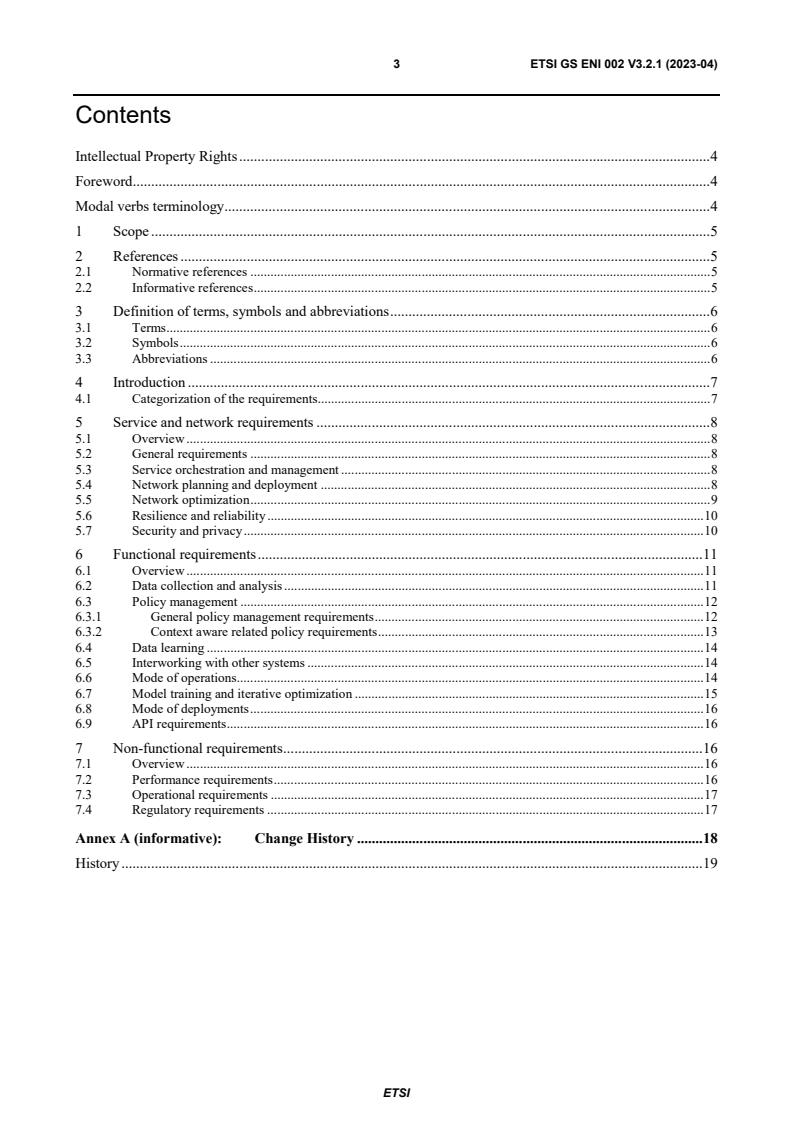
Contents
Intellectual Property Rights . 4
Foreword . 4
Modal verbs terminology . 4
1 Scope . 5
2 References . 5
2.1 Normative references . 5
2.2 Informative references . 5
3 Definition of terms, symbols and abbreviations . 6
3.1 Terms . 6
3.2 Symbols . 6
3.3 Abbreviations . 6
4 Introduction . 7
4.1 Categorization of the requirements. 7
5 Service and network requirements . 8
5.1 Overview . 8
5.2 General requirements . 8
5.3 Service orchestration and management . 8
5.4 Network planning and deployment . 8
5.5 Network optimization . 9
5.6 Resilience and reliability . 10
5.7 Security and privacy . 10
6 Functional requirements . 11
6.1 Overview . 11
6.2 Data collection and analysis . 11
6.3 Policy management . 12
6.3.1 General policy management requirements . 12
6.3.2 Context aware related policy requirements . 13
6.4 Data learning . 14
6.5 Interworking with other systems . 14
6.6 Mode of operations . 14
6.7 Model training and iterative optimization . 15
6.8 Mode of deployments . 16
6.9 API requirements . 16
7 Non-functional requirements . 16
7.1 Overview . 16
7.2 Performance requirements . 16
7.3 Operational requirements . 17
7.4 Regulatory requirements . 17
Annex A (informative): Change History . 18
History . 19
ETSI
4 ETSI GS ENI 002 V3.2.1 (2023-04)
Intellectual Property Rights
Essential patents
IPRs essential or potentially essential to normative deliverables may have been declared to ETSI. The declarations
pertaining to these essential IPRs, if any, are publicly available for ETSI members and non-members, and can be
found in ETSI SR 000 314: "Intellectual Property Rights (IPRs); Essential, or potentially Essential, IPRs notified to
ETSI in respect of ETSI standards", which is available from the ETSI Secretariat. Latest updates are available on the
ETSI Web server (https://ipr.etsi.org/).
Pursuant to the ETSI Directives including the ETSI IPR Policy, no investigation regarding the essentiality of IPRs,
including IPR searches, has been carried out by ETSI. No guarantee can be given as to the existence of other IPRs not
referenced in ETSI SR 000 314 (or the updates on the ETSI Web server) which are, or may be, or may become,
essential to the present document.
Trademarks
The present document may include trademarks and/or tradenames which are asserted and/or registered by their owners.
ETSI claims no ownership of these except for any which are indicated as being the property of ETSI, and conveys no
right to use or reproduce any trademark and/or tradename. Mention of those trademarks in the present document does
not constitute an endorsement by ETSI of products, services or organizations associated with those trademarks.
DECT™, PLUGTESTS™, UMTS™ and the ETSI logo are trademarks of ETSI registered for the benefit of its
Members. 3GPP™ and LTE™ are trademarks of ETSI registered for the benefit of its Members and of the 3GPP
Organizational Partners. oneM2M™ logo is a trademark of ETSI registered for the benefit of its Members and of the ®
oneM2M Partners. GSM and the GSM logo are trademarks registered and owned by the GSM Association.
Foreword
This Group Specification (GS) has been produced by ETSI Industry Specification Group (ISG) Experiential Networked
Intelligence (ENI).
Modal verbs terminology
In the present document "shall", "shall not", "should", "should not", "may", "need not", "will", "will not", "can" and
"cannot" are to be interpreted as described in clause 3.2 of the ETSI Drafting Rules (Verbal forms for the expression of
provisions).
"must" and "must not" are NOT allowed in ETSI deliverables except when used in direct citation.
ETSI
5 ETSI GS ENI 002 V3.2.1 (2023-04)
1 Scope
The present document specifies the requirements of how intelligence is applied to the network and applications in
different scenarios to improve experience of service provision and network operation. Also, how intelligence enables
dynamic autonomous behaviour and adaptive policy driven operation in a changing context. The ENI requirements are
based on the ENI use case document and identified requirements from other SDOs. These requirements will form the
base for the architecture design work.
In Release 3 the present document that is a specification will add:
• Requirements derived from API descriptions.
• Requirements derived from System Architecture.
• Requirements derived from new use cases.
2 References
2.1 Normative references
References are either specific (identified by date of publication and/or edition number or version number) or
non-specific. For specific references, only the cited version applies. For non-specific references, the latest version of the
referenced document (including any amendments) applies.
Referenced documents which are not found to be publicly available in the expected location might be found at
https://docbox.etsi.org/Reference.
NOTE: While any hyperlinks included in this clause were valid at the time of publication, ETSI cannot guarantee
their long term validity.
The following referenced documents are necessary for the application of the present document.
[1] ETSI GS ENI 001: "Experiential Networked Intelligence (ENI); ENI use cases".
[2] ETSI GS ENI 005: "Experiential Networked Intelligence (ENI); System Architecture".
[3] ETSI TS 102 165-1 (V5.2.5): "CYBER; Methods and protocols; Part 1: Method and pro forma for
Threat, Vulnerability, Risk Analysis (TVRA)".
[4] ETSI GS NFV 006 (V4.4.1): "Network Functions Virtualisation (NFV) Release 4; Management
and Orchestration; Architectural Framework Specification".
[5] ETSI TS 101 158: "Telecommunications security; Lawful Interception (LI); Requirements for
network functions".
2.2 Informative references
References are either specific (identified by date of publication and/or edition number or version number) or
non-specific. For specific references, only the cited version applies. For non-specific references, the latest version of the
referenced document (including any amendments) applies.
NOTE: While any hyperlinks included in this clause were valid at the time of publication, ETSI cannot guarantee
their long term validity.
The following referenced documents are not necessary for the application of the present document but they assist the
user with regard to a particular subject area.
[i.1] ETSI GR ENI 004: "Experiential Networked Intelligence (ENI); Terminology for Main Concepts
in ENI".
ETSI
6 ETSI GS ENI 002 V3.2.1 (2023-04)
[i.2] Service Operations Specification MEF 55: "Lifecycle Service Orchestration (LSO): Reference
Architecture and Framework".
[i.3] Regulation (EU) 2016/679 of the European Parliament and of the Council of 27 April 2016 on the
protection of natural persons with regard to the processing of personal data and on the free
movement of such data, and repealing Directive 95/46/EC (General Data Protection Regulation).
3 Definition of terms, symbols and abbreviations
3.1 Terms
For the purposes of the present document, the terms given in ETSI GR ENI 004 [i.1] apply.
3.2 Symbols
Void.
3.3 Abbreviations
For the purposes of the present document, the following abbreviations apply:
AI Artificial Intelligence
API Application Programming Interface
BP Back Propagation
BSS Business Support System
CAP Context Aware related Policy
CAPEX CAPital EXpenditure
DC Data Collection
NOTE: Used in the context of servers.
DCA Data Collection and Analysis
DSL Domain-Specific Language
EMS Element Management System
ENI Experiential Networked Intelligence
GDPR General Data Protection Regulation
GPM General Policy Management
IoT Internet of Things
IP Internet Protocol
IT Information Technology
KPI Key Performance Indicator
LI Lawful Interception
LLC Last Level Cache
LSO Lifecycle Service Orchestration
LSO RA Lifecycle Service Orchestration - Reference Architecture
MANO MANagement and Orchestration
MEC Multi-access Edge Computing
MEF Metro Ethernet Forum
MOP Mode Of Operations
NFV Network Functions Virtualisation
NM Network Model
NPD Network Planning & Deployment
OPEX OPerational EXpenditure
OR Operational Requirements
OSS Operational Support System
PINet Polymorphic Network
PR Performance Requirements
RA Reference Architecture
ETSI
7 ETSI GS ENI 002 V3.2.1 (2023-04)
RR Resilience and Reliability
SDN Software Defined Networking
SLA Service Level Agreement
SOM Service Orchestration and Management
SP Security and Privacy
SP.2A Security and Privacy 2A
SP.2B Security and Privacy 2B
SVM Support Vector Machine
TCO Total Cost of Ownership
TVRA Threat, Vulnerability and Risk Analysis
VNF Virtualised Network Function
4 Introduction
4.1 Categorization of the requirements
The present document structure addresses the requirements in the following areas:
1) Service and network requirements:
- General requirements
- Service orchestration and management
- Network planning and deployment
- Network optimization
- Resilience and reliability
- Security and privacy
2) Functional requirements:
- Data collection and analysis
- Policy management
- Data learning
- Interworking with other systems
- Mode of operations
- Model training and iterative optimization
- Mode of deployments
- API requirements
3) Non-functional requirements:
- Performance requirements
- Operational requirements
- Regulatory requirements
ETSI
8 ETSI GS ENI 002 V3.2.1 (2023-04)
5 Service and network requirements
5.1 Overview
The requirements in this clause are addressed from service and network point of view and are derived directly from the
related use cases.
5.2 General requirements
This clause captures the requirements that are general and independent from other requirements categorized in other
specific clauses.
[GR.1] The ENI System shall use history data, context, and decisions taken to learn, process and provide
responses to events, whether generated from devices or from management systems.
[GR.2] The ENI System shall use context information as part of the computations that result in
recommendations, advisement, predictions, and decisions that are used to assist other network
systems, e.g. orchestration and management systems.
NOTE: As an example, MANO (from ETSI GS NFV 006 [4]) or the LSO RA (from MEF [i.2]) are different
types of orchestration and management systems.
[GR.3] The ENI architecture shall be flexible enough to support extensibility.
5.3 Service orchestration and management
This clause captures requirements related to the ENI System service provisioning, e.g. how to compile the service intent
and orchestrate the service atoms and workflows, as well as automatic service on boarding.
[SOM.1] The ENI System shall invoke policies based on models that describe and/or define traffic
behaviour, such as SLAs (e.g. past or current telemetry).
[SOM.2] The ENI System shall support the closed loop control model when different orchestration and
management systems are used.
NOTE 1: As an example, MANO (from ETSI GS NFV 006 [4]) and LSO RA (from MEF [i.2]) are different types
of orchestration and management systems.
[SOM.3] The ENI System should not directly manage, control or orchestrate physical or virtual entities,
either at the infrastructure level or service level.
NOTE 2: ENI System may interact with the Orchestration system, EMS or OSS/BSS to influence the state of the
resources or services.
5.4 Network planning and deployment
This clause captures requirements related to network planning and deployment, e.g. how to allocate network resources
to VNFs, or automatic VNF on boarding.
NOTE 1: The network resources that can be managed are not limited to the requirements addressed in this clause.
[NPD.1] The ENI System shall recommend allocation or retrieval of network resources, e.g. virtual
machines, bandwidth, IPv4 addresses and IPv6 prefixes to end users or service flows, in an
intelligent way to improve the efficiency of resource utilization. This ENI System function may be
implemented in a centralized and/or distributed manner, according to what is defined in ETSI
GR ENI 004 [i.1] and according to ETSI GS ENI 005 [2].
ETSI
9 ETSI GS ENI 002 V3.2.1 (2023-04)
[NPD.2] The ENI System shall assist the network equipment or network function to use the resource pools
that are used for resource allocation (e.g. virtual machines, network bandwidth, IP addresses, CPU
cores, CPU frequencies, memory, memory bandwidth), in an intelligent way in order to improve
the efficiency of resource utilization and user experiences.
[NPD.3] The ENI System should dynamically and intelligently compute and recommend the required
network resources, including both IPv4 and IPv6 resources as well as other resources.
[NPD.4] The ENI System shall compute the network resources required to dynamically and intelligently
deploy a given network service efficiently.
[NPD.5] IT resources to enable network services shall be managed within the ENI System.
NOTE 2: Similar capabilities within the data centre are outside the network scope of this phase of ENI.
[NPD.6] The ENI System shall be capable of understanding the context that a set of devices is operating
within.
[NPD.7] The ENI System shall be capable of performing the proper planning and deployment of resources
to ensure that applicable deployed policies are not violated.
[NPD.8] The ENI System shall identify different types of rollouts for different types of resources that lead
to the upgrade of virtualised software-based resources.
[NPD.9] The ENI System shall, in an efficient and dynamic manner, combine network slices, slice/service
prioritization and resource allocation concepts, e.g. in order to resolve resource allocation conflicts
between competing network slices deployed on top of a shared infrastructure.
[NPD.10] The ENI System shall support cross-domain and global resource management, e.g. cross-domain
node content resource aggregation and integration, as well as cross-domain permissions
management of unified user identity.
5.5 Network optimization
This clause captures requirements related to network optimization, e.g. how to adjust the network configurations to
improve its efficiency and performance, as well as the user experience of the service.
[NO.1] The ENI System shall collect and process the necessary data according to specific algorithms in
order to achieve network optimization.
NOTE 1: Data collection and processing algorithms for systems will be specified in the functional architecture.
[NO.2] The ENI System shall meet or exceed all performance requirements when improving the target
performance.
[NO.3] The ENI System shall support central optimization, local optimization and distributed joint
optimization, according to what is defined in ETSI GR ENI 004 [i.1].
[NO.4] The ENI System shall support an adaptive optimization process where changes in the environment
are reflected in the results of the optimization.
[NO.5] The ENI System shall use prioritization and other scheduling and traffic shaping techniques to
prevent SLA violations related with priority services.
[NO.6] The ENI System shall use AI (e.g. Machine Learning) to identify traffic type and support traffic
handling and QoS assurance for specific type of traffic.
[NO.7] The ENI System shall support traffic type identification in different granularity levels, including
application types, action types (e.g. sending pictures, voice calls, etc.).
[NO.8] The ENI System shall support dynamic policy adjustment, i.e. to select or re-select and enforce a
policy dynamically, for a specific flow based on traffic identification results.
NOTE 2: Applying policies to specific flows may lead to hundreds of thousands of policies.
ETSI
10 ETSI GS ENI 002 V3.2.1 (2023-04)
5.6 Resilience and reliability
This clause captures requirements related to resilience and reliability of the network, including fault diagnosis and
prediction, high availability and back up, conflict detection, and rolling back to previous policies and status.
[RR.1] The ENI System shall intelligently recommend allocation or retrieval of IP addresses without
causing route oscillation.
[RR.2] The ENI System shall intelligently recommend allocation or retrieval of IP addresses without
causing any interruption in the offered services.
[RR.3] The ENI System shall support root cause analysis to
...
Questions, Comments and Discussion
Ask us and Technical Secretary will try to provide an answer. You can facilitate discussion about the standard in here.
Loading comments...