


ETSI TS 137 579-2 V17.5.0 (2026-04)
LTE; 5G; Mission Critical (MC) services; Part 2: Mission Critical Push To Talk (MCPTT) User Equipment (UE) Protocol conformance specification (3GPP TS 37.579-2 version 17.5.0 Release 17)
LTE; 5G; Mission Critical (MC) services; Part 2: Mission Critical Push To Talk (MCPTT) User Equipment (UE) Protocol conformance specification (3GPP TS 37.579-2 version 17.5.0 Release 17)
RTS/TSGR-0537579-2vh50
General Information
- Status
- Not Published
- Technical Committee
- 3GPP RAN 5 - Mobile Terminal Conformance Testing (formely T1)
- Current Stage
- 12 - Citation in the OJ (auto-insert)
- Completion Date
- 02-Apr-2026
Buy Documents
ETSI TS 137 579-2 V17.5.0 (2026-04) - LTE; 5G; Mission Critical (MC) services; Part 2: Mission Critical Push To Talk (MCPTT) User Equipment (UE) Protocol conformance specification (3GPP TS 37.579-2 version 17.5.0 Release 17)
Frequently Asked Questions
ETSI TS 137 579-2 V17.5.0 (2026-04) is a standard published by the European Telecommunications Standards Institute (ETSI). Its full title is "LTE; 5G; Mission Critical (MC) services; Part 2: Mission Critical Push To Talk (MCPTT) User Equipment (UE) Protocol conformance specification (3GPP TS 37.579-2 version 17.5.0 Release 17)". This standard covers: RTS/TSGR-0537579-2vh50
RTS/TSGR-0537579-2vh50
ETSI TS 137 579-2 V17.5.0 (2026-04) is available in PDF format for immediate download after purchase. The document can be added to your cart and obtained through the secure checkout process. Digital delivery ensures instant access to the complete standard document.
Standards Content (Sample)
TECHNICAL SPECIFICATION
LTE;
5G;
Mission Critical (MC) services;
Part 2: Mission Critical Push To Talk (MCPTT) User Equipment
(UE) Protocol conformance specification
(3GPP TS 37.579-2 version 17.5.0 Release 17)
3GPP TS 37.579-2 version 17.5.0 Release 17 1 ETSI TS 137 579-2 V17.5.0 (2026-04)
Reference
RTS/TSGR-0537579-2vh50
Keywords
5G,LTE
ETSI
650 Route des Lucioles
F-06921 Sophia Antipolis Cedex - FRANCE
Tel.: +33 4 92 94 42 00 Fax: +33 4 93 65 47 16
Siret N° 348 623 562 00017 - APE 7112B
Association à but non lucratif enregistrée à la
Sous-Préfecture de Grasse (06) N° w061004871
Important notice
The present document can be downloaded from the
ETSI Search & Browse Standards application.
The present document may be made available in electronic versions and/or in print. The content of any electronic and/or
print versions of the present document shall not be modified without the prior written authorization of ETSI. In case of any
existing or perceived difference in contents between such versions and/or in print, the prevailing version of an ETSI
deliverable is the one made publicly available in PDF format on ETSI deliver repository.
Users should be aware that the present document may be revised or have its status changed,
this information is available in the Milestones listing.
If you find errors in the present document, please send your comments to
the relevant service listed under Committee Support Staff.
If you find a security vulnerability in the present document, please report it through our
Coordinated Vulnerability Disclosure (CVD) program.
Notice of disclaimer & limitation of liability
The information provided in the present deliverable is directed solely to professionals who have the appropriate degree of
experience to understand and interpret its content in accordance with generally accepted engineering or
other professional standard and applicable regulations.
No recommendation as to products and services or vendors is made or should be implied.
No representation or warranty is made that this deliverable is technically accurate or sufficient or conforms to any law
and/or governmental rule and/or regulation and further, no representation or warranty is made of merchantability or fitness
for any particular purpose or against infringement of intellectual property rights.
In no event shall ETSI be held liable for loss of profits or any other incidental or consequential damages.
Any software contained in this deliverable is provided "AS IS" with no warranties, express or implied, including but not
limited to, the warranties of merchantability, fitness for a particular purpose and non-infringement of intellectual property
rights and ETSI shall not be held liable in any event for any damages whatsoever (including, without limitation, damages
for loss of profits, business interruption, loss of information, or any other pecuniary loss) arising out of or related to the use
of or inability to use the software.
Copyright Notification
No part may be reproduced or utilized in any form or by any means, electronic or mechanical, including photocopying and
microfilm except as authorized by written permission of ETSI.
The content of the PDF version shall not be modified without the written authorization of ETSI.
The copyright and the foregoing restriction extend to reproduction in all media.
© ETSI 2026.
All rights reserved.
ETSI
3GPP TS 37.579-2 version 17.5.0 Release 17 2 ETSI TS 137 579-2 V17.5.0 (2026-04)
Intellectual Property Rights
Essential patents
IPRs essential or potentially essential to normative deliverables may have been declared to ETSI. The declarations
pertaining to these essential IPRs, if any, are publicly available for ETSI members and non-members, and can be
found in ETSI SR 000 314: "Intellectual Property Rights (IPRs); Essential, or potentially Essential, IPRs notified to
ETSI in respect of ETSI standards", which is available from the ETSI Secretariat. Latest updates are available on the
ETSI IPR online database.
Pursuant to the ETSI Directives including the ETSI IPR Policy, no investigation regarding the essentiality of IPRs,
including IPR searches, has been carried out by ETSI. No guarantee can be given as to the existence of other IPRs not
referenced in ETSI SR 000 314 (or the updates on the ETSI Web server) which are, or may be, or may become,
essential to the present document.
Trademarks
The present document may include trademarks and/or tradenames which are asserted and/or registered by their owners.
ETSI claims no ownership of these except for any which are indicated as being the property of ETSI, and conveys no
right to use or reproduce any trademark and/or tradename. Mention of those trademarks in the present document does
not constitute an endorsement by ETSI of products, services or organizations associated with those trademarks.
DECT™, PLUGTESTS™, UMTS™ and the ETSI logo are trademarks of ETSI registered for the benefit of its
Members. 3GPP™, LTE™ and 5G™ logo are trademarks of ETSI registered for the benefit of its Members and of the
3GPP Organizational Partners. oneM2M™ logo is a trademark of ETSI registered for the benefit of its Members and of ®
the oneM2M Partners. GSM and the GSM logo are trademarks registered and owned by the GSM Association.
Legal Notice
This Technical Specification (TS) has been produced by ETSI 3rd Generation Partnership Project (3GPP).
The present document may refer to technical specifications or reports using their 3GPP identities. These shall be
interpreted as being references to the corresponding ETSI deliverables.
The cross reference between 3GPP and ETSI identities can be found at 3GPP to ETSI numbering cross-referencing.
Modal verbs terminology
In the present document "shall", "shall not", "should", "should not", "may", "need not", "will", "will not", "can" and
"cannot" are to be interpreted as described in clause 3.2 of the ETSI Drafting Rules (Verbal forms for the expression of
provisions).
"must" and "must not" are NOT allowed in ETSI deliverables except when used in direct citation.
ETSI
3GPP TS 37.579-2 version 17.5.0 Release 17 3 ETSI TS 137 579-2 V17.5.0 (2026-04)
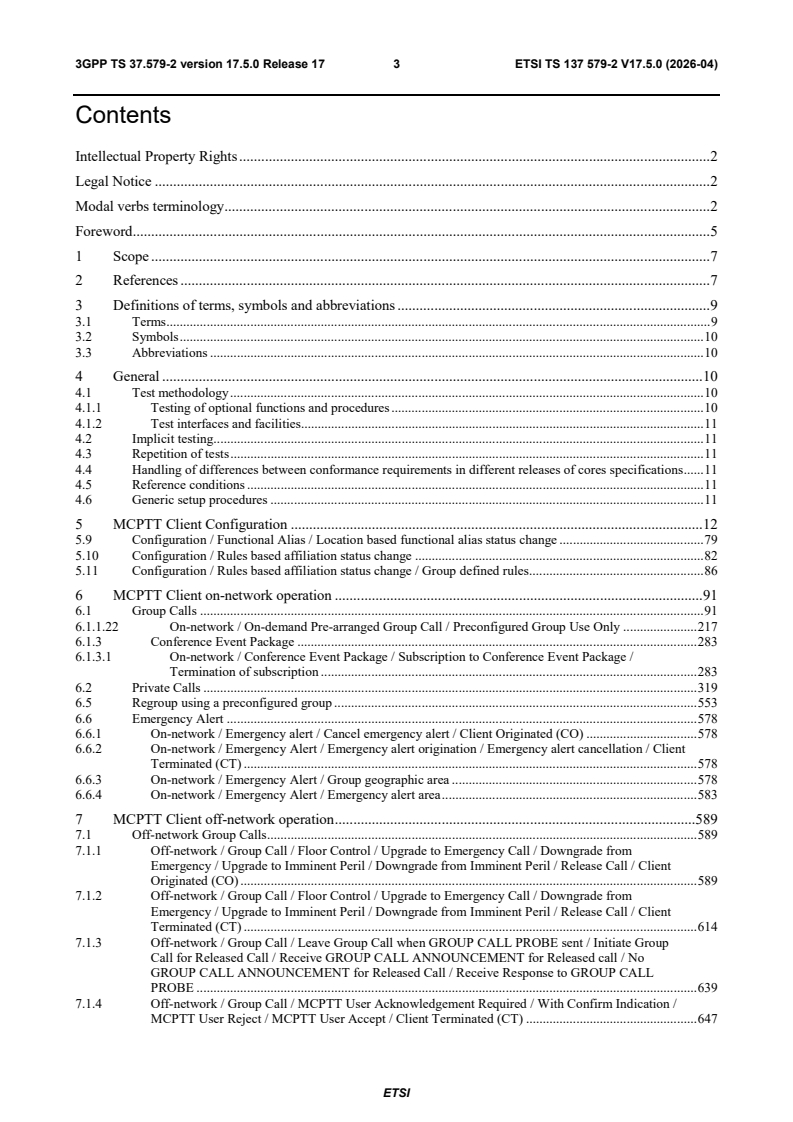
Contents
Intellectual Property Rights . 2
Legal Notice . 2
Modal verbs terminology . 2
Foreword . 5
1 Scope . 7
2 References . 7
3 Definitions of terms, symbols and abbreviations . 9
3.1 Terms . 9
3.2 Symbols . 10
3.3 Abbreviations . 10
4 General . 10
4.1 Test methodology . 10
4.1.1 Testing of optional functions and procedures . 10
4.1.2 Test interfaces and facilities. 11
4.2 Implicit testing . 11
4.3 Repetition of tests . 11
4.4 Handling of differences between conformance requirements in different releases of cores specifications . 11
4.5 Reference conditions . 11
4.6 Generic setup procedures . 11
5 MCPTT Client Configuration . 12
5.9 Configuration / Functional Alias / Location based functional alias status change . 79
5.10 Configuration / Rules based affiliation status change . 82
5.11 Configuration / Rules based affiliation status change / Group defined rules . 86
6 MCPTT Client on-network operation . 91
6.1 Group Calls . 91
6.1.1.22 On-network / On-demand Pre-arranged Group Call / Preconfigured Group Use Only . 217
6.1.3 Conference Event Package . 283
6.1.3.1 On-network / Conference Event Package / Subscription to Conference Event Package /
Termination of subscription . 283
6.2 Private Calls . 319
6.5 Regroup using a preconfigured group . 553
6.6 Emergency Alert . 578
6.6.1 On-network / Emergency alert / Cancel emergency alert / Client Originated (CO) . 578
6.6.2 On-network / Emergency Alert / Emergency alert origination / Emergency alert cancellation / Client
Terminated (CT) . 578
6.6.3 On-network / Emergency Alert / Group geographic area . 578
6.6.4 On-network / Emergency Alert / Emergency alert area . 583
7 MCPTT Client off-network operation . 589
7.1 Off-network Group Calls . 589
7.1.1 Off-network / Group Call / Floor Control / Upgrade to Emergency Call / Downgrade from
Emergency / Upgrade to Imminent Peril / Downgrade from Imminent Peril / Release Call / Client
Originated (CO) . 589
7.1.2 Off-network / Group Call / Floor Control / Upgrade to Emergency Call / Downgrade from
Emergency / Upgrade to Imminent Peril / Downgrade from Imminent Peril / Release Call / Client
Terminated (CT) . 614
7.1.3 Off-network / Group Call / Leave Group Call when GROUP CALL PROBE sent / Initiate Group
Call for Released Call / Receive GROUP CALL ANNOUNCEMENT for Released call / No
GROUP CALL ANNOUNCEMENT for Released Call / Receive Response to GROUP CALL
PROBE . 639
7.1.4 Off-network / Group Call / MCPTT User Acknowledgement Required / With Confirm Indication /
MCPTT User Reject / MCPTT User Accept / Client Terminated (CT) . 647
ETSI
3GPP TS 37.579-2 version 17.5.0 Release 17 4 ETSI TS 137 579-2 V17.5.0 (2026-04)
7.1.5 Off-network / Group Call / MCPTT User Acknowledgement Required / Without Confirm Indication
/ MCPTT User Reject / MCPTT User Accept / Client Terminated (CT) . 653
7.1.6 Off-network / Group Call / Merge Two Calls . 658
7.1.7 Off-network / Group Call / Emergency Call / Imminent Peril Call / Client Originated (CO) . 665
7.1.8 Off-network / Group Call / Emergency Call / Imminent Peril Call / Client Terminated (CT) . 674
7.1.9 Off-network / Group Call / Emergency Alert / Emergency Alert Retransmission / Cancel Emergency
Alert / Client Originated (CO) . 683
7.1.10 Off-network / Group Call / Emergency Alert / Emergency Alert Retransmission / Cancel Emergency
Alert / Client Terminated (CT) . 687
7.1.11 Off-network / Group Call / Broadcast Group Call / Broadcast Group Call Retransmitting / Broadcast
Group Call Release / Client Originated (CO) . 692
7.1.12 Off-network / Group Call / Broadcast Group Call / MCPTT User Ack Not Required / Originator
Releases Call / Client Terminated (CT) . 697
7.1.13 Off-network / Group Call / Broadcast Group Call / MCPTT User Ack Required / MCPTT User
Reject / MCPTT User Accept / MCPTT User Releases Call / Client Terminated (CT) . 700
7.2 Off-network Private Calls . 706
7.2.1 Off-network / Private Call / On-demand / Automatic Commencement Mode / No Response to
Private Call Setup Request / Private call setup success / With Floor Control / Upgrade to Emergency
Call / Cancellation of Emergency on User request / Client Originated (CO) . 706
7.2.2 Off-network / Private Call / On-demand / Automatic Commencement Mode / No Response to
Private Call Setup Accept / Private call setup success / With Floor Control / Upgrade to Emergency
Call / Cancellation of Emergency on User request / Client Terminated (CT) . 724
7.2.3 Off-network / Private Call / On-demand / Automatic Commencement Mode / Upgrade to
Emergency Call Reject / Downgrade from Emergency Call Failure / Client Originated (CO) . 741
7.2.4 Off-network / Private Call / On-demand / Manual Commencement Mode / Call Released before
establishment completion / Call request Rejected / Call establishment successful / Client Originated
(CO) . 750
7.2.5 Off-network / Private Call / On-demand / Manual Commencement Mode / Call Released before
establishment completion / User does not answer to Ringing / User Rejects call request / Call
establishment successful / Client Terminated (CT) . 759
Annex A (informative): Change history . 770
History . 780
ETSI
3GPP TS 37.579-2 version 17.5.0 Release 17 5 ETSI TS 137 579-2 V17.5.0 (2026-04)
Foreword
This Technical Specification has been produced by the 3rd Generation Partnership Project (3GPP).
The contents of the present document are subject to continuing work within the TSG and may change following formal
TSG approval. Should the TSG modify the contents of the present document, it will be re-released by the TSG with an
identifying change of release date and an increase in version number as follows:
Version x.y.z
where:
x the first digit:
1 presented to TSG for information;
2 presented to TSG for approval;
3 or greater indicates TSG approved document under change control.
y the second digit is incremented for all changes of substance, i.e. technical enhancements, corrections,
updates, etc.
z the third digit is incremented when editorial only changes have been incorporated in the document.
The present document is part 1 of a multi-part deliverable covering conformance test specification for Mission Critical
Services consisting of:
3GPP TS 37.579-1 [2]: "Mission Critical (MC) services; Part 1: Common test environment" (the present
document)
3GPP TS 37.579-2: "Mission Critical (MC) services; Part 2: Mission Critical Push To Talk (MCPTT)
User Equipment (UE) Protocol conformance specification"
3GPP TS 37.579-4 [4]: "Mission Critical (MC) services; Part 4: Test Applicability and Implementation
Conformance Statement (ICS)"
3GPP TS 37.579-5 [5]: "Mission Critical (MC) services; Part 5: Abstract test suite (ATS)"
3GPP TS 37.579-6 [37]: "Mission Critical (MC) services: Mission Critical Video (MCVideo) User Equipment
(UE) Protocol conformance specification"
3GPP TS 37.579-7 [38]: "Mission Critical (MC) services; Part 7: Mission Critical Data (MCData) User
Equipment (UE) Protocol conformance specification"
In the present document, modal verbs have the following meanings:
shall indicates a mandatory requirement to do something
shall not indicates an interdiction (prohibition) to do something
The constructions "shall" and "shall not" are confined to the context of normative provisions, and do not appear in
Technical Reports.
The constructions "must" and "must not" are not used as substitutes for "shall" and "shall not". Their use is avoided
insofar as possible, and they are not used in a normative context except in a direct citation from an external, referenced,
non-3GPP document, or so as to maintain continuity of style when extending or modifying the provisions of such a
referenced document.
should indicates a recommendation to do something
should not indicates a recommendation not to do something
may indicates permission to do something
need not indicates permission not to do something
ETSI
3GPP TS 37.579-2 version 17.5.0 Release 17 6 ETSI TS 137 579-2 V17.5.0 (2026-04)
The construction "may not" is ambiguous and is not used in normative elements. The unambiguous constructions
"might not" or "shall not" are used instead, depending upon the meaning intended.
can indicates that something is possible
cannot indicates that something is impossible
The constructions "can" and "cannot" are not substitutes for "may" and "need not".
will indicates that something is certain or expected to happen as a result of action taken by an agency
the behaviour of which is outside the scope of the present document
will not indicates that something is certain or expected not to happen as a result of action taken by an
agency the behaviour of which is outside the scope of the present document
might indicates a likelihood that something will happen as a result of action taken by some agency the
behaviour of which is outside the scope of the present document
might not indicates a likelihood that something will not happen as a result of action taken by some agency
the behaviour of which is outside the scope of the present document
In addition:
is (or any other verb in the indicative mood) indicates a statement of fact
is not (or any other negative verb in the indicative mood) indicates a statement of fact
The constructions "is" and "is not" do not indicate requirements.
ETSI
3GPP TS 37.579-2 version 17.5.0 Release 17 7 ETSI TS 137 579-2 V17.5.0 (2026-04)
1 Scope
The present document specifies the protocol conformance testing for testing a MCPTT Client for compliance to the
Mission Critical Push To Talk (MCPTT) protocol requirements defined by 3GPP.
In particular the present document contains:
- the overall test structure;
- the test configurations;
- the conformance requirement and reference to the core specifications;
- the test purposes; and
- a brief description of the test procedure, the specific test requirements and short message exchange table.
The present document is valid for MCPTT Clients implemented according to 3GPP releases starting from Release 13 up
to the Release indicated on the cover page of the present document.
The following information relevant to testing specified in the present document could be found in accompanying
specifications:
- default setting of the test parameters TS 37.579-1 [2];
- Implementation Conformance Statement (ICS) TS 37.579-4 [4] and Implementation eXtra Information for
Testing (IXIT) TS 37.579-5 [5];
- the applicability of each test case TS 37.579-4 [4].
The test cases are expected to be executed through the 3GPP radio interface. The present document does not specify the
protocol conformance testing for the 3GPP bearers which carry the MCPTT data sent or received by the MCPTT Client
and which are required to be supported by the UE in which the MCPTT Client is installed. This is defined in TS 36.523-
1 [6] for EPS (LTE) or TS 38.523-1 [39] for NR/5GC.
2 References
The following documents contain provisions which, through reference in this text, constitute provisions of the present
document.
- References are either specific (identified by date of publication, edition number, version number, etc.) or
non-specific.
- For a specific reference, subsequent revisions do not apply.
- For a non-specific reference, the latest version applies. In the case of a reference to a 3GPP document (including
a GSM document), a non-specific reference implicitly refers to the latest version of that document in the same
Release as the present document.
[1] 3GPP TR 21.905: "Vocabulary for 3GPP Specifications".
[2] 3GPP TS 37.579-1: "Mission Critical (MC) services; Part 1: Common test environment".
[3] Void.
[4] 3GPP TS 37.579-4: " Mission Critical (MC) services; Part 4: Test Applicability and
Implementation Conformance Statement (ICS).
[5] 3GPP TS 37.579-5: "Mission Critical (MC) services; Part 5: Abstract test suite (ATS)".
[6] 3GPP TS 36.523-1: "Evolved Universal Terrestrial Radio Access (E-UTRA) and Evolved Packet
Core (EPC); User Equipment (UE) conformance specification; Part 1: Protocol conformance
specification".
ETSI
3GPP TS 37.579-2 version 17.5.0 Release 17 8 ETSI TS 137 579-2 V17.5.0 (2026-04)
[7] 3GPP TS 22.179: "Mission Critical Push To Talk (MCPTT) over LTE; Stage 1".
[8] 3GPP TS 23.179: "Functional architecture and information flows to support mission critical
communication services; Stage 2".
[9] 3GPP TS 24.379: "Mission Critical Push To Talk (MCPTT) call control; Protocol specification".
[10] 3GPP TS 24.380: "Mission Critical Push To Talk (MCPTT) media plane control; Protocol
specification ".
[11] 3GPP TS 24.481: "Mission Critical Services (MCS) group management; Protocol specification".
[12] 3GPP TS 24.482: "Mission Critical Services (MCS) identity management; Protocol specification".
[13] 3GPP TS 24.483: "Mission Critical Services (MCS) Management Object (MO)".
[14] 3GPP TS 24.484: "Mission Critical Services (MCS) configuration management; Protocol
specification".
[15] 3GPP TS 33.179: " Security of Mission Critical Push To Talk (MCPTT) over LTE ".
[16] 3GPP TS 24.229: "IP multimedia call control protocol based on Session Initiation Protocol (SIP)
and Session Description Protocol (SDP); Stage 3".
[17] Void.
[18] Void.
[19] 3GPP TS 24.301: "Non-Access-Stratum (NAS) protocol for Evolved Packet System (EPS); Stage
3".
[20] 3GPP TS 24.008: "Mobile Radio Interface Layer 3 specification; Core Network Protocols; Stage
3".
[21] Void.
[22] Void.
[23] 3GPP TS 36.509: "Evolved Universal Terrestrial Radio Access (E-UTRA) and Evolved Universal
Terrestrial Radio Access Network (E-UTRAN); Special conformance testing functions for User
Equipment (UE)".
[24] 3GPP TS 36.508: "Evolved Universal Terrestrial Radio Access (E-UTRA) and Evolved Universal
Terrestrial Radio Access (E-UTRAN); Common Test Environments for User Equipment (UE)
Conformance Testing".
[25] OpenID Connect 1.0: "OpenID Connect Core 1.0 incorporating errata set 1",
http://openid.net/specs/openid-connect-core-1_0.html.
[26] Void.
[27] Void
[28] Void.
[29] Void.
[30] 3GPP TS 33.310: "Network Domain Security (NDS); Authentication Framework (AF)".
[31] Void.
[32] 3GPP TS 23.003: "Numbering, addressing and identification".
[33] 3GPP TS 33.180: "Security of the mission critical service".
[34] IETF RFC 4354 "A Session Initiation Protocol (SIP) Event Package and Data Format for Various
Settings in Support for the Push-to-Talk over Cellular (PoC) Service"
ETSI
3GPP TS 37.579-2 version 17.5.0 Release 17 9 ETSI TS 137 579-2 V17.5.0 (2026-04)
[35] IETF RFC 4575 " A Session Initiation Protocol (SIP) Event Package for Conference State"
[36] 3GPP TS 23.032: "Universal Geographical Area Description (GAD)".
[37] 3GPP TS 37.579-6: "Mission Critical (MC) services; Part 6: Mission Critical Video (MCVideo)
User Equipment (UE) Protocol conformance specification"
[38] 3GPP TS 37.579-7: "Mission Critical (MC) services; Part 7: Mission Critical Data (MCData) User
Equipment (UE) Protocol conformance specification"
[39] 3GPP TS 38.523-1: " 5GS; User Equipment (UE) conformance specification;Part 1: Protocol"
3 Definitions of terms, symbols and abbreviations
3.1 Terms
For the purposes of the present document, the terms given in TR 21.905 [1] and the following apply. A term defined in
the present document takes precedence over the definition of the same term, if any, in TR 21.905 [1].
For the purpose of the present document, the following terms and definitions given in 3GPP TS 24.379 [9] apply:
An MCPTT user is affiliated to an MCPTT group
An MCPTT user is affiliated to an MCPTT group at an MCPTT client
Affiliation status
Group identity
In-progress emergency private call state
In-progress imminent peril group state
MCPTT client ID
MCPTT emergency alert state
MCPTT emergency group state
MCPTT emergency group call state
MCPTT emergency private call state
MCPTT emergency private priority state
MCPTT imminent peril group call state
MCPTT imminent peril group state
MCPTT private emergency alert state
MCPTT speech
Media-floor control entity
Temporary MCPTT group identity
Trusted mutual aid
Untrusted mutual aid
For the purposes of the present document, the following terms and definitions given in 3GPP TS 22.179 [7] apply:
In-progress emergency
MCPTT emergency alert
MCPTT emergency group call
MCPTT emergency state
Partner MCPTT system
Primary MCPTT system
For the purpose of the present document, the following terms and definitions given in 3GPP TS 24.380 [10] apply:
MBMS subchannel
For the purpose of the present document, the following terms and definitions given in 3GPP TS 23.179 [8] apply:
Pre-selected MCPTT user profile
ETSI
3GPP TS 37.579-2 version 17.5.0 Release 17 10 ETSI TS 137 579-2 V17.5.0 (2026-04)
3.2 Symbols
Void.
3.3 Abbreviations
For the purposes of the present document, the abbreviations given in TR 21.905 [1] and the following apply. An
abbreviation defined in the present document takes precedence over the definition of the same abbreviation, if any, in
TR 21.905 [1].
ECGI E-UTRAN Cell Global Identification
FFS For Further Study
ICS Implementation Conformance Statement
IPEG In-Progress Emergency Group
IPEPC In-Progress Emergency Private Call
IPIG In-Progress Imminent peril Group
IUT Implementation Under Test
IXIT Implementation eXtra Information for Testing
MBMS Multimedia Broadcast and Multicast Service
MBSFN Multimedia Broadcast multicast service Single Frequency Network
MCPTT Mission Critical Push To Talk
MCPTT group ID MCPTT group IDentity
MEA MCPTT Emergency Alert
MEG MCPTT Emergency Group
MEGC MCPTT Emergency Group Call
MEPC MCPTT Emergency Private Call
MEPP MCPTT Emergency Private Priority
MES MCPTT Emergency State
MIME Multipurpose Internet Mail Extensions
MIG MCPTT Imminent peril Group
MIGC MCPTT Imminent peril Group Call
MONP MCPTT Off-Network Protocol
MPEA MCPTT Private Emergency Alert
NAT Network Address Translation
PLMN Public Land Mobile Network
QCI QoS Class Identifier
RTP Real-time Transport Protocol
SAI Service Area Identifier
SDP Session Description Protocol
SIP Session Initiation Protocol
SS System Simulator
SSRC Synchronization SouRCe
TGI Temporary MCPTT Group Identity
TMGI Temporary Mobile Group Identity
TP Transmission Point
TP Test Purpose
UE User Equipment
URI Uniform Resource Identifier
4 General
4.1 Test methodology
4.1.1 Testing of optional functions and procedures
Any function or procedure which is optional, may be subject to a conformance test if it is implemented in the MCPTT
Client.
ETSI
3GPP TS 37.579-2 version 17.5.0 Release 17 11 ETSI TS 137 579-2 V17.5.0 (2026-04)
A declaration by the MCPTT Client supplier (to use the Implementation Conformance Statement (ICS) proforma
specified in TS 37.579-4 [4]) is used to determine whether an optional function/procedure has been implemented.
4.1.2 Test interfaces and facilities
Detailed descriptions of the MCPTT Client test interfaces and special facilities for testing are provided in 3GPP
TS 36.509 [23].
4.2 Implicit testing
For some 3GPP MCPTT protocol features conformance is not verified explicitly in the present document. This does not
imply that correct functioning of these features is not essential, but that these are implicitly tested to a sufficient degree
in tests which are not explicitly dedicated to test the feature.
4.3 Repetition of tests
As a general rule, the test cases specified in the present document are highly reproducible and do not need to be
repeated unless otherwise stated.
4.4 Handling of differences between conformance requirements
in different releases of cores specifications
The conformance requirements which determine the scope of each test case are explicitly copy-pasted from relevant
core specifications in the especially dedicated for this clause of each test with the title 'Conformance requirements'.
NOTE: When in the copy/pasted text there are references to other specifications the reference numbers will not
match the reference numbers used in the present document. This approach has been taken in order to
allow easy copy and then search for conformance requirements in those specifications.
When differences between conformance requirements in different releases of the cores specifications have impact on
the Pre-test conditions, Test procedure sequence or/and the Specific message contents, the Conformance requirements
related to different releases are specified separately with clear indication of the Release of the spec from which they
were copied.
When there is no Release indicated for a conformance requirement text, this should be understood either as the
Conformance requirements in the latest version of the spec with release = the TC Applicability release (which can be
found in TS 37.579-4 [4], Table 4-1: Applicability of tests and additional information for testing, column 'Release'), or,
as the Conformance requirements in the latest version of the spec of the release when the feature was introduced to the
core specs.
4.5 Reference conditions
The reference environments used by all signalling and protocol tests is specified in TS 37.579-1 [2]. Where a test
requires an environment that is different, this will be specified in the test itself.
For all test cases in this document unless specified otherwise the condition MCPTT applies for all message contents.
4.6 Generic setup procedures
A set of basic generic procedures for MCPTT Client-Server communication are described in TS 37.579-1 [2]. These
procedures will be used in numerous test cases throughout the present document.
ETSI
3GPP TS 37.579-2 version 17.5.0 Release 17 12 ETSI TS 137 579-2 V17.5.0 (2026-04)
5 MCPTT Client Configuration
5.1 Configuration / Authentication / User Authorisation / UE
Configuration / User Profile / Key Generation
5.1.1 Test Purpose (TP)
(1)
with { UE (MCPTT Client) attached to EPS or 5GS services }
ensure that {
when { the MCPTT User activates an MCPTT application and requests MCPTT initialisation }
then { UE (MCPTT Client) performs MCPTT User Authentication }
}
(2)
with { UE (MCPTT Client) user authenticated }
ensure that {
when { the UE (MCPTT Client) has established a secure HTTP tunnel }
then { UE (MCPTT Client) performs key management authorization and obtains identity management
key material }
}
(3)
with { UE (MCPTT Client) has obtained identity management key material }
ensure that {
when { the UE (MCPTT Client) requests user service authorization }
then { UE (MCPTT Client) sends a user authorization request to the MCPTT Server }
}
(4)
with { UE (MCPTT Client) authorized for user services }
ensure that {
when { the UE (MCPTT Client) requests configuration management authorization}
then { UE (MCPTT Client) requests subscription to multiple documents simultaneously and request
the retrieval of the MCPTT UE Configuration document, the MCPTT User Profile Configuration Document
and the MCPTT Service Configuration Document }
}
(5)
with { UE (MCPTT Client) having obtained user configuration data }
ensure that {
when { the UE (MCPTT Client) requests group management authorization }
then { UE (MCPTT Client) receives the group profile including group traffic keys }
}
(6)
with { UE (MCPTT Client) having obtained all required configuration data }
ensure that {
when { the UE (MCPTT Client) requires to refresh its service settings }
then { UE (MCPTT Client) sends a SIP PUBLISH request }
}
5.1.2 Conformance requirements
References: The conformance requirements covered in the present TC are specified in: TR 24.980 clauses 4.2.1, 4.3.1,
TS 24.482 clause 6.2.1, Annex A.2.1.2, TS 24.484 clauses 4.2.1, 4.2.2.1, 6.2.2, 6.3.1.1, 6.3.2.1, 6.3.2.2, 6.3.13.2.1,
6.3.13.2.2, TS 24.481 clauses 6.2.2.2, 6.2.3, 6.3.3.2.1, 6.3.3.2.2, 6.3.13.2.1, TS 24.379 clauses 7.2.1, 7.2.1AA, 7.2.1A,
7.2.2, 7.2.3, TS 33.180 clauses 5.1.3.1, 5.3.3, 6.1.2, Annex D.1. The. Unless otherwise stated these are Rel-14
requirements.
ETSI
3GPP TS 37.579-2 version 17.5.0 Release 17 13 ETSI TS 137 579-2 V17.5.0 (2026-04)
[TR 24.980, clause 4.2.1]
The MCPTT UE follows the SIP registration procedures defined in 3GPP TS 24.229 [4]. In addition, when the
conditions for performing IMS registration in bullets 2, 3, 4, 5 and 6 in subclause L.3.1.2 of 3GPP TS 24.229 [4]
evaluate to true, the MCPTT UE registers with the IMS.
[TR 24.980, clause 4.3.1]
The MCPTT UE follows the procedures defined in 3GPP TS 24.229 [4] and 3GPP TS 33.203 [7] for authentication
with IMS Authentication and Key Agreement (IMS-AKA), Sec-Agree and IPSec. The MCPTT UE supports integrity
protection.
[TS 24.482, clause 6.2.1]
Upon an indication from the MC service client to initiate MC service user authentication, the IdM client shall perform
the user authentication procedure according to 3GPP TS 33.180 [17] with the following clarifications:
1) shall establish a TLS tunnel to the authorisation endpoint of the IdM server as specified in 3GPP TS 33.180 [17]
using the configured URL of the authorisation endpoint of the IdM server as specified in the
"//OnNetwork/AppServerInfo/IDMSAuthEndpoint" leaf node defined in 3GPP TS 24.483 [11] and the
clarifications in annex A;
2) shall generate an OIDC Authentication Request message as specified in the OpenID Connect 1.0 [6] and
IETF RFC 6749 [5] with the following clarifications:
a) shall generate an HTTP GET request method according to IETF RFC 2616 [4];
b) shall include the configured parameter IdM client id as the client_id parameter specified in 3GPP TS 33.180 [17] in
the query component of the authorization endpoint’s URI using the "application/x-www-form-urlencoded" format as
specified in W3C.REC-html401-19991224 [7]; and
NOTE 1: The configuration of client_id is specified in 3GPP TS 24.483 [11].
c) shall include the remaining required parameters as specified in 3GPP TS 33.180 [17] in the query component of the
authorization endpoint’s URI using the "application/x-www-form-urlencoded" format as specified in W3C.REC-
html401-19991224 [7]; and
3) shall send the HTTP GET request method towards the IdM server.
NOTE 2: The OpenID Connect 1.0 [6] specification allows for an alternative mechanism for sending the OIDC
Authentication request message using an HTTP POST request method which can be used in place of steps 1, 2, and 3
above.
Upon receipt of an HTTP 200 (OK) response from the IdM server, the IdM client:
1) shall prompt the MC service user for their username and password;
NOTE 3: Other types of authentication are supported and are not defined by the OIDC specifications.
3GPP TS 33.180 [17] has defined username and password as a mandatory authentication method to be supported, hence
a procedure to realize that method is included here.
2) shall generate an HTTP POST request method containing the MC service user's username and password; and
3) shall send the HTTP POST request method towards the IdM server.
Upon receipt of an OIDC Authentication Response message, the IdM client:
1) shall establish a TLS tunnel to the token endpoint of the IdM server as specified in 3GPP TS 33.180 [17] using the
configured URL of the token endpoint of the IdM server as specified in the
"//OnNetwork/AppServerInfo/IDMSTokenEndpoint" leaf node defined in 3GPP TS 24.483 [11] and the
clarifications in annex A;
2) shall generate an OIDC Token Request message as specified in OpenID Connect 1.0 [6] and IETF RFC 6749 [5]
with the following clarifications:
a) shall generate an HTTP POST request method according to IETF RFC 2616 [4]; and
ETSI
3GPP TS 37.579-2 version 17.5.0 Release 17 14 ETSI TS 137 579-2 V17.5.0 (2026-04)
b) shall include the grant_type parameter set to a value of "authorization_code" and the other required parameters in
the entity body of the HTTP POST request method using the using the "application/x-www-form-urlencoded" format as
specified in 3GPP TS 33.180 [17]; and
3) shall send the HTTP POST request method towards the IdM server.
Upon receipt of an OIDC Token Response message, the IdM client:
1) shall validate the id_token, access_token and refresh token in the received OIDC Token Response message as
specified in the OpenID Connect 1.0 [6] specification; and
2) shall provide the id_token and access_token in the received OIDC Token Response message to the MC service
client.
NOTE 4: The method in which the IdM client provides the id_token and access_token to the MC service client is
implementation specific.
The MC UE may repeat the entire procedure in this subclause as needed to obtain the necessary authorisation tokens for
the MC service clients, depending on the scope parameter in the Authentication Request message as specified in
3GPP TS 33.180 [17].
[TS 24.482, Annex A.2.1.2]
The HTTP client in the UE shall support the client role defined in IETF RFC 2818 [10].
The HTTP client in the UE shall support transport layer security (TLS) as specified in 3GPP TS 33.180 [17].
The HTTP client in the UE is configured with the following parameters:
1) a home HTTP proxy FQDN;
2) a home HTTP proxy port;
3) a TLS tunnel authentication method. The TLS tunnel authentication method parameter is set to one of the following:
a) one-way authentication of the HTTP proxy based on the server certificate;
b) mutual authentication based on certificates; and
c) mutual authentication based on pre-shared key;
as specified in 3GPP TS 33.180 [17];
4) if the TLS tunnel authentication method is the mutual authentication based on certificates:
a) TLS tunnel authentication X.509 certificate; and
5) if the TLS tunnel authentication method is the mutual authentication based on pre-shared key;
a) TLS tunnel authentication pre-shared key.
The HTTP client in the UE shall establish a TCP connection towards the home HTTP proxy FQDN and the home
HTTP proxy port, unless the specific TCP connection is to be used for the IdM client to IdM server procedures
described in subclause 6.2 and subclause 6.3 in the present document, in which case the HTTP client shall establish a
TCP connection towards the IdM server.
The HTTP client in the UE shall establish a TLS tunnel via the TCP connection as specified in 3GPP TS 33.180 [17].
When establishing the TLS tunnel, the HTTP client in the UE shall act as a TLS client and the UE shall perform the
TLS tunnel authentication using the TLS authentication method indicated by the TLS tunnel authentication method
parameter according to 3GPP TS 33.180 [17]. The UE shall use the configured TLS tunnel authentication X.509
certificate and the configured TLS tunnel authentication pre-shared key when applicable for the used TLS
authentication method. In order to prevent man-in-the-middle attacks, the HTTP client in the UE shall check the home
HTTP proxy FQDN against the server's identity as presented in the received server's certificate message if the TCP
connection terminates on the HTTP proxy. The HTTP client in the UE shall not check the portion of dereferenced
HTTP URL against the server's identity as presented in the received server's certificate message if the TCP connection
terminates on the HTTP proxy, but shall do so if the TCP connection terminates on the IdM server.
ETSI
3GPP TS 37.579-2 version 17.5.0 Release 17 15 ETSI TS 137 579-2 V17.5.0 (2026-04)
NOTE: The TLS tunnel can be terminated in the HTTP proxy (rather than in the HTTP server providing the
dereferenced HTTP URL).
The HTTP client in the UE shall send and receive all HTTP messages via the TLS tunnel.
If the HTTP client in the UE has an access token of the "bearer" token type as specified in
...
Questions, Comments and Discussion
Ask us and Technical Secretary will try to provide an answer. You can facilitate discussion about the standard in here.
Loading comments...