


ETSI GS PDL 012 V1.2.1 (2023-06)
Permissioned Distributed Ledger (PDL); Reference Architecture
Permissioned Distributed Ledger (PDL); Reference Architecture
RGS/PDL-0012v121 Ref Arch
General Information
Standards Content (Sample)
GROUP SPECIFICATION
Permissioned Distributed Ledger (PDL);
Reference Architecture
Disclaimer
The present document has been produced and approved by the Permissioned Distributed Ledger (PDL) ETSI Industry
Specification Group (ISG) and represents the views of those members who participated in this ISG.
It does not necessarily represent the views of the entire ETSI membership.
2 ETSI GS PDL 012 V1.2.1 (2023-06)
Reference
RGS/PDL-0012v121 Ref Arch
Keywords
architecture, distributed ledger
ETSI
650 Route des Lucioles
F-06921 Sophia Antipolis Cedex - FRANCE
Tel.: +33 4 92 94 42 00 Fax: +33 4 93 65 47 16
Siret N° 348 623 562 00017 - APE 7112B
Association à but non lucratif enregistrée à la
Sous-Préfecture de Grasse (06) N° w061004871
Important notice
The present document can be downloaded from:
https://www.etsi.org/standards-search
The present document may be made available in electronic versions and/or in print. The content of any electronic and/or
print versions of the present document shall not be modified without the prior written authorization of ETSI. In case of any
existing or perceived difference in contents between such versions and/or in print, the prevailing version of an ETSI
deliverable is the one made publicly available in PDF format at www.etsi.org/deliver.
Users of the present document should be aware that the document may be subject to revision or change of status.
Information on the current status of this and other ETSI documents is available at
https://portal.etsi.org/TB/ETSIDeliverableStatus.aspx
If you find errors in the present document, please send your comment to one of the following services:
https://portal.etsi.org/People/CommiteeSupportStaff.aspx
If you find a security vulnerability in the present document, please report it through our
Coordinated Vulnerability Disclosure Program:
https://www.etsi.org/standards/coordinated-vulnerability-disclosure
Notice of disclaimer & limitation of liability
The information provided in the present deliverable is directed solely to professionals who have the appropriate degree of
experience to understand and interpret its content in accordance with generally accepted engineering or
other professional standard and applicable regulations.
No recommendation as to products and services or vendors is made or should be implied.
No representation or warranty is made that this deliverable is technically accurate or sufficient or conforms to any law
rule and/or regulation and further, no representation or warranty is made of merchantability or fitness
and/or governmental
for any particular purpose or against infringement of intellectual property rights.
In no event shall ETSI be held liable for loss of profits or any other incidental or consequential damages.
Any software contained in this deliverable is provided "AS IS" with no warranties, express or implied, including but not
limited to, the warranties of merchantability, fitness for a particular purpose and non-infringement of intellectual property
rights and ETSI shall not be held liable in any event for any damages whatsoever (including, without limitation, damages
for loss of profits, business interruption, loss of information, or any other pecuniary loss) arising out of or related to the use
of or inability to use the software.
Copyright Notification
No part may be reproduced or utilized in any form or by any means, electronic or mechanical, including photocopying and
microfilm except as authorized by written permission of ETSI.
The content of the PDF version shall not be modified without the written authorization of ETSI.
The copyright and the foregoing restriction extend to reproduction in all media.
© ETSI 2023.
All rights reserved.
ETSI
3 ETSI GS PDL 012 V1.2.1 (2023-06)
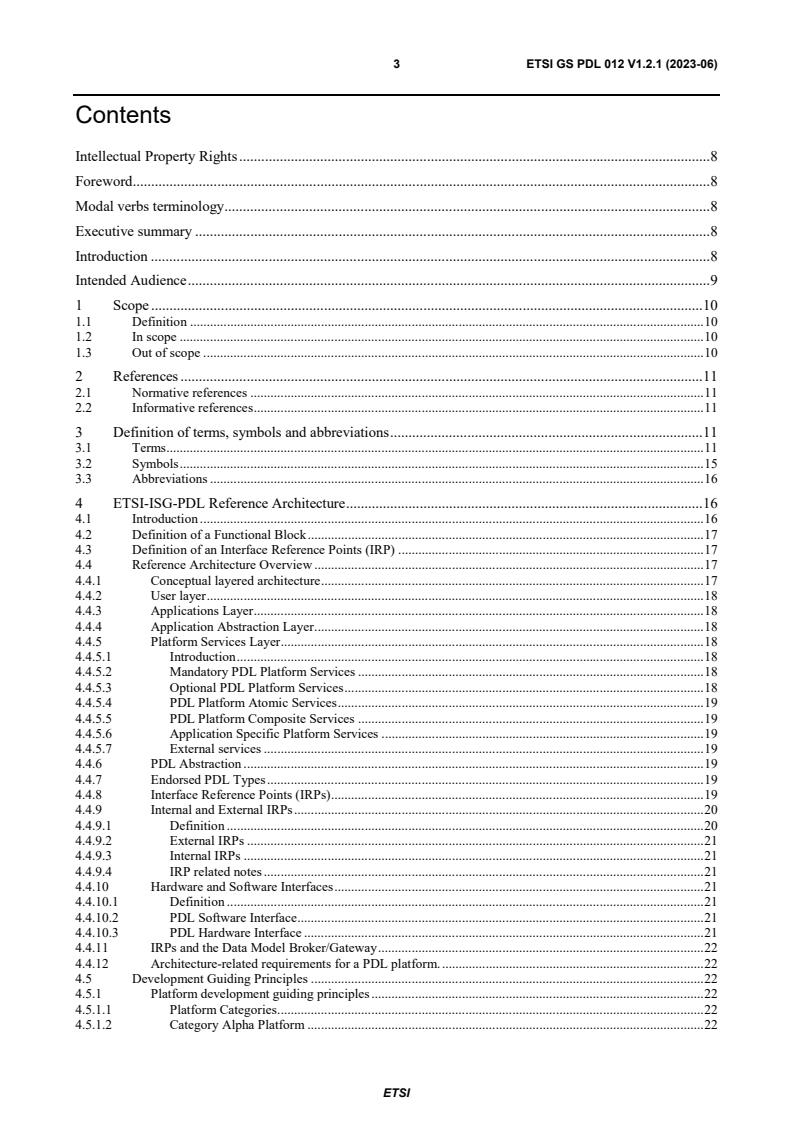
Contents
Intellectual Property Rights . 8
Foreword . 8
Modal verbs terminology . 8
Executive summary . 8
Introduction . 8
Intended Audience . 9
1 Scope . 10
1.1 Definition . 10
1.2 In scope . 10
1.3 Out of scope . 10
2 References . 11
2.1 Normative references . 11
2.2 Informative references . 11
3 Definition of terms, symbols and abbreviations . 11
3.1 Terms . 11
3.2 Symbols . 15
3.3 Abbreviations . 16
4 ETSI-ISG-PDL Reference Architecture . 16
4.1 Introduction . 16
4.2 Definition of a Functional Block . 17
4.3 Definition of an Interface Reference Points (IRP) . 17
4.4 Reference Architecture Overview . 17
4.4.1 Conceptual layered architecture . 17
4.4.2 User layer . 18
4.4.3 Applications Layer . 18
4.4.4 Application Abstraction Layer . 18
4.4.5 Platform Services Layer . 18
4.4.5.1 Introduction . 18
4.4.5.2 Mandatory PDL Platform Services . 18
4.4.5.3 Optional PDL Platform Services . 18
4.4.5.4 PDL Platform Atomic Services . 19
4.4.5.5 PDL Platform Composite Services . 19
4.4.5.6 Application Specific Platform Services . 19
4.4.5.7 External services . 19
4.4.6 PDL Abstraction . 19
4.4.7 Endorsed PDL Types . 19
4.4.8 Interface Reference Points (IRPs) . 19
4.4.9 Internal and External IRPs . 20
4.4.9.1 Definition . 20
4.4.9.2 External IRPs . 21
4.4.9.3 Internal IRPs . 21
4.4.9.4 IRP related notes . 21
4.4.10 Hardware and Software Interfaces . 21
4.4.10.1 Definition . 21
4.4.10.2 PDL Software Interface . 21
4.4.10.3 PDL Hardware Interface . 21
4.4.11 IRPs and the Data Model Broker/Gateway . 22
4.4.12 Architecture-related requirements for a PDL platform. . 22
4.5 Development Guiding Principles . 22
4.5.1 Platform development guiding principles . 22
4.5.1.1 Platform Categories . 22
4.5.1.2 Category Alpha Platform . 22
ETSI
4 ETSI GS PDL 012 V1.2.1 (2023-06)
4.5.1.2.1 Introduction . 22
4.5.1.2.2 Category Alpha-1 Platform . 23
4.5.1.2.3 Category Alpha-2 Platform . 23
4.5.1.3 Category Bravo Platform . 23
4.5.1.3.1 Introduction . 23
4.5.1.3.2 Category Bravo-1 Platform . 24
4.5.1.3.3 Category Bravo-2 Platform . 24
4.5.1.4 Category Charlie Platform . 24
4.5.1.4.1 Introduction . 24
4.5.1.4.2 Category Charlie-1 Platform . 25
4.5.1.4.3 Category Charlie-2 Platform . 25
4.5.1.4.4 Category Charlie-3 Platform . 25
4.5.1.4.5 Category Charlie-4 Platform . 25
4.5.1.5 Category "Delta" Platform . 26
4.5.1.5.1 Introduction . 26
4.5.1.5.2 Category Delta-1 Platform. 26
4.5.1.5.3 Category Delta-2 Platform. 26
4.5.1.5.4 Category Delta-3 Platform. 27
4.5.1.5.5 Category Delta-4 Platform. 27
4.5.2 Application development guiding principles . 27
4.5.3 Platform Services Dependency . 27
4.5.4 Platform Services Plurality . 27
4.5.5 Abstraction Layer Implementation . 28
4.6 Platform Services . 28
4.6.1 List of all Platform Services . 28
4.6.2 Atomic Platform Services . 31
4.6.2.1 Introduction to Atomic Platform Services . 31
4.6.2.2 Namespace Platform Service . 32
4.6.2.3 Identity Platform Service . 32
4.6.2.4 Location Platform Service . 32
4.6.2.5 Registration Platform Service . 33
4.6.2.6 Discovery Platform Service . 33
4.6.3 Composite Services. 33
4.6.3.1 List of all Composite platform Services . 33
4.6.3.2 Messaging Service . 34
4.6.3.3 Policy Service . 35
4.6.3.4 Security Platform Services . 35
4.6.3.4.1 Introduction to Security Platform Services . 35
4.6.3.4.2 Authentication Platform Service . 36
4.6.3.4.3 Authorization Platform Service . 36
4.6.3.4.4 Cryptography Platform Service . 36
4.6.3.4.5 Encryption Platform Service . 36
4.6.3.4.6 Identity Management Platform Service . 36
4.6.3.4.7 Key Management Platform Service . 37
4.6.3.5 Logging Platform Service . 37
4.6.3.6 Governance Platform Services . 37
4.6.3.6.1 Introduction to Governance Platform Services . 37
4.6.3.6.2 ETSI-ISG-PDL Implementation Agreements . 38
4.6.3.6.3 Governing Entity . 38
4.6.2.6.4 Creating, Changing and Enforcing Governance IAs and rules . 39
4.6.3.7 Composition Platform Service . 40
4.6.3.8 Access Control Platform Service . 40
4.6.3.9 Fault Tolerance Platform Service . 40
4.6.3.10 Distribution Transparency Platform Service . 41
4.6.3.11 Publish and Subscribe Platform Service . 41
4.6.3.12 Concurrency Platform Service . 41
4.6.3.13 Storage related services . 41
4.6.3.13.1 Types of Storage Platform Services . 41
4.6.3.13.2 In Memory Storage Platform Service . 41
4.6.3.13.3 File System Storage Platform Service . 42
4.6.3.13.4 On-Chain Storage Platform Service . 42
4.6.3.13.5 Off-Chain Storage Service. 42
ETSI
5 ETSI GS PDL 012 V1.2.1 (2023-06)
4.6.3.13.6 Distributed Blockchain Storage Platform Service . 43
4.6.3.14 Modelling Related Platform Services. 43
4.6.3.14.1 Introduction to Modelling . 43
4.6.3.14.2 Information Model . 44
4.6.3.14.3 Data Model . 44
4.6.3.14.4 Model Search . 45
4.6.3.14.5 Model Stitching . 45
4.6.3.15 Topology Platform Service . 46
4.6.3.16 Event Processing Platform Service . 46
4.6.3.17 Distributed Data Collection Platform Service . 47
4.6.3.18 Distributed Secret Sharing Platform Service . 47
4.6.3.19 Resource Management Platform Services . 47
4.6.3.19.1 Introduction to Resource Management . 47
4.6.3.19.2 Resource Discovery . 48
4.6.3.19.3 Resource Virtualization . 48
4.6.3.19.4 Resource Inventory Management . 48
4.6.3.19.5 Resource Administration and Management . 48
4.6.3.19.6 Resource FCAPS . 49
4.6.3.19.7 Resource Composition . 49
4.6.3.20 Platform Service Management Platform Services . 49
4.6.3.20.1 Introduction to Platform Service Management . 49
4.6.3.20.2 Platform Service Discovery Platform Service . 49
4.6.3.20.3 Platform Service Virtualization . 49
4.6.3.20.4 Platform Service Inventory Management . 50
4.6.3.20.5 Platform Service Administration and Management . 50
4.6.3.20.6 Platform Service FCAPS . 50
4.6.3.20.7 Platform Service Composition . 50
4.6.3.21 Application Management Services . 50
4.6.3.21.1 Introduction to Application Management . 50
4.6.3.21.2 Application Composition . 51
4.6.3.21.3 Application and Platform Service Orchestration . 51
4.6.3.21.4 Orchestration Platform Service . 51
4.6.3.21.5 Platform exploration . 51
4.6.3.21.6 Application Registration . 51
4.6.3.22 Transaction Management Service . 51
4.6.3.23 Data Model Gateway/Broker . 52
4.6.3.23.1 Introduction to presentation services . 52
4.6.3.23.2 API Presentation Platform Service . 53
4.6.3.23.3 Micro-services . 53
4.6.3.23.4 Webhooks . 53
4.6.3.24 Application Specific Services . 53
4.6.3.25 Accounting Service . 54
4.7 Application Clients . 54
4.7.1 Introduction to Application Clients . 54
4.7.2 Computer Applications . 54
4.7.3 Mobile Device Application . 54
4.7.4 PDL Cloud Applications . 55
5 Summary . 55
Annex A (informative): Change history . 56
History . 57
ETSI
6 ETSI GS PDL 012 V1.2.1 (2023-06)
List of figures
Figure 1: ETSI-ISG-PDL Reference Architecture .17
Figure 2: Category Alpha platform .23
Figure 3: Category Bravo platform .24
Figure 4: Category Charlie platform .25
Figure 5: Category Delta platform .26
Figure 6: Abstraction Layer Implementation .28
Figure 7: Atomic Platform Services .31
Figure 8: Composite Platform Services .34
Figure 9: Security Platform Services .36
Figure 10: Governance Platform Services .37
Figure 11: Data Collection matrix .47
ETSI
7 ETSI GS PDL 012 V1.2.1 (2023-06)
List of tables
Figure 1: ETSI-ISG-PDL Reference Architecture .17
Figure 2: Category Alpha platform .23
Figure 3: Category Bravo platform .24
Figure 4: Category Charlie platform .25
Figure 5: Category Delta platform .26
Figure 6: Abstraction Layer Implementation .28
Figure 7: Atomic Platform Services .31
Figure 8: Composite Platform Services .34
Figure 9: Security Platform Services .36
Figure 10: Governance Platform Services .37
Figure 11: Data Collection matrix .47
ETSI
8 ETSI GS PDL 012 V1.2.1 (2023-06)
Intellectual Property Rights
Essential patents
IPRs essential or potentially essential to normative deliverables may have been declared to ETSI. The declarations
pertaining to these essential IPRs, if any, are publicly available for ETSI members and non-members, and can be
found in ETSI SR 000 314: "Intellectual Property Rights (IPRs); Essential, or potentially Essential, IPRs notified to
ETSI in respect of ETSI standards", which is available from the ETSI Secretariat. Latest updates are available on the
ETSI Web server (https://ipr.etsi.org/).
Pursuant to the ETSI Directives including the ETSI IPR Policy, no investigation regarding the essentiality of IPRs,
including IPR searches, has been carried out by ETSI. No guarantee can be given as to the existence of other IPRs not
referenced in ETSI SR 000 314 (or the updates on the ETSI Web server) which are, or may be, or may become,
essential to the present document.
Trademarks
The present document may include trademarks and/or tradenames which are asserted and/or registered by their owners.
ETSI claims no ownership of these except for any which are indicated as being the property of ETSI, and conveys no
right to use or reproduce any trademark and/or tradename. Mention of those trademarks in the present document does
not constitute an endorsement by ETSI of products, services or organizations associated with those trademarks.
DECT™, PLUGTESTS™, UMTS™ and the ETSI logo are trademarks of ETSI registered for the benefit of its
Members. 3GPP™ and LTE™ are trademarks of ETSI registered for the benefit of its Members and of the 3GPP
Organizational Partners. oneM2M™ logo is a trademark of ETSI registered for the benefit of its Members and of the ®
oneM2M Partners. GSM and the GSM logo are trademarks registered and owned by the GSM Association.
Foreword
This Group Specification (GS) has been produced by ETSI Industry Specification Group (ISG) Permissioned
Distributed Ledger (PDL).
Modal verbs terminology
In the present document "shall", "shall not", "should", "should not", "may", "need not", "will", "will not", "can" and
"cannot" are to be interpreted as described in clause 3.2 of the ETSI Drafting Rules (Verbal forms for the expression of
provisions).
"must" and "must not" are NOT allowed in ETSI deliverables except when used in direct citation.
Executive summary
The present document is a revision of ETSI GS PDL 012 (V1.1.1) that defines an ETSI-ISG-PDL Reference
Architecture (RA) for a permissioned Distributed Ledger Technology (PDL) platform. The present document also
describes the characteristics and behaviour of such a platform, along with the services that it can provide and solutions
that can be built using it. It includes improved definitions, additional clauses and tables resulting from feedback
received from stakeholders using the previous version since its release.
Introduction
The present document defines an ETSI-ISG-PDL Reference Architecture (RA) for a permissioned Distributed Ledger
Technology (PDL) platform. The present document also describes the characteristics and behaviour of such a platform,
along with the services that it can provide and solutions that can be built using it.
ETSI
9 ETSI GS PDL 012 V1.2.1 (2023-06)
The ETSI-ISG-PDL RA is a template for defining a solution to a particular problem domain (in this case, a PDL
platform). The ETSI-ISG-PDL RA describes abstract functional components that support specific sets of functionalities
and reference points that describe standard interactions between different parts of the platform and users of that
platform (refer to Figure1). The present document uses a Functional Block architecture to define three key aspects of a
PDL Platform:
• Standardized platform services, which are services and functionality provided by the PDL platform that
conform with pre-defined requirements so they can interoperate with other components of the platform.
• Abstraction layers, which are Data Model Brokers allowing different and diverse applications on one side and
different PDL chain types on the other side to interface with the PDL platform.
• Modularity, which allows evolution and adaptation of PDL platforms to changing requirements.
The objectives of using the RA are to:
• Maximize the choice of technology solutions available to entities using ETSI-ISG-PDL-endorsed technologies,
Services, and applications.
• Maximize ETSI-ISG-PDL endorsed PDL platforms' scalability in terms of the applications supported and the
number of entities able to use them.
The ETSI-ISG-PDL RA also provides standardized terminology to simplify the interaction between objects such as
PDL Platforms, Services, and applications (as defined in clause 3.1) developed by ETSI-ISG-PDL members including
operators and technology vendors/developers.
This approach enables operators and technology vendors/developers to focus on their respective areas of expertise and
market leadership by providing solutions for one or more Reference Architecture functional components and/or
services. It also allows users to choose appropriate vendors and solutions for their specific environment and product
portfolio.
The architecture aims to be independent of specific implementations to accommodate a wide range of technology
solutions that comply with both the requirements of the supported applications and ensures adherence to critical
architectural requirements such as interoperability, security, privacy, etc.
The ETSI-ISG-PDL RA comprises two categories of architectural components - those components mandated in all
platforms (i.e. PDL Mandatory Platform Services), and those components that are optional and may be included or
excluded depending on the applications implemented on the Platform (i.e. PDL Optional Platform Services). This
approach facilitates the introduction and support of new applications in a structured manner without changing the
common, mandatory, parts. The RA also supports the concept of a distributed lifecycle for applications, where different
parties take different roles and responsibilities (for example Buyer versus Seller). This expands the vendor-operator
space, by allowing vendors to focus on, and operators to choose from, specific architectural components in the stacks
and focus their offerings on the different PDL Platforms, Services, and applications.
Intended Audience
All ETSI members, any technical, commercial and operations experts working in the ICT industry, software vendors,
standards organizations, other service providers, and industry bodies.
ETSI
10 ETSI GS PDL 012 V1.2.1 (2023-06)
1 Scope
1.1 Definition
The present document defines a RA for a Permissioned Distributed Ledger platform. Following the terminology and
general architectural requirements, the present document discusses the architectural components listed below:
a) Orchestration, governance, process management, and eco-system coordination in a complex environment (for
example node and PDL management in an environment involving multiple competing parties or supply
chains).
b) External and internal information exchange (for example through Oracles, APIs, micro services, webhooks, or
external data sources).
c) Off-chain Storage (another chain, local/cloud node that is not part of the PDL, PDL node but not sharing with
other nodes of said PDL, trusted by a single node or trusted by all nodes based on governance, etc.).
d) Smart Contracts (including commonalities between Smart Contracts, interoperability of Smart Contracts across
chains, PDL agnosticism).
1.2 In scope
a) Definition of functionalities, interfaces, reference points (for example Identity services such as PDL identity,
Node identity, and User identity).
b) Functional capabilities of commercial applications using PDL to create/trade value (for example wholesale
settlement, cryptocurrency or stable coins-based payments, tokenization, and asset/inventory management).
c) Non-functional capabilities of commercial applications using PDL to create/trade value (for example
network design, security, privacy, and access control).
d) Capabilities of different PDL protocols (common aspects of PDL protocols that can be use case, platform,
application, and service agnostic amplified through inter-ledger interoperability).
1.3 Out of scope
a) Architecture design and implementation details.
b) PDL network design and implementation details.
c) Design and implementation details of platforms built on PDL network.
d) Specific application/ service implementation details of application platforms built on PDL network (for
example implementation of identity using a specific method).
NOTE: Any platform, application, or network specific implementation details will be added at a later phase
through dedicated ETSI-ISG-PDL PRD documents (Including Functional, Privacy and Security related
services and requirements) or an annex to the present document (for other services) on need basis.
ETSI
11 ETSI GS PDL 012 V1.2.1 (2023-06)
2 References
2.1 Normative references
References are either specific (identified by date of publication and/or edition number or version number) or
non-specific. For specific references, only the cited version applies. For non-specific references, the latest version of the
referenced document (including any amendments) applies.
Referenced documents which are not found to be publicly available in the expected location might be found at
https://docbox.etsi.org/Reference.
NOTE: While any hyperlinks included in this clause were valid at the time of publication, ETSI cannot guarantee
their long term validity.
The following referenced documents are necessary for the application of the present document.
Not applicable.
2.2 Informative references
References are either specific (identified by date of publication and/or edition number or version number) or
non-specific. For specific references, only the cited version applies. For non-specific references, the latest version of the
referenced document (including any amendments) applies.
NOTE: While any hyperlinks included in this clause were valid at the time of publication, ETSI cannot guarantee
their long term validity.
The following referenced documents are not necessary for the application of the present document but they assist the
user with regard to a particular subject area.
[i.1] MEF 55.1: "Lifecycle Service Orchestration (LSO): Reference Architecture and Framework",
January 2021.
[i.2] NIST Special Publication 800-162, January 2014: "Guide to Attribute Based Access Control
(ABAC) Definition and Considerations".
[i.3] Gamma E., Helm R., Johnson R., Vlissides J.: "Design Patterns: -Elements of Reusable Object-
Oriented Software", Addison-Wesley, Nov 1994.-ISBN 978-0201633610.
3 Definition of terms, symbols and abbreviations
3.1 Terms
For the purposes of the present document, the following terms apply:
abstraction layer: functionality that serves as an intermediator between subsystems that may be using different
protocols, vocabulary, and methods that serves their respective purposes
access control policy: privileges and permissions of a subject entity to perform operations on a set of target en
...
Questions, Comments and Discussion
Ask us and Technical Secretary will try to provide an answer. You can facilitate discussion about the standard in here.
Loading comments...