

ETSI EN 300 175-2 V2.4.1 (2012-04)
Digital Enhanced Cordless Telecommunications (DECT); Common Interface (CI); Part 2: Physical Layer (PHL)
General Information
- Abstract
REN/DECT-000258
- Status
- Published
- Publication Date
- 22-Apr-2012
- Technical Committee
- DECT - Digital Enhanced Cordless Telecommunications (DECT)
- Current Stage
- 12 - Completion
- Due Date
- 01-May-2012
- Completion Date
- 23-Apr-2012
Buy Documents
en_30017502v020400o - Digital Enhanced Cordless Telecommunications (DECT); Common Interface (CI); Part 2: Physical Layer (PHL)
en_30017502v020401p - Digital Enhanced Cordless Telecommunications (DECT); Common Interface (CI); Part 2: Physical Layer (PHL)

Overview
ETSI EN 300 175-2 V2.4.1 (2012-04) (ETSI EN 300 175-2 V2.4.1) defines the Physical Layer (PHL) of the DECT Common Interface (CI). This edition updates the PHL to incorporate new functions introduced for NG‑DECT (Next‑Generation DECT), supports mechanisms defined in NG‑DECT Part 5, and includes enhancements to security. The standard is maintained by ETSI and adopted by SIST for Slovenia.
Key topics and technical requirements
The standard specifies physical‑layer services, interfaces and procedures including:
- RF channels and carriers - nominal carrier positions, accuracy and stability requirements for DECT RF carriers.
- Time Division Multiple Access (TDMA) - frame and slot structure (full, half, double, long and variable capacity slots), reference timer accuracy, jitter and synchronization methods.
- Physical packets and channels - definitions and formats for packet types (P00 short, P32 basic, P00j variable capacity, P80 high capacity) and corresponding physical channels (R00, R32, R00j, R80).
- Fields and signaling - synchronization field (S), data fields (D), Z‑field and bit patterns during ramping.
- Transmission requirements - burst timing (attack/release), transmitted power definitions (Normal Transmitted Power, peak/EIRP rules), modulation method and symbol definitions, and limits for unwanted emissions and intermodulation.
- Reception requirements - receiver sensitivity, reference BER/FER, interference and blocking performance, and spurious emission limits.
- Primitives and interfaces - PHL primitives to MAC and management entities (e.g., PL_TX, PL_RX, PL_FREQ_ADJ, PL_ME_SYNC, PL_ME_TIME_ADJ) and their expected behaviors.
- Procedures - synchronization insertion/removal, signal strength measurement, timing and frequency adjustment.
- Safety and ports - annexes cover RF exposure recommendations and synchronization port (including GPS) specifications.
Practical applications and users
This standard is essential for:
- DECT device and chipset manufacturers designing radios compliant with DECT/NG‑DECT physical-layer rules.
- Base station and handset integrators implementing Common Interface functionality across vendors.
- Test laboratories and certification bodies performing conformance testing (RF, timing, emissions, receiver performance).
- Network engineers and system designers deploying multi‑cell DECT networks requiring synchronization and interference management.
- Regulators and compliance officers assessing safety (RF exposure) and spectrum behavior.
Keywords: DECT, NG‑DECT, Common Interface, Physical Layer, PHL, TDMA, RF channels, synchronization, ETSI, SIST, DECT security.
Related standards
- ETSI EN 300 175‑1..n series (Common Interface family) - Part 5 (NG‑DECT mechanisms) is directly referenced for NG‑DECT features.
- National adoptions of ETSI DECT standards (e.g., SIST EN 300 175‑2) and other ETSI DECT technical reports relevant to IMT‑2000 and TDD/TDMA implementations.
Buy Documents
en_30017502v020400o - Digital Enhanced Cordless Telecommunications (DECT); Common Interface (CI); Part 2: Physical Layer (PHL)
en_30017502v020401p - Digital Enhanced Cordless Telecommunications (DECT); Common Interface (CI); Part 2: Physical Layer (PHL)
Frequently Asked Questions
ETSI EN 300 175-2 V2.4.1 (2012-04) is a standard published by the European Telecommunications Standards Institute (ETSI). Its full title is "Digital Enhanced Cordless Telecommunications (DECT); Common Interface (CI); Part 2: Physical Layer (PHL)". This standard covers: REN/DECT-000258
REN/DECT-000258
ETSI EN 300 175-2 V2.4.1 (2012-04) is available in PDF format for immediate download after purchase. The document can be added to your cart and obtained through the secure checkout process. Digital delivery ensures instant access to the complete standard document.
Standards Content (Sample)
Final draft ETSI EN 300 175-2 V2.4.0 (2011-12)
European Standard
Digital Enhanced Cordless Telecommunications (DECT);
Common Interface (CI);
Part 2: Physical Layer (PHL)
2 Final draft ETSI EN 300 175-2 V2.4.0 (2011-12)
Reference
REN/DECT-000258
Keywords
DECT, IMT-2000, mobility, radio, TDD, TDMA
ETSI
650 Route des Lucioles
F-06921 Sophia Antipolis Cedex - FRANCE
Tel.: +33 4 92 94 42 00 Fax: +33 4 93 65 47 16
Siret N° 348 623 562 00017 - NAF 742 C
Association à but non lucratif enregistrée à la
Sous-Préfecture de Grasse (06) N° 7803/88
Important notice
Individual copies of the present document can be downloaded from:
http://www.etsi.org
The present document may be made available in more than one electronic version or in print. In any case of existing or
perceived difference in contents between such versions, the reference version is the Portable Document Format (PDF).
In case of dispute, the reference shall be the printing on ETSI printers of the PDF version kept on a specific network drive
within ETSI Secretariat.
Users of the present document should be aware that the document may be subject to revision or change of status.
Information on the current status of this and other ETSI documents is available at
http://portal.etsi.org/tb/status/status.asp
If you find errors in the present document, please send your comment to one of the following services:
http://portal.etsi.org/chaircor/ETSI_support.asp
Copyright Notification
No part may be reproduced except as authorized by written permission.
The copyright and the foregoing restriction extend to reproduction in all media.
© European Telecommunications Standards Institute 2011.
All rights reserved.
TM TM TM
DECT , PLUGTESTS , UMTS and the ETSI logo are Trade Marks of ETSI registered for the benefit of its Members.
TM
3GPP and LTE™ are Trade Marks of ETSI registered for the benefit of its Members and
of the 3GPP Organizational Partners.
GSM® and the GSM logo are Trade Marks registered and owned by the GSM Association.
ETSI
3 Final draft ETSI EN 300 175-2 V2.4.0 (2011-12)
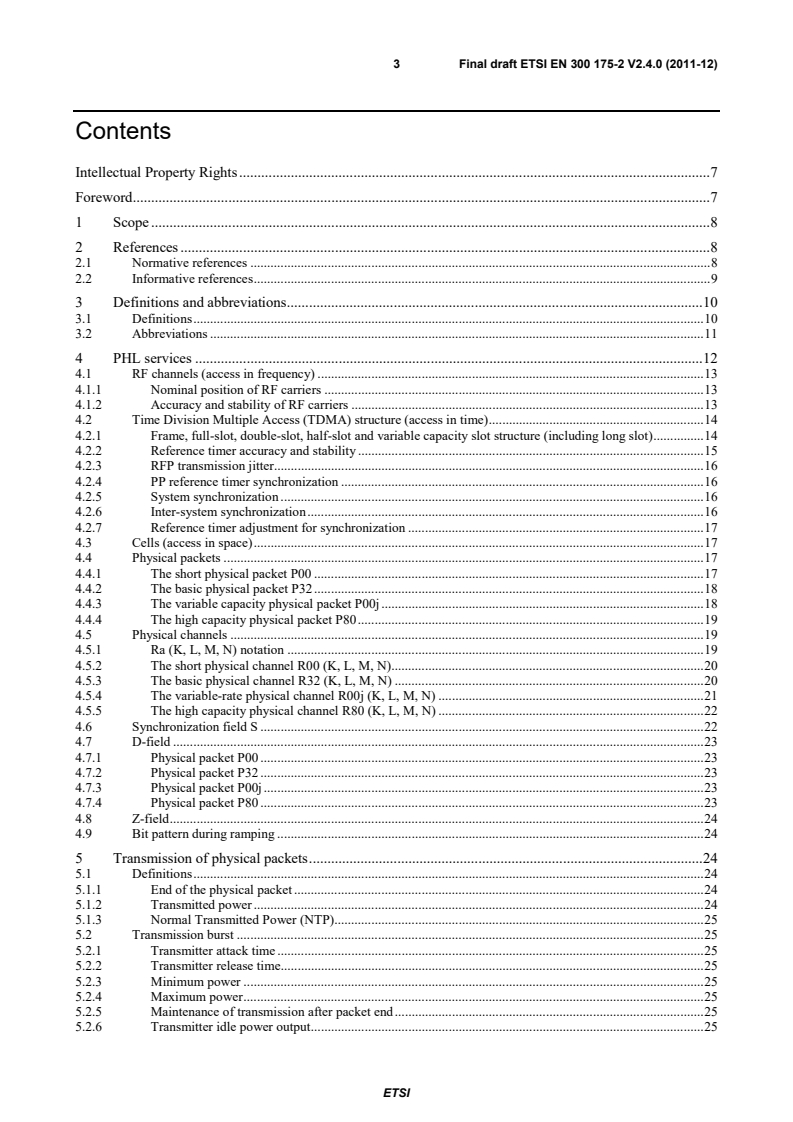
Contents
Intellectual Property Rights . 7
Foreword . 7
1 Scope . 8
2 References . 8
2.1 Normative references . 8
2.2 Informative references . 9
3 Definitions and abbreviations . 10
3.1 Definitions . 10
3.2 Abbreviations . 11
4 PHL services . 12
4.1 RF channels (access in frequency) . 13
4.1.1 Nominal position of RF carriers . 13
4.1.2 Accuracy and stability of RF carriers . 13
4.2 Time Division Multiple Access (TDMA) structure (access in time) . 14
4.2.1 Frame, full-slot, double-slot, half-slot and variable capacity slot structure (including long slot) . 14
4.2.2 Reference timer accuracy and stability . 15
4.2.3 RFP transmission jitter. 16
4.2.4 PP reference timer synchronization . 16
4.2.5 System synchronization . 16
4.2.6 Inter-system synchronization . 16
4.2.7 Reference timer adjustment for synchronization . 17
4.3 Cells (access in space) . 17
4.4 Physical packets . 17
4.4.1 The short physical packet P00 . 17
4.4.2 The basic physical packet P32 . 18
4.4.3 The variable capacity physical packet P00j . 18
4.4.4 The high capacity physical packet P80 . 19
4.5 Physical channels . 19
4.5.1 Ra (K, L, M, N) notation . 19
4.5.2 The short physical channel R00 (K, L, M, N) . 20
4.5.3 The basic physical channel R32 (K, L, M, N) . 20
4.5.4 The variable-rate physical channel R00j (K, L, M, N) . 21
4.5.5 The high capacity physical channel R80 (K, L, M, N) . 22
4.6 Synchronization field S . 22
4.7 D-field . 23
4.7.1 Physical packet P00 . 23
4.7.2 Physical packet P32 . 23
4.7.3 Physical packet P00j . 23
4.7.4 Physical packet P80 . 23
4.8 Z-field . 24
4.9 Bit pattern during ramping . 24
5 Transmission of physical packets . 24
5.1 Definitions . 24
5.1.1 End of the physical packet . 24
5.1.2 Transmitted power . 24
5.1.3 Normal Transmitted Power (NTP) . 25
5.2 Transmission burst . 25
5.2.1 Transmitter attack time . 25
5.2.2 Transmitter release time . 25
5.2.3 Minimum power . 25
5.2.4 Maximum power . 25
5.2.5 Maintenance of transmission after packet end . 25
5.2.6 Transmitter idle power output . 25
ETSI
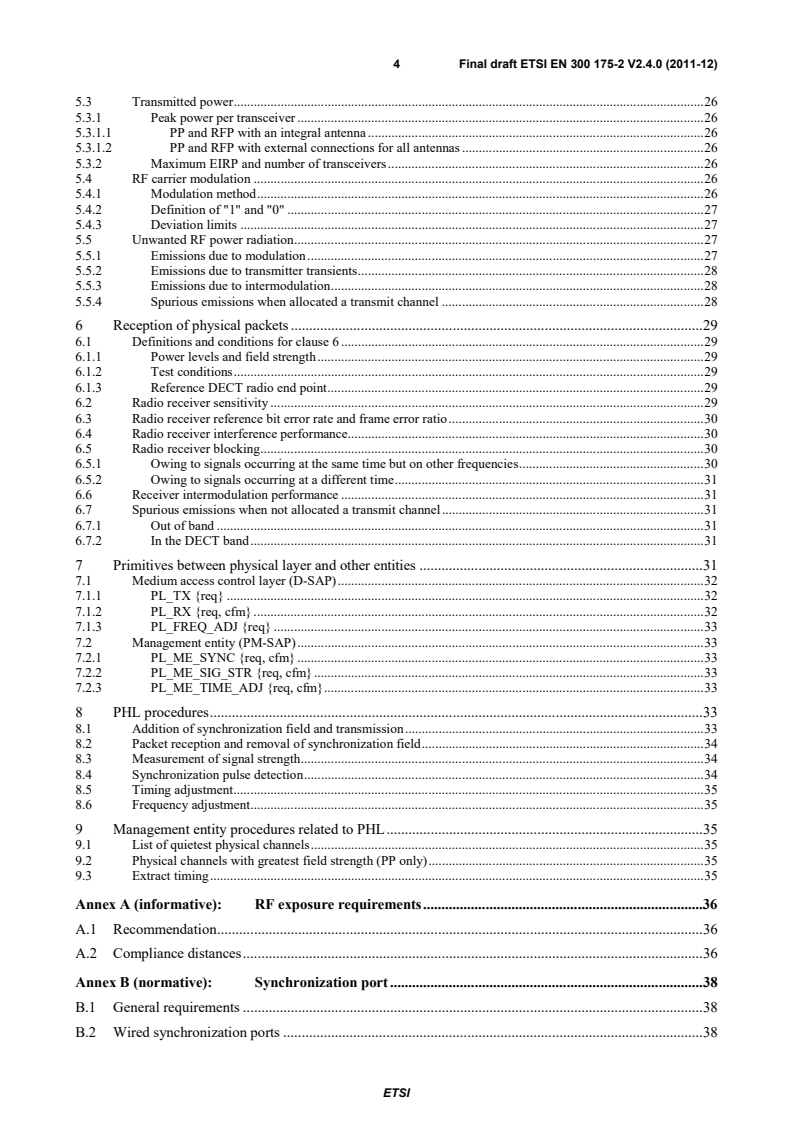
4 Final draft ETSI EN 300 175-2 V2.4.0 (2011-12)
5.3 Transmitted power . 26
5.3.1 Peak power per transceiver . 26
5.3.1.1 PP and RFP with an integral antenna . 26
5.3.1.2 PP and RFP with external connections for all antennas . 26
5.3.2 Maximum EIRP and number of transceivers . 26
5.4 RF carrier modulation . 26
5.4.1 Modulation method . 26
5.4.2 Definition of "1" and "0" . 27
5.4.3 Deviation limits . 27
5.5 Unwanted RF power radiation . 27
5.5.1 Emissions due to modulation . 27
5.5.2 Emissions due to transmitter transients . 28
5.5.3 Emissions due to intermodulation . 28
5.5.4 Spurious emissions when allocated a transmit channel . 28
6 Reception of physical packets . 29
6.1 Definitions and conditions for clause 6 . 29
6.1.1 Power levels and field strength . 29
6.1.2 Test conditions . 29
6.1.3 Reference DECT radio end point . 29
6.2 Radio receiver sensitivity . 29
6.3 Radio receiver reference bit error rate and frame error ratio . 30
6.4 Radio receiver interference performance. 30
6.5 Radio receiver blocking . 30
6.5.1 Owing to signals occurring at the same time but on other frequencies . 30
6.5.2 Owing to signals occurring at a different time . 31
6.6 Receiver intermodulation performance . 31
6.7 Spurious emissions when not allocated a transmit channel . 31
6.7.1 Out of band . 31
6.7.2 In the DECT band . 31
7 Primitives between physical layer and other entities . 31
7.1 Medium access control layer (D-SAP) . 32
7.1.1 PL_TX {req} . 32
7.1.2 PL_RX {req, cfm} . 32
7.1.3 PL_FREQ_ADJ {req} . 33
7.2 Management entity (PM-SAP) . 33
7.2.1 PL_ME_SYNC {req, cfm} . 33
7.2.2 PL_ME_SIG_STR {req, cfm} . 33
7.2.3 PL_ME_TIME_ADJ {req, cfm} . 33
8 PHL procedures . 33
8.1 Addition of synchronization field and transmission . 33
8.2 Packet reception and removal of synchronization field . 34
8.3 Measurement of signal strength . 34
8.4 Synchronization pulse detection . 34
8.5 Timing adjustment . 35
8.6 Frequency adjustment . 35
9 Management entity procedures related to PHL . 35
9.1 List of quietest physical channels . 35
9.2 Physical channels with greatest field strength (PP only) . 35
9.3 Extract timing . 35
Annex A (informative): RF exposure requirements . 36
A.1 Recommendation . 36
A.2 Compliance distances . 36
Annex B (normative): Synchronization port . 38
B.1 General requirements . 38
B.2 Wired synchronization ports . 38
ETSI
5 Final draft ETSI EN 300 175-2 V2.4.0 (2011-12)
B.2.1 Synchronization signal . 39
B.3 GPS synchronization . 40
B.3.1 Synchronization signal . 41
B.3.2 DECT timings derivation from the GPS time. 41
B.3.2.1 DECT multiframe number synchronization using GPS . 42
B.3.2.2 DECT PSCN synchronization using GPS . 42
B.4 Guidance for installation . 43
B.4.1 Interconnection cable . 43
B.4.2 Propagation delay of synchronization signals . 43
B.4.2.1 Calculation of Propagation delay (informative) . 43
B.4.2.2 Delay compensation . 44
B.4.3 GPS receiver stability . 44
Annex C (informative): Prolonged preamble . 45
C.1 Bit pattern . 45
C.2 The power-time template. 45
Annex D (normative): 4-level/8-level/16-level/64-level modulation option . 46
D.1 The π/2-DBPSK modulation scheme . 47
D.1.1 RF carrier modulation . 47
D.1.1.1 Modulation accuracy. 47
D.1.2 Transmission of physical packets . 47
D.2 The π/4-DQPSK modulation scheme . 48
D.2.1 RF carrier modulation . 48
D.2.1.1 Modulation accuracy. 48
D.2.2 Transmission of physical packets . 48
D.3 The π/8-D8PSK modulation scheme . 48
D.3.1 RF carrier modulation . 48
D.3.1.1 Modulation accuracy. 49
D.3.2 Transmission of physical packets . 49
D.4 The 16 QAM modulation scheme . 49
D.4.1 RF carrier modulation . 49
D.4.1.1 Modulation accuracy. 50
D.4.2 Transmission of physical packets . 50
D.5 The 64 QAM modulation scheme . 50
D.5.1 RF carrier modulation . 50
D.5.1.1 Modulation accuracy. 51
D.5.2 Transmission of physical packets . 52
D.6 Transmission of physical packets . 52
D.6.1 Error vector magnitude definition . 52
D.6.2 EVM requirement . 52
Annex E (normative): Power control procedures . 53
E.1 Definitions of parameters and relations between parameters . 54
E.2 Procedure for PP power adjustment due to movement . 55
E.3 Setting the power control threshold, RSSpT . 55
Annex F (normative): DECT carrier numbers and carrier positions in the range 1 880 MHz
to 2 025 MHz and for the US market 902 MHz to 928 MHz and
2 400 MHz to 2 483,5 MHz . 57
F.1 Introduction . 57
F.2 1 880 MHz to 1 978 MHz and 2 010 MHz to 2 025 MHz RF band 00001 . 58
ETSI
6 Final draft ETSI EN 300 175-2 V2.4.0 (2011-12)
F.3 1 880 MHz to 1 925 MHz and 2 010 MHz to 2 025 MHz RF band 00010 . 59
F.4 1 880 MHz to 1 900 MHz, 1 915 MHz to 1 940 MHz and 2 010 MHz to 2 025 MHz RF band
00011 . 60
F.5 1 880 MHz to 1 900 MHz, 1 935 MHz to 1 960 MHz and 2 010 MHz to 2 025 MHz RF band
00100 . 61
F.6 1 880 MHz to 1 900 MHZ, 1 955 MHz to 1 980 MHz and 2 010 MHz to 2 025 MHz RF band
00101 . 62
F.7 US ISM band carriers . 63
F.7.1 902 MHz to 928 MHz RF band 01000 . 63
F.7.2 2 400 MHz to 2 483,5 MHz RF band 01001 . 63
Annex G (informative): Bibliography . 64
Annex H (informative): Change history . 65
History . 66
ETSI
7 Final draft ETSI EN 300 175-2 V2.4.0 (2011-12)
Intellectual Property Rights
IPRs essential or potentially essential to the present document may have been declared to ETSI. The information
pertaining to these essential IPRs, if any, is publicly available for ETSI members and non-members, and can be found
in ETSI SR 000 314: "Intellectual Property Rights (IPRs); Essential, or potentially Essential, IPRs notified to ETSI in
respect of ETSI standards", which is available from the ETSI Secretariat. Latest updates are available on the ETSI Web
server (http://ipr.etsi.org).
Pursuant to the ETSI IPR Policy, no investigation, including IPR searches, has been carried out by ETSI. No guarantee
can be given as to the existence of other IPRs not referenced in ETSI SR 000 314 (or the updates on the ETSI Web
server) which are, or may be, or may become, essential to the present document.
Foreword
This final draft European Standard (EN) has been produced by ETSI Technical Committee Digital Enhanced Cordless
Telecommunications (DECT), and is now submitted for the ETSI standards One-step Approval Procedure.
The present document is part 2 of a multi-part deliverable. Full details of the entire series can be found in part 1 [1].
Further details of the DECT system may be found in TR 101 178 [i.1] and ETR 043 [i.2].
Proposed national transposition dates
Date of latest announcement of this EN (doa): 3 months after ETSI publication
Date of latest publication of new National Standard
or endorsement of this EN (dop/e): 6 months after doa
Date of withdrawal of any conflicting National Standard (dow): 6 months after doa
ETSI
8 Final draft ETSI EN 300 175-2 V2.4.0 (2011-12)
1 Scope
The present document is one of the parts of the specification of the Digital Enhanced Cordless Telecommunications
(DECT) Common Interface (CI).
The present document specifies the physical channel arrangements. DECT physical channels are radio communication
paths between two radio end points. A radio end point is either part of the fixed infrastructure, a privately owned Fixed
Part (FP), typically a base station, or a Portable Part (PP), typically a handset. The assignment of one or more particular
physical channels to a call is the task of higher layers.
The Physical Layer (PHL) interfaces with the Medium Access Control (MAC) layer, and with the Lower Layer
Management Entity (LLME). On the other side of the PHL is the radio transmission medium which has to be shared
extensively with other DECT users and a wide variety of other radio services. The tasks of the PHL can be grouped into
five categories:
a) to modulate and demodulate radio carriers with a bit stream of a defined rate to create a radio frequency
channel;
b) to acquire and maintain bit and slot synchronization between transmitters and receivers;
c) to transmit or receive a defined number of bits at a requested time and on a particular frequency;
d) to add and remove the synchronization field and the Z-field used for rear end collision detection;
e) to observe the radio environment to report signal strengths.
The present document includes New Generation DECT, a further development of the DECT standard introducing
wideband speech, improved data services, new slot types and other technical enhancements.
2 References
References are either specific (identified by date of publication and/or edition number or version number) or
non-specific. For specific references, only the cited version applies. For non-specific references, the latest version of the
reference document (including any amendments) applies.
Referenced documents which are not found to be publicly available in the expected location might be found at
http://docbox.etsi.org/Reference.
NOTE: While any hyperlinks included in this clause were valid at the time of publication ETSI cannot guarantee
their long term validity.
2.1 Normative references
The following referenced documents are necessary for the application of the present document.
[1] ETSI EN 300 175-1: "Digital Enhanced Cordless Telecommunications (DECT); Common
Interface (CI); Part 1: Overview".
[2] Void.
[3] ETSI EN 300 175-3: "Digital Enhanced Cordless Telecommunications (DECT); Common
Interface (CI); Part 3: Medium Access Control (MAC) layer".
[4] ETSI EN 300 175-4: "Digital Enhanced Cordless Telecommunications (DECT); Common
Interface (CI); Part 4: Data Link Control (DLC) layer".
[5] ETSI EN 300 175-5: "Digital Enhanced Cordless Telecommunications (DECT); Common
Interface (CI); Part 5: Network (NWK) layer".
ETSI
9 Final draft ETSI EN 300 175-2 V2.4.0 (2011-12)
[6] ETSI EN 300 175-6: "Digital Enhanced Cordless Telecommunications (DECT); Common
Interface (CI); Part 6: Identities and addressing".
[7] Void.
[8] Void.
[9] ETSI EN 300 176-1: "Digital Enhanced Cordless Telecommunications (DECT); Test
specification; Part 1: Radio".
[10] ITU-R Recommendation M.1457-6: "Detailed specifications of the radio interfaces of
International Mobile Telecommunications-2000 (IMT-2000)".
[11] ITU-T Recommendation V.11: "Electrical characteristics for balanced double-current interchange
circuits operating at data signalling rates up to 10 Mbit/s".
[12] Federal Communications Commission FCC 02-151: "Second Report and Order, Amendment of
Part 15 of the Commission's Rules Regarding Spread Spectrum Devices".
[13] CEPT/ECC/DEC/(06)01: "ECC Decision of 24 March 2006 on the harmonized utilization of
spectrum for terrestrial IMT-2000/UMTS systems operating within the bands 1900 - 1980 MHz,
2010 - 2025 MHz and 2110 - 2170 MHz".
2.2 Informative references
The following referenced documents are not necessary for the application of the present document but they assist the
user with regard to a particular subject area.
[i.1] ETSI TR 101 178: "Digital Enhanced Cordless Telecommunications (DECT); A High Level Guide
to the DECT Standardization".
[i.2] ETSI ETR 043: "Digital Enhanced Cordless Telecommunications (DECT); Common Interface
(CI); Services and facilities requirements specification".
[i.3] International Commission on Non-Ionizing Radiation Protection (ICNIRP): "Guidelines for
limiting exposure to time-varying electric, magnetic, and electromagnetic fields (up to 300 GHz),
Health Physics", vol. 74, pp 494-522, April 1998.
[i.4] Council Recommendation 1999/519/EC of 12 July 1999 on the limitation of exposure of the
general public to electromagnetic fields (0 Hz to 300 GHz) (Official Journal of the European
Communities, July 1999).
[i.5] CENELEC EN 50360: "Product standard to demonstrate the compliance of mobile phones with
the basic restrictions related to human exposure to electromagnetic fields (300 MHz - 3 GHz)",
European Committee for Electrotechnical Standardization (CENELEC), July 2001. (Harmonized
standard listed under the R&TTE directive).
[i.6] CENELEC EN 50385: "Product standard to demonstrate the compliance of radio base stations and
fixed terminal stations for wireless telecommunication systems with the basic restrictions or the
reference levels related to human exposure to radio frequency electromagnetic fields (110 MHz -
40 GHz) - General public", European Committee for Electrotechnical Standardization
(CENELEC), November 2001 (draft).
[i.7] CENELEC EN 50383: "Basic standard for the calculation and measurement of electromagnetic
field strength and SAR related to human exposure from radio base stations and fixed terminal
stations for wireless telecommunication systems (110 MHz - 40 GHz)", European Committee for
Electrotechnical Standardization (CENELEC), November 2001 (draft).
[i.8] IEEE 802.11b: "Standard for Information Technology - Telecommunications and Information
Exchange Between Systems - Local and Metropolitan Area Networks - Specific Requirements -
Part 11: Wireless LAN Medium Access Control (MAC) and Physical Layer (PHY)
Specifications".
ETSI
10 Final draft ETSI EN 300 175-2 V2.4.0 (2011-12)
3 Definitions and abbreviations
3.1 Definitions
For the purposes of the present document, the following terms and definitions apply:
antenna diversity: See EN 300 175-1 [1].
cell: See EN 300 175-1 [1].
Central Control Fixed Part (CCFP): See EN 300 175-1 [1].
channel: See EN 300 175-1 [1].
cluster: See EN 300 175-1 [1].
Connection Oriented mode (C/O): See EN 300 175-1 [1].
Cordless Radio Fixed Part (CRFP): See EN 300 175-1 [1].
coverage area: See EN 300 175-1 [1].
DECT Network (DNW): See EN 300 175-1 [1].
double duplex bearer: See EN 300 175-1 [1].
double simplex bearer: See EN 300 175-1 [1].
double slot: See EN 300 175-1 [1].
down-link: See EN 300 175-1 [1].
duplex bearer: See EN 300 175-1 [1].
Fixed Part (DECT Fixed Part) (FP): See EN 300 175-1 [1].
Fixed radio Termination (FT): See EN 300 175-1 [1].
frame: See EN 300 175-1 [1].
full slot (slot): See EN 300 175-1 [1].
guard space: See EN 300 175-1 [1].
half slot: See EN 300 175-1 [1].
handover: See EN 300 175-1 [1].
IMT-2000: International Mobile Telecommunications, Third Generation Mobile Systems
IMT-FT: International Mobile Telecommunications, FDMA/TDMA
NOTE: This is the DECT family member of IMT-2000.
intercell handover: See EN 300 175-1 [1].
intracell handover: See EN 300 175-1 [1].
Lower Layer Management Entity (LLME): See EN 300 175-1 [1].
multiframe: See EN 300 175-1 [1].
New Generation DECT: See EN 300 175-1 [1].
physical channel (channel): See EN 300 175-1 [1].
ETSI
11 Final draft ETSI EN 300 175-2 V2.4.0 (2011-12)
Portable Part (DECT Portable Part) (PP): See EN 300 175-1 [1].
Portable radio Termination (PT): See EN 300 175-1 [1].
public access service: See EN 300 175-1 [1].
radio channel: See EN 300 175-1 [1].
radio end point: See EN 300 175-1 [1].
Radio Fixed Part (RFP): See EN 300 175-1 [1].
Repeater Part (REP): See EN 300 175-1 [1].
RF carrier (carrier): See EN 300 175-1 [1].
RF channel: See EN 300 175-1 [1].
simplex bearer: See EN 300 175-1 [1].
Single Radio Fixed Part (SRFP): See EN 300 175-1 [1].
TDMA frame: See EN 300 175-1 [1].
Wireless Relay Station (WRS): See EN 300 175-1 [1].
3.2 Abbreviations
For the purposes of the present document, the following abbreviations apply:
AC ACcuracy
AM Amplitude Modulation
BER Bit Error Rate
CCFP Central Control Fixed Part
CI Common Interface (standard)
CRFP Cordless Radio Fixed Part
CTA Cordless Terminal Adapter
dBm dB relative to 1 milliwatt
DBPSK Differential Binary Phase Shift Keying
DC Direct Current
DLC Data Link Control layer
DNW DECT Network
DQPSK Differential Quaternary Phase Shift Keying
D-SAP Data field-Service Access Point
DSV Digital Sum Variation
EIRP Equivalent Isotropically Radiated Power
ERP Effective Radiated Power
EVM Error-Vector Magnitude
FMID Fixed part MAC IDentity
FP Fixed Part
FT Fixed radio Termination
Fy Frequency
GFSK Gaussian Frequency Shift Keying
GMSK Gaussian Minimum Shift Keying
GPS Global Positioning System
HLM High Level Modulation
ICNIRP International Commission on Non-Ionizing Radiation Protection
iDCS instant Dynamic Channel Selection
IMT-FT International Mobile Telecommunications - Frequency Time
ISM Industrial, Scientific and Medical
LCD Largest Common Denominator
LLME Lower Layer Management Entity
MAC Medium Access Control layer
MCM Minimum Common Multiple
ETSI
12 Final draft ETSI EN 300 175-2 V2.4.0 (2011-12)
MF Fading Margin
MFN MultiFrame Number
NTP Normal Transmitted Power
NWK NetWorK
PCMCIA Personal Computer Memory Card International Association
PHL PHysical Layer
PM-SAP Physical layer Management entity - Service Access Point
PP Portable Part
ppm parts per million
PSCN Primary receiver Scan Carrier Number
PT Portable radio Termination
REP REpeater Part
RF Radio Frequency
RFP Radio Fixed Part
RMS Root Mean Square
RPN Radio fixed Part Number
RSSp Radio Signal Strength PP
SAP Service Access Point
SAR Specific Absorption Rate
SDU Service Data Unit
SRFP Single Radio Fixed Part
TDD Time Division Duplex
TDMA Time Division Multiple Access
UMTS Universal Mobile Telecommunication System
UTC Universal Time Coordinated
VF cable Velocity Factor
WLAN Wireless Local Area Network
WRS Wireless Relay Station
4 PHL services
A physical channel provides a simplex bit-pipe between two radio end points. To establish, for example, a duplex
telephone connection, two physical channels have to be established between the endpoints.
Radio spectrum is needed to create a physical channel. The radio spectrum space has three dimensions:
• geometric (geographic) space;
• frequency;
• time.
Spectrum is assigned to physical channels by sharing it in these three dimensions.
DECT provides a mechanism called "handover" to release a physical channel and to establish another one in any or all
of the three dimensions without releasing the end-to-end connection.
The requirements of the present document should be read in conjunction with EN 300 176-1 [9].
The requirements specified apply for nominal conditions unless extreme conditions are stated. Tests at extreme
conditions may include combinations of limit values of extreme temperature and of power supply variation, defined for
each case in EN 300 176-1 [9].
Nominal and extreme temperature ranges are defined below:
Nominal temperature: PP, FP, RFP, CCFP +15 °C to +35 °C;
Extreme temperature: PP 0 °C to +40 °C;
FP, RFP, CCFP, class E1 +10 °C to +40 °C;
FP, RFP, CCFP, class E2 -10 °C to +55 °C.
ETSI
13 Final draft ETSI EN 300 175-2 V2.4.0 (2011-12)
The environmental class E1 refers to installation in indoor heated and/or cooled areas allowing for personal comfort,
e.g. homes, offices, laboratories or workshops. The environmental class E2 refers to all other installations.
For nominal temperature, each measurement is made at the temperature of the test site, which shall be within +15 °C to
+35 °C. For extreme temperatures, additional measurements are made, at each limit value of the extreme temperature.
4.1 RF channels (access in frequency)
4.1.1 Nominal position of RF carriers
DECT carriers are specified for the whole frequency range 1 880 MHz to 1 980 MHz and 2 010 MHz to 2 025 MHz.
Carrier positions in the 902 MHz to 928 MHz ISM band and the 2 400 MHz to 2 483,5 MHz ISM band have been
defined for the US market [12].
DECT is also an IMT-2000 [10] family member, called IMT-FT, the only member that provides for uncoordinated
installations on an unlicensed spectrum. RF carriers for IMT-FT applications of DECT are placed within the parts of the
European UMTS spectrum applicable for TDD operation. (See ECC/DEC/(06)01 [13].) E.g. within 1 900 MHz to
1 920 MHz, 1 920 MHz to 1 980 MHz and/or 2 010 MHz to 2 025 MHz.
The most common spectrum allocation is 1 880 MHz to 1 900 MHz, but outside Europe spectrum is also available in
1 900 MHz to 1 920 MHz and in 1 910 MHz to 1 930 MHz (several countries).
Ten RF carriers are defined in the frequency band 1 880 MHz to 1 900 MHz with centre frequencies Fc given by:
Fc = F0 - c × 1,728 MHz;
where: F0 = 1 897,344 MHz; and
c = 0,1, ., 9.
Above this band, additional carriers are defined in annex F. Annex F shows the carrier frequencies for c = 0 to 9 and for
c ≥ 10 and RF bands 00001 to 01001 (see EN 300 175-3 [3], clauses 7.2.3.3 and 7.2.3.9).
The frequency band between Fc - 1,728/2 MHz and Fc + 1,728/2 MHz shall be designated RF channel c.
NOTE: A nominal DECT RF carrier is one whose centre frequency is generated by the formula:
Fg = F0 - g × 1,728 MHz, where g is any integer.
All DECT equipment should when allowed be capable of working on all 10 RF channels, c = 0, 1, ., 9.
New or modified carrier positions and/or frequency bands can (locally) be defined when needed by utilizing reserved
RF band numbers.
4.1.2 Accuracy and stability of RF carriers
At an RFP the transmitted RF carrier frequency corresponding to RF channel c shall be in the range Fc ± 50 kHz at
extreme conditions.
At a PP the centre frequency accuracy shall be within ±50 kHz at extreme conditions either relative to an absolute
frequency reference or relative to the received carrier, except that during the
...
European Standard
Digital Enhanced Cordless Telecommunications (DECT);
Common Interface (CI);
Part 2: Physical Layer (PHL)
2 ETSI EN 300 175-2 V2.4.1 (2012-04)
Reference
REN/DECT-000258
Keywords
DECT, IMT-2000, mobility, radio, TDD, TDMA
ETSI
650 Route des Lucioles
F-06921 Sophia Antipolis Cedex - FRANCE
Tel.: +33 4 92 94 42 00 Fax: +33 4 93 65 47 16
Siret N° 348 623 562 00017 - NAF 742 C
Association à but non lucratif enregistrée à la
Sous-Préfecture de Grasse (06) N° 7803/88
Important notice
Individual copies of the present document can be downloaded from:
http://www.etsi.org
The present document may be made available in more than one electronic version or in print. In any case of existing or
perceived difference in contents between such versions, the reference version is the Portable Document Format (PDF).
In case of dispute, the reference shall be the printing on ETSI printers of the PDF version kept on a specific network drive
within ETSI Secretariat.
Users of the present document should be aware that the document may be subject to revision or change of status.
Information on the current status of this and other ETSI documents is available at
http://portal.etsi.org/tb/status/status.asp
If you find errors in the present document, please send your comment to one of the following services:
http://portal.etsi.org/chaircor/ETSI_support.asp
Copyright Notification
No part may be reproduced except as authorized by written permission.
The copyright and the foregoing restriction extend to reproduction in all media.
© European Telecommunications Standards Institute 2012.
All rights reserved.
TM TM TM
DECT , PLUGTESTS , UMTS and the ETSI logo are Trade Marks of ETSI registered for the benefit of its Members.
TM
3GPP and LTE™ are Trade Marks of ETSI registered for the benefit of its Members and
of the 3GPP Organizational Partners.
GSM® and the GSM logo are Trade Marks registered and owned by the GSM Association.
ETSI
3 ETSI EN 300 175-2 V2.4.1 (2012-04)
Contents
Intellectual Property Rights . 7
Foreword . 7
1 Scope . 8
2 References . 8
2.1 Normative references . 8
2.2 Informative references . 9
3 Definitions and abbreviations . 10
3.1 Definitions . 10
3.2 Abbreviations . 11
4 PHL services . 12
4.1 RF channels (access in frequency) . 13
4.1.1 Nominal position of RF carriers . 13
4.1.2 Accuracy and stability of RF carriers . 13
4.2 Time Division Multiple Access (TDMA) structure (access in time) . 14
4.2.1 Frame, full-slot, double-slot, half-slot and variable capacity slot structure (including long slot) . 14
4.2.2 Reference timer accuracy and stability . 15
4.2.3 RFP transmission jitter. 16
4.2.4 PP reference timer synchronization . 16
4.2.5 System synchronization . 16
4.2.6 Inter-system synchronization . 16
4.2.7 Reference timer adjustment for synchronization . 17
4.3 Cells (access in space) . 17
4.4 Physical packets . 17
4.4.1 The short physical packet P00 . 17
4.4.2 The basic physical packet P32 . 18
4.4.3 The variable capacity physical packet P00j . 18
4.4.4 The high capacity physical packet P80 . 19
4.5 Physical channels . 19
4.5.1 Ra (K, L, M, N) notation . 19
4.5.2 The short physical channel R00 (K, L, M, N) . 20
4.5.3 The basic physical channel R32 (K, L, M, N) . 20
4.5.4 The variable-rate physical channel R00j (K, L, M, N) . 21
4.5.5 The high capacity physical channel R80 (K, L, M, N) . 22
4.6 Synchronization field S . 22
4.7 D-field . 23
4.7.1 Physical packet P00 . 23
4.7.2 Physical packet P32 . 23
4.7.3 Physical packet P00j . 23
4.7.4 Physical packet P80 . 23
4.8 Z-field . 24
4.9 Bit pattern during ramping . 24
5 Transmission of physical packets . 24
5.1 Definitions . 24
5.1.1 End of the physical packet . 24
5.1.2 Transmitted power . 24
5.1.3 Normal Transmitted Power (NTP) . 25
5.2 Transmission burst . 25
5.2.1 Transmitter attack time . 25
5.2.2 Transmitter release time . 25
5.2.3 Minimum power . 25
5.2.4 Maximum power . 25
5.2.5 Maintenance of transmission after packet end . 25
5.2.6 Transmitter idle power output . 25
ETSI
4 ETSI EN 300 175-2 V2.4.1 (2012-04)
5.3 Transmitted power . 26
5.3.1 Peak power per transceiver . 26
5.3.1.1 PP and RFP with an integral antenna . 26
5.3.1.2 PP and RFP with external connections for all antennas . 26
5.3.2 Maximum EIRP and number of transceivers . 26
5.4 RF carrier modulation . 26
5.4.1 Modulation method . 26
5.4.2 Definition of "1" and "0" . 27
5.4.3 Deviation limits . 27
5.5 Unwanted RF power radiation . 27
5.5.1 Emissions due to modulation . 27
5.5.2 Emissions due to transmitter transients . 28
5.5.3 Emissions due to intermodulation . 28
5.5.4 Spurious emissions when allocated a transmit channel . 28
6 Reception of physical packets . 29
6.1 Definitions and conditions for clause 6 . 29
6.1.1 Power levels and field strength . 29
6.1.2 Test conditions . 29
6.1.3 Reference DECT radio end point . 29
6.2 Radio receiver sensitivity . 29
6.3 Radio receiver reference bit error rate and frame error ratio . 30
6.4 Radio receiver interference performance. 30
6.5 Radio receiver blocking . 30
6.5.1 Owing to signals occurring at the same time but on other frequencies . 30
6.5.2 Owing to signals occurring at a different time . 31
6.6 Receiver intermodulation performance . 31
6.7 Spurious emissions when not allocated a transmit channel . 31
6.7.1 Out of band . 31
6.7.2 In the DECT band . 31
7 Primitives between physical layer and other entities . 31
7.1 Medium access control layer (D-SAP) . 32
7.1.1 PL_TX {req} . 32
7.1.2 PL_RX {req, cfm} . 32
7.1.3 PL_FREQ_ADJ {req} . 33
7.2 Management entity (PM-SAP) . 33
7.2.1 PL_ME_SYNC {req, cfm} . 33
7.2.2 PL_ME_SIG_STR {req, cfm} . 33
7.2.3 PL_ME_TIME_ADJ {req, cfm} . 33
8 PHL procedures . 33
8.1 Addition of synchronization field and transmission . 33
8.2 Packet reception and removal of synchronization field . 34
8.3 Measurement of signal strength . 34
8.4 Synchronization pulse detection . 34
8.5 Timing adjustment . 35
8.6 Frequency adjustment . 35
9 Management entity procedures related to PHL . 35
9.1 List of quietest physical channels . 35
9.2 Physical channels with greatest field strength (PP only) . 35
9.3 Extract timing . 35
Annex A (informative): RF exposure requirements . 36
A.1 Recommendation . 36
A.2 Compliance distances . 36
Annex B (normative): Synchronization port . 38
B.1 General requirements . 38
B.2 Wired synchronization ports . 38
ETSI
5 ETSI EN 300 175-2 V2.4.1 (2012-04)
B.2.1 Synchronization signal . 39
B.3 GPS synchronization . 40
B.3.1 Synchronization signal . 41
B.3.2 DECT timings derivation from the GPS time. 41
B.3.2.1 DECT multiframe number synchronization using GPS . 42
B.3.2.2 DECT PSCN synchronization using GPS . 42
B.4 Guidance for installation . 43
B.4.1 Interconnection cable . 43
B.4.2 Propagation delay of synchronization signals . 43
B.4.2.1 Calculation of Propagation delay (informative) . 43
B.4.2.2 Delay compensation . 44
B.4.3 GPS receiver stability . 44
Annex C (informative): Prolonged preamble . 45
C.1 Bit pattern . 45
C.2 The power-time template. 45
Annex D (normative): 4-level/8-level/16-level/64-level modulation option . 46
D.1 The π/2-DBPSK modulation scheme . 47
D.1.1 RF carrier modulation . 47
D.1.1.1 Modulation accuracy. 47
D.1.2 Transmission of physical packets . 47
D.2 The π/4-DQPSK modulation scheme . 48
D.2.1 RF carrier modulation . 48
D.2.1.1 Modulation accuracy. 48
D.2.2 Transmission of physical packets . 48
D.3 The π/8-D8PSK modulation scheme . 48
D.3.1 RF carrier modulation . 48
D.3.1.1 Modulation accuracy. 49
D.3.2 Transmission of physical packets . 49
D.4 The 16 QAM modulation scheme . 49
D.4.1 RF carrier modulation . 49
D.4.1.1 Modulation accuracy. 50
D.4.2 Transmission of physical packets . 50
D.5 The 64 QAM modulation scheme . 50
D.5.1 RF carrier modulation . 50
D.5.1.1 Modulation accuracy. 51
D.5.2 Transmission of physical packets . 52
D.6 Transmission of physical packets . 52
D.6.1 Error vector magnitude definition . 52
D.6.2 EVM requirement . 52
Annex E (normative): Power control procedures . 53
E.1 Definitions of parameters and relations between parameters . 54
E.2 Procedure for PP power adjustment due to movement . 55
E.3 Setting the power control threshold, RSSpT . 55
Annex F (normative): DECT carrier numbers and carrier positions in the range 1 880 MHz
to 2 025 MHz and for the US market 902 MHz to 928 MHz and
2 400 MHz to 2 483,5 MHz . 57
F.1 Introduction . 57
F.2 1 880 MHz to 1 978 MHz and 2 010 MHz to 2 025 MHz RF band 00001 . 58
ETSI
6 ETSI EN 300 175-2 V2.4.1 (2012-04)
F.3 1 880 MHz to 1 925 MHz and 2 010 MHz to 2 025 MHz RF band 00010 . 59
F.4 1 880 MHz to 1 900 MHz, 1 915 MHz to 1 940 MHz and 2 010 MHz to 2 025 MHz RF band
00011 . 60
F.5 1 880 MHz to 1 900 MHz, 1 935 MHz to 1 960 MHz and 2 010 MHz to 2 025 MHz RF band
00100 . 61
F.6 1 880 MHz to 1 900 MHZ, 1 955 MHz to 1 980 MHz and 2 010 MHz to 2 025 MHz RF band
00101 . 62
F.7 US ISM band carriers . 63
F.7.1 902 MHz to 928 MHz RF band 01000 . 63
F.7.2 2 400 MHz to 2 483,5 MHz RF band 01001 . 63
Annex G (informative): Bibliography . 64
Annex H (informative): Change history . 65
History . 66
ETSI
7 ETSI EN 300 175-2 V2.4.1 (2012-04)
Intellectual Property Rights
IPRs essential or potentially essential to the present document may have been declared to ETSI. The information
pertaining to these essential IPRs, if any, is publicly available for ETSI members and non-members, and can be found
in ETSI SR 000 314: "Intellectual Property Rights (IPRs); Essential, or potentially Essential, IPRs notified to ETSI in
respect of ETSI standards", which is available from the ETSI Secretariat. Latest updates are available on the ETSI Web
server (http://ipr.etsi.org).
Pursuant to the ETSI IPR Policy, no investigation, including IPR searches, has been carried out by ETSI. No guarantee
can be given as to the existence of other IPRs not referenced in ETSI SR 000 314 (or the updates on the ETSI Web
server) which are, or may be, or may become, essential to the present document.
Foreword
This European Standard (EN) has been produced by ETSI Technical Committee Digital Enhanced Cordless
Telecommunications (DECT).
The present document is part 2 of a multi-part deliverable. Full details of the entire series can be found in part 1 [1].
Further details of the DECT system may be found in TR 101 178 [i.1] and ETR 043 [i.2].
National transposition dates
Date of adoption of this EN: 17 April 2012
Date of latest announcement of this EN (doa): 31 July 2012
Date of latest publication of new National Standard
or endorsement of this EN (dop/e): 31 January 2013
Date of withdrawal of any conflicting National Standard (dow): 31 January 2013
ETSI
8 ETSI EN 300 175-2 V2.4.1 (2012-04)
1 Scope
The present document is one of the parts of the specification of the Digital Enhanced Cordless Telecommunications
(DECT) Common Interface (CI).
The present document specifies the physical channel arrangements. DECT physical channels are radio communication
paths between two radio end points. A radio end point is either part of the fixed infrastructure, a privately owned Fixed
Part (FP), typically a base station, or a Portable Part (PP), typically a handset. The assignment of one or more particular
physical channels to a call is the task of higher layers.
The Physical Layer (PHL) interfaces with the Medium Access Control (MAC) layer, and with the Lower Layer
Management Entity (LLME). On the other side of the PHL is the radio transmission medium which has to be shared
extensively with other DECT users and a wide variety of other radio services. The tasks of the PHL can be grouped into
five categories:
a) to modulate and demodulate radio carriers with a bit stream of a defined rate to create a radio frequency
channel;
b) to acquire and maintain bit and slot synchronization between transmitters and receivers;
c) to transmit or receive a defined number of bits at a requested time and on a particular frequency;
d) to add and remove the synchronization field and the Z-field used for rear end collision detection;
e) to observe the radio environment to report signal strengths.
The present document includes New Generation DECT, a further development of the DECT standard introducing
wideband speech, improved data services, new slot types and other technical enhancements.
2 References
References are either specific (identified by date of publication and/or edition number or version number) or
non-specific. For specific references, only the cited version applies. For non-specific references, the latest version of the
reference document (including any amendments) applies.
Referenced documents which are not found to be publicly available in the expected location might be found at
http://docbox.etsi.org/Reference.
NOTE: While any hyperlinks included in this clause were valid at the time of publication ETSI cannot guarantee
their long term validity.
2.1 Normative references
The following referenced documents are necessary for the application of the present document.
[1] ETSI EN 300 175-1: "Digital Enhanced Cordless Telecommunications (DECT); Common
Interface (CI); Part 1: Overview".
[2] Void.
[3] ETSI EN 300 175-3: "Digital Enhanced Cordless Telecommunications (DECT); Common
Interface (CI); Part 3: Medium Access Control (MAC) layer".
[4] ETSI EN 300 175-4: "Digital Enhanced Cordless Telecommunications (DECT); Common
Interface (CI); Part 4: Data Link Control (DLC) layer".
[5] ETSI EN 300 175-5: "Digital Enhanced Cordless Telecommunications (DECT); Common
Interface (CI); Part 5: Network (NWK) layer".
ETSI
9 ETSI EN 300 175-2 V2.4.1 (2012-04)
[6] ETSI EN 300 175-6: "Digital Enhanced Cordless Telecommunications (DECT); Common
Interface (CI); Part 6: Identities and addressing".
[7] Void.
[8] Void.
[9] ETSI EN 300 176-1: "Digital Enhanced Cordless Telecommunications (DECT); Test
specification; Part 1: Radio".
[10] ITU-R Recommendation M.1457-6: "Detailed specifications of the radio interfaces of
International Mobile Telecommunications-2000 (IMT-2000)".
[11] ITU-T Recommendation V.11: "Electrical characteristics for balanced double-current interchange
circuits operating at data signalling rates up to 10 Mbit/s".
[12] Federal Communications Commission FCC 02-151: "Second Report and Order, Amendment of
Part 15 of the Commission's Rules Regarding Spread Spectrum Devices".
[13] CEPT/ECC/DEC/(06)01: "ECC Decision of 24 March 2006 on the harmonized utilization of
spectrum for terrestrial IMT-2000/UMTS systems operating within the bands 1900 - 1980 MHz,
2010 - 2025 MHz and 2110 - 2170 MHz".
2.2 Informative references
The following referenced documents are not necessary for the application of the present document but they assist the
user with regard to a particular subject area.
[i.1] ETSI TR 101 178: "Digital Enhanced Cordless Telecommunications (DECT); A High Level Guide
to the DECT Standardization".
[i.2] ETSI ETR 043: "Digital Enhanced Cordless Telecommunications (DECT); Common Interface
(CI); Services and facilities requirements specification".
[i.3] International Commission on Non-Ionizing Radiation Protection (ICNIRP): "Guidelines for
limiting exposure to time-varying electric, magnetic, and electromagnetic fields (up to 300 GHz),
Health Physics", vol. 74, pp 494-522, April 1998.
[i.4] Council Recommendation 1999/519/EC of 12 July 1999 on the limitation of exposure of the
general public to electromagnetic fields (0 Hz to 300 GHz) (Official Journal of the European
Communities, July 1999).
[i.5] CENELEC EN 50360: "Product standard to demonstrate the compliance of mobile phones with
the basic restrictions related to human exposure to electromagnetic fields (300 MHz - 3 GHz)",
European Committee for Electrotechnical Standardization (CENELEC), July 2001. (Harmonized
standard listed under the R&TTE directive).
[i.6] CENELEC EN 50385: "Product standard to demonstrate the compliance of radio base stations and
fixed terminal stations for wireless telecommunication systems with the basic restrictions or the
reference levels related to human exposure to radio frequency electromagnetic fields (110 MHz -
40 GHz) - General public", European Committee for Electrotechnical Standardization
(CENELEC), November 2001 (draft).
[i.7] CENELEC EN 50383: "Basic standard for the calculation and measurement of electromagnetic
field strength and SAR related to human exposure from radio base stations and fixed terminal
stations for wireless telecommunication systems (110 MHz - 40 GHz)", European Committee for
Electrotechnical Standardization (CENELEC), November 2001 (draft).
[i.8] IEEE 802.11b: "Standard for Information Technology - Telecommunications and Information
Exchange Between Systems - Local and Metropolitan Area Networks - Specific Requirements -
Part 11: Wireless LAN Medium Access Control (MAC) and Physical Layer (PHY)
Specifications".
ETSI
10 ETSI EN 300 175-2 V2.4.1 (2012-04)
3 Definitions and abbreviations
3.1 Definitions
For the purposes of the present document, the following terms and definitions apply:
antenna diversity: See EN 300 175-1 [1].
cell: See EN 300 175-1 [1].
Central Control Fixed Part (CCFP): See EN 300 175-1 [1].
channel: See EN 300 175-1 [1].
cluster: See EN 300 175-1 [1].
Connection Oriented mode (C/O): See EN 300 175-1 [1].
Cordless Radio Fixed Part (CRFP): See EN 300 175-1 [1].
coverage area: See EN 300 175-1 [1].
DECT Network (DNW): See EN 300 175-1 [1].
double duplex bearer: See EN 300 175-1 [1].
double simplex bearer: See EN 300 175-1 [1].
double slot: See EN 300 175-1 [1].
down-link: See EN 300 175-1 [1].
duplex bearer: See EN 300 175-1 [1].
Fixed Part (DECT Fixed Part) (FP): See EN 300 175-1 [1].
Fixed radio Termination (FT): See EN 300 175-1 [1].
frame: See EN 300 175-1 [1].
full slot (slot): See EN 300 175-1 [1].
guard space: See EN 300 175-1 [1].
half slot: See EN 300 175-1 [1].
handover: See EN 300 175-1 [1].
IMT-2000: International Mobile Telecommunications, Third Generation Mobile Systems
IMT-FT: International Mobile Telecommunications, FDMA/TDMA
NOTE: This is the DECT family member of IMT-2000.
intercell handover: See EN 300 175-1 [1].
intracell handover: See EN 300 175-1 [1].
Lower Layer Management Entity (LLME): See EN 300 175-1 [1].
multiframe: See EN 300 175-1 [1].
New Generation DECT: See EN 300 175-1 [1].
physical channel (channel): See EN 300 175-1 [1].
ETSI
11 ETSI EN 300 175-2 V2.4.1 (2012-04)
Portable Part (DECT Portable Part) (PP): See EN 300 175-1 [1].
Portable radio Termination (PT): See EN 300 175-1 [1].
public access service: See EN 300 175-1 [1].
radio channel: See EN 300 175-1 [1].
radio end point: See EN 300 175-1 [1].
Radio Fixed Part (RFP): See EN 300 175-1 [1].
Repeater Part (REP): See EN 300 175-1 [1].
RF carrier (carrier): See EN 300 175-1 [1].
RF channel: See EN 300 175-1 [1].
simplex bearer: See EN 300 175-1 [1].
Single Radio Fixed Part (SRFP): See EN 300 175-1 [1].
TDMA frame: See EN 300 175-1 [1].
Wireless Relay Station (WRS): See EN 300 175-1 [1].
3.2 Abbreviations
For the purposes of the present document, the following abbreviations apply:
AC ACcuracy
AM Amplitude Modulation
BER Bit Error Rate
CCFP Central Control Fixed Part
CI Common Interface (standard)
CRFP Cordless Radio Fixed Part
CTA Cordless Terminal Adapter
dBm dB relative to 1 milliwatt
DBPSK Differential Binary Phase Shift Keying
DC Direct Current
DLC Data Link Control layer
DNW DECT Network
DQPSK Differential Quaternary Phase Shift Keying
D-SAP Data field-Service Access Point
DSV Digital Sum Variation
EIRP Equivalent Isotropically Radiated Power
ERP Effective Radiated Power
EVM Error-Vector Magnitude
FMID Fixed part MAC IDentity
FP Fixed Part
FT Fixed radio Termination
Fy Frequency
GFSK Gaussian Frequency Shift Keying
GMSK Gaussian Minimum Shift Keying
GPS Global Positioning System
HLM High Level Modulation
ICNIRP International Commission on Non-Ionizing Radiation Protection
iDCS instant Dynamic Channel Selection
IMT-FT International Mobile Telecommunications - Frequency Time
ISM Industrial, Scientific and Medical
LCD Largest Common Denominator
LLME Lower Layer Management Entity
MAC Medium Access Control layer
MCM Minimum Common Multiple
ETSI
12 ETSI EN 300 175-2 V2.4.1 (2012-04)
MF Fading Margin
MFN MultiFrame Number
NTP Normal Transmitted Power
NWK NetWorK
PCMCIA Personal Computer Memory Card International Association
PHL PHysical Layer
PM-SAP Physical layer Management entity - Service Access Point
PP Portable Part
ppm parts per million
PSCN Primary receiver Scan Carrier Number
PT Portable radio Termination
REP REpeater Part
RF Radio Frequency
RFP Radio Fixed Part
RMS Root Mean Square
RPN Radio fixed Part Number
RSSp Radio Signal Strength PP
SAP Service Access Point
SAR Specific Absorption Rate
SDU Service Data Unit
SRFP Single Radio Fixed Part
TDD Time Division Duplex
TDMA Time Division Multiple Access
UMTS Universal Mobile Telecommunication System
UTC Universal Time Coordinated
VF cable Velocity Factor
WLAN Wireless Local Area Network
WRS Wireless Relay Station
4 PHL services
A physical channel provides a simplex bit-pipe between two radio end points. To establish, for example, a duplex
telephone connection, two physical channels have to be established between the endpoints.
Radio spectrum is needed to create a physical channel. The radio spectrum space has three dimensions:
• geometric (geographic) space;
• frequency;
• time.
Spectrum is assigned to physical channels by sharing it in these three dimensions.
DECT provides a mechanism called "handover" to release a physical channel and to establish another one in any or all
of the three dimensions without releasing the end-to-end connection.
The requirements of the present document should be read in conjunction with EN 300 176-1 [9].
The requirements specified apply for nominal conditions unless extreme conditions are stated. Tests at extreme
conditions may include combinations of limit values of extreme temperature and of power supply variation, defined for
each case in EN 300 176-1 [9].
Nominal and extreme temperature ranges are defined below:
Nominal temperature: PP, FP, RFP, CCFP +15 °C to +35 °C;
Extreme temperature: PP 0 °C to +40 °C;
FP, RFP, CCFP, class E1 +10 °C to +40 °C;
FP, RFP, CCFP, class E2 -10 °C to +55 °C.
ETSI
13 ETSI EN 300 175-2 V2.4.1 (2012-04)
The environmental class E1 refers to installation in indoor heated and/or cooled areas allowing for personal comfort,
e.g. homes, offices, laboratories or workshops. The environmental class E2 refers to all other installations.
For nominal temperature, each measurement is made at the temperature of the test site, which shall be within +15 °C to
+35 °C. For extreme temperatures, additional measurements are made, at each limit value of the extreme temperature.
4.1 RF channels (access in frequency)
4.1.1 Nominal position of RF carriers
DECT carriers are specified for the whole frequency range 1 880 MHz to 1 980 MHz and 2 010 MHz to 2 025 MHz.
Carrier positions in the 902 MHz to 928 MHz ISM band and the 2 400 MHz to 2 483,5 MHz ISM band have been
defined for the US market [12].
DECT is also an IMT-2000 [10] family member, called IMT-FT, the only member that provides for uncoordinated
installations on an unlicensed spectrum. RF carriers for IMT-FT applications of DECT are placed within the parts of the
European UMTS spectrum applicable for TDD operation. (See ECC/DEC/(06)01 [13].) E.g. within 1 900 MHz to
1 920 MHz, 1 920 MHz to 1 980 MHz and/or 2 010 MHz to 2 025 MHz.
The most common spectrum allocation is 1 880 MHz to 1 900 MHz, but outside Europe spectrum is also available in
1 900 MHz to 1 920 MHz and in 1 910 MHz to 1 930 MHz (several countries).
Ten RF carriers are defined in the frequency band 1 880 MHz to 1 900 MHz with centre frequencies Fc given by:
Fc = F0 - c × 1,728 MHz;
where: F0 = 1 897,344 MHz; and
c = 0,1, ., 9.
Above this band, additional carriers are defined in annex F. Annex F shows the carrier frequencies for c = 0 to 9 and for
c ≥ 10 and RF bands 00001 to 01001 (see EN 300 175-3 [3], clauses 7.2.3.3 and 7.2.3.9).
The frequency band between Fc - 1,728/2 MHz and Fc + 1,728/2 MHz shall be designated RF channel c.
NOTE: A nominal DECT RF carrier is one whose centre frequency is generated by the formula:
Fg = F0 - g × 1,728 MHz, where g is any integer.
All DECT equipment should when allowed be capable of working on all 10 RF channels, c = 0, 1, ., 9.
New or modified carrier positions and/or frequency bands can (locally) be defined when needed by utilizing reserved
RF band numbers.
4.1.2 Accuracy and stability of RF carriers
At an RFP the transmitted RF carrier frequency corresponding to RF channel c shall be in the range Fc ± 50 kHz at
extreme conditions.
At a PP the centre frequency accuracy shall be within ±50 kHz at extreme conditions either relative to an absolute
frequency reference or relative to the received carrier, except that during the first 1 s after the transition from the
idle-locked state to the active-locked state the centre frequency accuracy shall be within ±100 kHz at extreme
conditions relative to the received carrier.
NOTE: The above state transition
...
2003-01.Slovenski inštitut za standardizacijo. Razmnoževanje celote ali delov tega standarda ni dovoljeno.Digital Enhanced Cordless Telecommunications (DECT) - Common Interface (CI) - Part 2: Physical Layer (PHL)35.100.10Physical layer33.070.30'(&7Digital Enhanced Cordless Telecommunications (DECT)ICS:Ta slovenski standard je istoveten z:EN 300 175-2 Version 2.4.1SIST EN 300 175-2 V2.4.1:2012en01-junij-2012SIST EN 300 175-2 V2.4.1:2012SLOVENSKI
STANDARD
European Standard SIST EN 300 175-2 V2.4.1:2012
ETSI ETSI EN 300 175-2 V2.4.1 (2012-04) 2
Reference REN/DECT-000258 Keywords DECT, IMT-2000, mobility, radio, TDD, TDMA ETSI 650 Route des Lucioles F-06921 Sophia Antipolis Cedex - FRANCE
Tel.: +33 4 92 94 42 00
Fax: +33 4 93 65 47 16
Siret N° 348 623 562 00017 - NAF 742 C Association à but non lucratif enregistrée à la Sous-Préfecture de Grasse (06) N° 7803/88
Important notice Individual copies of the present document can be downloaded from: http://www.etsi.org The present document may be made available in more than one electronic version or in print. In any case of existing or perceived difference in contents between such versions, the reference version is the Portable Document Format (PDF). In case of dispute, the reference shall be the printing on ETSI printers of the PDF version kept on a specific network drive within ETSI Secretariat. Users of the present document should be aware that the document may be subject to revision or change of status. Information on the current status of this and other ETSI documents is available at http://portal.etsi.org/tb/status/status.asp If you find errors in the present document, please send your comment to one of the following services: http://portal.etsi.org/chaircor/ETSI_support.asp Copyright Notification No part may be reproduced except as authorized by written permission. The copyright and the foregoing restriction extend to reproduction in all media.
© European Telecommunications Standards Institute 2012. All rights reserved.
DECTTM, PLUGTESTSTM, UMTSTM and the ETSI logo are Trade Marks of ETSI registered for the benefit of its Members. 3GPPTM and LTE™ are Trade Marks of ETSI registered for the benefit of its Members and of the 3GPP Organizational Partners. GSM® and the GSM logo are Trade Marks registered and owned by the GSM Association. SIST EN 300 175-2 V2.4.1:2012
ETSI ETSI EN 300 175-2 V2.4.1 (2012-04) 3 Contents Intellectual Property Rights . 7 Foreword . 7 1 Scope . 8 2 References . 8 2.1 Normative references . 8 2.2 Informative references . 9 3 Definitions and abbreviations . 10 3.1 Definitions . 10 3.2 Abbreviations . 11 4 PHL services . 12 4.1 RF channels (access in frequency) . 13 4.1.1 Nominal position of RF carriers . 13 4.1.2 Accuracy and stability of RF carriers . 13 4.2 Time Division Multiple Access (TDMA) structure (access in time) . 14 4.2.1 Frame, full-slot, double-slot, half-slot and variable capacity slot structure (including long slot) . 14 4.2.2 Reference timer accuracy and stability . 15 4.2.3 RFP transmission jitter. 16 4.2.4 PP reference timer synchronization . 16 4.2.5 System synchronization . 16 4.2.6 Inter-system synchronization . 16 4.2.7 Reference timer adjustment for synchronization . 17 4.3 Cells (access in space) . 17 4.4 Physical packets . 17 4.4.1 The short physical packet P00 . 17 4.4.2 The basic physical packet P32 . 18 4.4.3 The variable capacity physical packet P00j . 18 4.4.4 The high capacity physical packet P80 . 19 4.5 Physical channels . 19 4.5.1 Ra (K, L, M, N) notation . 19 4.5.2 The short physical channel R00 (K, L, M, N) . 20 4.5.3 The basic physical channel R32 (K, L, M, N) . 20 4.5.4 The variable-rate physical channel R00j (K, L, M, N) . 21 4.5.5 The high capacity physical channel R80 (K, L, M, N) . 22 4.6 Synchronization field S . 22 4.7 D-field . 23 4.7.1 Physical packet P00 . 23 4.7.2 Physical packet P32 . 23 4.7.3 Physical packet P00j . 23 4.7.4 Physical packet P80 . 23 4.8 Z-field . 24 4.9 Bit pattern during ramping . 24 5 Transmission of physical packets . 24 5.1 Definitions . 24 5.1.1 End of the physical packet . 24 5.1.2 Transmitted power . 24 5.1.3 Normal Transmitted Power (NTP) . 25 5.2 Transmission burst . 25 5.2.1 Transmitter attack time . 25 5.2.2 Transmitter release time . 25 5.2.3 Minimum power . 25 5.2.4 Maximum power . 25 5.2.5 Maintenance of transmission after packet end . 25 5.2.6 Transmitter idle power output . 25 SIST EN 300 175-2 V2.4.1:2012
ETSI ETSI EN 300 175-2 V2.4.1 (2012-04) 4 5.3 Transmitted power . 26 5.3.1 Peak power per transceiver . 26 5.3.1.1 PP and RFP with an integral antenna . 26 5.3.1.2 PP and RFP with external connections for all antennas . 26 5.3.2 Maximum EIRP and number of transceivers . 26 5.4 RF carrier modulation . 26 5.4.1 Modulation method . 26 5.4.2 Definition of "1" and "0" . 27 5.4.3 Deviation limits . 27 5.5 Unwanted RF power radiation . 27 5.5.1 Emissions due to modulation . 27 5.5.2 Emissions due to transmitter transients . 28 5.5.3 Emissions due to intermodulation . 28 5.5.4 Spurious emissions when allocated a transmit channel . 28 6 Reception of physical packets . 29 6.1 Definitions and conditions for clause 6 . 29 6.1.1 Power levels and field strength . 29 6.1.2 Test conditions . 29 6.1.3 Reference DECT radio end point . 29 6.2 Radio receiver sensitivity . 29 6.3 Radio receiver reference bit error rate and frame error ratio . 30 6.4 Radio receiver interference performance. 30 6.5 Radio receiver blocking . 30 6.5.1 Owing to signals occurring at the same time but on other frequencies . 30 6.5.2 Owing to signals occurring at a different time . 31 6.6 Receiver intermodulation performance . 31 6.7 Spurious emissions when not allocated a transmit channel . 31 6.7.1 Out of band . 31 6.7.2 In the DECT band . 31 7 Primitives between physical layer and other entities . 31 7.1 Medium access control layer (D-SAP) . 32 7.1.1 PL_TX {req} . 32 7.1.2 PL_RX {req, cfm} . 32 7.1.3 PL_FREQ_ADJ {req} . 33 7.2 Management entity (PM-SAP) . 33 7.2.1 PL_ME_SYNC {req, cfm} . 33 7.2.2 PL_ME_SIG_STR {req, cfm} . 33 7.2.3 PL_ME_TIME_ADJ {req, cfm} . 33 8 PHL procedures . 33 8.1 Addition of synchronization field and transmission . 33 8.2 Packet reception and removal of synchronization field . 34 8.3 Measurement of signal strength . 34 8.4 Synchronization pulse detection . 34 8.5 Timing adjustment . 35 8.6 Frequency adjustment . 35 9 Management entity procedures related to PHL . 35 9.1 List of quietest physical channels . 35 9.2 Physical channels with greatest field strength (PP only) . 35 9.3 Extract timing . 35 Annex A (informative): RF exposure requirements . 36 A.1 Recommendation . 36 A.2 Compliance distances . 36 Annex B (normative): Synchronization port . 38 B.1 General requirements . 38 B.2 Wired synchronization ports . 38 SIST EN 300 175-2 V2.4.1:2012
ETSI ETSI EN 300 175-2 V2.4.1 (2012-04) 5 B.2.1 Synchronization signal . 39 B.3 GPS synchronization . 40 B.3.1 Synchronization signal . 41 B.3.2 DECT timings derivation from the GPS time. 41 B.3.2.1 DECT multiframe number synchronization using GPS . 42 B.3.2.2 DECT PSCN synchronization using GPS . 42 B.4 Guidance for installation . 43 B.4.1 Interconnection cable . 43 B.4.2 Propagation delay of synchronization signals . 43 B.4.2.1 Calculation of Propagation delay (informative) . 43 B.4.2.2 Delay compensation . 44 B.4.3 GPS receiver stability . 44 Annex C (informative): Prolonged preamble . 45 C.1 Bit pattern . 45 C.2 The power-time template. 45 Annex D (normative): 4-level/8-level/16-level/64-level modulation option . 46 D.1 The π/2-DBPSK modulation scheme . 47 D.1.1 RF carrier modulation . 47 D.1.1.1 Modulation accuracy. 47 D.1.2 Transmission of physical packets . 47 D.2 The π/4-DQPSK modulation scheme . 48 D.2.1 RF carrier modulation . 48 D.2.1.1 Modulation accuracy. 48 D.2.2 Transmission of physical packets . 48 D.3 The π/8-D8PSK modulation scheme . 48 D.3.1 RF carrier modulation . 48 D.3.1.1 Modulation accuracy. 49 D.3.2 Transmission of physical packets . 49 D.4 The 16 QAM modulation scheme . 49 D.4.1 RF carrier modulation . 49 D.4.1.1 Modulation accuracy. 50 D.4.2 Transmission of physical packets . 50 D.5 The 64 QAM modulation scheme . 50 D.5.1 RF carrier modulation . 50 D.5.1.1 Modulation accuracy. 51 D.5.2 Transmission of physical packets . 52 D.6 Transmission of physical packets . 52 D.6.1 Error vector magnitude definition . 52 D.6.2 EVM requirement . 52 Annex E (normative): Power control procedures . 53 E.1 Definitions of parameters and relations between parameters . 54 E.2 Procedure for PP power adjustment due to movement . 55 E.3 Setting the power control threshold, RSSpT . 55 Annex F (normative): DECT carrier numbers and carrier positions in the range 1 880 MHz to 2 025 MHz and for the US market 902 MHz to 928 MHz and 2 400 MHz to 2 483,5 MHz . 57 F.1 Introduction . 57 F.2 1 880 MHz to 1 978 MHz and 2 010 MHz to 2 025 MHz RF band 00001 . 58 SIST EN 300 175-2 V2.4.1:2012
ETSI ETSI EN 300 175-2 V2.4.1 (2012-04) 6 F.3 1 880 MHz to 1 925 MHz and 2 010 MHz to 2 025 MHz RF band 00010 . 59 F.4 1 880 MHz to 1 900 MHz, 1 915 MHz to 1 940 MHz and 2 010 MHz to 2 025 MHz RF band 00011 . 60 F.5 1 880 MHz to 1 900 MHz, 1 935 MHz to 1 960 MHz and 2 010 MHz to 2 025 MHz RF band 00100 . 61 F.6 1 880 MHz to 1 900 MHZ, 1 955 MHz to 1 980 MHz and 2 010 MHz to 2 025 MHz RF band 00101 . 62 F.7 US ISM band carriers . 63 F.7.1 902 MHz to 928 MHz RF band 01000 . 63 F.7.2 2 400 MHz to 2 483,5 MHz RF band 01001 . 63 Annex G (informative): Bibliography . 64 Annex H (informative): Change history . 65 History . 66
ETSI ETSI EN 300 175-2 V2.4.1 (2012-04) 7 Intellectual Property Rights IPRs essential or potentially essential to the present document may have been declared to ETSI. The information pertaining to these essential IPRs, if any, is publicly available for ETSI members and non-members, and can be found in ETSI SR 000 314: "Intellectual Property Rights (IPRs); Essential, or potentially Essential, IPRs notified to ETSI in respect of ETSI standards", which is available from the ETSI Secretariat. Latest updates are available on the ETSI Web server (http://ipr.etsi.org). Pursuant to the ETSI IPR Policy, no investigation, including IPR searches, has been carried out by ETSI. No guarantee can be given as to the existence of other IPRs not referenced in ETSI SR 000 314 (or the updates on the ETSI Web server) which are, or may be, or may become, essential to the present document. Foreword This European Standard (EN) has been produced by ETSI Technical Committee Digital Enhanced Cordless Telecommunications (DECT). The present document is part 2 of a multi-part deliverable. Full details of the entire series can be found in part 1 [1]. Further details of the DECT system may be found in TR 101 178 [i.1] and ETR 043 [i.2].
National transposition dates Date of adoption of this EN: 17 April 2012 Date of latest announcement of this EN (doa): 31 July 2012 Date of latest publication of new National Standard or endorsement of this EN (dop/e):
31 January 2013 Date of withdrawal of any conflicting National Standard (dow): 31 January 2013
ETSI ETSI EN 300 175-2 V2.4.1 (2012-04) 8 1 Scope The present document is one of the parts of the specification of the Digital Enhanced Cordless Telecommunications (DECT) Common Interface (CI). The present document specifies the physical channel arrangements. DECT physical channels are radio communication paths between two radio end points. A radio end point is either part of the fixed infrastructure, a privately owned Fixed Part (FP), typically a base station, or a Portable Part (PP), typically a handset. The assignment of one or more particular physical channels to a call is the task of higher layers. The Physical Layer (PHL) interfaces with the Medium Access Control (MAC) layer, and with the Lower Layer Management Entity (LLME). On the other side of the PHL is the radio transmission medium which has to be shared extensively with other DECT users and a wide variety of other radio services. The tasks of the PHL can be grouped into five categories: a) to modulate and demodulate radio carriers with a bit stream of a defined rate to create a radio frequency channel; b) to acquire and maintain bit and slot synchronization between transmitters and receivers; c) to transmit or receive a defined number of bits at a requested time and on a particular frequency; d) to add and remove the synchronization field and the Z-field used for rear end collision detection; e) to observe the radio environment to report signal strengths. The present document includes New Generation DECT, a further development of the DECT standard introducing wideband speech, improved data services, new slot types and other technical enhancements. 2 References References are either specific (identified by date of publication and/or edition number or version number) or non-specific. For specific references, only the cited version applies. For non-specific references, the latest version of the reference document (including any amendments) applies. Referenced documents which are not found to be publicly available in the expected location might be found at http://docbox.etsi.org/Reference. NOTE: While any hyperlinks included in this clause were valid at the time of publication ETSI cannot guarantee their long term validity. 2.1 Normative references The following referenced documents are necessary for the application of the present document. [1] ETSI EN 300 175-1: "Digital Enhanced Cordless Telecommunications (DECT); Common Interface (CI); Part 1: Overview". [2] Void. [3] ETSI EN 300 175-3: "Digital Enhanced Cordless Telecommunications (DECT); Common Interface (CI); Part 3: Medium Access Control (MAC) layer". [4] ETSI EN 300 175-4: "Digital Enhanced Cordless Telecommunications (DECT); Common Interface (CI); Part 4: Data Link Control (DLC) layer". [5] ETSI EN 300 175-5: "Digital Enhanced Cordless Telecommunications (DECT); Common Interface (CI); Part 5: Network (NWK) layer". SIST EN 300 175-2 V2.4.1:2012
ETSI ETSI EN 300 175-2 V2.4.1 (2012-04) 9 [6] ETSI EN 300 175-6: "Digital Enhanced Cordless Telecommunications (DECT); Common Interface (CI); Part 6: Identities and addressing". [7] Void. [8] Void. [9] ETSI EN 300 176-1: "Digital Enhanced Cordless Telecommunications (DECT); Test specification; Part 1: Radio". [10] ITU-R Recommendation M.1457-6: "Detailed specifications of the radio interfaces of International Mobile Telecommunications-2000 (IMT-2000)". [11] ITU-T Recommendation V.11: "Electrical characteristics for balanced double-current interchange circuits operating at data signalling rates up to 10 Mbit/s". [12] Federal Communications Commission FCC 02-151: "Second Report and Order, Amendment of Part 15 of the Commission's Rules Regarding Spread Spectrum Devices". [13] CEPT/ECC/DEC/(06)01: "ECC Decision of 24 March 2006 on the harmonized utilization of spectrum for terrestrial IMT-2000/UMTS systems operating within the bands 1900 - 1980 MHz, 2010 - 2025 MHz and 2110 - 2170 MHz". 2.2 Informative references The following referenced documents are not necessary for the application of the present document but they assist the user with regard to a particular subject area. [i.1] ETSI TR 101 178: "Digital Enhanced Cordless Telecommunications (DECT); A High Level Guide to the DECT Standardization". [i.2] ETSI ETR 043: "Digital Enhanced Cordless Telecommunications (DECT); Common Interface (CI); Services and facilities requirements specification". [i.3] International Commission on Non-Ionizing Radiation Protection (ICNIRP): "Guidelines for limiting exposure to time-varying electric, magnetic, and electromagnetic fields (up to 300 GHz), Health Physics", vol. 74, pp 494-522, April 1998. [i.4] Council Recommendation 1999/519/EC of 12 July 1999 on the limitation of exposure of the general public to electromagnetic fields (0 Hz to 300 GHz) (Official Journal of the European Communities, July 1999). [i.5] CENELEC EN 50360: "Product standard to demonstrate the compliance of mobile phones with the basic restrictions related to human exposure to electromagnetic fields (300 MHz - 3 GHz)", European Committee for Electrotechnical Standardization (CENELEC), July 2001. (Harmonized standard listed under the R&TTE directive). [i.6] CENELEC EN 50385: "Product standard to demonstrate the compliance of radio base stations and fixed terminal stations for wireless telecommunication systems with the basic restrictions or the reference levels related to human exposure to radio frequency electromagnetic fields (110 MHz - 40 GHz) - General public", European Committee for Electrotechnical Standardization (CENELEC), November 2001 (draft). [i.7] CENELEC EN 50383: "Basic standard for the calculation and measurement of electromagnetic field strength and SAR related to human exposure from radio base stations and fixed terminal stations for wireless telecommunication systems (110 MHz - 40 GHz)", European Committee for Electrotechnical Standardization (CENELEC), November 2001 (draft). [i.8] IEEE 802.11b: "Standard for Information Technology - Telecommunications and Information Exchange Between Systems - Local and Metropolitan Area Networks - Specific Requirements - Part 11: Wireless LAN Medium Access Control (MAC) and Physical Layer (PHY) Specifications". SIST EN 300 175-2 V2.4.1:2012
ETSI ETSI EN 300 175-2 V2.4.1 (2012-04) 10 3 Definitions and abbreviations 3.1 Definitions For the purposes of the present document, the following terms and definitions apply: antenna diversity: See EN 300 175-1 [1]. cell: See EN 300 175-1 [1]. Central Control Fixed Part (CCFP): See EN 300 175-1 [1]. channel: See EN 300 175-1 [1]. cluster: See EN 300 175-1 [1]. Connection Oriented mode (C/O): See EN 300 175-1 [1]. Cordless Radio Fixed Part (CRFP): See EN 300 175-1 [1]. coverage area: See EN 300 175-1 [1]. DECT Network (DNW): See EN 300 175-1 [1]. double duplex bearer: See EN 300 175-1 [1]. double simplex bearer: See EN 300 175-1 [1]. double slot: See EN 300 175-1 [1]. down-link: See EN 300 175-1 [1]. duplex bearer: See EN 300 175-1 [1]. Fixed Part (DECT Fixed Part) (FP): See EN 300 175-1 [1]. Fixed radio Termination (FT): See EN 300 175-1 [1]. frame: See EN 300 175-1 [1]. full slot (slot): See EN 300 175-1 [1]. guard space: See EN 300 175-1 [1]. half slot: See EN 300 175-1 [1]. handover: See EN 300 175-1 [1]. IMT-2000: International Mobile Telecommunications, Third Generation Mobile Systems IMT-FT: International Mobile Telecommunications, FDMA/TDMA NOTE: This is the DECT family member of IMT-2000. intercell handover: See EN 300 175-1 [1]. intracell handover: See EN 300 175-1 [1]. Lower Layer Management Entity (LLME): See EN 300 175-1 [1]. multiframe: See EN 300 175-1 [1]. New Generation DECT: See EN 300 175-1 [1]. physical channel (channel): See EN 300 175-1 [1]. SIST EN 300 175-2 V2.4.1:2012
ETSI ETSI EN 300 175-2 V2.4.1 (2012-04) 11 Portable Part (DECT Portable Part) (PP): See EN 300 175-1 [1]. Portable radio Termination (PT): See EN 300 175-1 [1]. public access service: See EN 300 175-1 [1]. radio channel: See EN 300 175-1 [1]. radio end point: See EN 300 175-1 [1]. Radio Fixed Part (RFP): See EN 300 175-1 [1]. Repeater Part (REP): See EN 300 175-1 [1]. RF carrier (carrier): See EN 300 175-1 [1]. RF channel: See EN 300 175-1 [1]. simplex bearer: See EN 300 175-1 [1]. Single Radio Fixed Part (SRFP): See EN 300 175-1 [1]. TDMA frame: See EN 300 175-1 [1]. Wireless Relay Station (WRS): See EN 300 175-1 [1]. 3.2 Abbreviations For the purposes of the present document, the following abbreviations apply: AC ACcuracy AM Amplitude Modulation BER Bit Error Rate CCFP Central Control Fixed Part CI Common Interface (standard) CRFP Cordless Radio Fixed Part CTA Cordless Terminal Adapter dBm dB relative to 1 milliwatt DBPSK Differential Binary Phase Shift Keying DC Direct Current DLC Data Link Control layer DNW DECT Network DQPSK Differential Quaternary Phase Shift Keying D-SAP Data field-Service Access Point DSV Digital Sum Variation EIRP Equivalent Isotropically Radiated Power ERP Effective Radiated Power EVM Error-Vector Magnitude FMID Fixed part MAC IDentity FP Fixed Part FT Fixed radio Termination Fy Frequency GFSK Gaussian Frequency Shift Keying GMSK Gaussian Minimum Shift Keying GPS Global Positioning System HLM High Level Modulation ICNIRP International Commission on Non-Ionizing Radiation Protection iDCS instant Dynamic Channel Selection IMT-FT International Mobile Telecommunications - Frequency Time ISM Industrial, Scientific and Medical LCD Largest Common Denominator
LLME Lower Layer Management Entity MAC Medium Access Control layer MCM Minimum Common Multiple SIST EN 300 175-2 V2.4.1:2012
ETSI ETSI EN 300 175-2 V2.4.1 (2012-04) 12 MF Fading Margin MFN MultiFrame Number NTP Normal Transmitted Power NWK NetWorK PCMCIA Personal Computer Memory Card International Association PHL PHysical Layer PM-SAP Physical layer Management entity - Service Access Point PP Portable Part ppm parts per million PSCN Primary receiver Scan Carrier Number PT Portable radio Termination REP REpeater Part RF Radio Frequency RFP Radio Fixed Part RMS Root Mean Square RPN Radio fixed Part Number RSSp Radio Signal Strength PP SAP Service Access Point SAR Specific Absorption Rate SDU Service Data Unit SRFP Single Radio Fixed Part TDD Time Division Duplex TDMA Time Division Multiple Access UMTS Universal Mobile Telecommunication System UTC Universal Time Coordinated VF cable Velocity Factor
WLAN Wireless Local Area Network WRS Wireless Relay Station 4 PHL services A physical channel provides a simplex bit-pipe between two radio end points. To establish, for example, a duplex telephone connection, two physical channels have to be established between the endpoints. Radio spectrum is needed to create a physical channel. The radio spectrum space has three dimensions: • geometric (geographic) space; • frequency; • time. Spectrum is assigned to physical channels by sharing it in these three dimensions. DECT provides a mechanism called "handover" to release a physical channel and to establish another one in any or all of the three dimensions without releasing the end-to-end connection. The requirements of the present document should be read in conjunction with EN 300 176-1 [9]. The requirements specified apply for nominal conditions unless extreme conditions are stated. Tests at extreme conditions may include combinations of limit values of extreme temperature and of power supply variation, defined for each case in EN 300 176-1 [9]. Nominal and extreme temperature ranges are defined below: Nominal temperature: PP, FP, RFP, CCFP +15 °C to +35 °C; Extreme temperature: PP 0 °C to +40 °C; FP, RFP, CCFP, class E1 +10 °C to +40 °C; FP, RFP, CCFP, class E2 -10 °C to +55 °C. SIST EN 300 175-2 V2.4.1:2012
ETSI ETSI EN 300 175-2 V2.4.1 (2012-04) 13 The environmental class E1 refers to installation in indoor heated and/or cooled areas allowing for personal comfort, e.g. homes, offices, laboratories or workshops. The environmental class E2 refers to all other installations. For nominal temperature, each measurement is made at the temperature of the test site, which shall be within +15 °C to +35 °C. For extreme temperatures, additional measurements are made, at each limit value of the extreme temperature. 4.1 RF channels (access in frequency) 4.1.1 Nominal position of RF carriers DECT carriers are specified for the whole frequency range 1 880 MHz to 1 980 MHz and 2 010 MHz to 2 025 MHz. Carrier positions in the 902 MHz to 928 MHz ISM band and the 2 400 MHz to 2 483,5 MHz ISM band have been defined for the US market [12]. DECT is also an IMT-2000 [10] family member, called IMT-FT, the only member that provides for uncoordinated installations on an unlicensed spectrum. RF carriers for IMT-FT applications of DECT are placed within the parts of the European UMTS spectrum applicable for TDD operation. (See ECC/DEC/(06)01 [13].) E.g. within 1 900 MHz to 1 920 MHz, 1 920 MHz to 1 980 MHz and/or 2 010 MHz to 2 025 MHz. The most common spectrum allocation is 1 880 MHz to 1 900 MHz, but outside Europe spectrum is also available in 1 900 MHz to 1 920 MHz and in 1 910 MHz to 1 930 MHz (several countries). Ten RF carriers are defined in the frequency band 1 880 MHz to 1 900 MHz with centre frequencies Fc given by:
Fc = F0 - c × 1,728 MHz; where: F0 = 1 897,344 MHz; and
c = 0,1, ., 9. Above this band, additional carriers are defined in annex F. Annex F shows the carrier frequencies for c = 0 to 9 and for c ≥ 10 and RF bands 00001 to 01001 (see EN 300 175-3 [3], clauses 7.2.3.3 and 7.2.3.9). The frequency band between Fc - 1,728/2 MHz and Fc + 1,728/2 MHz shall be designated RF channel c. NOTE: A nominal DECT RF carrier is one whose centre frequency is generated by the formula: Fg = F0 - g × 1,728 MHz, where g is any integer. All DECT equipment should when allowed be capable of working on all 10 RF channels, c = 0, 1, ., 9. New or modified carrier positions and/or frequency bands can (locally) be defined when needed by utilizing reserved RF band numbers. 4.1.2 Accuracy and stability of RF carriers At an RFP the transmitted RF carrier frequency corresponding to RF channel c shall be in the range Fc ± 50 kHz at extreme conditions. At a PP the centre frequency accuracy shall be within ±50 kHz at extreme conditions either relative to an absolute frequency reference or relative to the received carrier, except that during the first 1 s after the transition from the idle-locked state to the active-locked state the centre frequency accuracy shall be within ±100 kHz at extreme conditions relative to the received carrier. NOTE: The above state transition is defined in EN 300 175-3 [3]. The maximum rate of change of the centre frequency at both the RFP and the PP while transmitting, shall not exceed 15 kHz per slot. SIST EN 300 175-2 V2.4.1:2012
ETSI ETSI EN 300 175-2 V2.4.1 (2012-04) 14 4.2 Time Division Multiple Access (TDMA) structure (access in time) 4.2.1 Frame, full-slot, double
...