


ETSI TR 101 551 V2.1.0 (2025-10)
CEN / CLC / ETSI Guidelines for public procurement of ICT products and services in the EU; Accessibility award criteria and conformity assessment
CEN / CLC / ETSI Guidelines for public procurement of ICT products and services in the EU; Accessibility award criteria and conformity assessment
RTR/HF-00301571TR101551-2 REV
General Information
Standards Content (Sample)
TECHNICAL REPORT FINAL DRAFT
FprCEN/CLC/ETSI/TR 101551
RAPPORT TECHNIQUE
TECHNISCHER REPORT
October 2025
ICS
Will supersede CEN/CLC/ETSI TR 101551:2014,
CEN/CLC/ETSI/TR 101 552:2014
English version
Guidelines for public procurement of ICT products and
services in the European Union: accessibility award
criteria and conformity assessment.
Leitlinien für die öffentliche Beschaffung von IKT-
Produkten und -Dienstleistungen in der Europäischen
Union: Vergabekriterien für Barrierefreiheit und
Konformitätsbewertung.
This draft Technical Report is submitted to CEN members for Vote. It has been drawn up by the Technical Committee
CEN/CLC/ETSI/JWG eAcc.
CEN and CENELEC members are the national standards bodies and national electrotechnical committees of Austria, Belgium,
Bulgaria, Croatia, Cyprus, Czech Republic, Denmark, Estonia, Finland, France, Germany, Greece, Hungary, Iceland, Ireland, Italy,
Latvia, Lithuania, Luxembourg, Malta, Netherlands, Norway, Poland, Portugal, Republic of North Macedonia, Romania, Serbia,
Slovakia, Slovenia, Spain, Sweden, Switzerland, Türkiye and United Kingdom.
Recipients of this draft are invited to submit, with their comments, notification of any relevant patent rights of which they are
aware and to provide supporting documentation.
Warning : This document is not a Technical Report. It is distributed for review and comments. It is subject to change without
notice and shall not be referred to as a Technical Report.
CEN-CENELEC Management Centre: ETSI Secretariat
Rue de la Science 23, B-1040 Brussels 650, Route des Lucdioles
06921 Sophia-Antipolis Cedex
France
© 2025 CEN/CENELEC All rights of exploitation in any form and by any means Ref. No. FprCEN/CLC/ETSI/TR 101551:2025 E
reserved worldwide for CEN national Members and for
CENELEC Members.
FprCEN/CLC/ETSI TR 101551:2025 (E)
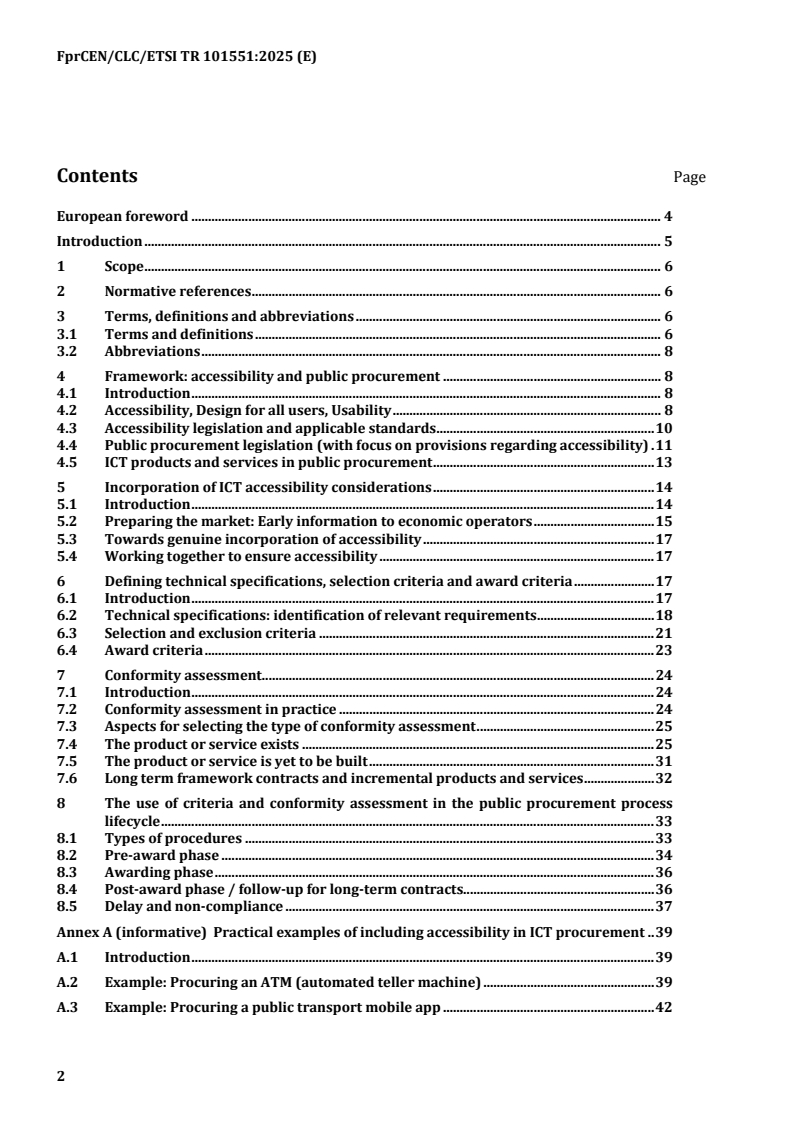
Contents Page
European foreword . 4
Introduction . 5
1 Scope . 6
2 Normative references . 6
3 Terms, definitions and abbreviations . 6
3.1 Terms and definitions . 6
3.2 Abbreviations . 8
4 Framework: accessibility and public procurement . 8
4.1 Introduction . 8
4.2 Accessibility, Design for all users, Usability . 8
4.3 Accessibility legislation and applicable standards . 10
4.4 Public procurement legislation (with focus on provisions regarding accessibility) . 11
4.5 ICT products and services in public procurement . 13
5 Incorporation of ICT accessibility considerations . 14
5.1 Introduction . 14
5.2 Preparing the market: Early information to economic operators . 15
5.3 Towards genuine incorporation of accessibility . 17
5.4 Working together to ensure accessibility . 17
6 Defining technical specifications, selection criteria and award criteria . 17
6.1 Introduction . 17
6.2 Technical specifications: identification of relevant requirements . 18
6.3 Selection and exclusion criteria . 21
6.4 Award criteria . 23
7 Conformity assessment . 24
7.1 Introduction . 24
7.2 Conformity assessment in practice . 24
7.3 Aspects for selecting the type of conformity assessment . 25
7.4 The product or service exists . 25
7.5 The product or service is yet to be built . 31
7.6 Long term framework contracts and incremental products and services . 32
8 The use of criteria and conformity assessment in the public procurement process
lifecycle . 33
8.1 Types of procedures . 33
8.2 Pre-award phase . 34
8.3 Awarding phase . 36
8.4 Post-award phase / follow-up for long-term contracts. 36
8.5 Delay and non-compliance . 37
Annex A (informative) Practical examples of including accessibility in ICT procurement . 39
A.1 Introduction . 39
A.2 Example: Procuring an ATM (automated teller machine) . 39
A.3 Example: Procuring a public transport mobile app . 42
FprCEN/CLC/ETSI/TR 101551:2025 (E)
A.4 Example: Procuring a local council website. 45
A.5 Example: Procuring a museum audiovisual guide . 47
Annex B (informative) Examples of tools for identifying relevant EN 301549 requirements
................................................................................................................................................................... 51
B.1 EN 301549 Filter Tool (ETSI) . 51
B.2 ICT accessibility requirements wizard (Government of Canada) . 51
B.3 Standardanforderungskatalog (ITZBund, German Federal Ministry of the Interior)
................................................................................................................................................................... 52
Bibliography . 53
FprCEN/CLC/ETSI TR 101551:2025 (E)
European foreword
This document (FprCEN/CLC/ETSI/TR 101551 rev) has been prepared by Technical Committee
CEN/CLC/ETSI/JWG eAcc “eAccessibility”, the secretariat of which is held by UNE.
This document is currently submitted to the Vote on TR.
This document will supersede CEN/CLC/ETSI TR 101551:2014 and CEN/CLC/ETSI/TR 101 552:2014.
FprCEN/CLC/ETSI TR 101551 rev includes the following significant technical changes with respect to
CEN/CLC/ETSI TR 101551:2014 and CEN/CLC/ETSI/TR 101 552:2014:
— It merges the scope of the two earlier TRs into one coherent framework, covering technical
specifications, selection, exclusion and award criteria, conformity assessment, and contract
management and has been updated to reflect the latest legislative and standardisation framework.
— It has been aligned to the EU public procurement legislation of 2014, the European Accessibility Act
(Directive (EU) 2019/882) and the Web Accessibility Directive (Directive (EU) 2016/2102).
— It has been aligned with the ongoing revision of European standard EN 301 549 and considers
European standard EN 17161 and other relevant standards.
— It provides extended guidance with more comprehensive coverage of the procurement lifecycle,
including preparatory activities and post-award contract follow-up.
— It includes two new annexes that provide practical examples (Annex A) and give examples of tools to
support the identification of relevant EN 301 549 requirements (Annex B).
— It has an increased focus on implementation, emphasising methods for ensuring genuine accessibility
in practice, bridging gaps between legal requirements and market readiness.
This document has been prepared under a standardization request addressed to CEN by the European
Commission. The Standing Committee of the EFTA States subsequently approves these requests for its
Member States.
FprCEN/CLC/ETSI/TR 101551:2025 (E)
Introduction
This document supports contracting authorities who need to ensure that mandatory accessibility
requirements are integral to their public procurement procedures – from the technical specifications
down to awarding contracts and to managing contracts with suppliers. To that aim, it provides guidance
to contracting authorities on how to determine technical specifications to meet the accessibility
requirements of Directive (EU) 2019/882 (European Accessibility Act, EAA) and Directive (EU)
2016/2102 (Web Accessibility Directive, WAD) as well as award criteria to ensure better accessibility;
and on how to verify the conformance of publicly procured ICT products and services with these
requirements.
This document describes how the accessibility requirements for ICT to be procured should be specified,
documented and assessed in the frame of the procurement process under the EU public procurement
directives. The different mechanisms for conformity assessment based on the applicable accessibility
requirements are explained. The role of these mechanisms is discussed in the pre-award phase, during
contract awarding, and in the post-award stage, as part of contract management. The Technical Report
also provides a useful guidance for bidders who prepare an offer for public procurement of ICT products
and services, as well as for private organisations wanting to ensure that the ICT they procure will be
accessible.
This document is the result of the revision of CEN/CLC/ETSI TR 101551:2014 “Guidelines on the use of
accessibility award criteria suitable for public procurement of ICT products and services in Europe”, and
of CEN/CLC/ETSI/TR 101 552:2014 “Guidance for the application of conformity assessment to
accessibility requirements for public procurement of ICT products and services in Europe”. The technical
reports CEN/CLC/ETSI TR 101551:2014 and CEN/CLC/ETSI TR 101 552:2014 have been combined in
this revision.
The specific aims of the revision have been:
— to support the implementation of Directive (EU) 2019/882,
— to align the Technical Report with the current public procurement directives,
— to align the Technical Report with the ongoing revision of European standard EN 301 549
“Accessibility requirements for ICT products and services”,
— to facilitate the use by stakeholders of the revised harmonised European standard EN 301 549 in the
procurement process in support of Directive (EU) 2019/882 and Directive (EU) 2016/2102.
The document was prepared in response to Standardisation request M/587 (Commission Implementing
Decision of 14.9.2022, C(2022) 6456 final) to CEN, CENELEC and ETSI.
FprCEN/CLC/ETSI TR 101551:2025 (E)
1 Scope
This document provides guidance to contracting authorities on how to determine contract award criteria
to meet the accessibility requirements of Directive (EU) 2019/882 (European Accessibility Act, EAA) and
Directive (EU) 2016/2102 (Web Accessibility Directive, WAD); and on how to verify the conformance of
publicly procured ICT products and services with these requirements. The present document describes
how the accessibility requirements for the ICT should be specified, documented and assessed in the frame
of the procurement process, under the EU public procurement directives . The different mechanisms for
conformity assessment with the applicable accessibility requirements are explained. It discusses how
these mechanisms can be applied both in the pre-procurement research phase and when awarding a
contract, as well as part of contract management in the post-award stage.
This document also provides a useful guidance for bidders who prepare an offer for public procurement
of ICT products and services, and others aiming to procure accessible ICT.
Aspects that do not deal with accessibility in ICT procurement in Europe are outside the scope of this
document.
2 Normative references
There are no normative references in this document.
3 Terms, definitions and abbreviations
For the purposes of this document, the following terms and definitions apply.
ISO and IEC maintain terminology databases for use in standardization at the following addresses:
— ISO Online browsing platform: available at https://www.iso.org/obp/
— IEC Electropedia: available at https://www.electropedia.org/
3.1 Terms and definitions
3.1.1
accessibility
extent to which products, systems, services, environments, and facilities can be used by people from a
population with the widest range of user needs, characteristics, and capabilities to achieve identified
goals in identified contexts of use
[SOURCE ISO 9241-11:2018]
3.1.2
assistive technology
equipment, product system, hardware, software or service that is used to increase, maintain or improve
capabilities of individuals
[SOURCE ISO/IEC Guide 71:2014]
Directive 2014/24/EU on public procurement; Directive 2014/25/EU on procurement by entities operating
in the water, energy, transport and postal services sectors; Directive 2014/23/EU on the award of concession
contracts
FprCEN/CLC/ETSI/TR 101551:2025 (E)
3.1.3
award criteria
criteria by which the award of a contract is judged
3.1.4
conformity assessment
structured process to evaluate, through manual and/or automatic testing, if a product or service meets
each applicable requirement of an accessibility regulation, standard (such as EN 301549), guideline or
specification
3.1.5
contracting authority
state, regional or local authorities, bodies governed by public law, or associations of such bodies
3.1.6
economic operator
contractor, supplier or a service provider
3.1.7
open procedures
procedures whereby any interested economic operator can submit a tender
3.1.8
public contract
contracts for pecuniary interest concluded in writing between one or more economic operators and one
or more contracting authorities
3.1.9
restricted procedure
procedures in which any economic operator can request to participate and whereby only those economic
operators invited by the contracting authority can submit a tender
3.1.10
selection criteria
criteria by which the eligibility or ability of a contractor is judged
3.1.11
usability
extent to which a system, product or service can be used by specified users to achieve specified goals with
effectiveness, efficiency and satisfaction in a specified context of use
[SOURCE ISO 9241-11:2018]
FprCEN/CLC/ETSI TR 101551:2025 (E)
3.2 Abbreviations
For the purposes of the present document, the following abbreviations apply:
API application programming interface
EAA Directive (EU) 2019/882 of the European Parliament and of the Council of 17 April
2019 on the accessibility requirements for products and services. Also known as
the European Accessibility Act.
EN European Standard
ICT Information and communication technology
OPD Organisation of Persons with Disabilities
PPD Directive 2014/24/EU of the European Parliament and of the Council of 26
February 2014 on public procurement and repealing Directive 2004/18/EC
SME Small or Medium-sized Enterprise
TR Technical Report
WAD Directive (EU) 2016/2102 of the European Parliament and of the Council of 26
October 2016 on the accessibility of the websites and mobile applications of public
sector bodies. Also known as the Web Accessibility Directive.
4 Framework: accessibility and public procurement
4.1 Introduction
This section provides an overview of the EU accessibility legislation and how the public procurement
directives relate to the requirement of accessibility.
4.2 Accessibility, Design for all users, Usability
4.2.1 Accessibility
Accessibility is the extent to which products, systems, services, environments and facilities can be used
by people from a population with the widest range of user needs, characteristics and capabilities, to
achieve identified goals in identified contexts of use (ISO 9241-11:2018). The context of use can include
direct use or use supported by assistive technologies.
Accessibility concentrates on the environment surrounding a person, to break down the barriers in the
environment that limit access, and not on the condition or disability of a person. For example: a person
in a wheelchair has equivalent access to a building if there is a ramp next to (or instead of) the stairs. The
limitations are not grounded in the disability but in the environment, and accessibility means that the
environment is formed so that it creates no barriers for any person with a disability.
The same principle holds for digital environments. ICT can be built in a way that allows persons with
disabilities to use it equitably in their preferred mode of use. Users in general are diverse, but there is
also diversity within the specific user groups of persons with disabilities, and one solution never fits all.
Keeping that in mind, here are some examples of user needs:
— users with low vision might need good contrast and the ability to magnify a screen-based user
interface in order to navigate and understand content;
— users who are blind often use screen readers to interpret and navigate the interface, which is
presented to them via audio and/or Braille output;
FprCEN/CLC/ETSI/TR 101551:2025 (E)
— users who are hard-of hearing need videos with subtitles;
— users with motor impairments, who use assistive technology such as eye gaze control or sip-and-puff
switches, need keyboard navigable interfaces;
— users with motor impairments, who use a mouse or their finger to interact, benefit from large
controls;
— users with cognitive impairments benefit from multimodality, clarity in layout, easy-to-understand
language, clear links, stepwise interaction, explanations, and so on.
Addressing the needs of persons with disabilities makes products, services and information more usable
and accessible for all users. For example, good contrast makes an ATM screen easier to read outdoors;
large controls are helpful in shaky environments such as public transport; subtitles help people
understand audio who are not native speakers, and help in situations where turning on the sound would
disturb others; and easy-to-understand language makes content easier to understand for everyone and
improves the quality of automatic translation.
4.2.2 Design for all users
Design for all users – a term used in EU public procurement legislation – is achieved by application of the
“Design for All” approach. In the “Design for All” approach, a product or service is designed, developed
and provided so that it can be accessed, understood and used by the widest range of users, including (but
not only) persons with disabilities.
The Design for All approach focuses on accessibility and usability from the earliest possible stages of
development and continues to guide the decisions throughout the entire lifecycle of a product or service.
A key element of the Design for All approach is interoperability across the chain of use, ensuring that ICT
products and services function effectively for all users. For example, they perform as expected regardless
of differences in underlying systems or the use of assistive technologies. This is achieved by identifying
diverse needs, characteristics, capabilities and preferences, by involving users and using knowledge
about accessibility and usability in the relevant procedures and processes.
In practice, accessibility outcomes are results of an organisation’s policies, processes and activities that
aim for products and services that the widest range of users can access, understand and use.
4.2.3 Usability
Accessibility is about making sure that products and services in a way that there are no barriers to
equivalent access for people with disabilities. Usability is about ensuring that products and services are
easy to use. ISO 9241-11:2018 defines usability as the “extent to which a system, product or service can
be used by specified users to achieve specified goals with effectiveness, efficiency and satisfaction in a
specified context of use”, and provides a framework for understanding the concept of usability and
applying it to situations where people use products and services.
For people with disabilities, accessibility is in many cases a precondition for successful use and, in turn,
usability. Increasing usability leads to an overall better user experience. However, it is important to note
that while it is required to ensure accessibility, there is no legal requirement to ensure usability in public
procurement.
FprCEN/CLC/ETSI TR 101551:2025 (E)
4.3 Accessibility legislation and applicable standards
4.3.1 General
This section provides a short description of the accessibility legislation and how it sets accessibility
requirements, as well as the role of accessibility standards in the presumption of conformity.
4.3.2 Web Accessibility Directive
The Web Accessibility Directive (Directive (EU) 2016/2102, WAD) sets the accessibility requirements for
public sector websites and mobile applications in the EU, and requires providing an accessibility
statement on how those websites and mobile applications comply with the directive.
4.3.3 European Accessibility Act
The European Accessibility Act (Directive (EU) 2019/882, EAA) aims to harmonise accessibility
requirements for certain products and services. The accessibility requirements set in the act also clarify
the existing accessibility obligation in other EU law, particularly in public procurement and structural
funds.
4.3.4 Accessibility requirements in other EU legal acts
The Audiovisual Media Services Directive (Directive 2010/13/EU, AVMSD) requires media service
providers to make their content progressively accessible (by offering features like subtitles, audio
description, and sign language), and to ensure that the interfaces, menus and electronic program guides
are accessible. (Access to audiovisual media services is covered by the EAA.)
The European Electronic Communications Code (Directive (EU) 2018/1972, EECC) requires that
persons with disabilities have equivalent access to electronic communications services (like mobile and
fixed telephony, internet access, messaging apps); contracts, billing and customer support are available
in accessible formats; and emergency communications are accessible.
The Electronic Identification, Authentication and Trust Services Regulation (Regulation (EU) No
910/2014, eIDAS) requires that electronic identification means, trust services (e.g., electronic signatures
and website certificates) and end-user products used in those services are available in plain and
intelligible language, following the EAA requirements. In addition, European Digital Identity Wallets need
to be accessible by following the EAA requirements.
The EU Passenger Rights Regulations set accessibility requirements for air, rail, bus and boat
passenger transport.
The Artificial Intelligence Act (Regulation (EU) 2024/1689, AI Act) sets accessibility requirements for
high-risk Artificial Intelligence (AI) systems, for the EU database for high-risk AI systems, and for
transparent information about certain AI systems.
4.3.5 European accessibility standards
The accessibility requirements in European accessibility legislation are supported by harmonised
European standards. The EAA will be supported by:
— European standard EN 301549, specifying accessibility requirements for checking the conformance
of ICT products and services with the EAA and the WAD;
Regulation (EC) No 1107/2006, Regulation (EU) 2021/782, Regulation (EU) No 181/2011 and Regulation (EU)
No 1177/2010.
Annex I Table 2 in Standardisation request M/587.
FprCEN/CLC/ETSI/TR 101551:2025 (E)
— European standard EN 17161, specifying requirements for the development process based on the
Design for All approach in products, goods and services so that accessibility is incorporated, and can
also be used to define, require and assess the technical capacity of the supplier;
— European standard EN 17210, setting requirements for accessibility and usability of the built
environment;
— a new European standard on support services;
— a new European standard on information about accessibility;
— a new European standard on the accessibility and interoperability of emergency communications.
All harmonized European standards are required to contain an Annex Z where it is shown which technical
requirements can be used to meet the legal obligations.
4.4 Public procurement legislation (with focus on provisions regarding accessibility)
4.4.1 Introduction
This section provides an overview of the logic and provisions of the public procurement directives in
relation to accessibility and explains how the EAA affects procurement.
This report is based on the provisions of the public procurement directives, and not on the national
legislation of EU Member States resulting from the EU legislation. It is important to underline that
national implementations might differ, and the use of the guidance in this report might be influenced by
such differences.
Tenders with a value estimated to be below specified thresholds are not covered by the public
procurement directives, and so it is for Member States to decide whether such contracts are subject to
national rules. These thresholds were originally specified in Article 7 of Directive 2004/18/EC, and are
now regularly updated by regulation.
4.4.2 Public Procurement Directive (Directive 2014/24/EU)
The Public Procurement Directive (Directive 2014/24/EU, PPD) provides the general legal reference for
the obligatory requirements for public procurement. For all procurement that falls under the PPD and is
intended for use by natural persons, the technical specifications need to set accessibility criteria and
require a Design for All approach, except in duly justified cases. These requirements are not limited to
products and services for the general public, but also need to be set for those used by the staff of the
contracting authority or other public authorities. This helps accessibility and inclusion in the workplace,
both for current staff with disabilities and facilitating future hires.
Annex I Table 2 in Standardisation request M/587.
Annex I Table 2 in Standardisation request M/587.
Harmonised standard(s) setting up requirements on the accessibility of non-digital information related to
products, see Annex I Table 1 in Standardisation request M/587.
Harmonised standard for the accessibility of support services related to products and services (help desks, call
centres, technical support, relay services 1and training services), see Annex I Table 1 in Standardisation request
M/587.
Harmonised standard for the accessibility and interoperability of emergency communications and for the
answering of emergency communications by the public safety answering point (PSAPs) (including to the single
European Emergency number 112), see Annex I Table 1 in Standardisation request M/587. A blueprint for the
EN 303 919 has been published as ETSI TS 103 919 and can already be reviewed.
FprCEN/CLC/ETSI TR 101551:2025 (E)
If EU law sets mandatory accessibility requirements (e.g., the EAA ), the technical specifications will
reference those requirements. However, the technical specifications do not need to be limited to them: it
is possible to set further accessibility requirements, as long as they do not create unjustified obstacles for
competition.
When there is no EU legislation that sets mandatory accessibility requirements, they need to be set in the
technical specifications, as usual, in terms of performance or functional requirements and/or by
reference to technical specifications (e.g., standards).
Beyond establishing the requirement of accessibility in the technical specifications, the contracting
authorities can also establish selection and award criteria to ensure the accessibility of the procured
product or service.
Below is an overview of the aspects where the PPD refers to accessibility:
— Technical specifications need to consider accessibility, meaning setting requirements ensuring that
the procured product / service is accessible, apart from duly justified cases. (See: Recital (76),
Article 42(1), Annex VII Section(1)(a-b).)
— Labels (e.g., EC marking) might be required (in the in the technical specifications, the award criteria
or the contract performance conditions) to prove that the product / service complies with the
accessibility requirements. (See: Recital (75), Article 43(1).)
— Selection and/or exclusion criteria might consider the ability of the bidders to deliver accessible
products or services, or their history of violating accessibility rules. (See: Recital (101), Article 58(4).)
— Award criteria and contract performance conditions might consider accessibility beyond the
mandatory requirements, and be part of identifying the most economically advantageous tender with
best price-quality ratio. (See: Recital (99), Article 67(2)(a), Article 76(2).)
— Quality assurance certificates might be required regarding accessibility. (See: Article 62(1).)
— Electronic communication in the public procurement procedure should take accessibility in due
account. (See: Recital (53).)
The principle of proportionality has implications for the selection of the types of evidence requested, in
particular with respect to cost and time resources needed for producing the evidence. Proportionality
means that the contracting authority does not impose restrictions on the tenderers by setting out more
requirements than necessary to meet the needs in the procurement in question. In addition,
proportionality means that the personnel and financial resources spent on the procurement process are
reasonable, considering the scope and cost of the subject-matter of the procurement.
4.4.3 Concession Directive (2014/23/EU) and Utilities Directive (2014/25/EU)
Directive 2014/25/EU on procurement by entities operating in the water, energy, transport and postal
services sectors (Utilities Directive) contains similar provisions to those in the Public Procurement
Directive. Where this report refers to the PPD, those parts are also applicable to procurements under the
Utilities Directive.
Directive 2014/23/EU on the award of concession contracts (Concession Directive) makes it possible –
but not mandatory – to address accessibility in the technical and functional requirements.
The EAA expressly states that it constitutes mandatory accessibility requirements within the meaning of the
public procurement directives. (See Article 24.)
FprCEN/CLC/ETSI/TR 101551:2025 (E)
4.5 ICT products and services in public procurement
4.5.1 General
This section describes in general the products and services that are covered by accessibility legislation;
as well as covering the accessibility aspect for products and services where there are no mandatory
accessibility requirements adopted by a legal act of the EU.
4.5.2 Products and services with mandatory accessibility requirements
A number of EU laws set mandatory accessibility requirements, that need to be referenced in the technical
specifications. (See the legislation listed in section 4.3.)
The EAA requires that a wide range of products and services are designed and produced to maximise the
(foreseeable) use by persons with disabilities. These products and services, beyond being accessible
themselves, also need to be accompanied by accessible information on their functions and features.
— Examples of products that fall under the EAA include personal computers (PCs), mobile phones, smart
TVs, e-book readers, payment terminals, ATMs (automated teller machines), ticketing machines,
check-in machines, and interactive self-service terminals.
— Examples of services that fall under the EAA include web- or app-based communication services,
access to TV broadcast and streaming, passenger transport, consumer banking, e-commerce and e-
books.
— For the full list of products and services, refer to Article 2 of the EAA.
Future legislation might adopt mandatory accessibility requirements for further ICT products and
services.
The EAA sets a thorough list of accessibility requirements, both at the general level and for the specific
product/service categories, covering the provision of information about the product/service (including
packaging and user instructions as well as the available accessibility features), the user interface and
support services. These requirements can also be used – and be referenced in technical specifications –
for products and services that are covered by accessibility legislation other than the EAA, whenever they
are applicable technically.
The accessibility requirements set in the EAA will be supported and further detailed in harmonised
European standards . From the legal point of view, these standards are voluntary: it is permitted to fulfil
the legal requirements in other ways. However, these standards provide a structured set of technical
requirements, and they also provide the presumption of conformity: if a harmonised standard is followed,
the product/service is considered conforming to the legislation in regard to the aspects the standard
covers.
It is important to note that these standards can also contain technical requirements that are not necessary
for conforming with the relevant law. For that reason, harmonised European standards have an Annex Z
(earlier Annex A) that lists the parts of the standard that correspond the requirements in the legislation.
The WAD covers public sector websites, web applications, and mobile apps and sets accessibility
requirements by referring to the four accessibility principles: perceivable, operable, understandable and
robust. These requirements are further detailed in the Harmonised European Standard for the directive:
EN 301549. Annex A of the standard lists the relevant technical requirements that correspond the
requirements in the Directive. (Annex A is being moved to Annex Z, and EN 301549 will have two
A harmonised European standard is a European standard that can be used to demonstrate that products,
services, or processes comply with relevant EU legislation.
FprCEN/CLC/ETSI TR 101551:2025 (E)
‘Annex Z’s: Annex ZA listing the technical requirements relevant for the WAD, Annex ZB listing the
relevant technical requirements for the EAA.)
For more details on harmonised standards related to accessibility legislation, see section 4.3.5.
4.5.3 Products and services without set accessibility requirements
There is a wide range of ICT products and services that do not fall under EU accessibility legislation, for
example, internal IT systems used by public administrations for electronic document management,
process management, or other internal functions. However, when they are the subject of public
procurement, according to the Public Procurement Directive the technical specifications need to set
accessibility requirements.
The accessibility requirements in the EAA can also be used for products or services not directly in the
EAA scope or not in the scope of any EU accessibility legislation. The EAA requirements can help clarifying
how to comply with accessibility requirements set in other EU laws or provide the accessibility
requirements where there are none set in EU legislation. They also help complying with the requirement
of accessibility set in the Public Procurement Directive.
For products and services that are not directly covered by the EAA, but whose features, elements or
functions correspond to those set in the Directive, the technical specifications can refer to the EAA – at
least to the extent of those features, elements and/or functions. For example: an intranet website, that is
not covered by any EU accessibility legislation, but that is not technically different from any websites that
are covered under the EAA. The EAA establishes that if there is another EU law requiring accessibility for
a product or service, the requirements of the EAA can be applied.
For the contracting authority, on the other hand, referring to the EAA in the technical specifications also
provides the presumption of compliance with the Public Procurement Directive: it ensures that
accessibility is adequately considered.
For ICT products and services that have no features, elements or functions covered in the EAA,
accessibility requirements need to be set in the technical specifications in terms of performance or
functional requirements and/or by reference to standards (see Article 42(3) of the PPD). The selection of
standards depends on the specific features, elements, and functions of the ICT; options might include the
European standard EN 301549, other applicable standards, and notably European standard EN 17161,
which addresses the Design for All approach.
Section 6.2 provides further details on identifying relevant accessibility requirements.
5 Incorporation of ICT accessibility considerations
5.1 Introduction
As indicated in section 4.4.1, the Public Procurement Directive has been requiring since 2017 that
accessibility is taken into account in the procurement process for products and services intended for
natural persons (Article 42). Still, contracting authorities were lacking a clear guidance on what specific
accessibility requirements to use. Consequently, such requirements have often not been included as part
of the technical specifications or were included only in a general manner. The EAA equips the contracting
authorities with a clear guidance on the minimum level of accessibility that needs to be ensured for the
various products and services, making it easier to arrive at better specifications.
However, currently there is an apparent gap between the degree of accessibility that needs to be achieved
for the products and services procured, and the ability of the market to deliver accessibility. This gap
poses a severe problem for a successful procurement. The subsequent subclauses elaborate on how to
bridge and prevent such gap from occurring in the future.
See Article 24(2) of the EAA.
FprCEN/CLC/ETSI/TR 101551:2025 (E)
The primary goal of this document is to offer guidance on integrating accessibility considerations into
procurement processes. At the time of the writing of the present document, the market frequently falls
short of meeting even the basic accessibility requirements immediately. This section provides
recommendations on how to address these shortcomings and promote necessary changes, to ensure the
successful procurement of accessible products and services.
5.2 Preparing the market: Early information to economic operators
5.2.1 General
One of the fundamental remedies to facilitate the market adaptation to the new accessibility
requirements is an active and forward-looking planning on the side of the contracting authorities.
5.2.2 Understanding and tracking user accessibility needs
Contracting authorities might involve end-users, particularly persons with disabilities or Organisations
of Persons with Disabilities (OPDs) to ensure that users' accessibility needs are considered in the
procurement and reflected in the public procurement documents. This is more important for products
and services without accessibility requirements in European legislation, and even more for those that use
novel solutions, The involvement of end-users can happen in various phases: when defining the
product/service, when conducting market consultations, and when verifying compliance.
Following technological developments, user needs regarding accessibility are continuously evolving. It is
important that contracting authorities monitor these changes. Such monitoring is realistically achievable
only at regional or national levels, where sufficient resources, data infrastructure, and coordination
mechanisms are in place. To support this process, it is advisable for the contracting authorities to
maintain an active dialogue with OPDs. This can include:
— involving disability organizations in preliminary market consultations to define accessibility needs,
— creating advisory panels with accessibility experts and user representatives to review procurement
plans—focusing on how well these plans reflect user requirements and address existing barriers.
The national or regional authorities are also encouraged to coordinate sharing and exchange of good
practices among contracting authorities. This could be achieved by:
— organisation of regular meetings where contracting authorities share their experiences,
— an online repository of good practices, with practical tips on how to achieve best results.
An example for the latter: a municipality partnering with a local OPD to define accessibility requirements
for a new ticketing app, resulting in a 20% increase in user satisfaction among persons with disabilities
While the inclus
...
Questions, Comments and Discussion
Ask us and Technical Secretary will try to provide an answer. You can facilitate discussion about the standard in here.
Loading comments...