


ETSI TS 138 551 V18.6.0 (2026-04)
5G; NR; User Equipment (UE) Multiple Input Multiple Output (MIMO) Over-the-Air (OTA) performance; Conformance testing (3GPP TS 38.551 version 18.6.0 Release 18)
5G; NR; User Equipment (UE) Multiple Input Multiple Output (MIMO) Over-the-Air (OTA) performance; Conformance testing (3GPP TS 38.551 version 18.6.0 Release 18)
RTS/TSGR-0538551vi60
General Information
- Status
- Not Published
- Technical Committee
- 3GPP RAN 5 - Mobile Terminal Conformance Testing (formely T1)
- Current Stage
- 12 - Citation in the OJ (auto-insert)
- Completion Date
- 02-Apr-2026
Frequently Asked Questions
ETSI TS 138 551 V18.6.0 (2026-04) is a standard published by the European Telecommunications Standards Institute (ETSI). Its full title is "5G; NR; User Equipment (UE) Multiple Input Multiple Output (MIMO) Over-the-Air (OTA) performance; Conformance testing (3GPP TS 38.551 version 18.6.0 Release 18)". This standard covers: RTS/TSGR-0538551vi60
RTS/TSGR-0538551vi60
ETSI TS 138 551 V18.6.0 (2026-04) is available in PDF format for immediate download after purchase. The document can be added to your cart and obtained through the secure checkout process. Digital delivery ensures instant access to the complete standard document.
Standards Content (Sample)
TECHNICAL SPECIFICATION
5G;
NR;
User Equipment (UE) Multiple Input Multiple Output (MIMO)
Over-the-Air (OTA) performance;
Conformance testing
(3GPP TS 38.551 version 18.6.0 Release 18)
3GPP TS 38.551 version 18.6.0 Release 18 1 ETSI TS 138 551 V18.6.0 (2026-04)
Reference
RTS/TSGR-0538551vi60
Keywords
5G
ETSI
650 Route des Lucioles
F-06921 Sophia Antipolis Cedex - FRANCE
Tel.: +33 4 92 94 42 00 Fax: +33 4 93 65 47 16
Siret N° 348 623 562 00017 - APE 7112B
Association à but non lucratif enregistrée à la
Sous-Préfecture de Grasse (06) N° w061004871
Important notice
The present document can be downloaded from the
ETSI Search & Browse Standards application.
The present document may be made available in electronic versions and/or in print. The content of any electronic and/or
print versions of the present document shall not be modified without the prior written authorization of ETSI. In case of any
existing or perceived difference in contents between such versions and/or in print, the prevailing version of an ETSI
deliverable is the one made publicly available in PDF format on ETSI deliver repository.
Users should be aware that the present document may be revised or have its status changed,
this information is available in the Milestones listing.
If you find errors in the present document, please send your comments to
the relevant service listed under Committee Support Staff.
If you find a security vulnerability in the present document, please report it through our
Coordinated Vulnerability Disclosure (CVD) program.
Notice of disclaimer & limitation of liability
The information provided in the present deliverable is directed solely to professionals who have the appropriate degree of
experience to understand and interpret its content in accordance with generally accepted engineering or
other professional standard and applicable regulations.
No recommendation as to products and services or vendors is made or should be implied.
No representation or warranty is made that this deliverable is technically accurate or sufficient or conforms to any law
and/or governmental rule and/or regulation and further, no representation or warranty is made of merchantability or fitness
for any particular purpose or against infringement of intellectual property rights.
In no event shall ETSI be held liable for loss of profits or any other incidental or consequential damages.
Any software contained in this deliverable is provided "AS IS" with no warranties, express or implied, including but not
limited to, the warranties of merchantability, fitness for a particular purpose and non-infringement of intellectual property
rights and ETSI shall not be held liable in any event for any damages whatsoever (including, without limitation, damages
for loss of profits, business interruption, loss of information, or any other pecuniary loss) arising out of or related to the use
of or inability to use the software.
Copyright Notification
No part may be reproduced or utilized in any form or by any means, electronic or mechanical, including photocopying and
microfilm except as authorized by written permission of ETSI.
The content of the PDF version shall not be modified without the written authorization of ETSI.
The copyright and the foregoing restriction extend to reproduction in all media.
© ETSI 2026.
All rights reserved.
ETSI
3GPP TS 38.551 version 18.6.0 Release 18 2 ETSI TS 138 551 V18.6.0 (2026-04)
Intellectual Property Rights
Essential patents
IPRs essential or potentially essential to normative deliverables may have been declared to ETSI. The declarations
pertaining to these essential IPRs, if any, are publicly available for ETSI members and non-members, and can be
found in ETSI SR 000 314: "Intellectual Property Rights (IPRs); Essential, or potentially Essential, IPRs notified to
ETSI in respect of ETSI standards", which is available from the ETSI Secretariat. Latest updates are available on the
ETSI IPR online database.
Pursuant to the ETSI Directives including the ETSI IPR Policy, no investigation regarding the essentiality of IPRs,
including IPR searches, has been carried out by ETSI. No guarantee can be given as to the existence of other IPRs not
referenced in ETSI SR 000 314 (or the updates on the ETSI Web server) which are, or may be, or may become,
essential to the present document.
Trademarks
The present document may include trademarks and/or tradenames which are asserted and/or registered by their owners.
ETSI claims no ownership of these except for any which are indicated as being the property of ETSI, and conveys no
right to use or reproduce any trademark and/or tradename. Mention of those trademarks in the present document does
not constitute an endorsement by ETSI of products, services or organizations associated with those trademarks.
DECT™, PLUGTESTS™, UMTS™ and the ETSI logo are trademarks of ETSI registered for the benefit of its
Members. 3GPP™, LTE™ and 5G™ logo are trademarks of ETSI registered for the benefit of its Members and of the
3GPP Organizational Partners. oneM2M™ logo is a trademark of ETSI registered for the benefit of its Members and of ®
the oneM2M Partners. GSM and the GSM logo are trademarks registered and owned by the GSM Association.
Legal Notice
This Technical Specification (TS) has been produced by ETSI 3rd Generation Partnership Project (3GPP).
The present document may refer to technical specifications or reports using their 3GPP identities. These shall be
interpreted as being references to the corresponding ETSI deliverables.
The cross reference between 3GPP and ETSI identities can be found at 3GPP to ETSI numbering cross-referencing.
Modal verbs terminology
In the present document "shall", "shall not", "should", "should not", "may", "need not", "will", "will not", "can" and
"cannot" are to be interpreted as described in clause 3.2 of the ETSI Drafting Rules (Verbal forms for the expression of
provisions).
"must" and "must not" are NOT allowed in ETSI deliverables except when used in direct citation.
ETSI
3GPP TS 38.551 version 18.6.0 Release 18 3 ETSI TS 138 551 V18.6.0 (2026-04)
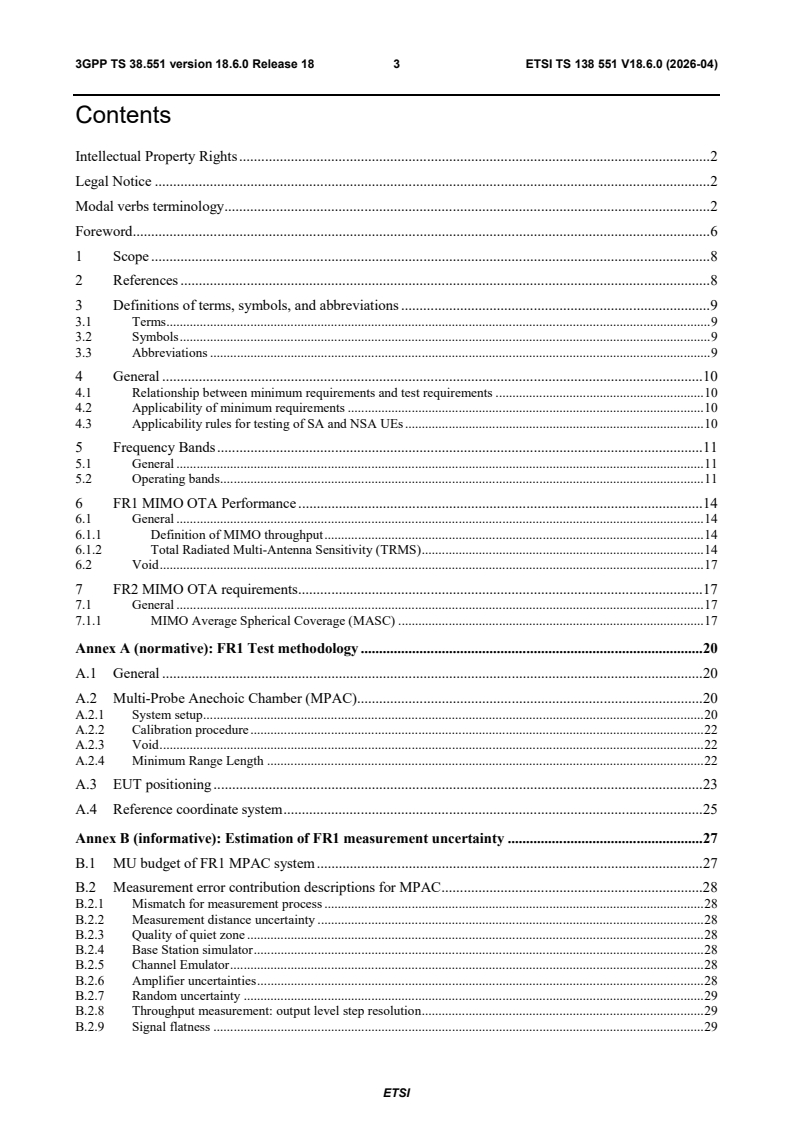
Contents
Intellectual Property Rights . 2
Legal Notice . 2
Modal verbs terminology . 2
Foreword . 6
1 Scope . 8
2 References . 8
3 Definitions of terms, symbols, and abbreviations . 9
3.1 Terms . 9
3.2 Symbols . 9
3.3 Abbreviations . 9
4 General . 10
4.1 Relationship between minimum requirements and test requirements . 10
4.2 Applicability of minimum requirements . 10
4.3 Applicability rules for testing of SA and NSA UEs . 10
5 Frequency Bands . 11
5.1 General . 11
5.2 Operating bands . 11
6 FR1 MIMO OTA Performance . 14
6.1 General . 14
6.1.1 Definition of MIMO throughput . 14
6.1.2 Total Radiated Multi-Antenna Sensitivity (TRMS) . 14
6.2 Void . 17
7 FR2 MIMO OTA requirements . 17
7.1 General . 17
7.1.1 MIMO Average Spherical Coverage (MASC) . 17
Annex A (normative): FR1 Test methodology . 20
A.1 General . 20
A.2 Multi-Probe Anechoic Chamber (MPAC). 20
A.2.1 System setup . 20
A.2.2 Calibration procedure . 22
A.2.3 Void . 22
A.2.4 Minimum Range Length . 22
A.3 EUT positioning . 23
A.4 Reference coordinate system . 25
Annex B (informative): Estimation of FR1 measurement uncertainty . 27
B.1 MU budget of FR1 MPAC system . 27
B.2 Measurement error contribution descriptions for MPAC . 28
B.2.1 Mismatch for measurement process . 28
B.2.2 Measurement distance uncertainty . 28
B.2.3 Quality of quiet zone . 28
B.2.4 Base Station simulator . 28
B.2.5 Channel Emulator . 28
B.2.6 Amplifier uncertainties . 28
B.2.7 Random uncertainty . 29
B.2.8 Throughput measurement: output level step resolution . 29
B.2.9 Signal flatness . 29
ETSI
3GPP TS 38.551 version 18.6.0 Release 18 4 ETSI TS 138 551 V18.6.0 (2026-04)
B.2.10 Mismatch for calibration process . 30
B.2.11 Reference antenna positioning misalignment . 30
B.2.12 Total Uncertainty of the Network Analyzer . 30
B.2.13 Uncertainty of an absolute gain of the calibration antenna . 30
B.2.14 Offset of the Phase Center of the Reference Antenna . 30
Annex C (normative): FR1 Channel models and Validation procedure . 31
C.1 FR1 Channel models . 31
C.2 FR1 Base Station beam configuration . 32
C.3 FR1 Channel model validation . 33
C.3.1 General . 33
C.3.2 Power Delay Profile (PDP) . 34
C.3.3 Doppler/Temporal correlation . 36
C.3.4 Spatial correlation. 40
C.3.5 Cross-polarization . 46
C.3.6 Power validation . 49
C.4 Validation Pass/fail limit . 50
C.4.1 General . 50
C.4.2 Pass/Fail Criteria of PDP . 50
C.4.3 Pass/Fail Criteria of Doppler/Temporal correlation . 51
C.4.4 Pass/Fail Criteria of Spatial correlation . 53
C.4.5 Pass/Fail Criteria of Cross-polarization . 56
C.4.6 Pass/Fail Criteria of Power validation . 57
Annex D (normative): gNB configurations . 57
D.1 FR1 gNB configurations . 57
D.2 FR2 gNB configurations . 62
Annex E (normative): Environmental requirements . 66
E.1 Scope . 66
E.2 Ambient temperature . 66
E.3 Operating voltage . 66
Annex F (normative): Maximum uncertainty of test system and test tolerance . 68
F.1 Maximum uncertainty of test system . 68
F.2 Test tolerances . 68
Annex G (normative): FR2 Test methodology . 68
G.1 General . 68
G.2 FR2 3D Multi-Probe Anechoic Chamber (3D-MPAC) . 69
G.2.1 System setup . 69
G.2.2 Calibration procedure . 71
G.2.3 Void . 71
G.2.4 Minimum Range Length . 71
G.2.5 Sample Device Orientations for Selected Test Points . 72
G.3 Coordinate System and Device positioning . 75
Annex H (informative): Estimation of FR2 measurement uncertainty . 79
H.1 MU Budget for FR2 3D-MPAC system . 79
H2 Measurement error contribution descriptions for 3D-MPAC . 80
H.2.1 Mismatch for measurement process . 80
H.2.2 Measurement distance uncertainty . 80
H.2.3 Quality of quiet zone . 80
ETSI
3GPP TS 38.551 version 18.6.0 Release 18 5 ETSI TS 138 551 V18.6.0 (2026-04)
H.2.4 Base Station simulator . 80
H.2.5 Channel Emulator . 80
H.2.6 Amplifier uncertainties . 80
H.2.7 Random uncertainty . 81
H.2.8 Throughput measurement: output level step resolution . 81
H.2.9 Signal flatness . 81
H.2.10 Mismatch for calibration process . 82
H.2.11 Reference antenna positioning misalignment . 82
H.2.12 Total Uncertainty of the Network Analyzer . 82
H.2.13 Uncertainty of an absolute gain of the calibration antenna . 82
H.2.14 Offset of the Phase Center of the Reference Antenna . 82
Annex I (normative): FR2 Channel models and Validation procedure . 82
I.1 FR2 Channel models . 82
I.2 FR2 Base Station beam configuration . 83
I.3 FR2 Channel model validation . 84
I.3.1 General . 84
I.3.2 FR2 Power Delay Profile (PDP) . 84
I.3.3 FR2 Doppler/Temporal correlation . 86
I.3.4 FR2 PAS similarity percentage (PSP) . 88
I.3.5 FR2 Cross-polarization . 92
I.3.6 FR2 Power validation . 93
I.4 Validation Pass/fail limit . 94
I.4.1 General . 94
I.4.2 Pass/Fail Criteria of PDP . 94
I.4.3 Pass/Fail Criteria of Doppler/Temporal correlation . 94
I.4.4 Pass/Fail Criteria of PSP . 95
I.4.5 Pass/Fail Criteria of Cross-polarization . 96
I.4.6 Pass/Fail Criteria of Power validation . 96
Annex J (informative): Change history . 97
History . 100
ETSI
3GPP TS 38.551 version 18.6.0 Release 18 6 ETSI TS 138 551 V18.6.0 (2026-04)
Foreword
This Technical Specification has been produced by the 3rd Generation Partnership Project (3GPP).
The contents of the present document are subject to continuing work within the TSG and may change following formal
TSG approval. Should the TSG modify the contents of the present document, it will be re-released by the TSG with an
identifying change of release date and an increase in version number as follows:
Version x.y.z
where:
x the first digit:
1 presented to TSG for information;
2 presented to TSG for approval;
3 or greater indicates TSG approved document under change control.
y the second digit is incremented for all changes of substance, i.e. technical enhancements, corrections,
updates, etc.
z the third digit is incremented when editorial only changes have been incorporated in the document.
In the present document, modal verbs have the following meanings:
shall indicates a mandatory requirement to do something
shall not indicates an interdiction (prohibition) to do something
The constructions "shall" and "shall not" are confined to the context of normative provisions, and do not appear in
Technical Reports.
The constructions "must" and "must not" are not used as substitutes for "shall" and "shall not". Their use is avoided
insofar as possible, and they are not used in a normative context except in a direct citation from an external, referenced,
non-3GPP document, or so as to maintain continuity of style when extending or modifying the provisions of such a
referenced document.
should indicates a recommendation to do something
should not indicates a recommendation not to do something
may indicates permission to do something
need not indicates permission not to do something
The construction "may not" is ambiguous and is not used in normative elements. The unambiguous constructions
"might not" or "shall not" are used instead, depending upon the meaning intended.
can indicates that something is possible
cannot indicates that something is impossible
The constructions "can" and "cannot" are not substitutes for "may" and "need not".
will indicates that something is certain or expected to happen as a result of action taken by an agency
the behaviour of which is outside the scope of the present document
will not indicates that something is certain or expected not to happen as a result of action taken by an
agency the behaviour of which is outside the scope of the present document
might indicates a likelihood that something will happen as a result of action taken by some agency the
behaviour of which is outside the scope of the present document
ETSI
3GPP TS 38.551 version 18.6.0 Release 18 7 ETSI TS 138 551 V18.6.0 (2026-04)
might not indicates a likelihood that something will not happen as a result of action taken by some agency
the behaviour of which is outside the scope of the present document
In addition:
is (or any other verb in the indicative mood) indicates a statement of fact
is not (or any other negative verb in the indicative mood) indicates a statement of fact
The constructions "is" and "is not" do not indicate requirements.
ETSI
3GPP TS 38.551 version 18.6.0 Release 18 8 ETSI TS 138 551 V18.6.0 (2026-04)
1 Scope
The present document establishes the Multiple Input Multiple Output (MIMO) Over-the-Air (OTA) performance
requirements for NR UEs operating on frequency Range 1 and frequency range 2, for NR standalone (SA) and NR non-
standalone (NSA) operation mode. The corresponding test methodologies are also presented in the Annex of this
Technical Specification.
2 References
The following documents contain provisions which, through reference in this text, constitute provisions of the present
document.
- References are either specific (identified by date of publication, edition number, version number, etc.) or
non-specific.
- For a specific reference, subsequent revisions do not apply.
- For a non-specific reference, the latest version applies. In the case of a reference to a 3GPP document (including
a GSM document), a non-specific reference implicitly refers to the latest version of that document in the same
Release as the present document.
[1] 3GPP TR 21.905: "Vocabulary for 3GPP Specifications".
[2] 3GPP TS 38.101-1: "NR; User Equipment (UE) radio transmission and reception; Part 1: Range 1
Standalone".
[3] 3GPP TS 38.101-3: "NR; User Equipment (UE) radio transmission and reception; Part 3: Range 1
and Range 2 Interworking operation with other radios".
[4] 3GPP TS 38.508-1: "5GS; User Equipment (UE) conformance specification; Part 1: Common test
environment".
[5] 3GPP TR 38.901: "Study on channel model for frequencies from 0.5 to 100 GHz".
[6] 3GPP TS 38.101-4: "NR; User Equipment (UE) radio transmission and reception; Part 4:
Performance requirements".
[7] 3GPP TS 38.151: "NR; User Equipment (UE) Multiple Input Multiple Output (MIMO) Over-the-
Air (OTA) performance requirements".
[8] 3GPP TS 38.561: "UE TRP (Total Radiated Power) and TRS (Total Radiated Sensitivity)
requirements and test methodologies for FR1 (NR SA and EN-DC); User Equipment (UE)
conformance specification".
[9] IEEE Std 149-2021: "IEEE Recommended Practice for Antenna Measurements", IEEE.
[10] 3GPP TR 38.827: “Study on radiated metrics and test methodology for the verification of multi-
antenna reception performance of NR User Equipment (UE)”.
[11] 3GPP TS 38.101-2: "NR; User Equipment (UE) radio transmission and reception; Part 2: Range 2
Standalone".
[12] 3GPP TS 38.508-2: "5GS; User Equipment (UE) conformance specification; Part 2: Common
Implementation Conformance Statement (ICS) proforma".
[13] 3GPP TS 38.521-2: "User Equipment (UE) conformance specification; Radio transmission and
reception; Part 2: Range 2 Standalone".
[14] 3GPP TR 38.903: " NR; Derivation of test tolerances and measurement uncertainty for User
Equipment (UE) conformance test cases"
ETSI
3GPP TS 38.551 version 18.6.0 Release 18 9 ETSI TS 138 551 V18.6.0 (2026-04)
3 Definitions of terms, symbols, and abbreviations
3.1 Terms
For the purposes of the present document, the terms given in 3GPP TR 21.905 [1] and the following apply. A term
defined in the present document takes precedence over the definition of the same term, if any, in 3GPP TR 21.905 [1].
Free Space (FS): UE used in a free space configuration
Handheld UE: UE intended to be used in hand held scenario.
MIMO Average Spherical Coverage: An averaged sensitivity of best 18 FR2 MIMO OTA sensitivity values within the
3D sphere with constant-density points for PC3 device.
Primary mechanical mode: mode that is most often used for a specific user scenario. Every terminal has at least one
primary mechanical mode, if multiple modes are supported, different primary mechanical modes may be applicable for
different user scenarios, e.g., different primary mechanical modes for Free Space and Hand phantom usage for the same
UE.
PSP (PAS Similarity Percentage): The similarity of the PAS produced by the OTA system and the reference PAS,
which is presented by the Total Variation Distance (TVD) of power angular spectrum (PAS). PSP is defined as (1-
TVD)*100%. PSP=100% denotes full similarity and PSP=0% denotes full dissimilarity.
3.2 Symbols
For the purposes of the present document, the following symbols apply:
PRS-EPRE-MAX Maximum downlink RS-EPRE
3.3 Abbreviations
For the purposes of the present document, the abbreviations given in 3GPP TR 21.905 [1] and the following apply. An
abbreviation defined in the present document takes precedence over the definition of the same abbreviation, if any, in
3GPP TR 21.905 [1].
ACK Acknowledgment
AOA Azimuth angle Of Arrival
AOD Azimuth angle Of Departure
ASA Azimuth Spread of Arrival angles
ASD Azimuth Spread of Departure angles
BS Base Station
CASA Cluster ASA
CASD Cluster ASD
CDL Clustered Delay Line
CIR Channel Impulse Response
CSI Channel state information
CSI-RS CSI reference signal
CW Continuous Wave
CZSA Cluster ZSA
CZSD Cluster ZSD
DML Data Mode Landscape
DMP Data Mode Portrait
DMRS Demodulation reference signal
DMSU Data Mode Screen Up
DUT Device Under Test
EUT Equipment Under Test
EVM Error Vector Magnitude
FR1 Frequency Range 1
FR2 Frequency Range 2
ETSI
3GPP TS 38.551 version 18.6.0 Release 18 10 ETSI TS 138 551 V18.6.0 (2026-04)
FRC Fixed Reference Measurement Channel
FS Free Space
gNB Next Generation Node B
HARQ Hybrid automatic repeat request
MIMO Multiple Input Multiple Output
MPAC Multi-Probe Anechoic Chamber
MU Measurement Uncertainty
NACK Not Acknowledged
NR New Radio
NSA Non-Standalone a mode of operation where operation of a radio is assisted with another radio
OCNG OFDMA Channel Noise Generator
OTA Over The Air
PAS Power Angular Spectrum
PDP Power Delay Profile
PDSCH Physical downlink shared channel
PRB Physical resource block
PSP PAS Similarity Percentage
RE Resource Element
RS-EPRE Reference Signal-Energy Per Resource Element
SCS Subcarrier spacing
SNR Signal to Noise Ratio
SS System Simulator
SSS Secondary Synchronization Signal
TBS Transport Block Size
TCI Transmission Configuration Indicator
TRMS Total Radiated Multi-antenna Sensitivity
UE User Equipment
UMa Urban Macro
UMi Urban Micro
VNA Vector Network Analyser
XPR Cross-Polarization Ratio
ZOA Zenith angle Of Arrival
ZOD Zenith angle Of Departure
ZSA Zenith angle Spread of Arrival
ZSD Zenith angle Spread of Departure
4 General
4.1 Relationship between minimum requirements and test
requirements
The Minimum Requirements given in 3GPP TS 38.151 [7] make no allowance for Measurement Uncertainty (MU). The
present document defines the MU and Test Tolerances in Annex B for FR1 MIMO OTA and Annex H for FR2 MIMO
OTA. The test tolerances are used to relax the Minimum Requirements in 3GPP TS 38.151 [7] to create the Test
Requirements.
4.2 Applicability of minimum requirements
The MIMO OTA minimum requirements apply only to the primary mechanical mode of UE which is declared by the
manufacturer if the UE can support multiple mechanical modes.
The minimum requirements apply only to the UE under normal environmental conditions specified in Annex E.
4.3 Applicability rules for testing of SA and NSA UEs
The applicability and test coverage rules for Non-Standalone (NSA) only capable UEs shall include the following:
ETSI
3GPP TS 38.551 version 18.6.0 Release 18 11 ETSI TS 138 551 V18.6.0 (2026-04)
- For FR1 NSA (EN-DC) only capable UEs, testing is not required.
- For FR2 NSA (EN-DC) only capable UEs, for each FR2 NR band supported by the device, test the UE in EN-
DCmode using any one example configuration containing that NR band or configuration declaration decision
tree as per recommended MIMO OTA test procedures in this specification.
The applicability and test coverage rules for Standalone (SA) and NSA (EN-DC) capable UEs shall include the
following:
- For FR1 UEs, for each NR band in a device, test the UE in Standalone Mode as per the TRMS test procedures in
this specification. This shall also fulfil coverage for all EN-DC minimum performance requirements for that NR
band and need not be retested in EN-DC mode.
- For FR2 UEs, for each FR2 NR band supported by the device, test the UE in any of SA modes including FR2
only mode, FR1+FR2 NR-DC mode and FR1+FR2 NR-CA mode using any one example configuration
containing that NR band. This shall fulfil coverage for FR2 MIMO OTA requirements for that NR band and
need not be retested in EN-DC mode.
5 Frequency Bands
5.1 General
NR MIMO OTA Requirements are defined separately for different Frequency Ranges (FR). The frequency ranges in
which NR can operate according to this version of the specification are identified as described in Table 5.1-1.
Table 5.1-1: Definition of frequency ranges
Frequency range designation Corresponding frequency range
FR1 410 MHz - 7125 MHz
FR2 24250 MHz - 52600 MHz
The present specification covers both FR1 and FR2 operating bands. For FR2, only FR2-1 bands are applicable.
5.2 Operating bands
NR is designed to operate in FR1 operating bands defined in 3GPP TS 38.101-1 [2] and FR2 operating bands defined in
TS 38.101-2 [11]. NSA band combinations are defined in 3GPP TS 38.101-3 [3].
For FR2 EN-DC capable UEs, principle of EN-DC band combinations selection for FR2 MIMO OTA testing is as
following:
1) Focus on the performance of the NR carrier and do not consider multiple permutations between different LTE
bands and NR band under test, i.e., for each NR band, only select one EN-DC band combination.
2) For UE supporting multiple EN-DC band combinations for the same NR band, consider only those EN-DC
configurations which have no MSD impact on either LTE or NR.
Table 5.2-1: Measurement parameters for example inter-band EN-DC band combinations (LTE + FR2,
two bands)
EN-DC E-UTRA NR FR2
configuration configurations configurations
DC_66A_n261A Mid channel Mid channel
ETSI
3GPP TS 38.551 version 18.6.0 Release 18 12 ETSI TS 138 551 V18.6.0 (2026-04)
Table 5.2-2: Measurement parameters for example inter-band NR-DC band combinations (FR1 + FR2,
two bands)
NR-DC NR FR1 NR FR2
configuration configurations configurations
DC_n66A_n261A Mid channel Mid channel
Table 5.2-3: Measurement parameters for example inter-band NR-CA band combinations (FR1 + FR2,
two bands)
NR-CA NR FR1 NR FR2
configuration configurations configurations
CA-n66A_n261A Mid channel Mid channel
With the above basic principle and example band combination, the selection logic for testing is defined by the decision
trees shown in Figure 5.2-1 and Figure 5.2-2.
Figure 5.2-1: Decision tree for FR1 MIMO OTA testing
ETSI
3GPP TS 38.551 version 18.6.0 Release 18 13 ETSI TS 138 551 V18.6.0 (2026-04)
Figure 5.2-2: Decision tree for FR2 MIMO OTA testing
ETSI
3GPP TS 38.551 version 18.6.0 Release 18 14 ETSI TS 138 551 V18.6.0 (2026-04)
6 FR1 MIMO OTA Performance
6.1 General
6.1.1 Definition of MIMO throughput
The MIMO throughput is defined here as the time-averaged number of correctly received transport blocks in a
communication system running an application, where a Transport Block is defined in the reference measurement
channel. From OTA perspective, this is also called MIMO OTA throughput. It will be used as the baseline figure of
merit for FR1 and FR2 MIMO OTA testing.
The MIMO OTA throughput is measured at the top of physical layer of NR system under the use of FRC, the SS
transmit fixed-size payload bits to the DUT. The DUT signals back either ACK or NACK to the SS. The SS then
records the following:
- number of ACKs;
- number of NACKs; and
- number of DTX slots.
Hence the MIMO (OTA) throughput can be calculated as:
Transmitted TBS × Num of ACKs
MIMO (OTA) Throughput =
MeasurementTime
Where Transmitted TBS is the Transport Block Size transmitted by the SS, which is fixed for an FRC during the
measurement period. Measurement Time is the total composed of successful slots (ACK), unsuccessful slots (NACK)
and DTX-symbols.
The time-averaging is to be taken over a time period sufficiently long to average out the variations due to the fading
channel. Therefore, this is also called the average MIMO OTA throughput. The throughput should be measured at a
time when eventual start-up transients in the system have evanesced.
6.1.2 Total Radiated Multi-Antenna Sensitivity (TRMS)
6.1.2.1 Test Purpose
The purpose of this test is to ensure that the UE meets the TRMS minimum performance requirements.
6.1.2.2 Test Applicability
This test case applies to all types of NR UE release 17 and forward. See clause 4.2 for additional applicability.
6.1.2.3 Minimum Conformance Requirements
Editor's Note: TRMS value for band n79 is pending in RAN4 spec TS38.151.
The average TRMS of free space data mode portrait (FS DMP), free space data mode landscape (FS DML), and free
space data mode screen up (FS DMSU), is defined as the FR1 MIMO OTA requirement. The averaging shall be done in
linear scale for the TRMS results at these DUT positions, according to the formula:
11 1
TRMS=+10log 3 +
a,verage70SS10 10S 10
FS _ DMP ,70 FS _ DML ,70 FS _ DMSU ,70
10 10 10
where
ETSI
3GPP TS 38.551 version 18.6.0 Release 18 15 ETSI TS 138 551 V18.6.0 (2026-04)
11 1
S=+10log 12 +⋅⋅⋅+
MODE,70
PP10 10 P 10
MODE ,70,0 MODE ,70,1 MODE ,70,11
10 10 10
Such that MODE is one of {FS_DMP, FS_DML, FS_DMSU}, and {P , …, P } are the measured
MODE,70,0 MODE,70,11
sensitivity values at each azimuth position at the 70% throughput outage.
The reported TRMS value shall be corrected by -0.5 dB output level step resolution of the final power step search and
the correction shall be noted in the test report.
If 1 azimuth position does not result in a defined measured sensitivity at 70 % throughput, SMODE,70 is calculated using
the 11 measured sensitivities and the maximum downlink RS-EPRE P (substitution approach) for the one
RS-EPRE-MAX
missing result. P is the maximum downlink RS-EPRE supported by the test system, and is defined as -80
RS-EPRE-MAX
dBm/15 kHz (or equivalent -77 dBm/30 kHz) for FR1 MIMO OTA.
The TRMS shall be measured at the mid channel as specified in 3GPP TS 38.508-1 [4], subclause 4.3.1.The average
TRMS shall be lower than the average TRMS requirements specified in Table 6.1.2.3-1.
The additional criterion in azimuthal orientations shall be met:
- The EUT has to meet 70 % throughput in 11 of total 12 azimuthal orientations. If the EUT fails to meet this
criterion even under maximum downlink power condition (i.e. P ), the EUT shall fail the FR1 MIMO
RS-EPRE-MAX
OTA test.
meet 90 % throughput in 10 of total 12 azimuthal orientations for bands > 1 GHz, and 8 of total
- The EUT has to
12 azimuthal orientations for bands < 1 GHz. If the EUT fails to meet this criterion even under maximum
downlink power condition (i.e. PRS-EPRE-MAX), the EUT shall fail the FR1 MIMO OTA test.
FR1 TRMS minimum performance requirements for NR handheld UEs operating in SA mode in free space and the
primary mechanical mode for 70% DL throughput with the corresponding measurement configurations (i.e. channel
model and gNB configuration) specified in clause C.1 and clause E.1 are
...
Questions, Comments and Discussion
Ask us and Technical Secretary will try to provide an answer. You can facilitate discussion about the standard in here.
Loading comments...