


ETSI GS NFV-IFA 014 V3.6.1 (2022-01)
Network Functions Virtualisation (NFV) Release 3; Management and Orchestration; Network Service Templates Specification
Network Functions Virtualisation (NFV) Release 3; Management and Orchestration; Network Service Templates Specification
RGS/NFV-IFA014ed361
General Information
Standards Content (Sample)
GROUP SPECIFICATION
Network Functions Virtualisation (NFV) Release 3;
Management and Orchestration;
Network Service Templates Specification
Disclaimer
The present document has been produced and approved by the Network Functions Virtualisation (NFV) ETSI Industry
Specification Group (ISG) and represents the views of those members who participated in this ISG.
It does not necessarily represent the views of the entire ETSI membership.
2 ETSI GS NFV-IFA 014 V3.6.1 (2022-01)
Reference
RGS/NFV-IFA014ed361
Keywords
MANO, network, NFV, service, virtualisation
ETSI
650 Route des Lucioles
F-06921 Sophia Antipolis Cedex - FRANCE
Tel.: +33 4 92 94 42 00 Fax: +33 4 93 65 47 16
Siret N° 348 623 562 00017 - APE 7112B
Association à but non lucratif enregistrée à la
Sous-Préfecture de Grasse (06) N° w061004871
Important notice
The present document can be downloaded from:
http://www.etsi.org/standards-search
The present document may be made available in electronic versions and/or in print. The content of any electronic and/or
print versions of the present document shall not be modified without the prior written authorization of ETSI. In case of any
existing or perceived difference in contents between such versions and/or in print, the prevailing version of an ETSI
deliverable is the one made publicly available in PDF format at www.etsi.org/deliver.
Users of the present document should be aware that the document may be subject to revision or change of status.
Information on the current status of this and other ETSI documents is available at
https://portal.etsi.org/TB/ETSIDeliverableStatus.aspx
If you find errors in the present document, please send your comment to one of the following services:
https://portal.etsi.org/People/CommiteeSupportStaff.aspx
Notice of disclaimer & limitation of liability
The information provided in the present deliverable is directed solely to professionals who have the appropriate degree of
experience to understand and interpret its content in accordance with generally accepted engineering or
other professional standard and applicable regulations.
No recommendation as to products and services or vendors is made or should be implied.
No representation or warranty is made that this deliverable is technically accurate or sufficient or conforms to any law
and/or governmental rule and/or regulation and further, no representation or warranty is made of merchantability or fitness
for any particular purpose or against infringement of intellectual property rights.
In no event shall ETSI be held liable for loss of profits or any other incidental or consequential damages.
Any software contained in this deliverable is provided "AS IS" with no warranties, express or implied, including but not
limited to, the warranties of merchantability, fitness for a particular purpose and non-infringement of intellectual property
rights and ETSI shall not be held liable in any event for any damages whatsoever (including, without limitation, damages
for loss of profits, business interruption, loss of information, or any other pecuniary loss) arising out of or related to the use
of or inability to use the software.
Copyright Notification
No part may be reproduced or utilized in any form or by any means, electronic or mechanical, including photocopying and
microfilm except as authorized by written permission of ETSI.
The content of the PDF version shall not be modified without the written authorization of ETSI.
The copyright and the foregoing restriction extend to reproduction in all media.
© ETSI 2022.
All rights reserved.
ETSI
3 ETSI GS NFV-IFA 014 V3.6.1 (2022-01)
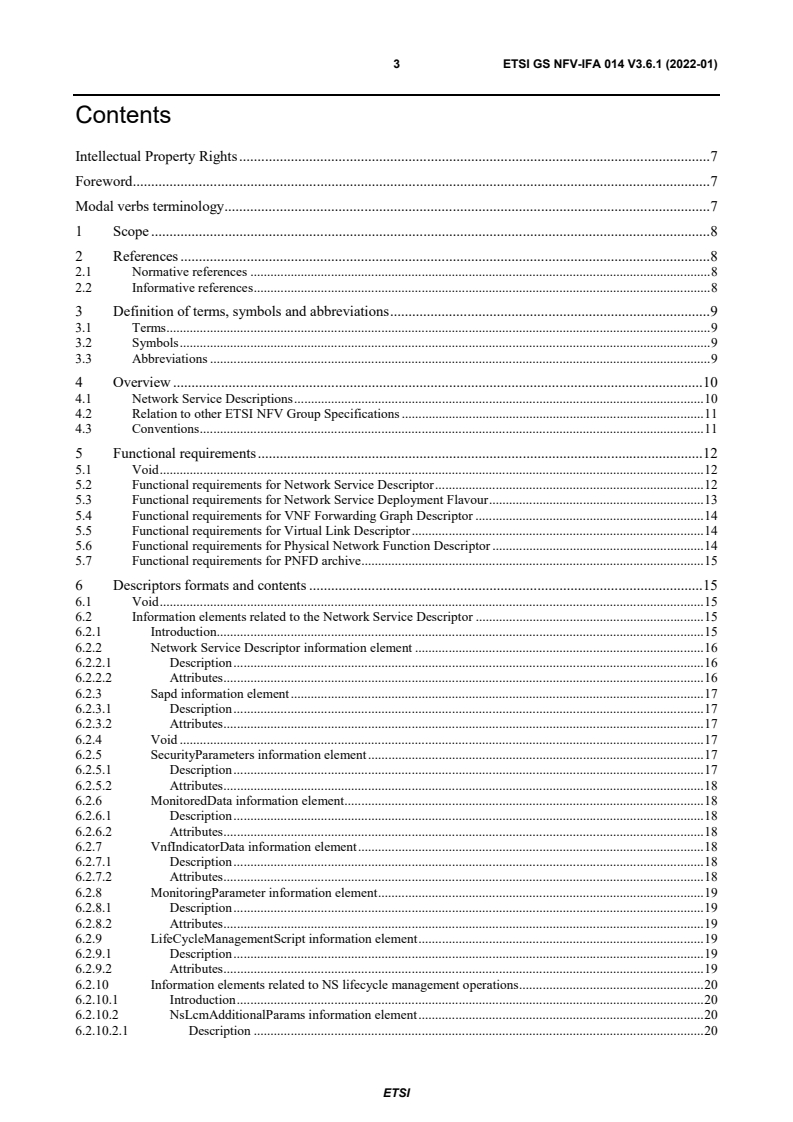
Contents
Intellectual Property Rights . 7
Foreword . 7
Modal verbs terminology . 7
1 Scope . 8
2 References . 8
2.1 Normative references . 8
2.2 Informative references . 8
3 Definition of terms, symbols and abbreviations . 9
3.1 Terms . 9
3.2 Symbols . 9
3.3 Abbreviations . 9
4 Overview . 10
4.1 Network Service Descriptions . 10
4.2 Relation to other ETSI NFV Group Specifications . 11
4.3 Conventions . 11
5 Functional requirements . 12
5.1 Void . 12
5.2 Functional requirements for Network Service Descriptor . 12
5.3 Functional requirements for Network Service Deployment Flavour . 13
5.4 Functional requirements for VNF Forwarding Graph Descriptor . 14
5.5 Functional requirements for Virtual Link Descriptor . 14
5.6 Functional requirements for Physical Network Function Descriptor . 14
5.7 Functional requirements for PNFD archive . 15
6 Descriptors formats and contents . 15
6.1 Void . 15
6.2 Information elements related to the Network Service Descriptor . 15
6.2.1 Introduction. 15
6.2.2 Network Service Descriptor information element . 16
6.2.2.1 Description . 16
6.2.2.2 Attributes . 16
6.2.3 Sapd information element . 17
6.2.3.1 Description . 17
6.2.3.2 Attributes . 17
6.2.4 Void . 17
6.2.5 SecurityParameters information element . 17
6.2.5.1 Description . 17
6.2.5.2 Attributes . 18
6.2.6 MonitoredData information element . 18
6.2.6.1 Description . 18
6.2.6.2 Attributes . 18
6.2.7 VnfIndicatorData information element . 18
6.2.7.1 Description . 18
6.2.7.2 Attributes . 18
6.2.8 MonitoringParameter information element . 19
6.2.8.1 Description . 19
6.2.8.2 Attributes . 19
6.2.9 LifeCycleManagementScript information element . 19
6.2.9.1 Description . 19
6.2.9.2 Attributes . 19
6.2.10 Information elements related to NS lifecycle management operations . 20
6.2.10.1 Introduction . 20
6.2.10.2 NsLcmAdditionalParams information element . 20
6.2.10.2.1 Description . 20
ETSI
4 ETSI GS NFV-IFA 014 V3.6.1 (2022-01)
6.2.10.2.2 Attributes . 20
6.2.10.3 InstantiateNsAdditionalParams information element . 20
6.2.10.3.1 Description . 20
6.2.10.3.2 Attributes . 20
6.2.10.4 ScaleNsAdditionalParams information element . 20
6.2.10.4.1 Description . 20
6.2.10.4.2 Attributes . 21
6.2.10.5 HealNsAdditionalParams information element . 21
6.2.10.5.1 Description . 21
6.2.10.5.2 Attributes . 21
6.3 Information elements related to the Network Service Deployment Flavour . 21
6.3.1 Introduction. 21
6.3.2 NsDf information element . 21
6.3.2.1 Description . 21
6.3.2.2 Attributes . 21
6.3.3 VnfProfile information element . 23
6.3.3.1 Description . 23
6.3.3.2 Attributes . 23
6.3.4 VirtualLinkProfile information element . 24
6.3.4.1 Description . 24
6.3.4.2 Attributes . 24
6.3.5 AffinityOrAntiAffinityGroup information element . 25
6.3.5.1 Description . 25
6.3.5.2 Attributes . 25
6.3.6 PnfProfile information element . 25
6.3.6.1 Description . 25
6.3.6.2 Attributes . 25
6.3.7 NsVirtualLinkConnectivity information element . 26
6.3.7.1 Description . 26
6.3.7.2 Attributes . 26
6.3.8 LocalAffinityOrAntiAffinityRule information element. 26
6.3.8.1 Description . 26
6.3.8.2 Attributes . 27
6.3.9 NsLevel information element . 27
6.3.9.1 Description . 27
6.3.9.2 Attributes . 27
6.3.10 Void . 28
6.3.11 NsProfile information element . 28
6.3.11.1 Description . 28
6.3.11.2 Attributes . 28
6.3.12 Dependencies information element . 29
6.3.12.1 Description . 29
6.3.12.2 Attributes . 29
6.3.13 VirtualLinkProtocolData information element . 30
6.3.13.1 Description . 30
6.3.13.2 Attributes . 30
6.3.14 L2ProtocolData information element. 30
6.3.14.1 Description . 30
6.3.14.2 Attributes . 31
6.3.15 L3ProtocolData information element. 31
6.3.15.1 Description . 31
6.3.15.2 Attributes . 31
6.4 Information elements related to the VNF Forwarding Graph Descriptor . 32
6.4.1 Introduction. 32
6.4.2 Vnffgd information element . 32
6.4.2.1 Description . 32
6.4.2.2 Attributes . 32
6.4.3 Nfpd information element . 33
6.4.3.1 Description . 33
6.4.3.2 Attributes . 33
6.4.4 Void . 33
6.4.5 NfpPositionDesc information element . 33
ETSI
5 ETSI GS NFV-IFA 014 V3.6.1 (2022-01)
6.4.5.1 Description . 33
6.4.5.2 Attributes . 33
6.4.6 NfpPositionElement information element . 34
6.4.6.1 Description . 34
6.4.6.2 Attributes . 34
6.4.7 Void . 35
6.4.8 CpdInConstituentElement information element . 35
6.4.8.1 Description . 35
6.4.8.2 Attributes . 35
6.5 Information elements related to the Network Service Virtual Link Descriptor . 35
6.5.1 Introduction. 35
6.5.2 NsVirtualLinkDesc information element . 35
6.5.2.1 Description . 35
6.5.2.2 Attributes . 36
6.5.3 ConnectivityType information element . 36
6.5.3.1 Description . 36
6.5.3.2 Attributes . 36
6.5.4 VirtualLinkDf information element . 36
6.5.4.1 Description . 36
6.5.4.2 Attributes . 36
6.5.5 LinkBitrateRequirements information element. 37
6.5.5.1 Description . 37
6.5.5.2 Attributes . 37
6.5.6 NsQoS information element . 37
6.5.6.1 Description . 37
6.5.6.2 Attributes . 37
6.6 Information elements related to the PNFD . 38
6.6.1 Introduction. 38
6.6.2 Pnfd information element . 38
6.6.2.1 Description . 38
6.6.2.2 Attributes . 38
6.6.3 Cpd information element . 38
6.6.3.1 Description . 38
6.6.3.2 Attributes . 38
6.6.4 PnfExtCpd information element . 38
6.6.4.1 Description . 38
6.6.4.2 Attributes . 39
6.7 Information elements related to scaling. 39
6.7.1 Introduction. 39
6.7.2 NsScalingAspect information element. 39
6.7.2.1 Description . 39
6.7.2.2 Attributes . 39
6.7.3 Void . 39
6.7.4 VnfToLevelMapping information element . 39
6.7.4.1 Description . 39
6.7.4.2 Attributes . 39
6.7.5 VirtualLinkToLevelMapping information element . 40
6.7.5.1 Description . 40
6.7.5.2 Attributes . 40
6.7.6 NsToLevelMapping information element . 40
6.7.6.1 Description . 40
6.7.6.2 Attributes . 41
Annex A (informative): Support of service function chaining. 42
A.1 Introduction . 42
A.2 IETF SFC concepts . 42
A.3 Use of the NFP Management interface . 44
A.4 Mapping . 44
ETSI
6 ETSI GS NFV-IFA 014 V3.6.1 (2022-01)
Annex B (informative): Change History . 46
History . 48
ETSI
7 ETSI GS NFV-IFA 014 V3.6.1 (2022-01)
Intellectual Property Rights
Essential patents
IPRs essential or potentially essential to normative deliverables may have been declared to ETSI. The declarations
pertaining to these essential IPRs, if any, are publicly available for ETSI members and non-members, and can be
found in ETSI SR 000 314: "Intellectual Property Rights (IPRs); Essential, or potentially Essential, IPRs notified to
ETSI in respect of ETSI standards", which is available from the ETSI Secretariat. Latest updates are available on the
ETSI Web server (https://ipr.etsi.org/).
Pursuant to the ETSI Directives including the ETSI IPR Policy, no investigation regarding the essentiality of IPRs,
including IPR searches, has been carried out by ETSI. No guarantee can be given as to the existence of other IPRs not
referenced in ETSI SR 000 314 (or the updates on the ETSI Web server) which are, or may be, or may become,
essential to the present document.
Trademarks
The present document may include trademarks and/or tradenames which are asserted and/or registered by their owners.
ETSI claims no ownership of these except for any which are indicated as being the property of ETSI, and conveys no
right to use or reproduce any trademark and/or tradename. Mention of those trademarks in the present document does
not constitute an endorsement by ETSI of products, services or organizations associated with those trademarks.
DECT™, PLUGTESTS™, UMTS™ and the ETSI logo are trademarks of ETSI registered for the benefit of its
Members. 3GPP™ and LTE™ are trademarks of ETSI registered for the benefit of its Members and of the 3GPP
Organizational Partners. oneM2M™ logo is a trademark of ETSI registered for the benefit of its Members and of the ®
oneM2M Partners. GSM and the GSM logo are trademarks registered and owned by the GSM Association.
Foreword
This Group Specification (GS) has been produced by ETSI Industry Specification Group (ISG) Network Functions
Virtualisation (NFV).
Modal verbs terminology
In the present document "shall", "shall not", "should", "should not", "may", "need not", "will", "will not", "can" and
"cannot" are to be interpreted as described in clause 3.2 of the ETSI Drafting Rules (Verbal forms for the expression of
provisions).
"must" and "must not" are NOT allowed in ETSI deliverables except when used in direct citation.
ETSI
8 ETSI GS NFV-IFA 014 V3.6.1 (2022-01)
1 Scope
The present document specifies requirements and templates for describing Network Functions Virtualisation (NFV)
Network Services (NSs) in the form of meta-data.
2 References
2.1 Normative references
References are either specific (identified by date of publication and/or edition number or version number) or
non-specific. For specific references, only the cited version applies. For non-specific references, the latest version of the
referenced document (including any amendments) applies.
Referenced documents which are not found to be publicly available in the expected location might be found at
https://docbox.etsi.org/Reference/.
NOTE: While any hyperlinks included in this clause were valid at the time of publication, ETSI cannot guarantee
their long term validity.
The following referenced documents are necessary for the application of the present document.
[1] ETSI GS NFV 003: "Network Functions Virtualisation (NFV); Terminology for Main Concepts in
NFV".
[2] ETSI GS NFV-IFA 011: "Network Functions Virtualisation (NFV); Release 3; Management and
Orchestration; VNF Descriptor and Packaging Specification".
2.2 Informative references
References are either specific (identified by date of publication and/or edition number or version number) or
non-specific. For specific references, only the cited version applies. For non-specific references, the latest version of the
referenced document (including any amendments) applies.
NOTE: While any hyperlinks included in this clause were valid at the time of publication, ETSI cannot guarantee
their long term validity.
The following referenced documents are not necessary for the application of the present document but they assist the
user with regard to a particular subject area.
[i.1] ETSI GS NFV 002: "Network Functions Virtualisation (NFV); Architectural Framework".
[i.2] ETSI GS NFV-IFA 013: "Network Functions Virtualisation (NFV); Release 3; Management and
Orchestration; Os-Ma-Nfvo reference point - Interface and Information Model Specification".
[i.3] ETSI GS NFV-SWA 001: "Network Functions Virtualisation (NFV); Virtual Network Functions
Architecture".
[i.4] ISO/IEC 9646-7: "Information technology -- Open Systems Interconnection -- Conformance
testing methodology and framework -- Part 7: Implementation Conformance Statements".
[i.5] Void.
[i.6] IETF RFC 7665: "Service Function Chaining (SFC) Architecture".
[i.7] ETSI GS NFV-IFA 005: "Network Functions Virtualisation (NFV); Release 3; Management and
Orchestration; Or-Vi reference point - Interface and Information Model Specification".
[i.8] IETF RFC 4090: "Fast Reroute Extensions to RSVP-TE for LSP Tunnels".
ETSI
9 ETSI GS NFV-IFA 014 V3.6.1 (2022-01)
[i.9] ETSI GS NFV-IFA 014 (V3.3.1): "Network Functions Virtualisation (NFV) Release 3;
Management and Orchestration; Network Service Templates Specification".
3 Definition of terms, symbols and abbreviations
3.1 Terms
For the purposes of the present document, the terms given in ETSI GS NFV 003 [1] and the following apply:
Service Access Point (SAP): connection point where an NS can be accessed
NOTE: A SAP can either provide access to an NS, e.g. to an end-user, or interconnect different NS.
3.2 Symbols
Void.
3.3 Abbreviations
For the purposes of the present document, the abbreviations given in ETSI GS NFV 003 [1] and the following apply:
CDN Content Delivery Network
CM Conditional Mandatory
CO Conditional Optional
CP Connection Point
CPD Connection Point Descriptor
DF Deployment Flavour
DSL Domain Specific Language
E-LAN Ethernet Local Area Network
GS Group Specification
IPV4 Internet Protocol Version 4
IPV6 Internet Protocol Version 6
LAN Local Area Network
LSP Label-Switched Path
MANO Management and Orchestration
MPLS MultiProtocol Label Switching
NCT Network Connectivity Topology
NFP Network Forwarding Path
NFPD Network Forwarding Path Descriptor
NS Network Service
NSD Network Service Descriptor
ODU2 Optical channel Data Unit - type 2
PM Performance Management
PNFD Physical Network Function Descriptor
RSVP-TE Resource Reservation Protocol Traffic Engineering
SAL Service Availability Level
SAP Service Access Point
SAPD Service Access Point Descriptor
SFC Service Function Chaining
TE Traffic Engineering
UML Unified Modelling Language
VL Virtual Link
VLD Virtual Link Descriptor
VNFFG VNF Forwarding Graph
VNFFGD VNF Forwarding Graph Descriptor
XOR eXclusive OR
ETSI
10 ETSI GS NFV-IFA 014 V3.6.1 (2022-01)
4 Overview
4.1 Network Service Descriptions
The Network Service Descriptor (NSD) is a deployment template which consists of information used by the NFV
Orchestrator (NFVO) for life cycle management of an NS.
An NS is a composition of Network Functions (NFs) arranged as a set of functions with unspecified connectivity
between them or according to one or more forwarding graphs. As illustrated in figure 4.1-1, the description of an NS as
used by the NFV Management and Orchestration (MANO) functions to deploy an NS instance includes or references
the descriptors of its constituent objects:
• Zero, one or more Virtualised Network Function Descriptors (VNFD);
• Zero, one or more Physical Network Function Descriptor (PNFD) used by the NFVO to determine how to
connect PNFs to VLs;
• Zero, one or more nested NSD;
NOTE 1: The information contained within the PNFD is limited to the description of the connectivity requirements
to integrate PNFs in an NS.
NOTE 2: An NSD references at least either one VNFD or one nested NSD.
• Zero, one or more Virtual Link Descriptor (VLD) used by the NFVO to deploy Virtual Links (VL); and
• Zero, one or more VNF Forwarding Graph Descriptor (VNFFGD).
A VNF Forwarding Graph Descriptor (VNFFGD) describes a topology of the NS or a portion of the NS, by referencing
a pool of connection points and service access points, the descriptors of its constituent VNFs, PNFs and of the VLs that
connect them. It may also contain one or more Network Forwarding Path (NFP) descriptors.
NOTE 3: Different VNFFGDs can be contained in a given NSD. Each VNFFGD uses subsets of the lists of VLDs,
VNFDs and PNFDs included in the NSD.
NOTE 4: For a given NS different VNFFGs can result in packets/frames traversing identical sequences of (V)NFs,
depending on the NFP descriptors included in the VNFFGDs.
NOTE 5: In a given VNFFG the connectivity topology represents how the (V)NFs among which packets/frames
can be exchanged are connected to each other. A Network Connectivity Topology (NCT), as defined in
ETSI GS NFV-SWA 001 [i.3] represents a higher logical level connectivity, possibly a global view of
combined connectivity from different VNFFGs of a given NS.
ETSI
11 ETSI GS NFV-IFA 014 V3.6.1 (2022-01)
Figure 4.1-1: NSD overview
4.2 Relation to other ETSI NFV Group Specifications
The concepts of network services and forwarding graphs are described in ETSI GS NFV 002 [i.1].
Instances of objects created according to the templates specified in the present document are exchanged at the
Os-Ma-Nfvo reference point as specified in ETSI GS NFV-IFA 013 [i.2].
The format of the VNF descriptors referenced in a network service template shall comply with the specifications in
ETSI GS NFV-IFA 011 [2].
4.3 Conventions
The attributes of the NSD and associated information elements are described in the tables provided in clause 6. Each
table has 5 columns, with the following significance:
• The "Attribute" column provides the attribute name.
• The "Qualifier" column indicates whether the support of the attribute is mandatory, optional or conditional.
• The "Cardinality" column contains the minimum and maximum cardinality of this information element (e.g. 1,
2, 0.N, 1.N). A cardinality range starting with 0 indicates that the attribute needs not always to be included.
• The "Content" column provides information on the type of the attribute values. It can be the name of an
Information Element, a primitive type (Identifier, DateTime, etc.) or a generic UML type (String, Integer,
etc.). If a cell in the "Content" column is marked as "Not specified", this means that the specification of the
type is part of the data model design.
• The "Description column" provides a brief explanatory description and additional constraints.
The following notations, defined in ISO/IEC 9646-7 [i.4], are used for the qualifier column of information elements:
• M mandatory - the attribute shall be supported.
• O optional - the attribute may, but need not, be supported.
• CM conditional mandatory - the attribute shall be supported under certain conditions. If the specified
conditions are met then the attribute shall be supported. These conditions are specified in the Description
column.
ETSI
12 ETSI GS NFV-IFA 014 V3.6.1 (2022-01)
• CO conditional optional - the attribute may, but need not, be supported under certain conditions. If the
specified conditions are met then the attribute may, but need not, be supported. These conditions are specified
in the Description column.
The following notation is used for parameters that represent identifiers, and for attributes that represent identifiers in
information elements and notifications:
• If parameters are referring to an identifier of an actual object, their type is "Identifier".
• If an object (information element or notification) contains an attribute that identifies the object, the type of that
attribute is "Identifier" and the description states that the attribute is the identifier of that particular notification
or information element.
EXAMPLE 1: Identifier "resourceId" of the "NetworkSubnet information element" has type "Identifier" and
description "Identifier of this NetworkSubnet information element".
• If an object (information element or notification) contains an attribute that references another object or objects
defined in an ETSI NFV Group Specification (GS), the type of the attribute is "Identifier", followed by the list
of objects it references.
EXAMPLE 2: "Identifier (Reference to Vnfc)" or "Identifier (Reference to Vnfc, VirtualLink or VirtualStorage)".
4.4 Various levels of NFV entities
For NFV management and orchestration, there are four basic level
...
Questions, Comments and Discussion
Ask us and Technical Secretary will try to provide an answer. You can facilitate discussion about the standard in here.
Loading comments...