


ETSI GS MOI 010 V1.1.1 (2010-05)
Measurement Ontology for IP traffic (MOI); Report on information models for IP traffic measurement
Measurement Ontology for IP traffic (MOI); Report on information models for IP traffic measurement
DGS/MOI-0001
General Information
Standards Content (Sample)
Group Specification
Measurement Ontology for IP traffic (MOI);
Report on information models for IP traffic measurement
2 ETSI GS MOI 010 V1.1.1 (2010-05)
Reference
DGS/MOI-0001
Keywords
IP, traffic, ontology, information model
ETSI
650 Route des Lucioles
F-06921 Sophia Antipolis Cedex - FRANCE
Tel.: +33 4 92 94 42 00 Fax: +33 4 93 65 47 16
Siret N° 348 623 562 00017 - NAF 742 C
Association à but non lucratif enregistrée à la
Sous-Préfecture de Grasse (06) N° 7803/88
Important notice
Individual copies of the present document can be downloaded from:
http://www.etsi.org
The present document may be made available in more than one electronic version or in print. In any case of existing or
perceived difference in contents between such versions, the reference version is the Portable Document Format (PDF).
In case of dispute, the reference shall be the printing on ETSI printers of the PDF version kept on a specific network drive
within ETSI Secretariat.
Users of the present document should be aware that the document may be subject to revision or change of status.
Information on the current status of this and other ETSI documents is available at
http://portal.etsi.org/tb/status/status.asp
If you find errors in the present document, please send your comment to one of the following services:
http://portal.etsi.org/chaircor/ETSI_support.asp
Copyright Notification
No part may be reproduced except as authorized by written permission.
The copyright and the foregoing restriction extend to reproduction in all media.
© European Telecommunications Standards Institute 2010.
All rights reserved.
TM TM TM TM
DECT , PLUGTESTS , UMTS , TIPHON , the TIPHON logo and the ETSI logo are Trade Marks of ETSI registered
for the benefit of its Members.
TM
3GPP is a Trade Mark of ETSI registered for the benefit of its Members and of the 3GPP Organizational Partners.
LTE™ is a Trade Mark of ETSI currently being registered
for the benefit of its Members and of the 3GPP Organizational Partners.
GSM® and the GSM logo are Trade Marks registered and owned by the GSM Association.
ETSI
3 ETSI GS MOI 010 V1.1.1 (2010-05)
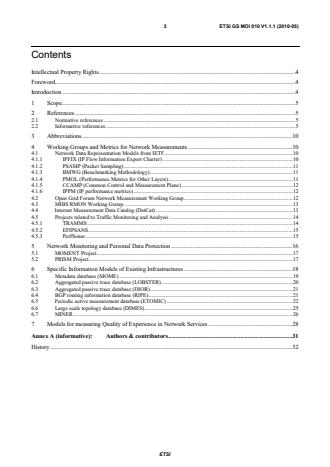
Contents
Intellectual Property Rights . 4
Foreword . 4
Introduction . 4
1 Scope . 5
2 References . 5
2.1 Normative references . 5
2.2 Informative references . 5
3 Abbreviations . 10
4 Working Groups and Metrics for Network Measurements . 10
4.1 Network Data Representation Models from IETF . 10
4.1.1 IPFIX (IP Flow Information Export Charter) . 10
4.1.2 PSAMP (Packet Sampling) . 11
4.1.3 BMWG (Benchmarking Methodology) . 11
4.1.4 PMOL (Performance Metrics for Other Layers) . 11
4.1.5 CCAMP (Common Control and Measurement Plane) . 12
4.1.6 IPPM (IP performance metrics) . 12
4.2 Open Grid Forum Network Measurement Working Group . 12
4.3 MIBS RMON Working Group . 13
4.4 Internet Measurement Data Catalog (DatCat) . 13
4.5 Projects related to Traffic Monitoring and Analysis . 14
4.5.1 TRAMMS . 14
4.5.2 EFIPSANS . 15
4.5.3 PerfSonar . 15
5 Network Monitoring and Personal Data Protection . . 16
5.1 MOMENT Project . 17
5.2 PRISM Project . 17
6 Specific Information Models of Existing Infrastructures . 18
6.1 Metadata database (MOME) . 19
6.2 Aggregated passive trace database (LOBSTER) . 20
6.3 Aggregated passive trace database (DIOR) . 21
6.4 BGP routing information database (RIPE) . 21
6.5 Periodic active measurement database (ETOMIC) . 22
6.6 Large scale topology database (DIMES) . 25
6.7 MINER . 26
7 Models for measuring Quality of Experience in Network Services . 28
Annex A (informative): Authors & contributors . 31
History . 32
ETSI
4 ETSI GS MOI 010 V1.1.1 (2010-05)
Intellectual Property Rights
IPRs essential or potentially essential to the present document may have been declared to ETSI. The information
pertaining to these essential IPRs, if any, is publicly available for ETSI members and non-members, and can be found
in ETSI SR 000 314: "Intellectual Property Rights (IPRs); Essential, or potentially Essential, IPRs notified to ETSI in
respect of ETSI standards", which is available from the ETSI Secretariat. Latest updates are available on the ETSI Web
server (http://webapp.etsi.org/IPR/home.asp).
Pursuant to the ETSI IPR Policy, no investigation, including IPR searches, has been carried out by ETSI. No guarantee
can be given as to the existence of other IPRs not referenced in ETSI SR 000 314 (or the updates on the ETSI Web
server) which are, or may be, or may become, essential to the present document.
Foreword
This Group Specification (GS) has been produced by ETSI Industry Specification (ISG) Measurement Ontology for IP
traffic (MOI).
Introduction
A number of different models, information schemas and best-pratices have recently been proposed in order to cope with
a lack of de-facto standards for interoperability and the extreme heterogeneity of tools' operational modes and
repositories' internal organization of data that one can observe, as of now, in the Traffic Measurement and Analysis
domain. To accomplish any standardization goal in the TMA field, a detailed analysis of such proposals, and of existing
information models for IP traffic measurement is mandatory. A further step is then needed in order to unify the existing
models into a set of well-defined ontological models, which will fully describe the domain of Internet traffic
measurements and will tackle the most problematic aspects such as legally-compliant privacy protection and support for
widely accepted QoS/QoE parameters.
ETSI
5 ETSI GS MOI 010 V1.1.1 (2010-05)
1 Scope
The present document constitutes an analysis of information models for IP traffic measurement. This will include the
basic definitions and state-of-the-art study, as well as the main guidelines to specify a complete set of vocabulary of
classes and relations to describe Internet measurements, supporting QoS parameters and offering privacy protection, by
studying existing schemas that are currently used to describe such information.
The present document is to give an initial focus and guide the process of the MOI ISG. The focus is on the key QoS
parameters and the key approaches in privacy protection when manipulating, analysing and distributing IP traffic
measurements.
2 References
References are either specific (identified by date of publication and/or edition number or version number) or
non-specific. For specific references, only the cited version applies. For non-specific references, the latest version of the
reference document (including any amendments) applies.
Referenced documents which are not found to be publicly available in the expected location might be found at
http://docbox.etsi.org/Reference.
NOTE: While any hyperlinks included in this clause were valid at the time of publication ETSI cannot guarantee
their long term validity.
2.1 Normative references
The following referenced documents are necessary for the application of the present document.
Not applicable
2.2 Informative references
The following referenced documents are not necessary for the application of the present document but they assist the
user with regard to a particular subject area.
[i.1] "IP Flow Information Export (ipfix)".
NOTE: See http://www.ietf.org/dyn/wg/charter/ipfix-charter.html.
[i.2] "IP Flow Anonymisation Support", IETF Internet Draft , November 2009, E. Boschi and
B. Trammel.
NOTE: See http://tools.ietf.org/html/draft-ietf-ipfix-anon-03.
[i.3] "Packet Sampling (psamp)" (concluded WG).
NOTE: See http://www.ietf.org/dyn/wg/charter/psamp-charter.html.
[i.4] "Benchmarking Methodology (bmwg)".
NOTE: See http://www.ietf.org/dyn/wg/charter/bmwg-charter.html.
[i.5] "Performance Metrics for Other Layers (pmol)".
NOTE: See http://www.ietf.org/dyn/wg/charter/pmol-charter.html.
[i.6] "Common Control and Measurement Plane (ccamp)".
NOTE: See http://www.ietf.org/dyn/wg/charter/ccamp-charter.html.
ETSI
6 ETSI GS MOI 010 V1.1.1 (2010-05)
[i.7] "IP Performance Metrics (ippm)".
NOTE: See http://www.ietf.org/dyn/wg/charter/ippm-charter.html.
[i.8] "Relax-NG".
NOTE: See http://en.wikipedia.org/wiki/RELAX_NG.
[i.9] Revision 387.
NOTE: See http://anonsvn.internet2.edu/svn/nmwg/.
[i.10] "Internet Measurement Data Catalog".
NOTE: See http://www.datcat.org/.
[i.11] "Traffic Measurements and Models in Multi-Service Networks (2007 - 2009). Winner of the Celtic
gold award 2009".
NOTE: See http://projects.celtic-initiative.org/tramms/.
[i.12] "What is perfSONAR?".
NOTE: See http://www.perfsonar.net/.
[i.13] P. Ohm, D. Sicker, and D. Grunwald: "Legal issues surrounding monitoring during network
research", in Proceedings of the 7th ACM SIGCOMM Conference on Internet Measurement
(IMC "07), San Diego, USA, October 24 - 26, 2007, pp. 141 - 148.
[i.14] M. Barbaro and T. Zeller Jr.: "A face is exposed for AOL searcher No. 4417749", The New York
Times, August 9, 2006.
[i.15] G. D. Bissias, M. Liberatore, D. Jensen, and B. N. Levine: "Privacy vulnerabilities in encrypted
HTTP streams", in Proceedings of the 5th Workshop on Privacy Enhancing Technologies
(PET 2005), Cavtat, Croatia, May 30 - June 1, 2005.
[i.16] S. Bellovin: "A technique for counting NATted hosts", in Proceedings of the 2nd ACM
SIGCOMM Workshop on Internet Measurement (IMW '02), Marseille, France,
6 - 8 November 2002, pp. 267 - 272.
[i.17] D. Koukis, S. Antonatos, D. Antoniades, P. Trimintzios, and E.P. Markatos: "A generic
anonymization framework for network traffic", in Proceedings of the 2006 IEEE International
Conference on Communications (IEEE ICC 2006), Istanbul, Turkey, June 11 - 15, 2006.
[i.18] R. Pang, M. Allman, V. Paxson, and J. Lee: "The devil and packet trace anonymization", ACM
SIGCOMM Computer Communication Review, Vol. 36, No. 1, pp. 29 - 38, January 2006.
[i.19] Y. Lindell and B. Pinkas: "Privacy preserving data mining. In Advances in Cryptology - CRYPTO
'00", volume 1880 of Lecture Notes in Computer Science, pages 36--54. Springer-Verlag, 2000.
[i.20] Privacy Preserving Data Mining Bibliography.
NOTE: See http://www.cs.umbc.edu/~kunliu1/research/privacy_review.html.
[i.21] References to Privacy-Preserving Data Mining Literature.
NOTE: See http://privacy.cs.cmu.edu/dataprivacy/papers/ppdm/.
[i.22] Privacy Preserving Data Mining Publications.
NOTE: See http://www.cs.ualberta.ca/%7Eoliveira/psdm/pub-by-year.html.
[i.23] R. Canetti, Y. Ishai, R. Kumar, M. K. Reiter, R. Rubinfeld, and R. N. Wright: "Selective private
function evaluation with applications to private statistics", Proc. of the 20th ACM Symposium on
Principles of Distributed Computing (PODC), 2001.
ETSI
7 ETSI GS MOI 010 V1.1.1 (2010-05)
[i.24] Matthew Roughan and Yin Zhang: "Secure distributed data-mining and its application to large-
scale network measurements", ACM SIGCOMM Computer Communication Review, Volume 36,
Issue 1 (January 2006).
[i.25] Mitra, P., Pan, C., Liu, P., and Atluri, V. 2006: "Privacy-preserving semantic interoperation and
access control of heterogeneous databases", in Proceedings of the 2006 ACM Symposium on
information, Computer and Communications Security (Taipei, Taiwan, March 21 - 24, 2006).
ASIACCS '06. ACM, New York, NY, 66-77.
[i.26] T. Finin, A. Joshi, L. Kagal, J. Niu, R. Sandhu, W. Winsborough and B. Thuraisingham:
"ROWLBAC: representing Role Based Access Control in OWL", in Proceedings of the 13th ACM
Symposium on Access Control Models and Technologies (SACMAT'08), Estes Park, CO, USA,
June 11 - 13, 2008.
[i.27] A. Noorollahi Ravari, M. Amini, R. Jalili: "A Semantic Aware Access Control Model with Real
Time Constraints on History of Accesses", in Proceedings of the 3rd International Workshop on
Secure Information Systems (SIS'08), Wisla, Poland, 20 - 22 October 2008.
[i.28] G. V. Lioudakis, E. A. Koutsoloukas, N. Dellas, G. M. Kapitsaki, D. I. Kaklamani, I. S. Venieris:
"A Semantic Framework for Privacy-Aware Access Control", in Proceedings of the 3rd
International Workshop on Secure Information Systems (SIS'08), Wisla, Poland, 20 - 22 October
2008.
[i.29] Organization for the Advancement of Structured Information Standards (OASIS): "OASIS
eXtensible Access Control Markup Language (XACML) TC", 2004.
NOTE: See http://www.oasis-open.org/committees/xacml/.
[i.30] T. Moses: "OASIS Privacy Policy Profile of XACML v2.0", OASIS Standard, February 2005.
[i.31] FP7 ICT project PRISM (PRIvacy-aware Secure Monitoring).
NOTE: See http://fp7-prism.eu/.
[i.32] FP7 ICT project MOMENT (Monitoring and Measurement in the Next Generation Technologies).
NOTE: See http://fp7-moment.eu/.
[i.33] A. Salvador, J. E. López de Vergara, G. Tropea, N. Blefari-Melazzi, Á. Ferreiro, Á. Katsu: "A
Semantically Distributed Approach to Map IP Traffic Measurements to a Standardized Ontology",
International Journal of Computer Networks & Communications (IJCNC), vol. 2, Issue 1,
pp 13-31, January 2010.
[i.34] ITU-T Recommendation X.509: "Information technology - Open Systems Interconnection - The
Directory: Public-key and Attribute Certificate Frameworks", August 2005.
[i.35] G. V. Lioudakis, F. Gogoulos, A. Antonakopoulou, D. I. Kaklamani, I. S. Venieris: "An Access
Control Approach for Privacy-Preserving Passive Network Monitoring" in Proceedings of the
4th International Conference for Internet Technology and Secured Transactions (ICITST-2009),
London, UK, November 9 - 12, 2009.
[i.36] IETF RFC 5101: "Specification of the IP Flow Information Export (IPFIX) Protocol for the
Exchange of IP Traffic Flow Information", B. Claise, Ed.
[i.37] M. Casassa Mont: "Dealing with Privacy Obligations: Important Aspects and Technical
Approaches," in Proceedings of the International Workshop on Trust and Privacy in Digital
Business (TrustBus 2004), Zaragoza, Spain, August 30-September 3, 2004.
[i.38] Project, Strohmeier, F., et al: "D03 - MOME Final Project Report", IST MoMe Project, 2006.
NOTE: See http://www.ist-mome.org/deliverables/mome-wp0-0603-d03-update_final_report.pdf.
[i.39] LOBSTER IST Project.
NOTE: See http://www.ist-lobster.org
ETSI
8 ETSI GS MOI 010 V1.1.1 (2010-05)
[i.40] D. Antoniades, M. Polychronakis, A. Papadogiannakis, P. Trimintzios, S. Ubik, V. Smotlacha,
A. Øslebø and E. P. Markatos. LOBSTER: "A European Platform for Passive Network Traffic
Monitoring".
NOTE: In Proceedings of the 4th International Conference on Testbeds and Research Infrastructures for the
Development of Networks & Communities (TRIDENTCOM), March 2008, Innsbruck, Austria.
[i.41] D. Antoniades, M. Polychronakis, S. Antonatos, E. P. Markatos, S. Ubik, and A. Øslebø. Appmon:
"An Application for Accurate per Application Network Traffic Characterization".
NOTE: In Proceedings of the IST Broadband Europe 2006 Conference, December 2006, Geneva, Switzerland.
[i.42] DIOR Project.
NOTE: See http://arantxa.ii.uam.es/~networking/projects/DIOR/index.htm. Also in José L. García-Dorado, José
Alberto Hernández, Javier Aracil, Jorge E. López de Vergara, Francisco Montserrat, Esther Robles and
Tomás de Miguel, "On the Duration and Spatial Characteristics of Internet Traffic Measurement
Experiments", IEEE Communications Magazine, vol. 46, issue 11, November 2008.
[i.43] RIPE Document Store.
NOTE: See http://www.ripe.net/ripe/docs.
[i.44] "RIPE Routing Working Group Recommendations on Route-flap Dam".
NOTE: See http://www.ripe.net/ripe/docs/routeflap-damping.html.
[i.45] ETOMIC project.
NOTE: See www.etomic.org.
[i.46] P. Mátray, I. Csabai, P. Hága, J. Stéger, L. Dobos, G. Vattay: "Building a Prototype for Network
Measurement Virtual Observatory" Proceedings of ACM SIGMETRICS - MineNet 2007,
12 June 2007, San Diego, CA, USA (2007).
[i.47] DIMES project.
NOTE: See www.netDimes.org.
[i.48] MINER, Salzburg Research: "MINER - Measurement Infrastructure for network Research", 2008.
NOTE: See http://miner.salzburgresearch.at.
[i.49] Quality of experience.
NOTE: See http://en.wikipedia.org/w/index.php?title=Quality-of-experience
[i.50] ETSI ETR 003: "Network Aspects (NA); General aspects of Quality of Service (QoS) and
Network Performance (NP)".
[i.51] ITU-T Recommendation E.800: "Terms and Definitions Related to Quality of Service and
Network Performance Including Dependability".
[i.52] ITU-T Recommendation X.641: "Quality of Service: Framework", Geneva, Switzerland,
December 1997.
[i.53] ITU-R Recommendation BT.500-11: "Methodology for the subjective assessment of the quality of
television pictures".
[i.54] Rubino, G. and Varela M.: "A new approach for the prediction of end-to-end performance of
multimedia streams", First International Conference on the Quantitative Evaluation of Systems,
2004. QEST 2004. Proceedings. September 2004.
[i.55] Rodríguez-Bocca, P., Cancela, H., and Rubino, G. 2007. Video quality assurance in multi-source
streaming techniques. In Proceedings of the 4th international IFIP/ACM Latin American
Conference on Networking (San José, Costa Rica, October 10 - 11, 2007). LANC '07. ACM,
New York, NY, 83-93.
ETSI
9 ETSI GS MOI 010 V1.1.1 (2010-05)
[i.56] Alfonso Sánchez-Macián, Jorge E. López de Vergara, Encarna Pastor, Luis Bellido: "A System for
Monitoring, Assessing and Certifying Quality of Service in Telematic Services".
Knowledge-Based Systems, Vol. 21, Issue 2, March 2008, Elsevier, ISSN 0950-7051.
[i.57] Alfonso Sánchez-Macián, David López Berzosa, Jorge E López de Vergara, Encarna Pastor
Martín: "A Framework for the Automatic Calculation of Quality of Experience in Telematic
Services", Proceedings of the 13th HP-OVUA Workshop, Côte d'Azur, France, 21-24 May 2006.
ISBN 3000187804.
[i.58] EFIPSANS project.
NOTE: See http://www.efipsans.org/.
[i.59] R. Chaparadza: "Requirements for a Generic Autonomic Network Architecture Suitable
Requirements for Autonomic Behavior Specifications of Decision-Making-Elements for Diverse
Networking Environments", International Engineering Consortium (IEC) Annual Review in
Communications, vol. 61, December 2008.
[i.60] R. Natale: "Converting SNMP MIBs to SOA/Web Services Management Artifact; draft-natale-
snmp-mibs-to-ontology-00", IETF Network Working Group Internet-Draft, August 2007.
NOTE: See http://tools.ietf.org/html/draft-natale-snmp-mibs-to-ontology-00.
[i.61] Kun Liu, Hillol Kargupta, Jessica Ryan: "Random Projection-Based Multiplicative Data
Perturbation for Privacy Preserving Distributed Data Mining", IEEE Transactions on Knowledge
and Data Engineering, vol. 18, no. 1, pp. 92-106, Jan., 2006.
[i.62] S. Agrawal and J.R. Haritsa: "A Framework for High-Accuracy Privacy-Preserving Mining", Proc.
21st Int'l Conf. Data Eng. (ICDE'05), pp. 193-204, Apr. 2005.
[i.63] IETF RFC 3577: "Introduction to the Remote Monitoring (RMON) Family of MIB Modules".
[i.64] IETF RFC 2819: "Remote Network Monitoring Management Information Base".
[i.65] IETF RFC 1513: "Token Ring Extensions to the Remote Network Monitoring MIB".
[i.66] IETF RFC 2613: "Remote Network Monitoring MIB Extensions for Switched Networks
Version 1.0".
[i.67] IETF RFC 3144: "Remote Monitoring MIB Extensions for Interface Parameters Monitoring".
[i.68] IETF RFC 3273: "Remote Network Monitoring Management Information Base for High Capacity
Networks".
[i.69] IETF RFC 3434: "Remote Monitoring MIB Extensions for High Capacity Alarms".
[i.70] IETF RFC 2021: "Remote Network Monitoring Management Information Base Version 2 using
SMIv2".
[i.71] IETF RFC 2895: "Remote Network Monitoring MIB Protocol Identifier Reference".
[i.72] IETF RFC 3395: "Remote Network Monitoring MIB Protocol Identifier Reference Extensions".
[i.73] IETF RFC 2896: "Remote Network Monitoring MIB Protocol Identifier Macros".
[i.74] IETF RFC 3287: "Remote Monitoring MIB Extensions for Differentiated Services".
[i.75] IETF RFC 3729: "Application Performance Measurement MIB".
[i.76] IETF RFC 4150: "Transport Performance Metrics MIB".
[i.77] IETF RFC 4711: "Real-time Application Quality-of-Service Monitoring (RAQMON) MIB".
[i.78] IETF RFC 4149: "Definition of Managed Objects for Synthetic Sources for Performance
Monitoring Algorithms".
ETSI
10 ETSI GS MOI 010 V1.1.1 (2010-05)
[i.79] ITU-T Recommendation Y.1540: "Internet protocol data communication service - IP packet
transfer and availability performance parameters".
3 Abbreviations
For the purposes of the present document, the following abbreviations apply:
CCAMP Common Control and Measurement Plane
IMDC Internet Measurement Data Catalog
IPFIX IP Flow Information export
IPPM IP performance metrics
IS-IS Intermediate System to Intermediate System
MIB Management Information Base
NIC Network Information Centre
NMWG Network Measurement Working Group
NOC Network Operations Centre
OSPF Open Shortest Path First
OWL W3C Web Ontology Language
PMOL Performance Metrics for Other Layers
PQoS Perceived Quality of Service
QoS/QoE Quality of Service/Quality of Experience
RELAX NG Regular Language for XML Next Generation
RRD Round-Robin Database
SOA Service Oriented Architecture
TMA Traffic Monitoring and Analysis
4 Working Groups and Metrics for Network
Measurements
We start by reviewing the most common external data representation efforts from IETF. Then this clause includes an
outline of the Open Grid Forum work on measurement data standardization, and continues with PerfSonar, a mediator
for monitoring services developed by GEANT and other partners. A detailed overview of the MIBS RMON
working-group activities and of the DatCat meta-data repository is finally given.
4.1 Network Data Representation Models from IETF
There are a few attempts to standardise network measurement protocols in order to provide a common understanding of
measures across different networks and organisations, promoted by IETF. This clause provides a short list of a few of
them, their characteristics, progress, future and implementation, if any.
4.1.1 IPFIX (IP Flow Information Export Charter)
The IETF IPFIX [i.1] working group defined a protocol to transmit information about captured flows. It has specified
both the Information Model (to describe IP flows) and the IPFIX protocol to transfer IP flow data from IPFIX exporters
to collectors, which is used to transmit to a collector the captured information flows. It considers a flow as a group of
packets sent from the same source to the same destination through the same protocol.
The work towards standardisation is quite advanced and several drafts have been published as RFCs so far, and some
others are about to be reviewed. However, the group activities are still ongoing and new issues are raised. Ongoing
activities are now focusing on anonymization, with an initial draft on this specific issue [i.2] made available since
November 2009.
ETSI
11 ETSI GS MOI 010 V1.1.1 (2010-05)
4.1.2 PSAMP (Packet Sampling)
PSAMP [i.3] is an IETF group whose target is to define a standard set of capabilities for network elements to sample
subsets of packets by statistical and other methods. They should be simple as they are supposed to work at maximal line
rate ubiquitously.
The standard will specify a set of selection operations by which packets are sampled, will specify the information that is
to be made available for reporting on sampled packets, describe protocols by which information on sampled packets is
reported to applications; describe protocols by which packet selection and reporting can be configured. Unreliable
transport is permitted to allow ubiquitous deployment.
The standard will specify:
• Selectors for packet solving.
• Packet information available for reporting.
• Sampled packet reports format.
• Report Streams format for a stream of packet reports.
• Multiple Report Streams requirements for parallel packet samplers in one network element.
• Configuration and Management packet format.
• Presentation, Export and Transport of Packet Reports.
4.1.3 BMWG (Benchmarking Methodology)
The BMWG [i.4] group tries to make a series of recommendations concerning the measurement of the performance
characteristics of various internetworking technologies focusing on:
• The systems or services that are built from these technologies, describing the class of equipment, system, or
service being addressed.
• The performance characteristics that are pertinent to that class.
• The set of metrics that aid in the description of those characteristics.
• The methodologies required to collect said metrics.
• The requirements for the common, unambiguous reporting of benchmarking results.
These standards will be limited to technology characterization using simulated stimuli in a laboratory environment, and
will not be prepared for live, operational networks. The most interesting goal of the WG is to produce benchmarks
which strive to be vendor independent and have universal applicability to a given technology class, but not to deal with
acceptance criteria or performance requirements. Works are well developed, with most of the methodologies taken to
AD Review and around 30 RFC have been published so far.
4.1.4 PMOL (Performance Metrics for Other Layers)
This group has finished its activities in November 2008, with the publication of two Internet Drafts, available at [i.5].
The first one is a framework and guidelines memo which describes any necessary elements of performance metrics of
protocols and applications transported over IETF-specified protocols (such as the formal definition, purpose, and units
of measure) and the various types of metrics that characterize traffic on live networks (such as metrics derived from
other metrics, possibly on lower layers).
Most important for other standardization initiatives can be the enclosed guidelines for a performance metric
development process that includes entry criteria for new proposals (how a proposal might be evaluated for possible
endorsement by a protocol development working group), and how an successful proposal will be developed.
ETSI
12 ETSI GS MOI 010 V1.1.1 (2010-05)
The second Internet Draft is a proof-of-concept, defining performance metrics for SIP, based on the previous
draft-malas-performance-metrics. This memo serves as an example of the framework and the PMOL development
process in the IETF.
4.1.5 CCAMP (Common Control and Measurement Plane)
The CCAMP [i.6] has been a very active and prolific WG, which focused on defining measurement methods on the
physical path and core tunnelling technologies. Its results included the definition of protocol-independent metrics for
describing links and paths required for routing, signalling, protocols and extensions to them required for link and path
attribute measurement (LMP among others).
CCAMP WG has been working on the following most interesting tasks:
• Define how the properties of network resources gathered by a measurement protocol can be distributed in
existing routing protocols, such as OSPF and IS-IS.
• Define abstract link and path properties needed for link and path protection.
Functional specification of extensions for routing and signalling required for path establishment is also under the scope
of the WG.
Collaborations with other IETF groups have been very fluid. The standards are quite developed with around 60 RFCs
published. This group seems to have closed its activities in June 2009.
4.1.6 IPPM (IP performance metrics)
The IPPM [i.7] WG is developing a set of quantitative unbiased standard metrics that can be applied to the quality,
performance, and reliability of Internet data delivery services. These metrics will be designed such that they can be
performed by network operators, end users, or independent testing groups. NOC/NIC services are not included.
Metrics to be standardised are connectivity, one-way delay and loss, round-trip delay and loss, delay variation, loss
patterns, packet reordering, bulk transport capacity and link bandwidth capacity. Some of them have already been
completed and published.
This working group intends to produce also a protocol to enable communication among test equipment that implements
the one-way metrics. The intent is to create a protocol that provides a base level of functionality that will allow different
manufacturer's equipment that implements the metrics according to a standard to interoperate.
The WG will also produce a MIB to retrieve the results of IPPM metrics, such as one-way delay and loss, to facilitate
the communication of metrics to existing network management systems. Around twenty RFCs have been published on
some of the metrics.
As a concluding remark of this clause, it shall be noticed that an Internet Draft about converting SNMP MIBs to
corresponding ontology models has been proposed in 2007 by R. Natale [i.60], but the term "ontology" was loosely
employed in the document to mean SOA management artifacts in general. The initiative failed to generate a specific
working group, and was considered to be an extension of the "MIB-to-XML" work.
4.2 Open Grid Forum Network Measurement Working Group
This clause analyses Open Grid Forum Network Measurement Working Group (NMWG) work on sharing knowledge
about measurement tools and metrics. The NMWG developed an infrastructure in order to communicate among
different systems knowledge in relation to network measurement. Basically, the works of NMWG focus on a common
vocabulary used to provide information about different measuring tools. Actually, a particular XML Schema is defined
for each of these tools, in a particular language, RELAX NG (Regular Language for XML Next Generation) [i.8], and
the information is sent in XML code defined by that schema.
NMWG has published a public SVN repository of their work, which can be accessed at [i.9]. There is one compact
syntax RELAX NG file (.rnc) for each tool, and a few more with information used by all of them. There are also some
examples of how to code in XML from a tool wrapper, which prepares XML messages to be sent following the XML
schema of the tool.
ETSI
13 ETSI GS MOI 010 V1.1.1 (2010-05)
The .rnc schema files can be categorised as:
• Description of tools.
• Description of output data.
• Description of topological features, which are included by other schemas and defined for several network
levels.
• Description of errors and other system outcomes, included by other schemas.
• General structure for the messages, including different statistics, times and other measurements, and also
interface utilisation description.
• Specific elements for Perfsonar implementation.
The advantage of Relax NG files is that they can be written in a compact syntax, more similar to Perl or Python, rather
than XML files, and at the same time, these files can be automatically mapped to their XML Schemas. In addition, this
language is widely used and there is plenty of information about it.
The disadvantage of this specification is that it does not include any semantic information which could be used in
combination with inference rules to make decisions.
Unfortunately, it seems that NMWG have not met for long time, and its website was last time updated on August, 2007,
so it is hard to know whether they keep improving the project or not. However they keep updating a subversion
repository with small changes, around once a month.
4.3 MIBS RMON Working Group
The family of RMON MIBs is described in RFC 3577 [i.63]. This family starts with the RMON-1 MIB
(RFC 2819 [i.64]), which provides statistics focused on the data-link level. It also provides alarms, as well as traffic
capture capabilities. This MIB, defined for Ethernet networks, is completed with Token Ring extensions in
RFC 1513 [i.65]. At the same time, SMON MIB (RFC 2613 [i.66]) and IfTopN MIB (RFC 3144 [i.67]) are defined for
switched networks. Finally, two additional MIBs have been defined (RFC 3273 [i.68] and RFC 3434 [i.69]) for high
capacity networks, where 32 bit counters are too small to measure the traffic.
RMON-2 MIB (RFC 2021 [i.70]) extends RMON-1 by providing an analysis of the monitored traffic in the network,
transport and application levels. For this, it is necessary to define a set of protocol identifiers (RFC 2895 [i.71]),
protocol operations identifiers (RFC 3395 [i.72]), as well as a macro to define new identifiers (RFC 2896 [i.73]).
RMON-2 is complemented with DSMON MIB (RFC 3287 [i.74]), to monitor differentiated services traffic, and with
APM MIB (RFC 3729 [i.75]), TPM MIB (RFC 4150 [i.76]) and RAQMON MIB (RFC 4711 [i.77]), to measure
application performance at several levels and perspectives. This set of MIBs is completed with the SSPM MIB
(RFC 4149 [i.78]), useful to generate traffic from a synthetic source as a way to perform active measurements.
All these MIBs have in common that they define a set of control tables to define the monitoring tasks, and another set of
tables to read the information obtained as a result of those tasks.
4.4 Internet Measurement Data Catalog (DatCat)
DatCat [i.10], developed and run by CAIDA, is an Internet Measurement Data Catalog (IMDC), a searchable registry of
information about network measurement datasets. It serves the global network research community by allowing anyone
to find, annotate, and cite data contributed by others, and soon by allowing anyone to contribute new data.
The goals of DatCat IMDC are:
• To facilitate searching for and sharing of data among researchers. Finding data to use in network research has
historically been difficult. By serving as a shared global resource where anyone can find the data needed for
network analysis, DatCat mitigates a significant barrier to research.
• To enhance documentation of datasets via a public annotation system. Instead of relying on the data
contributor alone to document the data, DatCat allows any researcher to annotate datasets with problems,
features, or missing information they discover in the data, thereby increasing the utility of the datasets.
ETSI
14 ETSI GS MOI 010 V1.1.1 (2010-05)
• To advance network science by promoting reproducible research. Reproducibility of results is a cornerstone of
good science, but requires that the researcher's data is available to others. Similarly, to get the most meaningful
comparison of analysis methodologies and algorithms, researchers must test them against the same data. By
putting their data in DatCat or using data already in DatCat, and then citing the IMDC Handle in their
published results, researchers can make it easier for others to obtain their data and validate their results or
perform alternate analyses on the same data.
Note that IMDC does not store the data (or tools) itself, but only metadata, that is, descriptions of the data and
instructions for obtaining it. The storage of the data itself remains in the hands of the contributor. As such, it may or
may not be freely available; it might, for example, reside on a password-protected server, or require asking the owner of
the data. IMDC does not dictate the terms of availability of the data, it just helps you with the first step of finding the
data.
Information in IMDC is organized as Objects, each of which describes a real-world object or idea. For the purposes of
finding and obtaining data, the most important types of objects are:
• Data. The core of IMDC is the Data object. A Data object describes a dataset in a single file in its most natural
working form, even if the data is not made available directly in that form.
• Data Collection. A set of Data objects with a common purpose and/or collected as part of a single effort. When
searching, it is often most convenient to search for Collections as a unit rather than searching through
thousands of individual Data objects.
• Package. A Package object describes a collection of one or more data files, in a form that can be downloaded
or otherwise made available. Package objects usually represent compressed archives of data files, but can be as
simple as a single uncompressed data file, if that file is the downloadable form.
• Location. Location objects represent the method for obtaining a package. Often this will be a URL linked
directly to the package (external to IMDC), but it can also be text instructions (e.g. for packages that require
human approval or agreement to an AUP).
IMDC is designed to work with any browser that supports standard HTML. IMDC does not require graphics, cookies,
JavaScript, or CSS, but it will take advantage of those features if available to make the interface more convenient,
faster, and generally more pleasant, so we recommend using a browser with those features enabled. All infrastructural
IMDC text is in ASCII English, although user-contributed text may contain other languages and character sets.
Interoperability with the DatCat repository is, as of now, achievable through the Import and Export key functionalities:
for importing IMDC has an XML based meta-data format and a set of tools to help in creating the XML needed for
submitting meta-data to the catalog. The tools are a programmatic Perl API and a declarative interface called 'subcat'
based on the YAML data format (www.yaml.org). IMDC does not have an official data export format or method, but it
has an undocumented prototype of a data export facility, that outputs in YAML format.
4.5 Projects related to Traffic Monitoring and Analysis
4.5.1 TRAMMS
The main objective of TRAMMS [i.11] was to model traffic in multi-service IP networks, and to develop tools for
monitoring of QoS and bottlenecks in networks. The project has closed in December 2009 and its models are built upon
data acquired in different parts of Europe and combined with new tools developed within the project, they aim at
bringing significant new insight into network traffic, bottleneck analysis, user behaviour and QoS monitoring.
The main focus in TRAMMS has been to increase the knowledge of traffic patterns and possibilities for traffic
management and QoS monitoring of IP networks. This has been realized through development of low cost tools for
analyzing QoS parameters, available bandwidth on end-to-end links, routing events, as well as using available state
of-the art deep packet inspection devices to analyse actual traffic in live access networks.
Parameters such as applications used, trends in application usage, penetration of applications, peak hours, peak rates,
service specific user behaviour have been analysed, and typical user types have been defined. The influence on the user
behaviour from different first mile technologies has been studied as well as the difference in user behaviour between
different regions in Europe.
ETSI
15 ETSI GS MOI 010 V1.1.1 (2010-05)
Measurements from the application to the packet level per household were collected in real networks located in
different countries (Sweden and Spain) covering different types of access (FTTH, xDSL, CMTS, GGSN, university
network). Measurements from a large amount of users were gathered for long periods of time (close to 3 000 TiB of
traffic volume was analysed in Spanish and Swedish networks from 2007 to 2009 in periods ranging from several days
to several years).
The project has promoted standardization of active end-to-end capacity measurement methods in the International
Telecommunication Union (ITU). The main result so far is the acceptance and inclusion of the "IP-layer capacity
framework" in ITU-T Recommendation Y.1540 [i.79].
4.5.2 EFIPSANS
The EFIPSANS-IP-Project [i.58] that started in January 2008, aims at exposing the features in IPv6 protocols that can
be exploited or extended for the purposes of designing or building autonomic networks and services. A study of the
emerging research areas that target desirable user behaviours, terminal behaviours, service mobility, e-mobility,
context-aware communi
...
Questions, Comments and Discussion
Ask us and Technical Secretary will try to provide an answer. You can facilitate discussion about the standard in here.
Loading comments...