


ETSI GS CIM 019 V1.1.1 (2022-08)
cross-cutting Context Information Management (CIM); handling of provenance information in NGSI-LD
cross-cutting Context Information Management (CIM); handling of provenance information in NGSI-LD
DGS/CIM-0019
General Information
Standards Content (Sample)
GROUP SPECIFICATION
cross-cutting Context Information Management (CIM);
handling of provenance information in NGSI-LD
Disclaimer
The present document has been produced and approved by the cross-cutting Context Information Management (CIM) ETSI
Industry Specification Group (ISG) and represents the views of those members who participated in this ISG.
It does not necessarily represent the views of the entire ETSI membership.
2 ETSI GS CIM 019 V1.1.1 (2022-08)
Reference
DGS/CIM-0019
Keywords
data, digital signature, provenance,
reliability, trust
ETSI
650 Route des Lucioles
F-06921 Sophia Antipolis Cedex - FRANCE
Tel.: +33 4 92 94 42 00 Fax: +33 4 93 65 47 16
Siret N° 348 623 562 00017 - APE 7112B
Association à but non lucratif enregistrée à la
Sous-Préfecture de Grasse (06) N° w061004871
Important notice
The present document can be downloaded from:
http://www.etsi.org/standards-search
The present document may be made available in electronic versions and/or in print. The content of any electronic and/or
print versions of the present document shall not be modified without the prior written authorization of ETSI. In case of any
existing or perceived difference in contents between such versions and/or in print, the prevailing version of an ETSI
deliverable is the one made publicly available in PDF format at www.etsi.org/deliver.
Users of the present document should be aware that the document may be subject to revision or change of status.
Information on the current status of this and other ETSI documents is available at
https://portal.etsi.org/TB/ETSIDeliverableStatus.aspx
If you find errors in the present document, please send your comment to one of the following services:
https://portal.etsi.org/People/CommiteeSupportStaff.aspx
If you find a security vulnerability in the present document, please report it through our
Coordinated Vulnerability Disclosure Program:
https://www.etsi.org/standards/coordinated-vulnerability-disclosure
Notice of disclaimer & limitation of liability
The information provided in the present deliverable is directed solely to professionals who have the appropriate degree of
experience to understand and interpret its content in accordance with generally accepted engineering or
other professional standard and applicable regulations.
No recommendation as to products and services or vendors is made or should be implied.
No representation or warranty is made that this deliverable is technically accurate or sufficient or conforms to any law
rule and/or regulation and further, no representation or warranty is made of merchantability or fitness
and/or governmental
for any particular purpose or against infringement of intellectual property rights.
In no event shall ETSI be held liable for loss of profits or any other incidental or consequential damages.
Any software contained in this deliverable is provided "AS IS" with no warranties, express or implied, including but not
limited to, the warranties of merchantability, fitness for a particular purpose and non-infringement of intellectual property
rights and ETSI shall not be held liable in any event for any damages whatsoever (including, without limitation, damages
for loss of profits, business interruption, loss of information, or any other pecuniary loss) arising out of or related to the use
of or inability to use the software.
Copyright Notification
No part may be reproduced or utilized in any form or by any means, electronic or mechanical, including photocopying and
microfilm except as authorized by written permission of ETSI.
The content of the PDF version shall not be modified without the written authorization of ETSI.
The copyright and the foregoing restriction extend to reproduction in all media.
© ETSI 2022.
All rights reserved.
ETSI
3 ETSI GS CIM 019 V1.1.1 (2022-08)
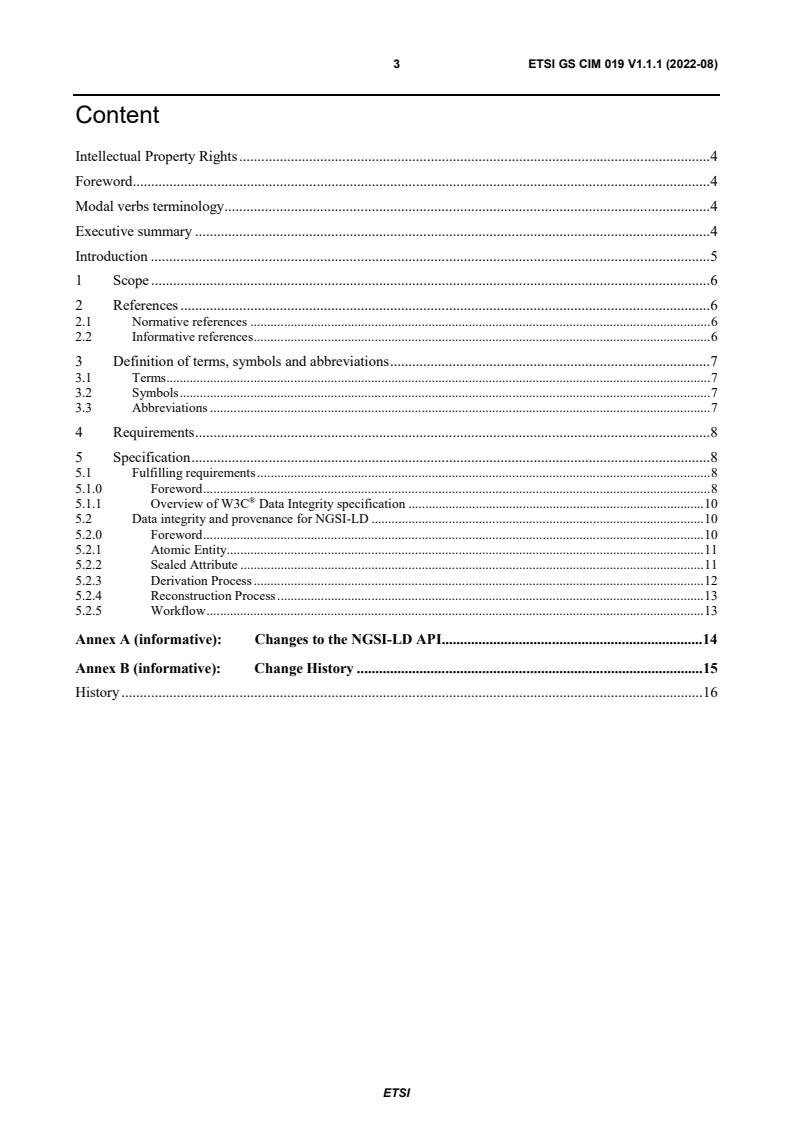
Content
Intellectual Property Rights . 4
Foreword . 4
Modal verbs terminology . 4
Executive summary . 4
Introduction . 5
1 Scope . 6
2 References . 6
2.1 Normative references . 6
2.2 Informative references . 6
3 Definition of terms, symbols and abbreviations . 7
3.1 Terms . 7
3.2 Symbols . 7
3.3 Abbreviations . 7
4 Requirements . 8
5 Specification . 8
5.1 Fulfilling requirements . 8
5.1.0 Foreword . 8 ®
5.1.1 Overview of W3C Data Integrity specification . 10
5.2 Data integrity and provenance for NGSI-LD . 10
5.2.0 Foreword . 10
5.2.1 Atomic Entity. 11
5.2.2 Sealed Attribute . 11
5.2.3 Derivation Process . 12
5.2.4 Reconstruction Process . 13
5.2.5 Workflow . 13
Annex A (informative): Changes to the NGSI-LD API . 14
Annex B (informative): Change History . 15
History . 16
ETSI
4 ETSI GS CIM 019 V1.1.1 (2022-08)
Intellectual Property Rights
Essential patents
IPRs essential or potentially essential to normative deliverables may have been declared to ETSI. The declarations
pertaining to these essential IPRs, if any, are publicly available for ETSI members and non-members, and can be
found in ETSI SR 000 314: "Intellectual Property Rights (IPRs); Essential, or potentially Essential, IPRs notified to
ETSI in respect of ETSI standards", which is available from the ETSI Secretariat. Latest updates are available on the
ETSI Web server (https://ipr.etsi.org/).
Pursuant to the ETSI Directives including the ETSI IPR Policy, no investigation regarding the essentiality of IPRs,
including IPR searches, has been carried out by ETSI. No guarantee can be given as to the existence of other IPRs not
referenced in ETSI SR 000 314 (or the updates on the ETSI Web server) which are, or may be, or may become,
essential to the present document.
Trademarks
The present document may include trademarks and/or tradenames which are asserted and/or registered by their owners.
ETSI claims no ownership of these except for any which are indicated as being the property of ETSI, and conveys no
right to use or reproduce any trademark and/or tradename. Mention of those trademarks in the present document does
not constitute an endorsement by ETSI of products, services or organizations associated with those trademarks.
DECT™, PLUGTESTS™, UMTS™ and the ETSI logo are trademarks of ETSI registered for the benefit of its
Members. 3GPP™ and LTE™ are trademarks of ETSI registered for the benefit of its Members and of the 3GPP
Organizational Partners. oneM2M™ logo is a trademark of ETSI registered for the benefit of its Members and of the ®
oneM2M Partners. GSM and the GSM logo are trademarks registered and owned by the GSM Association.
Foreword
This Group Specification (GS) has been produced by ETSI Industry Specification Group (ISG) cross-cutting Context
Information Management (CIM).
Modal verbs terminology
In the present document "shall", "shall not", "should", "should not", "may", "need not", "will", "will not", "can" and
"cannot" are to be interpreted as described in clause 3.2 of the ETSI Drafting Rules (Verbal forms for the expression of
provisions).
"must" and "must not" are NOT allowed in ETSI deliverables except when used in direct citation.
Executive summary ®
The present document specifies a mechanism for embedding W3C Data Integrity digital signatures into NGSI-LD
Entities.
ETSI
5 ETSI GS CIM 019 V1.1.1 (2022-08)
Introduction
In the most generic scenario of a NGSI-LD [i.2] ecosystem, Entities from Context Providers are sent, through multiple
Context Brokers, to Clients. In this scenario, the context information creator is the Context Provider, which is trusted by
the Clients.
When an Entity typically contains multiple Attributes, it is important to guarantee that these values will not be altered
through all its cycles, so that a Client, without further contact with the Context Provider, can be sure of the integrity.
The preferred solution in both literature and industry, to the data integrity problem, is the implementation of a digital
signature system.
ETSI
6 ETSI GS CIM 019 V1.1.1 (2022-08)
1 Scope
The present document designs a solution to verify integrity and to precisely evaluate attribution and authenticity of
NGSI-LD [i.2] Context Information, throughout its lifecycle. It defines technical means for enabling a chain of trust
from Context Providers to Context Consumers, by embedding verifiable credentials into NGSI-LD documents, ®
leveraging the W3C Data Integrity methodology for digital signatures.
2 References
2.1 Normative references
References are either specific (identified by date of publication and/or edition number or version number) or
non-specific. For specific references, only the cited version applies. For non-specific references, the latest version of the
referenced document (including any amendments) applies.
Referenced documents which are not found to be publicly available in the expected location might be found at
https://docbox.etsi.org/Reference.
NOTE: While any hyperlinks included in this clause were valid at the time of publication, ETSI cannot guarantee
their long term validity.
The following referenced documents are necessary for the application of the present document. ®
[1] W3C Draft Community Group Report 13 April 2021: "RDF Dataset Canonicalization".
NOTE: Available at https://json-ld.github.io/rdf-dataset-canonicalization/spec. ®
[2] W3C Final Community Group Report 22 July 2022: "Data Integrity 1.0".
NOTE: Available at https://www.w3.org/community/reports/credentials/CG-FINAL-data-integrity-20220722.
[3] IETF RFC 8785: "JSON Canonicalization Scheme (JCS)".
NOTE: Available at https://datatracker.ietf.org/doc/html/rfc8785.
2.2 Informative references
References are either specific (identified by date of publication and/or edition number or version number) or
non-specific. For specific references, only the cited version applies. For non-specific references, the latest version of the
referenced document (including any amendments) applies.
NOTE: While any hyperlinks included in this clause were valid at the time of publication, ETSI cannot guarantee
their long term validity.
The following referenced documents are not necessary for the application of the present document but they assist the
user with regard to a particular subject area.
[i.1] ETSI GR CIM 007 (V1.1.1): "Context Information Management (CIM); Security and Privacy".
NOTE: Available at
https://www.etsi.org/deliver/etsi_gr/CIM/001_099/007/01.01.01_60/gr_CIM007v010101p.pdf.
[i.2] ETSI GS CIM 009 (V1.5.1): "Context Information Management (CIM); NGSI-LD API".
NOTE: Available at
https://www.etsi.org/deliver/etsi_gs/CIM/001_099/009/01.05.01_60/gs_CIM009v010501p.pdf.
ETSI
7 ETSI GS CIM 019 V1.1.1 (2022-08)
3 Definition of terms, symbols and abbreviations
3.1 Terms
For the purposes of the present document, the following terms apply:
Atomic Entity: digitally signed NGSI-LD Entity with only one Attribute
Client: shorthand for NGSI-LD Context Consumer
Context Provider: NGSI-LD Context Source or NGSI-LD Context Producer
Derivation Process: process that transforms NGSI-LD Attributes into Sealed Attributes
NGSI-LD Attribute: reference to both an NGSI-LD Property and to an NGSI-LD Relationship
NGSI-LD Context Broker: architectural component that implements all the NGSI-LD interfaces
NGSI-LD Context Consumer: agent that uses the query and subscription functionality of NGSI-LD to retrieve context
information
NGSI-LD Context Producer: agent that uses the NGSI-LD context provision and/or registration functionality to
provide or announce the availability of its context information to an NGSI-LD Context Broker
NGSI-LD Context Source: source of context information which implements the NGSI-LD consumption and
subscription (and possibly provision) interfaces defined by the present document
NGSI-LD Entity: informational representative of something that is supposed to exist in the real world, physically or
conceptually
NGSI-LD Property: description instance which associates a main characteristic, i.e. an NGSI-LD Value, to either an
NGSI-LD Entity, an NGSI-LD Relationship or another NGSI-LD Property and that uses the special hasValue property
to define its target value
Reconstruction Process: opposite process of the Derivation Process
Sealed Attribute: NGSI-LD Attribute with "ngsildproof" sub-property
verification method: method that can be used together with a process to independently verify a proof
3.2 Symbols
Void.
3.3 Abbreviations
For the purposes of the present document, the following abbreviations apply:
JCS JSON Canonicalization Scheme
JSON JavaScript Object Notation
JSON-LD JSON Linked Data
JWS JSON Web Signature
JWS/CT JSON Web Signature Clear Text
LD Linked Data
NGSI Next Generation Service Interfaces
NGSI-LD NGSI Linked Data
RDF Resource Description Format
ETSI
8 ETSI GS CIM 019 V1.1.1 (2022-08)
4 Requirements
ETSI's Industry Specification Group on cross-cutting Context Information Management (ISG CIM) is tasked with
specifying security structures for, among other things, ensuring data integrity and provenance of NGSI-LD Entities
throughout the typical workflow from data sources, which are the creators of the context information/data, to a
federation of Context Providers and NGSI-LD Context Brokers, to NGSI-LD Context Consumers.
Critical requirements for the integrity of data flowing within the NGSI-LD ecosystem, are (adapted from [i.1]):
• INT-1: The NGSI-LD Context Consumers should be able to determine that data integrity has been preserved.
This requirement dictates that data integrity for NGSI-LD Entities is recommended, but not mandatory, when
assembling NGSI-LD Entities.
• INT-2: Verification of integrity shall be independent of syntactical re-ordering that may occur when serializing
NGSI-LD Entities between peers.
• INT-3: Verification of integrity should be independent of the NGSI-LD serialization format itself, i.e.
serialization formats should not strip verification information.
Information for verification of integrity is transported within NGS
...
Questions, Comments and Discussion
Ask us and Technical Secretary will try to provide an answer. You can facilitate discussion about the standard in here.
Loading comments...