


ETSI GS F5G 022 V1.1.1 (2025-01)
Fifth Generation Fixed Network (F5G); Specification for PON based Industrial Network
Fifth Generation Fixed Network (F5G); Specification for PON based Industrial Network
DGS/F5G-0022
General Information
Standards Content (Sample)
GROUP SPECIFICATION
Fifth Generation Fixed Network (F5G);
Specification for PON based Industrial Network
Disclaimer
The present document has been produced and approved by the Fifth Generation Fixed Network (F5G) ETSI Industry
Specification Group (ISG) and represents the views of those members who participated in this ISG.
It does not necessarily represent the views of the entire ETSI membership.
2 ETSI GS F5G 022 V1.1.1 (2025-01)
Reference
DGS/F5G-0022
Keywords
F5G, F5G Advanced, industrial, PON
ETSI
650 Route des Lucioles
F-06921 Sophia Antipolis Cedex - FRANCE
Tel.: +33 4 92 94 42 00 Fax: +33 4 93 65 47 16
Siret N° 348 623 562 00017 - APE 7112B
Association à but non lucratif enregistrée à la
Sous-Préfecture de Grasse (06) N° w061004871
Important notice
The present document can be downloaded from the
ETSI Search & Browse Standards application.
The present document may be made available in electronic versions and/or in print. The content of any electronic and/or
print versions of the present document shall not be modified without the prior written authorization of ETSI. In case of any
existing or perceived difference in contents between such versions and/or in print, the prevailing version of an ETSI
deliverable is the one made publicly available in PDF format on ETSI deliver repository.
Users should be aware that the present document may be revised or have its status changed,
this information is available in the Milestones listing.
If you find errors in the present document, please send your comments to
the relevant service listed under Committee Support Staff.
If you find a security vulnerability in the present document, please report it through our
Coordinated Vulnerability Disclosure (CVD) program.
Notice of disclaimer & limitation of liability
The information provided in the present deliverable is directed solely to professionals who have the appropriate degree of
experience to understand and interpret its content in accordance with generally accepted engineering or
other professional standard and applicable regulations.
No recommendation as to products and services or vendors is made or should be implied.
No representation or warranty is made that this deliverable is technically accurate or sufficient or conforms to any law
and/or governmental rule and/or regulation and further, no representation or warranty is made of merchantability or fitness
for any particular purpose or against infringement of intellectual property rights.
In no event shall ETSI be held liable for loss of profits or any other incidental or consequential damages.
Any software contained in this deliverable is provided "AS IS" with no warranties, express or implied, including but not
limited to, the warranties of merchantability, fitness for a particular purpose and non-infringement of intellectual property
rights and ETSI shall not be held liable in any event for any damages whatsoever (including, without limitation, damages
for loss of profits, business interruption, loss of information, or any other pecuniary loss) arising out of or related to the use
of or inability to use the software.
Copyright Notification
No part may be reproduced or utilized in any form or by any means, electronic or mechanical, including photocopying and
microfilm except as authorized by written permission of ETSI.
The content of the PDF version shall not be modified without the written authorization of ETSI.
The copyright and the foregoing restriction extend to reproduction in all media.
© ETSI 2025.
All rights reserved.
ETSI
3 ETSI GS F5G 022 V1.1.1 (2025-01)
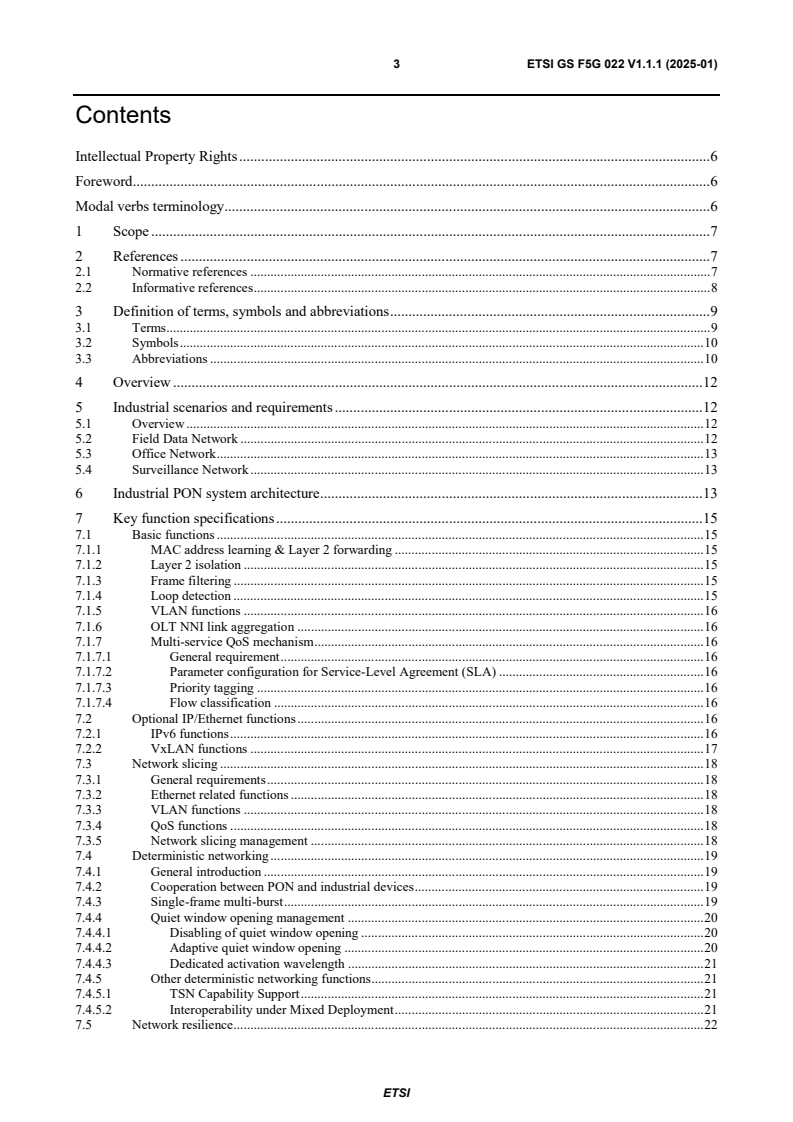
Contents
Intellectual Property Rights . 6
Foreword . 6
Modal verbs terminology . 6
1 Scope . 7
2 References . 7
2.1 Normative references . 7
2.2 Informative references . 8
3 Definition of terms, symbols and abbreviations . 9
3.1 Terms . 9
3.2 Symbols . 10
3.3 Abbreviations . 10
4 Overview . 12
5 Industrial scenarios and requirements . 12
5.1 Overview . 12
5.2 Field Data Network . 12
5.3 Office Network . 13
5.4 Surveillance Network . 13
6 Industrial PON system architecture . 13
7 Key function specifications . 15
7.1 Basic functions . 15
7.1.1 MAC address learning & Layer 2 forwarding . 15
7.1.2 Layer 2 isolation . 15
7.1.3 Frame filtering . 15
7.1.4 Loop detection . 15
7.1.5 VLAN functions . 16
7.1.6 OLT NNI link aggregation . 16
7.1.7 Multi-service QoS mechanism . 16
7.1.7.1 General requirement . 16
7.1.7.2 Parameter configuration for Service-Level Agreement (SLA) . 16
7.1.7.3 Priority tagging . 16
7.1.7.4 Flow classification . 16
7.2 Optional IP/Ethernet functions . 16
7.2.1 IPv6 functions . 16
7.2.2 VxLAN functions . 17
7.3 Network slicing . 18
7.3.1 General requirements . 18
7.3.2 Ethernet related functions . 18
7.3.3 VLAN functions . 18
7.3.4 QoS functions . 18
7.3.5 Network slicing management . 18
7.4 Deterministic networking . 19
7.4.1 General introduction . 19
7.4.2 Cooperation between PON and industrial devices . 19
7.4.3 Single-frame multi-burst . 19
7.4.4 Quiet window opening management . 20
7.4.4.1 Disabling of quiet window opening . 20
7.4.4.2 Adaptive quiet window opening . 20
7.4.4.3 Dedicated activation wavelength . 21
7.4.5 Other deterministic networking functions . 21
7.4.5.1 TSN Capability Support . 21
7.4.5.2 Interoperability under Mixed Deployment . 21
7.5 Network resilie nce . 22
ETSI
4 ETSI GS F5G 022 V1.1.1 (2025-01)
7.5.1 Optical link protection switching requirements . 22
7.5.1.1 General functional requirements for optical link protection switching . 22
7.5.1.2 Optical link protection switching type . 22
7.5.1.3 Switchback mechanisms . 23
7.5.2 Device protection switching requirements . 23
7.5.2.1 OLT core switch card 1+1 redundancy . 23
7.5.2.2 OLT uplink port dual-homing protection . 23
7.5.2.3 Configuration restoration . 24
7.5.2.4 OLT power redundancy . 24
7.6 Security functions . 24
7.6.1 Access security . 24
7.6.1.1 ONU access authentication . 24
7.6.1.2 Authentication and authorization in management plane . 24
7.6.2 Data security . 25
7.6.2.1 Data encryption . 25
7.6.2.2 Data isolation . 25
7.7 Edge computing . 25
7.7.1 OLT-side infrastructure capabilities to support edge computing . 25
7.7.2 ONU-side integrated industrial data collection capability requirements . 26
7.8 Interfaces and industrial protocol adaptions . 26
7.8.1 Interfaces on the OLT side . 26
7.8.2 Interfaces on the ONU side . 26
7.8.3 Industrial protocol adaptions. 26
7.9 Environmental adaption related functions . 27
8 Performance specifications . 27
8.1 PON and Ethernet related performance . 27
8.1.1 Ethernet-related functions . 27
8.1.2 Support on Jumbo Frames . 27
8.1.3 Link Aggregation in the OLT uplink . 27
8.1.4 VxLAN Functionality Requirements . 28
8.2 Network slicing performance . 28
8.2.1 General performance requirements . 28
8.2.2 MAC Address Learning . 28
8.2.3 Link Aggregation . 28
8.3 Deterministic performance . 29
8.3.1 Requirements for transmission latency . 29
8.3.1.1 North-to-south latency . 29
8.3.1.2 East-to-west latency . 29
8.3.2 Requirements for transmission jitter . 30
8.4 Network protection switch performance . 30
8.5 Environmental adaption . 30
8.5.1 Temperature . 30
8.5.2 Water/dust resistance . 31
8.5.3 Humidity . 31
8.5.4 Electromagnetic Compatibility (EMC) . 31
8.6 Edge computing . 31
8.6.1 OLT side . 31
8.6.2 ONU side . 32
9 Management and provisioning specifications . 32
9.1 Management protocols . 32
9.2 Local management and provisioning . 33
9.3 Remote management and provisioning . 33
9.4 Configuration and delivery . 33
9.4.1 General description . 33
9.4.2 Field Data Network and surveillance network requirements . 34
9.4.3 Office Network Requirements . 34
10 Conclusion . 34
Annex A (informative): Cooperation between PON and industrial devices . 35
ETSI
5 ETSI GS F5G 022 V1.1.1 (2025-01)
A.1 Introduction . 35
A.2 Typical implementation details . 35
Annex B (informative): Calculating effective upstream throughput from single-frame multi-
burst values . 37
B.1 Introduction . 37
B.2 GPON scenario . 37
B.3 XGS-PON scenario . 38
History . 40
ETSI
6 ETSI GS F5G 022 V1.1.1 (2025-01)
Intellectual Property Rights
Essential patents
IPRs essential or potentially essential to normative deliverables may have been declared to ETSI. The declarations
pertaining to these essential IPRs, if any, are publicly available for ETSI members and non-members, and can be
found in ETSI SR 000 314: "Intellectual Property Rights (IPRs); Essential, or potentially Essential, IPRs notified to
ETSI in respect of ETSI standards", which is available from the ETSI Secretariat. Latest updates are available on the
ETSI IPR online database.
Pursuant to the ETSI Directives including the ETSI IPR Policy, no investigation regarding the essentiality of IPRs,
including IPR searches, has been carried out by ETSI. No guarantee can be given as to the existence of other IPRs not
referenced in ETSI SR 000 314 (or the updates on the ETSI Web server) which are, or may be, or may become,
essential to the present document.
Trademarks
The present document may include trademarks and/or tradenames which are asserted and/or registered by their owners.
ETSI claims no ownership of these except for any which are indicated as being the property of ETSI, and conveys no
right to use or reproduce any trademark and/or tradename. Mention of those trademarks in the present document does
not constitute an endorsement by ETSI of products, services or organizations associated with those trademarks.
DECT™, PLUGTESTS™, UMTS™ and the ETSI logo are trademarks of ETSI registered for the benefit of its
Members. 3GPP™, LTE™ and 5G™ logo are trademarks of ETSI registered for the benefit of its Members and of the
3GPP Organizational Partners. oneM2M™ logo is a trademark of ETSI registered for the benefit of its Members and of ®
the oneM2M Partners. GSM and the GSM logo are trademarks registered and owned by the GSM Association.
Foreword
This Group Specification (GS) has been produced by ETSI Industry Specification Group (ISG) Fifth Generation Fixed
Network (F5G).
Modal verbs terminology
In the present document "shall", "shall not", "should", "should not", "may", "need not", "will", "will not", "can" and
"cannot" are to be interpreted as described in clause 3.2 of the ETSI Drafting Rules (Verbal forms for the expression of
provisions).
"must" and "must not" are NOT allowed in ETSI deliverables except when used in direct citation.
ETSI
7 ETSI GS F5G 022 V1.1.1 (2025-01)
1 Scope
The present document specifies the network architecture, functional requirements, performance requirements,
management and provisioning specifications for PON based industrial networks deployed in typical industrial
application scenarios, and satisfies the requirements from industrial services.
2 References
2.1 Normative references
References are either specific (identified by date of publication and/or edition number or version number) or
non-specific. For specific references, only the cited version applies. For non-specific references, the latest version of the
referenced document (including any amendments) applies.
Referenced documents which are not found to be publicly available in the expected location might be found in the
ETSI docbox.
NOTE: While any hyperlinks included in this clause were valid at the time of publication, ETSI cannot guarantee
their long term validity.
The following referenced documents are necessary for the application of the present document.
[1] ETSI GS F5G 013: "Fifth Generation Fixed Network (F5G); F5G Technology Landscape
Release 2".
[2] ETSI GS F5G 024: "Fifth Generation Fixed Network (F5G); F5G Advanced Network Architecture
Release 3".
[3] IEC 61158: "Industrial communication networks - Fieldbus specifications".
TM
[4] IEEE 802.3as -2006: "IEEE Standard for Information technology -- Telecommunications and
information exchange between systems -- Local and metropolitan area networks -- Specific
requirements Part 3: Carrier Sense Multiple Access with Collision Detection (CSMA/CD) Access
Method and Physical Layer Specifications".
TM
[5] IEEE 802.1Q -2018: "IEEE Standard for Local and Metropolitan Area Networks -- Bridges and
Bridged Networks".
TM
[6] IEEE 802.1ad -2005: "IEEE Standard for Local and Metropolitan Area Networks -- Virtual
Bridged Local Area Networks -- Amendment 4: Provider Bridges".
[7] Recommendation ITU-T Y.1291 (2004): "An architectural framework for support of Quality of
Service in packet networks".
TM
[8] IEEE 802.1D -2004: "IEEE Standard for Local and metropolitan area networks: Media Access
Control (MAC) Bridges".
[9] IETF RFC 7348: "Virtual eXtensible Local Area Network (VXLAN): A Framework for
Overlaying Virtualized Layer 2 Networks over Layer 3 Networks".
TM
[10] IEEE 802.3ad -2000: "IEEE Standard for Information Technology -- Local and Metropolitan
Area Networks -- Part 3: Carrier Sense Multiple Access with Collision Detection (CSMA/CD)
Access Method and Physical Layer Specifications-Aggregation of Multiple Link Segments".
[11] Recommendation ITU-T G.9807.1 Amendment 2 (2020): "10-Gigabit-capable symmetric passive
optical network (XGS-PON)".
[12] Recommendation ITU-T G.987.1 (2016): "10-Gigabit-capable passive optical networks
(XG-PON): General requirements".
ETSI
8 ETSI GS F5G 022 V1.1.1 (2025-01)
TM
[13] IEEE 802.1Qci -2017: "IEEE Standard for Local and metropolitan area networks -- Bridges and
Bridged Networks -- Amendment 28: Per-Stream Filtering and Policing".
[14] Recommendation ITU-T G.983.5: "A broadband optical access system with enhanced
survivability".
TM
[15] IEEE 802.3af -2003: "IEEE Standard for Information Technology -- Local and Metropolitan
Area Networks -- Specific Requirements -- Part 3: Carrier Sense Multiple Access with Collision
Detection (CSMA/CD) Access Method and Physical Layer Specifications -- Data Terminal
Equipment (DTE) Power Via Media Dependent Interface (MDI)".
TM
-2009: "IEEE Standard for Information technology -- Local and metropolitan area
[16] IEEE 802.3at
networks -- Specific requirements -- Part 3: CSMA/CD Access Method and Physical Layer
Specifications Amendment 3: Data Terminal Equipment (DTE) Power via the Media Dependent
Interface (MDI) Enhancements".
TM
[17] IEEE 802.3bt -2018 IEEE: "Standard for Ethernet Amendment 2: Physical Layer and
Management Parameters for Power over Ethernet over 4 pairs".
[18] IEC 60529: "Degrees of protection provided by enclosures (IP Code)".
[19] IEC 61000-4-2:2008: "Electromagnetic compatibility (EMC) - Part 4-2: Testing and measurement
techniques - Electrostatic discharge immunity test".
[20] Recommendation ITU-T G.988: "ONU management and control interface (OMCI) specification".
[21] IETF RFC 6241: "Network Configuration Protocol (NETCONF)".
[22] ISO/IEC 20922:2016: "Information technology — Message Queuing Telemetry Transport
(MQTT) v3.1.1".
TM
[23] IEEE 802.3 -2018: "IEEE Standard for Ethernet".
[24] IETF RFC 4789 (2006): "Simple network management protocol (SNMP) over IEEE 802
networks".
TM
[25] IEEE 802.1X -2020: "IEEE Standard for Local and Metropolitan Area Networks -- Port-Based
Network Access Control".
2.2 Informative references
References are either specific (identified by date of publication and/or edition number or version number) or
non-specific. For specific references, only the cited version applies. For non-specific references, the latest version of the
referenced document (including any amendments) applies.
NOTE: While any hyperlinks included in this clause were valid at the time of publication, ETSI cannot guarantee
their long term validity.
The following referenced documents are not necessary for the application of the present document but they assist the
user with regard to a particular subject area.
[i.1] ETSI GR F5G 001: "Fifth Generation Fixed Network (F5G); F5G Generation Definition
Release #1".
[i.2] ETSI GR F5G 007 (V1.1.1): "Fifth Generation Fixed Network (F5G); F5G Industrial PON".
[i.3] ETSI GR F5G 008 (V1.1.1): "Fifth Generation Fixed Network (F5G); F5G Use Cases Release #2".
[i.4] IETF RFC 8040: "RESTCONF Protocol".
[i.5] Recommendation ITU-T G.Sup51 (06/17): "Passive optical network protection considerations".
[i.6] ETSI GR F5G 021: "Fifth Generation Fixed Network (F5G); F5G Advanced Generation
Definition".
ETSI
9 ETSI GS F5G 022 V1.1.1 (2025-01)
[i.7] IETF RFC 4241: "A Model of IPv6/IPv4 Dual Stack Internet Access Service".
[i.8] IETF RFC 4213: "Basic Transition Mechanisms for IPv6 Hosts and Routers".
[i.9] IETF RFC 8305: "Happy Eyeballs Version 2: Better Connectivity Using Concurrency".
[i.10] IETF RFC 8200: "Internet Protocol, Version 6 (IPv6) Specification".
[i.11] IETF RFC 2474: "Definition of the Differentiated Services Field (DS Field) in the IPv4 and IPv6
Headers".
[i.12] IETF RFC 9099: "Operational Security Considerations for IPv6 Networks".
[i.13] Recommendation ITU-T G.987.3 (2020): "10-Gigabit-capable passive optical networks
(XG-PON): Transmission convergence (TC) layer specification".
[i.14] Recommendation ITU-T G.9804.2 (2021): "Higher speed passive optical networks - Common
transmission convergence layer specification".
[i.15] Recommendation ITU-T G.Sup71: "Optical line termination capabilities for supporting
cooperative dynamic bandwidth assignment".
[i.16] Recommendation ITU-T G.984.3 (2014): "Gigabit-capable passive optical networks (G-PON):
Transmission convergence layer specification".
[i.17] Recommendation ITU-T G.984.1 (2008): "Gigabit-capable passive optical networks (GPON):
General characteristics".
[i.18] Recommendation ITU-T G.9804.1 (2019): "Higher speed passive optical networks –
Requirements".
TM
[i.19] IEEE 802.1Qbv -2015: "IEEE Standard for Local and metropolitan area networks -- Bridges and
Bridged Networks -- Amendment 25: Enhancements for Scheduled Traffic".
TM
[i.20] IEEE 802.1Qbu -2016: "IEEE Standard for Local and metropolitan area networks -- Bridges and
Bridged Networks -- Amendment 26: Frame Preemption".
[i.21] Recommendation ITU-T E.419 (2006): "Business oriented Key Performance Indicators for
management of networks and services".
[i.22] ETSI EN 300 019-1-4: "Environmental Engineering (EE); Environmental conditions and
environmental tests for telecommunications equipment; Part 1-4: Classification of environmental
conditions; Stationary use at non-weather protected locations".
[i.23] ETSI EN 300 019-2-4: "Environmental Engineering (EE); Environmental conditions and
environmental tests for telecommunications equipment; Part 2-4: Specification of environmental
tests; Stationary use at non-weather protected locations".
3 Definition of terms, symbols and abbreviations
3.1 Terms
For the purposes of the present document, the following terms apply:
deterministic networking: network feature primarily in a best-effort packet network, in which the deterministic quality
of service is applied to flows designated as being critical to a real-time application
field data network: network transporting factory intra-plant industrial data
NOTE: The industrial PON-based network serves as a connection and convergence network for the machines
within the factory because the product line data is carried over the industrial PON-based network.
ETSI
10 ETSI GS F5G 022 V1.1.1 (2025-01)
industrial environment adaptation: capability of a device to adapt to the industrial environments while maintaining
an acceptable level of service
industrial protocol adaptation: capability of a device to adapt to the industrial scenarios to interpreting and/or
converting a range of industrial communication protocols
network resilience: capability of a network to protect against and maintain an acceptable level of service in the
presence of network failure(s)
PON slice: resource allocation and isolation mechanism in Passive Optical Networks (PON), which divides the
physical PON network into multiple logically independent networks
NOTE: Each slice is configured to support the specific Service Level Agreements (SLAs), ensuring that various
types of traffic are appropriately handled and isolated on a shared physical infrastructure, guaranteeing
that the quality of critical applications and services is not affected.
3.2 Symbols
Void.
3.3 Abbreviations
For the purposes of the present document, the following abbreviations apply:
10GE 10 Gbit/s Ethernet
10G-EPON 10 Gbit/s Ethernet Passive Optical Network
40GE 40 Gbit/s Ethernet
50G-PON 50 Gbit/s Passive Optical Network
100GE 100 Gbit/s Ethernet
ACL Access Control List
AI Artificial Intelligence
AN Access Network
ARP Address Resolution Protocol
BNG Broadband Network Gateway
CAN Controller Area Network
CLI Command-Line Interface
CO DBA Cooperative Dynamic Bandwidth Allocation
CPU Central Processing Unit
CPN Customer Premises Network
CVBS Composite Video Baseband Signal
DA Destination Address
DBA Dynamic Bandwidth Allocation
DHCP Dynamic Host Configuration Protocol
DHCPv6 Dynamic Host Configuration Protocol for IPv6
DoS Denial of Service
DSCP Differentiated Services Code Point
EMC Electromagnetic Compatibility
ERP Enterprise Resource Planning
EMS Element Management System
EPON Ethernet Passive Optical Network
FE Fast Ethernet
FEC Forward Error Correction
FP16 16-bit Floating Point
FP32 32-bit Floating Point
GE Gigabit Ethernet
GEM GPON Encapsulation Method
GFLOPS Giga Floating Point Operations Per Second
GPON Gigabit Passive Optical Network
GPU Graphics Processing Unit
GTC GPON Transmission Convergence
HART Highway Addressable Remote Transducer Protocol
ETSI
11 ETSI GS F5G 022 V1.1.1 (2025-01)
ID Identifier
IGMP Internet Group Management Protocol
IPv6 Internet Protocol version 6
IP Internet Protocol
IPG Inter-Packet Gap
ITU-T International Telecommunication Union - Telecommunication Standardization Sector
LAND Local Area Network Denial Attack
MAC Media Access Control
MB Megabyte
MES Manufacturing Execution System
MLQ Multicast Listener Query
MQTT Message Queuing Telemetry Transport
NPU Neural Processing Unit
NETCONF Network Configuration Protocol
NNI Network-to-Network Interface
OLT Optical Line Terminal
OMCI Optical Network Terminal Management and Control Interface
ME Managed Entity
ONU Optical Network Unit
ONU-ID Optical Network Unit Identifier
OSI Open Systems Interconnection
PLOAM Physical Layer Operations, Administration, and Maintenance
PLC Power Line Communication
PoE Power over Ethernet
PPPoE Point-to-Point Protocol over Ethernet
PRI Primary Rate Interface
QoS Quality of Service
RA Router Advertisement
RESTCONF RESTful Configuration Protocol
SA Source Address
SAP Service Access Point
SLA Service-Level Agreement
SDN Software-Defined Networking
SNI Server Name Indication
SNMP Simple Network Management Protocol
SPP Service Processing Point
SSD Solid State Drive
SYN Synchronization
TCP Transmission Control Protocol
T-CONT Transmission Container
TFLOPS Tera Floating Point Operations Per Second
TOS Type of Service
TSN Time-Sensitive Networking
UDP User Datagram Protocol
UCL User Control List
UNI User-Network Interface
VLAN Virtual Local Area Network
VNI VxLAN Network Identifier
VTEP VxLAN Tunnel End Point
VxLAN Virtual eXtensible LAN
TM
Wireless Fidelity
Wi-Fi
XGEM 10 Gigabit GPON Encapsulation Method
XG-PON 10-Gigabit-capable Passive Optical Network
XGS-PON 10-Gigabit-capable Symmetric Passive Optical Network
XGTC 10 Gigabit GPON Transmission Convergence
ETSI
12 ETSI GS F5G 022 V1.1.1 (2025-01)
4 Overview
Industrial networks are designed to connect and control devices, systems, machines, and other assets within the
industrial environment. With digital transformation, remote control machinery and sensors are deployed to automate
production, monitoring, and management. Industrial networks are incorporate facilities related to the Industrial business
including R&D centres, warehouses, administrative offices and customer service branches.
Industrial PON, is inheriting a mature PON technology from the residential access network, and enhancing it to include
functions required by the industrial customers. Industrial PON shall support high quality connectivity for
communication between sensors, devices, machines, and people within the industrial parks.
NOTE: For more detailed description of PON based industrial network see ETSI GR F5G 001 [i.1], ETSI
GS F5G 013 [1], ETSI GR F5G 007 [i.2] and ETSI GR F5G 021 [i.6].
The present document describes the typical industrial PON deployment scenarios, encompassing the architecture, the
key industrial functions and the interfaces of the industrial PON system. The PON based industrial network architecture
includes the management system, the OLTs, and ONUs used in industrial scenarios. PON based industrial network shall
comply with the industrial environmental recommendations.
In the present document, the network architecture, the functional requirements, the performance requirements, the
management and provisioning specifications for PON based industrial networks are specified.
5 Industrial scenarios and requirements
5.1 Overview
There are three deployment scenarios for PON based industrial networks, as described in ETSI GR F5G 007 [i.2]
(Industrial PON) and in ETSI GR F5G 008 [i.3] (Use Cases Release #2), namely:
1) The field data network which is primarily in the industrial environment.
2) The office network including sales, marketing, finance and managerial staff areas.
3) The surveillance network including internal and external video surveillance and sensors.
PON based industrial networks shall support the above three sub-networks within a single network infrastructure.
Network slicing is essential for the isolation of these sub-networks.
Smart network monitoring and management functions based on NETCONF/YANG and telemetry technology are
needed for smart operation and rapid service configuration in the PON based industrial networks.
5.2 Field Data Network
The primary application in PON based industrial networks is transport factory intra-plant industrial services. PON
serves as a connection and convergence network for the machines within the factory.
There are several industrial field level interfaces and protocols defined in the IEC 61158 series [3]. Therefore, the
ONUs in the industrial network need to be equipped with the corresponding physical interfaces and the built-in
protocol-related functions, or provide connectivity to existing industrial gateways, to support the communications
between the Power Line Communication (PLC), other industrial gateways, and production management systems.
Deterministic network transmission and high service availability are required for these field data network scenarios. The
PON based industrial network integrated with deterministic networking functions, shall support the configuration of
bounded transmission times, and various network protection schemes for the differential network resilience scenarios.
ETSI
13 ETSI GS F5G 022 V1.1.1 (2025-01)
Machine vision applications are being deployed in the production line, which require high bandwidth. High-resolution
images/video cameras are installed on the production lines to capture high-definition images or video streams for
further AI-based analysis and recognition, which quickly locate malfunctioning production and defective products.
These applications require very large upstream network bandwidth, with traffic flows in the order of tens of gigabits per
production line. XGS-PON [11] systems support symmetric 10 Gbit/s bandwidth, which satisfy these bandwidth needs,
and in future 50G-PON [i.18] will provide up to symmetric 50 Gbit/s bandwidth to further enhance the network
capabilities.
5.3 Office Network
PON based industrial network should support the transport of traffic from the office area of a factory for ®
internet/intranet surfing, telephony and Wi-Fi APs traffic. The applications and services in this scenario are similar to
the majority of services carried by PON system in the public access network.
The PON system need to provide Ethernet physical interfaces, and network functions for internet/intranet surfing
similar to the ONUs in the residential and business scenarios, and also support configuration and management for rapid
service configurations. XGS-PON [11] with 10 Gbit/s bandwidth satisfies the large bandwidth requirements in office
network.
5.4 Surveillance Network
Another important industrial network scenarios are the video surveillance networks and the environment sensing
networks around the factory.
PON ONUs shall support Power over Ethernet (PoE) functionality to provide both network connectivity and electricity ®
supply for remote video monitoring cameras. Other capabilities like Wi-Fi Access Point (AP), small cellular cells may
also be embedded to the industrial PON ONU to realize the data transmission for several kinds of sensors.
6 Industrial PON system architecture
The industrial PON system is part of the end-to-end F5G network architecture defined in ETSI GS F5G 024 [2], which
includes both the Customer Premises Network (CPN) and the Access Network (AN) segments.
NOTE 1: The aggregation network for Industrial PON scenario is for further study.
The industrial PON system provides service connectivity for the users and devices in the industrial area. The most often
deployed protocols used in the industrial scenarios shall be supported by the industrial PON system. The industrial
ONUs are ONUs specifically used in PON based industrial networks. These ONUs support industrial
interfaces/protocols and industrial scenario specific functions. They perform the Service Access Point (SAP) functions
and the OLTs performs the Service Processing Point (SPP) functions.
As the industrial PON system is the industrial factory intranet, the factory intranet may be self-contained depending on
the network scale, deployment scenario, and security considerations of the customers. The OLT
...
Questions, Comments and Discussion
Ask us and Technical Secretary will try to provide an answer. You can facilitate discussion about the standard in here.
Loading comments...