


ETSI GR F5G 007 V1.1.1 (2023-01)
Fifth Generation Fixed Network (F5G); F5G Industrial PON
Fifth Generation Fixed Network (F5G); F5G Industrial PON
DGR/F5G-007 Industrial PON
General Information
Standards Content (Sample)
GROUP REPORT
Fifth Generation Fixed Network (F5G);
F5G Industrial PON
Disclaimer
The present document has been produced and approved by the Fifth Generation Fixed Network (F5G) ETSI Industry
Specification Group (ISG) and represents the views of those members who participated in this ISG.
It does not necessarily represent the views of the entire ETSI membership.
2 ETSI GR F5G 007 V1.1.1 (2023-01)
Reference
DGR/F5G-007 Industrial PON
Keywords
F5G, industrial, PON
ETSI
650 Route des Lucioles
F-06921 Sophia Antipolis Cedex - FRANCE
Tel.: +33 4 92 94 42 00 Fax: +33 4 93 65 47 16
Siret N° 348 623 562 00017 - APE 7112B
Association à but non lucratif enregistrée à la
Sous-Préfecture de Grasse (06) N° w061004871
Important notice
The present document can be downloaded from:
http://www.etsi.org/standards-search
The present document may be made available in electronic versions and/or in print. The content of any electronic and/or
print versions of the present document shall not be modified without the prior written authorization of ETSI. In case of any
existing or perceived difference in contents between such versions and/or in print, the prevailing version of an ETSI
deliverable is the one made publicly available in PDF format at www.etsi.org/deliver.
Users of the present document should be aware that the document may be subject to revision or change of status.
Information on the current status of this and other ETSI documents is available at
https://portal.etsi.org/TB/ETSIDeliverableStatus.aspx
If you find errors in the present document, please send your comment to one of the following services:
https://portal.etsi.org/People/CommiteeSupportStaff.aspx
If you find a security vulnerability in the present document, please report it through our
Coordinated Vulnerability Disclosure Program:
https://www.etsi.org/standards/coordinated-vulnerability-disclosure
Notice of disclaimer & limitation of liability
The information provided in the present deliverable is directed solely to professionals who have the appropriate degree of
experience to understand and interpret its content in accordance with generally accepted engineering or
other professional standard and applicable regulations.
No recommendation as to products and services or vendors is made or should be implied.
No representation or warranty is made that this deliverable is technically accurate or sufficient or conforms to any law
rule and/or regulation and further, no representation or warranty is made of merchantability or fitness
and/or governmental
for any particular purpose or against infringement of intellectual property rights.
In no event shall ETSI be held liable for loss of profits or any other incidental or consequential damages.
Any software contained in this deliverable is provided "AS IS" with no warranties, express or implied, including but not
limited to, the warranties of merchantability, fitness for a particular purpose and non-infringement of intellectual property
rights and ETSI shall not be held liable in any event for any damages whatsoever (including, without limitation, damages
for loss of profits, business interruption, loss of information, or any other pecuniary loss) arising out of or related to the use
of or inability to use the software.
Copyright Notification
No part may be reproduced or utilized in any form or by any means, electronic or mechanical, including photocopying and
microfilm except as authorized by written permission of ETSI.
The content of the PDF version shall not be modified without the written authorization of ETSI.
The copyright and the foregoing restriction extend to reproduction in all media.
© ETSI 2023.
All rights reserved.
ETSI
3 ETSI GR F5G 007 V1.1.1 (2023-01)
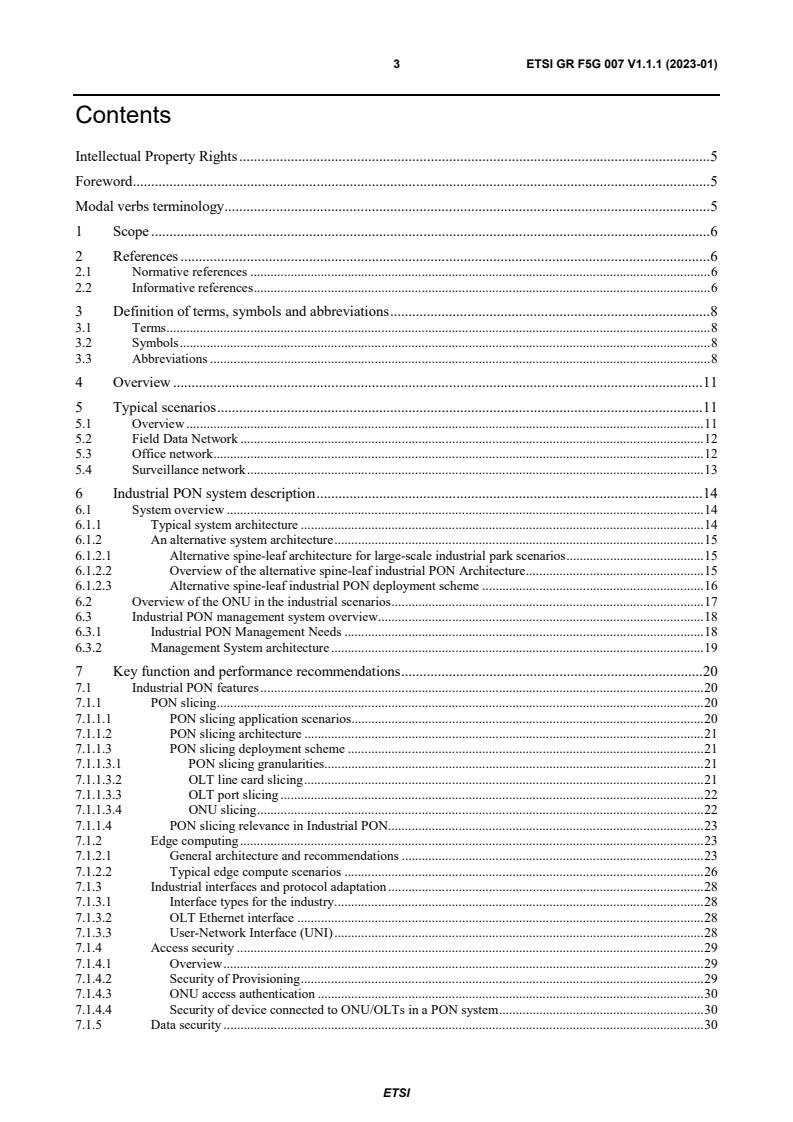
Contents
Intellectual Property Rights . 5
Foreword . 5
Modal verbs terminology . 5
1 Scope . 6
2 References . 6
2.1 Normative references . 6
2.2 Informative references . 6
3 Definition of terms, symbols and abbreviations . 8
3.1 Terms . 8
3.2 Symbols . 8
3.3 Abbreviations . 8
4 Overview . 11
5 Typical scenarios . 11
5.1 Overview . 11
5.2 Field Data Network . 12
5.3 Office network . 12
5.4 Surveillance network . 13
6 Industrial PON system description . 14
6.1 System overview . 14
6.1.1 Typical system architecture . 14
6.1.2 An alternative system architecture . 15
6.1.2.1 Alternative spine-leaf architecture for large-scale industrial park scenarios . 15
6.1.2.2 Overview of the alternative spine-leaf industrial PON Archit ecture . 15
6.1.2.3 Alternative spine-leaf industrial PON deployment scheme . 16
6.2 Overview of the ONU in the industrial scenarios . 17
6.3 Industrial PON management system overview. 18
6.3.1 Industrial PON Management Needs . 18
6.3.2 Management System architecture . 19
7 Key function and performance recommendations . 20
7.1 Industrial PON features . 20
7.1.1 PON slicing . 20
7.1.1.1 PON slicing application scenarios . 20
7.1.1.2 PON slicing architecture . 21
7.1.1.3 PON slicing deployment scheme . 21
7.1.1.3.1 PON slicing granularities. 21
7.1.1.3.2 OLT line card slicing . 21
7.1.1.3.3 OLT port slicing . 22
7.1.1.3.4 ONU slicing . 22
7.1.1.4 PON slicing relevance in Industrial P ON . 23
7.1.2 Edge computing . 23
7.1.2.1 General architecture and recommendations . 23
7.1.2.2 Typical edge compute scenarios . 26
7.1.3 Industrial interfaces and protocol adaptation . 28
7.1.3.1 Interface types for the industry. 28
7.1.3.2 OLT Ethernet interface . 28
7.1.3.3 User-Network Interface (UNI) . 28
7.1.4 Access security . 29
7.1.4.1 Overview . 29
7.1.4.2 Security of Provisioning . 29
7.1.4.3 ONU access authentication . 30
7.1.4.4 Security of device connected to ONU/OLTs in a PON system . 30
7.1.5 Data security . 30
ETSI
4 ETSI GR F5G 007 V1.1.1 (2023-01)
7.1.5.1 Overview . 30
7.1.5.2 Data encryption . 30
7.1.5.3 Cryptographic key protection . 30
7.1.5.4 Data isolation . 31
7.1.6 E2E latency/jitter optimization . 31
7.1.6.1 Overview . 31
7.1.6.2 E2E latency/jitter industrial needs . 31
7.1.6.3 Latency and jitter supported by current XGS PON standards . 32
7.1.6.4 Optimization for industrial PON system latency and jitter . 33
7.1.6.4.1 Overview . 33
7.1.6.4.2 PON link latency optimization by dual wavelengths . 33
7.1.6.4.3 PON link latency optimization by means of fractional frame based burst . 33
7.1.6.4.4 Cooperative DBA (CO DBA) that combines PON DBA and wireless DBA to reduce latency
and buffer between these two segments . 34
7.1.6.4.5 System level optimization such as network slicing and setting industry PON link with fixed
bandwidth and high priority . 35
7.1.6.4.6 E2E latency/jitter optimization based on cooperation between PON and industrial devices . 35
7.1.7 Evolution to higher speed PON . 37
7.1.7.1 Evolution of service and application drivers . 37
7.1.7.2 Technology evolution. 38
7.1.8 TSN over PON . 39
7.1.8.1 Background of TSN-enabled PON . 39
7.1.8.2 TSN-related technologies which may be used in industrial PON system . 39
7.1.8.2.1 Overview . 39
7.1.8.2.2 Time-Triggered Ethernet (TTE) . 39
7.1.8.2.3 Frame preemption (IEEE 802.1Qbu/IEEE 802.3br) . 39
7.1.8.2.4 Proactive fragmentation of jumbo packets . 40
7.1.8.2.5 Enhancements to Traffic Scheduling (IEEE 802.1Qbv) . 40
7.1.8.2.6 Cyclic Queuing and Forwarding (IEEE 802.1Qch) . 40
7.1.8.3 Integration of TSN features to enable TSN in an industrial PON system . 41
7.1.8.3.1 Overview . 41
7.1.8.3.2 Upstream packet transmission over PON . 41
7.1.8.3.3 Downstream packet transmission over PON . 41
7.1.8.4 Summary . 42
7.2 ODN . 42
7.2.1 Network topology . 42
7.2.1.1 Application scenarios . 42
7.2.1.2 ODN System architecture . 43
7.2.2 Network resilience . 44
7.2.2.1 Type C protection . 44
7.2.2.2 Rogue ONU detection and isolation . 45
7.3 PON management system for industrial scenarios . 46
7.3.1 Comparison to traditional PON management systems . 46
7.3.2 Function recommendations . 47
7.3.3 Typical Industrial PON management system architecture . 47
7.3.4 Key function and modules . 47
7.4 Industrial environment adaptation . 48
7.4.1 Overview . 48
7.4.2 Temperature . 49
7.4.3 Water/dust resistance . 49
7.4.4 Humidity . 50
7.4.5 EMC (Electromagnetic Compatibility) . 50
8 Conclusion and next steps . 50
History . 52
ETSI
5 ETSI GR F5G 007 V1.1.1 (2023-01)
Intellectual Property Rights
Essential patents
IPRs essential or potentially essential to normative deliverables may have been declared to ETSI. The declarations
pertaining to these essential IPRs, if any, are publicly available for ETSI members and non-members, and can be
found in ETSI SR 000 314: "Intellectual Property Rights (IPRs); Essential, or potentially Essential, IPRs notified to
ETSI in respect of ETSI standards", which is available from the ETSI Secretariat. Latest updates are available on the
ETSI Web server (https://ipr.etsi.org/).
Pursuant to the ETSI Directives including the ETSI IPR Policy, no investigation regarding the essentiality of IPRs,
including IPR searches, has been carried out by ETSI. No guarantee can be given as to the existence of other IPRs not
referenced in ETSI SR 000 314 (or the updates on the ETSI Web server) which are, or may be, or may become,
essential to the present document.
Trademarks
The present document may include trademarks and/or tradenames which are asserted and/or registered by their owners.
ETSI claims no ownership of these except for any which are indicated as being the property of ETSI, and conveys no
right to use or reproduce any trademark and/or tradename. Mention of those trademarks in the present document does
not constitute an endorsement by ETSI of products, services or organizations associated with those trademarks.
DECT™, PLUGTESTS™, UMTS™ and the ETSI logo are trademarks of ETSI registered for the benefit of its
Members. 3GPP™ and LTE™ are trademarks of ETSI registered for the benefit of its Members and of the 3GPP
Organizational Partners. oneM2M™ logo is a trademark of ETSI registered for the benefit of its Members and of the ®
oneM2M Partners. GSM and the GSM logo are trademarks registered and owned by the GSM Association.
Foreword
This Group Report (GR) has been produced by ETSI Industry Specification Group (ISG) Fifth Generation Fixed
Network (F5G).
Modal verbs terminology
In the present document "should", "should not", "may", "need not", "will", "will not", "can" and "cannot" are to be
interpreted as described in clause 3.2 of the ETSI Drafting Rules (Verbal forms for the expression of provisions).
"must" and "must not" are NOT allowed in ETSI deliverables except when used in direct citation.
ETSI
6 ETSI GR F5G 007 V1.1.1 (2023-01)
1 Scope
The present document studies the application of PON systems for industrial networks, including various deployment
scenarios, industrial PON system descriptions, key functions, performance recommendations, interfaces, management
system, ONU with industrial interfaces and industrial environment adaptation recommendations.
2 References
2.1 Normative references
Normative references are not applicable in the present document.
2.2 Informative references
References are either specific (identified by date of publication and/or edition number or version number) or
non-specific. For specific references, only the cited version applies. For non-specific references, the latest version of the
referenced document (including any amendments) applies.
NOTE: While any hyperlinks included in this clause were valid at the time of publication, ETSI cannot guarantee
their long term validity.
The following referenced documents are not necessary for the application of the present document but they assist the
user with regard to a particular subject area.
[i.1] ETSI GR F5G 001: "Fifth Generation Fixed Network (F5G); F5G Generation Definition
Release #1".
[i.2] ETSI GR F5G 008: "Fifth Generation Fixed Network (F5G); F5G Use Cases Release #2".
[i.3] ETSI GS F5G 003: "Fifth Generation Fixed Network (F5G); F5G Technology Landscape".
[i.4] ETSI GS F5G 004: "Fifth Generation Fixed Network (F5G); F5G Network Architecture".
[i.5] Recommendation ITU-T G.984.1 (2008): "Gigabit-capable passive optical networks (GPON):
General characteristics".
[i.6] Recommendation ITU-T G.987 (2012): "10-Gigabit-capable passive optical network (XG-PON)
systems: Definitions, abbreviations, and acronyms".
[i.7] Recommendation ITU-T G.987.1 (2016): "10-Gigabit-capable passive optical networks
(XG--PON): General requirements".
[i.8] Recommendation ITU-T G. Sup74 (2021): "Network slicing in a passive optical network context".
[i.9] Recommendation E.419 (2006): "Business oriented Key Performance Indicators for management
of networks and services".
[i.10] IEC 60529: "Degrees of protection provided by enclosures (IP Code)".
[i.11] ETSI EN 300 019-1-4: "Environmental Engineering (EE); Environmental conditions and
environmental tests for telecommunications equipment; Part 1-4: Classification of environmental
conditions; Stationary use at non-weatherprotected locations".
[i.12] ETSI EN 300 019-2-4: "Environmental Engineering (EE); Environmental conditions and
environmental tests for telecommunications equipment; Part 2-4: Specification of environmental
tests; Stationary use at non-weatherprotected locations".
[i.13] IEC 61000-4-2:2008: "Electromagnetic compatibility (EMC) - Part 4-2: Testing and measurement
techniques - Electrostatic discharge immunity test".
ETSI
7 ETSI GR F5G 007 V1.1.1 (2023-01)
[i.14] CCSA (China Communications Standards Association) 2018-0172T-YD: "Networking
Technology for Industrial Internet-General Technical Requirements for Passive Optical Network
(PON)".
[i.15] IEEE 802.3ae™-2002: "IEEE Standard for Information technology - Local and metropolitan area
networks - Part 3: CSMA/CD Access Method and Physical Layer Specifications - Media Access
Control (MAC) Parameters, Physical Layer, and Management Parameters for 10 Gb/s Operation".
[i.16] IEEE 802.3af™-2003: "IEEEE Standard for Information Technology - Telecommunications and
Information Exchange Between Systems - Local and Metropolitan Area Networks - Specific
Requirements - Part 3: Carrier Sense Multiple Access with Collision Detection (CSMA/CD)
Access Method and Physical Layer Specifications - Data Terminal Equipment (DTE) Power Via
Media Dependent Interface (MDI)".
[i.17] IEEE 802.3at™-2009: "IEEE Standard for Information technology - Local and metropolitan area
networks - Specific requirements - Part 3: CSMA/CD Access Method and Physical Layer
Specifications Amendment 3: Data Terminal Equipment (DTE) Power via the Media Dependent
Interface (MDI) Enhancements".
[i.18] IEEE 802.3bt™-2018: "IEEE Standard for Ethernet Amendment 2: Physical Layer and
Management Parameters for Power over Ethernet over 4 pairs".
[i.19] IEEE 802.3bz™-2016: "IEEE Standard for Ethernet Amendment 7: Media Access Control
Parameters, Physical Layers, and Management Parameters for 2.5 Gb/s and 5 Gb/s Operation,
Types 2.5GBASE-T and 5GBASE-T".
[i.20] IEEE 802.3i™-1990: "IEEE Standard for Local and Metropolitan Area Networks - System
Considerations for Multi-segment 10 Mb/S Baseband Networks (Section 13) and Twisted-Pair
Medium Attachment Unit (MAU) and Baseband Medium, Type 10BASE-T (Section 14)".
[i.21] IEEE 802.3u™-1995: "IEEE Standards for Local and Metropolitan Area Networks: Supplement -
Media Access Control (MAC) Parameters, Physical Layer, Medium Attachment Units, and
Repeater for 100Mb/s Operation, Type 100BASE-T (Clauses 21-30)".
[i.22] IEEE 802.11™-2020: "IEEE Standard for Information Technology--Telecommunications and
Information Exchange between Systems - Local and Metropolitan Area Networks--Specific
Requirements - Part 11: Wireless LAN Medium Access Control (MAC) and Physical Layer (PHY)
Specifications".
[i.23] IEEE 802.11a™-1999: "IEEE Standard for Telecommunications and Information Exchange
Between Systems - LAN/MAN Specific Requirements - Part 11: Wireless Medium Access Control
(MAC) and physical layer (PHY) specifications: High Speed Physical Layer in the 5 GHz band".
[i.24] IEEE 802.11b™-1999: "IEEE Standard for Information Technology - Telecommunications and
information exchange between systems - Local and Metropolitan networks - Specific requirements
- Part 11: Wireless LAN Medium Access Control (MAC) and Physical Layer (PHY)
specifications: Higher Speed Physical Layer (PHY) Extension in the 2.4 GHz band".
[i.25] IEEE 802.11n™-2009: "IEEE Standard for Information technology-- Local and metropolitan area
networks-- Specific requirements-- Part 11: Wireless LAN Medium Access Control (MAC)and
Physical Layer (PHY) Specifications Amendment 5: Enhancements for Higher Throughput".
[i.26] IEEE 802.11ac™-2013: "IEEE Standard for Information technology - Telecommunications and
information exchange between systems-Local and metropolitan area networks - Specific
requirements - Part 11: Wireless LAN Medium Access Control (MAC) and Physical Layer (PHY)
Specifications - Amendment 4: Enhancements for Very High Throughput for Operation in Bands
below 6 GHz".
[i.27] IEEE 802.11ax™-2021: "IEEE Standard for Information Technology - Telecommunications and
Information Exchange between Systems Local and Metropolitan Area Networks - Specific
Requirements Part 11: Wireless LAN Medium Access Control (MAC) and Physical Layer (PHY)
Specifications Amendment 1: Enhancements for High-Efficiency WLAN".
[i.28] NIST SP 800-57 Part 1 Rev. 5: "Recommendation for Key Management: Part 1 - General".
ETSI
8 ETSI GR F5G 007 V1.1.1 (2023-01)
[i.29] IEC 61158: "Industrial communication networks - Fieldbus specifications".
[i.30] Recommendation ITU-T G.987.3 (2014): "10-Gigabit-capable passive optical networks
(XG-PON): Transmission convergence (TC) layer specification".
[i.31] Recommendation ITU-T G.9804.1 (2019): "Higher speed passive optical networks -
Requirements".
[i.32] Recommendation ITU-T G.9804.2 (2021): "Higher speed passive optical networks - Common
transmission convergence layer specification".
[i.33] Recommendation ITU-T G.9804.3 (2021): "50-Gigabit-capable passive optical networks
(50G-PON): Physical media dependent (PMD) layer specification".
[i.34] IEEE 802.1Qbv™-2015: "IEEE Standard for Local and metropolitan area networks -- Bridges and
Bridged Networks - Amendment 25: Enhancements for Scheduled Traffic".
[i.35] IEEE 802.1Qch™-2017: "IEEE Standard for Local and metropolitan area networks--Bridges and
Bridged Networks--Amendment 29: Cyclic Queuing and Forwarding".
[i.36] IEEE 802.11g™-2003:"IEEE Standard for Information technology-- Local and metropolitan area
networks-- Specific requirements-- Part 11: Wireless LAN Medium Access Control (MAC) and
Physical Layer (PHY) Specifications: Further Higher Data Rate Extension in the 2.4 GHz Band".
[i.37] IEEE 802.1Qbu™-2016: "IEEE Standard for Local and metropolitan area networks -- Bridges and
Bridged Networks -- Amendment 26: Frame Preemption".
[i.38] IEEE 802.3br™-2016: "IEEE Standard for Ethernet Amendment 5: Specification and Management
Parameters for Interspersing Express Traffic".
3 Definition of terms, symbols and abbreviations
3.1 Terms
For the purposes of the present document, the following terms apply:
industrial environment adaptation: capability of maintaining acceptable level of service within industrial
environments
industrial protocol adaptation: capability to interpret and/or convert a range of industrial communication protocols
network resilience: capability of a network to protect against and maintain an acceptable level of service in the
presence of network failure(s)
PON slice: group of one or more flows associated with one or more ONUs that are treated as a single entity by a
hierarchical traffic scheduler
NOTE: Defined in ITU-T G. Sup74 (2021) [i.8], clause 3.2.3.
3.2 Symbols
Void.
3.3 Abbreviations
For the purposes of the present document, the following abbreviations apply:
10GE 10 Gbit/s Ethernet
10G-EPON 10 Gbit/s Ethernet PON
AES Advanced Encryption Standard
ETSI
9 ETSI GR F5G 007 V1.1.1 (2023-01)
AGV Automated Guided Vehicles
AI Artificial Intelligence
AN Access Network
AP Access Point
API Application Programming Interface
AR Augmented Reality
ASIC Application Specific Integrated Circuit
BASE-T Baseband Twisted pair cable
BE Best Effort
BNG Border Network Gateway
CAN Controller Area Network
CCD Charge Coupled Device
CMOS Complementary Metal Oxide Semiconductor
CO Cooperative
CPN Customer Premise Network
CPU Central Processing Unit
CQF Cyclic Queing and Forwarding
CX short-haul Copper
DBA Dynamic Bandwidth Allocation
DC Data Centre
DevOp Development and Operation
DHCP Dynamic Host Configuration Protocol
DI/DO Digital Input/Digital Output
DSP Digital Signal Processing
DU Distributed Unit
E2E End to End
EC Edge Computing
EMC ElectroMagnetic Compatibility
EMI Electro-Magnetic Interference
EMS Electro-Magnetic Susceptibility
EPON Ethernet PON
ER Extended Range
ERP Enterprise Resource Planning
ETH Ethernet
F5G Fifth Generation Fixed Network
FE Fast Ethernet
FEC Forward Error Correction
FOCAS Flight Operations, Compliance and Safety
FPGA Field Programmable Gate Array
FTTx Fiber To The x
FTTX Fibre To The X
GE Gigabit Ethernet
GPON Gigabit PON
GPU Graphical Processing Unit
GTC Gigabit-capable passive optical network Transmission Convergence
HD High Definition
HMEE Hardware-Mediated Execution Enclave
HSP Higher Speed PON
HTTP HyperText Transfer Protocol
IaaS Infrastructure as a Service
ID Identification
IEEE Institute of Electrical and Electronic Engineers
IIoT Industrial IoT
IoT Internet of Things
IP Internet Protocol
IT Information Technology
LAG Link Aggregation
LLS-FH Low-Layer Split mobile Fronthaul
LOSi Loss Of Signal for ONUi
LR Long Range
LRM Long Reach Multimode
LX Long-haul fibre
ETSI
10 ETSI GR F5G 007 V1.1.1 (2023-01)
M&C Management & Control
MAC Media Access Control
MCA Management, Control & Analytics
MES Manufacturing Execution System
MITM Man-In-The-Middle
MQ Message Queue
MQTT Message Queue Telemetry Transport
MS Management System
NAND Not-And
NBI Northbound Interface
NMS Network Management System
O&M Operation & Management
OAM Operation Administration and Maintenance
ODN Optical Distribution Network
OLT Optical Line Termination
OMCI ONU Management and Control Interface
ONU Optical Network Unit
ONUi Optical Network Unit No. i
OPC UA Object linking and embedding for Process Control - Unified Architecture
OPC-UA Open Platform Communications Unified Architecture
OS Operating System
OT Operational Technology
P2MP Point to Multipoint
PaaS Platform as a Service
PC Personal Computer
PLC Programmable Logic Controller
PMD Physical Media Dependent
PoE Power over Ethernet
PON Passive Optical Network
POTS Plain Old Telephone Service
QBV 802.1Qbv
QoS Quality of Service
RFID Radio Frequency Identification
RS Recommended Standards
RTOS Real-Time Operating System
RTT Round-trip Time
SAP Service Access Point
SCADA Supervisory Control And Data Acquisition
SDi Signal Degraded of ONUi
SDN Software-Defined Network
SFi Signal Fail of ONUi
SN Serial Number
SPP Service Processing Point
SR Short Range
SR-DBA Status Reporting DBA
SSD Solid-State Drive
SX Short-haul fibre
TC Transmission Convergence
T-CONT Transmission Container
TDM Time-Division-Multiplex
TDMA Time-Division-Multiple Access
TF Transmitter Failure
TL1 Transaction Language 1
TM Traffic Management
TSN Time Sensitive Network
TTE Time Triggered Ethernet
UART Universal Asynchronous Receiver-Transmitter
UE User Equipment
UNI User Network Interface
URL Uniform Resource Locator
VLAN Virtual Local Area Network
VM Virtual Machine
ETSI
11 ETSI GR F5G 007 V1.1.1 (2023-01)
VR Virtual Reality ®
Wi-Fi Wireless Fidelity
XG 10 Gbps
XG-PON 10-Gigabit-capable Passive Optical Network
XGS 10 Gbps Symetrical
XGS-PON 10-Gigabit-capable Symmetric Passive Optical Network
XML eXtensible Markup Language
YANG Yet Another Next Generation
ZTP Zero Touching Provisioning
4 Overview
Industrial networks are designed to connect and control devices, systems, machines, and other assets within the
industrial environment. With digital transformation, remote control machinery and sensors are deployed to automate the
process of production, monitoring, and management. Industrial networks are extended to include facilities related to the
business, such as R&D centres, warehouses, administrative offices, and customer service branches.
Industrial PON, inherited a mature PON technology from residential access network (see [i.5], [i.6] and [i.7]), and
enhances it to include functions required by the industrial customers. Industrial PON needs to support high quality
connectivity to communicate between sensors, devices machines, and people within the industrial parks, see ETSI
GR F5G 001 [i.1] and ETSI GS F5G 003 [i.3].
In the present document, typical industrial PON deployment scenarios, the architecture, the key functions and interfaces
of the industrial PON system are described. These include the management system; the ONUs used in industrial
scenarios and addresses industrial environmental recommendations.
5 Typical scenarios
5.1 Overview
There are three typical main deployment scenarios for industrial PON, which are illustrated as a complete overview in
Figure 1. These scenarios have been included in F5G use cases (see ETSI GR F5G 008 [i.2]), and there follows a brief
overview of these scenarios.
Figure 1: Overview of the industrial PON with typical connectivity scenarios within the factory
ETSI
12 ETSI GR F5G 007 V1.1.1 (2023-01)
The industrial PON system is comprised of three main area (see ETSI GR F5G 008 [i.2]):
1) The field data network which is primarily the industrial environment, described in clause 5.2.
2) The office network including sales, marketing, finance and managerial staff areas, described in clause 5.3.
3) The surveillance network including internal and external video surveillance, alarms sensors and machine
monitoring, described in clause 5.4.
5.2 Field Data Network
One major application in industrial PON is the transport of factory intra-plant industrial field level services. Industrial
PON serves as a connection and convergence network for the machines within the factory, because the field data from
the product line process is carried by the industrial PON.
There are several industrial field level interfaces and protocols defined in the IEC 61158 series [i.29]. Therefore, the
industrial PON ONUs need to support the corresponding physical interfaces and the built-in protocol-related functions,
or provide connectivity to existing industrial gateways, to support the communications among PLCs, other gateways,
production management systems, etc.
Figure 2: Fieldbus connection and converge network overview
5.3 Office network
The Industrial network supports the transport of traffic from the office area of a factory as internet/intranet surfing, ®
telephony and Wi-Fi APs traffic, etc. As the PON system is one of the dominant solutions for the fixed network in the
public access network, it is an ideal candidate to transport these office network services in the factory.
By replacing existing copper-wire based network with fibre, higher access bandwidth can be available, and a single
fibre can transport all the network services within the office. In addition, by using an industrial PON solution, the
conventional copper cables can be replaced, the duct resources within the buildings are freed up and the duct space is
available for future network expansion or network scaling.
By achieving a single converged PON network solution for both the factory workshop and office area, the services
configurations and managements can be unified, and faster troubleshooting can be achieved.
ETSI
13 ETSI GR F5G 007 V1.1.1 (2023-01)
Figure 3: Office network connection via Industrial PON overview
5.4 Surveillance network
Beside the field level network and the office network, other major industrial network scenarios are the video
surveillance networks and environment sensing networks around the factory. The industrial PON can fully support
sensing services. A PON ONU needs to be capable of supporting Power over Ethernet (PoE) functionality when
necessary to provide both network connectivity and electricity supply for remote video monitoring cameras. Other ®
capabilities like Wi-Fi AP, small cellular cells can also be embedded to the industrial PON ONU to realize the data
transmission for several kinds of sensors.
Figure 4: Industrial PON for sensor & surveillance network overview
In the intelligent factory, there are more and more machine vision applications being deployed. High-resolution
image/video cameras are installed on the production lines to capture high-definition images or video streams for further
AI-based analysis and recognitions, which can quickly locate defective production and products.
Such applications need very large upstream bandwidth on the network, as the traffic could be in the order of tens of
gigabits per production line. 10G industrial PON systems, such as 10G-EPON and XGS-PON can be used to satisfy
these bandwidth needs and future 50G PON system can further provide 5 times more bandwidth.
ETSI
14 ETSI GR F5G 007 V1.1.1 (2023-01)
6 Industrial PON system description
6.1 System overview
6.1.1 Typical system architecture
The industrial PON system is within the scope of the F5G network architecture defined in ETSI GR F5G 004 [i.4], and
it includes both the CPN (Customer Premises Network) and AN (Access Network) segments of the underlay plane.
The industrial PON system provides service connectivity for the users and devices in the industrial area. The major
protocols used in the industrial scenarios are supported by the industrial PON system. The ONUs performs the SAP
(Service Access Point) functions and the OLTs performs the SPP (Service Processing Point) functions.
As the industrial PON system is the underlying network of the industrial factory intranet, the factory intranet may be
self-contained depending on the network scale and security considerations of the customers. The aggregation edge
functions such as BNGs are optional for the OLT uplinks. The industrial PON can either be connected to higher level
network elements or be stand-alone.
The industrial PON system supports the MCA (Management, Control & Analytics) plane interfaces and related
operation and management functions. Conventional network management protocols such as TL1 and SDN based
protocols such as NETCONF/YANG are supported by the industrial PON, and advanced functions such as AI analyser
can also be deployed in the industrial PON system, see Figure 6.
Figure 6: Industrial PON system architecture overview
As shown in Figure 6, the industrial PON system acts as the intra-plant communication hub. The Industrial ONUs
provide the interconnection capability and various industrial physical interfaces and protocol conversion capabilities.
Various factory facilities, office and surveillance services can easily be connected. The Industrial ONUs are optimized
for operations in harsh environments, which may include very high temperature and/or complexelectro-magnetic issues.
The OLT has enhanced capabilities including network slicing, network resilience, encryption and edge computing to
fulfil the services for industrial applications. OLTs with built-in open computation platforms can realize essential edge
computing functions, to satisfy the local data processing in the factory, and can further cooperate with higher layer
cloud computing facilities to provide dedicated cloud and IT services for industrial customers.
The industrial PON control and management system support conventional and SDN-based intelligent operation and
management. The industrial PON control and management system can provide open API to other existing manufacture
management system within the factory, and can lead to IT and OT convergence.
ETSI
15 ETSI GR F5G 007 V1.1.1 (2023-01)
6.1.2 An alternative system architecture
6.1.2.1 Alternative spine-leaf architecture for large-scale industrial park scenarios
For
...
Questions, Comments and Discussion
Ask us and Technical Secretary will try to provide an answer. You can facilitate discussion about the standard in here.
Loading comments...