


IEC 60794-3-40:2008
(Main)Optical fibre cables - Part 3-40: Outdoor cables - Family specification for sewer cables and conduits for installation by blowing and/or pulling in non-man accessible storm and sanitary sewers
General Information
- Abstract
IEC 60794-3-40:2008 is part of IEC 60794 family specification that covers sewer cables and conduits for installation by blowing and/or pulling in non-man accessible storm and sanitary sewers, also applicable for man-accessible and lateral ones. Systems built with components covered by this standard are subject to the requirements of sectional specification IEC 60794-3.
This publication is to be read in conjunction with IEC 60794-1-1:2011, IEC 60794-1-2:2003 and IEC 60794-3:2001.
- Status
- Published
- Publication Date
- 07-Oct-2008
- Technical Committee
- SC 86A - Fibres and cables
- Drafting Committee
- PT 60794-3-40 - TC 86/SC 86A/PT 60794-3-40
- Current Stage
- DELPUB - Deleted Publication
- Start Date
- 27-Apr-2022
- Completion Date
- 11-Jan-2019
Buy Documents

IEC 60794-3-40:2008 - Optical fibre cables - Part 3-40: Outdoor cables - Family specification for sewer cables and conduits for installation by blowing and/or pulling in non-man accessible storm and sanitary sewers Released:10/8/2008
IEC 60794-3-40:2008 - Optical fibre cables - Part 3-40: Outdoor cables - Family specification for sewer cables and conduits for installation by blowing and/or pulling in non-man accessible storm and sanitary sewers Released:10/8/2008
Overview
IEC 60794-3-40:2008 is an international family specification within the IEC 60794 series for optical fibre cables and conduits intended for installation by blowing and/or pulling in non-man accessible storm and sanitary sewers. Published as Edition 1.0 (2008), this standard defines minimum construction features, performance expectations and test requirements for sewer cables and conduits used in outdoor telecom networks. It is intended to be read together with IEC 60794-1-1, IEC 60794-1-2 and IEC 60794-3 and complements sectional specifications under IEC 60794-3.
Key Topics
The standard addresses technical and practical aspects including:
- Cable and conduit construction: general construction rules, conduit types and specific sewer cable designs (for conduits or direct installation).
- Optical fibre types: applicable single-mode classes (B1.1, B2, B4, B6) and multimode fibre considerations.
- Mechanical and environmental tests: minimum test regimes for conduits and cables to verify durability in sewer environments (mechanical loads, chemical exposure, cleaning and maintenance stresses).
- Installation and operating conditions: requirements for installation by blowing/pulling, installation limits, and acceptable operating conditions inside sewers.
- Rodent protection and armouring: provisions for protecting cables in harsh subterranean environments.
- Blank detail specification and annexes: templates for purchaser/supplier detail specifications, examples of conduit/cable constructions, and sample installation schemes (including robotized conduit installation and spanning/laying examples).
Applications
IEC 60794-3-40:2008 is practical for:
- Deployment of optical fibre sewer cables in urban infrastructures where direct access is limited.
- Use cases involving installation by blowing or pulling, such as inserting cables into pre-installed conduits within sewer systems.
- Design, procurement and testing of cables for networks crossing storm drains, sanitary sewers and laterals - including man-accessible and non-man-accessible situations.
- Projects requiring documented compliance with international tests for mechanical, chemical and environmental resilience.
Who should use this standard
- Cable manufacturers and designers specifying sewer-rated optical fibre cables.
- Network planners and system integrators evaluating installation methods (blowing/pulling) in sewer ducts.
- Utilities, sewer operators and municipalities that host telecom infrastructure in sewer systems.
- Test laboratories and procurement teams preparing detail specifications and acceptance tests.
Related Standards
Important companion documents:
- IEC 60794-1-1 (Generic specification – General)
- IEC 60794-1-2 (Basic optical cable test procedures)
- IEC 60794-3 (Sectional specification – Outdoor cables)
- Relevant optical fibre product specs: IEC 60793-2 and subparts (e.g., IEC 60793-2-50)
Keywords: IEC 60794-3-40:2008, optical fibre cables, sewer cables, conduits, blowing, pulling, non-man accessible sewers, outdoor cables, installation, IEC.
Relations
- Effective Date
- 05-Sep-2023
Buy Documents
IEC 60794-3-40:2008 - Optical fibre cables - Part 3-40: Outdoor cables - Family specification for sewer cables and conduits for installation by blowing and/or pulling in non-man accessible storm and sanitary sewers Released:10/8/2008
IEC 60794-3-40:2008 - Optical fibre cables - Part 3-40: Outdoor cables - Family specification for sewer cables and conduits for installation by blowing and/or pulling in non-man accessible storm and sanitary sewers Released:10/8/2008
Get Certified
Connect with accredited certification bodies for this standard

ANCE
Mexican certification and testing association.

Intertek Slovenia
Intertek testing, inspection, and certification services in Slovenia.

LNE (Laboratoire National de Métrologie et d'Essais)
French national laboratory for metrology and testing.
Sponsored listings
Frequently Asked Questions
IEC 60794-3-40:2008 is a standard published by the International Electrotechnical Commission (IEC). Its full title is "Optical fibre cables - Part 3-40: Outdoor cables - Family specification for sewer cables and conduits for installation by blowing and/or pulling in non-man accessible storm and sanitary sewers". This standard covers: IEC 60794-3-40:2008 is part of IEC 60794 family specification that covers sewer cables and conduits for installation by blowing and/or pulling in non-man accessible storm and sanitary sewers, also applicable for man-accessible and lateral ones. Systems built with components covered by this standard are subject to the requirements of sectional specification IEC 60794-3. This publication is to be read in conjunction with IEC 60794-1-1:2011, IEC 60794-1-2:2003 and IEC 60794-3:2001.
IEC 60794-3-40:2008 is part of IEC 60794 family specification that covers sewer cables and conduits for installation by blowing and/or pulling in non-man accessible storm and sanitary sewers, also applicable for man-accessible and lateral ones. Systems built with components covered by this standard are subject to the requirements of sectional specification IEC 60794-3. This publication is to be read in conjunction with IEC 60794-1-1:2011, IEC 60794-1-2:2003 and IEC 60794-3:2001.
IEC 60794-3-40:2008 is classified under the following ICS (International Classification for Standards) categories: 33.180.10 - Fibres and cables. The ICS classification helps identify the subject area and facilitates finding related standards.
IEC 60794-3-40:2008 has the following relationships with other standards: It is inter standard links to IEC 60794-3-40:2022. Understanding these relationships helps ensure you are using the most current and applicable version of the standard.
IEC 60794-3-40:2008 is available in PDF format for immediate download after purchase. The document can be added to your cart and obtained through the secure checkout process. Digital delivery ensures instant access to the complete standard document.
Standards Content (Sample)
IEC 60794-3-40
Edition 1.0 2008-10
INTERNATIONAL
STANDARD
Optical fibre cables –
Part 3-40: Outdoor cables – Family specification for sewer cables and conduits
for installation by blowing and/or pulling in non-man accessible storm and
sanitary sewers
All rights reserved. Unless otherwise specified, no part of this publication may be reproduced or utilized in any form
or by any means, electronic or mechanical, including photocopying and microfilm, without permission in writing from
either IEC or IEC's member National Committee in the country of the requester.
If you have any questions about IEC copyright or have an enquiry about obtaining additional rights to this publication,
please contact the address below or your local IEC member National Committee for further information.
IEC Central Office
3, rue de Varembé
CH-1211 Geneva 20
Switzerland
Email: inmail@iec.ch
Web: www.iec.ch
About the IEC
The International Electrotechnical Commission (IEC) is the leading global organization that prepares and publishes
International Standards for all electrical, electronic and related technologies.
About IEC publications
The technical content of IEC publications is kept under constant review by the IEC. Please make sure that you have the
latest edition, a corrigenda or an amendment might have been published.
ƒ Catalogue of IEC publications: www.iec.ch/searchpub
The IEC on-line Catalogue enables you to search by a variety of criteria (reference number, text, technical committee,…).
It also gives information on projects, withdrawn and replaced publications.
ƒ IEC Just Published: www.iec.ch/online_news/justpub
Stay up to date on all new IEC publications. Just Published details twice a month all new publications released. Available
on-line and also by email.
ƒ Electropedia: www.electropedia.org
The world's leading online dictionary of electronic and electrical terms containing more than 20 000 terms and definitions
in English and French, with equivalent terms in additional languages. Also known as the International Electrotechnical
Vocabulary online.
ƒ Customer Service Centre: www.iec.ch/webstore/custserv
If you wish to give us your feedback on this publication or need further assistance, please visit the Customer Service
Centre FAQ or contact us:
Email: csc@iec.ch
Tel.: +41 22 919 02 11
Fax: +41 22 919 03 00
IEC 60794-3-40
Edition 1.0 2008-10
INTERNATIONAL
STANDARD
Optical fibre cables –
Part 3-40: Outdoor cables – Family specification for sewer cables and conduits
for installation by blowing and/or pulling in non-man accessible storm and
sanitary sewers
INTERNATIONAL
ELECTROTECHNICAL
COMMISSION
PRICE CODE
W
ICS 33.180.10 ISBN 978-2-88910-295-2
– 2 – 60794-3-40 © IEC:2008(E)
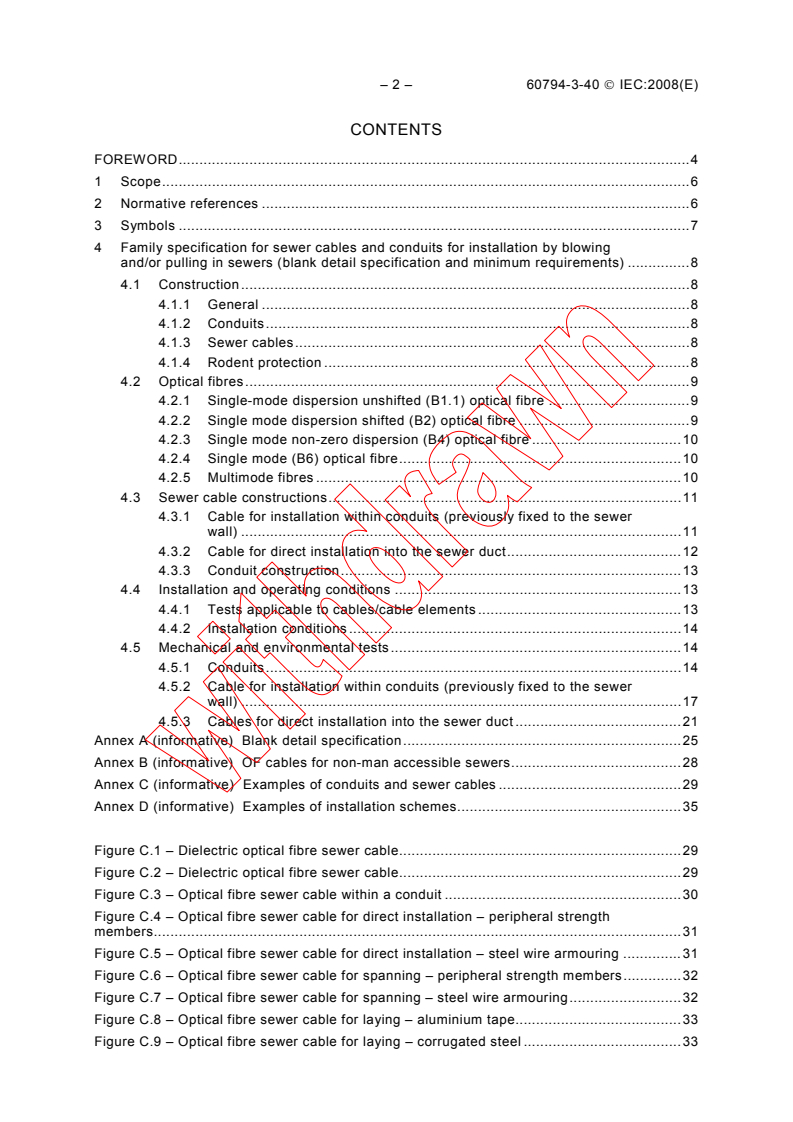
CONTENTS
FOREWORD.4
1 Scope.6
2 Normative references .6
3 Symbols .7
4 Family specification for sewer cables and conduits for installation by blowing
and/or pulling in sewers (blank detail specification and minimum requirements) .8
4.1 Construction.8
4.1.1 General .8
4.1.2 Conduits.8
4.1.3 Sewer cables.8
4.1.4 Rodent protection .8
4.2 Optical fibres.9
4.2.1 Single-mode dispersion unshifted (B1.1) optical fibre .9
4.2.2 Single mode dispersion shifted (B2) optical fibre .9
4.2.3 Single mode non-zero dispersion (B4) optical fibre .10
4.2.4 Single mode (B6) optical fibre.10
4.2.5 Multimode fibres .10
4.3 Sewer cable constructions.11
4.3.1 Cable for installation within conduits (previously fixed to the sewer
wall) .11
4.3.2 Cable for direct installation into the sewer duct.12
4.3.3 Conduit construction.13
4.4 Installation and operating conditions .13
4.4.1 Tests applicable to cables/cable elements .13
4.4.2 Installation conditions .14
4.5 Mechanical and environmental tests.14
4.5.1 Conduits.14
4.5.2 Cable for installation within conduits (previously fixed to the sewer
wall) .17
4.5.3 Cables for direct installation into the sewer duct .21
Annex A (informative) Blank detail specification.25
Annex B (informative) OF cables for non-man accessible sewers.28
Annex C (informative) Examples of conduits and sewer cables .29
Annex D (informative) Examples of installation schemes.35
Figure C.1 – Dielectric optical fibre sewer cable.29
Figure C.2 – Dielectric optical fibre sewer cable.29
Figure C.3 – Optical fibre sewer cable within a conduit .30
Figure C.4 – Optical fibre sewer cable for direct installation – peripheral strength
members.31
Figure C.5 – Optical fibre sewer cable for direct installation – steel wire armouring .31
Figure C.6 – Optical fibre sewer cable for spanning – peripheral strength members.32
Figure C.7 – Optical fibre sewer cable for spanning – steel wire armouring.32
Figure C.8 – Optical fibre sewer cable for laying – aluminium tape.33
Figure C.9 – Optical fibre sewer cable for laying – corrugated steel .33
60794-3-40 © IEC:2008(E) – 3 –
Figure C.10 – Optical fibre sewer cable for laying – 2-layer-steel wire armouring.34
Figure D.1 – Conduit robotized installation.35
Figure D.2 – Spring loaded stainless-steel ring – conduit fastening.36
Figure D.3 – Schematic drawing robotized installation – Drilling.36
Figure D.4 – Schematic drawing – Spanning of optical fibre cables within sewers .37
Figure D.5 – Schematic drawing – laying on the ground of optical fibre cables within
sewers .37
Table 1 – Single-mode dispersion unshifted (B1.1) optical fibre .9
Table 2 – Single mode dispersion shifted (B2) optical fibre .9
Table 3 – Single mode non-zero dispersion (B4) optical fibre.10
Table 4 – Single mode (B6) optical fibre .10
Table 5 – Characteristics – Cable for installation within conduits (previously fixed to
the sewer wall) .11
Table 6 – Characteristics – Cable for direct installation into the sewer duct .12
Table 7 – Characteristics – Conduit construction .13
Table 8 – Tests applicable to cables/cable elements.13
Table 9 – Conduits – Tests applicable .14
Table 10 – Optical fibre cable – Tests applicable .17
Table 11 – Tests applicable .21
Table A.1 – Sewer optical fibre cable description – Within conduits .25
Table A.2 – Sewer optical fibre description – Direct installation .26
Table A.3 – Conduit description .27
Table B.1 – Characteristics for optical fibre cables within non-man accessible sewers.28
– 4 – 60794-3-40 © IEC:2008(E)
INTERNATIONAL ELECTROTECHNICAL COMMISSION
_____________
OPTICAL FIBRE CABLES –
Part 3-40: Outdoor cables –
Family specification for sewer cables and
conduits for installation by blowing and/or pulling
in non-man accessible storm and sanitary sewers
FOREWORD
1) The International Electrotechnical Commission (IEC) is a worldwide organization for standardization comprising
all national electrotechnical committees (IEC National Committees). The object of IEC is to promote
international co-operation on all questions concerning standardization in the electrical and electronic fields. To
this end and in addition to other activities, IEC publishes International Standards, Technical Specifications,
Technical Reports, Publicly Available Specifications (PAS) and Guides (hereafter referred to as “IEC
Publication(s)”). Their preparation is entrusted to technical committees; any IEC National Committee interested
in the subject dealt with may participate in this preparatory work. International, governmental and non-
governmental organizations liaising with the IEC also participate in this preparation. IEC collaborates closely
with the International Organization for Standardization (ISO) in accordance with conditions determined by
agreement between the two organizations.
2) The formal decisions or agreements of IEC on technical matters express, as nearly as possible, an international
consensus of opinion on the relevant subjects since each technical committee has representation from all
interested IEC National Committees.
3) IEC Publications have the form of recommendations for international use and are accepted by IEC National
Committees in that sense. While all reasonable efforts are made to ensure that the technical content of IEC
Publications is accurate, IEC cannot be held responsible for the way in which they are used or for any
misinterpretation by any end user.
4) In order to promote international uniformity, IEC National Committees undertake to apply IEC Publications
transparently to the maximum extent possible in their national and regional publications. Any divergence
between any IEC Publication and the corresponding national or regional publication shall be clearly indicated in
the latter.
5) IEC provides no marking procedure to indicate its approval and cannot be rendered responsible for any
equipment declared to be in conformity with an IEC Publication.
6) All users should ensure that they have the latest edition of this publication.
7) No liability shall attach to IEC or its directors, employees, servants or agents including individual experts and
members of its technical committees and IEC National Committees for any personal injury, property damage or
other damage of any nature whatsoever, whether direct or indirect, or for costs (including legal fees) and
expenses arising out of the publication, use of, or reliance upon, this IEC Publication or any other IEC
Publications.
8) Attention is drawn to the Normative references cited in this publication. Use of the referenced publications is
indispensable for the correct application of this publication.
9) Attention is drawn to the possibility that some of the elements of this IEC Publication may be the subject of
patent rights. IEC shall not be held responsible for identifying any or all such patent rights.
International Standard IEC 60794-3-40 Ed. 1 has been prepared by sub-committee 86A:
Fibres and cables, of IEC technical committee 86: Fibre optics.
This standard is to be used in conjunction with IEC 60794-1-1, IEV 60794-1-2 and
IEC 60794-3.
60794-3-40 © IEC:2008(E) – 5 –
The text of this standard is based on the following documents:
FDIS Report on voting
86A/1228/FDIS 86A/1241/RVD
Full information on the voting for the approval of this standard can be found in the report on
voting indicated in the above table.
This publication has been drafted in accordance with the ISO/IEC Directives, Part 2.
A list of all parts of IEC 60794 series, published under the general title Optical fibre cables,
can be found on the IEC website.
The committee has decided that the contents of this publication will remain unchanged until
the maintenance result date indicated on the IEC web site under "http://webstore.iec.ch" in
the data related to the specific publication. At this date, the publication will be
• reconfirmed,
• withdrawn,
• replaced by a revised edition, or
• amended.
A bilingual version of this publication may be issued at a later date.
– 6 – 60794-3-40 © IEC:2008(E)
OPTICAL FIBRE CABLES –
Part 3-40: Outdoor cables –
Family specification for sewer cables and
conduits for installation by blowing and/or pulling
in non-man accessible storm and sanitary sewers
1 Scope
This part of IEC 60794 is a family specification that covers sewer cables and conduits for
installation by blowing and/ or pulling in non-man accessible storm and sanitary sewers, also
applicable for man-accessible and lateral ones. Systems built with components covered by
this standard are subject to the requirements of sectional specification IEC 60794-3.
Sewer cable and conduit constructions have to meet the different requirements of the sewer
operating companies and/or associations regarding chemical, environmental, operational,
cleaning and in general maintenance conditions.
Preferential applications, describing sewer cable characteristics versus methods of
installation is reported in Annex A and Annex B for non-man accessible sewers.
Clause 4 describes a blank detail specification for sewer cables and conduits for installation
by blowing and/or pulling in storm and sanitary sewers. It incorporates some minimum
requirements.
Detail specifications may be prepared on the basis of this family specification.
The parameters specified in this standard may be affected by measurement uncertainty
arising either from measurement errors or calibration errors due to lack of suitable standards.
Acceptance criteria should be interpreted with respect to this consideration.
The number of fibres tested is representative of the sewer cable and should be agreed
between the customer and the supplier.
2 Normative references
The following referenced documents are indispensable for the application of this document.
For dated references, only the edition cited applies. For undated references, the latest edition
of the referenced document (including any amendments) applies.
IEC 60304:1982, Standard colours for insulation for low-frequency cables and wires
IEC 60793-1-20, Optical fibres – Part 1-20: Measurement methods and test procedures –
Fibre geometry
IEC 60793-1-40, Optical fibres – Part 1-40: Measurement methods and test procedures –
Attenuation
IEC 60793-1-44, Optical fibres – Part 1-44: Measurement methods and test procedures – Cut-
off wavelength
IEC 60793-2, Optical fibres – Part 2: Product specifications– General
60794-3-40 © IEC:2008(E) – 7 –
IEC 60793-2-50, Optical fibres – Part 2-50: Product specifications – Sectional specification for
class B single-mode fibres
IEC 60794-1-1, Optical fibre cables – Part 1-1: Generic specification – General
IEC 60794-1-2, Optical fibre cables – Part 1-2: Generic specification – Basic optical cable test
procedures
IEC 60794-3, Optical fibre cables – Part 3: Sectional specification – Outdoor cables
IEC 60794-3-10, Optical fibre cables – Part 3-10: Outdoor cables – Family specification for
duct and directly buried optical telecommunication cables
IEC 60811-1-1:1993, Common test methods for insulating and sheathing materials of electric
cables and optical cables – Part 1-1: Methods for general application – Measurement of
thickness and overall dimensions – Tests for determining the mechanical properties
IEC 60811-5-1:1990, Insulating and sheathing materials of electric and optical cables –
Common test methods – Part 5-1: Methods specific to filling compounds – Drop point –
Separation of oil – Lower temperature brittleness – Total acid number – Absence of corrosive
components – Permittivity at 23 °C – DC resistivity at 23 °C and 100 °C
3 Symbols
For the purposes of this document, the following symbols apply.
APL Aluminium/polyethylene laminate
SPL Steel/polyethylene laminate
λ cabled fibre cut-off wavelength
CC
d nominal outer diameter of the sewer cable
d nominal outer diameter of the conduit
c
DS detail specification
n x d a value times cable outer diameter used for bends, mandrels, etc.
T threshold tensile load below which no attenuation and/or fibre strain increase should
O
occur in the tensile performance test
T the acceptable amount of short-term tensile load that can be applied to the cable
M
without permanent degradation of the characteristics of the fibres in the tensile
performance test
T temperature cycling test low-temperature limit according to IEC 60794-1-2, method Fl
A1
T temperature cycling test low-temperature limit according to IEC 60794-1-2, method Fl
A2
T temperature cycling test high-temperature limit according to IEC 60794-1-2, method Fl
B1
T temperature cycling test high-temperature limit according to IEC 60794-1-2, method Fl
B2
t temperature cycling dwell time
– 8 – 60794-3-40 © IEC:2008(E)
4 Family specification for sewer cables and conduits for installation by
blowing and/or pulling in sewers (blank detail specification and minimum
requirements)
4.1 Construction
4.1.1 General
In addition to the constructional requirements of sectional specification IEC 60794-3, the
following considerations apply to the sewer cables and/or conduits.
The sewer cables and/or conduits shall be designed and manufactured for an expected
operating lifetime of at least 15 years. It shall be possible to install or remove the cable in or
from the sewer throughout the operational lifetime. Upon removal of the cable or conduit, no
remnants which would snag normal sewage debris or which would affect laminar sewage flow
shall remain. The materials in the sewer cable and/or as well as accessories including fixing
elements and conduits shall not present a health hazard within its intended use.
4.1.2 Conduits
In case of use, the conduits with outer nominal diameters ranging from xx mm to yy mm shall
be able to resist pressure differences needed for installation by blowing. They shall be circular
and, if needed, corrugated in cross-section throughout their length. The material shall
withstand all possible chemical attacks by the sewer liquid itself, as for instance the stainless
steel type 1.4401 (X5CrNiMo17-12-2), 1.4571 (X6CrNiMoTi17-12-2), AISI 316L). Inner- and
outer-diameter and overall minimum wall thickness shall be specified.
4.1.3 Sewer cables
A sewer cable in accordance to this specification should be suitable for installation in non-
man accessible storm and sanitary sewers by the following installation methods, also
applicable for man-accessible sewers and for lateral sewer systems:
– blowing and/or pulling into a conduit, previously fixed to the sewer wall or, for laterals,
placed in between the lateral sewer wall and the in-liner system;
– direct installation into the sewer duct, according to the following applications:
– drilling and screwing to the inner wall;
– spanning between manholes, etc. similarly to aerial cables;
– laying on the ground of the sewer.
The attenuation of the installed cable at the operational wavelength(s) shall not exceed values
agreed between the customer and the supplier.
There shall be no fibre splice in a delivery length unless otherwise agreed by the customer
and the supplier.
It shall be possible to identify each individual fibre throughout the length of the sewer cable.
4.1.4 Rodent protection
Rodent protection is generally needed but there is presently no standard test to measure the
level of rodent protection. Rodent protection can be provided by the cable or by the duct.
Tests and requirements are under consideration.
60794-3-40 © IEC:2008(E) – 9 –
4.2 Optical fibres
4.2.1 Single-mode dispersion unshifted (B1.1) optical fibre
Table 1 – Single-mode dispersion unshifted (B1.1) optical fibre
Characteristics IEC 60794-3 Family Test methods Remarks
Clause/subclause requirements
(9) (10) (11) (12) (13)
Uncabled optical fibre 5 IEC 60793-2-50
Attenuation coefficient 5.2.1 According to DS IEC 60793-1-40,
(cabled fibres) method A, B or C
at 1 310 nm ≤ 0,40 dB/km
at 1 550 nm and
≤ 0,35 dB/km
at 1 625 nm . ≤ 0,40 dB/km
Attenuation discontinuities 5.2.2 ≤ 0,10 dB IEC 60793-1-40,
at 1 310 and 1 550 nm
method C
Cabled fibre cut-off 5.3 λCC < λ IEC 60793-1-44,
wavelength operational
method B
Fibre colouring 5.4 IEC 60304 Visual inspection
Outer diameter including 8.2.1.1 IEC 60793-2 IEC 60793-1-20,
colouring
method D
4.2.2 Single mode dispersion shifted (B2) optical fibre
Table 2 – Single mode dispersion shifted (B2) optical fibre
Characteristics IEC 60794-3 Family Test methods Remarks
Clause/subclause requirements
(9) (10) (11) (12) (13)
Uncabled optical fibre 5.1 IEC 60793-2
Attenuation coefficient 5.2.1 According to DS IEC 60793-1-40,
(cabled fibres) method A, B or C
at 1 550 nm 5.2.1
≤ 0,35 dB/km
Attenuation discontinuities 5.2.2 IEC 60793-1-40,
≤ 0,10 dB/km
at 1 550 nm method C
Cabled fibre cut-off 5.3 λ < λ IEC 60793-1-44,
CC
wavelength operational method B
Fibre colouring 5.4 IEC 60304 Visual inspection
Outer diameter including 8.2.1.1 IEC 60793-2 IEC 60793-1-20,
colouring method D
___________
Measurements at 1 625 nm are optional
– 10 – 60794-3-40 © IEC:2008(E)
4.2.3 Single mode non-zero dispersion (B4) optical fibre
Table 3 – Single mode non-zero dispersion (B4) optical fibre
Characteristics IEC 60794-3 Family Test methods Remarks
Clause/subclause requirements
(9) (10) (11) (12) (13)
Uncabled optical fibre 5.1 IEC 60793-2
Attenuation coefficient 5.2.1 According to DS IEC 60793-1-40,
(cabled fibres) method A, B or C
at 1 550 nm 5.2.1 ≤ 0,35 dB/km
≤ 0,40 dB/km
at 1 625 nm
5.2.2 IEC 60793-1-40,
Attenuation discontinuities ≤ 0,10 dB/km
method C
at 1 550 nm
Cabled fibre cut-off 5.3 λ < λ IEC 60793-1-44,
CC
wavelength operational method B
Fibre colouring 5.4 IEC 60304 Visual inspection
Outer diameter including 8.2.1.1 IEC 60793-2 IEC 60793-1-20,
colouring method D
4.2.4 Single mode (B6) optical fibre
Table 4 – Single mode (B6) optical fibre
Characteristics IEC 60794-3 Family Test methods Remarks
Clause/subclause requirements
(9) (10) (11) (12) (13)
Uncabled optical fibre 5.1 IEC 60793-2
Attenuation coefficient 5.2.1 According to DS IEC 60793-1-40,
(cabled fibres) method A, B or C
at 1 550 nm 5.2.1 ≤ 0,30 dB/km
≤ 0,40 dB/km
at 1 625 nm
5.2.2 IEC 60793-1-40,
Attenuation discontinuities ≤ 0,10 dB/km
method C
at 1 550 nm
Cabled fibre cut-off 5.3 λ < λ IEC 60793-1-44,
CC
wavelength operational method B
Fibre colouring 5.4 IEC 60304 Visual inspection
Outer diameter including 8.2.1.1 IEC 60793-2 IEC 60793-1-20,
colouring method D
4.2.5 Multimode fibres
Under consideration.
___________
Measurements at 1 625 nm are optional
Measurements at 1 625 nm are optional
60794-3-40 © IEC:2008(E) – 11 –
4.3 Sewer cable constructions
4.3.1 Cable for installation within conduits (previously fixed to the sewer wall)
Table 5 – Characteristics – Cable for installation within conduits
(previously fixed to the sewer wall)
Characteristics IEC 60794-3 Family Test methods Remarks
Clause/subclause requirements
(9) (10) (11) (12) (13)
Lay-up 7.2 According to DS Visual inspection
Sewer cable core 7.3 According to DS
Filling compound According to DS Either IEC 60794-1-2,
(if used) method E14 or
IEC 60811-5-1, Clause
IEC 60811-5-1, Clause
IEC 60811-5-1, Clause
Dry blocking compound 7.3 According to DS Under consideration
Strength member 7.4 According to DS Visual inspection
- central
- peripheral
Moisture barrier 7.5 According to DS
Metallic tapes (if any):
Outer cable sheath 7.6
Material
Minimum sheath thickness According to DS IEC 60811-1-1
Outer cable diameter According to DS IEC 60811-1-1
Optional protection According to DS
Sheath marking 7.7
Configuration, dimensions According to DS Visual inspection
Abrasion resistance According to DS IEC 60794-1-2, Method 1
method E2B
Steel needle
diameter
d = 1,0 mm
load: 4 N
Method 2 with:
felt pad
consisting of
either
1) water
soaked wool
felt or
2) rayon felt
with < 30 %
wool
Weight: >
450 g
Sheath abrasion 9.2.8 According to DS IEC 60794-1-2,
method E2A
Sewer cable length Under consideration
– 12 – 60794-3-40 © IEC:2008(E)
4.3.2 Cable for direct installation into the sewer duct
Table 6 – Characteristics – Cable for direct installation into the sewer duct
Characteristics IEC60794-3 Family Test methods Remarks
Clause/subclause requirements
(9) (10) (11) (12) (13)
Lay-up 7.2 According to DS Visual inspection
Sewer cable core 7.3 According to DS
Filling compound According to DS Either IEC 60794-1-2,
(if used) method E14 or
IEC 60811-5-1, Clause
IEC 60811-5-1, Clause
IEC 60811-5-1, Clause
Dry blocking compound 7.3 According to DS Under consideration
Strength member 7.4 According to DS Visual inspection
- central
- peripheral
Moisture barrier 7.5 According to DS
Metallic tapes:
Outer cable sheath 7.6
Material
Minimum sheath thickness According to DS IEC 60811-1-1
Outer cable diameter According to DS IEC 60811-1-1
Optional protection According to DS
Sheath marking 7.7
Configuration, dimensions According to DS Visual inspection
Abrasion resistance According to DS IEC 60794-1-2 Method 1
method E2B
Steel needle
diameter
d = 1,0 mm
load: 4 N
Method 2 with:
felt pad
consisting of
either
1) water
soaked wool
felt or
2) rayon felt
with < 30 %
wool
Weight: >
450 g
Sheath abrasion 9.2.8 According to DS IEC 60794-1-2
method E2A
Sewer cable length Under consideration
60794-3-40 © IEC:2008(E) – 13 –
4.3.3 Conduit construction
Table 7 – Characteristics – Conduit construction
Characteristics IEC 60794-3 as Family Test methods Remarks
applicable requirements
Clause/subclause
(9) (10) (11) (12) (13)
Material(s)
Conduit inner diameter According to DS IEC 60811-1-1
Conduit outer diameter According to DS IEC 60811-1-1
Corrugated conduit ( metallic )
- metallic tape thickness
- corrugated depth
- pitch
Non-corrugated conduit
Under Under Under Under
Inner tube (if any):
consideration consideration consideration consideration
- tube wall thickness
Moisture barrier (if any):
- metallic tapes
Additional outer sheath (if any):
- thickness
Conduit length Under
consideration
4.4 Installation and operating conditions
4.4.1 Tests applicable to cables/cable elements
Table 8 – Tests applicable to cables/cable elements
Characteristics IEC 60794-3 Family Test methods Remarks
Clause/subclause requirements
(9) (10) (11) (12) (13)
General requirements 8.1 Agreement
between customer
Tests applicable to loose
and supplier
tubes:
Bend test 8.2.1.2 According to DS IEC 60794-1-2,
method G1
Tube kinking 8.2.2.1 According to DS IEC 60794-1-2,
method G7
Tests applicable to ribbons:
- dimensions 8.2.3.1 IEC 60794-3, IEC 60794-3,
Table 1 8.2.3.1
- separability of individual 8.2.3.2.1 IEC 60794-3, IEC 60794-1-2,
fibres from ribbon 7.2.3.2.1 method G5
or according to DS or according to DS
- ribbon stripping 8.2.3.2.2 According to DS
- torsion 8.2.3.2.3 According to DS IEC 60794-1-2,
method G6
– 14 – 60794-3-40 © IEC:2008(E)
4.4.2 Installation conditions
Under consideration.
4.5 Mechanical and environmental tests
4.5.1 Conduits
4.5.1.1 Tests applicable
Tests listed in the following table are those relevant to IEC 60794-3 as applicable for
conduits.
Table 9 – Conduits – Tests applicable
Characteristics IEC 60794-3 Family Test methods Remarks
Clause/subclause requirements
(9) (10) (11) (12) (13)
Tensile performance 9.1 4
...
IEC 60794-3-40 ®
Edition 1.0 2008-10
INTERNATIONAL
STANDARD
NORME
INTERNATIONALE
colour
inside
Optical fibre cables –
Part 3-40: Outdoor cables – Family specification for sewer cables and conduits
for installation by blowing and/or pulling in non-man accessible storm and
sanitary sewers
Câbles à fibres optiques –
Partie 3-40: Câbles extérieurs – Spécification de famille pour les câbles en
égouts et les conduites installés par soufflage et/ou tirage dans les évacuations
d’eaux sanitaires et pluviales non accessibles par l’homme
All rights reserved. Unless otherwise specified, no part of this publication may be reproduced or utilized in any form or by
any means, electronic or mechanical, including photocopying and microfilm, without permission in writing from either IEC or
IEC's member National Committee in the country of the requester.
If you have any questions about IEC copyright or have an enquiry about obtaining additional rights to this publication,
please contact the address below or your local IEC member National Committee for further information.
Droits de reproduction réservés. Sauf indication contraire, aucune partie de cette publication ne peut être reproduite
ni utilisée sous quelque forme que ce soit et par aucun procédé, électronique ou mécanique, y compris la photocopie
et les microfilms, sans l'accord écrit de la CEI ou du Comité national de la CEI du pays du demandeur.
Si vous avez des questions sur le copyright de la CEI ou si vous désirez obtenir des droits supplémentaires sur cette
publication, utilisez les coordonnées ci-après ou contactez le Comité national de la CEI de votre pays de résidence.
IEC Central Office
3, rue de Varembé
CH-1211 Geneva 20
Switzerland
Email: inmail@iec.ch
Web: www.iec.ch
About the IEC
The International Electrotechnical Commission (IEC) is the leading global organization that prepares and publishes
International Standards for all electrical, electronic and related technologies.
About IEC publications
The technical content of IEC publications is kept under constant review by the IEC. Please make sure that you have the
latest edition, a corrigenda or an amendment might have been published.
Catalogue of IEC publications: www.iec.ch/searchpub
The IEC on-line Catalogue enables you to search by a variety of criteria (reference number, text, technical committee,…).
It also gives information on projects, withdrawn and replaced publications.
IEC Just Published: www.iec.ch/online_news/justpub
Stay up to date on all new IEC publications. Just Published details twice a month all new publications released. Available
on-line and also by email.
Electropedia: www.electropedia.org
The world's leading online dictionary of electronic and electrical terms containing more than 20 000 terms and definitions
in English and French, with equivalent terms in additional languages. Also known as the International Electrotechnical
Vocabulary online.
Customer Service Centre: www.iec.ch/webstore/custserv
If you wish to give us your feedback on this publication or need further assistance, please visit the Customer Service
Centre FAQ or contact us:
Email: csc@iec.ch
Tel.: +41 22 919 02 11
Fax: +41 22 919 03 00
A propos de la CEI
La Commission Electrotechnique Internationale (CEI) est la première organisation mondiale qui élabore et publie des
normes internationales pour tout ce qui a trait à l'électricité, à l'électronique et aux technologies apparentées.
A propos des publications CEI
Le contenu technique des publications de la CEI est constamment revu. Veuillez vous assurer que vous possédez
l’édition la plus récente, un corrigendum ou amendement peut avoir été publié.
Catalogue des publications de la CEI: www.iec.ch/searchpub/cur_fut-f.htm
Le Catalogue en-ligne de la CEI vous permet d’effectuer des recherches en utilisant différents critères (numéro de référence,
texte, comité d’études,…). Il donne aussi des informations sur les projets et les publications retirées ou remplacées.
Just Published CEI: www.iec.ch/online_news/justpub
Restez informé sur les nouvelles publications de la CEI. Just Published détaille deux fois par mois les nouvelles
publications parues. Disponible en-ligne et aussi par email.
Electropedia: www.electropedia.org
Le premier dictionnaire en ligne au monde de termes électroniques et électriques. Il contient plus de 20 000 termes et
définitions en anglais et en français, ainsi que les termes équivalents dans les langues additionnelles. Egalement appelé
Vocabulaire Electrotechnique International en ligne.
Service Clients: www.iec.ch/webstore/custserv/custserv_entry-f.htm
Si vous désirez nous donner des commentaires sur cette publication ou si vous avez des questions, visitez le FAQ du
Service clients ou contactez-nous:
Email: csc@iec.ch
Tél.: +41 22 919 02 11
Fax: +41 22 919 03 00
IEC 60794-3-40 ®
Edition 1.0 2008-10
INTERNATIONAL
STANDARD
NORME
INTERNATIONALE
colour
inside
Optical fibre cables –
Part 3-40: Outdoor cables – Family specification for sewer cables and conduits
for installation by blowing and/or pulling in non-man accessible storm and
sanitary sewers
Câbles à fibres optiques –
Partie 3-40: Câbles extérieurs – Spécification de famille pour les câbles en
égouts et les conduites installés par soufflage et/ou tirage dans les évacuations
d’eaux sanitaires et pluviales non accessibles par l’homme
INTERNATIONAL
ELECTROTECHNICAL
COMMISSION
COMMISSION
ELECTROTECHNIQUE
PRICE CODE
INTERNATIONALE
CODE PRIX W
ICS 33.180.10 ISBN 978-2-88912-748-1
– 2 – 60794-3-40 IEC:2008
CONTENTS
FOREWORD . 4
1 Scope . 6
2 Normative references . 6
3 Symbols . 7
4 Family specification for sewer cables and conduits for installation by blowing
and/or pulling in sewers (blank detail specification and minimum requirements) . 8
4.1 Construction . 8
4.1.1 General . 8
4.1.2 Conduits . 8
4.1.3 Sewer cables . 8
4.1.4 Rodent protection . 8
4.2 Optical fibres . 9
4.2.1 Single-mode dispersion unshifted (B1.1) optical fibre . 9
4.2.2 Single mode dispersion shifted (B2) optical fibre . 9
4.2.3 Single mode non-zero dispersion (B4) optical fibre . 10
4.2.4 Single mode (B6) optical fibre . 10
4.2.5 Multimode fibres . 10
4.3 Sewer cable constructions . 11
4.3.1 Cable for installation within conduits (previously fixed to the sewer
wall) . 11
4.3.2 Cable for direct installation into the sewer duct . 12
4.3.3 Conduit construction . 13
4.4 Installation and operating conditions . 13
4.4.1 Tests applicable to cables/cable elements . 13
4.4.2 Installation conditions . 14
4.5 Mechanical and environmental tests . 14
4.5.1 Conduits . 14
4.5.2 Cable for installation within conduits (previously fixed to the sewer
wall) . 17
4.5.3 Cables for direct installation into the sewer duct . 21
Annex A (informative) Blank detail specification . 25
Annex B (informative) OF cables for non-man accessible sewers . 28
Annex C (informative) Examples of conduits and sewer cables . 29
Annex D (informative) Examples of installation schemes . 35
Figure C.1 – Dielectric optical fibre sewer cable. 29
Figure C.2 – Dielectric optical fibre sewer cable. 29
Figure C.3 – Optical fibre sewer cable within a conduit . 30
Figure C.4 – Optical fibre sewer cable for direct installation – peripheral strength
members. 31
Figure C.5 – Optical fibre sewer cable for direct installation – steel wire armouring . 31
Figure C.6 – Optical fibre sewer cable for spanning – peripheral strength members . 32
Figure C.7 – Optical fibre sewer cable for spanning – steel wire armouring . 32
Figure C.8 – Optical fibre sewer cable for laying – aluminium tape. 33
Figure C.9 – Optical fibre sewer cable for laying – corrugated steel . 33
60794-3-40 IEC:2008 – 3 –
Figure C.10 – Optical fibre sewer cable for laying – 2-layer-steel wire armouring . 34
Figure D.1 – Conduit robotized installation . 35
Figure D.2 – Spring loaded stainless-steel ring – conduit fastening . 36
Figure D.3 – Schematic drawing robotized installation – Drilling. 36
Figure D.4 – Schematic drawing – Spanning of optical fibre cables within sewers . 37
Figure D.5 – Schematic drawing – laying on the ground of optical fibre cables within
sewers . 37
Table 1 – Single-mode dispersion unshifted (B1.1) optical fibre . 9
Table 2 – Single mode dispersion shifted (B2) optical fibre . 9
Table 3 – Single mode non-zero dispersion (B4) optical fibre . 10
Table 4 – Single mode (B6) optical fibre . 10
Table 5 – Characteristics – Cable for installation within conduits (previously fixed to
the sewer wall) . 11
Table 6 – Characteristics – Cable for direct installation into the sewer duct . 12
Table 7 – Characteristics – Conduit construction . 13
Table 8 – Tests applicable to cables/cable elements . 13
Table 9 – Conduits – Tests applicable . 14
Table 10 – Optical fibre cable – Tests applicable . 17
Table 11 – Tests applicable . 21
Table A.1 – Sewer optical fibre cable description – Within conduits . 25
Table A.2 – Sewer optical fibre description – Direct installation . 26
Table A.3 – Conduit description . 27
Table B.1 – Characteristics for optical fibre cables within non-man accessible sewers . 28
– 4 – 60794-3-40 IEC:2008
INTERNATIONAL ELECTROTECHNICAL COMMISSION
_____________
OPTICAL FIBRE CABLES –
Part 3-40: Outdoor cables –
Family specification for sewer cables and
conduits for installation by blowing and/or pulling
in non-man accessible storm and sanitary sewers
FOREWORD
1) The International Electrotechnical Commission (IEC) is a worldwide organization for standardization comprising
all national electrotechnical committees (IEC National Committees). The object of IEC is to promote
international co-operation on all questions concerning standardization in the electrical and electronic fields. To
this end and in addition to other activities, IEC publishes International Standards, Technical Specifications,
Technical Reports, Publicly Available Specifications (PAS) and Guides (hereafter referred to as “IEC
Publication(s)”). Their preparation is entrusted to technical committees; any IEC National Committee interested
in the subject dealt with may participate in this preparatory work. International, governmental and non-
governmental organizations liaising with the IEC also participate in this preparation. IEC collaborates closely
with the International Organization for Standardization (ISO) in accordance with conditions determined by
agreement between the two organizations.
2) The formal decisions or agreements of IEC on technical matters express, as nearly as possible, an international
consensus of opinion on the relevant subjects since each technical committee has representation from all
interested IEC National Committees.
3) IEC Publications have the form of recommendations for international use and are accepted by IEC National
Committees in that sense. While all reasonable efforts are made to ensure that the technical content of IEC
Publications is accurate, IEC cannot be held responsible for the way in which they are used or for any
misinterpretation by any end user.
4) In order to promote international uniformity, IEC National Committees undertake to apply IEC Publications
transparently to the maximum extent possible in their national and regional publications. Any divergence
between any IEC Publication and the corresponding national or regional publication shall be clearly indicated in
the latter.
5) IEC provides no marking procedure to indicate its approval and cannot be rendered responsible for any
equipment declared to be in conformity with an IEC Publication.
6) All users should ensure that they have the latest edition of this publication.
7) No liability shall attach to IEC or its directors, employees, servants or agents including individual experts and
members of its technical committees and IEC National Committees for any personal injury, property damage or
other damage of any nature whatsoever, whether direct or indirect, or for costs (including legal fees) and
expenses arising out of the publication, use of, or reliance upon, this IEC Publication or any other IEC
Publications.
8) Attention is drawn to the Normative references cited in this publication. Use of the referenced publications is
indispensable for the correct application of this publication.
9) Attention is drawn to the possibility that some of the elements of this IEC Publication may be the subject of
patent rights. IEC shall not be held responsible for identifying any or all such patent rights.
International Standard IEC 60794-3-40 Ed. 1 has been prepared by sub-committee 86A:
Fibres and cables, of IEC technical committee 86: Fibre optics.
This standard is to be used in conjunction with IEC 60794-1-1, IEV 60794-1-2 and
IEC 60794-3.
This bilingual version corresponds to the monolingual English version, published in 2008-10.
60794-3-40 IEC:2008 – 5 –
The text of this standard is based on the following documents:
FDIS Report on voting
86A/1228/FDIS 86A/1241/RVD
Full information on the voting for the approval of this standard can be found in the report on
voting indicated in the above table.
The French version of this standard has not been voted upon.
This publication has been drafted in accordance with the ISO/IEC Directives, Part 2.
A list of all parts of IEC 60794 series, published under the general title Optical fibre cables,
can be found on the IEC website.
The committee has decided that the contents of this publication will remain unchanged until
the maintenance result date indicated on the IEC web site under "http://webstore.iec.ch" in
the data related to the specific publication. At this date, the publication will be
• reconfirmed,
• withdrawn,
• replaced by a revised edition, or
• amended.
IMPORTANT – The 'colour inside' logo on the cover page of this publication indicates
that it contains colours which are considered to be useful for the correct
understanding of its contents. Users should therefore print this document using a
colour printer.
– 6 – 60794-3-40 IEC:2008
OPTICAL FIBRE CABLES –
Part 3-40: Outdoor cables –
Family specification for sewer cables and
conduits for installation by blowing and/or pulling
in non-man accessible storm and sanitary sewers
1 Scope
This part of IEC 60794 is a family specification that covers sewer cables and conduits for
installation by blowing and/ or pulling in non-man accessible storm and sanitary sewers, also
applicable for man-accessible and lateral ones. Systems built with components covered by
this standard are subject to the requirements of sectional specification IEC 60794-3.
Sewer cable and conduit constructions have to meet the different requirements of the sewer
operating companies and/or associations regarding chemical, environmental, operational,
cleaning and in general maintenance conditions.
Preferential applications, describing sewer cable characteristics versus methods of
installation is reported in Annex A and Annex B for non-man accessible sewers.
Clause 4 describes a blank detail specification for sewer cables and conduits for installation
by blowing and/or pulling in storm and sanitary sewers. It incorporates some minimum
requirements.
Detail specifications may be prepared on the basis of this family specification.
The parameters specified in this standard may be affected by measurement uncertainty
arising either from measurement errors or calibration errors due to lack of suitable standards.
Acceptance criteria should be interpreted with respect to this consideration.
The number of fibres tested is representative of the sewer cable and should be agreed
between the customer and the supplier.
2 Normative references
The following referenced documents are indispensable for the application of this document.
For dated references, only the edition cited applies. For undated references, the latest edition
of the referenced document (including any amendments) applies.
IEC 60304:1982, Standard colours for insulation for low-frequency cables and wires
IEC 60793-1-20, Optical fibres – Part 1-20: Measurement methods and test procedures –
Fibre geometry
IEC 60793-1-40, Optical fibres – Part 1-40: Measurement methods and test procedures –
Attenuation
IEC 60793-1-44, Optical fibres – Part 1-44: Measurement methods and test procedures – Cut-
off wavelength
IEC 60793-2, Optical fibres – Part 2: Product specifications– General
60794-3-40 IEC:2008 – 7 –
IEC 60793-2-50, Optical fibres – Part 2-50: Product specifications – Sectional specification for
class B single-mode fibres
IEC 60794-1-1, Optical fibre cables – Part 1-1: Generic specification – General
IEC 60794-1-2, Optical fibre cables – Part 1-2: Generic specification – Basic optical cable test
procedures
IEC 60794-3, Optical fibre cables – Part 3: Sectional specification – Outdoor cables
IEC 60794-3-10, Optical fibre cables – Part 3-10: Outdoor cables – Family specification for
duct and directly buried optical telecommunication cables
IEC 60811-1-1:1993, Common test methods for insulating and sheathing materials of electric
cables and optical cables – Part 1-1: Methods for general application – Measurement of
thickness and overall dimensions – Tests for determining the mechanical properties
IEC 60811-5-1:1990, Insulating and sheathing materials of electric and optical cables –
Common test methods – Part 5-1: Methods specific to filling compounds – Drop point –
Separation of oil – Lower temperature brittleness – Total acid number – Absence of corrosive
components – Permittivity at 23 °C – DC resistivity at 23 °C and 100 °C
3 Symbols
For the purposes of this document, the following symbols apply.
APL Aluminium/polyethylene laminate
SPL Steel/polyethylene laminate
λ cabled fibre cut-off wavelength
CC
d nominal outer diameter of the sewer cable
d nominal outer diameter of the conduit
c
DS detail specification
n × d a value times cable outer diameter used for bends, mandrels, etc.
T threshold tensile load below which no attenuation and/or fibre strain increase should
O
occur in the tensile performance test
T the acceptable amount of short-term tensile load that can be applied to the cable
M
without permanent degradation of the characteristics of the fibres in the tensile
performance test
T temperature cycling test low-temperature limit according to IEC 60794-1-2, method Fl
A1
T temperature cycling test low-temperature limit according to IEC 60794-1-2, method Fl
A2
T temperature cycling test high-temperature limit according to IEC 60794-1-2, method Fl
B1
T temperature cycling test high-temperature limit according to IEC 60794-1-2, method Fl
B2
t temperature cycling dwell time
– 8 – 60794-3-40 IEC:2008
4 Family specification for sewer cables and conduits for installation by
blowing and/or pulling in sewers (blank detail specification and minimum
requirements)
4.1 Construction
4.1.1 General
In addition to the constructional requirements of sectional specification IEC 60794-3, the
following considerations apply to the sewer cables and/or conduits.
The sewer cables and/or conduits shall be designed and manufactured for an expected
operating lifetime of at least 15 years. It shall be possible to install or remove the cable in or
from the sewer throughout the operational lifetime. Upon removal of the cable or conduit, no
remnants which would snag normal sewage debris or which would affect laminar sewage flow
shall remain. The materials in the sewer cable and/or as well as accessories including fixing
elements and conduits shall not present a health hazard within its intended use.
4.1.2 Conduits
In case of use, the conduits with outer nominal diameters ranging from xx mm to yy mm shall
be able to resist pressure differences needed for installation by blowing. They shall be circular
and, if needed, corrugated in cross-section throughout their length. The material shall
withstand all possible chemical attacks by the sewer liquid itself, as for instance the stainless
steel type 1.4401 (X5CrNiMo17-12-2), 1.4571 (X6CrNiMoTi17-12-2), AISI 316L). Inner- and
outer-diameter and overall minimum wall thickness shall be specified.
4.1.3 Sewer cables
A sewer cable in accordance to this specification should be suitable for installation in non-
man accessible storm and sanitary sewers by the following installation methods, also
applicable for man-accessible sewers and for lateral sewer systems:
– blowing and/or pulling into a conduit, previously fixed to the sewer wall or, for laterals,
placed in between the lateral sewer wall and the in-liner system;
– direct installation into the sewer duct, according to the following applications:
– drilling and screwing to the inner wall;
– spanning between manholes, etc. similarly to aerial cables;
– laying on the ground of the sewer.
The attenuation of the installed cable at the operational wavelength(s) shall not exceed values
agreed between the customer and the supplier.
There shall be no fibre splice in a delivery length unless otherwise agreed by the customer
and the supplier.
It shall be possible to identify each individual fibre throughout the length of the sewer cable.
4.1.4 Rodent protection
Rodent protection is generally needed but there is presently no standard test to measure the
level of rodent protection. Rodent protection can be provided by the cable or by the duct.
Tests and requirements are under consideration.
60794-3-40 IEC:2008 – 9 –
4.2 Optical fibres
4.2.1 Single-mode dispersion unshifted (B1.1) optical fibre
Table 1 – Single-mode dispersion unshifted (B1.1) optical fibre
Characteristics IEC 60794-3 Family Test methods Remarks
Clause/subclause requirements
(9) (10) (11) (12) (13)
Uncabled optical fibre 5 IEC 60793-2-50
Attenuation coefficient 5.2.1 According to DS IEC 60793-1-40,
(cabled fibres) method A, B or C
at 1 310 nm ≤ 0,40 dB/km
at 1 550 nm and
≤ 0,35 dB/km
at 1 625 nm . ≤ 0,40 dB/km
Attenuation discontinuities 5.2.2 ≤ 0,10 dB IEC 60793-1-40,
at 1 310 and 1 550 nm
method C
Cabled fibre cut-off 5.3 λ < λ IEC 60793-1-44,
CC
wavelength operational
method B
Fibre colouring 5.4 IEC 60304 Visual inspection
Outer diameter including 8.2.1.1 IEC 60793-2 IEC 60793-1-20,
colouring
method D
4.2.2 Single mode dispersion shifted (B2) optical fibre
Table 2 – Single mode dispersion shifted (B2) optical fibre
Characteristics IEC 60794-3 Family Test methods Remarks
Clause/subclause requirements
(9) (10) (11) (12) (13)
Uncabled optical fibre 5.1 IEC 60793-2
Attenuation coefficient 5.2.1 According to DS IEC 60793-1-40,
(cabled fibres) method A, B or C
at 1 550 nm 5.2.1
≤ 0,35 dB/km
Attenuation discontinuities 5.2.2 IEC 60793-1-40,
≤ 0,10 dB/km
at 1 550 nm method C
Cabled fibre cut-off 5.3 λ < λ IEC 60793-1-44,
CC
wavelength operational method B
Fibre colouring 5.4 IEC 60304 Visual inspection
Outer diameter including 8.2.1.1 IEC 60793-2 IEC 60793-1-20,
colouring method D
___________
Measurements at 1 625 nm are optional
– 10 – 60794-3-40 IEC:2008
4.2.3 Single mode non-zero dispersion (B4) optical fibre
Table 3 – Single mode non-zero dispersion (B4) optical fibre
Characteristics IEC 60794-3 Family Test methods Remarks
Clause/subclause requirements
(9) (10) (11) (12) (13)
Uncabled optical fibre 5.1 IEC 60793-2
Attenuation coefficient 5.2.1 According to DS IEC 60793-1-40,
(cabled fibres) method A, B or C
at 1 550 nm 5.2.1 ≤ 0,35 dB/km
≤ 0,40 dB/km
at 1 625 nm
5.2.2 IEC 60793-1-40,
Attenuation discontinuities ≤ 0,10 dB/km
method C
at 1 550 nm
Cabled fibre cut-off 5.3 λ < λ IEC 60793-1-44,
CC
wavelength operational method B
Fibre colouring 5.4 IEC 60304 Visual inspection
Outer diameter including 8.2.1.1 IEC 60793-2 IEC 60793-1-20,
colouring method D
4.2.4 Single mode (B6) optical fibre
Table 4 – Single mode (B6) optical fibre
Characteristics IEC 60794-3 Family Test methods Remarks
Clause/subclause requirements
(9) (10) (11) (12) (13)
Uncabled optical fibre 5.1 IEC 60793-2
Attenuation coefficient 5.2.1 According to DS IEC 60793-1-40,
(cabled fibres) method A, B or C
at 1 550 nm 5.2.1 ≤ 0,30 dB/km
≤ 0,40 dB/km
at 1 625 nm
5.2.2 IEC 60793-1-40,
Attenuation discontinuities ≤ 0,10 dB/km
method C
at 1 550 nm
Cabled fibre cut-off 5.3 λ < λ IEC 60793-1-44,
CC
wavelength operational method B
Fibre colouring 5.4 IEC 60304 Visual inspection
Outer diameter including 8.2.1.1 IEC 60793-2 IEC 60793-1-20,
colouring method D
4.2.5 Multimode fibres
Under consideration.
___________
Measurements at 1 625 nm are optional
Measurements at 1 625 nm are optional
60794-3-40 IEC:2008 – 11 –
4.3 Sewer cable constructions
4.3.1 Cable for installation within conduits (previously fixed to the sewer wall)
Table 5 – Characteristics – Cable for installation within conduits
(previously fixed to the sewer wall)
Characteristics IEC 60794-3 Family Test methods Remarks
Clause/subclause requirements
(9) (10) (11) (12) (13)
Lay-up 7.2 According to DS Visual inspection
Sewer cable core 7.3 According to DS
Filling compound According to DS Either IEC 60794-1-2,
(if used) method E14 or
IEC 60811-5-1, Clause
IEC 60811-5-1, Clause
IEC 60811-5-1, Clause
Dry blocking compound 7.3 According to DS Under consideration
Strength member 7.4 According to DS Visual inspection
- central
- peripheral
Moisture barrier 7.5 According to DS
Metallic tapes (if any):
Outer cable sheath 7.6
Material
Minimum sheath thickness According to DS IEC 60811-1-1
Outer cable diameter According to DS IEC 60811-1-1
Optional protection According to DS
Sheath marking 7.7
Configuration, dimensions According to DS Visual inspection
Abrasion resistance According to DS IEC 60794-1-2, Method 1
method E2B
Steel needle
diameter
d = 1,0 mm
load: 4 N
Method 2 with:
felt pad
consisting of
either
1) water
soaked wool
felt or
2) rayon felt
with < 30 %
wool
Weight: >
450 g
Sheath abrasion 9.2.8 According to DS IEC 60794-1-2,
method E2A
Sewer cable length Under consideration
– 12 – 60794-3-40 IEC:2008
4.3.2 Cable for direct installation into the sewer duct
Table 6 – Characteristics – Cable for direct installation into the sewer duct
Characteristics IEC60794-3 Family Test methods Remarks
Clause/subclause requirements
(9) (10) (11) (12) (13)
Lay-up 7.2 According to DS Visual inspection
Sewer cable core 7.3 According to DS
Filling compound According to DS Either IEC 60794-1-2,
(if used) method E14 or
IEC 60811-5-1, Clause
IEC 60811-5-1, Clause
IEC 60811-5-1, Clause
Dry blocking compound 7.3 According to DS Under consideration
Strength member 7.4 According to DS Visual inspection
- central
- peripheral
Moisture barrier 7.5 According to DS
Metallic tapes:
Outer cable sheath 7.6
Material
Minimum sheath thickness According to DS IEC 60811-1-1
Outer cable diameter According to DS IEC 60811-1-1
Optional protection According to DS
Sheath marking 7.7
Configuration, dimensions According to DS Visual inspection
Abrasion resistance According to DS IEC 60794-1-2 Method 1
method E2B
Steel needle
diameter
d = 1,0 mm
load: 4 N
Method 2 with:
felt pad
consisting of
either
1) water
soaked wool
felt or
2) rayon felt
with < 30 %
wool
Weight: >
450 g
Sheath abrasion 9.2.8 According to DS IEC 60794-1-2
method E2A
Sewer cable length Under consideration
60794-3-40 IEC:2008 – 13 –
4.3.3 Conduit construction
Table 7 – Characteristics – Conduit construction
Characteristics IEC 60794-3 as Family Test methods Remarks
applicable requirements
Clause/subclause
(9) (10) (11) (12) (13)
Material(s)
Conduit inner diameter According to DS IEC 60811-1-1
Conduit outer diameter According to DS IEC 60811-1-1
Corrugated conduit ( metallic )
- metallic tape thickness
- corrugated depth
- pitch
Non-corrugated conduit
Under Under Under Under
Inner tube (if any):
consideration consideration consideration consideration
- tube wall thickness
Moisture barrier (if any):
- metallic tapes
Additional outer sheath (if any):
- thickness
Conduit length Under
consideration
4.4 Installation and operating conditions
4.4.1 Tests applicable to cables/cable elements
Table 8 – Tests applicable to cables/cable elements
Characteristics IEC 60794-3 Family Test methods Remarks
Clause/subclause requirements
(9) (10) (11) (12) (13)
General requirements 8.1 Agreement
between customer
Tests applicable to loose
and supplier
tubes:
Bend test 8.2.1.2 According to DS IEC 60794-1-2,
method G1
Tube kinking 8.2.2.1 According to DS IEC 60794-1-2,
method G7
Tests applicable to ribbons:
- dimensions 8.2.3.1 IEC 60794-3, IEC 60794-3,
Table 1 8.2.3.1
- separability of individual 8.2.3.2.1 IEC 60794-3, IEC 60794-1-2,
fibres from ribbon 7.2.3.2.1 method G5
or according to DS or according to DS
- ribbon stripping 8.2.3.2.2 According to DS
- torsion 8.2.3.2.3 According to DS IEC 60794-1-2,
method G6
– 14 – 60794-3-40 IEC:2008
4.4.2 Installation conditions
Under consideration.
4.5 Mechanical and environmental tests
4.5.1 Conduits
4.5.1.1 Tests applicable
Tests listed in the following table are those relevant to IEC 60794-3 as applicable for
conduits.
Table 9 – Conduits – Tests applicable
Characteristics IEC 60794-3 Family Test methods Remarks
Clause/subclause requirements
(9) (10) (11) (12) (13)
Tensile performance 9.1 4.5.1.2.2 IEC 60794-1-2, See 5.6.2.1
methods E1A and
E1B
Installation capability 9.2
(selection from the
following)
- bending under 9.2.1 According to DS IEC 60794-1-2,
tension method E18
- repeated bending 9.2.2 na IEC 60794-1-2,
method E6
- impact 9.2.3 4.5.1.2.5 IEC 60794-1-2,
method E4
- kink 9.2.4 4.5.1.2.3 IEC 60794-1-2,
method E10
- torsion 9.2.5 IEC 60794-1-2,
method E7
Conduit bend 9.3 According to DS IEC 60794-1-2, See 5.6.2.5
method E11
Crush 9.4 4.5.1.2.4 IEC 60794-1-2, See 5.6.2.6
method E3
Flexibility 4.5.1.2.6
Ageing 9.6 na
- finished conduit 9.6.2 Under
consideration
Pressure 4.5.1.2.1
Induced voltage 9.9 Under
(for tubes with metallic consideration
elements)
Chemical exposure Under 4.5.1.2.7 Under consideration
(fluid and contaminant) consideration
4.5.1.2 Details of family requirements and test conditions for conduits
Tests shall be selected from those of Table 9 and the following described hereinafter:
4.5.1.2.1 Pressure
a) Family requirements
Under visual examination, without magnification, there shall be no damage to the conduit.
60794-3-40 IEC:2008 – 15 –
b) Test conditions
Method: under consideration
All conduits shall resist an air pressure of at least [2,5 × the installation pressure] at a
temperature of 20 °C for a period of 0,5 h.
Additionally, the same performance shall be demonstrated after a sample of conduit has been
maintained at 60 °C for a period of 12 weeks.
All conduits shall resist a proof test pressure of at least [1,3 × the installation pressure] at a
temperature of 20 °C for a period of 24 h, after tensile and bending tests.
4.5.1.2.2 Tensile performance
a) Family requirements
Under visual examination without magnification, there shall be no damage and the
diameter shall not change by more than × %.
b) Test conditions
Method: under consideration
Tube length under tension: under consideration
Tensile load on tube: under consideration
Diameter of test pulleys: under consideration
4.5.1.2.3 Kink
a) Family requirements
Under visual examination, without magnification, there shall be no kink to the conduits.
b) Test conditions
Method: IEC 60794-1-2, E10
Minimum diameter: 20 times the outer diameter of the conduit
4.5.1.2.4 Crush
a) Family requirements
Under visual examination, without magnification, there shall be no damage to the conduit.
There shall be no residual deformation greater than 15 % of the tube diameter, no splitting
or permanent damage after removing the load. The imprint of the anvil on the jacket is not
considered as mechanical damage.
b) Test conditions
Method: IEC 60794-1-2, E3
Sample length: 250 mm
load (plate/plate): 50 × d (N) (d in mm) or 450 N whichever is lower
c c
Duration time: 60 s
Recovery time: 1 h
4.5.1.2.5 Impact
a) Family requirements
Under visual examination without magnification, there shall be no damage to the conduit
There shall be no residual deformation greater than 15 % of the conduit diameter, no
splitting or permanent damage. The imprint of the striking surface on the tube is not
considered mechanical damage.
b) Test conditions
– 16 – 60794-3-40 IEC:2008
Method: under consideration
Striking surface radius: 10 mm
Impact energy: 1 J
Recovery time: 1 h
Number of impacts: one in 3 different places spaced not less than 500 mm apart
4.5.1.2.6 Flexibility
a) Family requirements
The outer and inner diameter of the conduits shall show, under visual examination without
magnification, no damage and no reduction of diameter greater than 15 %.
b) Tests conditions
Method: ten turns of the conduit shall be wrapped tightly and secured around a mandrel
of diameter 12 times the outer diameter of the conduit itself
Duration: 30 min
4.5.1.2.7 Chemical exposure
a) Family requirements
Under consideration
b) Test conditions
Under consideration
60794-3-40 IEC:2008 – 17 –
4.5.2 Cable for installation within conduits (previously fixed to the sewer wall)
4.5.2.1 Tests applicable
Table 10 – Optical fibre cable – Tests applicable
Characteristics IEC 60794-3 Family Test methods Remarks
Clause/subclause requirements
(9) (10) (11) (12) (13)
Tensile performance 9.1 4.5.2.2.1 IEC 60794-1-2,
methods E1A and
E1B
Installation capability 9.2
(selection from the
following)
- bending under 9.2.1 According to DS IEC 60794-1-2,
tension method E18
- repeated bending 9.2.2 4.5.2.2.2 IEC 60794-1-2,
method E6
- impact 9.2.3 IEC 60794-1-2,
method E4
- kink 9.2.4 According to DS IEC 60794-1-2,
method E10
- torsion 9.2.5 4.5.2.2.3 IEC 60794-1-2,
According to DS method E7
- blowing
Cable bend 9.3 4.6.2.2.4 IEC 60794-1-2,
method E11
Crush 9.4 4.5.2.2.5 IEC 60794-1-2,
method E3
Impact 9.2.3 4.5.2.2.6 IEC 60794-1-2,
method E4
Temperature cycling 9.5 4.5.2.2.7 IEC 60794-1-2,
method F1
Ageing 9.6
- coating adhesion 9.6.1 According to DS IEC 60794-1-2,
stability method E5
- finished cable 9.6.2 Under
consideration
Water penetration 9.7 According to DS IEC 60794-1-2,
method F5B
Pneumatic resistance 9.8 According to DS IEC 60794-1-2,
(for unfilled cable) method F6
(under
consideration)
Induced voltage 9.9 Under
(for cables with metallic consideration
elements)
Chemical exposure Under Under Under consideration
(fluid and contaminant) consideration consideration
– 18 – 60794-3-40 IEC:2008
4.5.2.2 Details of family requirements and test conditions for sewer cable tests
The expression of "no change in attenuation" means that any change in measurement value,
either positive or negative, within the uncertainty of measurement shall be ignored. The
uncertainty of measurement for this standard shall be < 0,05 dB for attenuation.
Tests shall be selected from those given in Table 10 and the following described hereinafter:
4.5.2.2.1 Tensile performance
a) Family requirements
Under long term tensile load (T ) the fibre strain shall not exceed 20 % of the fibre proof
L
strain and there shall be no change in attenuation during the test. Under installation load
(T ) the fibre strain shall not exceed 60 % of the fibre proof strain and the attenuation
M
change during test shall be measured and recorded. Other criteria may be agreed
between the customer and the supplier.
Under visual examination without magnification, there shall be no damage to the sheath or
to the cable elements.
There shall be no change after test in attenuation when measured in the 1 550 nm region
or at the operational wavelength when specified by the customer, at room temperature.
b) Test conditions
Method: IEC 60794-1-2, E1A and E1B
Cable length under tension: not less than 50 m. Taking into account the measurement
accuracy and end effects, shorter lengths may be used by
agreement between the customer and the supplier
Fibre length: finished cable length
Tensile load on cable: long term tensile load (T ) and installation load (T ) Other
L M
loads may be applied in accordance with particular user
conditions
Diameter of test pulleys: 1 m but not less than the minimum loaded bending
diameter specified for the cable
T : equivalent to weight of 1 km of sewer cable or 50 N
M
whichever is greater
T : equivalent to weight of 500 m of sewer cable or 25 N
L
whichever is greater (ffs)
4.5.2.2.2 Repeated bending
a) Family requirements
Under visual examination without magnification, there shall be no damage to the sheath
and to the cable elements.
b) Test conditions
Method: IEC 60794-1-2, E6
Bending radius: 20 d or 30 mm whichever is greater
Load: adequate to assure uniform contact with the mandrel
Number of cycles: 25
Duration of cycle: approximately 2 s
4.5.2.2.3 Torsion
a) Family requirements
___________
Cables for blowing in ducts with thin sheath constructions are not designed for long distance pulling (i.e. 300 m)
60794-3-40 IEC:2008 – 19 –
Under visual examination without magnification, there shall be no damage to the sheath or
to the cable elements.
The variation on attenuation for each fibre shall be less than or equal to 0,10 dB at
1 550 nm, or at the operational wavelength when specified by the customer.
There shall be no permanent change in attenuation after the test.
b) Test conditions
Method: IEC 60794-1-2, E7
Length under test: 2 m
Number of turns: one half turn (through 180°) over the length of 2 m in each direction
Number of cycles: 5
4.5.2.2.4 Bend
a) Family requirements
There shall be no change in attenuation when measured in the 1 550 nm region or at the
operational wavelength when specified by the customer, at room temperature.
The change in attenuation when tested at −30 °C shall be ≤ 0,1 dB if required.
b) Test conditions
Method: IEC 60794-1-2, E11
Diameter of mandrel: ≤ 40 d or 60 mm whichever is greater
Number of turns/helix: 4
Number of cycles: 3
4.5.2.2.5 Crush
a) Family requirements
Immediately after removal of the load, there shall be no increase in attenuation when
measured in the 1 550 nm region or at the operational wavelength when specified by the
customer.
Under visual examination, there shall be no damage to the sheath or to the cable elements
after removing the load. The imprint of the plate or mandrel on the sheath is not
considered mechanical damage.
b) Test conditions
Method: IEC 60794-1-2, E3
Load (plate/plate): 450 N
Duration of load: 1 min
4.5.2.2.6 Impact
a) Family requirements
The cable shall be tested in accordance with IEC 60794-1-2, method E4.
b) Test
...