

IEC 61812-1:1996
(Main)Specified time relays for industrial use - Part 1: Requirements and tests
General Information
- Abstract
Applies to specified time relays, such as time delay relays, for use in industrial applications (e.g. control, automation, signal and industrial equipment).
- Status
- Published
- Publication Date
- 16-Oct-1996
- Technical Committee
- TC 94 - Electrical relays
- Current Stage
- DELPUB - Deleted Publication
- Start Date
- 25-May-2011
- Completion Date
- 28-Aug-2026
Overview
IEC 61812-1:1996 is an international standard developed by the International Electrotechnical Commission (IEC) that specifies the requirements and testing procedures for specified time relays intended for industrial use. These relays, which include time delay relays, are critical components in industrial control, automation, signaling, and various industrial equipment. The standard ensures consistent performance, safety, and reliability across all specified time relays used in industrial applications.
This first edition of IEC 61812-1, published in 1996, provides comprehensive guidelines for the design, electrical and mechanical characteristics, environmental conditions, and testing requirements. It is designed to harmonize international practices, facilitate global trade, and ensure safety and compatibility of time relay products.
Key Topics
Scope and Definitions
Covers the relay types included under the scope and clearly defines terms ensuring common understanding for manufacturers, users, and testing bodies.Input and Output Circuit Requirements
Addresses operating electrical conditions such as rated voltage and current, power consumption, mechanical and electrical endurance, insulation and protection standards, and environmental conditions including temperature, humidity, and electromagnetic compatibility (EMC).Timing Circuit Specifications
Defines requirements for timing accuracy, setting precision, and factors influencing timing performance to maintain operational consistency in industrial processes.Mechanical Strength and Durability
Specifies criteria for mechanical resistance including vibration, shock, terminal robustness, and fire resistance, assuring relays withstand harsh industrial environments.Testing Procedures
Details a wide range of tests, including mechanical strength tests, insulation and heat resistance verification, electrical performance tests, endurance testing, EMC compliance, humidity resilience, and functional checks to verify conformity with the standard.Marking and Documentation
Sets requirements for clear marking and provision of operating documentation to facilitate identification, safe use, and maintenance of relays.
Applications
IEC 61812-1 relays are widely applied in industrial automation, process control, motor control centers, signaling systems, and equipment protection circuits. Their precision timing capabilities make them essential for operations where timed control sequences are critical for safety, efficiency, and automation performance. Benefits of applying this standard include heightened product reliability, improved safety margins, and compatibility across international markets - essential for manufacturers and users operating in global supply chains.
Industries utilizing these relays include:
- Manufacturing and assembly lines
- Power generation and distribution
- Building automation and security systems
- Transportation and traffic control
- Food and beverage processing
Reliable time relay performance helps reduce downtime and maintenance costs, optimize operational workflows, and support compliance with international safety and quality regulations.
Related Standards
In conjunction with IEC 61812-1:1996, users and manufacturers may refer to related IEC standards such as:
- IEC 50 (International Electrotechnical Vocabulary) - for standardized terminology in electrotechnics.
- IEC 27, IEC 417, IEC 617, IEC 878 - for graphical and letter symbols used in electrotechnical documentation and circuit diagrams.
- IEC 61000 Series - covering electromagnetic compatibility (EMC) test methods and performance criteria.
- Other IEC standards on electrical relays and industrial control equipment - for complementary product requirements and safety measures.
These associated standards provide detailed guidance that complements IEC 61812-1’s specifications, creating a robust framework for designing, testing, and applying specified time relays in complex industrial systems.
Key Keywords: IEC 61812-1 standard, specified time relays, time delay relays, industrial relays, industrial automation, relay testing, electrical relays, IEC standards, relay requirements, relay endurance, electromagnetic compatibility, industrial control equipment.
Relations
- Revised
IEC 61812-1:2011 - Time relays for industrial and residential use - Part 1: Requirements and tests - Effective Date
- 05-Sep-2023
Get Certified
Connect with accredited certification bodies for this standard

IMQ S.p.A. (Certification)
Italian electrical product certification.

SLG Prüf- und Zertifizierungs GmbH
German testing and certification body.

UL Solutions
Global safety science company with testing, inspection and certification.
Sponsored listings
Frequently Asked Questions
IEC 61812-1:1996 is a standard published by the International Electrotechnical Commission (IEC). Its full title is "Specified time relays for industrial use - Part 1: Requirements and tests". This standard covers: Applies to specified time relays, such as time delay relays, for use in industrial applications (e.g. control, automation, signal and industrial equipment).
Applies to specified time relays, such as time delay relays, for use in industrial applications (e.g. control, automation, signal and industrial equipment).
IEC 61812-1:1996 is classified under the following ICS (International Classification for Standards) categories: 29.120.70 - Relays. The ICS classification helps identify the subject area and facilitates finding related standards.
IEC 61812-1:1996 has the following relationships with other standards: It is inter standard links to IEC 61812-1:2011. Understanding these relationships helps ensure you are using the most current and applicable version of the standard.
IEC 61812-1:1996 is available in PDF format for immediate download after purchase. The document can be added to your cart and obtained through the secure checkout process. Digital delivery ensures instant access to the complete standard document.
Standards Content (Sample)
NORME
CEI
INTERNATIONALE
IEC
1812-1
INTERNATIONAL
Première édition
STANDARD
First edition
1996-09
Relais à temps spécifié
pour applications industrielles –
Partie 1:
Prescriptions et essais
Specified time relays
for industrial use –
Part 1:
Requirements and tests
Numéro de référence
Reference number
CEI/IEC 1812-1: 1996
Validité de la présente publication Validity of this publication
Le contenu technique des publications de la CEI est cons- The technical content of IEC publications is kept under
tamment revu par la CEI afin qu'il reflète l'état actuel de constant review by the IEC, thus ensuring that the content
la technique. reflects current technology.
Des renseignements relatifs à la date de reconfirmation de Information relating to the date of the reconfirmation of the
la publication sont disponibles auprès du Bureau Central de publication is available from the IEC Central Office.
la CEI.
Les renseignements relatifs à ces révisions, à l'établis- Information on the revision work, the issue of revised
sement des éditions révisées et aux amendements peuvent editions and amendments may be obtained from IEC
être obtenus auprès des Comités nationaux de la CEI et National Committees and from the following IEC
dans les documents ci-dessous: sources:
• Bulletin de la CEI • IEC Bulletin
• Annuaire de la CEI • IEC Yearbook
Publié annuellement Published yearly
• Catalogue des publications de la CEI • Catalogue of IEC publications
Publié annuellement et mis à jour régulièrement Published yearly with regular updates
Terminologie Terminology
En ce qui concerne la terminologie générale, le lecteur se For general terminology, readers are referred to IEC 50:
reportera à la CEI 50: Vocabulaire Electrotechnique Inter- International Electrotechnical Vocabulary (IEV), which is
national (VEI), qui se présente sous forme de chapitres issued in the form of separate chapters each dealing
séparés traitant chacun d'un sujet défini. Des détails with a specific field. Full details of the IEV will be
complets sur le VEI peuvent être obtenus sur demande. supplied on request. See also the IEC Multilingual
Voir également le dictionnaire multilingue de la CEI. Dictionary.
Les termes et définitions figurant dans la présente publi- The terms and definitions contained in the present publi-
cation ont été soit tirés du VEI, soit spécifiquement cation have either been taken from the IEV or have been
approuvés aux fins de cette publication. specifically approved for the purpose of this publication.
Symboles graphiques et littéraux Graphical and letter symbols
Pour les symboles graphiques, les symboles littéraux et les For graphical symbols, and letter symbols and signs
signes d'usage général approuvés par la CEI, le lecteur approved by the IEC for general use, readers are referred to
consultera: publications:
– la CEI 27: Symboles littéraux à utiliser en – IEC 27: Letter symbols to be used in electrical
électro-technique; technology;
– la CEI 417: Symboles graphiques utilisables – IEC 417: Graphical symbols for use on
sur le matériel. Index, relevé et compilation des equipment. Index, survey and compilation of the
feuilles individuelles; single sheets;
– la CEI 617: Symboles graphiques pour schémas; – IEC 617: Graphical symbols for diagrams;
et pour les appareils électromédicaux, and for medical electrical equipment,
– la CEI 878: Symboles graphiques pour – IEC 878: Graphical symbols for electromedical
équipements électriques en pratique médicale. equipment in medical practice.
Les symboles et signes contenus dans la présente publi- The symbols and signs contained in the present publication
cation ont été soit tirés de la CEI 27, de la CEI 417, de la have either been taken from IEC 27, IEC 417, IEC 617
CEI 617 et/ou de la CEI 878, soit spécifiquement approuvés and/or IEC 878, or have been specifically approved for the
aux fins de cette publication. purpose of this publication.
Publications de la CEI établies par le IEC publications prepared by the same
même comité d'études technical committee
L'attention du lecteur est attirée sur les listes figurant à la fin The attention of readers is drawn to the end pages of this
de cette publication, qui énumèrent les publications de la publication which list the IEC publications issued by the
CEI préparées par le comité d'études qui a établi la technical committee which has prepared the present
présente publication. publication.
NORME
CEI
INTERNATIONALE
IEC
1812-1
INTERNATIONAL
Première édition
STANDARD
First edition
1996-09
Relais à temps spécifié
pour applications industrielles –
Partie 1:
Prescriptions et essais
Specified time relays
for industrial use –
Part 1:
Requirements and tests
CEI 1996 Droits de reproduction réservés Copyright - all rights reserved
Aucune partie de cette publication ne peut être reproduite ni No part of this publication may be reproduced or utilized
utilisée sous quelque forme que ce soit et par aucun procédé, in any form or by any means, electronic or mechanical,
électronique ou mécanique, y compris la photocopie et les including photocopying and microfilm, without permission
microfilms, sans l'accord écrit de l'éditeur. in writing from the publisher
Bureau central de la Commission Electrotechnique Internationale 3, rue de Varembé Genève, Suisse
CODE PRIX
Commission Electrotechnique Internationale
U
International Electrotechnical Commission PRICE CODE
Pour prix, voir catalogue en vigueur
For price, see current catalogue
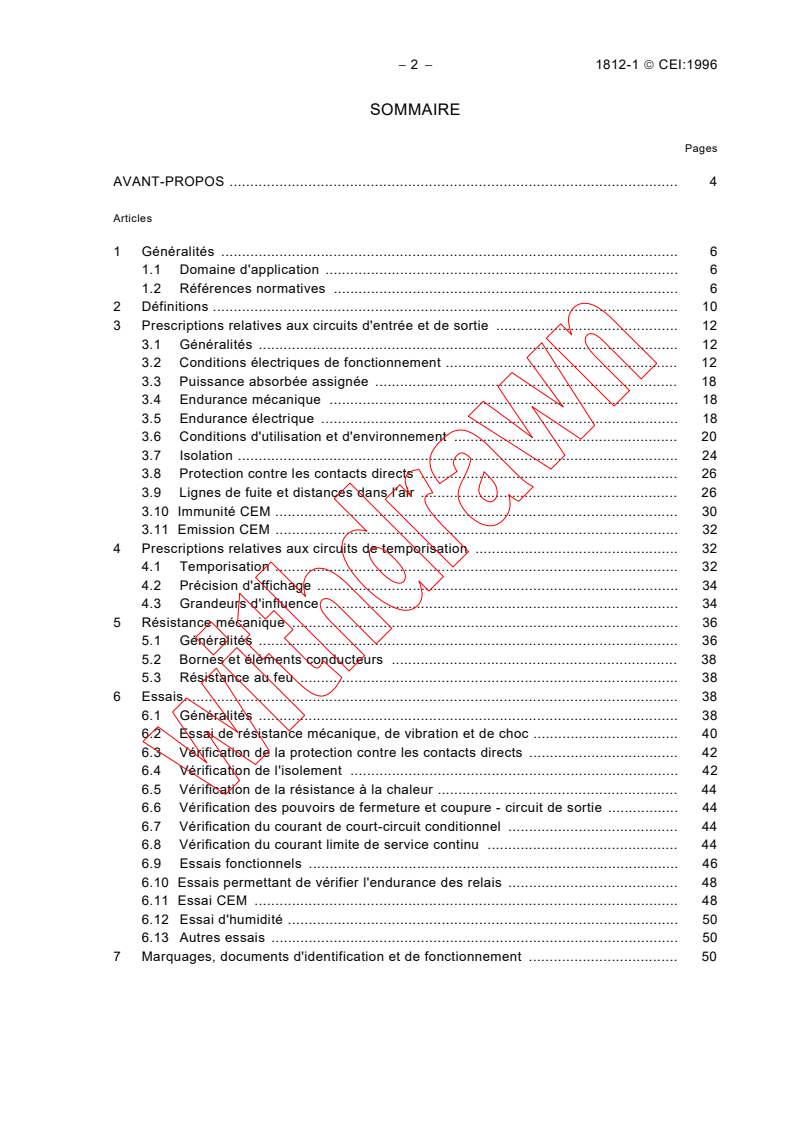
− 2 − 1812-1 CEI:1996
SOMMAIRE
Pages
AVANT-PROPOS . 4
Articles
1 Généralités . 6
1.1 Domaine d'application . 6
1.2 Références normatives . 6
2 Définitions . 10
3 Prescriptions relatives aux circuits d'entrée et de sortie . 12
3.1 Généralités . 12
3.2 Conditions électriques de fonctionnement . 12
3.3 Puissance absorbée assignée . 18
3.4 Endurance mécanique . 18
3.5 Endurance électrique . 18
3.6 Conditions d'utilisation et d'environnement . 20
3.7 Isolation . 24
3.8 Protection contre les contacts directs . 26
3.9 Lignes de fuite et distances dans l'air . 26
3.10 Immunité CEM . 30
3.11 Emission CEM . 32
4 Prescriptions relatives aux circuits de temporisation . 32
4.1 Temporisation . 32
4.2 Précision d'affichage . 34
4.3 Grandeurs d'influence . 34
5 Résistance mécanique . 36
5.1 Généralités . 36
5.2 Bornes et éléments conducteurs . 38
5.3 Résistance au feu . 38
6 Essais. 38
6.1 Généralités . 38
6.2 Essai de résistance mécanique, de vibration et de choc . 40
6.3 Vérification de la protection contre les contacts directs . 42
6.4 Vérification de l'isolement . 42
6.5 Vérification de la résistance à la chaleur . 44
6.6 Vérification des pouvoirs de fermeture et coupure - circuit de sortie . 44
6.7 Vérification du courant de court-circuit conditionnel . 44
6.8 Vérification du courant limite de service continu . 44
6.9 Essais fonctionnels . 46
6.10 Essais permettant de vérifier l'endurance des relais . 48
6.11 Essai CEM . 48
6.12 Essai d'humidité . 50
6.13 Autres essais . 50
7 Marquages, documents d'identification et de fonctionnement . 50
1812-1 IEC:1996 − 3 −
CONTENTS
Page
FOREWORD . 5
Clause
1 General . 7
1.1 Scope . 7
1.2 Normative references . 7
2 Definitions . 11
3 Requirements with regard to input and output circuits . 13
3.1 General . 13
3.2 Electrical operating conditions . 13
3.3 Rated power consumption . 19
3.4 Mechanical endurance . 19
3.5 Electrical endurance . 19
3.6 Operational and environmental conditions . 21
3.7 Insulation . 25
3.8 Protection against direct contact . 27
3.9 Creepage distances and clearances . 27
3.10 EMC immunity . 31
3.11 EMC emission . 33
4 Requirements for timing circuit . 33
4.1 Specified time . 33
4.2 Setting accuracy . 35
4.3 Influencing quantities . 35
5 Mechanical strength . 37
5.1 General . 37
5.2 Terminals and current-carrying parts . 39
5.3 Resistance to fire . 39
6 Tests . 39
6.1 General . 39
6.2 Test of mechanical strength, vibration and shock . 41
6.3 Checking of protection against direct contact . 43
6.4 Checking of insulation . 43
6.5 Checking of resistance to heat . 45
6.6 Checking of making and breaking capacity - output circuit . 45
6.7 Checking of conditional short-circuit current . 45
6.8 Checking of limiting continuous current . 45
6.9 Functional tests . 47
6.10 Tests for checking the endurance of the relays . 49
6.11 EMC test . 49
6.12 Humidity test . 51
6.13 Other tests . 51
7 Markings, identification and operating documents . 51
− 4 − 1812-1 CEI:1996
COMMISSION ÉLECTROTECHNIQUE INTERNATIONALE
_____________
RELAIS À TEMPS SPÉCIFIÉ POUR APPLICATIONS INDUSTRIELLES −
Partie 1: Prescriptions et essais
AVANT-PROPOS
1) La CEI (Commission Electrotechnique Internationale) est une organisation mondiale de normalisation
composée de l'ensemble des comités électrotechniques nationaux (Comités nationaux de la CEI). La CEI a
pour objet de favoriser la coopération internationale pour toutes les questions de normalisation dans les
domaines de l'électricité et de l'électronique. A cet effet, la CEI, entre autres activités, publie des Normes
Internationales. Leur élaboration est confiée à des comités d'études, aux travaux desquels tout Comité
national intéressé par le sujet traité peut participer. Les organisations internationales, gouvernementales et
non gouvernementales, en liaison avec la CEI, participent également aux travaux. La CEI collabore
étroitement avec l'Organisation Internationale de Normalisation (ISO), selon des conditions fixées par accord
entre les deux organisations.
2) Les décisions ou accords officiels de la CEI concernant les questions techniques, représentent, dans la
mesure du possible un accord international sur les sujets étudiés, étant donné que les Comités nationaux
intéressés sont représentés dans chaque comité d’études.
3) Les documents produits se présentent sous la forme de recommandations internationales. Ils sont publiés
comme normes, rapports techniques ou guides et agréés comme tels par les Comités nationaux.
4) Dans le but d'encourager l'unification internationale, les Comités nationaux de la CEI s'engagent à appliquer
de façon transparente, dans toute la mesure possible, les Normes internationales de la CEI dans leurs normes
nationales et régionales. Toute divergence entre la norme de la CEI et la norme nationale ou régionale
correspondante doit être indiquée en termes clairs dans cette dernière.
5) La CEI n’a fixé aucune procédure concernant le marquage comme indication d’approbation et sa
responsabilité n’est pas engagée quand un matériel est déclaré conforme à l’une de ses normes.
6) L’attention est attirée sur le fait que certains des éléments de la présente Norme internationale peuvent faire
l’objet de droits de propriété intellectuelle ou de droits analogues. La CEI ne saurait être tenue pour
responsable de ne pas avoir identifié de tels droits de propriété et de ne pas avoir signalé leur existence.
La Norme internationale CEI 1812-1 a été établie par le comité d'études 94 de la CEI: Relais
électriques de tout-ou-rien.
Le texte de cette norme est issu des documents suivants:
FDIS Rapport de vote
94/45/FDIS 94/49/RVD
Le rapport de vote indiqué dans le tableau ci-dessus donne toute information sur le vote ayant
abouti à l'approbation de cette norme.
1812-1 IEC:1996 − 5 −
INTERNATIONAL ELECTROTECHNICAL COMMISSION
_____________
SPECIFIED TIME RELAYS FOR INDUSTRIAL USE −
Part 1: Requirements and tests
FOREWORD
1) The IEC (International Electrotechnical Commission) is a worldwide organization for standardization
comprising all national electrotechnical committees (IEC National Committees). The object of the IEC is to
promote international co-operation on all questions concerning standardization in the electrical and electronic
fields. To this end and in addition to other activities, the IEC publishes International Standards. Their
preparation is entrusted to technical committees; any IEC National Committee interested in the subject dealt
with may participate in this preparatory work. International, governmental and non-governmental organizations
liaising with the IEC also participate in this preparation. The IEC collaborates closely with the International
Organization for Standardization (ISO) in accordance with conditions determined by agreement between the
two organizations.
2) The formal decisions or agreements of the IEC on technical matters express, as nearly as possible, an
international consensus of opinion on the relevant subjects since each technical committee has representation
from all interested National Committees.
3) The documents produced have the form of recommendations for international use and are published in the
form of standards, technical reports or guides and they are accepted by the National Committees in that
sense.
4) In order to promote international unification, IEC National Committees undertake to apply IEC International
Standards transparently to the maximum extent possible in their national and regional standards. Any
divergence between the IEC Standard and the corresponding national or regional standard shall be clearly
indicated in the latter.
5) The IEC provides no marking procedure to indicate its approval and cannot be rendered responsible for any
equipment declared to be in conformity with one of its standards.
6) Attention is drawn to the possibility that some of the elements of this International Standard may be the
subject of patent rights. The IEC shall not be held responsible for identifying any or all such patent rights.
International Standard IEC 1812-1 has been prepared by IEC technical committee 94: All-or-
nothing electrical relays.
The text of this standard is based on the following documents:
FDIS Report on voting
94/45/FDIS 94/49/RVD
Full information on the voting for the approval of this standard can be found in the report on
voting indicated in the above table.
− 6 − 1812-1 CEI:1996
RELAIS À TEMPS SPÉCIFIÉ POUR APPLICATIONS INDUSTRIELLES −
Partie 1: Prescriptions et essais
1 Généralités
1.1 Domaine d’application
La présente partie de la CEI 1812 s'applique aux relais à temps spécifié, comme les relais
temporisés, selon les définitions indiquées dans la CEI 50(446), utilisés dans les applications
industrielles (par exemple: équipements industriels de commande, d'automatisme et de signali-
sation).
Le terme «relais», utilisé dans cette norme, comprend tous les types de relais avec fonction de
temps spécifié, hormis les relais de mesure.
Selon le champ d'application de ces relais (par exemple: pour la génération, la transmission et
la distribution de l'électricité), des normes différentes peuvent s'appliquer.
1.2 Références normatives
Les documents normatifs suivants contiennent des dispositions qui, par suite de la référence
qui y est faite, constituent des dispositions valables pour la présente partie de la CEI 1812. Au
moment de la publication, les éditions indiquées étaient en vigueur. Tout document normatif est
sujet à révision et les parties prenantes aux accords fondés sur la présente partie de la
CEI 1812 sont invitées à rechercher la possibilité d'appliquer les éditions les plus récentes des
documents normatifs indiqués ci-après. Les membres de la CEI et de l'ISO possèdent le
registre des Normes internationales en vigueur.
CEI 50(441): 1984, Vocabulaire Electrotechnique International (VEI) – Chapitre 441: Appareil-
lage et fusibles
CEI 50(446): 1983, Vocabulaire Electrotechnique International (VEI) – Chapitre 446: Relais
électriques
CEI 60-1: 1989, Techniques des essais à haute tension – Partie 1: Définitions et prescriptions
générales relatives aux essais
CEI 62: 1992, Codes pour le marquage des résistances et des condensateurs
CEI 68-1: 1988, Essais d'environnement – Partie 1: Généralités et guide
CEI 68-2-3: 1969, Essais d'environnement – Partie 2: Essais − Essai Ca: Essai continu de
chaleur humide
CEI 68-2-6: 1995, Essais d'environnement – Partie 2: Essais – Essai Fc: Vibrations
(sinusoïdales)
CEI 68-2-27: 1987, Essais d'environnement – Partie 2: Essais – Essai Ea et guide: Chocs
CEI 85: 1984, Evaluation et classification thermiques de l'isolation électrique
1812-1 IEC:1996 − 7 −
SPECIFIED TIME RELAYS FOR INDUSTRIAL USE −
Part 1: Requirements and tests
1 General
1.1 Scope
This part of IEC 1812 applies to specified time relays, such as time delay relays, in accordance
with definitions as laid down in IEC 50(446), for use in industrial applications (e.g. control,
automation, signal and industrial equipment).
The term “relay” as used in this standard comprises all types of relays, other than measuring
relays, with specified time function.
Depending on the field of application of these relays (e.g. for electricity generation,
transmission and distribution), further standards may be applicable.
1.2 Normative references
The following normative documents contain provisions which, through reference in this text,
constitute provisions of this part of IEC 1812. At the time of publication, the editions indicated
were valid. All normative documents are subject to revision, and parties to agreements based
on this part of IEC 1812 are encouraged to investigate the possibility of applying the most
recent editions of the normative documents indicated below. Members of IEC and ISO maintain
registers of currently valid International Standards.
IEC 50(441): 1984, International Electrotechnical Vocabulary (IEV) – Chapter 441: Switchgear,
controlgear and fuses
IEC 50(446): 1983, International Electrotechnical Vocabulary (IEV) – Chapter 446: Electrical
relays
IEC 60-1: 1989, High-voltage test techniques – Part 1: General definitions and test
requirements
IEC 62: 1992, Marking codes for resistors and capacitors
IEC 68-1: 1988, Environmental testing – Part 1: General and guidance
IEC 68-2-3: 1969, Environmental testing – Part 2: Tests – Test Ca: Damp heat, steady state
IEC 68-2-6: 1995, Environmental testing – Part 2: Tests – Test Fc: Vibration (sinusoidal)
IEC 68-2-27: 1987, Environmental testing – Part 2: Tests – Test Ea and guidance: Shock
IEC 85: 1984, Thermal evaluation and classification of electrical insulation
− 8 − 1812-1 CEI:1996
CEI 112: 1979, Méthode pour déterminer les indices de résistance et de tenue au cheminement
des matériaux isolants solides dans des conditions humides
CEI 529: 1989, Degrés de protection procurés par les enveloppes (Code IP)
CEI 664-1: 1992, Coordination de l'isolement des matériels dans les systèmes (réseaux) à
basse tension – Partie 1: Principes, prescriptions et essais
CEI 664-3: 1992, Coordination de l'isolement des matériels dans les systèmes (réseaux) à
basse tension – Partie 3: Utilisation de revêtements pour réaliser la coordination de l'isolement
des cartes imprimées équipées
CEI 695-2-1/0: 1994, Essais relatifs aux risques de feu – Partie 2: Méthodes d'essai – Section
1/feuille 0: Méthodes d'essai au fil incandescent – Généralités
CEI 695-2-1/1: 1994, Essais relatifs aux risques de feu – Partie 2: Méthodes d'essai – Section
1/feuille 1: Essai au fil incandescent sur produits finis et guide
CEI 695-2-1/2: 1994, Essais relatifs aux risques de feu – Partie 2: Méthodes d'essai – Section
1/feuille 2: Essai d'inflammabilité au fil incandescent sur matériaux
CEI 695-2-1/3: 1994, Essais relatifs aux risques de feu – Partie 2: Méthodes d'essai – Section
1/feuille 3: Essai d'allumabilité au fil incandescent sur matériaux
CEI 721-3-3: 1994, Classification des conditions d'environnement – Partie 3: Classification des
groupements des agents d'environnement et de leurs sévérités – Section 3: Utilisation à poste
fixe, protégé contre les intempéries
CEI 947-1: 1988, Appareillage à basse tension – Partie 1: Règles générales
CEI 947-5-1: 1990, Appareillage à basse tension – Partie 5: Appareils et éléments de commu-
tation pour circuits de commande – Section 1: Appareils électromécaniques pour circuits de
commande
CEI 947-5-2: 1992, Appareillage à basse tension – Partie 5: Appareils et éléments de commu-
tation pour circuits de commande – Section 2: Détecteurs de proximité
CEI 999: 1990, Dispositifs de connexion. Prescriptions de sécurité pour organes de serrage à
vis et sans vis pour conducteurs électriques en cuivre
CEI 1000-4-2: 1995, Compatibilité électromagnétique (CEM) – Partie 4: Techniques d'essai et
de mesure – Section 2: Essai d'immunité aux décharges électrostatiques
CEI 1000-4-3: 1995, Compatibilité électromagnétique (CEM) – Partie 4: Techniques d'essai et
de mesure – Section 3: Essai d'immunité aux champs électromagnétiques rayonnés aux
fréquences radioélectriques
CEI 1000-4-4: 1995, Compatibilité électromagnétique (CEM) – Partie 4: Techniques d'essai et
de mesure – Section 4: Essais d'immunité aux transitoires électriques rapides en salves
CEI 1000-4-5: 1995, Compatibilité électromagnétique (CEM) – Partie 4: Techniques d'essai et
de mesure – Section 5: Essai d'immunité aux ondes de choc
1812-1 IEC:1996 − 9 −
IEC 112: 1979, Method for determining the comparative and the proof tracking indices of solid
insulating materials under moist conditions
IEC 529: 1989, Degrees of protection provided by enclosures (IP code)
IEC 664-1: 1992, Insulation coordination for equipment within low-voltage systems – Part 1:
Principles, requirements and tests
IEC 664-3: 1992, Insulation coordination for equipment within low-voltage systems – Part 3:
Use of coatings to achieve insulation coordination of printed board assemblies
IEC 695-2-1/0: 1994, Fire hazard testing – Part 2: Test methods – Section 1/sheet 0: Glow-
wire test methods – General
IEC 695-2-1/1: 1994, Fire hazard testing – Part 2: Test methods – Section 1/sheet 1: Glow-wire
end-product test and guidance
IEC 695-2-1/2: 1994, Fire hazard testing – Part 2: Test methods – Section 1/sheet 2: Glow-wire
flammability test on materials
IEC 695-2-1/3: 1994, Fire hazard testing – Part 2: Test methods – Section 1/sheet 3: Glow-wire
ignitability test on materials
IEC 721-3-3: 1994, Classification of environmental conditions – Part 3: Classification of groups
of environmental parameters and their severities – Section 3: Stationary use at weather-
protected locations
IEC 947-1: 1988, Low-voltage switchgear and controlgear – Part 1: General rules
IEC 947-5-1: 1990, Low-voltage switchgear and controlgear – Part 5: Control circuit devices
and switching elements – Section 1: Electromechanical control circuit devices
IEC 947-5-2: 1992, Low-voltage switchgear and controlgear – Part 5: Control circuit devices
and switching elements – Section 2: Proximity switches
IEC 999: 1990, Connecting devices − Safety requirements for screw-type and screwless-type
clamping units for electrical copper conductors
IEC 1000-4-2: 1995, Electromagnetic compatibility (EMC) – Part 4: Testing and measurement
techniques – Section 2: Electrostatic discharge immunity test
IEC 1000-4-3: 1995, Electromagnetic compatibility (EMC) – Part 4: Testing and measurement
techniques – Section 3: Radiated, radio-frequency, electromagnetic field immunity test
IEC 1000-4-4: 1995, Electromagnetic compatibility (EMC) – Part 4: Testing and measurement
techniques – Section 4: Electrical fast transient/burst immunity test
IEC 1000-4-5: 1995, Electromagnetic compatibility (EMC) – Part 4: Testing and measurement
techniques – Section 5: Surge immunity test
− 10 − 1812-1 CEI:1996
CISPR 11: 1990, Limites et méthodes de mesure des caractéristiques de perturbations
électromagnétiques des appareils industriels, scientifiques et médicaux (ISM) à fréquence
radioélectrique
CISPR 22: 1993, Limites et méthodes de mesure des caractéristiques de perturbations radio-
électriques produites par les appareils de traitement de l'information
2 Définitions
Pour les besoins de la présente partie de la CEI 1812, les définitions suivantes incluent une
terminologie applicable aux relais à temps spécifié.
Certains des termes utilisés dans cette norme sont définis dans la CEI 50(441) et la
CEI 50(446).
2.1 précision d’affichage: Différence entre la valeur mesurée de la temporisation et la
valeur de référence affichée sur l’échelle.
2.2 effet d’influence: Degré jusqu'où la modification d’un facteur d’influence à l’intérieur de
son domaine nominal exerce une influence sur le temps.
2.3 relais en série avec charge: Relais temporisé à connecter en série à la charge.
2.4 temps de réarmement: Temps nécessaire pour ré-initialiser un relais avec la précision
définie après la suppression de la grandeur d’alimentation d’entrée. [VEI 446-17-21, modifié]
2.5 impulsion de commande minimale: Temps minimal requis pour la grandeur
d’alimentation d’entrée afin de réaliser le cycle.
2.6 fidélité de répétition: Différence entre les limites supérieures et inférieures de l'inter-
valle de confiance déterminée à partir de plusieurs mesures de temps d'un relais à temps
spécifié dans des conditions établies identiques. La fidélité de répétition est indiquée de
préférence sous la forme d’un pourcentage de la valeur moyenne de toutes les valeurs
mesurées.
2.7 courant de court-circuit conditionnel: Courant présumé qu’un circuit ou un appareil de
connexion protégé par un dispositif spécifié de protection contre les courts-circuits peut
supporter de façon satisfaisante pendant la durée totale de fonctionnement de ce dispositif
dans des conditions spécifiées d’emploi et de comportement (voir 2.5.29 de la CEI 947-1).
2.8 chute de tension: Tension mesurée au niveau de la sortie active d’un relais à temps
spécifié supportant le courant de charge dans des conditions établies (voir 4.3.1.4, modifié de
la CEI 947-5-2).
2.9 courant de fuite: Courant circulant à travers le circuit de charge d’un relais à temps
spécifié à l’état bloqué (voir 2.4.5.1, modifié de la CEI 947-5-2).
2.10 courant de courte durée admissible: Courant pouvant être supporté par un circuit de
sortie d’un relais à temps spécifié en position fermée, pendant une courte durée spécifiée dans
les conditions d’utilisation et de fonctionnement prescrites. [VEI 441-17-17, modifié]
2.11 temps spécifié: Caractéristique spécifiée d’un relais pour un type de fonction donné, par
exemple le temps de fonctionnement, le temps de relâchement, le temps d’effacement, le
temps d’impulsion, l’intervalle. [VEI 446-17-14, modifié]
1812-1 IEC:1996 − 11 −
CISPR 11: 1990, Limits and methods of measurement of electromagnetic disturbance
characteristics of industrial, scientific and medical (ISM) radio-frequency equipment
CISPR 22: 1993, Limits and methods of measurement of radio disturbance characteristics of
information technology equipment
2 Definitions
For the purpose of this part of IEC 1812, the following definitions contain terminology
applicable to specified time relays.
Some of the terms used in this standard are defined in IEC 50(441) and IEC 50(446).
2.1 setting accuracy: Difference between the measured value of the specified time and the
reference value set on the scale.
2.2 effect of influence: Degree to which the change of an influencing factor within its
nominal range has an effect on the specified time.
2.3 load series relay: Time delay relay to be connected in series with the load.
2.4 recovery time: Necessary time to start the relay again with the defined accuracy after
the input energizing quantity has been taken away. [IEV 446-17-21, modified]
2.5 minimum control pulse: Shortest time of the input energizing quantity to start and
complete the time function.
2.6 repeatability: Difference between the upper and lower limits of the confidence range
from several time measurements of a specified time relay under identical stated conditions.
Preferably the repeatability is indicated as a percentage of the mean value of all measured
values.
2.7 conditional short-circuit current: Prospective current that a circuit or a switching
device, protected by a specified short-circuit protective device, can satisfactorily withstand for
the total operating time of that device under specified conditions of use and behaviour (see
2.5.29 of IEC 947-1).
2.8 voltage drop: Voltage measured across the active output of a specified time relay, when
carrying the load current under stated conditions (see 4.3.1.4, modified of IEC 947-5-2).
2.9 off-state current: Current which flows through the load circuit of a specified time relay in
the off-state (see 2.4.5.1, modified of IEC 947-5-2).
2.10 short-time withstand current: Current that an output circuit of a specified time relay in
the closed position can carry during a specified short time under prescribed conditions of use
and behaviour. [IEV 441-17-17, modified]
2.11 specified time: Specified characteristic of a relay at a given type of function, e.g.
operation time, release time, wiping time, impulse time, interval. [IEV 446-17-14, modified]
− 12 − 1812-1 CEI:1996
2.12 accès de puissance: Point du relais à temps spécifié auquel la tension d'alimentation
(alternative ou continue) est raccordée.
2.13 accès de commande: Accès additionnel pour le démarrage des fonctions en présence
de la tension d'alimentation ou le raccordement d'un potentiomètre externe etc.
2.14 accès de sortie: Accès relié à des sorties statiques ou à des contacts de relais.
2.15 accès par l'enveloppe: Frontière physique de l'appareil à travers laquelle les champs
électromagnétiques peuvent rayonner ou à laquelle ils peuvent se heurter.
Accès par l'enveloppe
Relais
Accès de puissance à Accès de sortie
temps spécifié
Accès de commande
(si existant)
Figure 1 − Définition des accès
3 Prescriptions relatives aux circuits d’entrée et de sortie
3.1 Généralités
Les valeurs numériques indiquées dans cette norme sont des valeurs normalisées recom-
mandées ou des valeurs pratiques typiques relatives aux relais électroniques et électro-
mécaniques à temps spécifié en l’état actuel des connaissances. Il est recommandé de faire
confirmer par le fabricant que les valeurs réelles correspondantes pour tout produit spécifique
sont conformes à cette norme ou les décrire explicitement si elles s’écartent de cette norme.
3.2 Conditions électriques de fonctionnement
3.2.1 Circuit d’entrée [VEI 446-12-05]
3.2.1.1 Tension d'alimentation assignée
La grandeur d’alimentation d'entrée [VEI 446-12-01] et/ou la grandeur d’alimentation auxiliaire
[VEI 446-12-03], permet au relais de remplir la fonction.
Si les valeurs assignées des grandeurs d’alimentation d'entrée et d'alimentation auxiliaire sont
différentes, elles doivent être indiquées.
1812-1 IEC:1996 − 13 −
2.12 power port: Point at which the supply voltage (either a.c. or d.c.) is connected to the
specified time relay.
2.13 control port: Additional port for the starting of functions whilst supply voltage is applied,
or for the connection of a remote potentiometer, etc.
2.14 output port: Port containing relay contacts or static contacts.
2.15 enclosure port: Physical boundary of the specified time relay through which
electromagnetic fields may radiate or impinge.
Enclosure port
Sepcified-time
Power port Output port
relay
Control port
(if any)
Figure 1 – Definition of ports
3 Requirements with regard to input and output circuits
3.1 General
The numerical values given in this standard are either recommended standard values or typical
practical values for electronic and electromechanical specified time relays at the known state of
the art. The corresponding actual values for any specific product should be confirmed by the
manufacturer as complying with this standard or quoted explicitly if they deviate from this
standard.
3.2 Electrical operating conditions
3.2.1 Input circuit [IEV 446-12-05]
3.2.1.1 Rated voltage
The input energizing quantity [IEV 446-12-01] and/or auxiliary energizing quantity [IEV 446-12-03]
enable the relay to complete the function.
Should the rated values of input and auxiliary energizing quantities differ, said values shall be
indicated.
− 14 − 1812-1 CEI:1996
Tableau 1 – Valeurs préférentielles de tension assignée
Tension c.c. V 12 24 − 48 60 110 125 220 −−
Tension c.a. V − 24 42 48 − 110 127 − 230 240
(valeurs efficaces)
NOTE – Il est permis d’utiliser d’autres valeurs pour des applications particulières.
3.2.1.1.1 Les relais doivent fonctionner correctement lorsqu’ils sont alimentés de façon
permanente dans les limites de fonctionnement suivantes:
− 80 % à 110 %
ou
− 85 % à 110 %
ou
− 90 % à 110 %
de la tension d’entrée assignée.
3.2.1.1.2 Valeur de dégagement de la tension d’entrée [VEI 446-15-08, modifié]
La valeur de dégagement de la tension d’entrée pour les relais à temps spécifié ne doit pas
être inférieure à 10 % de la tension assignée.
NOTE – Des valeurs plus élevées peuvent être déterminées par accord entre le fabricant et l'utilisateur.
3.2.2 Fréquence assignée
f : 50 Hz, 60 Hz; écarts permis ±1 Hz.
n
3.2.3 Circuit de sortie [VEI 446-16-01]
3.2.3.1 Circuit de sortie électromécanique
3.2.3.1.1 Les contacts des relais utilisés dans le circuit de sortie sont caractérisés par le
pouvoir de fermeture et de coupure (voir 3.2.3.1.5).
NOTE – Il est possible d’attribuer différents couples de valeurs de tension assignée et de courant de
fonctionnement assigné à un contact de relais.
3.2.3.1.2 Tensions assignées des circuits de sortie
Selon le tableau 1.
3.2.3.1.3 Valeurs assignées pour le courant limite de service continu I
th
[VEI 446-16-17, modifié]
Valeurs préférentielles: 0,5 A; 1 A; 2 A; 3 A; 4 A; 5 A; 8 A; 10 A et 15 A.
1812-1 IEC:1996 − 15 −
Table 1 – Preferred values of rated voltage
DC voltage V 12 24 48 60 110 125 220
− −−
AC voltage V − 24 42 48 − 110 127 − 230 240
(r.m.s. values)
NOTE – Other values may be used for particular applications.
3.2.1.1.1 The relays shall operate properly when they are permanently energized within the
following operating limits:
− 80 % to 110 %
or
− 85 % to 110 %
or
− 90 % to 110 %
of the rated input voltage.
3.2.1.1.2 Disengaging value of input voltage [IEV 446-15-08, modified]
The disengaging value of the input voltage for specified time relays shall be not inferior to 10 %
of the rated voltage.
NOTE – Higher values can be stated upon agreement between manufacturer and user.
3.2.2 Rated frequency
f : 50 Hz, 60 Hz; permissible deviations ±1 Hz.
n
3.2.3 Output circuit [IEV 446-16-01]
3.2.3.1 Electromechanical output circuit
3.2.3.1.1 The relay contacts which are arranged in the output circuit are characterized by
making and breaking capacity (see 3.2.3.1.5).
NOTE – Varying pairs of rated voltage and rated operating current values may be assigned to a relay contact.
3.2.3.1.2 Rated voltages of output circuits
According to table 1.
3.2.3.1.3 Rated values for limiting continuous current I [IEV 446-16-17, modified]
th
Preferred values: 0,5 A; 1 A; 2 A; 3 A; 4 A; 5 A; 8 A; 10 A and 15 A.
− 16 − 1812-1 CEI:1996
3.2.3.1.4 Courant de court-circuit conditionnel
Lorsqu’il est protégé par un fusible, le courant limite admis de courte durée du relais doit être
adapté aux caractéristiques du fusible choisi et à la spécification du fabricant, par exemple une
fusion rapide de 6,3 A.
3.2.3.1.5 Catégories d’utilisation des éléments de commutation
Les catégories d’utilisation déclarées par le fabricant doivent être établies en conformité avec
le tableau 1 de la CEI 947-5-1. Pour faire référence aux catégories d’utilisation d’un contact de
relais, il n’est pas nécessaire d’indiquer le pouvoir de fermeture assigné ni le pouvoir de
coupure assigné, ces valeurs étant déterminées par les catégories d’utilisation en conformité
avec les tableaux 4 et 5 dans la CEI 947-5-1.
3.2.3.2 Circuit de sortie statique
3.2.3.2.1 Les sorties statiques possèdent les caractéristiques suivantes:
3.2.3.2.2 Tensions assignées des circuits de sortie
Selon le tableau 1.
3.2.3.2.3 Valeurs assignées pour le courant limite de service continu I
th
[VEI 446-16-17, modifié]
Valeurs préférentielles: 0,1 A; 0,5 A et 1 A.
3.2.3.2.4 Courant de court-circuit conditionnel
Selon 3.2.3.1.4.
3.2.3.2.5 Catégories d’utilisation pour les éléments de commutation
Les catégories d’utilisation sont conformes au tableau 2 de la CEI 947-5-2. Pour faire référence
aux catégories d’utilisation d’une sortie statique, il n’est pas nécessaire d’indiquer le pouvoir de
fonctionnement assigné, ces valeurs étant déterminées par les catégories d’utilisation en
conformité avec les tableaux 4 et 5 de cette norme.
3.2.3.2.6 Chute de tension
Le fabricant doit indiquer la valeur maximale de la chute de tension pour un courant de charge
assigné.
3.2.3.2.7 Courant de fuite
Le fabricant doit établir la valeur maximale du courant de fuite à la température ambiante
maximale déclarée.
Courant de courte durée admissible
3.2.3.2.8
Le fabricant doit indiquer cette valeur pour une durée de 10 ms.
1812-1 IEC:1996 − 17 −
3.2.3.1.4 Conditional short-circuit current
When protected by a fuse, the acceptable limiting short-time current of the relay shall be in
accordance with the characteristics of the chosen fuse and the specification of the
manufacturer, e.g. 6,3 A quick response.
3.2.3.1.5 Utilization categories for switching elements
Utilization categories declared by the manufacturer shall be stated in accordance with table 1
of IEC 947-5-1. When indicating the utilization categories of a relay contact, the rated making
capacity and the rated breaking capacity need not be given, as these values are determined by
the utilization categories in accordance with tables 4 and 5 in IEC 947-5-1.
3.2.3.2 Static output circuit
3.2.3.2.1 The static outputs have the following characteristics:
3.2.3.2.2 Rated voltage of output circuits
According to table 1.
3.2.3.2.3 Rated values for limiting continuous current I [IEV 446-16-17, modified]
th
Prefe
...