

IEC 62056-5-3:2023
(Main)Electricity metering data exchange - The DLMS®/COSEM suite - Part 5-3: DLMS®/COSEM application layer
- Abstract
IEC 62056-5-3:2023 specifies the DLMS®/COSEM application layer in terms of structure, services and protocols for DLMS®/COSEM clients and servers, and defines rules to specify the DLMS®/COSEM communication profiles.
It defines services for establishing and releasing application associations, and data communication services for accessing the methods and attributes of COSEM interface objects, defined in IEC 62056-6-2:2021 using either logical name (LN) or short name (SN) referencing.
Annex A (normative) defines how to use the COSEM application layer in various communication profiles. It specifies how various communication profiles can be constructed for exchanging data with metering equipment using the COSEM interface model, and what are the necessary elements to specify in each communication profile. The actual, media-specific communication profiles are specified in separate parts of the IEC 62056 series.
Annex B (normative) specifies the SMS short wrapper.
Annex C (normative) specifies the gateway protocol.
Annex D, Annex E and Annex F (informative) include encoding examples for APDUs.
Annex G (normative) provides NSA Suite B elliptic curves and domain parameters.
Annex H (informative) provides an example of an End entity signature certificate using P-256 signed with P-256.
Annex I (normative) specifies the use of key agreement schemes in DLMS®/COSEM.
Annex J (informative) provides examples of exchanging protected xDLMS APDUs between a third party and a server.
This fourth edition cancels and replaces the third edition published in 2017. This edition constitutes a technical revision.
The significant technical changes with respect to the previous edition are listed in Annex K (Informative).
- Status
- Published
- Publication Date
- 27-Sep-2023
- Technical Committee
- TC 13 - Electrical energy measurement and control
- Drafting Committee
- WG 14 - TC 13/WG 14
- Current Stage
- PPUB - Publication issued
- Start Date
- 28-Sep-2023
- Completion Date
- 11-Aug-2023
Overview
IEC 62056-5-3:2023 is the international standard specifying the DLMS®/COSEM application layer for electricity metering data exchange. As part of the IEC 62056 suite, this fourth edition updates and replaces the 2017 version, providing a comprehensive framework for structuring, servicing, and protocol handling between DLMS®/COSEM clients and servers. The standard defines rules and mechanisms to facilitate reliable and secure data communication with metering equipment through the COSEM interface model.
It extensively covers the establishment and release of application associations, as well as data services for accessing methods and attributes of COSEM interface objects based on logical name (LN) or short name (SN) referencing. This ensures interoperability in smart grid and advanced metering infrastructures by supporting multiple communication profiles tailored to media-specific environments.
Key Topics
DLMS®/COSEM Application Structure
The standard outlines the application layer's structure including services for connection management, data transfer, and message integrity between metering systems.Communication Profiles and Protocols
Annex A details the construction of communication profiles essential for data exchange using COSEM, while media-specific profiles are defined in other parts of the IEC 62056 series.Security and Cryptography
IEC 62056-5-3 integrates robust security features, including authentication, data confidentiality, cryptographic keys management, and suite B elliptic curve parameters (Annex G). The document specifies how to protect xDLMS application protocol data units (APDUs) and defines security contexts covering symmetric and public key algorithms.Service Specifications
A broad array of application services are standardized such as OPEN, RELEASE, ABORT, GET, SET, ACTION, ACCESS, and notification services ensuring flexible and reliable meter communication.Message and Protocol Handling
Detailed protocol definitions include APDU encoding, service negotiation, confirmed/unconfirmed service invocations, and general block data transfer mechanisms, supporting interoperability for meter reading and control.Annexes and Examples
Normative annexes provide implementation details such as SMS short wrapper (Annex B), gateway protocol (Annex C), and cryptographic key agreement schemes (Annex I). Informative annexes illustrate APDU encoding examples and protected data exchange scenarios.
Applications
IEC 62056-5-3:2023 applies primarily to the domain of electricity metering and smart grid communications. Key applications include:
Smart Metering Systems
Enables standardized data exchange between smart meters and utility data management systems, facilitating remote meter reading, tariff management, and demand response.Metering Equipment Interoperability
Supports diverse meter types and manufacturers by defining uniform application layer protocols, helping utilities to integrate multi-vendor equipment.Advanced Metering Infrastructure (AMI)
Enhances security and service reliability for AMI deployments by prescribing cryptographic protections and secure application-layer services.Energy Management Systems
Enables real-time data collection and control for energy monitoring, consumption analysis, and load balancing in residential, commercial, and industrial environments.Third-Party Data Access
Facilitates secure data exchange mechanisms allowing authorized third parties to access metering data with defined access rights, improving transparency and innovation in energy services.
Related Standards
IEC 62056-5-3:2023 is part of the comprehensive IEC 62056 DLMS®/COSEM series, which includes:
IEC 62056-6-2:2021
Defines COSEM interface object models referenced by the application layer for standardized object attribute and method access.Other parts of IEC 62056 that outline physical and data link layers, media-specific communication profiles, and transport protocols to enable end-to-end metering communication.
Cryptographic and Security Standards
The standard references cryptographic algorithms and security concepts aligned with international best practices for public key infrastructure (PKI) and symmetric key encryption.Electricity Metering and Communication Protocols
Complements related standards for smart meters and communication technologies, ensuring interoperability across different network infrastructures.
IEC 62056-5-3:2023 offers a vital foundation for efficient, secure, and flexible electricity metering communication systems, promoting interoperability and innovation within the global energy sector. Its detailed protocol specifications and security framework make it an essential standard for utilities, meter manufacturers, system integrators, and software developers focused on smart metering solutions.
Relations
- Effective Date
- 05-Sep-2023
Get Certified
Connect with accredited certification bodies for this standard

BSI Group
BSI (British Standards Institution) is the business standards company that helps organizations make excellence a habit.

DIBt (Deutsches Institut für Bautechnik)
German Institute for Building Technology.
DIN CERTCO
DIN Group product certification.
Sponsored listings
Frequently Asked Questions
IEC 62056-5-3:2023 is a standard published by the International Electrotechnical Commission (IEC). Its full title is "Electricity metering data exchange - The DLMS®/COSEM suite - Part 5-3: DLMS®/COSEM application layer". This standard covers: IEC 62056-5-3:2023 specifies the DLMS®/COSEM application layer in terms of structure, services and protocols for DLMS®/COSEM clients and servers, and defines rules to specify the DLMS®/COSEM communication profiles. It defines services for establishing and releasing application associations, and data communication services for accessing the methods and attributes of COSEM interface objects, defined in IEC 62056-6-2:2021 using either logical name (LN) or short name (SN) referencing. Annex A (normative) defines how to use the COSEM application layer in various communication profiles. It specifies how various communication profiles can be constructed for exchanging data with metering equipment using the COSEM interface model, and what are the necessary elements to specify in each communication profile. The actual, media-specific communication profiles are specified in separate parts of the IEC 62056 series. Annex B (normative) specifies the SMS short wrapper. Annex C (normative) specifies the gateway protocol. Annex D, Annex E and Annex F (informative) include encoding examples for APDUs. Annex G (normative) provides NSA Suite B elliptic curves and domain parameters. Annex H (informative) provides an example of an End entity signature certificate using P-256 signed with P-256. Annex I (normative) specifies the use of key agreement schemes in DLMS®/COSEM. Annex J (informative) provides examples of exchanging protected xDLMS APDUs between a third party and a server. This fourth edition cancels and replaces the third edition published in 2017. This edition constitutes a technical revision. The significant technical changes with respect to the previous edition are listed in Annex K (Informative).
IEC 62056-5-3:2023 specifies the DLMS®/COSEM application layer in terms of structure, services and protocols for DLMS®/COSEM clients and servers, and defines rules to specify the DLMS®/COSEM communication profiles. It defines services for establishing and releasing application associations, and data communication services for accessing the methods and attributes of COSEM interface objects, defined in IEC 62056-6-2:2021 using either logical name (LN) or short name (SN) referencing. Annex A (normative) defines how to use the COSEM application layer in various communication profiles. It specifies how various communication profiles can be constructed for exchanging data with metering equipment using the COSEM interface model, and what are the necessary elements to specify in each communication profile. The actual, media-specific communication profiles are specified in separate parts of the IEC 62056 series. Annex B (normative) specifies the SMS short wrapper. Annex C (normative) specifies the gateway protocol. Annex D, Annex E and Annex F (informative) include encoding examples for APDUs. Annex G (normative) provides NSA Suite B elliptic curves and domain parameters. Annex H (informative) provides an example of an End entity signature certificate using P-256 signed with P-256. Annex I (normative) specifies the use of key agreement schemes in DLMS®/COSEM. Annex J (informative) provides examples of exchanging protected xDLMS APDUs between a third party and a server. This fourth edition cancels and replaces the third edition published in 2017. This edition constitutes a technical revision. The significant technical changes with respect to the previous edition are listed in Annex K (Informative).
IEC 62056-5-3:2023 is classified under the following ICS (International Classification for Standards) categories: 17.220 - Electricity. Magnetism. Electrical and magnetic measurements; 35.110 - Networking; 91.140.50 - Electricity supply systems. The ICS classification helps identify the subject area and facilitates finding related standards.
IEC 62056-5-3:2023 has the following relationships with other standards: It is inter standard links to IEC 62056-5-3:2017. Understanding these relationships helps ensure you are using the most current and applicable version of the standard.
IEC 62056-5-3:2023 is available in PDF format for immediate download after purchase. The document can be added to your cart and obtained through the secure checkout process. Digital delivery ensures instant access to the complete standard document.
Standards Content (Sample)
IEC 62056-5-3 ®
Edition 4.0 2023-09
INTERNATIONAL
STANDARD
NORME
INTERNATIONALE
colour
inside
Electricity metering data exchange – The DLMS®/COSEM suite –
Part 5-3: DLMS®/COSEM application layer
Échange des données de comptage de l'électricité – La suite DLMS®/COSEM –
Partie 5-3: Couche application DLMS®/COSEM
All rights reserved. Unless otherwise specified, no part of this publication may be reproduced or utilized in any form
or by any means, electronic or mechanical, including photocopying and microfilm, without permission in writing from
either IEC or IEC's member National Committee in the country of the requester. If you have any questions about IEC
copyright or have an enquiry about obtaining additional rights to this publication, please contact the address below or
your local IEC member National Committee for further information.
Droits de reproduction réservés. Sauf indication contraire, aucune partie de cette publication ne peut être reproduite ni
utilisée sous quelque forme que ce soit et par aucun procédé, électronique ou mécanique, y compris la photocopie et
les microfilms, sans l'accord écrit de l'IEC ou du Comité national de l'IEC du pays du demandeur. Si vous avez des
questions sur le copyright de l'IEC ou si vous désirez obtenir des droits supplémentaires sur cette publication, utilisez
les coordonnées ci-après ou contactez le Comité national de l'IEC de votre pays de résidence.
IEC Secretariat Tel.: +41 22 919 02 11
3, rue de Varembé info@iec.ch
CH-1211 Geneva 20 www.iec.ch
Switzerland
About the IEC
The International Electrotechnical Commission (IEC) is the leading global organization that prepares and publishes
International Standards for all electrical, electronic and related technologies.
About IEC publications
The technical content of IEC publications is kept under constant review by the IEC. Please make sure that you have the
latest edition, a corrigendum or an amendment might have been published.
IEC publications search - webstore.iec.ch/advsearchform IEC Products & Services Portal - products.iec.ch
The advanced search enables to find IEC publications by a Discover our powerful search engine and read freely all the
variety of criteria (reference number, text, technical publications previews. With a subscription you will always have
committee, …). It also gives information on projects, replaced access to up to date content tailored to your needs.
and withdrawn publications.
Electropedia - www.electropedia.org
IEC Just Published - webstore.iec.ch/justpublished
The world's leading online dictionary on electrotechnology,
Stay up to date on all new IEC publications. Just Published
containing more than 22 300 terminological entries in English
details all new publications released. Available online and once
and French, with equivalent terms in 19 additional languages.
a month by email.
Also known as the International Electrotechnical Vocabulary
(IEV) online.
IEC Customer Service Centre - webstore.iec.ch/csc
If you wish to give us your feedback on this publication or need
further assistance, please contact the Customer Service
Centre: sales@iec.ch.
A propos de l'IEC
La Commission Electrotechnique Internationale (IEC) est la première organisation mondiale qui élabore et publie des
Normes internationales pour tout ce qui a trait à l'électricité, à l'électronique et aux technologies apparentées.
A propos des publications IEC
Le contenu technique des publications IEC est constamment revu. Veuillez vous assurer que vous possédez l’édition la
plus récente, un corrigendum ou amendement peut avoir été publié.
Recherche de publications IEC - IEC Products & Services Portal - products.iec.ch
webstore.iec.ch/advsearchform Découvrez notre puissant moteur de recherche et consultez
La recherche avancée permet de trouver des publications IEC gratuitement tous les aperçus des publications. Avec un
en utilisant différents critères (numéro de référence, texte, abonnement, vous aurez toujours accès à un contenu à jour
comité d’études, …). Elle donne aussi des informations sur les adapté à vos besoins.
projets et les publications remplacées ou retirées.
Electropedia - www.electropedia.org
IEC Just Published - webstore.iec.ch/justpublished
Le premier dictionnaire d'électrotechnologie en ligne au monde,
Restez informé sur les nouvelles publications IEC. Just
avec plus de 22 300 articles terminologiques en anglais et en
Published détaille les nouvelles publications parues.
français, ainsi que les termes équivalents dans 19 langues
Disponible en ligne et une fois par mois par email.
additionnelles. Egalement appelé Vocabulaire
Electrotechnique International (IEV) en ligne.
Service Clients - webstore.iec.ch/csc
Si vous désirez nous donner des commentaires sur cette
publication ou si vous avez des questions contactez-nous:
sales@iec.ch.
IEC 62056-5-3 ®
Edition 4.0 2023-09
INTERNATIONAL
STANDARD
NORME
INTERNATIONALE
colour
inside
Electricity metering data exchange – The DLMS®/COSEM suite –
Part 5-3: DLMS®/COSEM application layer
Échange des données de comptage de l'électricité – La suite DLMS®/COSEM –
Partie 5-3: Couche application DLMS®/COSEM
INTERNATIONAL
ELECTROTECHNICAL
COMMISSION
COMMISSION
ELECTROTECHNIQUE
INTERNATIONALE
ICS 17.220, 35.110, 91.140.50 ISBN 978-2-8322-7223-7
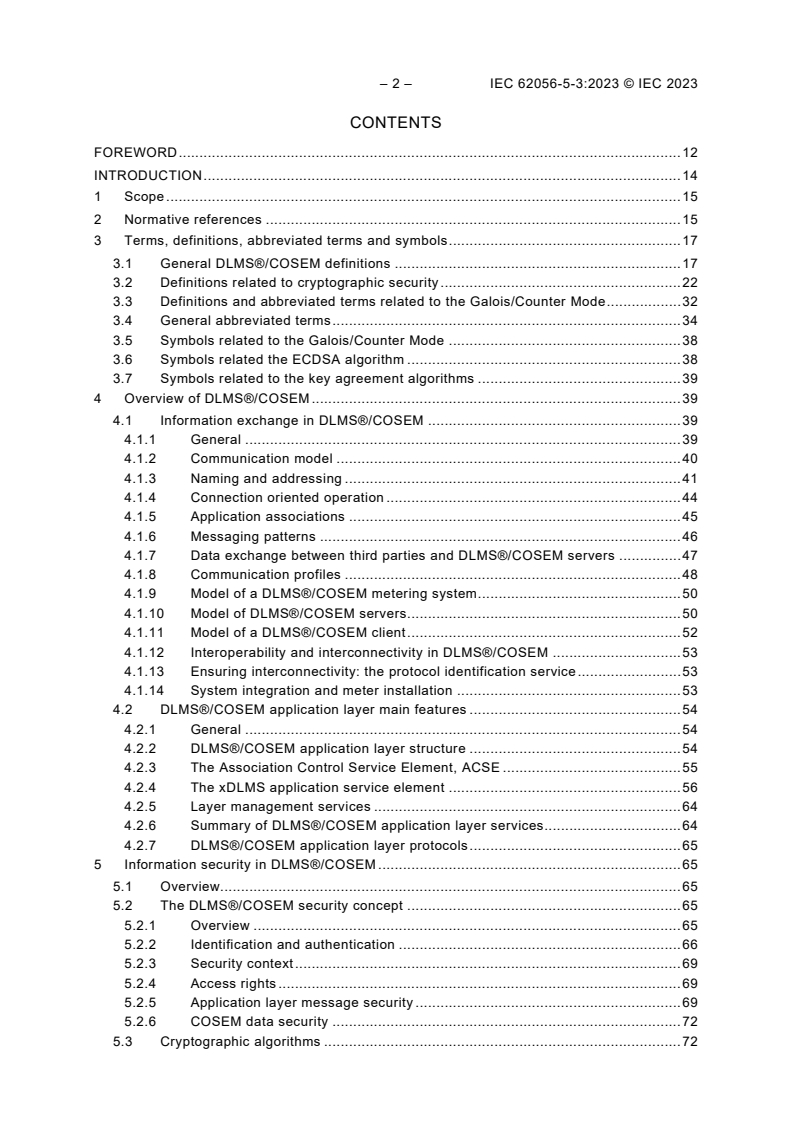
– 2 – IEC 62056-5-3:2023 © IEC 2023
CONTENTS
FOREWORD . 12
INTRODUCTION . 14
1 Scope . 15
2 Normative references . 15
3 Terms, definitions, abbreviated terms and symbols . 17
3.1 General DLMS®/COSEM definitions . 17
3.2 Definitions related to cryptographic security . 22
3.3 Definitions and abbreviated terms related to the Galois/Counter Mode . 32
3.4 General abbreviated terms . 34
3.5 Symbols related to the Galois/Counter Mode . 38
3.6 Symbols related the ECDSA algorithm . 38
3.7 Symbols related to the key agreement algorithms . 39
4 Overview of DLMS®/COSEM . 39
4.1 Information exchange in DLMS®/COSEM . 39
4.1.1 General . 39
4.1.2 Communication model . 40
4.1.3 Naming and addressing . 41
4.1.4 Connection oriented operation . 44
4.1.5 Application associations . 45
4.1.6 Messaging patterns . 46
4.1.7 Data exchange between third parties and DLMS®/COSEM servers . 47
4.1.8 Communication profiles . 48
4.1.9 Model of a DLMS®/COSEM metering system . 50
4.1.10 Model of DLMS®/COSEM servers . 50
4.1.11 Model of a DLMS®/COSEM client . 52
4.1.12 Interoperability and interconnectivity in DLMS®/COSEM . 53
4.1.13 Ensuring interconnectivity: the protocol identification service . 53
4.1.14 System integration and meter installation . 53
4.2 DLMS®/COSEM application layer main features . 54
4.2.1 General . 54
4.2.2 DLMS®/COSEM application layer structure . 54
4.2.3 The Association Control Service Element, ACSE . 55
4.2.4 The xDLMS application service element . 56
4.2.5 Layer management services . 64
4.2.6 Summary of DLMS®/COSEM application layer services . 64
4.2.7 DLMS®/COSEM application layer protocols . 65
5 Information security in DLMS®/COSEM . 65
5.1 Overview. 65
5.2 The DLMS®/COSEM security concept . 65
5.2.1 Overview . 65
5.2.2 Identification and authentication . 66
5.2.3 Security context . 69
5.2.4 Access rights . 69
5.2.5 Application layer message security . 69
5.2.6 COSEM data security . 72
5.3 Cryptographic algorithms . 72
5.3.1 Overview . 72
5.3.2 Hash function . 72
5.3.3 Symmetric key algorithms . 73
5.3.4 Public key algorithms . 80
5.3.5 Random number generation . 90
5.3.6 Compression . 91
5.3.7 Security suite . 91
5.4 Cryptographic keys – overview . 92
5.5 Key used with symmetric key algorithms . 92
5.5.1 Symmetric keys types . 92
5.5.2 Key information with general-ciphering APDU and data protection . 94
5.5.3 Key identification . 94
5.5.4 Key wrapping . 95
5.5.5 Key agreement . 95
5.5.6 Symmetric key cryptoperiods . 96
5.6 Keys used with public key algorithms . 96
5.6.1 Overview . 96
5.6.2 Key pair generation . 96
5.6.3 Public key certificates and infrastructure . 97
5.6.4 Certificate and certificate extension profile . 100
5.6.5 Suite B end entity certificate types to be supported by DLMS®/COSEM
servers . 108
5.6.6 Management of certificates . 108
5.7 Applying cryptographic protection . 113
5.7.1 Overview . 113
5.7.2 Protecting xDLMS APDUs . 113
5.7.3 Multi-layer protection by multiple parties . 126
5.7.4 HLS authentication mechanisms . 127
5.7.5 Protecting COSEM data . 130
6 DLMS®/COSEM application layer service specification . 131
6.1 Service primitives and parameters . 131
6.2 The COSEM-OPEN service . 133
6.3 The COSEM-RELEASE service . 138
6.4 COSEM-ABORT service . 141
6.5 Protection and general block transfer parameters . 141
6.6 The GET service . 146
6.7 The SET service . 149
6.8 The ACTION service . 153
6.9 The ACCESS service . 156
6.9.1 Overview – Main features . 156
6.9.2 Service specification . 158
6.10 The DataNotification service . 162
6.11 The EventNotification service . 164
6.12 The TriggerEventNotificationSending service . 165
6.13 Variable access specification . 166
6.14 The Read service . 166
6.15 The Write service . 170
6.16 The UnconfirmedWrite service . 173
6.17 The InformationReport service . 175
– 4 – IEC 62056-5-3:2023 © IEC 2023
6.18 Client side layer management services: the SetMapperTable.request . 176
6.19 Summary of services and LN/SN data transfer service mapping . 176
7 DLMS®/COSEM application layer protocol specification . 177
7.1 The control function . 177
7.1.1 State definitions of the client side control function . 177
7.1.2 State definitions of the server side control function . 179
7.2 The ACSE services and APDUs . 181
7.2.1 ACSE functional units, services and service parameters . 181
7.2.2 Registered COSEM names . 184
7.2.3 APDU encoding rules . 187
7.2.4 Protocol for application association establishment . 187
7.2.5 Protocol for application association release . 193
7.3 Protocol for the data transfer services . 196
7.3.1 Negotiation of services and options – the conformance block . 196
7.3.2 Confirmed and unconfirmed service invocations . 197
7.3.3 Protocol for the GET service . 199
7.3.4 Protocol for the SET service . 202
7.3.5 Protocol for the ACTION service . 205
7.3.6 Protocol for the ACCESS service . 207
7.3.7 Protocol of the DataNotification service . 208
7.3.8 Protocol for the EventNotification service . 211
7.3.9 Protocol for the Read service . 212
7.3.10 Protocol for the Write service . 215
7.3.11 Protocol for the UnconfirmedWrite service . 219
7.3.12 Protocol for the InformationReport service . 220
7.3.13 Protocol of general block transfer mechanism . 221
7.3.14 Protocol of exception mechanism . 243
8 Abstract syntax of ACSE and COSEM APDUs . 244
9 COSEM APDU XML schema . 263
9.1 General . 263
9.2 XML Schema . 263
Annex A (normative) Using the DLMS®/COSEM application layer in various
communications profiles . 285
A.1 General . 285
A.2 Targeted communication environments . 285
A.3 The structure of the profile . 285
A.4 Identification and addressing schemes . 285
A.5 Supporting layer services and service mapping . 286
A.6 Communication profile specific parameters of the COSEM AL services . 286
A.7 Specific considerations / constraints using certain services within a given
profile . 286
A.8 The 3-layer, connection-oriented, HDLC based communication profile . 286
A.9 The TCP-UDP/IP based communication profiles (COSEM_on_IP) . 286
A.10 The wired and wireless M-Bus communication profiles . 286
A.11 The S-FSK PLC profile . 286
Annex B (normative) SMS short wrapper. 287
Annex C (normative) Gateway protocol . 288
C.1 General . 288
C.2 The gateway protocol . 289
C.3 HES in the WAN/NN acting as Initiator (Pull operation) . 290
C.4 End devices in the LAN acting as Initiators (Push operation) . 291
C.4.1 General . 291
C.4.2 End device with WAN/NN knowledge . 291
C.4.3 End devices without WAN/NN knowledge . 291
C.5 Security . 291
Annex D (informative) AARQ and AARE encoding examples . 292
D.1 General . 292
D.2 Encoding of the xDLMS InitiateRequest / InitiateResponse APDU . 292
D.3 Specification of the AARQ and AARE APDUs . 295
D.4 Data for the examples . 296
D.5 Encoding of the AARQ APDU . 297
D.6 Encoding of the AARE APDU . 300
Annex E (informative) Encoding examples: AARQ and AARE APDUs using a ciphered
application context . 306
E.1 A-XDR encoding of the xDLMS InitiateRequest APDU, carrying a dedicated
key. 306
E.2 Authenticated encryption of the xDLMS InitiateRequest APDU . 307
E.3 The AARQ APDU . 308
E.4 A-XDR encoding of the xDLMS InitiateResponse APDU . 310
E.5 Authenticated encryption of the xDLMS InitiateResponse APDU . 311
E.6 The AARE APDU . 312
E.7 The RLRQ APDU (carrying a ciphered xDLMS InitiateRequest APDU) . 314
E.8 The RLRE APDU (carrying a ciphered xDLMS InitiateResponse APDU) . 315
Annex F (informative) Data transfer service examples . 316
F.1 GET / Read, SET / Write examples . 316
F.2 ACCESS service example . 333
F.3 Compact array encoding example . 334
F.3.1 General . 334
F.3.2 The specification of compact-array . 335
F.3.3 Example 1: Compact array encoding an array of five long-unsigned
values . 336
F.3.4 Example 2: Compact-array encoding of five octet-string values . 337
F.3.5 Example 3: Encoding of the buffer of a Profile generic object . 338
F.4 Profile generic IC buffer attribute encoding examples . 339
F.4.1 General . 339
F.4.2 Get-response with Profile generic normal encoding example . 340
F.4.3 Get-response with Profile generic null-data compressed encoding
example . 342
F.4.4 Get-response with Profile generic compact-array encoding example . 345
F.4.5 Get-response with Profile generic null-data and delta-value encoding
example . 347
F.4.6 Comparison of various encoding methods for Get-response APDU . 350
F.4.7 Combination of the various encoding methods and V.44 compression . 350
Annex G (normative) NSA Suite B elliptic curves and domain parameters . 352
Annex H (informative) Example of an End entity signature certificate using P-256
signed with P-256 . 354
H.1 Fields of public key certificates . 354
H.2 Example of a Root-CA Certificate using P-256 signed with P-256 . 355
– 6 – IEC 62056-5-3:2023 © IEC 2023
H.3 Example of an end entity digital signature Certificate using P-256 signed
with P-256 . 356
Annex I (normative) Use of key agreement schemes in DLMS®/COSEM . 357
I.1 Ephemeral Unified Model C(2e, 0s, ECC CDH) scheme . 357
I.2 One-Pass Diffie-Hellman C(1e, 1s, ECC CDH) scheme . 360
I.3 Static Unified Model C(0e, 2s, ECC CDH) scheme . 363
Annex J (informative) Exchanging protected xDLMS APDUs between TP and server . 367
J.1 General . 367
J.2 Example 1: Protection is the same in the two directions . 367
J.3 Example 2: Protection is different in the two directions . 368
Annex K (informative) Significant technical changes with respect to
IEC 62056‑5‑3:2017 . 370
Bibliography . 373
Figure 1 – Client–server model and communication protocols . 41
Figure 2 – Naming and addressing in DLMS®/COSEM . 42
Figure 3 – A complete communication session in the CO environment . 44
Figure 4 – DLMS®/COSEM messaging patterns . 47
Figure 5 – DLMS®/COSEM generic communication profile . 49
Figure 6 – Model of a DLMS®/COSEM metering system . 50
Figure 7 – DLMS®/COSEM server model . 51
Figure 8 – Model of a DLMS®/COSEM client using multiple protocol stacks. 52
Figure 9 – The structure of the DLMS®/COSEM application layers . 54
Figure 10 – The concept of composable xDLMS messages . 61
Figure 11 – Summary of DLMS®/COSEM AL services . 64
Figure 12 – Authentication mechanisms . 67
Figure 13 – Client – server message security concept . 70
Figure 14 – End-to-end message security concept . 71
Figure 15 – Hash function . 73
Figure 16 – Encryption and decryption . 74
Figure 17 – Message Authentication Codes (MACs) . 75
Figure 18 – GCM functions . 77
Figure 19 – Digital signatures . 83
Figure 20 – C(2e, 0s) scheme: each party contributes only an ephemeral key pair . 85
Figure 21 – C(1e, 1s) schemes: party U contributes an ephemeral key pair, and party V
contributes a static key pair . 86
Figure 22 – C(0e, 2s) scheme: each party contributes only a static key pair . 88
Figure 23 – Architecture of a Public Key Infrastructure (example) . 99
Figure 24 – MSC for provisioning the server with CA certificates . 109
Figure 25 – MSC for security personalisation of the server . 110
Figure 26 – Provisioning the server with the certificate of the client . 111
Figure 27 – Provisioning the client / third party with a certificate of the server. 112
Figure 28 – Remove certificate from the server . 112
Figure 29 – Cryptographic protection of information using AES-GCM . 116
Figure 30 – Structure of service-specific global / dedicated ciphering xDLMS APDUs . 118
Figure 31 – Structure of general-glo-ciphering and general-ded-ciphering xDLMS
APDUs . 119
Figure 32 – Structure of general-ciphering xDLMS APDUs . 120
Figure 33 – Structure of general-signing APDUs . 126
Figure 34 – Service primitives . 131
Figure 35 – Time sequence diagrams . 132
Figure 36 – Additional service parameters to control cryptographic protection and GBT . 142
Figure 37 – Partial state machine for the client side control function . 178
Figure 38 – Partial state machine for the server side control function . 180
Figure 39 – MSC for successful AA establishment preceded by a successful lower
layer connection establishment . 189
Figure 40 – Graceful AA release using the A-RELEASE service . 194
Figure 41 – Graceful AA release by disconnecting the supporting layer . 195
Figure 42 – Aborting an AA following a PH-ABORT.indication . 196
Figure 43 – MSC of the GET service . 199
Figure 44 – MSC of the GET service with block transfer. 200
Figure 45 – MSC of the GET service with block transfer, long GET aborted . 202
Figure 46 – MSC of the SET service . 203
Figure 47 – MSC of the SET service with block transfer . 203
Figure 48 – MSC of the ACTION service . 205
Figure 49 – MSC of the ACTION service with block transfer . 207
Figure 50 – Access Service with long response . 208
Figure 51 – Access Service with long request and response . 208
Figure 52 – MSC for the DataNotification service, case 1) . 209
Figure 53 – MSC for the DataNotification service, case 2) . 210
Figure 54 – MSC for the DataNotification service, case 3) . 211
Figure 55 – MSC of the Read service used for reading an attribute . 214
Figure 56 – MSC of the Read service used for invoking a method . 214
Figure 57 – MSC of the Read Service used for reading an attribute, with block transfer . 215
Figure 58 – MSC of the Write service used for writing an attribute . 218
Figure 59 – MSC of the Write service used for invoking a method . 218
Figure 60 – MSC of the Write Service used for writing an attribute, with block transfer . 219
Figure 61 – MSC of the Unconfirmed Write service used for writing an attribute . 220
Figure 62 – Partial service invocations and GBT APDUs . 223
Figure 63 – The GBT procedure . 226
Figure 64 – Send GBT APDU stream sub-procedure . 230
Figure 65 – Process GBT APDU sub-procedure . 232
Figure 66 – Check RQ and fill gaps sub-procedure . 234
Figure 67 – GET service with GBT, switching to streaming . 235
th
Figure 68 – GET service with partial invocations, GBT and streaming, recovery of 4
nd
block sent in the 2 stream . 236
th
Figure 69 – GET service with partial invocations, GBT and streaming, recovery of 4
th
and 5 block . 238
– 8 – IEC 62056-5-3:2023 © IEC 2023
Figure 70 – GET service with partial invocations, GBT and streaming, recovery of last
block . 239
Figure 71 – SET service with GBT, with server not supporting streaming, recovery of
rd
3 block . 240
Figure 72 – ACTION-WITH-LIST service with bi-directional GBT and block recovery . 241
Figure 73 – DataNotification service with GBT with partial invocation . 243
Figure B.1 – Short wrapper . 287
Figure C.1 – General architecture with gateway . 288
Figure C.2 – The fields used for pre-fixing the COSEM APDUs . 289
Figure C.3 – Pull message sequence chart . 290
Figure C.4 – Push message sequence chart . 291
Figure I.1 – MSC for key agreement using the Ephemeral Unified Model C(2e, 0s,
ECC CDH) scheme . 357
Figure I.2 – Ciphered xDLMS APDU protected by an ephemeral key established using
the One-pass Diffie-Hellman (1e, 1s, ECC CDH) scheme . 360
Figure I.3 – Ciphered xDLMS APDU protected by an ephemeral key established using
the Static Unified Model C(0e, 2s, ECC CDH) scheme . 364
Figure J.1 – Exchanging protected xDLMS APDUs between TP and server: example 1 . 368
Figure J.2 – Exchanging protected xDLMS APDUs between TP and server: example 2 . 369
Table 1 – Client and server SAPs . 43
Table 2 – Clarification of the meaning of PDU size for DLMS®/COSEM . 63
Table 3 – Elliptic curves in DLMS®/COSEM security suites . 81
Table 4 – Ephemeral Unified Model key agreement scheme summary . 85
Table 5 – One-pass Diffie-Hellman key agreement scheme summary . 87
Table 6 – Static Unified Model key agreement scheme summary . 89
Table 7 – OtherInfo subfields and substrings . 90
Table 8 – Security algorithm ID-s . 90
Table 9 – DLMS®/COSEM security suites . 91
Table 10 – Symmetric keys types . 93
Table 11 – Key information with general-ciphering APDU and data protection . 94
Table 12 – Asymmetric keys types and their use . 96
Table 13 – X.509 v3 Certificate structure . 100
Table 14 – X.509 v3 tbsCertificate fields . 101
Table 15 – Naming scheme for the Root-CA instance (informative) . 102
Table 16 – Naming scheme for the Sub-CA instance (informative) . 102
Table 17 – Naming scheme for the end entity instance . 103
Table 18 – X.509 v3 Certificate extensions . 105
Table 19 – Key Usage extensions . 106
Table 20 – Subject Alternative Name values . 106
Table 21 – Issuer Alternative Name values . 107
Table 22 – Basic constraints extension values . 107
Table 23 – Certificates handled by DLMS®/COSEM end entities. 108
Table 24 – Security policy values ("Security setup" version 1) . 113
Table 25 – Access rights values ("Association LN" ver 3 "Association SN" ver 4) . 114
Table 26 – Ciphered xDLMS APDUs . 115
Table 27 – Security control byte . 117
Table 28 – Plaintext and Additional Authenticated Data . 117
Table 29 – Use of the fields of the ciphering xDLMS APDUs . 121
Table 30 – Example: glo-get-request xDLMS APDU . 122
Table 31 – ACCESS service with general-ciphering, One-Pass Diffie-Hellman C(1e,
1s, ECC CDH) key agreement scheme . 124
Table 32 – DLMS®/COSEM HLS authentication mechanisms . 128
Table 33 – HLS example using authentication-mechanism 5 with GMAC . 129
Table 34 – HLS example using authentication-mechanism 7 with ECDSA . 130
Table 35 – Codes for AL service parameters. 133
Table 36 – Service parameters of the COSEM-OPEN service primitives . 134
Table 37 – Service parameters of the COSEM-RELEASE service primitives . 138
Table 38 – Service parameters of the COSEM-ABORT service primitives . 141
Table 39 – Additional service parameters . 143
Table 40 – Security parameters . 144
Table 41 – APDUs used with security protection types . 145
Table 42 – Service parameters of the GET service . 147
Table 43 – GET service request and response types . 148
Table 44 – Service parameters of the SET service .
...