

IEC TR 62131-8:2022
(Main)Environmental conditions – Vibration and shock of electrotechnical equipment - Part 8: Transportation by ship
General Information
- Abstract
IEC TR 62131-8:2022 reviews available dynamic data relating to the transportation of electrotechnical equipment by marine craft such as ships and boats either at sea or during riverine use. In this instance, there is a clear similarity between dynamic data relating to the transportation of electrotechnical equipment and that of electrotechnical equipment installed on maritime platforms.
- Status
- Published
- Publication Date
- 19-Jul-2022
- Technical Committee
- TC 104 - Environmental conditions, classification and methods of test
- Current Stage
- PPUB - Publication issued
- Start Date
- 20-Jul-2022
- Completion Date
- 15-Aug-2022
Overview
IEC TR 62131-8:2022 is a Technical Report from the IEC that reviews dynamic data on vibration and shock affecting electrotechnical equipment during transportation by ship (including sea and riverine use). Edition 1.0 (2022-07) collects and compares measured vibration/shock datasets (for example NAV and RIB measurements), assesses data quality, and relates transportation environments to installed-equipment maritime environments. The report is informative (non‑normative) and provides recommendations to inform test selections and environmental classifications.
Key topics covered
- Scope and data sources: review of available measurement campaigns and supplementary datasets relevant to shipborne transportation.
- NAV and RIB measurements: presentation and analysis of vibration data from naval vessels and rigid-inflatable boats, including measurement layouts and statistical summaries.
- Data quality and comparisons: intra-source and inter-source comparisons to identify consistent patterns and variability across different vessel types and operating conditions.
- Environmental description: characterization of conditions causing vibration/shock (sea states, speed, manoeuvres) and environmental characteristics relevant to transportation.
- Test types and recommendations: mapping of measured environments to appropriate laboratory test approaches (random and sinusoidal vibration, shock) and guidance on selecting severities.
- Standards comparison: comparison with the IEC 60721 series and with other common references cited in the report (e.g., MIL‑STD, DEF STAN, IEC 60945), to help harmonize test profiles and classification levels.
Practical applications and who uses it
This Technical Report is useful for:
- Manufacturers of electrotechnical equipment who need to define robust design margins and specify relevant vibration/shock test profiles for products shipped by sea.
- Test laboratories and certification bodies selecting or justifying environmental test severities and procedures.
- Shipbuilders, system integrators and installers assessing risks during onboard transport and temporary stowage.
- Procurement, logistics and reliability engineers specifying transport conditions, packaging, and handling requirements for maritime shipments.
- Standards developers and researchers who need consolidated measurement data and comparisons to existing classification schemes.
Practical uses include selecting laboratory test profiles that reflect real transportation exposures, interpreting sea‑state-related vibration risks, and aligning product classification with IEC 60721 and other maritime test practices.
Related standards and references
- IEC 62131 series (Environmental conditions – Vibration and shock)
- IEC 60721 series (environmental classification)
- IEC 60945 (shipborne equipment guidance)
- Other industry references reviewed in the TR: MIL‑STD, DEF STAN, ISO guidance and classification documents
Keywords: IEC TR 62131-8:2022, vibration and shock, transportation by ship, electrotechnical equipment, marine transport, sea state, RIB, NAV, IEC 60721, vibration testing.
Get Certified
Connect with accredited certification bodies for this standard

IMP NDT d.o.o.
Non-destructive testing services. Radiography, ultrasonic, magnetic particle, penetrant, visual inspection.
Inštitut za kovinske materiale in tehnologije
Institute of Metals and Technology. Materials testing, metallurgical analysis, NDT.
Q Techna d.o.o.
NDT and quality assurance specialist. 30+ years experience. NDT personnel certification per ISO 9712, nuclear and thermal power plant inspections, QA/
Sponsored listings
Frequently Asked Questions
IEC TR 62131-8:2022 is a technical report published by the International Electrotechnical Commission (IEC). Its full title is "Environmental conditions – Vibration and shock of electrotechnical equipment - Part 8: Transportation by ship". This standard covers: IEC TR 62131-8:2022 reviews available dynamic data relating to the transportation of electrotechnical equipment by marine craft such as ships and boats either at sea or during riverine use. In this instance, there is a clear similarity between dynamic data relating to the transportation of electrotechnical equipment and that of electrotechnical equipment installed on maritime platforms.
IEC TR 62131-8:2022 reviews available dynamic data relating to the transportation of electrotechnical equipment by marine craft such as ships and boats either at sea or during riverine use. In this instance, there is a clear similarity between dynamic data relating to the transportation of electrotechnical equipment and that of electrotechnical equipment installed on maritime platforms.
IEC TR 62131-8:2022 is classified under the following ICS (International Classification for Standards) categories: 19.040 - Environmental testing. The ICS classification helps identify the subject area and facilitates finding related standards.
IEC TR 62131-8:2022 is available in PDF format for immediate download after purchase. The document can be added to your cart and obtained through the secure checkout process. Digital delivery ensures instant access to the complete standard document.
Standards Content (Sample)
IEC TR 62131-8 ®
Edition 1.0 2022-07
TECHNICAL
REPORT
colour
inside
Environmental conditions – Vibration and shock of electrotechnical equipment –
Part 8: Transportation by ship
All rights reserved. Unless otherwise specified, no part of this publication may be reproduced or utilized in any form
or by any means, electronic or mechanical, including photocopying and microfilm, without permission in writing from
either IEC or IEC's member National Committee in the country of the requester. If you have any questions about IEC
copyright or have an enquiry about obtaining additional rights to this publication, please contact the address below or
your local IEC member National Committee for further information.
IEC Secretariat Tel.: +41 22 919 02 11
3, rue de Varembé info@iec.ch
CH-1211 Geneva 20 www.iec.ch
Switzerland
About the IEC
The International Electrotechnical Commission (IEC) is the leading global organization that prepares and publishes
International Standards for all electrical, electronic and related technologies.
About IEC publications
The technical content of IEC publications is kept under constant review by the IEC. Please make sure that you have the
latest edition, a corrigendum or an amendment might have been published.
IEC publications search - webstore.iec.ch/advsearchform IEC Products & Services Portal - products.iec.ch
The advanced search enables to find IEC publications by a Discover our powerful search engine and read freely all the
variety of criteria (reference number, text, technical publications previews. With a subscription you will always
committee, …). It also gives information on projects, replaced have access to up to date content tailored to your needs.
and withdrawn publications.
Electropedia - www.electropedia.org
IEC Just Published - webstore.iec.ch/justpublished
The world's leading online dictionary on electrotechnology,
Stay up to date on all new IEC publications. Just Published
containing more than 22 300 terminological entries in English
details all new publications released. Available online and
and French, with equivalent terms in 19 additional languages.
once a month by email.
Also known as the International Electrotechnical Vocabulary
(IEV) online.
IEC Customer Service Centre - webstore.iec.ch/csc
If you wish to give us your feedback on this publication or
need further assistance, please contact the Customer Service
Centre: sales@iec.ch.
IEC TR 62131-8 ®
Edition 1.0 2022-07
TECHNICAL
REPORT
colour
inside
Environmental conditions – Vibration and shock of electrotechnical equipment
–
Part 8: Transportation by ship
INTERNATIONAL
ELECTROTECHNICAL
COMMISSION
ICS 19.040 ISBN 978-2-8322-3970-4
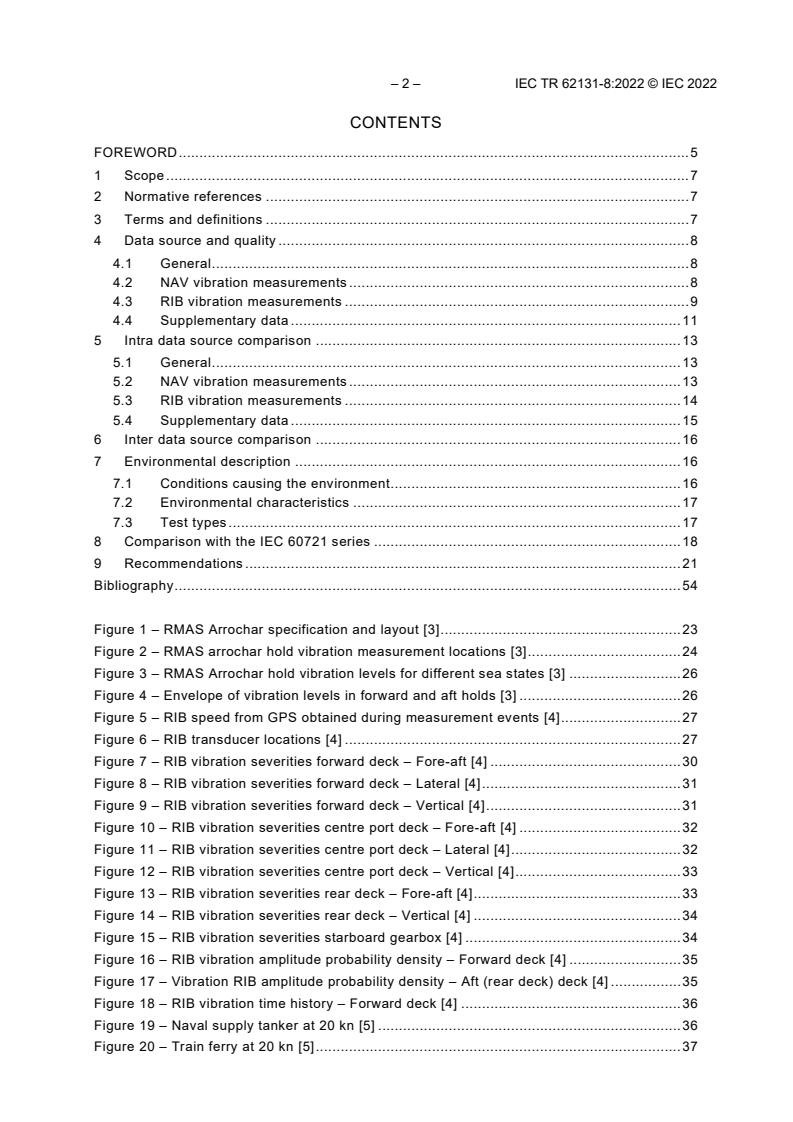
– 2 – IEC TR 62131-8:2022 © IEC 2022
CONTENTS
FOREWORD . 5
1 Scope . 7
2 Normative references . 7
3 Terms and definitions . 7
4 Data source and quality . 8
4.1 General . 8
4.2 NAV vibration measurements . 8
4.3 RIB vibration measurements . 9
4.4 Supplementary data . 11
5 Intra data source comparison . 13
5.1 General . 13
5.2 NAV vibration measurements . 13
5.3 RIB vibration measurements . 14
5.4 Supplementary data . 15
6 Inter data source comparison . 16
7 Environmental description . 16
7.1 Conditions causing the environment . 16
7.2 Environmental characteristics . 17
7.3 Test types . 17
8 Comparison with the IEC 60721 series . 18
9 Recommendations . 21
Bibliography . 54
Figure 1 – RMAS Arrochar specification and layout [3] . 23
Figure 2 – RMAS arrochar hold vibration measurement locations [3] . 24
Figure 3 – RMAS Arrochar hold vibration levels for different sea states [3] . 26
Figure 4 – Envelope of vibration levels in forward and aft holds [3] . 26
Figure 5 – RIB speed from GPS obtained during measurement events [4] . 27
Figure 6 – RIB transducer locations [4] . 27
Figure 7 – RIB vibration severities forward deck – Fore-aft [4] . 30
Figure 8 – RIB vibration severities forward deck – Lateral [4] . 31
Figure 9 – RIB vibration severities forward deck – Vertical [4] . 31
Figure 10 – RIB vibration severities centre port deck – Fore-aft [4] . 32
Figure 11 – RIB vibration severities centre port deck – Lateral [4] . 32
Figure 12 – RIB vibration severities centre port deck – Vertical [4] . 33
Figure 13 – RIB vibration severities rear deck – Fore-aft [4] . 33
Figure 14 – RIB vibration severities rear deck – Vertical [4] . 34
Figure 15 – RIB vibration severities starboard gearbox [4] . 34
Figure 16 – RIB vibration amplitude probability density – Forward deck [4] . 35
Figure 17 – Vibration RIB amplitude probability density – Aft (rear deck) deck [4] . 35
Figure 18 – RIB vibration time history – Forward deck [4] . 36
Figure 19 – Naval supply tanker at 20 kn [5] . 36
Figure 20 – Train ferry at 20 kn [5] . 37
Figure 21 – MIL STD 810 [6] random vibration test severity for shipborne equipment . 37
Figure 22 – MIL STD 810 [6] sinusoidal vibration test severity for shipborne equipment . 38
Figure 23 – DEF STAN 00-035 [7] test severity for transportation of equipment by sea . 38
Figure 24 – DEF STAN 00-035 [7] test severity for equipment installed in large ships . 39
Figure 25 – DEF STAN 00-035 [7] test severity for equipment installed in smaller ships
– Aft locations . 39
Figure 26 – DEF STAN 00-035 [7] test severity for equipment installed in small ships –
Mid and forward locations . 40
Figure 27 – DEF STAN 00-035 [7] information – Typical acceleration power spectral
density at aft region of naval frigate . 40
Figure 28 – DEF STAN 00-035 [7] information – Overall vibration RMS variations with
power demand . 41
Figure 29 – DEF STAN 00-035 [7] information – Overall vibration RMS variations with
manoeuvre condition . 41
Figure 30 – EXACT DK 1–237 [8] composite vibration spectrum of engine room
measurements from five different ship types . 42
Figure 31 – American Bureau of Shipping recommendations for vibration severities
[10] . 42
Figure 32 – ISO 20283 [11] recommendations for passenger comfort. 43
Figure 33 – IEC 60945 [14] severity for ship installed equipment . 43
Figure 34 – Comparison of random severities . 44
Figure 35 – Comparison of sinusoidal severities . 44
Figure 36 – IEC 60721-3-2 [28] – Stationary vibration random severities . 45
Figure 37 – IEC TR 60721-4-2 [30] – Stationary vibration random severities . 45
Figure 38 – IEC 60721-3-2 [28] – Stationary vibration sinusoidal severities . 46
Figure 39 – IEC TR 60721-4-2 [30] – Stationary vibration sinusoidal severities . 46
Figure 40 – IEC 60721-3-2 [28] – Shock severities . 47
Figure 41 – IEC TR 60721-4-2 [30] – Shock severities for IEC 60068-2-27 [32] test
procedure . 47
Figure 42 – IEC TR 60721-4-2 [30] – Shock severities for IEC 60068-2-29 [33] test
procedure . 48
Figure 43 – IEC 60721-3-6 [13] stationary vibration sinusoidal severities . 48
Figure 44 – IEC 60721-3-6 [13] shock severities . 49
Figure 45 – Comparison of NAV vibrations [3] with IEC 60721-3-2 [28] . 49
Figure 46 – Comparison of RIB vibrations [4] with IEC 60721-3-2 [28] . 50
Figure 47 – Comparison of RIB vibrations [4] (less rear floor measurements) with
IEC 60721-3-2 [28] . 50
Figure 48 – Comparison of GAM-EG-13 vibrations [5] with IEC 60721-3-2 [28] . 51
Figure 49 – Comparison of EXACT DK 1–237 composite vibration spectrum of engine
room measurements (from [8]) with IEC 60721-3-2 [28] . 51
Figure 50 – Comparison of MIL STD 810 [6] and DEF STAN 00-035 [7] ship
transportation severities with IEC 60721-3-2 [28] . 52
Figure 51 – Comparison of sinusoidal installed equipment severities with IEC 60721-3-
2 [28] . 52
Figure 52 – Comparison of Sinusoidal Installed Equipment Severities with IEC 60721-
3-6 [13] . 53
– 4 – IEC TR 62131-8:2022 © IEC 2022
Table 1 – RMAS Arrochar hold low frequency (up to 10 Hz) accelerations levels [3] . 24
Table 2 – RMAS Arrochar hold vibration levels for different sea states [3] . 25
Table 3 – Definition of sea states . 25
Table 4 – RIB measurement events [4] . 28
Table 5 – RIB statistics of vibration measurements from sea segment [4] . 28
Table 6 – RIB statistics of vibration measurements riverine events – RMS [4] . 29
Table 7 – RIB statistics of vibration measurements riverine events – Maximum and
minimum [4] . 29
INTERNATIONAL ELECTROTECHNICAL COMMISSION
____________
ENVIRONMENTAL CONDITIONS – VIBRATION AND
SHOCK OF ELECTROTECHNICAL EQUIPMENT –
Part 8: Transportation by ship
FOREWORD
1) The International Electrotechnical Commission (IEC) is a worldwide organization for standardization comprising
all national electrotechnical committees (IEC National Committees). The object of IEC is to promote
international co-operation on all questions concerning standardization in the electrical and electronic fields. To
this end and in addition to other activities, IEC publishes International Standards, Technical Specifications,
Technical Reports, Publicly Available Specifications (PAS) and Guides (hereafter referred to as “IEC
Publication(s)”). Their preparation is entrusted to technical committees; any IEC National Committee interested
in the subject dealt with may participate in this preparatory work. International, governmental and non-
governmental organizations liaising with the IEC also participate in this preparation. IEC collaborates closely
with the International Organization for Standardization (ISO) in accordance with conditions determined by
agreement between the two organizations.
2) The formal decisions or agreements of IEC on technical matters express, as nearly as possible, an international
consensus of opinion on the relevant subjects since each technical committee has representation from all
interested IEC National Committees.
3) IEC Publications have the form of recommendations for international use and are accepted by IEC National
Committees in that sense. While all reasonable efforts are made to ensure that the technical content of IEC
Publications is accurate, IEC cannot be held responsible for the way in which they are used or for any
misinterpretation by any end user.
4) In order to promote international uniformity, IEC National Committees undertake to apply IEC Publications
transparently to the maximum extent possible in their national and regional publications. Any divergence
between any IEC Publication and the corresponding national or regional publication shall be clearly indicated in
the latter.
5) IEC itself does not provide any attestation of conformity. Independent certification bodies provide conformity
assessment services and, in some areas, access to IEC marks of conformity. IEC is not responsible for any
services carried out by independent certification bodies.
6) All users should ensure that they have the latest edition of this publication.
7) No liability shall attach to IEC or its directors, employees, servants or agents including individual experts and
members of its technical committees and IEC National Committees for any personal injury, property damage or
other damage of any nature whatsoever, whether direct or indirect, or for costs (including legal fees) and
expenses arising out of the publication, use of, or reliance upon, this IEC Publication or any other IEC
Publications.
8) Attention is drawn to the Normative references cited in this publication. Use of the referenced publications is
indispensable for the correct application of this publication.
9) Attention is drawn to the possibility that some of the elements of this IEC Publication may be the subject of
patent rights. IEC shall not be held responsible for identifying any or all such patent rights.
IEC TR 62131-8 has been prepared by IEC technical committee 104: Environmental
conditions, classification and methods of test. It is a Technical Report.
The text of this Technical Report is based on the following documents:
Draft Report on voting
104/912/DTR 104/921A/RVDTR
Full information on the voting for its approval can be found in the report on voting indicated in
the above table.
The language used for the development of this Technical Report is English.
This document was drafted in accordance with ISO/IEC Directives, Part 2, and developed in
accordance with ISO/IEC Directives, Part 1 and ISO/IEC Directives, IEC Supplement,
– 6 – IEC TR 62131-8:2022 © IEC 2022
available at www.iec.ch/members_experts/refdocs. The main document types developed by
IEC are described in greater detail at www.iec.ch/standardsdev/publications.
A list of all parts in the IEC 62131 series, published under the general title Environmental
conditions – Vibration and shock of electrotechnical equipment, can be found on the IEC
website.
The committee has decided that the contents of this document will remain unchanged until the
stability date indicated on the IEC website under webstore.iec.ch in the data related to the
specific document. At this date, the document will be
• reconfirmed,
• withdrawn,
• replaced by a revised edition, or
• amended.
IMPORTANT – The "colour inside" logo on the cover page of this document indicates that it
contains colours which are considered to be useful for the correct understanding of its
contents. Users should therefore print this document using a colour printer.
ENVIRONMENTAL CONDITIONS – VIBRATION AND
SHOCK OF ELECTROTECHNICAL EQUIPMENT –
Part 8: Transportation by ship
1 Scope
This part of IEC 62131 reviews available dynamic data relating to the transportation of
electrotechnical equipment by marine craft such as ships and boats either at sea or during
riverine use. In this instance, there is a clear similarity between dynamic data relating to the
transportation of electrotechnical equipment and that of electrotechnical equipment installed
on maritime platforms.
The intent is that from all the available data, an environmental description will be generated
and compared to that set out in the IEC 60721 series [1] .
For each of the sources identified, the quality of the data is reviewed and checked for
self-consistency. The process used to undertake this check of data quality and that used to
intrinsically categorize the various data sources is set out in IEC TR 62131-1 [2].
This document primarily addresses data extracted from several different sources for which
reasonable confidence exists in their quality and validity. This document also reviews some
data for which the quality and validity cannot realistically be verified. These data are included
to facilitate validation of information from other sources. This document clearly indicates when
utilizing information in this latter category.
The aim of this document is to review information from a number of different data gathering
exercises. The quantity and quality of information in these exercises is expected to vary
considerably.
Not all the data reviewed were made available in electronic form. To permit comparison to be
made, in this assessment, a quantity of the original (non-electronic) data has been manually
digitized.
2 Normative references
There are no normative references in this document.
3 Terms and definitions
No terms and definitions are listed in this document.
ISO and IEC maintain terminological databases for use in standardization at the following
addresses:
• IEC Electropedia: available at http://www.electropedia.org/
• ISO Online browsing platform: available at http://www.iso.org/obp
___________
Numbers in square brackets refer to the bibliography.
– 8 – IEC TR 62131-8:2022 © IEC 2022
4 Data source and quality
4.1 General
The first step in the process of reviewing available dynamic data, in this case relating to the
transportation of electrotechnical equipment by marine craft, is to identify measurement
exercises containing vibration and shock data which are likely to meet the validation criteria
set out in IEC TR 62131-1. Whilst several exercises have been identified for this purpose,
relatively few contain suitable vibration and shock data which can be realistically assessed
against the validation criteria. There appears to be two underlying issues as to why little
measured vibration data are available. The first is that the vibration levels experienced during
sea transportation are generally of particularly low amplitude and consequently of insufficient
concern to justify a measurement exercise. The second issue is that vibrations tend to occur
for significant periods of time and vary with sea state. Consequently, presenting real
measured data can be difficult and it is generally easier to present worst case conditions in
terms of test severities. Essentially, most of the identified exercises would be classified as
"supplementary data" according to the process of IEC TR 62131-1. Only two measurement
exercises have been identified which have the potential to meet the required criteria and
neither of those relate to large transport marine craft. For that purpose, this document has
had to rely on evidence from the "supplementary data".
4.2 NAV vibration measurements
This measurement exercise [3] established the accelerations and vibrations on the floor of the
forward and aft holds, of a relatively small (approximately 2 000 tonnes) transport vessel
(RMAS Arrochar) on a three-day transit from Zeebrugge dockyard (Netherlands) to
Glen Mallen on the west coast of Scotland. The journey was via the English Channel and the
Irish Sea and occurred in March 1990. The measurements encompass all the prevailing
conditions arising during the journey, which includes sea states from 1 to 6. This was the
second of two similar measurement exercises on this class of vessel. The first exercise was
on RMAS Kinterbury in July 1987 and employed a similar measurement layout in the forward
and aft holds. Although measured data from the first exercise was not available for this work,
the measurements and test severities derived from both exercises were compared and found
to be similar. In this case, the measurement exercise and the data analysis were undertaken
by separate agencies. The results of both measurement exercises were utilized to ensure the
vibration experienced by an equipment were less than those to which it had been evaluated.
For this purpose, a third independent agency reviewed the results.
The transport vessels used for this work, RMAS Arrochar and RMAS Kinterbury, were both
naval armament vessels (NAVs) of the same class, both operated by the UK Royal Maritime
Auxiliary Service (RMAS). Both vessels are now decommissioned. The vessels had two holds,
both located in the centre of the ship, with the aft hold (Hold 2) the closest to the propulsion
system. However, as the vessels are relatively small, both holds are in proximity to some
rotating machinery, particularly the generators. Information on the overall vessel
configuration, in this case for RMAS Arrochar, is shown in Figure 1.
The measurement exercise employed 24 accelerometers and three dummy loads. The latter
were utilized to establish the underlying measurement noise levels at various locations in the
holds. This is an issue when measuring vibration on marine craft as the vibrations can be
quite low level and consequently easily influenced by contamination from electrical and
mechanical noise. The exercise measured both low frequency acceleration transducers to
establish payload loadings (up to 10 Hz) as well as higher frequency vibration transducers (up
to 200 Hz).
The vibration measurement locations used in both measurement exercises are shown in
Figure 2. Vibration measurements, on the floor of both holds, were made simultaneously.
Eight piezo-electric transducers were located in the aft hold, four measuring vertical (Z)
vibrations and two each for the lateral (X) and longitudinal (Y) vibrations. The transducers
were configured as two triaxial assemblies and two uniaxial devices. Two triaxial transducer
assemblies were located in the forward hold, each measuring in the vertical, lateral and
longitudinal axis. The measurements from the two holds were recorded on separate magnetic
FM tape recorders, but with measurements from one location common to both recorders. This
was to enable synchronization and correlation to be undertaken for data analysis purposes.
All the spectral information presented in the available report [3] is in terms of "equivalent peak
acceleration" with a frequency resolution of 0,5 Hz. Most of the measured vibration data are
for conditions less than sea state 4, but with some limited data at sea state 5 to 6. Vibration
severities for different sea states are presented for each hold. Noise measurements are
around 0,000 1 g /Hz.
As the report only presents data in the form of "equivalent peak acceleration" it can only
realistically be compared with sine-based environmental descriptions. It cannot be easily
compared with power spectral density environmental descriptions without resorting to
comparison of the effects of the vibration (for example using the maximum response spectrum
and fatigue damage spectrum). This is an underlying issue with vibration measurements made
on marine craft. Such measurements often contain sinusoidal vibrations arising from rotating
machinery. Consequently, the vibration analysis methods utilized are often those appropriate
for quantifying such sinusoidal vibrations. However, measurements made away from rotating
machinery can be more consistent with random vibration analysis assumptions, and hence
can utilize power spectral density analysis methods.
Most of the data analysis plots, included within the report, cannot be easily reproduced here.
However, summary information from that data analysis is included here as Table 1 and Table
2 and Figure 3 and Figure 4. Table 1 shows the most severe acceleration levels measured for
different sea states, for each vessel axis and for each hold. These measurements are limited
to 10 Hz (no information on the filtering used is provided) and are intended to indicate the
acceleration loading that equipment could experience during transportation. Essentially, the
values are indicators of the acceleration loading any payload tie down system would need to
resist. Table 2 shows the most severe vibration levels measured for different sea states, for
each vessel axis and each hold. Two parameters are provided, one for the long-term root
mean square of the vibrations, the other the peak-to-peak value. Table 2 is shown graphically
in Figure 3.
Envelopes of the "equivalent peak acceleration" for the vertical and lateral axes and for each
hold are shown in Figure 4. Also included in that figure are similar values obtained from the
earlier exercise on RMAS Kinterbury. The values of "equivalent peak acceleration" shown in
Figure 4 are composed of envelopes of all sea states and measurement locations in each hold
and axis.
The sea state definitions for wind and sea levels, adopted for the NAV measurement exercise,
were from the Douglas sea scale and information is provided in Table 3.
Although the information in the NAV vibration measurement report has some limitations, the
quality of the information is reasonable and meets the required validation criteria for data
quality (single data item).
4.3 RIB vibration measurements
This measurement exercise, undertaken in December 2005, was on a moderately sized rigid
inflatable boat (RIB), used at high speed in a sea estuary and a river. The purpose of the
exercise was to establish the vibration severities likely to be experienced by equipment at
several cargo locations. These vibration severities were required to be compared to those
experienced by the same equipment during road transportation. For commercial reasons,
some measurements on certain equipment cannot be made available in this report. However,
there are sufficient remaining measurements on the deck and cabin of the vessel to give a
satisfactory view of the overall vibrations experienced. Given that the RIB is a relatively small
craft operated at high speed, the measurements obtained from this vessel would be expected
to contain some of the most extreme vibration conditions arising during maritime
transportation.
– 10 – IEC TR 62131-8:2022 © IEC 2022
The report of the measurement exercise [4] documents measurements made in both inland
river conditions (referred to as "riverine") as well as during sea conditions. The riverine
measurements included eight individual events made on in-shore water on the River Ore in
Dorset in the UK. The sea measurements were made by following a route offshore to the
entrance of Barnstaple and Bideford Bay. Most of the time was spent in high-speed traverses
of the sand banks at the entrance to the bay. These sand banks produced white water
conditions deemed to represent the worst-case sea state the vessel would be operated in.
The speed and position of the vessel was obtained from GPS measurements. The GPS speed
measurements are reproduced here as Figure 5.
As shocks were anticipated within the vibrations, all the measurements were acquired at a
sample rate of 6 400 sps . The vibration transducers utilized were robust integral electronic
devices with a fixed sensitivity with a good voltage output which was fed directly into a solid-
state data recorder. The measurement ranges for the individual transducers were set by the
selection of an appropriate voltage measurement range for each recorder channel. The solid-
state recorder was configured with a 1 Gb memory and it was necessary to split the riverine
and sea measurements onto separate cards. However, other than that, all other measurement
conditions between riverine and sea conditions remained identical. The duration of
measurement of the riverine segment was approximately 23 min and for the sea segment
approximately 15 min.
A total of 24 integral electronic accelerometers were used in the measurement exercise and
the location of 18 of these is shown schematically in Figure 6. In this case the X axis
corresponds to the vessel fore-aft (longitudinal) axis, the Y axis to athwartships (lateral) and
the Z axis to the vertical axis with respect to the deck. As the environment was expected to be
mainly vibration, no check was made to establish the sense of the measurement (i.e. whether
positive accelerations were up going or down going). The consequences of this omission will
be addressed in Clause 5, the next stage of the data validation process. The two transducers
mounted on the gearbox were an attempt to measure engine speed. However, as the RIB
uses water jet propulsion, these measurements were not effective for that purpose.
Nevertheless, the gearbox measurements do permit the identification of engine and shaft
frequencies which are also apparent at several other locations. Up to about 150 Hz these are
identifiable (46 Hz, 72 Hz, 107 Hz and 140 Hz), although above that frequency so many
components exist that individual identification is difficult.
The vibration analysis of the measured data was undertaken for nine separate events (eight
for riverine and one for sea), these are listed in Table 4. A preliminary review of the data
indicated that a few measurements were defective. This was particularly noticeable after
riverine event 8, which was the longest period of sustained severe conditions. The
characteristic of those measurements suggested the most likely cause was from water
shorting the power supply at individual transducer connectors. This issue had been observed
on a previous measurement exercise, when it was established that the transducer connector
was not in-fact proof against water ingress to IPX9. The channels and events from which the
data was of doubtful quality are excluded from the vibration data assessment as well as the
data reproduced here.
The analysis undertaken included statistical analysis, amplitude probability densities and
acceleration power spectral densities. The sample rate for the data acquisition was 6 400 sps
and the frequency resolution was 0,78 Hz. This frequency resolution was considered
adequate as the responses were predominantly random and, for the purpose of the work,
there was no need to accurately quantify the periodic components. However, if this had been
the case, a higher frequency resolution to quantify the frequency of the periodic components
would have been necessary.
Summary statistical information for the vibration measurements is presented in Table 5, Table
6 and Table 7. Acceleration power spectral densities are presented for three locations in
Figure 7 to Figure 14. These figures overlay the measurements from the high-speed sea
___________
Samples per second.
event as well as the eight riverine events and show the vibration severities at the forward
deck, centre port deck and the rear deck. Also, for reference, an acceleration power spectral
density from one of the gearbox measurements is included in Figure 15. Figure 16 and Figure
17 show the amplitude probability densities for vertical measurements at the front and rear
deck, respectively, for the high-speed sea event. A time history of the acceleration
measurements for the forward deck vertical axis is shown in Figure 18.
Extensive information from the RIB vibration measurement exercise was made available for
the purpose of this document. Apart from the measurement issues addressed above, the
quality of the information is good and meets the required validation criteria for data quality
(single data item).
4.4 Supplementary data
The supplementary data, detailed below, comprises information arising from reputable
sources, but for which the data quality could not be fully verified. In this case, the
supplementary data largely comprise information of vibration test severities used by different
agencies.
The French military standard GAM-EG-13 [5] includes measured vibration information from
two marine craft, a naval supply tanker and a train ferry. Acceleration power spectral density
information for a small number of conditions is presented. However, no information is
provided on the location of the measurements or details of the marine craft. Acceleration
power spectral densities for the naval supply tanker travelling at 20 kn are shown in Figure 19
and for the train ferry, again at 20 kn, in Figure 20. It is clear from the figures that the
vibrations contain several periodic components and it is possible that the amplitudes shown
do not necessarily accurately quantify the periodic components (this is because of the use of
power spectral density to describe them).
The US defence equipment test standard MIL STD 810 [6] contains two test severities for
shipborne equipment. One of these is a simple random vibration test severity (shown in
Figure 21) and the other is a sinusoidal test severity (shown in Figure 22). For equipment
installed on ships, both severities are required to be applied. However, for transportation of
equipment, only the random vibration test severity is required.
The UK environmental test standard for defence equipment DEF STAN 00-035 [7] contains
vibration test severities for equipment transported by sea as well as for equipment installed on
ships. The test for transportation of equipment by sea is a simple random vibration test
severity (shown in Figure 23). Several sinusoidal tests are provided for equipment installed in
ships. These depend upon the size of the ship and location of the equipment. For larger ships
the severities are shown in Figure 24. For smaller ships (a naval minesweeper and smaller)
the severities are shown in Figure 25 and Figure 26. In this case Figure 25 relates to aft
locations (close to the propulsion machinery) and Figure 26 to other locations. Broadly, the
most severe test severities are for smaller ships and at (aft) locations close to the propulsion
machinery.
The UK defence standard DEF STAN 00-035 [7] also contains a small amount of information
related to equipment installed in the aft region of a naval frigate (again near the propulsion
machinery). The measurement exercise from which this information is extracted is not
disclosed nor is the specific location of the measurements. Nevertheless, it does provide
some useful insight into ship vibrations. Figure 27 shows an example acceleration power
spectral density which clearly shows the periodic components from the ships propulsion
system as well as the harmonics of those components. Figure 28 and Figure 29 show the
overall root mean square (RMS) vibration arising from different engine power demands and
for different ship manoeuvre conditions, respectively.
The SRETS study [8] was undertaken during 1998 and reviewed both measured data sources
and test severities for a variety of methods of transportation. For sea transportation it quotes
four sources of information viz. EXACT DK 1–237:1983, MIL STD 810, DEF STAN 00-035 and
GAM-EG-13. Of these only the first has not already been considered. Unfortunately, it has not
– 12 – IEC TR 62131-8:2022 © IEC 2022
been possible to confirm the existence of EXACT DK 1–237:1983. Nevertheless, the
information set out in the SRETS study indicates a composite test severity made up from
engine room measurements. The composite severity is shown in Figure 30. The severity is
made up from measurements on a ferry (approximately 11 000 tonnes), a small bulk carrier
(approximately 7 000 tonnes), a 20 m catamaran and a large bulk carrier
(approximately 64 000 tonnes). The SRETS study is referenced in ASTM D4728-17 which is a
random vibration test for shipping containers. Except for the SRETS reference no severities
specifically for sea transport are either quoted or referenced in this ASTM.
The MIL STD 810 random vibration severity appears to arise from a measurement exercise,
undertaken in the early 1970s, by J.T. Foley [9] at the US Sandia National Laboratories.
Unfortunately, the analysis process used by Foley throughout his work is unique and does not
lend itself to direct comparison with the information presented in this document.
Several documents have been identified which provide essentially identical, generic severities
for ship design purposes. The document specially considered is Guidance Notes on Ship
Vibration by the American Bureau of Shipping [10], published in 2006. Essentially two
vibration severities are provided. The higher severity is associated with ship structure in the
engine and equipment room. The second severity is associated with the ship structure in the
remainder of the vessel. These severities are shown in Figure 31. However, there is no
indication as to the source of these severities. Moreover, there is a caveat associated with the
severities, relating to crew and passenger compartments. For those locations, the vibration
criteria of ISO 20283-5:2016 [11] may be applicable. ISO 20283-5 specifies the vibration
severities which are likely to provoke adverse criticism from crew and passengers. Whilst not
entirely relevant to the purpose of this document, these severities, shown in Figure 32,
provide a useful benchmark.
The IEC 60092 series are vertical product standards for electrical installations within ships. Of
specific relevance here is IEC 60092-101:2018 [12] which sets out the general environmental
design requirements for electrical installations. The environmental design requirements,
especially those quoted within informative Annex A of IEC 60092-101:2018, are based upon
those in IEC 60721-3-6:1987 [13] and adopts the same categories (6M2, 6M3 and 6M4).
However, some additional values are quoted within the main body of the document which are
intended for specific types of equipment, notably accumulators as well as control and
instrumentation equipment. The primary mechanical environments are related to static and
dynamic angular motions (addressed in 7.1) as well as vibrations and shock. The vibrations
are all specified as sinusoidal and the shocks as shock response spectrum. The relationship
(as specified by IEC 60092-101) between the IEC 60721-3-6:1987 mechanical categories and
locations within vessels which are in excess of 500 tonnes is:
Category 6M2 Equipment in general locations including bow sections and on vessels
passing through ice.
Category 6M3 Equipment in stern sections including steering gear rooms for vessels up
to 10 000 tonnes as well as on masts and loading systems, for example on
container guides and cranes.
Category 6M4 Equipment on reciprocating machinery.
IEC 60945 [14] provides the test requirements for maritime navigation and radio
communication equipment. It groups the environmental test requirements into four types of
equipment (portable, protected, exposed and submerged). The environmental tests include
dry heat, damp heat, low temperature, thermal shock, drop onto a hard surface, drop into
water, vibration, rain and spray, water immersion, solar radiation, oil resistance and corrosion
(salt spray). The vibration test applies to all types of equipment and the procedure used is
based upon that of IEC 60068-2-6 [15]. The vibration test is a sine sweep resonance search
followed by a sine dwell test at all resonant frequencies identified by the sweep. The
amplitudes (shown in Figure 33) are 2 Hz to 13,2 Hz at ±1 mm and 13,2 Hz to 100 Hz at
−2
7 ms . The sine dwell is 2 h at each resonance otherwise 2 h at 30 Hz. The tests are applied
equally in all three axes. The drop tests apply to portable equipment only, and are six drops of
1 m onto a hard surface and three drops of 20 m onto water.
Although not strictly relevant to the purpose of this document, it is worth noting that standard
ISO 20283-2:2008 [16] sets out guidance on making vibration measurements on ships. The
guidance relates to conditions and manoeuvres, measuremen
...