

IEC 60601-2-68:2025
(Amendment)Medical electrical equipment - Part 2-68: Particular requirements for the basic safety and essential performance of X-ray-based image-guided radiotherapy equipment for use with electron accelerators, light ion beam therapy equipment and radionuclide beam therapy equipment
General Information
- Abstract
IEC 60601-2-68:2025 applies to the BASIC SAFETY and ESSENTIAL PERFORMANCE of X-ray based IMAGE-GUIDED RADIOTHERAPY equipment for use with EXTERNAL BEAM EQUIPMENT (EBE). This document covers safety aspects of kilovoltage (kV) and megavoltage (MV) X-ray imaging devices integrated in a specified geometrical relationship with EBE for the purpose of IGRT. It covers aspects of communication and relationships between the EXTERNAL BEAM EQUIPMENT and X-ray imaging devices, attached or not directly attached to, but in the same RADIATION shielded area as, and dedicated for use only with, the EXTERNAL BEAM EQUIPMENT. This document deals with equipment for OFFLINE X-IGRT, ONLINE X-IGRT and REAL-TIME X-IGRT. It covers procedures to reduce the risk of over-reliance on the X-IGRT EBE SYSTEM. For example, in the case of ONLINE X-IGRT, the MANUFACTURER will provide an interactive interface for user interaction with the correction suggested by the system. This document does not apply to CT SCANNERS, X-RAY EQUIPMENT for RADIOGRAPHY, and X-RAY EQUIPMENT for RADIOSCOPY, which are not intended for use for IGRT. Requirements that are being tested according to another standard can be identified by the manufacturer and if equivalent do not require retesting, instead evidence can refer to the CT SCANNER, X-RAY EQUIPMENT for RADIOGRAPHY, or X-RAY EQUIPMENT for RADIOSCOPY EQUIPMENT manufacturer's providing compliance statements or test reports. If the X-IGRT EQUIPMENT is combined with an MEE, any requirement that is the same for the X-IGRT EQUIPMENT and the MEE, such as a PATIENT POSITIONER, is not required to be tested twice, but can be accepted as tested by the MEE. This document applies for X-ray equipment for radiography, radioscopy, and COMPUTER tomography used for IGRT. If a clause or subclause is specifically intended to be applicable to X-IGRT EBE SYSTEMS, the content of that clause or subclause will say so. Where that is not the case, the clause or subclause applies only to X-IGRT EQUIPMENT.
This document, with the inclusion of TYPE TESTS and SITE TESTS, applies respectively to the MANUFACTURER and some installation aspects of X-IGRT EBE SYSTEMS intended to be:
• for NORMAL USE, operated under the authority of the RESPONSIBLE ORGANIZATION by QUALIFIED PERSONS having the required skills for a particular medical application, for particular specified clinical purposes, e.g., STATIONARY RADIOTHERAPY or MOVING BEAM RADIOTHERAPY,
• maintained in accordance with the recommendations given in the INSTRUCTIONS FOR USE, and
• subject to regular quality assurance performance and calibration checks by a QUALIFIED PERSON.
IEC 80601-2-68:2024 cancels and replaces the first edition published in 2014. This edition constitutes a technical revision.
This edition includes the following significant technical changes with respect to the previous edition:
a) alignment with the new editions of the relevant standards:
– IEC 60601-2-1:2020;
– IEC 60601-2-44:2009, IEC 60601-2-44:2009/AMD1:2012 and IEC 60601-2-44:2009/AMD2:2016;
– IEC 60601-2-64:2014;
b) clarification of the use of IEC 60601-2-68 for CT SCANNERS, X-RAY EQUIPMENT for RADIOGRAPHY and RADIOSCOPY used in the same room with an EXTERNAL BEAM EQUIPMENT (EBE);
c) introduction of updated requirements related to MECHANICAL HAZARDS, RADIATION HAZARDS, PROGRAMMABLE ELECTRICAL MEDICAL SYSTEMS (PEMS), ACCOMPANYING DOCUMENTATION of an ME SYSTEM, and REMOTE OPERATION.
- Status
- Published
- Publication Date
- 03-Feb-2025
- Drafting Committee
- WG 1 - TC 62/SC 62C/WG 1
- Current Stage
- PPUB - Publication issued
- Start Date
- 04-Feb-2025
- Completion Date
- 10-Jan-2025
Buy Documents
IEC 60601-2-68:2025 RLV - Medical electrical equipment - Part 2-68: Particular requirements for the basic safety and essential performance of X-ray-based image-guided radiotherapy equipment for use with electron accelerators, light ion beam therapy equipment and radionuclide beam therapy equipment Released:2/4/2025
IEC 60601-2-68:2025 - Medical electrical equipment - Part 2-68: Particular requirements for the basic safety and essential performance of X-ray-based image-guided radiotherapy equipment for use with electron accelerators, light ion beam therapy equipment and radionuclide beam therapy equipment/4/2025
Overview
IEC 60601-2-68:2025 is an international standard developed by the International Electrotechnical Commission (IEC) that specifies particular requirements for the basic safety and essential performance of X-ray-based image-guided radiotherapy (IGRT) equipment. Targeting equipment used in conjunction with electron accelerators, light ion beam therapy systems, and radionuclide beam therapy equipment, this standard provides guidance for manufacturers and healthcare professionals to ensure effective and safe operation of X-ray IGRT systems. The scope includes kilovoltage (kV) and megavoltage (MV) X-ray imaging devices used for IGRT, focusing on their integration with external beam equipment (EBE), equipment communication, risk management, and operational safeguards.
Key Topics
- Basic Safety and Essential Performance: The standard defines minimum requirements for protecting patients and operators from electrical, mechanical, and radiation-related hazards pertaining to IGRT X-ray equipment.
- System Integration: IEC 60601-2-68:2025 covers the safety and communication protocols between X-ray IGRT devices and external beam equipment, whether these components are physically attached or merely co-located within a radiation-shielded area.
- Risk Mitigation: Procedures are outlined to address the risks of over-reliance on automated IGRT corrections, emphasizing the need for interactive user interfaces and quality assurance.
- Applicability: The standard is applicable to offline, online, and real-time X-ray IGRT, as well as combinations of IGRT systems with other medical electrical equipment (MEE), without redundant testing for shared requirements (e.g., patient positioning systems).
- Quality Assurance and Testing: Requirements include type tests and site tests to ensure safety and performance during both manufacturing and installation. The standard stresses routine quality assurance, calibration, and performance evaluations carried out by qualified professionals.
- Exclusions: General CT scanners, radiography, and radioscopy X-ray equipment not used specifically for IGRT are outside the scope unless used in the same room for IGRT purposes.
Applications
- Cancer Radiotherapy Centers: Ensures that X-ray IGRT equipment used with external beams in radiotherapy meets internationally recognized safety and performance benchmarks, improving patient outcomes and supporting precision treatment.
- Medical Device Manufacture: Guides manufacturers in designing, testing, and certifying integrated radiotherapy imaging systems that comply with global regulatory and safety requirements.
- System Installation and Maintenance: Provides detailed criteria for installers and service providers, ensuring proper equipment setup, documentation, and ongoing maintenance in line with safety recommendations.
- Clinical Workflows: Supports clinical teams in integrating IGRT devices into workflow, reducing risks related to patient alignment and real-time anatomical changes before and during radiation treatment.
- Regulatory Compliance: Assists healthcare organizations and device manufacturers in fulfilling the relevant legal and regulatory obligations in regions that recognize IEC standards.
Related Standards
Compliance with IEC 60601-2-68:2025 involves alignment with several other key standards within the medical electrical equipment field, including:
- IEC 60601-1: General requirements for basic safety and essential performance of medical electrical equipment.
- IEC 60601-2-1: Particular requirements for electron accelerators in radiotherapy.
- IEC 60601-2-44: Standards for X-ray equipment used in computed tomography.
- IEC 60601-2-64: Requirements for light ion beam therapy equipment.
- IEC 60976 / IEC TR 60977: Functional performance requirements for medical electron accelerators.
- IEC 60601-1-3 / IEC 60601-1-6: Standards covering radiation protection and usability aspects.
- IEC 62083 / IEC 62274: Safety of radiotherapy treatment planning and record/verify systems.
By referencing and integrating applicable sections of these related standards, IEC 60601-2-68:2025 ensures a comprehensive safety and performance approach for advanced IGRT systems in radiotherapy environments.
Keywords: IEC 60601-2-68:2025, X-ray IGRT, image-guided radiotherapy, external beam equipment, radiation safety, medical electrical equipment standard, radiotherapy equipment compliance, quality assurance, system integration, medical device regulation.
Relations
- Effective Date
- 05-Sep-2023
Buy Documents
IEC 60601-2-68:2025 RLV - Medical electrical equipment - Part 2-68: Particular requirements for the basic safety and essential performance of X-ray-based image-guided radiotherapy equipment for use with electron accelerators, light ion beam therapy equipment and radionuclide beam therapy equipment Released:2/4/2025
IEC 60601-2-68:2025 - Medical electrical equipment - Part 2-68: Particular requirements for the basic safety and essential performance of X-ray-based image-guided radiotherapy equipment for use with electron accelerators, light ion beam therapy equipment and radionuclide beam therapy equipment/4/2025
Get Certified
Connect with accredited certification bodies for this standard

BSI Group
BSI (British Standards Institution) is the business standards company that helps organizations make excellence a habit.

TÜV Rheinland
TÜV Rheinland is a leading international provider of technical services.

TÜV SÜD
TÜV SÜD is a trusted partner of choice for safety, security and sustainability solutions.
Sponsored listings
Frequently Asked Questions
IEC 60601-2-68:2025 is a standard published by the International Electrotechnical Commission (IEC). Its full title is "Medical electrical equipment - Part 2-68: Particular requirements for the basic safety and essential performance of X-ray-based image-guided radiotherapy equipment for use with electron accelerators, light ion beam therapy equipment and radionuclide beam therapy equipment". This standard covers: IEC 60601-2-68:2025 applies to the BASIC SAFETY and ESSENTIAL PERFORMANCE of X-ray based IMAGE-GUIDED RADIOTHERAPY equipment for use with EXTERNAL BEAM EQUIPMENT (EBE). This document covers safety aspects of kilovoltage (kV) and megavoltage (MV) X-ray imaging devices integrated in a specified geometrical relationship with EBE for the purpose of IGRT. It covers aspects of communication and relationships between the EXTERNAL BEAM EQUIPMENT and X-ray imaging devices, attached or not directly attached to, but in the same RADIATION shielded area as, and dedicated for use only with, the EXTERNAL BEAM EQUIPMENT. This document deals with equipment for OFFLINE X-IGRT, ONLINE X-IGRT and REAL-TIME X-IGRT. It covers procedures to reduce the risk of over-reliance on the X-IGRT EBE SYSTEM. For example, in the case of ONLINE X-IGRT, the MANUFACTURER will provide an interactive interface for user interaction with the correction suggested by the system. This document does not apply to CT SCANNERS, X-RAY EQUIPMENT for RADIOGRAPHY, and X-RAY EQUIPMENT for RADIOSCOPY, which are not intended for use for IGRT. Requirements that are being tested according to another standard can be identified by the manufacturer and if equivalent do not require retesting, instead evidence can refer to the CT SCANNER, X-RAY EQUIPMENT for RADIOGRAPHY, or X-RAY EQUIPMENT for RADIOSCOPY EQUIPMENT manufacturer's providing compliance statements or test reports. If the X-IGRT EQUIPMENT is combined with an MEE, any requirement that is the same for the X-IGRT EQUIPMENT and the MEE, such as a PATIENT POSITIONER, is not required to be tested twice, but can be accepted as tested by the MEE. This document applies for X-ray equipment for radiography, radioscopy, and COMPUTER tomography used for IGRT. If a clause or subclause is specifically intended to be applicable to X-IGRT EBE SYSTEMS, the content of that clause or subclause will say so. Where that is not the case, the clause or subclause applies only to X-IGRT EQUIPMENT. This document, with the inclusion of TYPE TESTS and SITE TESTS, applies respectively to the MANUFACTURER and some installation aspects of X-IGRT EBE SYSTEMS intended to be: • for NORMAL USE, operated under the authority of the RESPONSIBLE ORGANIZATION by QUALIFIED PERSONS having the required skills for a particular medical application, for particular specified clinical purposes, e.g., STATIONARY RADIOTHERAPY or MOVING BEAM RADIOTHERAPY, • maintained in accordance with the recommendations given in the INSTRUCTIONS FOR USE, and • subject to regular quality assurance performance and calibration checks by a QUALIFIED PERSON. IEC 80601-2-68:2024 cancels and replaces the first edition published in 2014. This edition constitutes a technical revision. This edition includes the following significant technical changes with respect to the previous edition: a) alignment with the new editions of the relevant standards: – IEC 60601-2-1:2020; – IEC 60601-2-44:2009, IEC 60601-2-44:2009/AMD1:2012 and IEC 60601-2-44:2009/AMD2:2016; – IEC 60601-2-64:2014; b) clarification of the use of IEC 60601-2-68 for CT SCANNERS, X-RAY EQUIPMENT for RADIOGRAPHY and RADIOSCOPY used in the same room with an EXTERNAL BEAM EQUIPMENT (EBE); c) introduction of updated requirements related to MECHANICAL HAZARDS, RADIATION HAZARDS, PROGRAMMABLE ELECTRICAL MEDICAL SYSTEMS (PEMS), ACCOMPANYING DOCUMENTATION of an ME SYSTEM, and REMOTE OPERATION.
IEC 60601-2-68:2025 applies to the BASIC SAFETY and ESSENTIAL PERFORMANCE of X-ray based IMAGE-GUIDED RADIOTHERAPY equipment for use with EXTERNAL BEAM EQUIPMENT (EBE). This document covers safety aspects of kilovoltage (kV) and megavoltage (MV) X-ray imaging devices integrated in a specified geometrical relationship with EBE for the purpose of IGRT. It covers aspects of communication and relationships between the EXTERNAL BEAM EQUIPMENT and X-ray imaging devices, attached or not directly attached to, but in the same RADIATION shielded area as, and dedicated for use only with, the EXTERNAL BEAM EQUIPMENT. This document deals with equipment for OFFLINE X-IGRT, ONLINE X-IGRT and REAL-TIME X-IGRT. It covers procedures to reduce the risk of over-reliance on the X-IGRT EBE SYSTEM. For example, in the case of ONLINE X-IGRT, the MANUFACTURER will provide an interactive interface for user interaction with the correction suggested by the system. This document does not apply to CT SCANNERS, X-RAY EQUIPMENT for RADIOGRAPHY, and X-RAY EQUIPMENT for RADIOSCOPY, which are not intended for use for IGRT. Requirements that are being tested according to another standard can be identified by the manufacturer and if equivalent do not require retesting, instead evidence can refer to the CT SCANNER, X-RAY EQUIPMENT for RADIOGRAPHY, or X-RAY EQUIPMENT for RADIOSCOPY EQUIPMENT manufacturer's providing compliance statements or test reports. If the X-IGRT EQUIPMENT is combined with an MEE, any requirement that is the same for the X-IGRT EQUIPMENT and the MEE, such as a PATIENT POSITIONER, is not required to be tested twice, but can be accepted as tested by the MEE. This document applies for X-ray equipment for radiography, radioscopy, and COMPUTER tomography used for IGRT. If a clause or subclause is specifically intended to be applicable to X-IGRT EBE SYSTEMS, the content of that clause or subclause will say so. Where that is not the case, the clause or subclause applies only to X-IGRT EQUIPMENT. This document, with the inclusion of TYPE TESTS and SITE TESTS, applies respectively to the MANUFACTURER and some installation aspects of X-IGRT EBE SYSTEMS intended to be: • for NORMAL USE, operated under the authority of the RESPONSIBLE ORGANIZATION by QUALIFIED PERSONS having the required skills for a particular medical application, for particular specified clinical purposes, e.g., STATIONARY RADIOTHERAPY or MOVING BEAM RADIOTHERAPY, • maintained in accordance with the recommendations given in the INSTRUCTIONS FOR USE, and • subject to regular quality assurance performance and calibration checks by a QUALIFIED PERSON. IEC 80601-2-68:2024 cancels and replaces the first edition published in 2014. This edition constitutes a technical revision. This edition includes the following significant technical changes with respect to the previous edition: a) alignment with the new editions of the relevant standards: – IEC 60601-2-1:2020; – IEC 60601-2-44:2009, IEC 60601-2-44:2009/AMD1:2012 and IEC 60601-2-44:2009/AMD2:2016; – IEC 60601-2-64:2014; b) clarification of the use of IEC 60601-2-68 for CT SCANNERS, X-RAY EQUIPMENT for RADIOGRAPHY and RADIOSCOPY used in the same room with an EXTERNAL BEAM EQUIPMENT (EBE); c) introduction of updated requirements related to MECHANICAL HAZARDS, RADIATION HAZARDS, PROGRAMMABLE ELECTRICAL MEDICAL SYSTEMS (PEMS), ACCOMPANYING DOCUMENTATION of an ME SYSTEM, and REMOTE OPERATION.
IEC 60601-2-68:2025 is classified under the following ICS (International Classification for Standards) categories: 11.040.60 - Therapy equipment. The ICS classification helps identify the subject area and facilitates finding related standards.
IEC 60601-2-68:2025 has the following relationships with other standards: It is inter standard links to IEC 60601-2-68:2014. Understanding these relationships helps ensure you are using the most current and applicable version of the standard.
IEC 60601-2-68:2025 is available in PDF format for immediate download after purchase. The document can be added to your cart and obtained through the secure checkout process. Digital delivery ensures instant access to the complete standard document.
Standards Content (Sample)
IEC 60601-2-68 ®
Edition 2.0 2025-02
REDLINE VERSION
INTERNATIONAL
STANDARD
Medical electrical equipment –
Part 2-68: Particular requirements for the basic safety and essential performance
of X-ray-based image-guided radiotherapy equipment for use with electron
accelerators, light ion beam therapy equipment and radionuclide beam therapy
equipment
All rights reserved. Unless otherwise specified, no part of this publication may be reproduced or utilized in any form
or by any means, electronic or mechanical, including photocopying and microfilm, without permission in writing from
either IEC or IEC's member National Committee in the country of the requester. If you have any questions about IEC
copyright or have an enquiry about obtaining additional rights to this publication, please contact the address below or
your local IEC member National Committee for further information.
IEC Secretariat Tel.: +41 22 919 02 11
3, rue de Varembé info@iec.ch
CH-1211 Geneva 20 www.iec.ch
Switzerland
About the IEC
The International Electrotechnical Commission (IEC) is the leading global organization that prepares and publishes
International Standards for all electrical, electronic and related technologies.
About IEC publications
The technical content of IEC publications is kept under constant review by the IEC. Please make sure that you have the
latest edition, a corrigendum or an amendment might have been published.
IEC publications search - webstore.iec.ch/advsearchform IEC Products & Services Portal - products.iec.ch
The advanced search enables to find IEC publications by a Discover our powerful search engine and read freely all the
variety of criteria (reference number, text, technical publications previews, graphical symbols and the glossary.
committee, …). It also gives information on projects, replaced With a subscription you will always have access to up to date
and withdrawn publications. content tailored to your needs.
IEC Just Published - webstore.iec.ch/justpublished
Electropedia - www.electropedia.org
Stay up to date on all new IEC publications. Just Published
The world's leading online dictionary on electrotechnology,
details all new publications released. Available online and once
containing more than 22 500 terminological entries in English
a month by email.
and French, with equivalent terms in 25 additional languages.
Also known as the International Electrotechnical Vocabulary
IEC Customer Service Centre - webstore.iec.ch/csc
(IEV) online.
If you wish to give us your feedback on this publication or need
further assistance, please contact the Customer Service
Centre: sales@iec.ch.
IEC 60601-2-68 ®
Edition 2.0 2025-02
REDLINE VERSION
INTERNATIONAL
STANDARD
Medical electrical equipment –
Part 2-68: Particular requirements for the basic safety and essential
performance of X-ray-based image-guided radiotherapy equipment for use with
electron accelerators, light ion beam therapy equipment and radionuclide beam
therapy equipment
INTERNATIONAL
ELECTROTECHNICAL
COMMISSION
ICS 11.040.60 ISBN 978-2-8327-0203-1
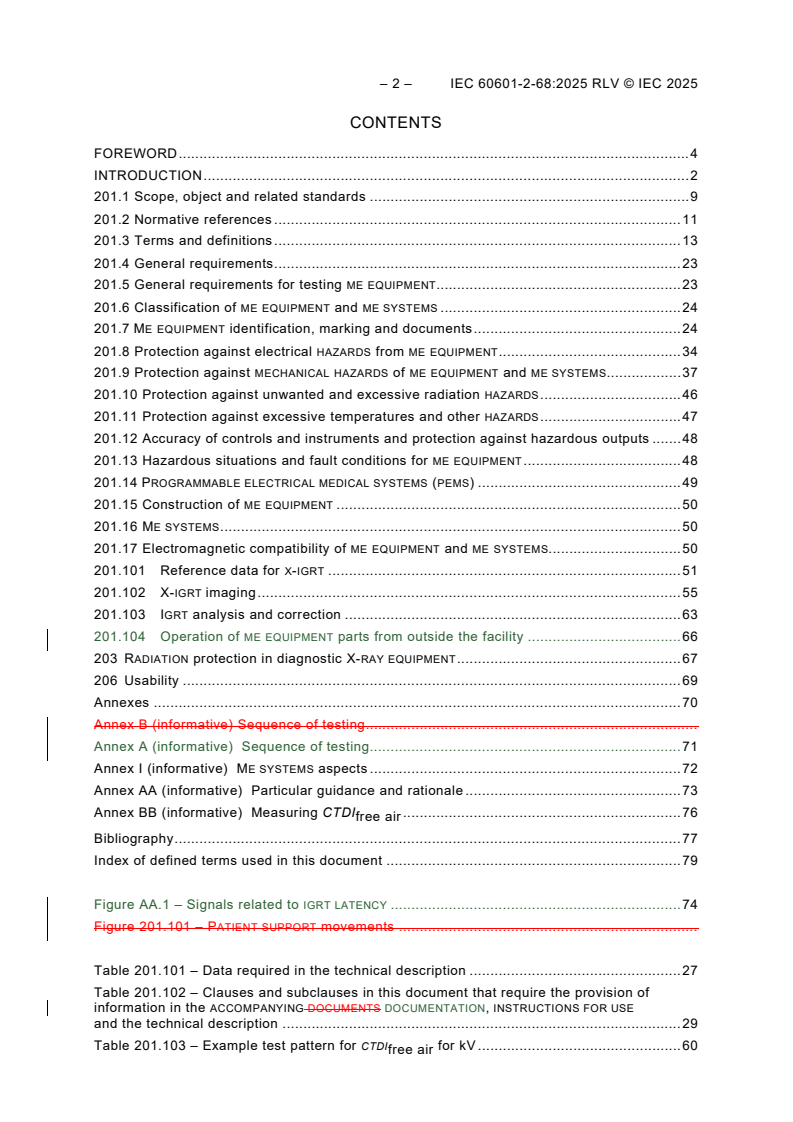
– 2 – IEC 60601-2-68:2025 RLV © IEC 2025
CONTENTS
FOREWORD . 4
INTRODUCTION . 2
201.1 Scope, object and related standards . 9
201.2 Normative references . 11
201.3 Terms and definitions . 13
201.4 General requirements . 23
201.5 General requirements for testing ME EQUIPMENT . 23
201.6 Classification of ME EQUIPMENT and ME SYSTEMS . 24
201.7 ME EQUIPMENT identification, marking and documents . 24
201.8 Protection against electrical HAZARDS from ME EQUIPMENT . 34
201.9 Protection against MECHANICAL HAZARDS of ME EQUIPMENT and ME SYSTEMS . 37
201.10 Protection against unwanted and excessive radiation HAZARDS . 46
201.11 Protection against excessive temperatures and other HAZARDS . 47
201.12 Accuracy of controls and instruments and protection against hazardous outputs . 48
201.13 Hazardous situations and fault conditions for ME EQUIPMENT . 48
201.14 PROGRAMMABLE ELECTRICAL MEDICAL SYSTEMS (PEMS) . 49
201.15 Construction of ME EQUIPMENT . 50
201.16 ME SYSTEMS . 50
201.17 Electromagnetic compatibility of ME EQUIPMENT and ME SYSTEMS. 50
201.101 Reference data for X-IGRT . 51
201.102 X-IGRT imaging . 55
201.103 IGRT analysis and correction . 63
201.104 Operation of ME EQUIPMENT parts from outside the facility . 66
203 RADIATION protection in diagnostic X-RAY EQUIPMENT . 67
206 Usability . 69
Annexes . 70
Annex B (informative) Sequence of testing .
Annex A (informative) Sequence of testing. 71
Annex I (informative) ME SYSTEMS aspects . 72
Annex AA (informative) Particular guidance and rationale . 73
Annex BB (informative) Measuring CTDI . 76
free air
Bibliography . 77
Index of defined terms used in this document . 79
Figure AA.1 – Signals related to IGRT LATENCY . 74
Figure 201.101 – PATIENT SUPPORT movements .
Table 201.101 – Data required in the technical description . 27
Table 201.102 – Clauses and subclauses in this document that require the provision of
information in the ACCOMPANYING DOCUMENTS DOCUMENTATION, INSTRUCTIONS FOR USE
and the technical description . 29
Table 201.103 – Example test pattern for CTDI for kV . 60
free air
Table AA.1 – Clauses of the standard that contain requirements for X-IGRT IMAGING
COMPONENTS and related clauses of IEC 60601-2-44 and IEC 60601-2-54 with
equivalent requirements for CT SCANNER, x-RAY EQUIPMENT for RADIOGRAPHY, and X-RAY
EQUIPMENT for RADIOSCOPY . 73
– 4 – IEC 60601-2-68:2025 RLV © IEC 2025
INTERNATIONAL ELECTROTECHNICAL COMMISSION
____________
MEDICAL ELECTRICAL EQUIPMENT –
Part 2-68: Particular requirements for the basic safety and essential
performance of X-ray-based image-guided radiotherapy equipment for use
with electron accelerators, light ion beam therapy equipment and
radionuclide beam therapy equipment
FOREWORD
1) The International Electrotechnical Commission (IEC) is a worldwide organization for standardization comprising
all national electrotechnical committees (IEC National Committees). The object of IEC is to promote international
co-operation on all questions concerning standardization in the electrical and electronic fields. To this end and
in addition to other activities, IEC publishes International Standards, Technical Specifications, Technical Reports,
Publicly Available Specifications (PAS) and Guides (hereafter referred to as "IEC Publication(s)"). Their
preparation is entrusted to technical committees; any IEC National Committee interested in the subject dealt with
may participate in this preparatory work. International, governmental and non-governmental organizations liaising
with the IEC also participate in this preparation. IEC collaborates closely with the International Organization for
Standardization (ISO) in accordance with conditions determined by agreement between the two organizations.
2) The formal decisions or agreements of IEC on technical matters express, as nearly as possible, an international
consensus of opinion on the relevant subjects since each technical committee has representation from all
interested IEC National Committees.
3) IEC Publications have the form of recommendations for international use and are accepted by IEC National
Committees in that sense. While all reasonable efforts are made to ensure that the technical content of IEC
Publications is accurate, IEC cannot be held responsible for the way in which they are used or for any
misinterpretation by any end user.
4) In order to promote international uniformity, IEC National Committees undertake to apply IEC Publications
transparently to the maximum extent possible in their national and regional publications. Any divergence between
any IEC Publication and the corresponding national or regional publication shall be clearly indicated in the latter.
5) IEC itself does not provide any attestation of conformity. Independent certification bodies provide conformity
assessment services and, in some areas, access to IEC marks of conformity. IEC is not responsible for any
services carried out by independent certification bodies.
6) All users should ensure that they have the latest edition of this publication.
7) No liability shall attach to IEC or its directors, employees, servants or agents including individual experts and
members of its technical committees and IEC National Committees for any personal injury, property damage or
other damage of any nature whatsoever, whether direct or indirect, or for costs (including legal fees) and
expenses arising out of the publication, use of, or reliance upon, this IEC Publication or any other IEC
Publications.
8) Attention is drawn to the Normative references cited in this publication. Use of the referenced publications is
indispensable for the correct application of this publication.
9) IEC draws attention to the possibility that the implementation of this document may involve the use of (a)
patent(s). IEC takes no position concerning the evidence, validity or applicability of any claimed patent rights in
respect thereof. As of the date of publication of this document, IEC had not received notice of (a) patent(s), which
may be required to implement this document. However, implementers are cautioned that this may not represent
the latest information, which may be obtained from the patent database available at https://patents.iec.ch. IEC
shall not be held responsible for identifying any or all such patent rights.
This redline version of the official IEC Standard allows the user to identify the changes
made to the previous edition IEC 60601-2-68:2014. A vertical bar appears in the margin
wherever a change has been made. Additions are in green text, deletions are in
strikethrough red text.
IEC 60601-2-68 has been prepared by IEC subcommittee 62C: Equipment for radiotherapy,
nuclear medicine and radiation dosimetry, of IEC technical committee 62: Medical equipment,
software, and systems. It is an International Standard.
This second edition cancels and replaces the first edition published in 2014. This edition
constitutes a technical revision.
This edition includes the following significant technical changes with respect to the previous
edition:
a) alignment with the new editions of the relevant standards:
– IEC 60601-2-1:2020;
– IEC 60601-2-44:2009, IEC 60601-2-44:2009/AMD1:2012 and IEC 60601-2-
44:2009/AMD2:2016;
– IEC 60601-2-64:2014;
b) clarification of the use of IEC 60601-2-68 for CT SCANNERS, X-RAY EQUIPMENT for
RADIOGRAPHY and RADIOSCOPY used in the same room with an EXTERNAL BEAM EQUIPMENT
(EBE);
MECHANICAL HAZARDS, RADIATION HAZARDS,
c) introduction of updated requirements related to
PROGRAMMABLE ELECTRICAL MEDICAL SYSTEMS (PEMS), ACCOMPANYING DOCUMENTATION of an
ME SYSTEM, and REMOTE OPERATION.
The text of this International Standard is based on the following documents:
Draft Report on voting
62C/927/FDIS 62C/941/RVD
Full information on the voting for its approval can be found in the report on voting indicated in
the above table.
The language used for the development of this International Standard is English.
This document was drafted in accordance with ISO/IEC Directives, Part 2, and developed in
accordance with ISO/IEC Directives, Part 1 and ISO/IEC Directives, IEC Supplement, available
at www.iec.ch/members_experts/refdocs. The main document types developed by IEC are
described in greater detail at www.iec.ch/publications.
In this document, the following print types are used:
– requirements and definitions: roman type;
– test specifications: italic type;
– informative material appearing outside of tables, such as notes, examples and references: in smaller type.
Normative text of tables is also in a smaller type;
– TERMS DEFINED IN CLAUSE 3 OF IEC 60601-1:2005, IEC 60601-1:2005/AMD1:2012, AND
IEC 60601-1:2005/AMD2:2020, IN THIS DOCUMENT OR AS NOTED: SMALL CAPITALS.
In referring to the structure of this document, the term
– "clause" means one of the seventeen numbered divisions within the table of contents,
inclusive of all subdivisions (e.g., Clause 7 includes subclauses 7.1, 7.2, etc.);
– "subclause" means a numbered subdivision of a clause (e.g., 7.1, 7.2 and 7.2.1 are all
subclauses of Clause 7).
References to clauses within this document are preceded by the term "Clause" followed by the
clause number. References to subclauses within this document are by number only.
– 6 – IEC 60601-2-68:2025 RLV © IEC 2025
In this document, the conjunctive "or" is used as an "inclusive or" so a statement is true if any
combination of the conditions is true.
The verbal forms used in this document conform to usage described in Clause 7 of the ISO/IEC
Directives, Part 2. For the purposes of this document, the auxiliary verb:
– "shall" means that compliance with a requirement or a test is mandatory for compliance with
this document;
– "should" means that compliance with a requirement or a test is recommended but is not
mandatory for compliance with this document;
– "may" is used to describe a permissible way to achieve compliance with a requirement or
test.
An asterisk (*) as the first character of a title or at the beginning of a paragraph or table title
indicates that there is guidance or rationale related to that item in Annex AA.
A list of all parts of the IEC 60601 series, published under the general title Medical electrical
equipment, can be found on the IEC website.
The committee has decided that the contents of this document will remain unchanged until the
stability date indicated on the IEC website under webstore.iec.ch in the data related to the
specific document. At this date, the document will be
• reconfirmed,
• withdrawn, or
• revised.
INTRODUCTION
Modern RADIOTHERAPY practices utilize information from various imaging modalities, acquired
prior to initiating administration of the therapy, to plan the TREATMENT. The imaging provides
information about the location of the TARGET VOLUME and other anatomical features so that a
TREATMENT PLAN can be developed that provides an optimal dose distribution to have the best
chance of achieving the intended effect of TREATMENT while minimizing side effects.
However, difficulties arise when trying to administer the RADIATION, since TARGET
VOLUMES/critical structures are constantly moving within the body. For example, in parts of the
body moving with respiration, the TARGET VOLUMES/critical structures may change position or
shape during the RADIATION BEAM delivery throughout any given fraction. Furthermore, a course
of therapy may can extend over many days, during which the TARGET VOLUME/PATIENT may can
shrink or grow and/or move. Hence, the exact location of the TARGET VOLUME/critical structures
may can change between the time of TREATMENT PLANNING imaging and the actual administration
of a TREATMENT.
IMAGE-GUIDED RADIOTHERAPY (IGRT) combines planar or volumetric imaging during the course of
RADIOTHERAPY to adjust the TREATMENT delivery based on the PATIENT anatomy and PATIENT
position. This enables the OPERATOR AND/or EXTERNAL BEAM EQUIPMENT (EBE) to adjust the
RADIATION BEAM delivery based on the imaging information, such as the position of the TARGET
VOLUME, critical organs and/or other reference features, to compensate for anatomical changes
including internal organ motions and/or TREATMENT setup uncertainties. The increased accuracy
and precision achieved allows higher doses of RADIATION to be delivered to the TARGET VOLUME
and a reduction in the margin of healthy cells affected by the RADIATION. This is often used in
conjunction with other monitoring equipment.
This document establishes requirements to be complied with by MANUFACTURERS in the design
and construction of X-RAY IGRT EQUIPMENT (X-IGRT).
This document covers safety aspects of kilovoltage (kV) and megavoltage (MV) X-ray imaging
devices in a known geometrical relationship with an EXTERNAL BEAM EQUIPMENT such as an
ELECTRON ACCELERATOR, medical LIGHT ION BEAM MEDICAL ELECTRICAL EQUIPMENT or
RADIONUCLIDE BEAM THERAPY EQUIPMENT, for the purpose of IGRT. It covers aspects of
communication and relationships between the EXTERNAL BEAM EQUIPMENT and X-ray imaging
devices, attached or not directly attached to, but in the same RADIATION shielded area as, and
dedicated for use only with, the EXTERNAL BEAM EQUIPMENT.
This particular standard applies to X-ray based IGRT equipment used in-room for IGRT purposes.
This particular standard does not apply to standard CT scanners, which are not used for IGRT.
However if a CT scanner is used in-room with a linear (electron) accelerator (linac) for IGRT
then this particular standard applies.
When performing a HAZARD ANALYSIS, the MANUFACTURER should consider relevant diagnostic
standards. For example, the IMAGE DISPLAY DEVICE quality is specified in IEC documents in
regard to diagnostic use (e.g., IEC 62563-1:2009). However, since IGRT usage may or may does
not require necessarily have such high requirements, it is left to the MANUFACTURER to specify
what is required for use with their X-IGRT EQUIPMENT.
This document deals with the safety aspect of image acquisitions, image analysis, data transfer
and TREATMENT replanning or EBE/PATIENT repositioning.
This document deals with equipment for OFFLINE X-IGRT, ONLINE X-IGRT, and REAL-TIME X-IGRT.
X-IGRT EQUIPMENT is also related to the following current publications:
– IEC 60976, Medical electrical equipment – Medical electron accelerators – Functional
performance characteristics
– 8 – IEC 60601-2-68:2025 RLV © IEC 2025
– IEC TR 60977, Medical electrical equipment – Medical electron accelerators – Guidelines
for functional performance characteristics.
– IEC 60601-2-1
– IEC 60601-2-44
– IEC 60601-2-64
– IEC 62083
– IEC 61217
– IEC 62274
This particular standard may give rise to amendments to some of the above standards.
This document will focus on the safety aspects of the primary function of X-IGRT. It will not focus
on emerging technologies within the field so as to not hinder progress, yet it will define a safe
way of achieving X-IGRT.
MEDICAL ELECTRICAL EQUIPMENT –
Part 2-68: Particular requirements for the basic safety and essential
performance of X-ray-based image-guided radiotherapy equipment for use
with electron accelerators, light ion beam therapy equipment and
radionuclide beam therapy equipment
201.1 Scope, object and related standards
Clause 1 of the general standard IEC 60601-1:2005, IEC 60601-1:2005/AMD1:2012, and
IEC 60601-1:2005/AMD2:2020 applies, except as follows:
201.1.1 * Scope
Replacement:
This part of IEC 60601 applies to the BASIC SAFETY and ESSENTIAL PERFORMANCE of X-ray based
IMAGE-GUIDED RADIOTHERAPY equipment for use with EXTERNAL BEAM EQUIPMENT (EBE).
This document covers safety aspects of kilovoltage (kV) and megavoltage (MV) X-ray imaging
devices integrated in a known specified geometrical relationship with EBE for the purpose of
IGRT. It covers aspects of communication and relationships between the EXTERNAL BEAM
EQUIPMENT and X-ray imaging devices, attached or not directly attached to, but in the same
RADIATION shielded area as, and dedicated for use only with, the EXTERNAL BEAM EQUIPMENT.
This document deals with equipment for OFFLINE X-IGRT, ONLINE X-IGRT and REAL-TIME X-IGRT. It
covers procedures to reduce the risk of over-reliance on the X-IGRT EXTERNAL BEAM EBE SYSTEM
(X-IGRT EBS). For example, in the case of ONLINE X-IGRT, the MANUFACTURER will provide an
interactive interface for user interaction with the correction suggested by the system.
This document does not apply to CT SCANNERS, X-RAY EQUIPMENT for RADIOGRAPHY, and X-RAY
EQUIPMENT for RADIOSCOPY, that are not intended for use for IGRT.
Requirements that are being tested according to another standard can be identified by the
manufacturer. If these requirements are equivalent, retesting is not required, but instead
evidence can refer to the CT SCANNER, X-RAY EQUIPMENT for RADIOGRAPHY, or X-RAY for
RADIOSCOPY manufacturer's compliance statements or test reports.
If the X-IGRT EQUIPMENT is combined with an MEE, any requirement that is the same for the X-
IGRT EQUIPMENT and the MEE, such as a PATIENT POSITIONER, is not required to be tested twice,
but can be accepted as tested by the MEE.
This document applies to X-RAY EQUIPMENT for RADIOGRAPHY, RADIOSCOPY, and COMPUTER
TOMOGRAPHY used for IGRT.
If a clause or subclause is specifically intended to be applicable to X-IGRT EBE SYSTEMS, the
content of that clause or subclause will say so. Where that is not the case, the clause or
subclause applies only to X-IGRT EQUIPMENT.
___________
The general standard is IEC 60601-1:2005 + IEC 60601-1:2005/AMD1:2012, Medical electrical equipment – Part
1: General requirements for basic safety and essential performance
– 10 – IEC 60601-2-68:2025 RLV © IEC 2025
This document, with the inclusion of TYPE TESTS and SITE TESTS, applies respectively to the
MANUFACTURER and some installation aspects of X-IGRT EBE SYSTEMS intended to be
• for NORMAL USE, operated under the authority of appropriately licensed or the RESPONSIBLE
ORGANIZATION by QUALIFIED PERSONS by OPERATORS having the required skills for a particular
medical application, for particular specified clinical purposes, e.g., STATIONARY
RADIOTHERAPY or MOVING BEAM RADIOTHERAPY,
• maintained in accordance with the recommendations given in the INSTRUCTIONS FOR USE,
and
• subject to regular quality assurance performance and calibration checks by a QUALIFIED
PERSON.
NOTE In this document, all references to installation refer to the installation in the RESPONSIBLE ORGANIZATION'S
premises.
201.1.2 Object
Replacement:
The object of this document is to establish particular BASIC SAFETY and ESSENTIAL PERFORMANCE
requirements for X-IGRT EQUIPMENT and X-IGRT EBE SYSTEMS.
201.1.3 Collateral standards
Addition:
This document refers to those applicable collateral standards that are listed in Clause 2 of
IEC 60601-1:2005, IEC 60601-1:2005/AMD1:2012 and IEC 60601-1:2005/AMD2:2020 and
Clause 201.2 of this document.
IEC 60601-1-3 and IEC 60601-1-6 apply as modified in Clause 203 and Clause 206
respectively. IEC 60601-1-8, IEC 60601-1-9, IEC 60601-1-10 and IEC 60601-1-11 do not apply.
All other published collateral standards in the IEC 60601-1 series apply as published.
Collateral standards published after the date of publication of this standard shall only apply
subject to further amendment to this standard.
All other published collateral standards in the IEC 60601-1 series apply as published.
201.1.4 Particular standards
Replacement:
In the IEC 60601 series, particular standards may modify, replace or delete requirements
contained in IEC 60601-1:2005, IEC 60601-1:2005/AMD1:2012 and
IEC 60601-1:2005/AMD2:2020 and collateral standards as appropriate for the particular
ME EQUIPMENT under consideration, and may add other BASIC SAFETY and ESSENTIAL
PERFORMANCE requirements.
A requirement of a particular standard takes priority over IEC 60601-1:2005,
IEC 60601-1:2005/AMD1:2012 and IEC 60601-1:2005/AMD2:2020.
For brevity, IEC 60601-1 is referred to in this particular standard as the general standard.
Collateral standards are referred to by their document number.
The numbering of clauses and subclauses of this document corresponds to that of
IEC 60601-1:2005, IEC 60601-1:2005/AMD1:2012 and IEC 60601-1:2005/AMD2:2020 with the
prefix "201" (e.g. 201.1 in this document addresses the content of Clause 1 of
IEC 60601-1:2005, IEC 60601-1:2005/AMD1:2012 and IEC 60601-1:2005/AMD2:2020) or
applicable collateral standard with the prefix "20x" where x is the final digit(s) of the collateral
standard document number (e.g. 202.4 in this document addresses the content of Clause 4 of
the IEC 60601-1-2 collateral standard, 203.4 in this document addresses the content of Clause
4 of the IEC 60601-1-3 collateral standard, etc.). The changes to the text of IEC 60601-1:2005,
IEC 60601-1:2005/AMD1:2012 and IEC 60601-1:2005/AMD2:2020 are specified by the use of
the following words:
"Replacement" means that the clause or subclause of IEC 60601-1:2005,
IEC 60601-1:2005/AMD1:2012 and IEC 60601-1:2005/AMD2:2020 or applicable collateral
standard is replaced completely by the text of this document.
"Addition" means that the text of this document is additional to the requirements of
IEC 60601-1:2005, IEC 60601-1:2005/AMD1:2012 and IEC 60601-1:2005/AMD2:2020 or
applicable collateral standard.
"Amendment" means that the clause or subclause of IEC 60601-1:2005,
IEC 60601-1:2005/AMD1:2012 and IEC 60601-1:2005/AMD2:2020 or applicable collateral
standard is amended as indicated by the text of this document.
Subclauses, figures or tables which are additional to those of IEC 60601-1:2005,
IEC 60601-1:2005/AMD1:2012 and IEC 60601-1:2005/AMD2:2020 are numbered starting from
201.101. However, due to the fact that definitions in IEC 60601-1:2005, IEC 60601-
1:2005/AMD1:2012 and IEC 60601-1:2005/AMD2:2020 are numbered 3.1 through 3.139154,
additional definitions in this document are numbered beginning from 201.3.201. Additional
annexes are lettered AA, BB, etc., and additional items aa), bb), etc.
Subclauses, figures or tables which are additional to those of a collateral standard are
numbered starting from 20x, where "x" is the number of the collateral standard, for example 202
for IEC 60601-1-2, 203 for IEC 60601-1-3, etc.
The term "this document" is used to make reference to IEC 60601-1:2005,
IEC 60601-1:2005/AMD1:2012 and IEC 60601-1:2005/AMD2:2020, any applicable collateral
standards and this document taken together.
Where there is no corresponding clause or subclause in this document, the clause or subclause
of IEC 60601-1:2005, IEC 60601-1:2005/AMD1:2012 and IEC 60601-1:2005/AMD2:2020 or
applicable collateral standard, although possibly not relevant, applies without modification;
where it is intended that any part of IEC 60601-1:2005, IEC 60601-1:2005/AMD1:2012 and
IEC 60601-1:2005/AMD2:2020 or applicable collateral standard, although possibly relevant, is
not to be applied, a statement to that effect is given in this document.
201.2 Normative references
NOTE Informative references are listed in the bibliography.
– 12 – IEC 60601-2-68:2025 RLV © IEC 2025
Clause 2 of IEC 60601-1:2005, IEC 60601-1:2005/AMD1:2012, and
IEC 60601-1:2005/AMD2:2020 applies, except as follows:
Replacement:
IEC 60601-1-3:2008, Medical electrical equipment – Part 1-3: General requirements for basic
safety and essential performance – Collateral Standard: Radiation protection in diagnostic X-ray
equipment
IEC 60601-1-3:2008/AMD1:2013
IEC 60601-1-3:2008/AMD2:2021
IEC 60601-1-6:2010, Medical electrical equipment – Part 1-6: General requirements for basic
safety and essential performance – Collateral standard: Usability
IEC 60601-1-6:2010/AMD1:2013
Addition:
IEC 60601-1:2005, Medical electrical equipment – Part 1: General requirements for basic safety
and essential performance
IEC 60601-1:2005/AMD1:2012
IEC 60601-1:2005/AMD2:2020
IEC 60601-2-1:20092020, Medical electrical equipment – Part 2-1: Particular requirements for
the basic safety and essential performance of electron accelerators in the range 1 MeV to
50 MeV
IEC 60601-2-4:2010, Medical electrical equipment – Part 2-4: Particular requirements for the
basic safety and essential performance of cardiac defibrillators
IEC 60601-2-44:2012, Medical electrical equipment – Part 2-44: Particular requirements for
the basic safety and essential performance of X-ray equipment for computed tomography
IEC 60731:2011, Medical electrical equipment – Dosimeters with ionization chambers as used
in radiotherapy
IEC TR 60788:2004, Medical electrical equipment – Glossary of defined terms
IEC 60976:2007, Medical electrical equipment – Medical electron accelerators – Functional
performance characteristics
IEC 61000-4-3, Electromagnetic compatibility (EMC) – Part 4-3 : Testing and measurement
techniques – Radiated, radio-frequency, electromagnetic field immunity test
IEC 61217:2011, Radiotherapy equipment – Coordinates, movements and scales
IEC 61223-3-5:2004, Evaluation and routine testing in medical imaging departments – Part 3-
5: Acceptance tests – Imaging performance of computed tomography X-ray equipment
IEC 61262-7:1995, Medical electrical equipment – Characteristics of electro-optical X-ray
image intensifiers – Part 7: Determination of the modulation transfer function
IEC 62083:2009, Medical electrical equipment – Requirements for the safety of radiotherapy
treatment planning systems
IEC 62274:2005, Medical electrical equipment – Safety of radiotherapy record and verify
systems
IEC 62366:2007, Medical devices – Application of usability engineering to medical devices
IEC 62396-1:2012, Process management for avionics – Atmospheric radiation effects – Part 1:
Accommodation of atmospheric radiation effects via single event effects within avionics
electronic equipment
IEC 62563-1:2009, Medical electrical equipment – Medical image display systems – Part 1:
Evaluation methods
CISPR 11, Industrial, scientific and medical equipment – Radio-frequency disturbance
characteristics – Limits and methods of measurement
NOTE Informative references are listed in the bibliography beginning on page 58.
201.3 Terms and definitions
For the purposes of this document, the terms and definitions given in IEC 60601-2-1:2020,
IEC 60601-1:2005, IEC 60601-1:2005/AMD1:2012, and IEC 60601-1:2005/AMD2:2020, and
IEC TR 60788:2004 apply, except as follows:
NOTE An index of defined terms is found at the end of the document.
ISO and IEC maintain terminology databases for use in standardization at the following
addresses:
• IEC Electropedia: available at https://www.electropedia.org/
• ISO Online browsing platform: available at https://www.iso.org/obp
Additional terms and definitions:
201.3.201
COMPUTED TOMOGRAPHY DOSE INDEX 100
CTDI
integral of the DOSE PROFILE representative of a single axial scan along a line perpendicular to
the TOMOGRAPHIC PLANE divided by N × T according to the following:
for N × T less than or equal to 40 mm
+50mm Dy
( )
CTDI = dy
∫
−50mm
N×T
for N × T greater than 40 mm (all CT CONDITIONS OF OPERATION IGRT IMAGING PROTOCOL except
collimation are kept the same for these measurements)
+50 mm
CTDI
D (y) free air, N×T
Ref
= dz ×
CTDI
∫
(N ×T) CTDI
Ref free air, Ref
−50 mm
+50mm Dy CTDI
( )
Ref free air, N×T
CTDI dy×
∫
−50mm
N×T CTDI
( )
free air, Ref
Ref
where
D(y) is the DOSE PROFILE representative of a single axial scan along a line
perpendicular to the TOMOGRAPHIC PLANE, where dose is reported as
ABSORBED DOSE in air and is evaluated within a polymethylmethacrylate
(PMMA) dosimetry PHANTOM (see 201.102.56.2);
=
– 14 – IEC 60601-2-68:2025 RLV © IEC 2025
(N × T) is a specific N × T of 20 mm or the largest N x T available not greater
Ref
than 20 mm;
D (y) is the DOSE PROFILE representative of a single axial scan along a line
Ref
perpendicular to the TOMOGRAPHIC PLANE, where dose is reported as
ABSORBED DOSE in air and is evaluated within a polymethylmethacrylate
(PMMA) dosimetry PHANTOM (see 201.102.56.2) for (N × T) ;
Ref
CTDI is the CTDI (201.3.202) for a specific value of N × T;
free air, N × T free air
CTDI is the CTDI (201.3.202) for (N × T) ;
free air, Ref free air Ref
N is the number of TOMOGRAPHIC SECTIONS produced in a single axial scan
of the X-ray source;
T is the NOMINAL TOMOGRAPHIC SECTION THICKNESS.
Note 1 to entry: The dose is reported as ABSORBED DOSE to air, but for practical purposes the evaluation of ABSORBED
DOSE to air within a PMMA dosimetry PHANTOM is well approximated by measurement of the AIR KERMA.
Note 2 to entry: This definition assumes that the DOSE PROFILE is centred on y = 0.
Note 3 to entry: A single axial scan is typically a 360° rotation of the X-ray source. For CBCT partial rotations are
still considered as a single axial scan.
Note 4 to entry: When the TOMOGRAPHIC SECTIONS overlap, e.g., in CT SCANNERS with a "y-flying FOCAL SPOT" or
with CBCT modes that merge multiple scans, the denominator of the integral needs to be replaced by the total nominal
width along y of overlapping tomographic sections. For example, if the percentage of overlap is 50 %, then the
denominator would be replaced with 0,5 x N x T.
Note 5 to entry: Typically, the y-axis is the axis of rotation (the y-axis corresponds to the z-axis in the DICOM
coordinate system).
Note 6 to entry: The CTDI is designed to include most of the scattered RADIATION.
Note 7 to entry: See IEC 60601-2-44:2009/AMD1:2012, Annex CC for more explanation.
Note 8 to entry: It is assumed for MV CBCT that an appropriate calibrated pencil chamber is used.
Note 9 to entry: The note to entry concerning the origin of the abbreviation CTDI APPLIES TO THE FRENCH TEXT ONLY.
[SOURCE: IEC 60601-2-44:2009/AMD1:2012, 201.3.203, modified – Notes 3, 4 and 5 to entry
have been extended, and Note 8 to entry added.]
201.3.202
COMPUTED TOMOGRAPHY DOSE INDEX FREE-IN-AIR
CTDI
free air
integral of the DOSE PROFILE representative of a single axial scan along a line through the
ISOCENTRE and perpendicular to the TOMOGRAPHIC PLANE divided by N × T according to the
following
+L/2
Dy( )
CTDI = dy
free air
∫
−L/2
N×T
where
D(y) is the DOSE PROFILE representative of a single axial scan along a line through ISOCENTRE
and perpendicular to the TOMOGRAPHIC PLANE, where dose is reported as ABSORBED DOSE
in air and is evaluated free-in-air in the absence of a PHANTOM and the PATIENT SUPPORT;
N is the number of TOMOGRAPHIC SECTIONS produced in a single axial scan of the X-ray
source;
T is the NOMINAL TOMOGRAPHIC SECTION THICKNESS;
L is at least (N × T) +40 mm, but not less than 100 mm.
Note 1 to entry: This definition assumes that the DOSE PROFILE is centred on y = 0. The y axis corresponds to the z
axis in the DICOM coordinate system.
Note 2 to entry: When the TOMOGRAPHIC SECTIONS overlap, e.g., in CT SCANNERS with a "y-flying FOCAL SPOT" or
with CBCT modes that merges multiple scans, the denominator of the integral needs to be replaced by the total
nominal width along y of overlapping tomographic sections. For example, if the percentage of overlap is 50 %, then
the denominator would be replaced by 0,5 × N × T.
Note 3 to entry: Typically, a RADIATION DETECTOR of length L or longer is used. Annex DD provides an example for
alternate measurements.
Note 4 to entry: For CBCT, the imaging is not slice based and N × T is the scan length along a line perpendicular to
the TOMOGRAPHIC PLANE with the NOMINAL collimation.
Note 5 to entry: It is assumed for MV CBCT that an appropriate calibrated pencil chamber or ion chamber, and a
build-up cap is used.
[SOURCE: IEC 60601-2-44:2009/AMD1:2012, 201.3.215, modified – Note 1 and 2 to entry have
been extended and Notes 4 and 5 to entry added.]
201.3.203
CONE BEAM COMPUTED TOMOGRAPHY
CBCT
computed tomography performed using a cone beam of X-RADIATION
201.3.204
CONTRAST TO NOISE RATIO
CNR
physical quantity describing the ability to distinguish between various contrast objects of a
digital image and the inherent noise within the image, defined as the difference of mean pixel
values of the contrast objects and image background, and divided by the standard deviation of
the image background pixel value
S – S
AB
C =
Note 1 to entry:
σ
S and S are signal intensities for the signal producing structures A and B in the region of interest and is the
σ
A B 0
standard deviation of the image noise. The MANUFACTURER specifies the structures defining A and B.
Note 2 to entry: The note to entry concerning the origin of the abbreviation CNR APPLIES TO THE FRENCH TEXT ONLY.
[SOURCE: IEC 61223-3-2:2007, 3.8, modified – Two notes to entry have been added.]
201.3.205
DOSE-LENGTH PRODUCT
DLP
index characterizing the product of the CTDI and the total length scanned
vol
a) For axial scanning
DLP = CTDI × ∆d × n
vol
where
∆d is the PATIENT SUPPORT travel in y-direction between consecutive scans;
n is the number of scans in the series.
b) For helical scanning
DLP = CTDI ×L
vol
where
– 16 – IEC 60601-2-68:2025 RLV © IEC 2025
L is the table travel during the entire LOADING, adjusted for dynamic collimation modes
where applicable.
Note 1 to entry: L might be longer than the programmed scan length.
Note 2 to entry: The time weighted average of CTDI is to be used if CTDI is variable.
vol vol
Note 3 to entry: A way for obtaining L could be to use the FWHM along a line perpendicular to the TOMOGRAPHIC
PLANE at isocentre of the free-in-air DOSE PROFILE for the entire scan. In the absence of dynamic collimation this
is approximately equivalent to table travel during the entire LOADING.
c) For scanning without movement of the PATIENT SUPPORT
DLP = CTDI ×N×T
vol
where
N is the number of TOMOGRAPHIC SECTIONS PRODUCED in a single axial scan of the X-ray
source;
T is the NOMINAL TOMOGRAPHIC SECTION THICKNESS.
Note 4 to entry: For CBCT, usually only c) is applicable where N × T is the scan length along a line perpendicular
to the TOMOGRAPHIC PLANE with the NOMINAL collimation.
Note 5 to entry: Typically, the y-axis is the axis of rotation. The y axis corresponds to the z axis in the DICOM
coordinate system.
d) For axial scanning without gaps and helical scanning, both involving back-and-forth PATIENT
SUPPORT movement between two positions (shuttle mode)
DLP = CTDI × N×T + R
(( ) )
vol
where
N is the number of TOMOGRAPHIC SECTIONS produced in a single axial scan of the X-ray
source;
T is the NOMINAL TOMOGRAPHIC SECTION THICKNESS;
R is the distance between the two positions.
Note 6 to entry: The note to entry concerning the origin of the abbreviation DLP APPLIES TO THE FRENCH TEXT
ONLY.
[SOURCE: IEC 60601-2-44:2009 and IEC 60601-2-44:2009/AMD1:2012, 201.3.214, modified –
Notes 4 and 5 to entry have been added.]
201.3.206
DOSE PROFILE
representation of the dose as a function of position along a line
[SOURCE: IEC 60601-2-44:2009/AMD1:2012, 201.3.205]
201.3.207
EQUIPMENT REFERENCE POINT
ERP
point in space used for referencing dimensions and positions of equipment and performing
dosimetry measurements
201.3.207208
EXTERNAL BEAM EQUIPMENT
EBE
external RADIATION EQUIPMENT utilizing ELECTRON ACCELERATORS, light ion beam medical
electrical equipment or RADIONUCLIDE BEAM THERAPY EQUIPMENT
Note 1 to entry: The note to entry concerning the origin of the abbreviation EBE APPLIES TO THE FRENCH TEXT ONLY.
201.3.208209
IGRT EQUIPMENT
ME EQUIPMENT that provides IGRT functionality
201.3.210
* IGRT LATENCY
time from initiation of image acquisition to output signal by X-IGRT EQUIPMENT to the EBE
Note 1 to entry: It is expected that the EBE can also state its latency time from receiving the signal to providing the
correction.
Note 2 to entry: The IGRT LATENCY includes the hardware and software latencies.
Note 3 to entry: Network transfer times vary from one installation to another as there are too many factors involved
that are supplied by the RESPONSIBLE ORGANIZATION. Network transfer latency therefore is not considered as part of
the IGRT LATENCY time.
201.3.209211
IMAGE-GUIDED RADIOTHERAPY
IGRT
radiotherapy process by which the location of a radiotherapy beam relative to the intended
TARGET VOLUME within a patient's anatomy is determined by imaging of the TARGET VOLUME and
surrounding anatomical structures at the time of TREATMENT, so as to enable any necessary
positional corrections to the intended relative location of beam to TARGET VOLUME
Note 1 to entry: The note to entry concerning the origin of the abbreviation IGRT APPLIES TO THE FRENCH TEXT ONLY.
Note 1 to entry: The time period of "at the time of TREATMENT" is specified in the definitions of OFFLINE IGRT, ONLINE
IGRT and REAL-TIME IGRT.
[SOURCE: IEC 60976:2007, 3.8, modified ─ Addition of Note 1 to entry.]
201.3.212
IMAGING PROTOCOL
set of parameters necessary to perform imaging
Note 1 to entry: The following modes are examples of different types of imaging: radiography, radioscopy, helical,
axial, axial series, scanning without movement of the PATIENT P
...
IEC 60601-2-68 ®
Edition 2.0 2025-02
INTERNATIONAL
STANDARD
NORME
INTERNATIONALE
Medical electrical equipment –
Part 2-68: Particular requirements for the basic safety and essential performance
of X-ray-based image-guided radiotherapy equipment for use with electron
accelerators, light ion beam therapy equipment and radionuclide beam therapy
equipment
Appareils électromédicaux –
Partie 2-68: Exigences particulières pour la sécurité de base et les performances
essentielles des appareils de radiothérapie à rayonnement X assistée par
imagerie médicale, destinés à être utilisés avec les accélérateurs d'électrons, les
appareils de thérapie par faisceau d'ions légers et les appareils de thérapie par
faisceau de radionucléides
All rights reserved. Unless otherwise specified, no part of this publication may be reproduced or utilized in any form
or by any means, electronic or mechanical, including photocopying and microfilm, without permission in writing from
either IEC or IEC's member National Committee in the country of the requester. If you have any questions about IEC
copyright or have an enquiry about obtaining additional rights to this publication, please contact the address below or
your local IEC member National Committee for further information.
Droits de reproduction réservés. Sauf indication contraire, aucune partie de cette publication ne peut être reproduite ni
utilisée sous quelque forme que ce soit et par aucun procédé, électronique ou mécanique, y compris la photocopie et
les microfilms, sans l'accord écrit de l'IEC ou du Comité national de l'IEC du pays du demandeur. Si vous avez des
questions sur le copyright de l'IEC ou si vous désirez obtenir des droits supplémentaires sur cette publication, utilisez
les coordonnées ci-après ou contactez le Comité national de l'IEC de votre pays de résidence.
IEC Secretariat Tel.: +41 22 919 02 11
3, rue de Varembé info@iec.ch
CH-1211 Geneva 20 www.iec.ch
Switzerland
About the IEC
The International Electrotechnical Commission (IEC) is the leading global organization that prepares and publishes
International Standards for all electrical, electronic and related technologies.
About IEC publications
The technical content of IEC publications is kept under constant review by the IEC. Please make sure that you have the
latest edition, a corrigendum or an amendment might have been published.
IEC publications search - webstore.iec.ch/advsearchform IEC Products & Services Portal - products.iec.ch
The advanced search enables to find IEC publications by a Discover our powerful search engine and read freely all the
variety of criteria (reference number, text, technical publications previews, graphical symbols and the glossary.
committee, …). It also gives information on projects, replaced With a subscription you will always have access to up to date
and withdrawn publications. content tailored to your needs.
IEC Just Published - webstore.iec.ch/justpublished
Electropedia - www.electropedia.org
Stay up to date on all new IEC publications. Just Published
The world's leading online dictionary on electrotechnology,
details all new publications released. Available online and once
containing more than 22 500 terminological entries in English
a month by email.
and French, with equivalent terms in 25 additional languages.
Also known as the International Electrotechnical Vocabulary
IEC Customer Service Centre - webstore.iec.ch/csc
(IEV) online.
If you wish to give us your feedback on this publication or need
further assistance, please contact the Customer Service
Centre: sales@iec.ch.
A propos de l'IEC
La Commission Electrotechnique Internationale (IEC) est la première organisation mondiale qui élabore et publie des
Normes internationales pour tout ce qui a trait à l'électricité, à l'électronique et aux technologies apparentées.
A propos des publications IEC
Le contenu technique des publications IEC est constamment revu. Veuillez vous assurer que vous possédez l’édition la
plus récente, un corrigendum ou amendement peut avoir été publié.
Recherche de publications IEC - IEC Products & Services Portal - products.iec.ch
webstore.iec.ch/advsearchform Découvrez notre puissant moteur de recherche et consultez
La recherche avancée permet de trouver des publications IEC gratuitement tous les aperçus des publications, symboles
en utilisant différents critères (numéro de référence, texte, graphiques et le glossaire. Avec un abonnement, vous aurez
comité d’études, …). Elle donne aussi des informations sur les toujours accès à un contenu à jour adapté à vos besoins.
projets et les publications remplacées ou retirées.
Electropedia - www.electropedia.org
IEC Just Published - webstore.iec.ch/justpublished
Le premier dictionnaire d'électrotechnologie en ligne au monde,
Restez informé sur les nouvelles publications IEC. Just
avec plus de 22 500 articles terminologiques en anglais et en
Published détaille les nouvelles publications parues.
français, ainsi que les termes équivalents dans 25 langues
Disponible en ligne et une fois par mois par email.
additionnelles. Egalement appelé Vocabulaire
Electrotechnique International (IEV) en ligne.
Service Clients - webstore.iec.ch/csc
Si vous désirez nous donner des commentaires sur cette
publication ou si vous avez des questions contactez-nous:
sales@iec.ch.
IEC 60601-2-68 ®
Edition 2.0 2025-02
INTERNATIONAL
STANDARD
NORME
INTERNATIONALE
Medical electrical equipment –
Part 2-68: Particular requirements for the basic safety and essential
performance of X-ray-based image-guided radiotherapy equipment for use with
electron accelerators, light ion beam therapy equipment and radionuclide beam
therapy equipment
Appareils électromédicaux –
Partie 2-68: Exigences particulières pour la sécurité de base et les
performances essentielles des appareils de radiothérapie à rayonnement X
assistée par imagerie médicale, destinés à être utilisés avec les accélérateurs
d'électrons, les appareils de thérapie par faisceau d'ions légers et les appareils
de thérapie par faisceau de radionucléides
INTERNATIONAL
ELECTROTECHNICAL
COMMISSION
COMMISSION
ELECTROTECHNIQUE
INTERNATIONALE
ICS 11.040.60 ISBN 978-2-8327-0134-8
– 2 – IEC 60601-2-68:2025 © IEC 2025
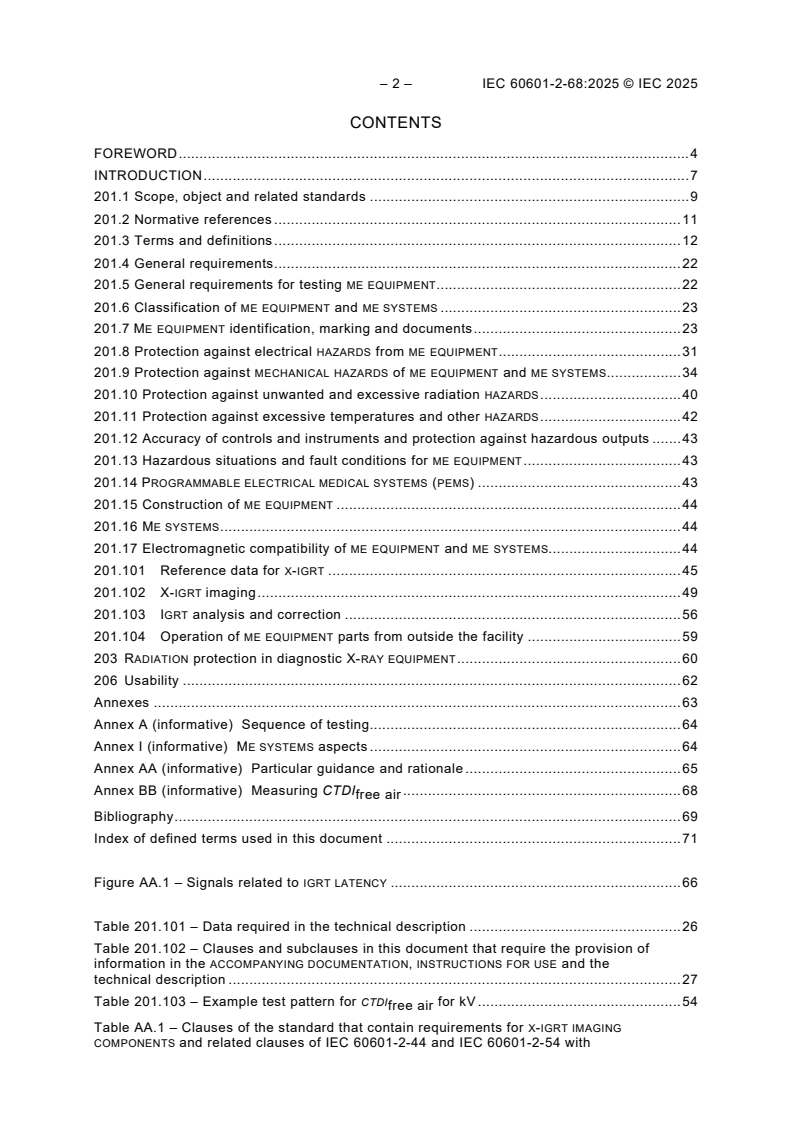
CONTENTS
FOREWORD . 4
INTRODUCTION . 7
201.1 Scope, object and related standards . 9
201.2 Normative references . 11
201.3 Terms and definitions . 12
201.4 General requirements . 22
201.5 General requirements for testing ME EQUIPMENT . 22
201.6 Classification of ME EQUIPMENT and ME SYSTEMS . 23
201.7 ME EQUIPMENT identification, marking and documents . 23
201.8 Protection against electrical HAZARDS from ME EQUIPMENT . 31
201.9 Protection against MECHANICAL HAZARDS of ME EQUIPMENT and ME SYSTEMS . 34
201.10 Protection against unwanted and excessive radiation HAZARDS . 40
201.11 Protection against excessive temperatures and other HAZARDS . 42
201.12 Accuracy of controls and instruments and protection against hazardous outputs . 43
201.13 Hazardous situations and fault conditions for ME EQUIPMENT . 43
201.14 PROGRAMMABLE ELECTRICAL MEDICAL SYSTEMS (PEMS) . 43
201.15 Construction of ME EQUIPMENT . 44
201.16 ME SYSTEMS . 44
201.17 Electromagnetic compatibility of ME EQUIPMENT and ME SYSTEMS. 44
201.101 Reference data for X-IGRT . 45
201.102 X-IGRT imaging . 49
201.103 IGRT analysis and correction . 56
201.104 Operation of ME EQUIPMENT parts from outside the facility . 59
203 RADIATION protection in diagnostic X-RAY EQUIPMENT . 60
206 Usability . 62
Annexes . 63
Annex A (informative) Sequence of testing. 64
Annex I (informative) ME SYSTEMS aspects . 64
Annex AA (informative) Particular guidance and rationale . 65
Annex BB (informative) Measuring CTDI . 68
free air
Bibliography . 69
Index of defined terms used in this document . 71
Figure AA.1 – Signals related to IGRT LATENCY . 66
Table 201.101 – Data required in the technical description . 26
Table 201.102 – Clauses and subclauses in this document that require the provision of
information in the ACCOMPANYING DOCUMENTATION, INSTRUCTIONS FOR USE and the
technical description . 27
Table 201.103 – Example test pattern for CTDI for kV . 54
free air
Table AA.1 – Clauses of the standard that contain requirements for X-IGRT IMAGING
COMPONENTS and related clauses of IEC 60601-2-44 and IEC 60601-2-54 with
equivalent requirements for CT SCANNER, x-RAY EQUIPMENT for RADIOGRAPHY, and X-RAY
EQUIPMENT for RADIOSCOPY . 65
– 4 – IEC 60601-2-68:2025 © IEC 2025
INTERNATIONAL ELECTROTECHNICAL COMMISSION
____________
MEDICAL ELECTRICAL EQUIPMENT –
Part 2-68: Particular requirements for the basic safety and essential
performance of X-ray-based image-guided radiotherapy equipment for use
with electron accelerators, light ion beam therapy equipment and
radionuclide beam therapy equipment
FOREWORD
1) The International Electrotechnical Commission (IEC) is a worldwide organization for standardization comprising
all national electrotechnical committees (IEC National Committees). The object of IEC is to promote international
co-operation on all questions concerning standardization in the electrical and electronic fields. To this end and
in addition to other activities, IEC publishes International Standards, Technical Specifications, Technical Reports,
Publicly Available Specifications (PAS) and Guides (hereafter referred to as "IEC Publication(s)"). Their
preparation is entrusted to technical committees; any IEC National Committee interested in the subject dealt with
may participate in this preparatory work. International, governmental and non-governmental organizations liaising
with the IEC also participate in this preparation. IEC collaborates closely with the International Organization for
Standardization (ISO) in accordance with conditions determined by agreement between the two organizations.
2) The formal decisions or agreements of IEC on technical matters express, as nearly as possible, an international
consensus of opinion on the relevant subjects since each technical committee has representation from all
interested IEC National Committees.
3) IEC Publications have the form of recommendations for international use and are accepted by IEC National
Committees in that sense. While all reasonable efforts are made to ensure that the technical content of IEC
Publications is accurate, IEC cannot be held responsible for the way in which they are used or for any
misinterpretation by any end user.
4) In order to promote international uniformity, IEC National Committees undertake to apply IEC Publications
transparently to the maximum extent possible in their national and regional publications. Any divergence between
any IEC Publication and the corresponding national or regional publication shall be clearly indicated in the latter.
5) IEC itself does not provide any attestation of conformity. Independent certification bodies provide conformity
assessment services and, in some areas, access to IEC marks of conformity. IEC is not responsible for any
services carried out by independent certification bodies.
6) All users should ensure that they have the latest edition of this publication.
7) No liability shall attach to IEC or its directors, employees, servants or agents including individual experts and
members of its technical committees and IEC National Committees for any personal injury, property damage or
other damage of any nature whatsoever, whether direct or indirect, or for costs (including legal fees) and
expenses arising out of the publication, use of, or reliance upon, this IEC Publication or any other IEC
Publications.
8) Attention is drawn to the Normative references cited in this publication. Use of the referenced publications is
indispensable for the correct application of this publication.
9) IEC draws attention to the possibility that the implementation of this document may involve the use of (a)
patent(s). IEC takes no position concerning the evidence, validity or applicability of any claimed patent rights in
respect thereof. As of the date of publication of this document, IEC had not received notice of (a) patent(s), which
may be required to implement this document. However, implementers are cautioned that this may not represent
the latest information, which may be obtained from the patent database available at https://patents.iec.ch. IEC
shall not be held responsible for identifying any or all such patent rights.
IEC 60601-2-68 has been prepared by IEC subcommittee 62C: Equipment for radiotherapy,
nuclear medicine and radiation dosimetry, of IEC technical committee 62: Medical equipment,
software, and systems. It is an International Standard.
This second edition cancels and replaces the first edition published in 2014. This edition
constitutes a technical revision.
This edition includes the following significant technical changes with respect to the previous
edition:
a) alignment with the new editions of the relevant standards:
– IEC 60601-2-1:2020;
– IEC 60601-2-44:2009, IEC 60601-2-44:2009/AMD1:2012 and IEC 60601-2-
44:2009/AMD2:2016;
– IEC 60601-2-64:2014;
b) clarification of the use of IEC 60601-2-68 for CT SCANNERS, X-RAY EQUIPMENT for
RADIOGRAPHY and RADIOSCOPY used in the same room with an EXTERNAL BEAM EQUIPMENT
(EBE);
c) introduction of updated requirements related to MECHANICAL HAZARDS, RADIATION HAZARDS,
PROGRAMMABLE ELECTRICAL MEDICAL SYSTEMS (PEMS), ACCOMPANYING DOCUMENTATION of an
ME SYSTEM, and REMOTE OPERATION.
The text of this International Standard is based on the following documents:
Draft Report on voting
62C/927/FDIS 62C/941/RVD
Full information on the voting for its approval can be found in the report on voting indicated in
the above table.
The language used for the development of this International Standard is English.
This document was drafted in accordance with ISO/IEC Directives, Part 2, and developed in
accordance with ISO/IEC Directives, Part 1 and ISO/IEC Directives, IEC Supplement, available
at www.iec.ch/members_experts/refdocs. The main document types developed by IEC are
described in greater detail at www.iec.ch/publications.
In this document, the following print types are used:
– requirements and definitions: roman type;
– test specifications: italic type;
– informative material appearing outside of tables, such as notes, examples and references: in smaller type.
Normative text of tables is also in a smaller type;
– TERMS DEFINED IN CLAUSE 3 OF IEC 60601-1:2005, IEC 60601-1:2005/AMD1:2012, AND
IEC 60601-1:2005/AMD2:2020, IN THIS DOCUMENT OR AS NOTED: SMALL CAPITALS.
In referring to the structure of this document, the term
– "clause" means one of the seventeen numbered divisions within the table of contents,
inclusive of all subdivisions (e.g., Clause 7 includes subclauses 7.1, 7.2, etc.);
– "subclause" means a numbered subdivision of a clause (e.g., 7.1, 7.2 and 7.2.1 are all
subclauses of Clause 7).
References to clauses within this document are preceded by the term "Clause" followed by the
clause number. References to subclauses within this document are by number only.
In this document, the conjunctive "or" is used as an "inclusive or" so a statement is true if any
combination of the conditions is true.
The verbal forms used in this document conform to usage described in Clause 7 of the ISO/IEC
Directives, Part 2. For the purposes of this document, the auxiliary verb:
– "shall" means that compliance with a requirement or a test is mandatory for compliance with
this document;
– "should" means that compliance with a requirement or a test is recommended but is not
mandatory for compliance with this document;
– "may" is used to describe a permissible way to achieve compliance with a requirement or
test.
– 6 – IEC 60601-2-68:2025 © IEC 2025
An asterisk (*) as the first character of a title or at the beginning of a paragraph or table title
indicates that there is guidance or rationale related to that item in Annex AA.
A list of all parts of the IEC 60601 series, published under the general title Medical electrical
equipment, can be found on the IEC website.
The committee has decided that the contents of this document will remain unchanged until the
stability date indicated on the IEC website under webstore.iec.ch in the data related to the
specific document. At this date, the document will be
• reconfirmed,
• withdrawn, or
• revised.
INTRODUCTION
Modern RADIOTHERAPY practices utilize information from various imaging modalities, acquired
prior to initiating administration of the therapy, to plan the TREATMENT. The imaging provides
information about the location of the TARGET VOLUME and other anatomical features so that a
TREATMENT PLAN can be developed that provides an optimal dose distribution to have the best
chance of achieving the intended effect of TREATMENT while minimizing side effects.
However, difficulties arise when trying to administer the RADIATION, since TARGET
VOLUMES/critical structures are constantly moving within the body. For example, in parts of the
body moving with respiration, the TARGET VOLUMES/critical structures may change position or
shape during the RADIATION BEAM delivery throughout any given fraction. Furthermore, a course
of therapy can extend over many days, during which the TARGET VOLUME/PATIENT can shrink or
grow or move. Hence, the exact location of the TARGET VOLUME/critical structures can change
between the time of TREATMENT PLANNING imaging and the actual administration of a TREATMENT.
IMAGE-GUIDED RADIOTHERAPY (IGRT) combines planar or volumetric imaging during the course of
RADIOTHERAPY to adjust the TREATMENT delivery based on the PATIENT anatomy and PATIENT
position. This enables the OPERATOR or EXTERNAL BEAM EQUIPMENT (EBE) to adjust the RADIATION
BEAM delivery based on the imaging information, such as the position of the TARGET VOLUME,
critical organs or other reference features, to compensate for anatomical changes including
internal organ motions or TREATMENT setup uncertainties. The increased accuracy and precision
achieved allows higher doses of RADIATION to be delivered to the TARGET VOLUME and a reduction
in the margin of healthy cells affected by the RADIATION. This is often used in conjunction with
other monitoring equipment.
This document establishes requirements to be complied with by MANUFACTURERS in the design
and construction of X-RAY IGRT EQUIPMENT (X-IGRT).
This document covers safety aspects of kilovoltage (kV) and megavoltage (MV) X-ray imaging
devices in a known geometrical relationship with an EXTERNAL BEAM EQUIPMENT such as an
ELECTRON ACCELERATOR, LIGHT ION BEAM MEDICAL ELECTRICAL EQUIPMENT or RADIONUCLIDE BEAM
THERAPY EQUIPMENT, for the purpose of IGRT. It covers aspects of communication and
relationships between the EXTERNAL BEAM EQUIPMENT and X-ray imaging devices, attached or
not directly attached to, but in the same RADIATION shielded area as, and dedicated for use only
with, the EXTERNAL BEAM EQUIPMENT.
When performing a HAZARD ANALYSIS, the MANUFACTURER should consider relevant diagnostic
standards. For example, the IMAGE DISPLAY DEVICE quality is specified in IEC documents in
regard to diagnostic use (e.g., IEC 62563-1:2009). However, since IGRT usage does not
necessarily have such high requirements, it is left to the MANUFACTURER to specify what is
required for use with their X-IGRT EQUIPMENT.
This document deals with the safety aspect of image acquisitions, image analysis, data transfer
and TREATMENT replanning or EBE/PATIENT repositioning.
This document deals with equipment for OFFLINE X-IGRT, ONLINE X-IGRT, and REAL-TIME X-IGRT.
X-IGRT EQUIPMENT is also related to the following current publications:
– IEC 60601-2-1
– IEC 60601-2-44
– IEC 60601-2-64
– IEC 62083
– IEC 61217
– IEC 62274
– 8 – IEC 60601-2-68:2025 © IEC 2025
This document will focus on the safety aspects of the primary function of X-IGRT. It will not focus
on emerging technologies within the field so as to not hinder progress, yet it will define a safe
way of achieving X-IGRT.
MEDICAL ELECTRICAL EQUIPMENT –
Part 2-68: Particular requirements for the basic safety and essential
performance of X-ray-based image-guided radiotherapy equipment for use
with electron accelerators, light ion beam therapy equipment and
radionuclide beam therapy equipment
201.1 Scope, object and related standards
Clause 1 of IEC 60601-1:2005, IEC 60601-1:2005/AMD1:2012, and
IEC 60601-1:2005/AMD2:2020 applies, except as follows:
201.1.1 * Scope
Replacement:
BASIC SAFETY and ESSENTIAL PERFORMANCE of X-ray based
This part of IEC 60601 applies to the
IMAGE-GUIDED RADIOTHERAPY equipment for use with EXTERNAL BEAM EQUIPMENT (EBE).
This document covers safety aspects of kilovoltage (kV) and megavoltage (MV) X-ray imaging
devices integrated in a specified geometrical relationship with EBE for the purpose of IGRT. It
covers aspects of communication and relationships between the EXTERNAL BEAM EQUIPMENT and
X-ray imaging devices, attached or not directly attached to, but in the same RADIATION shielded
area as, and dedicated for use only with, the EXTERNAL BEAM EQUIPMENT.
This document deals with equipment for OFFLINE X-IGRT, ONLINE X-IGRT and REAL-TIME X-IGRT. It
covers procedures to reduce the risk of over-reliance on the X-IGRT EBE SYSTEM. For example,
in the case of ONLINE X-IGRT, the MANUFACTURER will provide an interactive interface for user
interaction with the correction suggested by the system.
This document does not apply to CT SCANNERS, X-RAY EQUIPMENT for RADIOGRAPHY, and X-RAY
EQUIPMENT for RADIOSCOPY, that are not intended for use for IGRT.
Requirements that are being tested according to another standard can be identified by the
manufacturer. If these requirements are equivalent, retesting is not required, but instead
evidence can refer to the CT SCANNER, X-RAY EQUIPMENT for RADIOGRAPHY, or X-RAY for
RADIOSCOPY manufacturer's compliance statements or test reports.
If the X-IGRT EQUIPMENT is combined with an MEE, any requirement that is the same for the X-
IGRT EQUIPMENT and the MEE, such as a PATIENT POSITIONER, is not required to be tested twice,
but can be accepted as tested by the MEE.
This document applies to X-RAY EQUIPMENT for RADIOGRAPHY, RADIOSCOPY, and COMPUTER
TOMOGRAPHY used for IGRT.
If a clause or subclause is specifically intended to be applicable to X-IGRT EBE SYSTEMS, the
content of that clause or subclause will say so. Where that is not the case, the clause or
subclause applies only to X-IGRT EQUIPMENT.
– 10 – IEC 60601-2-68:2025 © IEC 2025
This document, with the inclusion of TYPE TESTS and SITE TESTS, applies respectively to the
MANUFACTURER and some installation aspects of X-IGRT EBE SYSTEMS intended to be
• for NORMAL USE, operated under the authority of the RESPONSIBLE ORGANIZATION by QUALIFIED
PERSONS having the required skills for a particular medical application, for particular
specified clinical purposes, e.g., STATIONARY RADIOTHERAPY or MOVING BEAM RADIOTHERAPY,
• maintained in accordance with the recommendations given in the INSTRUCTIONS FOR USE,
and
QUALIFIED
• subject to regular quality assurance performance and calibration checks by a
PERSON.
NOTE In this document, all references to installation refer to the installation in the RESPONSIBLE ORGANIZATION'S
premises.
201.1.2 Object
Replacement:
The object of this document is to establish particular BASIC SAFETY and ESSENTIAL PERFORMANCE
requirements for X-IGRT EQUIPMENT and X-IGRT EBE SYSTEMS.
201.1.3 Collateral standards
Addition:
This document refers to those applicable collateral standards that are listed in Clause 2 of
IEC 60601-1:2005, IEC 60601-1:2005/AMD1:2012 and IEC 60601-1:2005/AMD2:2020 and
Clause 201.2 of this document.
IEC 60601-1-3 and IEC 60601-1-6 apply as modified in Clause 203 and Clause 206
respectively. IEC 60601-1-8, IEC 60601-1-9, IEC 60601-1-10 and IEC 60601-1-11 do not apply.
All other published collateral standards in the IEC 60601-1 series apply as published.
All other published collateral standards in the IEC 60601-1 series apply as published.
201.1.4 Particular standards
Replacement:
In the IEC 60601 series, particular standards may modify, replace or delete requirements
contained in IEC 60601-1:2005, IEC 60601-1:2005/AMD1:2012 and
IEC 60601-1:2005/AMD2:2020 and collateral standards as appropriate for the particular
ME EQUIPMENT under consideration, and may add other BASIC SAFETY and ESSENTIAL
PERFORMANCE requirements.
A requirement of a particular standard takes priority over IEC 60601-1:2005,
IEC 60601-1:2005/AMD1:2012 and IEC 60601-1:2005/AMD2:2020.
The numbering of clauses and subclauses of this document corresponds to that of
IEC 60601-1:2005, IEC 60601-1:2005/AMD1:2012 and IEC 60601-1:2005/AMD2:2020 with the
prefix "201" (e.g. 201.1 in this document addresses the content of Clause 1 of
IEC 60601-1:2005, IEC 60601-1:2005/AMD1:2012 and IEC 60601-1:2005/AMD2:2020) or
applicable collateral standard with the prefix "20x" where x is the final digit(s) of the collateral
standard document number (e.g. 202.4 in this document addresses the content of Clause 4 of
the IEC 60601-1-2 collateral standard, 203.4 in this document addresses the content of Clause
4 of the IEC 60601-1-3 collateral standard, etc.). The changes to the text of IEC 60601-1:2005,
IEC 60601-1:2005/AMD1:2012 and IEC 60601-1:2005/AMD2:2020 are specified by the use of
the following words:
"Replacement" means that the clause or subclause of IEC 60601-1:2005,
IEC 60601-1:2005/AMD1:2012 and IEC 60601-1:2005/AMD2:2020 or applicable collateral
standard is replaced completely by the text of this document.
"Addition" means that the text of this document is additional to the requirements of
IEC 60601-1:2005, IEC 60601-1:2005/AMD1:2012 and IEC 60601-1:2005/AMD2:2020 or
applicable collateral standard.
"Amendment" means that the clause or subclause of IEC 60601-1:2005,
IEC 60601-1:2005/AMD1:2012 and IEC 60601-1:2005/AMD2:2020 or applicable collateral
standard is amended as indicated by the text of this document.
Subclauses, figures or tables which are additional to those of IEC 60601-1:2005,
IEC 60601-1:2005/AMD1:2012 and IEC 60601-1:2005/AMD2:2020 are numbered starting from
201.101. However, due to the fact that definitions in IEC 60601-1:2005, IEC 60601-
1:2005/AMD1:2012 and IEC 60601-1:2005/AMD2:2020 are numbered 3.1 through 3.154,
additional definitions in this document are numbered beginning from 201.3.201. Additional
annexes are lettered AA, BB, etc., and additional items aa), bb), etc.
Subclauses, figures or tables which are additional to those of a collateral standard are
numbered starting from 20x, where "x" is the number of the collateral standard, for example 202
for IEC 60601-1-2, 203 for IEC 60601-1-3, etc.
The term "this document" is used to make reference to IEC 60601-1:2005,
IEC 60601-1:2005/AMD1:2012 and IEC 60601-1:2005/AMD2:2020, any applicable collateral
standards and this document taken together.
Where there is no corresponding clause or subclause in this document, the clause or subclause
of IEC 60601-1:2005, IEC 60601-1:2005/AMD1:2012 and IEC 60601-1:2005/AMD2:2020 or
applicable collateral standard, although possibly not relevant, applies without modification;
where it is intended that any part of IEC 60601-1:2005, IEC 60601-1:2005/AMD1:2012 and
IEC 60601-1:2005/AMD2:2020 or applicable collateral standard, although possibly relevant, is
not to be applied, a statement to that effect is given in this document.
201.2 Normative references
NOTE Informative references are listed in the bibliography.
– 12 – IEC 60601-2-68:2025 © IEC 2025
Clause 2 of IEC 60601-1:2005, IEC 60601-1:2005/AMD1:2012, and
IEC 60601-1:2005/AMD2:2020 applies, except as follows:
Replacement:
IEC 60601-1-3:2008, Medical electrical equipment – Part 1-3: General requirements for basic
safety and essential performance – Collateral Standard: Radiation protection in diagnostic X-ray
equipment
IEC 60601-1-3:2008/AMD1:2013
IEC 60601-1-3:2008/AMD2:2021
Addition:
IEC 60601-1:2005, Medical electrical equipment – Part 1: General requirements for basic safety
and essential performance
IEC 60601-1:2005/AMD1:2012
IEC 60601-1:2005/AMD2:2020
IEC 60601-2-1:2020, Medical electrical equipment – Part 2-1: Particular requirements for the
basic safety and essential performance of electron accelerators in the range 1 MeV to 50 MeV
IEC 60601-2-4:2010, Medical electrical equipment – Part 2-4: Particular requirements for the
basic safety and essential performance of cardiac defibrillators
IEC TR 60788:2004, Medical electrical equipment – Glossary of defined terms
IEC 61000-4-3, Electromagnetic compatibility (EMC) – Part 4-3 : Testing and measurement
techniques – Radiated, radio-frequency, electromagnetic field immunity test
IEC 61217:2011, Radiotherapy equipment – Coordinates, movements and scales
IEC 62563-1:2009, Medical electrical equipment – Medical image display systems – Part 1:
Evaluation methods
CISPR 11, Industrial, scientific and medical equipment – Radio-frequency disturbance
characteristics – Limits and methods of measurement
201.3 Terms and definitions
For the purposes of this document, the terms and definitions given in IEC 60601-2-1:2020,
IEC 60601-1:2005, IEC 60601-1:2005/AMD1:2012, and IEC 60601-1:2005/AMD2:2020, and
IEC TR 60788:2004 apply, except as follows:
ISO and IEC maintain terminology databases for use in standardization at the following
addresses:
• IEC Electropedia: available at https://www.electropedia.org/
• ISO Online browsing platform: available at https://www.iso.org/obp
Additional terms and definitions:
201.3.201
COMPUTED TOMOGRAPHY DOSE INDEX 100
CTDI
integral of the DOSE PROFILE representative of a single axial scan along a line perpendicular to
the TOMOGRAPHIC PLANE divided by N × T according to the following:
for N × T less than or equal to 40 mm
+50mm Dy
( )
CTDI = dy
∫
−50mm
N×T
for N × T greater than 40 mm (all IGRT IMAGING PROTOCOL except collimation are kept the same
for these measurements)
+50mm Dy CTDI
( )
Ref free air, N×T
CTDI dy×
∫
−50mm
N×T CTDI
( )
free air, Ref
Ref
where
DOSE PROFILE representative of a single axial scan along a line
D(y) is the
perpendicular to the TOMOGRAPHIC PLANE, where dose is reported as
ABSORBED DOSE in air and is evaluated within a polymethylmethacrylate
(PMMA) dosimetry PHANTOM (see 201.102.6.2);
(N × T) is a specific N × T of 20 mm or the largest N x T available not greater
Ref
than 20 mm;
D (y) is the DOSE PROFILE representative of a single axial scan along a line
Ref
perpendicular to the TOMOGRAPHIC PLANE, where dose is reported as
ABSORBED DOSE in air and is evaluated within a polymethylmethacrylate
PHANTOM (see 201.102.6.2) for (N × T) ;
(PMMA) dosimetry
Ref
CTDI is the CTDI (201.3.202) for a specific value of N × T;
free air, N × T free air
CTDI is the CTDI (201.3.202) for (N × T) ;
free air, Ref free air Ref
N is the number of TOMOGRAPHIC SECTIONS produced in a single axial scan
of the X-ray source;
T is the NOMINAL TOMOGRAPHIC SECTION THICKNESS.
Note 1 to entry: The dose is reported as ABSORBED DOSE to air, but for practical purposes the evaluation of ABSORBED
DOSE to air within a PMMA dosimetry PHANTOM is well approximated by measurement of the AIR KERMA.
Note 2 to entry: This definition assumes that the DOSE PROFILE is centred on y = 0.
Note 3 to entry: A single axial scan is typically a 360° rotation of the X-ray source. For CBCT partial rotations are
still considered as a single axial scan.
Note 4 to entry: When the TOMOGRAPHIC SECTIONS overlap, e.g., in CT SCANNERS with a "y-flying FOCAL SPOT" or
with CBCT modes that merge multiple scans, the denominator of the integral needs to be replaced by the total nominal
width along y of overlapping tomographic sections. For example, if the percentage of overlap is 50 %, then the
denominator would be replaced with 0,5 x N x T.
Note 5 to entry: Typically, the y-axis is the axis of rotation (the y-axis corresponds to the z-axis in the DICOM
coordinate system).
Note 6 to entry: The CTDI is designed to include most of the scattered RADIATION.
Note 7 to entry: See IEC 60601-2-44:2009/AMD1:2012, Annex CC for more explanation.
Note 8 to entry: It is assumed for MV CBCT that an appropriate calibrated pencil chamber is used.
=
– 14 – IEC 60601-2-68:2025 © IEC 2025
[SOURCE: IEC 60601-2-44:2009/AMD1:2012, 201.3.203, modified – Notes 3, 4 and 5 to entry
have been extended, and Note 8 to entry added.]
201.3.202
COMPUTED TOMOGRAPHY DOSE INDEX FREE-IN-AIR
CTDI
free air
integral of the DOSE PROFILE representative of a single axial scan along a line through the
ISOCENTRE and perpendicular to the TOMOGRAPHIC PLANE divided by N × T according to the
following
+L/2 Dy
( )
CTDI = dy
free air
∫
−L/2
N×T
where
D(y) is the DOSE PROFILE representative of a single axial scan along a line through ISOCENTRE
and perpendicular to the TOMOGRAPHIC PLANE, where dose is reported as ABSORBED DOSE
in air and is evaluated free-in-air in the absence of a PHANTOM and the PATIENT SUPPORT;
N is the number of TOMOGRAPHIC SECTIONS produced in a single axial scan of the X-ray
source;
T is the NOMINAL TOMOGRAPHIC SECTION THICKNESS;
L is at least (N × T) +40 mm.
Note 1 to entry: This definition assumes that the DOSE PROFILE is centred on y = 0. The y axis corresponds to the z
axis in the DICOM coordinate system.
Note 2 to entry: When the TOMOGRAPHIC SECTIONS overlap, e.g., in CT SCANNERS with a "y-flying FOCAL SPOT" or
with CBCT modes that merges multiple scans, the denominator of the integral needs to be replaced by the total
nominal width along y of overlapping tomographic sections. For example, if the percentage of overlap is 50 %, then
the denominator would be replaced by 0,5 × N × T.
Note 3 to entry: Typically, a RADIATION DETECTOR of length L or longer is used. Annex DD provides an example for
alternate measurements.
Note 4 to entry: For CBCT, the imaging is not slice based and N × T is the scan length along a line perpendicular to
the TOMOGRAPHIC PLANE with the NOMINAL collimation.
Note 5 to entry: It is assumed for MV CBCT that an appropriate calibrated pencil chamber or ion chamber, and a
build-up cap is used.
[SOURCE: IEC 60601-2-44:2009/AMD1:2012, 201.3.215, modified – Note 1 and 2 to entry have
been extended and Notes 4 and 5 to entry added.]
201.3.203
CONE BEAM COMPUTED TOMOGRAPHY
CBCT
computed tomography performed using a cone beam of X-RADIATION
201.3.204
CONTRAST TO NOISE RATIO
CNR
physical quantity describing the ability to distinguish between various contrast objects of a
digital image and the inherent noise within the image, defined as the difference of mean pixel
values of the contrast objects and image background, and divided by the standard deviation of
the image background pixel value
S – S
AB
Note 1 to entry: C =
σ
S and S are signal intensities for the signal producing structures A and B in the region of interest and σ is the
A B 0
standard deviation of the image noise. The MANUFACTURER specifies the structures defining A and B.
[SOURCE: IEC 61223-3-2:2007, 3.8, modified – Two notes to entry have been added.]
201.3.205
DOSE-LENGTH PRODUCT
DLP
index characterizing the product of the CTDI and the total length scanned
vol
a) For axial scanning
DLP = CTDI × ∆d × n
vol
where
∆d is the PATIENT SUPPORT travel in y-direction between consecutive scans;
n is the number of scans in the series.
b) For helical scanning
DLP = CTDI ×L
vol
where
L is the table travel during the entire LOADING, adjusted for dynamic collimation modes
where applicable.
Note 1 to entry: L might be longer than the programmed scan length.
Note 2 to entry: The time weighted average of CTDI is to be used if CTDI is variable.
vol vol
Note 3 to entry: A way for obtaining L could be to use the FWHM along a line perpendicular to the TOMOGRAPHIC
PLANE at isocentre of the free-in-air DOSE PROFILE for the entire scan. In the absence of dynamic collimation this
is approximately equivalent to table travel during the entire LOADING.
c) For scanning without movement of the PATIENT SUPPORT
DLP = CTDI ×N×T
vol
where
N is the number of TOMOGRAPHIC SECTIONS PRODUCED in a single axial scan of the X-ray
source;
T is the NOMINAL TOMOGRAPHIC SECTION THICKNESS.
Note 4 to entry: For CBCT, usually only c) is applicable where N × T is the scan length along a line perpendicular
to the TOMOGRAPHIC PLANE with the NOMINAL collimation.
Note 5 to entry: Typically, the y-axis is the axis of rotation. The y axis corresponds to the z axis in the DICOM
coordinate system.
d) For axial scanning without gaps and helical scanning, both involving back-and-forth PATIENT
SUPPORT movement between two positions (shuttle mode)
DLP = CTDI × N×T + R
(( ) )
vol
where
N is the number of TOMOGRAPHIC SECTIONS produced in a single axial scan of the X-ray
source;
T is the NOMINAL TOMOGRAPHIC SECTION THICKNESS;
R is the distance between the two positions.
– 16 – IEC 60601-2-68:2025 © IEC 2025
[SOURCE: IEC 60601-2-44:2009 and IEC 60601-2-44:2009/AMD1:2012, 201.3.214, modified –
Notes 4 and 5 to entry have been added.]
201.3.206
DOSE PROFILE
representation of the dose as a function of position along a line
[SOURCE: IEC 60601-2-44:2009, 201.3.205]
201.3.207
EQUIPMENT REFERENCE POINT
ERP
point in space used for referencing dimensions and positions of equipment and performing
dosimetry measurements
201.3.208
EXTERNAL BEAM EQUIPMENT
EBE
external RADIATION EQUIPMENT utilizing ELECTRON ACCELERATORS, light ion beam medical
electrical equipment or RADIONUCLIDE BEAM THERAPY EQUIPMENT
201.3.209
IGRT EQUIPMENT
ME EQUIPMENT that provides IGRT functionality
201.3.210
* IGRT LATENCY
time from initiation of image acquisition to output signal by X-IGRT EQUIPMENT to the EBE
Note 1 to entry: It is expected that the EBE can also state its latency time from receiving the signal to providing the
correction.
Note 2 to entry: The IGRT LATENCY includes the hardware and software latencies.
Note 3 to entry: Network transfer times vary from one installation to another as there are too many factors involved
that are supplied by the RESPONSIBLE ORGANIZATION. Network transfer latency therefore is not considered as part of
the IGRT LATENCY time.
201.3.211
IMAGE-GUIDED RADIOTHERAPY
IGRT
radiotherapy process by which the location of a radiotherapy beam relative to the intended
TARGET VOLUME within a patient's anatomy is determined by imaging of the TARGET VOLUME and
surrounding anatomical structures at the time of TREATMENT, so as to enable any necessary
positional corrections to the intended relative location of beam to TARGET VOLUME
Note 1 to entry: The time period of "at the time of TREATMENT" is specified in the definitions of OFFLINE IGRT, ONLINE
IGRT and REAL-TIME IGRT.
[SOURCE: IEC 60976:2007, 3.8, modified ─ Addition of Note 1 to entry.]
201.3.212
IMAGING PROTOCOL
set of parameters necessary to perform imaging
Note 1 to entry: The following modes are examples of different types of imaging: radiography, radioscopy, helical,
axial, axial series, scanning without movement of the PATIENT POSITIONER and shuttle mode.
Note 2 to entry: To maintain consistency with their respective user interfaces and documentation, various X-IGRT
EQUIPMENT might use terminology different from "IMAGING PROTOCOL", e.g., "scan", "scan group", "scan series",
"presets", "CBCT modes" etc.
Note 3 to entry: An IMAGING PROTOCOL is typically associated with a IGRT task, anatomical region, age or size group.
201.3.213
IMAGE RECONSTRUCTION
method to process acquired data into an image data set that can be used for analysis
Note 1 to entry: The analysis of the reconstructed image data set can be for the purpose of IMAGE REGISTRATION
against reference data.
201.3.214
IMAGE REGISTRATION
method for mapping or registering corresponding points from one image data set to another
Note 1 to entry: IMA
...