

IEC 60794-1-1:2023
(Main)Optical fibre cables - Part 1-1: Generic specification - General
General Information
- Abstract
IEC 60794-1-1:2023 applies to optical fibre cables for use with communication equipment and devices employing similar techniques. Electrical properties are specified for optical ground wire (OPGW) and optical phase conductor (OPPC) cables. Hybrid communication cables are specified in the IEC 62807 series. The object of this document is to establish uniform generic requirements for the geometrical, transmission, material, mechanical, ageing (environmental exposure), climatic and electrical properties of optical fibre cables and cable elements, where appropriate. This fifth edition cancels and replaces the fourth edition published in 2015. This edition constitutes a technical revision. This edition includes the following significant technical changes with respect to the previous edition:
a) reorganization of the document to a more logical flow making it easier for the reader:
b) expansion of the tables to include names and definitions of all documents in the IEC 60794‑x series;
c) expansion of the definitions, graphical symbols, terminology and abbreviations content, with the aim of making this document the default and reference for all others in the IEC 60794‑x series;
d) inclusion of updated, reorganized and expanded optical fibre, attenuation and bandwidth subclauses, with the aim of making this document the default and reference for all others in the IEC 60794-x series.
- Status
- Published
- Publication Date
- 21-May-2023
- Technical Committee
- SC 86A - Fibres and cables
- Current Stage
- PPUB - Publication issued
- Start Date
- 22-May-2023
- Completion Date
- 28-Apr-2023
Buy Documents
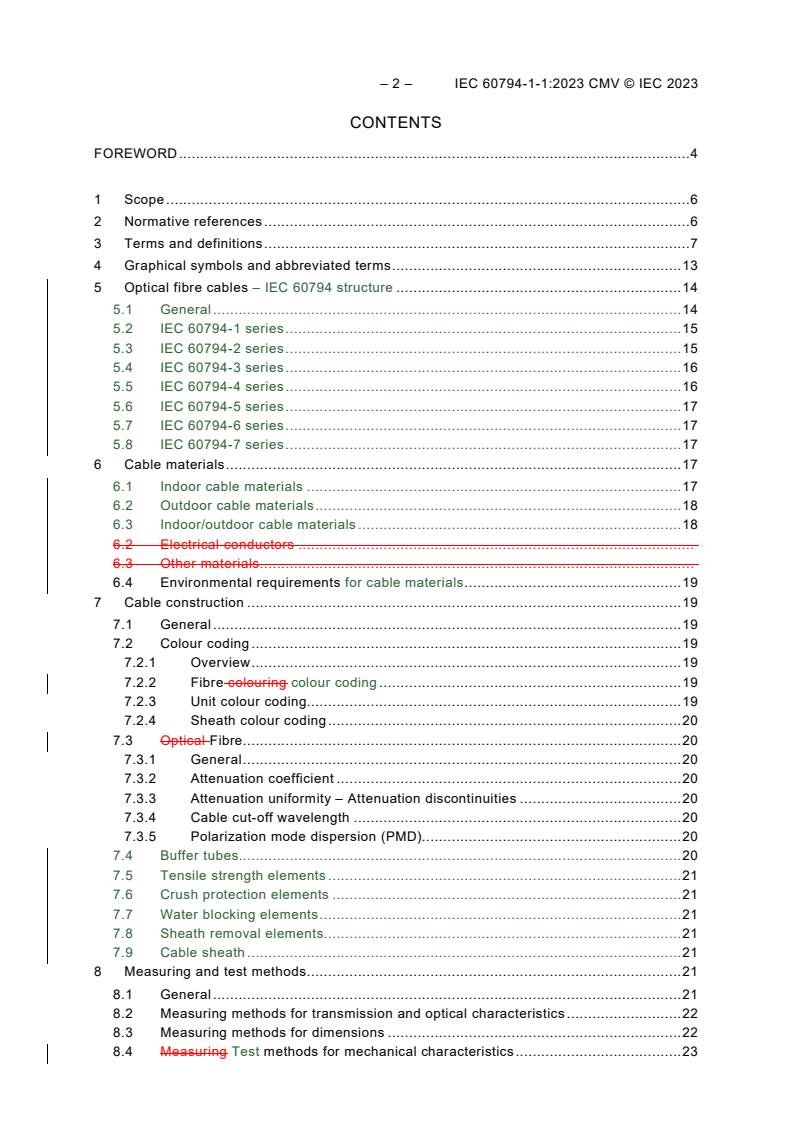
REDLINE IEC 60794-1-1:2023 CMV - Optical fibre cables - Part 1-1: Generic specification - General Released:5/22/2023
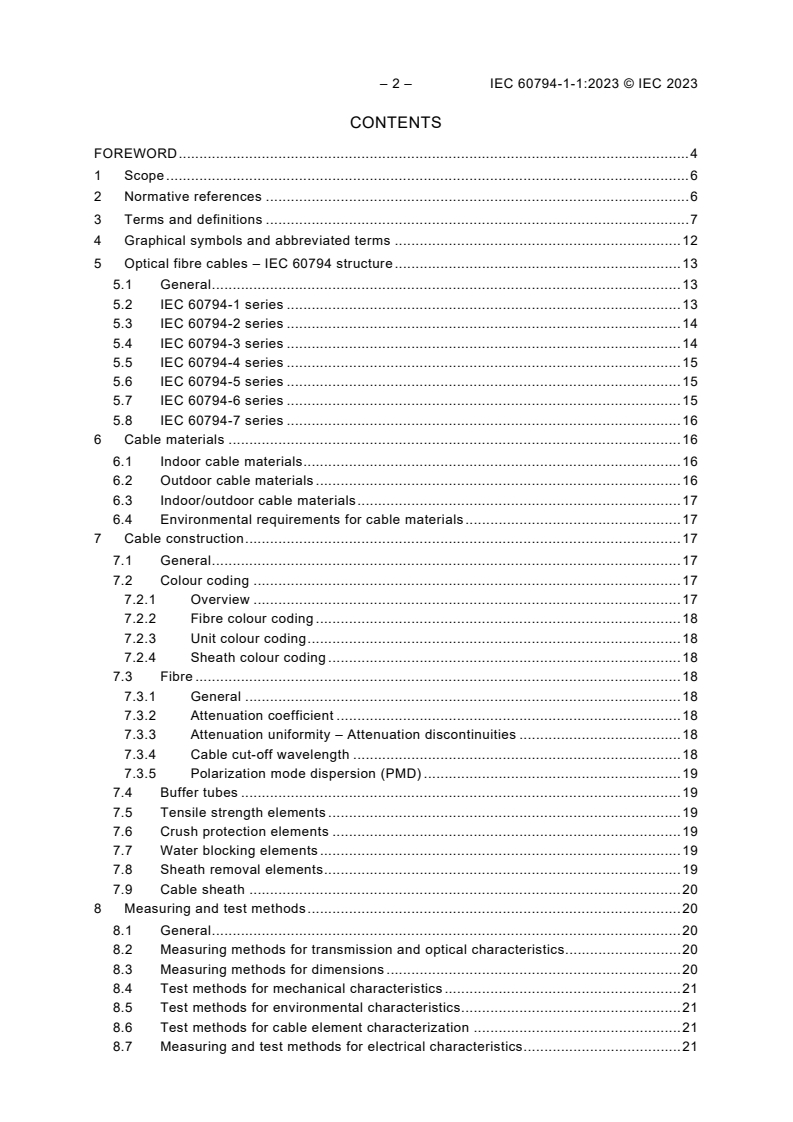
IEC 60794-1-1:2023 - Optical fibre cables - Part 1-1: Generic specification - General Released:5/22/2023
Overview
IEC 60794-1-1:2023 – Optical Fibre Cables – Part 1-1: Generic Specification – General is an international standard developed by the International Electrotechnical Commission (IEC). This standard specifies generic requirements for optical fibre cables, including cables for communication equipment, and cables that combine optical fibres with electrical conductors, such as optical ground wires (OPGW) and optical phase conductor cables (OPPC). Additionally, hybrid communication cables are specified in the IEC 62807 series.
The primary objective of IEC 60794-1-1:2023 is to establish uniform requirements for the design, construction, and performance characteristics of optical fibre cables. This includes specifications for geometrical, transmission, material, mechanical, environmental, climatic, and electrical properties of optical fibre cables and their elements. The 2023 edition is a technical revision, offering an improved, logical structure and expanded content to support consistent implementation worldwide.
Key Topics
Geometrical and Transmission Properties
- Uniform requirements for optical fibres and cables
- Transmission characteristics such as attenuation and bandwidth
- Measurement methods for dimensions and optical features
Material and Mechanical Properties
- Specifications for indoor, outdoor, and hybrid cable materials
- Requirements for mechanical strength, including tensile and crush resistance
- Guidelines for buffering, sheathing, and water blocking elements
Environmental and Ageing Performance
- Performance under environmental stressors such as temperature cycling and humidity
- Ageing and climatic resistance for long-term reliability
Electrical Properties
- Requirements for cables with conductive elements, such as OPGW and OPPC
- Electrical conductor materials and design considerations
Terminology, Symbols, and Definitions
- Extensive section on terms, abbreviations, and graphical symbols
- Clarity for interoperability and global adoption
Applications
IEC 60794-1-1:2023 is essential for:
Telecommunications Networks
Providing the baseline requirements for optical fibre cables used in broadband, FTTH (Fibre to the Home), data centers, and backbone communications infrastructure.Utility and Industrial Networks
Applying to optical ground wires (OPGW) and optical phase conductors (OPPC) deployed along electrical power lines for combined data and power transmission.Harsh and Specialized Environments
Ensuring cable designs meet rigorous demands in terms of environmental exposure, mechanical shocks, and climatic variations.Product Testing and Certification
Offering test methods and acceptance criteria that manufacturers and test labs can use to evaluate compliance and ensure quality.Specification and Procurement
Supporting procurement professionals and engineers in selecting and specifying optical fibre cables that conform to recognized international requirements, thereby simplifying supplier qualification and contract negotiations.
Related Standards
IEC 60794 Series
- IEC 60794-1-21, IEC 60794-1-22: Basic optical cable test procedures
- IEC 60794-2 to IEC 60794-7: Detailed product standards for specific cable types and applications
IEC 60793 Series
Covering measurement methods and product specifications for optical fibresIEC 62807 Series
Specifications for hybrid communication cablesIEC 60811 Series
Test methods for cable non-metallic materialsISO 14001 and ISO 14064-1
Environmental management and greenhouse gas quantification
Adhering to IEC 60794-1-1:2023 ensures the safety, reliability, and consistency of optical fibre cable installations worldwide, supporting current and future communications growth. This standard is an indispensable reference for cable manufacturers, network infrastructure planners, and quality assurance professionals seeking global compliance.
Relations
- Effective Date
- 05-Sep-2023
Buy Documents
REDLINE IEC 60794-1-1:2023 CMV - Optical fibre cables - Part 1-1: Generic specification - General Released:5/22/2023
IEC 60794-1-1:2023 - Optical fibre cables - Part 1-1: Generic specification - General Released:5/22/2023
Get Certified
Connect with accredited certification bodies for this standard

ANCE
Mexican certification and testing association.

Intertek Slovenia
Intertek testing, inspection, and certification services in Slovenia.

LNE (Laboratoire National de Métrologie et d'Essais)
French national laboratory for metrology and testing.
Sponsored listings
Frequently Asked Questions
IEC 60794-1-1:2023 is a standard published by the International Electrotechnical Commission (IEC). Its full title is "Optical fibre cables - Part 1-1: Generic specification - General". This standard covers: IEC 60794-1-1:2023 applies to optical fibre cables for use with communication equipment and devices employing similar techniques. Electrical properties are specified for optical ground wire (OPGW) and optical phase conductor (OPPC) cables. Hybrid communication cables are specified in the IEC 62807 series. The object of this document is to establish uniform generic requirements for the geometrical, transmission, material, mechanical, ageing (environmental exposure), climatic and electrical properties of optical fibre cables and cable elements, where appropriate. This fifth edition cancels and replaces the fourth edition published in 2015. This edition constitutes a technical revision. This edition includes the following significant technical changes with respect to the previous edition: a) reorganization of the document to a more logical flow making it easier for the reader: b) expansion of the tables to include names and definitions of all documents in the IEC 60794‑x series; c) expansion of the definitions, graphical symbols, terminology and abbreviations content, with the aim of making this document the default and reference for all others in the IEC 60794‑x series; d) inclusion of updated, reorganized and expanded optical fibre, attenuation and bandwidth subclauses, with the aim of making this document the default and reference for all others in the IEC 60794-x series.
IEC 60794-1-1:2023 applies to optical fibre cables for use with communication equipment and devices employing similar techniques. Electrical properties are specified for optical ground wire (OPGW) and optical phase conductor (OPPC) cables. Hybrid communication cables are specified in the IEC 62807 series. The object of this document is to establish uniform generic requirements for the geometrical, transmission, material, mechanical, ageing (environmental exposure), climatic and electrical properties of optical fibre cables and cable elements, where appropriate. This fifth edition cancels and replaces the fourth edition published in 2015. This edition constitutes a technical revision. This edition includes the following significant technical changes with respect to the previous edition: a) reorganization of the document to a more logical flow making it easier for the reader: b) expansion of the tables to include names and definitions of all documents in the IEC 60794‑x series; c) expansion of the definitions, graphical symbols, terminology and abbreviations content, with the aim of making this document the default and reference for all others in the IEC 60794‑x series; d) inclusion of updated, reorganized and expanded optical fibre, attenuation and bandwidth subclauses, with the aim of making this document the default and reference for all others in the IEC 60794-x series.
IEC 60794-1-1:2023 is classified under the following ICS (International Classification for Standards) categories: 33.180.10 - Fibres and cables. The ICS classification helps identify the subject area and facilitates finding related standards.
IEC 60794-1-1:2023 has the following relationships with other standards: It is inter standard links to IEC 60794-1-1:2015. Understanding these relationships helps ensure you are using the most current and applicable version of the standard.
IEC 60794-1-1:2023 is available in PDF format for immediate download after purchase. The document can be added to your cart and obtained through the secure checkout process. Digital delivery ensures instant access to the complete standard document.
Standards Content (Sample)
IEC 60794-1-1 ®
Edition 5.0 2023-05
COMMENTED VERSION
INTERNATIONAL
STANDARD
colour
inside
Optical fibre cables –
Part 1-1: Generic specification – General
All rights reserved. Unless otherwise specified, no part of this publication may be reproduced or utilized in any form
or by any means, electronic or mechanical, including photocopying and microfilm, without permission in writing from
either IEC or IEC's member National Committee in the country of the requester. If you have any questions about IEC
copyright or have an enquiry about obtaining additional rights to this publication, please contact the address below or
your local IEC member National Committee for further information.
IEC Secretariat Tel.: +41 22 919 02 11
3, rue de Varembé info@iec.ch
CH-1211 Geneva 20 www.iec.ch
Switzerland
About the IEC
The International Electrotechnical Commission (IEC) is the leading global organization that prepares and publishes
International Standards for all electrical, electronic and related technologies.
About IEC publications
The technical content of IEC publications is kept under constant review by the IEC. Please make sure that you have the
latest edition, a corrigendum or an amendment might have been published.
IEC publications search - webstore.iec.ch/advsearchform IEC Products & Services Portal - products.iec.ch
The advanced search enables to find IEC publications by a Discover our powerful search engine and read freely all the
variety of criteria (reference number, text, technical publications previews. With a subscription you will always have
committee, …). It also gives information on projects, replaced access to up to date content tailored to your needs.
and withdrawn publications.
Electropedia - www.electropedia.org
IEC Just Published - webstore.iec.ch/justpublished
The world's leading online dictionary on electrotechnology,
Stay up to date on all new IEC publications. Just Published
containing more than 22 300 terminological entries in English
details all new publications released. Available online and once
and French, with equivalent terms in 19 additional languages.
a month by email.
Also known as the International Electrotechnical Vocabulary
(IEV) online.
IEC Customer Service Centre - webstore.iec.ch/csc
If you wish to give us your feedback on this publication or need
further assistance, please contact the Customer Service
Centre: sales@iec.ch.
IEC 60794-1-1 ®
Edition 5.0 2023-05
COMMENTED VERSION
INTERNATIONAL
STANDARD
colour
inside
Optical fibre cables –
Part 1-1: Generic specification – General
INTERNATIONAL
ELECTROTECHNICAL
COMMISSION
ICS 33.180.10 ISBN 978-2-8322-7058-5
– 2 – IEC 60794-1-1:2023 CMV © IEC 2023
CONTENTS
FOREWORD .4
1 Scope .6
2 Normative references .6
3 Terms and definitions .7
4 Graphical symbols and abbreviated terms . 13
5 Optical fibre cables – IEC 60794 structure . 14
5.1 General . 14
5.2 IEC 60794-1 series . 15
5.3 IEC 60794-2 series . 15
5.4 IEC 60794-3 series . 16
5.5 IEC 60794-4 series . 16
5.6 IEC 60794-5 series . 17
5.7 IEC 60794-6 series . 17
5.8 IEC 60794-7 series . 17
6 Cable materials . 17
6.1 Indoor cable materials . 17
6.2 Outdoor cable materials . 18
6.3 Indoor/outdoor cable materials . 18
6.2 Electrical conductors .
6.3 Other materials .
6.4 Environmental requirements for cable materials . 19
7 Cable construction . 19
7.1 General . 19
7.2 Colour coding . 19
7.2.1 Overview . 19
7.2.2 Fibre colouring colour coding . 19
7.2.3 Unit colour coding. 19
7.2.4 Sheath colour coding . 20
7.3 Optical Fibre . 20
7.3.1 General . 20
7.3.2 Attenuation coefficient . 20
7.3.3 Attenuation uniformity – Attenuation discontinuities . 20
7.3.4 Cable cut-off wavelength . 20
7.3.5 Polarization mode dispersion (PMD). 20
7.4 Buffer tubes. 20
7.5 Tensile strength elements . 21
7.6 Crush protection elements . 21
7.7 Water blocking elements . 21
7.8 Sheath removal elements . 21
7.9 Cable sheath . 21
8 Measuring and test methods . 21
8.1 General . 21
8.2 Measuring methods for transmission and optical characteristics . 22
8.3 Measuring methods for dimensions . 22
8.4 Measuring Test methods for mechanical characteristics . 23
8.5 Measuring Test methods for environmental characteristics . 23
8.6 Measuring Test methods for cable element characterization . 23
8.7 Measuring and test methods for electrical characteristics . 23
9 Related Technical Reports .
Annex A (informative) Guidelines for specific defined applications optical fibre and cabled
fibre performance . 25
A.1 General . 25
A.2 Cabled fibre attenuation requirements . 25
A.3 Cabled fibre bandwidth requirements . 27
A.4 Type testing at 1 625 nm. 28
Annex B (informative) Guidelines for qualification sampling . 30
B.1 General . 30
B.2 Fibre selection for cable testing. 30
B.3 Pass/fail criteria . 31
Annex C (informative) Preferred temperatures. 32
Bibliography . 33
List of comments . 37
Table 1 – IEC 60794 structure . 15
Table 2 – IEC 60794-1 series . 15
Table 3 – IEC 60794-2 series . 15
Table 4 – IEC 60794-3 series . 16
Table 5 – IEC 60794-4 series . 16
Table 6 – IEC 60794-5 series . 17
Table 7 – IEC 60794-6 series . 17
Table 8 – Indoor cables materials (examples) . 18
Table 9 – Outdoor cable materials (examples) . 18
Table 10 – Measuring methods for transmission and optical characteristics of cabled
optical fibres . 22
Table 11 – Measuring methods for dimensions . 22
Table 12 – Measuring methods for electrical characteristics . 23
Table A.1 – Maximum single-mode cabled fibre attenuation coefficient (dB/km), as given
by ITU-T . 25
Table A.2 – Category A1 multimode fibre maximum cable attenuation coefficient (dB/km) . 27
Table A.3 – Single-mode maximum cable attenuation coefficient (dB/km) . 27
Table A.4 – Category A1 multimode cabled fibre bandwidth (MHz∙km) . 28
Table A.5 – Guidance values for 1 625 nm type test acceptance criteria . 29
Table B.1 – Recommended minimum number of tested fibres in a cable. 30
Table C.1 – Preferred low and high temperature . 32
– 4 – IEC 60794-1-1:2023 CMV © IEC 2023
INTERNATIONAL ELECTROTECHNICAL COMMISSION
____________
OPTICAL FIBRE CABLES –
Part 1-1: Generic specification – General
FOREWORD
1) The International Electrotechnical Commission (IEC) is a worldwide organization for standardization comprising
all national electrotechnical committees (IEC National Committees). The object of IEC is to promote international
co-operation on all questions concerning standardization in the electrical and electronic fields. To this end and
in addition to other activities, IEC publishes International Standards, Technical Specifications, Technical Reports,
Publicly Available Specifications (PAS) and Guides (hereafter referred to as “IEC Publication(s)”). Their
preparation is entrusted to technical committees; any IEC National Committee interested in the subject dealt with
may participate in this preparatory work. International, governmental and non-governmental organizations liaising
with the IEC also participate in this preparation. IEC collaborates closely with the International Organization for
Standardization (ISO) in accordance with conditions determined by agreement between the two organizations.
2) The formal decisions or agreements of IEC on technical matters express, as nearly as possible, an international
consensus of opinion on the relevant subjects since each technical committee has representation from all
interested IEC National Committees.
3) IEC Publications have the form of recommendations for international use and are accepted by IEC National
Committees in that sense. While all reasonable efforts are made to ensure that the technical content of IEC
Publications is accurate, IEC cannot be held responsible for the way in which they are used or for any
misinterpretation by any end user.
4) In order to promote international uniformity, IEC National Committees undertake to apply IEC Publications
transparently to the maximum extent possible in their national and regional publications. Any divergence between
any IEC Publication and the corresponding national or regional publication shall be clearly indicated in the latter.
5) IEC itself does not provide any attestation of conformity. Independent certification bodies provide conformity
assessment services and, in some areas, access to IEC marks of conformity. IEC is not responsible for any
services carried out by independent certification bodies.
6) All users should ensure that they have the latest edition of this publication.
7) No liability shall attach to IEC or its directors, employees, servants or agents including individual experts and
members of its technical committees and IEC National Committees for any personal injury, property damage or
other damage of any nature whatsoever, whether direct or indirect, or for costs (including legal fees) and
expenses arising out of the publication, use of, or reliance upon, this IEC Publication or any other IEC
Publications.
8) Attention is drawn to the Normative references cited in this publication. Use of the referenced publications is
indispensable for the correct application of this publication.
9) Attention is drawn to the possibility that some of the elements of this IEC Publication may be the subject of patent
rights. IEC shall not be held responsible for identifying any or all such patent rights.
This commented version (CMV) of the official standard IEC 60794-1-1:2023 edition 5.0
allows the user to identify the changes made to the previous IEC 60794-1-1:2015
edition 4.0. Furthermore, comments from IEC SC 86A experts are provided to explain the
reasons of the most relevant changes, or to clarify any part of the content.
A vertical bar appears in the margin wherever a change has been made. Additions are in
green text, deletions are in strikethrough red text. Experts' comments are identified by a
blue-background number. Mouse over a number to display a pop-up note with the
comment.
This publication contains the CMV and the official standard. The full list of comments is
available at the end of the CMV.
IEC 60794-1-1 has been prepared by subcommittee 86A: Fibres and cables, of IEC technical
committee 86: Fibre optics. It is an International Standard.
This fifth edition cancels and replaces the fourth edition published in 2015. This edition
constitutes a technical revision.
This edition includes the following significant technical changes with respect to the previous
edition:
a) reorganization of the document to a more logical flow making it easier for the reader:
b) expansion of the tables to include names and definitions of all documents in the IEC 60794‑x
series;
c) expansion of the definitions, graphical symbols, terminology and abbreviations content, with
the aim of making this document the default and reference for all others in the IEC 60794‑x
series;
d) inclusion of updated, reorganized and expanded optical fibre, attenuation and bandwidth
subclauses, with the aim of making this document the default and reference for all others in
the IEC 60794-x series.
The text of this International Standard is based on the following documents:
Draft Report on voting
86A/2286/FDIS 86A/2313/RVD
Full information on the voting for its approval can be found in the report on voting indicated in
the above table.
The language used for the development of this International Standard is English.
This document was drafted in accordance with ISO/IEC Directives, Part 2, and developed in
accordance with ISO/IEC Directives, Part 1 and ISO/IEC Directives, IEC Supplement, available
at www.iec.ch/members_experts/refdocs. The main document types developed by IEC are
described in greater detail at www.iec.ch/publications.
A list of all parts in the IEC 60794 series, published under the general title Optical fibre cables,
can be found on the IEC website.
The committee has decided that the contents of this document will remain unchanged until the
stability date indicated on the IEC website under webstore.iec.ch in the data related to the
specific document. At this date, the document will be
• reconfirmed,
• withdrawn,
• replaced by a revised edition, or
• amended.
IMPORTANT – The "colour inside" logo on the cover page of this document indicates that it
contains colours which are considered to be useful for the correct understanding of its
contents. Users should therefore print this document using a colour printer.
– 6 – IEC 60794-1-1:2023 CMV © IEC 2023
OPTICAL FIBRE CABLES –
Part 1-1: Generic specification – General
1 Scope
This part of IEC 60794 applies to optical fibre cables for use with communication equipment
and devices employing similar techniques and to cables having a combination of both optical
fibres and electrical conductors. Electrical properties are specified for optical ground wire
(OPGW) and optical phase conductor (OPPC) cables. Hybrid communication cables are
specified in the IEC 62807 series. 1
The object of this document is to establish uniform generic requirements for the geometrical,
transmission, material, mechanical, ageing (environmental exposure), climatic and electrical
properties of optical fibre cables and cable elements, where appropriate.
2 Normative references
The following documents are referred to in the text in such a way that some or all of their content
constitutes requirements of this document. For dated references, only the edition cited applies.
For undated references, the latest edition of the referenced document (including any
amendments) applies.
IEC 60189-1, Low-frequency cables and wires with PVC insulation and PVC sheath – Part 1:
General test and measuring methods
IEC 60304, Standard colours for insulation for low-frequency cables and wires
IEC 60793-1-21, Optical fibres – Part 1-21: Measurement methods and test procedures –
Coating geometry
IEC 60793-1-22, Optical fibres – Part 1-22: Measurement methods and test procedures –
Length measurement
IEC 60793-1-40, Optical fibres – Part 1-40: Measurement methods and test procedures –
Attenuation measurement methods
IEC 60793-1-44, Optical fibres – Part 1-44: Measurement methods and test procedures –
Cut-off wavelength
IEC 60793-1-46, Optical fibres – Part 1-46: Measurement methods and test procedures –
Monitoring of changes in optical transmittance
IEC 60793-1-48, Optical fibres – Part 1-48: Measurement methods and test procedures –
Polarization mode dispersion
IEC 60793-2, Optical fibres – Part 2: Product specifications – General
IEC 60793-2-10, Optical fibres – Part 2-10: Product specifications – Sectional specification for
category A1 multimode fibres
IEC 60793-2-40:2021, Optical fibres – Part 2-40: Product specifications – Sectional
specification for category A4 multimode fibres
IEC 60793-2-50, Optical fibres – Part 2-50: Product specifications – Sectional specification for
class B single-mode
IEC 60794-1-21, Optical fibre cables – Part 1-21: Generic specification – Basic optical cable
test procedures – Mechanical tests methods
IEC 60794-1-22 , Optical fibre cables – Part 1-22: Generic specification – Basic optical cable
test procedures – Environmental tests methods
IEC 60811-201, Electric and optical fibre cables – Test methods for non-metallic materials –
Part 201: General tests – Measurement of insulation thickness
IEC 60811-202, Electric and optical fibre cables – Test methods for non-metallic materials –
Part 202: General tests – Measurement of thickness of non-metallic sheath
IEC 60811-203, Electric and optical fibre cables – Test methods for non-metallic materials –
Part 203: General tests – Measurement of overall dimensions
IEC TR 61931, Fibre optic – Terminology
ISO 14001, Environmental management systems – Requirements with guidance for use
ISO 14064-1, Greenhouse gases – Part 1: Specification with guidance at the organization level
for quantification and reporting of greenhouse gas emissions and removals
3 Terms and definitions
For the purposes of this document, the following terms and definitions apply.
ISO and IEC maintain terminological databases for use in standardization at the following
addresses:
• IEC Electropedia: available at http://www.electropedia.org/
• ISO Online browsing platform: available at http://www.iso.org/obp
3.1
no change in attenuation
acceptance criterion for attenuation measurement that includes an allowance for measurement
uncertainty arising from measurement errors or calibration errors due to a lack of suitable
reference standards
Note 1 to entry: For a practical interpretation, the following values shall be used:
a) No change in attenuation, single-mode (class B): the total uncertainty of measurement shall be ≤ ± 0,05 dB for
the attenuation or ≤ ± 0,05 dB/km for the attenuation coefficient. Any measured value within this range shall be
considered as “no change in attenuation”.
The requirement for these parameters is indicated as “no change (≤ ± 0,05 dB or ≤ ± 0,05 dB/km)”.
By agreement between customer and supplier, minor deviation from this limit may be accepted at some low
frequency, for example less than 10 %. However, for mechanical tests no deviation in excess of 0,15 dB shall be
accepted. For environmental tests no deviation in excess of 0,10 dB/km shall be accepted.
b) No change in attenuation, multimode (category A1): the total uncertainty of measurement shall be ≤ ± 0,2 dB for
the attenuation or ≤ ± 0,2 dB/km for the attenuation coefficient.
___________
This document is progressively being replaced by the IEC 60794-1-2XX series.
– 8 – IEC 60794-1-1:2023 CMV © IEC 2023
Any measured value within this range shall be considered as “no change in attenuation”.
The requirement for these parameters is indicated as “no change (≤ ± 0,2 dB or ≤ ± 0,2 dB/km)”.
By agreement between customer and supplier, minor deviation from this limit may be accepted at some low
frequency, for example less than 10 %. However, for mechanical tests no deviation in excess of 0,5 dB shall be
accepted. For environmental tests no deviation in excess of 0,5 dB/km shall be accepted.
c) No change in attenuation, plastic optical fibre (category A4): the total uncertainty of measurement for this
document shall be ≤ 2 % of the maximum specified attenuation in IEC 60793-2-40:2021, Annex A to G Annex I.
Any measured value within this range shall be considered as “no change in attenuation”.
3.2
allowable change in attenuation
change in attenuation that may be a value larger
than the no change limits, depending on fibre category, single-mode or multimode, cable design
and application
3.3
link design attenuation
LDA
statistical average upper bound for the attenuation value for a link coefficient of the
concatenated optical fibre cables 2
3.4
no change in fibre strain
acceptance criterion for fibre strain measurement that includes an allowance for measurement
uncertainty arising from measurement errors or calibration errors due to a lack of suitable
reference standards
Note 1 to entry: For a practical interpretation, the total uncertainty of measurement shall be ± 0,05 % strain. Any
measured value within this range shall be considered as “no change in strain”.
3.5
allowable change in fibre strain
level of strain that will not compromise fibre
mechanical reliability for some of the parameters specified
Note 1 to entry: For 1 % proof-tested fibres, the fibre strain under long term tensile load (T ) shall not exceed 20
L
% of this fibre proof strain (equal to absolute 0,2 % strain) and there shall be no change in attenuation during the
test
Under short term tensile load (T ) the fibre strain shall not exceed 60 % of the fibre proof strain and the attenuation
S
change during test shall be measured and recorded.
Other criteria may be agreed between the customer and the supplier.
For fibres proof tested at higher levels the safe long-term load will not scale linearly with proof strain, so a lower
percentage of the proof strain is applicable. For greater than 1 % up to 2 % proof-tested fibres, the strain at T shall
L
be limited to 17 % of the proof-test strain (equal to absolute 0,34 % strain for 2 % proof tested fibres).
3.6
circuit integrity 3
ability of the cable under test to continue to operate in a designated manner whilst subjected to
a specified flame source for a specified period of time
3.7
fire resistance 3
ability of the cable under test to resist functional failure to operate in a designated manner whilst
subjected to a specified flame source for a specified period of time
3.8
shrinkage
irreversible contraction after extrusion of plastic materials caused by heating or over time at
ambient temperature
3.9
cable load definitions (non-aerial applications)
3.9.1
long-term load
T
L
acceptable amount of long-term load which the cable may can experience during operation (i.e.
after installation is completed)
Note 1 to entry: Long-term load may can be due either to residual loading from the installation process and/or
environmental effect, or both. This is the rated maximum load for which a cable is subject to in long term tests.
Note 2 to entry: For 1 % proof-tested fibres, the fibre strain under long term tensile load (T ) shall not exceed 20 %
L
of this fibre proof strain (equal to absolute 0,2 % strain) and there shall be no change in attenuation during the test.
Note 3 to entry: For fibres proof tested at higher levels the safe long-term load will not scale linearly with the proof
strain, so a lower percentage of the proof strain is applicable. For proof-tested fibres at levels higher than 1 % and
up to 2 %, the strain at T shall be limited to 17 % of the proof-test strain (equal to absolute 0,34 % strain for 2 %
L
proof tested fibres). 4
3.9.2
short-term load
T
S
TM
acceptable amount of short-term load that can be applied to a cable without permanent
degradation of the characteristics of the fibres, cable elements or sheath
Note 1 to entry: Short-term load is often called rated installation load.
Note 2 to entry: Under short term tensile load (T ) the fibre strain shall not exceed 60 % of the proof strain (equal
S
to absolute 0,6 % strain for 1 % proof-tested fibres) and the attenuation change during test shall be measured and
recorded. 5
3.10
cable load definitions and tensile testing terminology (self-supporting aerial
applications)
3.10.1
maximum allowable tension
MAT
maximum tensile load that may can be applied to the cable without detriment to the performance
requirements (e.g. attenuation, fibre reliability) due to fibre strain
Note 1 to entry: Due to installation codes the MAT value is sometimes restricted to be less than 60 % of the breaking
tension of the cable.
Note 2 to entry: This is also called ultimate operational strength (UOS), equal to 60 % of RTS (and fibre strain
< 0,35 %, 1/3 of proof test). MAT < 60 % UOS.
Note 3 to entry: This is also called every day stress (EDS), defined as 25 % of RTS and no fibre strain (< 0,05 %)
and no attenuation increase (< 0,05 dB). 6
3.10.2
strain margin
value of cable elongation at the onset of fibre strain
Note 1 to entry: The strain margin may can also be expressed as cable load (N) at the onset of the fibre strain.
– 10 – IEC 60794-1-1:2023 CMV © IEC 2023
3.10.3
breaking tension
tensile load that will produce physical rupture of the cable
Note 1 to entry: The breaking tension may can be calculated, provided that the design model has been validated.
3.10.4
maximum installation tension
MIT
maximum recommended stringing tension during installation
3.10.5
rated tensile strength
RTS
summation of the product of nominal cross-sectional area, nominal tensile strength, and
stranding factor for each load bearing material in the cable construction
Note 1 to entry: See IEC 60794-4:2003, Annex A for details of the recommended method to calculate breaking
tension of OPGW.
3.7.6
creep
tendency of a solid material to slowly move or deform permanently under the influence of stress
Note 1 to entry: The information derived from creep testing may be used in the sag-tension calculations during the
design layout of aerial optical cables used along electrical power lines.
3.11
cable section
individual reel of cable, as produced
3.9
fittings
hardware used for stringing and clipping of aerial cables to the structures (e.g. towers, poles)
at the end of the installation procedure
Note 1 to entry: Suspension, dead end, vibration damper and bonding clamps hardware are designed for a specific
size and/or type of aerial cable.
3.12
cable element
component of a cable designed to house and protect the optical fibres
Note 1 to entry: This was changed from “fibre optic unit” in IEC 60794-4-10 to “cable element” to be consistent with
IEC 60794-1-23 and also to avoid confusion with IEC 60794-5-20.
Note 2 to entry: The cable sheath is included as a cable element.
3.13
polarization mode dispersion (PMD) terms
3.13.1
differential group delay
DGD
relative time delay between the two fundamental polarization modes (principal states of
polarization) at the end of an optical fibre cable, at a particular time and wavelength
Note 1 to entry: Differential group delay is expressed in ps.
3.13.2
polarization mode dispersion value
PMD value
average of DGD values across wavelengths
Note 1 to entry: The polarization mode dispersion value is expressed in ps.
3.13.3
polarization mode dispersion coefficient
PMD coefficient
PMD value of an optical fibre cable divided by the square root sum of its length (km)
Note 1 to entry: The polarization mode dispersion coefficient is expressed in ps/√km.
3.13.4
link
length of cable composed of a number of individual cable sections
Note 1 to entry: Link PMD values are generally calculated in accordance with the formulae given in IEC TR 61282-
3:2006 but may be measured.
3.12
recovery time
time allowed for any of the tests before performing the after test measurement
Note 1 to entry: For a practical interpretation, this is typically 5 minutes minimum.
3.13
Ruggedized cable
cable having enhanced mechanical performances
3.14
terminated cable assembly
length of cable provisioned with a connector at each end
cable terminated with connectors
Note 1 to entry: A patch cord or jumper is one type of a terminated cable assembly.
Note 2 to entry: The following synonyms terms for terminated cable assemblies with connector(s) at both ends are
used in the ISO/IEC 11801 series: patch cords, work area cords and equipment cords.
3.15
aerial cable types
3.15.1
all dielectric self-supporting
ADSS
cable that is capable of enduring aerial installation and providing long term service, without any
external tensile support
3.15.2
optical attached cable
OPAC
dielectric cable that is not self-supported, but attached to an electrical earth wire or phase
conductor, using one of the following attachment methods: wrapped, lashed or preform attached
3.15.3
wrapped
lightweight flexible non-metallic (“wrap”) cable that can be wrapped helically around either the
earth wire or the phase conductor using special machinery
3.15.4
lashed
non-metallic cables that are installed longitudinally alongside the earth wire, the phase
conductor or on a separate support cable (on a pole route) and are held in position with a binder
or adhesive cord
– 12 – IEC 60794-1-1:2023 CMV © IEC 2023
3.15.5
preform/spiral attached
cable similar to the lashed cables but attached with the use of special preformed spiral
attachment clips
3.15.6
optical ground wire
OPGW
metallic optical cable for overhead power lines that has the dual performance functions of a
conventional ground wire with telecommunication capabilities
3.15.7
optical phase conductor
OPPC
Metallic hybrid optical cable that has the dual performance functions of a conventional phase
conductor with telecommunication capabilities
3.16
composite cable
optical fibre cable containing more than one fibre category
3.17
hybrid communication cable
cable that contains more than one media type, including but not limited to optical fibres and/or,
twisted pair/quad cables and/, or coaxial cables or all of them
3.18
rounding error
rule of “rounding half away from zero” when the results recorded display more than the
significant number of digits required in the acceptance criteria.
Note 1 to entry: Only the first digit beyond the number of significant digits is used in determining the rounding.
EXAMPLE 1: Against a requirement of 0,22 dB/km maximum attenuation, values up to 0,224 dB/km conform, whilst
values of 0,225 dB/km and above are failures.
EXAMPLE 2: Against a requirement of ± 0,05 dB, values between -0,054 and +0,054 are deemed acceptable.
3.19
maximum allowable ovality
largest permissible ovality of the optical unit or its component calculated as:
2 × (d1 − d2) / (d1 + d2) in % where:
d1 is the maximum measured diameter of the cable or the component
d2 is the minimum diameter of the cable or the component at the same cross-section as d1
3.20
breakout cable
cable consisting of subunits which may can be separate fibre optical cables surrounded by a
sheath of suitable material
Note 1 to entry: In the application this outer sheath of the breakout cable can be removed over a certain length and
the subunits can be used as separate fibre optic cables.
___________
Please see ISO/IEC Guide 98-3:2008, Clause 7, on uncertainty of measurement for additional information.
4 Graphical symbols and abbreviated terms
For the purposes of this document, the abbreviated terms given in IEC TR 61931 as well as the
following apply.
ADSS all dielectric self-supporting
APL aluminium/polyethylene laminate
∆D minimum wall thickness of a microduct
∆D’ minimum thickness of the outer sheath of a protected microduct
D nominal outer diameter of a microduct cable
d nominal outer diameter of a cable (including microduct fibre units)
dc nominal outer diameter of a conduit or subduct
DS detail specification
EDS every day stress
ID nominal inner diameter of a microduct
I/O-port input/output port for launching OF cables into and out of a pipe
cable cut-off wavelength
λ
CC
operational wavelength
λ
operational
LDA link design attenuation (tbd)
m mass of 1 km of cable (in the context of tensile testing)
MAOC maximum allowable ovality of cable
MAT maximum allowable tension
MASS metallic aerial self-supported cables
MICE mechanical, ingress, climatic, or electromagnetic
MIT maximum installation tension
n × d product of a variable and the cable outer diameter used for determining
appropriate sizes for bends, mandrels, etc.
n × OD product of a variable and the outer diameter of a microduct used for
determining appropriate sizes for bends, mandrels, etc.
n × OD’ product of a variable and the outer diameter of a protected microduct used
for determining appropriate sizes for bends, mandrels, etc.
OCEPL optical cable to be used along electrical power lines
OD nominal outer diameter of a microduct
OD’ nominal outer diameter of a protected microduct
OPAC optical attached cable (or optical power attached cable)
OPGW optical ground wire
OPPC optical phase conductor
PE polyethylene
RTS rated tensile strength
S outdoor subterranean or sub-surface environment
SPL steel/polyethylene laminate
SZ technique in which the lay reverses direction periodically
t temperature cycling dwell time
T temperature cycling test low-temperature limit in accordance with
A1
IEC 60794‑1‑22, Method F1
– 14 – IEC 60794-1-1:2023 CMV © IEC 2023
T temperature cycling test secondary low-temperature limit in accordance
A2
with IEC 60794-1-22, Method F1
T temperature cycling test high-temperature limit in accordance with
B1
IEC 60794‑1‑22, Method F1
T temperature cycling test secondary high-temperature limit in accordance
B2
with IEC 60794‑1‑22, Method F1
T long term load
L
T tensile load at “no fibre strain”
o
T short term load
S
UOS ultimate operation strength
W weight of 1 km of cable, microduct fibre unit or any form of ducting, as
applicable
5 Optical fibre cables – IEC 60794 structure 7
Optical fibre cables, containing optical fibres and possibly electrical conductors, consist of the
following types:
– indoor cables;
– patch cords;
– premises cabling;
– cables for installation in ducts and lashed aerial cables;
– cables for direct burial;
– cables for installation in tunnels;
– aerial cables;
– drop cables;
– underwater cables for lakes, river crossings and coastal applications;
– microduct cabling;
– cables for utility rights of way such as sewers, gas pipes and water pipes;
– overhead cables (power lines);
– optical cables for rapid/multiple deployment;
– other optical fibre cable types not listed above. 8
5.1 General
Optical fibre cables are a structure which is made of one or more elements containing optical
fibres, mechanical strength elements and a surrounding jacket or surrounding jackets for
protection against mechanical as well as environmental attacks. The IEC 60794 series consists
of the following parts (see Table 1):
Table 1 – IEC 60794 structure 9
IEC 60794-1-1 Generic specification
IEC 60794-2 Indoor cables – Sectional specification
IEC 60794-3 Outdoor cables – Sectional specification
IEC 60794-4 Sectional specification – Aerial optical cables along electrical power lines
IEC 60794-5 Sectional specification – Microduct cabling for installation by blowing
IEC 60794-6 Indoor-outdoor cables – Sectional specification for indoor-outdoor cables
3 Sectional specification – Fire-resistant cables for data communication – Sectional
IEC 60794-7
specification
5.2 IEC 60794-1 series
The object of this series is to establish uniform generic requirements for the geometrical,
transmission, material, mechanical, ageing (environmental exposure), climatic and electrical
properties of optical fibre cables and cable elements. The series is shown in Table 2.
Table 2 – IEC 60794-1 series 10
IEC 60794-1 60794-1-1, Generic specification – General
60794-1-2, Generic specification – Basic optical cable test procedures – General
guidance
60794-1-3, Generic specification – Optical cable elements
5.3 IEC 60794-2 series
The object of this series is to provide requirements that apply to optical fibre cables for indoor
use in communications networks. Other types of applications requiring similar types of cables
can be considered. The series is shown in Table 3.
Table 3 – IEC 60794-2 series 11
IEC 60794-2 IEC 60794-2-10, Indoor optical fibre cables – Family specification for simplex and duplex
cables
IEC 60794-2-11, Indoor cables – Detailed specification for simplex and duplex cables for
use in premises cabling
IEC 60794-2-20, Indoor cables – Family specification for multi-fibre optical cables
IEC 60794-2-21, Indoor cables – Detailed specification for multi-fibre optical distribution
cables for use in premises cabling
IEC 60794-2-22, Indoor cables – Detail specification for multi-simplex breakout optical
cables to be terminated with connectors
IEC 60794-2-23 , Indoor optical fibre cables – Detailed specification for multi-fibre cables
for use in MPO connector terminated cable assemblies
IEC 60794-2-24 , Indoor optical fibre cables – Detailed specification for multiple multi-
fibre unit cables for use in MPO connector terminated breakout cable assemblies
IEC 60794-2-30, Indoor cables – Family specification for optical fibre ribbon cables for
use in terminated cable assemblies
___________
This series is still at the development stage.
Under development. Stage at the time of publication; IEC CD 60794-2-23:2022.
Under development. Stage at the time of publication: IEC CC 60794-2-24:2022.
– 16 – IEC 60794-1-1:2023 CMV © IEC 2023
IEC 60794-2-31, Indoor cables – Detailed specification for optical fibre ribbon cables for
use in premises cabling
IEC 60794-2-40, Indoor optical fibre cables – Family specification for A4 fibre cables
IEC 60794-2-41, Indoor cables – Product specification for simplex and duplex buffered A4
fibres
IEC 60794-2-42, Indoor optical fibre cables – Product specification for simplex and duplex
cables with A4 fibres
IEC 60794-2-50, Indoor cables – Family specification for simplex and duplex cables for
use in terminated cable assemblies
5.4 IEC 60794-3 series
This series specifies the requirements for optical fibre cables and cable elements which are
intended to be used externally in communications networks. Other types of applications
requiring similar
...
IEC 60794-1-1 ®
Edition 5.0 2023-05
INTERNATIONAL
STANDARD
NORME
INTERNATIONALE
colour
inside
Optical fibre cables –
Part 1-1: Generic specification – General
Câbles à fibres optiques –
Partie 1-1: Spécification générique – Généralités
All rights reserved. Unless otherwise specified, no part of this publication may be reproduced or utilized in any form
or by any means, electronic or mechanical, including photocopying and microfilm, without permission in writing from
either IEC or IEC's member National Committee in the country of the requester. If you have any questions about IEC
copyright or have an enquiry about obtaining additional rights to this publication, please contact the address below or
your local IEC member National Committee for further information.
Droits de reproduction réservés. Sauf indication contraire, aucune partie de cette publication ne peut être reproduite ni
utilisée sous quelque forme que ce soit et par aucun procédé, électronique ou mécanique, y compris la photocopie et
les microfilms, sans l'accord écrit de l'IEC ou du Comité national de l'IEC du pays du demandeur. Si vous avez des
questions sur le copyright de l'IEC ou si vous désirez obtenir des droits supplémentaires sur cette publication, utilisez
les coordonnées ci-après ou contactez le Comité national de l'IEC de votre pays de résidence.
IEC Secretariat Tel.: +41 22 919 02 11
3, rue de Varembé info@iec.ch
CH-1211 Geneva 20 www.iec.ch
Switzerland
About the IEC
The International Electrotechnical Commission (IEC) is the leading global organization that prepares and publishes
International Standards for all electrical, electronic and related technologies.
About IEC publications
The technical content of IEC publications is kept under constant review by the IEC. Please make sure that you have the
latest edition, a corrigendum or an amendment might have been published.
IEC publications search - webstore.iec.ch/advsearchform IEC Products & Services Portal - products.iec.ch
The advanced search enables to find IEC publications by a Discover our powerful search engine and read freely all the
variety of criteria (reference number, text, technical publications previews. With a subscription you will always have
committee, …). It also gives information on projects, replaced access to up to date content tailored to your needs.
and withdrawn publications.
Electropedia - www.electropedia.org
IEC Just Published - webstore.iec.ch/justpublished
The world's leading online dictionary on electrotechnology,
Stay up to date on all new IEC publications. Just Published
containing more than 22 300 terminological entries in English
details all new publications released. Available online and once
and French, with equivalent terms in 19 additional languages.
a month by email.
Also known as the International Electrotechnical Vocabulary
(IEV) online.
IEC Customer Service Centre - webstore.iec.ch/csc
If you wish to give us your feedback on this publication or need
further assistance, please contact the Customer Service
Centre: sales@iec.ch.
A propos de l'IEC
La Commission Electrotechnique Internationale (IEC) est la première organisation mondiale qui élabore et publie des
Normes internationales pour tout ce qui a trait à l'électricité, à l'électronique et aux technologies apparentées.
A propos des publications IEC
Le contenu technique des publications IEC est constamment revu. Veuillez vous assurer que vous possédez l’édition la
plus récente, un corrigendum ou amendement peut avoir été publié.
Recherche de publications IEC - Découvrez notre puissant moteur de recherche et consultez
webstore.iec.ch/advsearchform gratuitement tous les aperçus des publications. Avec un
La recherche avancée permet de trouver des publications IEC abonnement, vous aurez toujours accès à un contenu à jour
en utilisant différents critères (numéro de référence, texte, adapté à vos besoins.
comité d’études, …). Elle donne aussi des informations sur les
projets et les publications remplacées ou retirées. Electropedia - www.electropedia.org
Le premier dictionnaire d'électrotechnologie en ligne au monde,
IEC Just Published - webstore.iec.ch/justpublished
avec plus de 22 300 articles terminologiques en anglais et en
Restez informé sur les nouvelles publications IEC. Just
français, ainsi que les termes équivalents dans 19 langues
Published détaille les nouvelles publications parues.
additionnelles. Egalement appelé Vocabulaire
Disponible en ligne et une fois par mois par email.
Electrotechnique International (IEV) en ligne.
Service Clients - webstore.iec.ch/csc
Si vous désirez nous donner des commentaires sur cette
publication ou si vous avez des questions contactez-nous:
sales@iec.ch.
IEC Products & Services Portal - products.iec.ch
IEC 60794-1-1 ®
Edition 5.0 2023-05
INTERNATIONAL
STANDARD
NORME
INTERNATIONALE
colour
inside
Optical fibre cables –
Part 1-1: Generic specification – General
Câbles à fibres optiques –
Partie 1-1: Spécification générique – Généralités
INTERNATIONAL
ELECTROTECHNICAL
COMMISSION
COMMISSION
ELECTROTECHNIQUE
INTERNATIONALE
ICS 33.180.10 ISBN 978-2-8322-6709-7
– 2 – IEC 60794-1-1:2023 © IEC 2023
CONTENTS
FOREWORD . 4
1 Scope . 6
2 Normative references . 6
3 Terms and definitions . 7
4 Graphical symbols and abbreviated terms . 12
5 Optical fibre cables – IEC 60794 structure . 13
5.1 General . 13
5.2 IEC 60794-1 series . 13
5.3 IEC 60794-2 series . 14
5.4 IEC 60794-3 series . 14
5.5 IEC 60794-4 series . 15
5.6 IEC 60794-5 series . 15
5.7 IEC 60794-6 series . 15
5.8 IEC 60794-7 series . 16
6 Cable materials . 16
6.1 Indoor cable materials . 16
6.2 Outdoor cable materials . 16
6.3 Indoor/outdoor cable materials . 17
6.4 Environmental requirements for cable materials . 17
7 Cable construction . 17
7.1 General . 17
7.2 Colour coding . 17
7.2.1 Overview . 17
7.2.2 Fibre colour coding . 18
7.2.3 Unit colour coding . 18
7.2.4 Sheath colour coding . 18
7.3 Fibre . 18
7.3.1 General . 18
7.3.2 Attenuation coefficient . 18
7.3.3 Attenuation uniformity – Attenuation discontinuities . 18
7.3.4 Cable cut-off wavelength . 18
7.3.5 Polarization mode dispersion (PMD) . 19
7.4 Buffer tubes . 19
7.5 Tensile strength elements . 19
7.6 Crush protection elements . 19
7.7 Water blocking elements . 19
7.8 Sheath removal elements . 19
7.9 Cable sheath . 20
8 Measuring and test methods . 20
8.1 General . 20
8.2 Measuring methods for transmission and optical characteristics. 20
8.3 Measuring methods for dimensions . 20
8.4 Test methods for mechanical characteristics . 21
8.5 Test methods for environmental characteristics . 21
8.6 Test methods for cable element characterization . 21
8.7 Measuring and test methods for electrical characteristics . 21
Annex A (informative) Guidelines for specific optical fibre and cabled fibre
performance . 23
A.1 General . 23
A.2 Cabled fibre attenuation requirements. 23
A.3 Cabled fibre bandwidth requirements . 24
A.4 Type testing at 1 625 nm . 25
Annex B (informative) Guidelines for qualification sampling . 26
B.1 General . 26
B.2 Fibre selection for cable testing . 26
B.3 Pass/fail criteria . 27
Annex C (informative) Preferred temperatures . 28
Bibliography . 29
Table 1 – IEC 60794 structure . 13
Table 2 – IEC 60794-1 series . 14
Table 3 – IEC 60794-2 series . 14
Table 4 – IEC 60794-3 series . 15
Table 5 – IEC 60794-4 series . 15
Table 6 – IEC 60794-5 series . 15
Table 7 – IEC 60794-6 series . 16
Table 8 – Indoor cables materials (examples) . 16
Table 9 – Outdoor cable materials (examples) . 17
Table 10 – Measuring methods for transmission and optical characteristics . 20
Table 11 – Measuring methods for dimensions . 21
Table 12 – Measuring methods for electrical characteristics. 22
Table A.1 – Maximum single-mode cabled fibre attenuation coefficient (dB/km), as
given by ITU-T . 23
Table A.2 – Category A1- multimode fibre maximum cable attenuation coefficient
(dB/km) . 24
Table A.3 – Single-mode maximum cable attenuation coefficient (dB/km) . 24
Table A.4 – Category A1 multimode cabled fibre bandwidth (MHz∙km) . 25
Table A.5 – Guidance values for 1 625 nm type test acceptance criteria . 25
Table B.1 – Recommended minimum number of tested fibres in a cable . 26
Table C.1 – Preferred low and high temperature . 28
– 4 – IEC 60794-1-1:2023 © IEC 2023
INTERNATIONAL ELECTROTECHNICAL COMMISSION
____________
OPTICAL FIBRE CABLES –
Part 1-1: Generic specification – General
FOREWORD
1) The International Electrotechnical Commission (IEC) is a worldwide organization for standardization comprising
all national electrotechnical committees (IEC National Committees). The object of IEC is to promote international
co-operation on all questions concerning standardization in the electrical and electronic fields. To this end and
in addition to other activities, IEC publishes International Standards, Technical Specifications, Technical Reports,
Publicly Available Specifications (PAS) and Guides (hereafter referred to as “IEC Publication(s)”). Their
preparation is entrusted to technical committees; any IEC National Committee interested in the subject dealt with
may participate in this preparatory work. International, governmental and non-governmental organizations liaising
with the IEC also participate in this preparation. IEC collaborates closely with the International Organization for
Standardization (ISO) in accordance with conditions determined by agreement between the two organizations.
2) The formal decisions or agreements of IEC on technical matters express, as nearly as possible, an international
consensus of opinion on the relevant subjects since each technical committee has representation from all
interested IEC National Committees.
3) IEC Publications have the form of recommendations for international use and are accepted by IEC National
Committees in that sense. While all reasonable efforts are made to ensure that the technical content of IEC
Publications is accurate, IEC cannot be held responsible for the way in which they are used or for any
misinterpretation by any end user.
4) In order to promote international uniformity, IEC National Committees undertake to apply IEC Publications
transparently to the maximum extent possible in their national and regional publications. Any divergence between
any IEC Publication and the corresponding national or regional publication shall be clearly indicated in the latter.
5) IEC itself does not provide any attestation of conformity. Independent certification bodies provide conformity
assessment services and, in some areas, access to IEC marks of conformity. IEC is not responsible for any
services carried out by independent certification bodies.
6) All users should ensure that they have the latest edition of this publication.
7) No liability shall attach to IEC or its directors, employees, servants or agents including individual experts and
members of its technical committees and IEC National Committees for any personal injury, property damage or
other damage of any nature whatsoever, whether direct or indirect, or for costs (including legal fees) and
expenses arising out of the publication, use of, or reliance upon, this IEC Publication or any other IEC
Publications.
8) Attention is drawn to the Normative references cited in this publication. Use of the referenced publications is
indispensable for the correct application of this publication.
9) Attention is drawn to the possibility that some of the elements of this IEC Publication may be the subject of patent
rights. IEC shall not be held responsible for identifying any or all such patent rights.
IEC 60794-1-1 has been prepared by subcommittee 86A: Fibres and cables, of IEC technical
committee 86: Fibre optics. It is an International Standard.
This fifth edition cancels and replaces the fourth edition published in 2015. This edition
constitutes a technical revision.
This edition includes the following significant technical changes with respect to the previous
edition:
a) reorganization of the document to a more logical flow making it easier for the reader:
b) expansion of the tables to include names and definitions of all documents in the IEC 60794‑x
series;
c) expansion of the definitions, graphical symbols, terminology and abbreviations content, with
the aim of making this document the default and reference for all others in the IEC 60794‑x
series;
d) inclusion of updated, reorganized and expanded optical fibre, attenuation and bandwidth
subclauses, with the aim of making this document the default and reference for all others in
the IEC 60794-x series.
The text of this International Standard is based on the following documents:
Draft Report on voting
86A/2286/FDIS 86A/2313/RVD
Full information on the voting for its approval can be found in the report on voting indicated in
the above table.
The language used for the development of this International Standard is English.
This document was drafted in accordance with ISO/IEC Directives, Part 2, and developed in
accordance with ISO/IEC Directives, Part 1 and ISO/IEC Directives, IEC Supplement, available
at www.iec.ch/members_experts/refdocs. The main document types developed by IEC are
described in greater detail at www.iec.ch/publications.
A list of all parts in the IEC 60794 series, published under the general title Optical fibre cables,
can be found on the IEC website.
The committee has decided that the contents of this document will remain unchanged until the
stability date indicated on the IEC website under webstore.iec.ch in the data related to the
specific document. At this date, the document will be
• reconfirmed,
• withdrawn,
• replaced by a revised edition, or
• amended.
– 6 – IEC 60794-1-1:2023 © IEC 2023
OPTICAL FIBRE CABLES –
Part 1-1: Generic specification – General
1 Scope
This part of IEC 60794 applies to optical fibre cables for use with communication equipment
and devices employing similar techniques. Electrical properties are specified for optical ground
wire (OPGW) and optical phase conductor (OPPC) cables. Hybrid communication cables are
specified in the IEC 62807 series.
The object of this document is to establish uniform generic requirements for the geometrical,
transmission, material, mechanical, ageing (environmental exposure), climatic and electrical
properties of optical fibre cables and cable elements, where appropriate.
2 Normative references
The following documents are referred to in the text in such a way that some or all of their content
constitutes requirements of this document. For dated references, only the edition cited applies.
For undated references, the latest edition of the referenced document (including any
amendments) applies.
IEC 60189-1, Low-frequency cables and wires with PVC insulation and PVC sheath – Part 1:
General test and measuring methods
IEC 60304, Standard colours for insulation for low-frequency cables and wires
IEC 60793-1-21, Optical fibres – Part 1-21: Measurement methods and test procedures –
Coating geometry
IEC 60793-1-22, Optical fibres – Part 1-22: Measurement methods and test procedures –
Length measurement
IEC 60793-1-40, Optical fibres – Part 1-40: Attenuation measurement methods
IEC 60793-1-44, Optical fibres – Part 1-44: Measurement methods and test procedures –
Cut-off wavelength
IEC 60793-1-46, Optical fibres – Part 1-46: Measurement methods and test procedures –
Monitoring of changes in optical transmittance
IEC 60793-1-48, Optical fibres – Part 1-48: Measurement methods and test procedures –
Polarization mode dispersion
IEC 60793-2, Optical fibres – Part 2: Product specifications – General
IEC 60793-2-10, Optical fibres – Part 2-10: Product specifications – Sectional specification for
category A1 multimode fibres
IEC 60793-2-40:2021, Optical fibres – Part 2-40: Product specifications – Sectional
specification for category A4 multimode fibres
IEC 60794-1-21, Optical fibre cables – Part 1-21: Generic specification – Basic optical cable
test procedures – Mechanical tests methods
IEC 60794-1-22 , Optical fibre cables – Part 1-22: Generic specification – Basic optical cable
test procedures – Environmental tests methods
IEC 60811-201, Electric and optical fibre cables – Test methods for non-metallic materials –
Part 201: General tests – Measurement of insulation thickness
IEC 60811-202, Electric and optical fibre cables – Test methods for non-metallic materials –
Part 202: General tests – Measurement of thickness of non-metallic sheath
IEC 60811-203, Electric and optical fibre cables – Test methods for non-metallic materials –
Part 203: General tests – Measurement of overall dimensions
3 Terms and definitions
For the purposes of this document, the following terms and definitions apply.
ISO and IEC maintain terminological databases for use in standardization at the following
addresses:
• IEC Electropedia: available at http://www.electropedia.org/
• ISO Online browsing platform: available at http://www.iso.org/obp
3.1
no change in attenuation
acceptance criterion for attenuation measurement that includes an allowance for measurement
uncertainty arising from measurement errors or calibration errors due to a lack of suitable
reference standards
Note 1 to entry: For a practical interpretation, the following values shall be used:
a) No change in attenuation, single-mode (class B): the total uncertainty of measurement shall be ≤ ± 0,05 dB for
the attenuation or ≤ ± 0,05 dB/km for the attenuation coefficient. Any measured value within this range shall be
considered as “no change in attenuation”.
The requirement for these parameters is indicated as “no change (≤ ± 0,05 dB or ≤ ± 0,05 dB/km)”.
By agreement between customer and supplier, minor deviation from this limit may be accepted at some low
frequency, for example less than 10 %. However, for mechanical tests no deviation in excess of 0,15 dB shall be
accepted. For environmental tests no deviation in excess of 0,10 dB/km shall be accepted.
b) No change in attenuation, multimode (category A1): the total uncertainty of measurement shall be ≤ ± 0,2 dB for
the attenuation or ≤ ± 0,2 dB/km for the attenuation coefficient.
Any measured value within this range shall be considered as “no change in attenuation”.
The requirement for these parameters is indicated as “no change (≤ ± 0,2 dB or ≤ ± 0,2 dB/km)”.
By agreement between customer and supplier, minor deviation from this limit may be accepted at some low
frequency, for example less than 10 %. However, for mechanical tests no deviation in excess of 0,5 dB shall be
accepted. For environmental tests no deviation in excess of 0,5 dB/km shall be accepted.
c) No change in attenuation, plastic optical fibre (category A4): the total uncertainty of measurement for this
document shall be ≤ 2 % of the maximum specified attenuation in IEC 60793-2-40:2021, Annex A to Annex I.
Any measured value within this range shall be considered as “no change in attenuation”.
___________
This document is progressively being replaced by the IEC 60794-1-2XX series.
– 8 – IEC 60794-1-1:2023 © IEC 2023
3.2
allowable change in attenuation
change in attenuation that may be a value larger
than the no change limits, depending on fibre category, single-mode or multimode, cable design
and application
3.3
link design attenuation
LDA
statistical upper bound for the attenuation coefficient of the concatenated optical fibre cables
3.4
no change in fibre strain
acceptance criterion for fibre strain measurement that includes an allowance for measurement
uncertainty arising from measurement errors or calibration errors due to a lack of suitable
reference standards
Note 1 to entry: For a practical interpretation, the total uncertainty of measurement shall be ± 0,05 % strain. Any
measured value within this range shall be considered as “no change in strain”.
3.5
allowable change in fibre strain
level of strain that will not compromise fibre
mechanical reliability for some of the parameters specified
3.6
circuit integrity
ability of the cable under test to continue to operate in a designated manner whilst subjected to
a specified flame source for a specified period of time
3.7
fire resistance
ability of the cable under test to resist functional failure to operate in a designated manner whilst
subjected to a specified flame source for a specified period of time
3.8
shrinkage
irreversible contraction after extrusion of plastic materials caused by heating or over time at
ambient temperature
3.9
cable load definitions (non-aerial applications)
3.9.1
long-term load
T
L
acceptable amount of long-term load which the cable can experience during operation (i.e. after
installation is completed)
Note 1 to entry: Long-term load can be due either to residual loading from the installation process or environmental
effect, or both. This is the rated maximum load for which a cable is subject to in long term tests.
Note 2 to entry: For 1 % proof-tested fibres, the fibre strain under long term tensile load (T ) shall not exceed 20 %
L
of this fibre proof strain (equal to absolute 0,2 % strain) and there shall be no change in attenuation during the test.
Note 3 to entry: For fibres proof tested at higher levels the safe long-term load will not scale linearly with the proof
strain, so a lower percentage of the proof strain is applicable. For proof-tested fibres at levels higher than 1 % and
up to 2 %, the strain at T shall be limited to 17 % of the proof-test strain (equal to absolute 0,34 % strain for 2 %
L
proof tested fibres).
3.9.2
short-term load
T
S
acceptable amount of short-term load that can be applied to a cable without permanent
degradation of the characteristics of the fibres, cable elements or sheath
Note 1 to entry: Short-term load is often called rated installation load.
Note 2 to entry: Under short term tensile load (T ) the fibre strain shall not exceed 60 % of the proof strain (equal
S
to absolute 0,6 % strain for 1 % proof-tested fibres) and the attenuation change during test shall be measured and
recorded.
3.10
cable load definitions and tensile testing terminology (self-supporting aerial
applications)
3.10.1
maximum allowable tension
MAT
maximum tensile load that can be applied to the cable without detriment to the performance
requirements (e.g. attenuation, fibre reliability) due to fibre strain
Note 1 to entry: Due to installation codes the MAT value is sometimes restricted to be less than 60 % of the breaking
tension of the cable.
Note 2 to entry: This is also called ultimate operational strength (UOS), equal to 60 % of RTS (and fibre strain
< 0,35 %, 1/3 of proof test). MAT < 60 % UOS.
Note 3 to entry: This is also called every day stress (EDS), defined as 25 % of RTS and no fibre strain (< 0,05 %)
and no attenuation increase (< 0,05 dB).
3.10.2
strain margin
value of cable elongation at the onset of fibre strain
Note 1 to entry: The strain margin can also be expressed as cable load (N) at the onset of the fibre strain.
3.10.3
breaking tension
tensile load that will produce physical rupture of the cable
Note 1 to entry: The breaking tension can be calculated, provided that the design model has been validated.
3.10.4
maximum installation tension
MIT
maximum recommended stringing tension during installation
3.10.5
rated tensile strength
RTS
summation of the product of nominal cross-sectional area, nominal tensile strength, and
stranding factor for each load bearing material in the cable construction
3.11
cable section
individual reel of cable, as produced
– 10 – IEC 60794-1-1:2023 © IEC 2023
3.12
cable element
component of a cable designed to house and protect the optical fibres
Note 1 to entry: This was changed from “fibre optic unit” in IEC 60794-4-10 to “cable element” to be consistent with
IEC 60794-1-23 and also to avoid confusion with IEC 60794-5-20.
Note 2 to entry: The cable sheath is included as a cable element.
3.13
polarization mode dispersion (PMD) terms
3.13.1
differential group delay
DGD
relative time delay between the two fundamental polarization modes (principal states of
polarization) at the end of an optical fibre cable, at a particular time and wavelength
Note 1 to entry: Differential group delay is expressed in ps.
3.13.2
polarization mode dispersion value
PMD value
average of DGD values across wavelengths
Note 1 to entry: The polarization mode dispersion value is expressed in ps.
3.13.3
polarization mode dispersion coefficient
PMD coefficient
PMD value of an optical fibre cable divided by the square root sum of its length (km)
Note 1 to entry: The polarization mode dispersion coefficient is expressed in ps/√km.
3.13.4
link
length of cable composed of a number of individual cable sections
Note 1 to entry: Link PMD values are generally calculated in accordance with the formulae given in IEC TR 61282-3
but may be measured.
3.14
terminated cable assembly
cable terminated with connectors
Note 1 to entry: A patch cord or jumper is one type of a terminated cable assembly.
Note 2 to entry: The following terms for terminated cable assemblies with connector(s) at both ends are used in the
ISO/IEC 11801 series: patch cords, work area cords and equipment cords.
3.15
aerial cable types
3.15.1
all dielectric self-supporting
ADSS
cable that is capable of enduring aerial installation and providing long term service, without any
external tensile support
3.15.2
optical attached cable
OPAC
dielectric cable that is not self-supported, but attached to an electrical earth wire or phase
conductor, using one of the following attachment methods: wrapped, lashed or preform attached
3.15.3
wrapped
lightweight flexible non-metallic (“wrap”) cable that can be wrapped helically around either the
earth wire or the phase conductor using special machinery
3.15.4
lashed
non-metallic cables that are installed longitudinally alongside the earth wire, the phase
conductor or on a separate support cable (on a pole route) and are held in position with a binder
or adhesive cord
3.15.5
preform attached
cable similar to the lashed cables but attached with the use of special preformed spiral
attachment clips
3.15.6
optical ground wire
OPGW
metallic optical cable for overhead power lines that has the dual performance functions of a
conventional ground wire with telecommunication capabilities
3.15.7
optical phase conductor
OPPC
Metallic hybrid optical cable that has the dual performance functions of a conventional phase
conductor with telecommunication capabilities
3.16
composite cable
optical fibre cable containing more than one fibre category
3.17
hybrid communication cable
cable that contains more than one media type, including but not limited to optical fibres, twisted
pair/quad cables, or coaxial cables or all of them
3.18
rounding error
rule of “rounding half away from zero” when the results recorded display more than the
significant number of digits required in the acceptance criteria.
Note 1 to entry: Only the first digit beyond the number of significant digits is used in determining the rounding.
EXAMPLE 1: Against a requirement of 0,22 dB/km maximum attenuation, values up to 0,224 dB/km conform, whilst
values of 0,225 dB/km and above are failures.
EXAMPLE 2: Against a requirement of ± 0,05 dB, values between -0,054 and +0,054 are deemed acceptable.
3.19
maximum allowable ovality
largest permissible ovality of the optical unit or its component calculated as:
2 × (d1 − d2) / (d1 + d2) in % where:
d1 is the maximum measured diameter of the cable or the component
d2 is the minimum diameter of the cable or the component at the same cross-section as d1
___________
Please see ISO/IEC Guide 98-3:2008, Clause 7, on uncertainty of measurement for additional information.
– 12 – IEC 60794-1-1:2023 © IEC 2023
3.20
breakout cable
cable consisting of subunits which can be separate fibre optical cables surrounded by a sheath
of suitable material
Note 1 to entry: In the application this outer sheath of the breakout cable can be removed over a certain length and
the subunits can be used as separate fibre optic cables.
4 Graphical symbols and abbreviated terms
For the purposes of this document, the abbreviated terms given in IEC TR 61931 as well as the
following apply.
ADSS all dielectric self-supporting
APL aluminium/polyethylene laminate
∆D minimum wall thickness of a microduct
∆D’ minimum thickness of the outer sheath of a protected microduct
D nominal outer diameter of a microduct cable
d nominal outer diameter of a cable (including microduct fibre units)
dc nominal outer diameter of a conduit or subduct
DS detail specification
EDS every day stress
ID nominal inner diameter of a microduct
I/O-port input/output port for launching OF cables into and out of a pipe
λ cable cut-off wavelength
CC
operational wavelength
λ
operational
LDA link design attenuation
m mass of 1 km of cable (in the context of tensile testing)
MAOC maximum allowable ovality of cable
MAT maximum allowable tension
MASS metallic aerial self-supported cables
MICE mechanical, ingress, climatic, or electromagnetic
MIT maximum installation tension
n × d product of a variable and the cable outer diameter used for determining
appropriate sizes for bends, mandrels, etc.
n × OD product of a variable and the outer diameter of a microduct used for
determining appropriate sizes for bends, mandrels, etc.
n × OD’ product of a variable and the outer diameter of a protected microduct used
for determining appropriate sizes for bends, mandrels, etc.
OCEPL optical cable to be used along electrical power lines
OD nominal outer diameter of a microduct
OD’ nominal outer diameter of a protected microduct
OPAC optical attached cable (or optical power attached cable)
OPGW optical ground wire
OPPC optical phase conductor
PE polyethylene
RTS rated tensile strength
S outdoor subterranean or sub-surface environment
SPL steel/polyethylene laminate
SZ technique in which the lay reverses direction periodically
t temperature cycling dwell time
T temperature cycling test low-temperature limit in accordance with
A1
IEC 60794‑1‑22, Method F1
T temperature cycling test secondary low-temperature limit in accordance
A2
with IEC 60794-1-22, Method F1
T temperature cycling test high-temperature limit in accordance with
B1
IEC 60794‑1‑22, Method F1
T temperature cycling test secondary high-temperature limit in accordance
B2
with IEC 60794‑1‑22, Method F1
T long term load
L
T tensile load at “no fibre strain”
o
T short term load
S
UOS ultimate operation strength
W weight of 1 km of cable, microduct fibre unit or any form of ducting, as
applicable
5 Optical fibre cables – IEC 60794 structure
5.1 General
Optical fibre cables are a structure which is made of one or more elements containing optical
fibres, mechanical strength elements and a surrounding jacket or surrounding jackets for
protection against mechanical as well as environmental attacks. The IEC 60794 series consists
of the following parts (see Table 1):
Table 1 – IEC 60794 structure
IEC 60794-1-1 Generic specification
IEC 60794-2 Indoor cables – Sectional specification
IEC 60794-3 Outdoor cables – Sectional specification
IEC 60794-4 Sectional specification – Aerial optical cables along electrical power lines
IEC 60794-5 Sectional specification – Microduct cabling for installation by blowing
IEC 60794-6 Indoor-outdoor cables – Sectional specification for indoor-outdoor cables
Sectional specification – Fire-resistant cables for data communication – Sectional
IEC 60794-7
specification
5.2 IEC 60794-1 series
The object of this series is to establish uniform generic requirements for the geometrical,
transmission, material, mechanical, ageing (environmental exposure), climatic and electrical
properties of optical fibre cables and cable elements. The series is shown in Table 2.
___________
This series is still at the development stage.
– 14 – IEC 60794-1-1:2023 © IEC 2023
Table 2 – IEC 60794-1 series
IEC 60794-1 60794-1-1, Generic specification – General
60794-1-2, Generic specification – Basic optical cable test procedures – General
guidance
60794-1-3, Generic specification – Optical cable elements
5.3 IEC 60794-2 series
The object of this series is to provide requirements that apply to optical fibre cables for indoor
use in communications networks. Other types of applications requiring similar types of cables
can be considered. The series is shown in Table 3.
Table 3 – IEC 60794-2 series
IEC 60794-2 IEC 60794-2-10, Indoor optical fibre cables – Family specification for simplex and duplex
cables
IEC 60794-2-11, Indoor cables – Detailed specification for simplex and duplex cables for
use in premises cabling
IEC 60794-2-20, Indoor cables – Family specification for multi-fibre optical cables
IEC 60794-2-21, Indoor cables – Detailed specification for multi-fibre optical distribution
cables for use in premises cabling
IEC 60794-2-22, Indoor cables – Detail specification for multi-simplex breakout optical
cables to be terminated with connectors
IEC 60794-2-23 , Indoor optical fibre cables – Detailed specification for multi-fibre cables
for use in MPO connector terminated cable assemblies
IEC 60794-2-24 , Indoor optical fibre cables – Detailed specification for multiple multi-
fibre unit cables for use in MPO connector terminated breakout cable assemblies
IEC 60794-2-30, Indoor cables – Family specification for optical fibre ribbon cables for
use in terminated cable assemblies
IEC 60794-2-31, Indoor cables – Detailed specification for optical fibre ribbon cables for
use in premises cabling
IEC 60794-2-40, Indoor optical fibre cables – Family specification for A4 fibre cables
IEC 60794-2-41, Indoor cables – Product specification for simplex and duplex buffered A4
fibres
IEC 60794-2-42, Indoor optical fibre cables – Product specification for simplex and duplex
cables with A4 fibres
IEC 60794-2-50, Indoor cables – Family specification for simplex and duplex cables for
use in terminated cable assemblies
5.4 IEC 60794-3 series
This series specifies the requirements for optical fibre cables and cable elements which are
intended to be used externally in communications networks. Other types of applications
requiring similar types of cables can be considered. Requirements for cables to be used in
ducts, for directly buried applications, aerial cables and cables for lake and river crossings are
included in this series. Also included are cables for specialized use in sewers and rapid
deployment. The series is shown in Table 4.
___________
Under development. Stage at the time of publication; IEC CD 60794-2-23:2022.
Under development. Stage at the time of publication: IEC CC 60794-2-24:2022.
Table 4 – IEC 60794-3 series
IEC 60794-3 IEC 60794-3-10, Outdoor cables – Family specification for duct, directly buried and lashed
aerial optical telecommunication cables
IEC 60794-3-11, Outdoor cables – Product specification for duct, directly buried, and
lashed aerial single-mode optical fibre telecommunication cables
IEC 60794-3-12, Outdoor cables – Detailed specification for duct and directly buried
optical telecommunication cables for use in premises cabling
IEC 60794-3-20, Outdoor cables – Family specification for self-supporting aerial
telecommunication cables
IEC 60794-3-21, Outdoor cables – Product specification for optical self-supporting aerial
telecommunication cables for use in premises cabling
IEC 60794-3-30, Outdoor cables – Family specification for optical telecommunication
cables for lakes, river crossings and coastal application
IEC 60794-3-40, Outdoor cables – Family specification for cables for storm and sanitary
sewers
IEC 60794-3-70, Outdoor cables – Family specification for outdoor optical fibre cables for
rapid/multiple deployment
5.5 IEC 60794-4 series
This series covers cable construction, test methods, optical, mechanical, environmental and
electrical performance requirements for aerial optical fibre cables and cable elements which
are intended to be used along power lines (OCEPL) as a high bandwidth transport media for
communications and control optical signals, including optical ground wires (OPGW), optical
phase conductors (OPPCs), metallic aerial self-supported cables (MASS), all-dielectric self-
supporting cables (ADSS) and optical attached cables (OPAC). The series is shown in Table 5.
Table 5 – IEC 60794-4 se
...