

IEC 60794-1-1:1999/AMD1:2000
(Amendment)Amendment 1 - Optical fibre cables - Part 1-1: Generic specification - General
General Information
- Abstract
- Status
- Published
- Publication Date
- 26-Jan-2000
- Technical Committee
- SC 86A - Fibres and cables
- Current Stage
- DELPUB - Deleted Publication
- Start Date
- 03-Aug-2001
- Completion Date
- 28-Aug-2026
Overview
IEC 60794-1-1:1999/AMD1:2000 is an amendment to the international standard for optical fibre cables, issued by the International Electrotechnical Commission (IEC). This amendment introduces important guidance on the effects of hydrogen in optical fibre cables. Relevant for cable designers, manufacturers, and network operators, the document extends the generic specification to address performance considerations and reliability in various environments, including terrestrial and subsea installations.
Key Topics
- Hydrogen Effects in Optical Fibre Cables: The amendment adds an informative annex focusing on how hydrogen interacts with both single mode (SM) and multimode (MM) optical fibre cables. Accumulation of hydrogen gas can degrade optical performance over time.
- Sources of Hydrogen: Hydrogen can build up within cables due to material aging, pressurized air, corrosion of metallic elements in the presence of moisture, or biological activity (such as sulphate-reducing bacteria).
- Types of Losses:
- Interstitial (Reversible) Loss: Linked to hydrogen molecules diffusing into the silica glass. This effect is proportional to hydrogen partial pressure and occurs in both single mode and multimode fibres.
- Permanent Chemical Loss: Caused by the chemical reaction between hydrogen and defect sites in the silica glass, leading to hydroxyl (OH) formation. Single mode fibres are much less sensitive to this effect than multimode fibres.
- Wavelength Dependent Loss: At high temperatures (above 60°C), single mode fibres may experience wavelength-dependent attenuation, though at lower levels compared to multimode fibres.
- Assessment Criteria: The amendment provides a decision matrix for evaluating the need to assess cables for hydrogen-induced losses, based on cable type, construction (metallic, non-metallic, hermetic), and deployment environment (direct buried, duct, aerial, underwater, submarine).
Applications
- Telecommunications Networks: Ensures long-term optical performance and reliability for high-capacity data transmission in core, access, and submarine networks.
- Underground and Submarine Cable Installations: Provides guidance for assessing and mitigating hydrogen-induced attenuation, particularly vital in environments susceptible to hydrogen exposure.
- Cable Design and Manufacturing: Assists engineers in selecting materials and construction techniques that minimize hydrogen susceptibility, optimizing cable lifetime and optical signal quality.
- Field Operations and Maintenance: Informs operators about monitoring and evaluating hydrogen effects for maintenance planning and longevity of deployed infrastructure.
Related Standards
- ITU-T Recommendation L.27: Methodology for estimating hydrogen concentration in optical fibre cables, referenced for detailed assessment protocols.
- IEC 60794 Series: The broader family of international standards covering specifications and performance criteria for optical fibre cables, both generic and application-specific.
- ISO/IEC Standards for Fibre Optics: Additional guidelines and specifications providing harmonized best practices in fibre optic technology.
Adopting the guidelines and evaluation criteria of IEC 60794-1-1:1999/AMD1:2000 helps ensure the robust design and reliable field performance of optical fibre cables, especially in challenging or long-term deployments where hydrogen-induced attenuation could compromise network performance. For telecom operators, engineers, and standards professionals, this amendment is a crucial reference for maintaining best practices in optical cable infrastructure.
Relations
- Effective Date
- 05-Sep-2023
- Effective Date
- 05-Sep-2023
Get Certified
Connect with accredited certification bodies for this standard

ANCE
Mexican certification and testing association.

Intertek Slovenia
Intertek testing, inspection, and certification services in Slovenia.

LNE (Laboratoire National de Métrologie et d'Essais)
French national laboratory for metrology and testing.
Sponsored listings
Frequently Asked Questions
IEC 60794-1-1:1999/AMD1:2000 is a standard published by the International Electrotechnical Commission (IEC). Its full title is "Amendment 1 - Optical fibre cables - Part 1-1: Generic specification - General". This standard covers: Amendment 1 - Optical fibre cables - Part 1-1: Generic specification - General
Amendment 1 - Optical fibre cables - Part 1-1: Generic specification - General
IEC 60794-1-1:1999/AMD1:2000 is classified under the following ICS (International Classification for Standards) categories: 33.180.10 - Fibres and cables. The ICS classification helps identify the subject area and facilitates finding related standards.
IEC 60794-1-1:1999/AMD1:2000 has the following relationships with other standards: It is inter standard links to IEC 60794-1-1:1999, IEC 60794-1-1:2001. Understanding these relationships helps ensure you are using the most current and applicable version of the standard.
IEC 60794-1-1:1999/AMD1:2000 is available in PDF format for immediate download after purchase. The document can be added to your cart and obtained through the secure checkout process. Digital delivery ensures instant access to the complete standard document.
Standards Content (Sample)
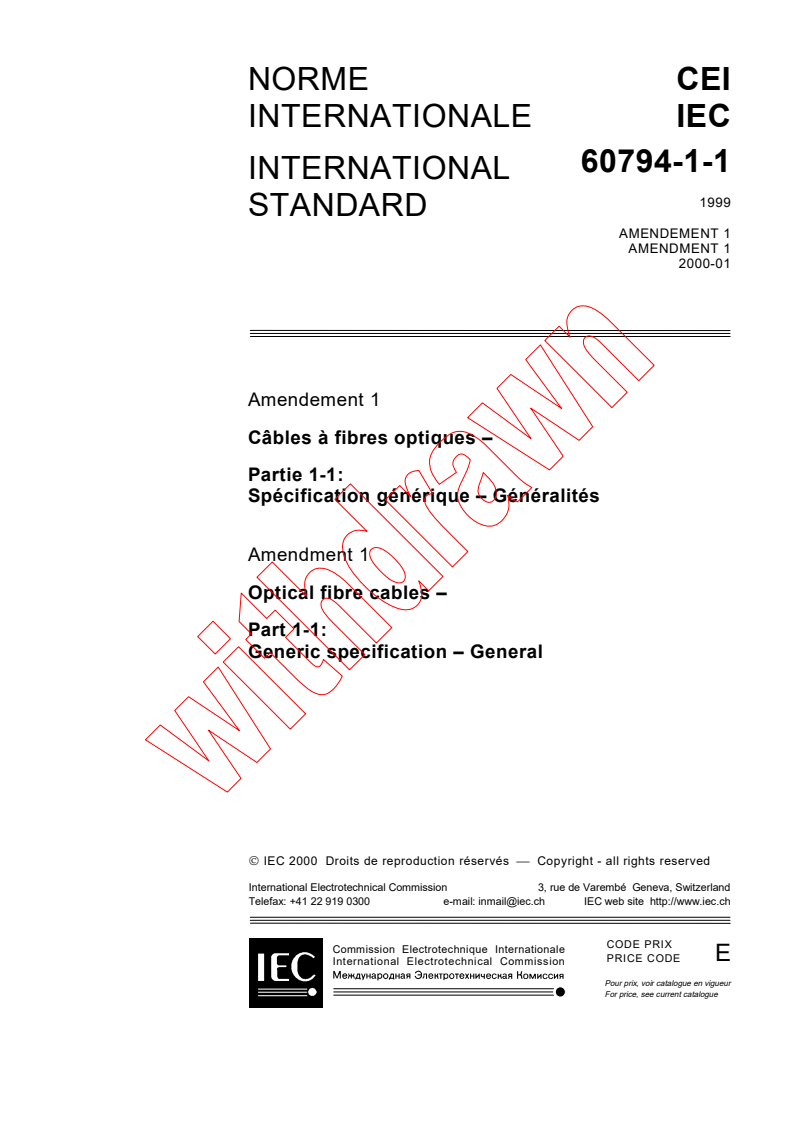
NORME CEI
INTERNATIONALE IEC
60794-1-1
INTERNATIONAL
STANDARD
AMENDEMENT 1
AMENDMENT 1
2000-01
Amendement 1
Câbles à fibres optiques –
Partie 1-1:
Spécification générique – Généralités
Amendment 1
Optical fibre cables –
Part 1-1:
Generic specification – General
IEC 2000 Droits de reproduction réservés Copyright - all rights reserved
International Electrotechnical Commission 3, rue de Varembé Geneva, Switzerland
Telefax: +41 22 919 0300 e-mail: inmail@iec.ch IEC web site http://www.iec.ch
CODE PRIX
Commission Electrotechnique Internationale
E
PRICE CODE
International Electrotechnical Commission
Pour prix, voir catalogue en vigueur
For price, see current catalogue
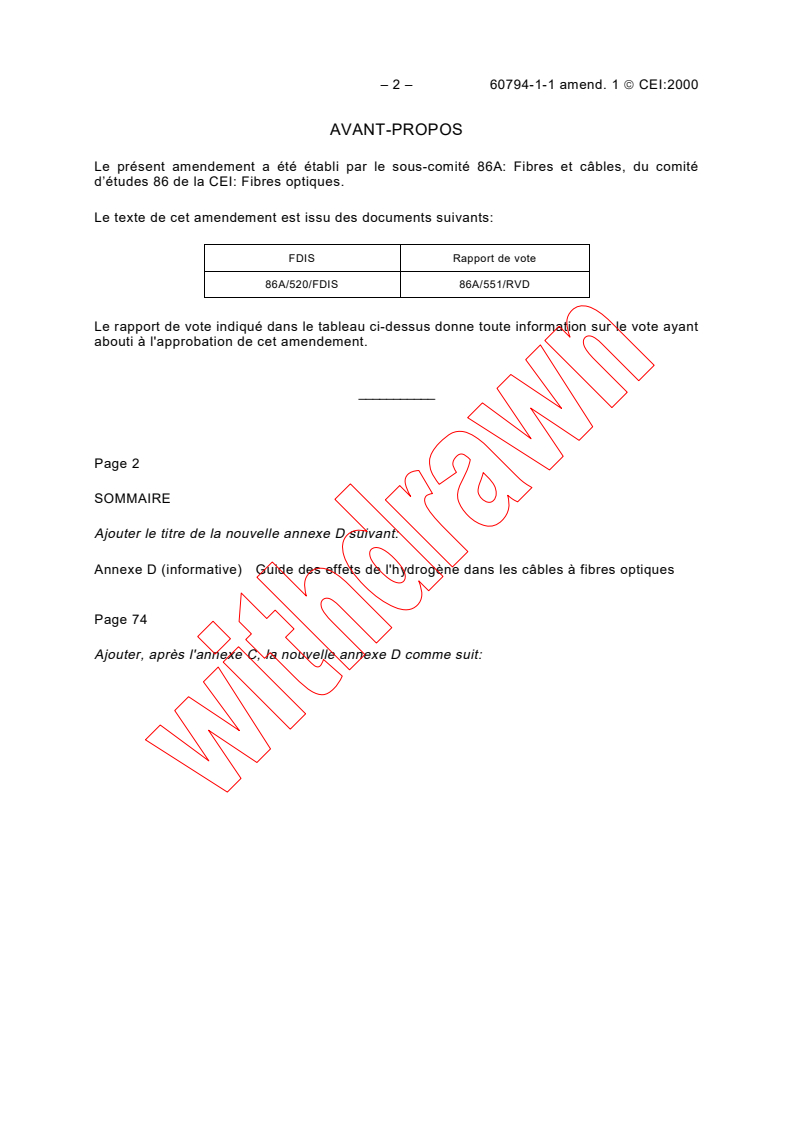
– 2 – 60794-1-1 amend. 1 CEI:2000
AVANT-PROPOS
Le présent amendement a été établi par le sous-comité 86A: Fibres et câbles, du comité
d’études 86 de la CEI: Fibres optiques.
Le texte de cet amendement est issu des documents suivants:
FDIS Rapport de vote
86A/520/FDIS 86A/551/RVD
Le rapport de vote indiqué dans le tableau ci-dessus donne toute information sur le vote ayant
abouti à l'approbation de cet amendement.
___________
Page 2
SOMMAIRE
Ajouter le titre de la nouvelle annexe D suivant:
Annexe D (informative) Guide des effets de l'hydrogène dans les câbles à fibres optiques
Page 74
Ajouter, après l'annexe C, la nouvelle annexe D comme suit:
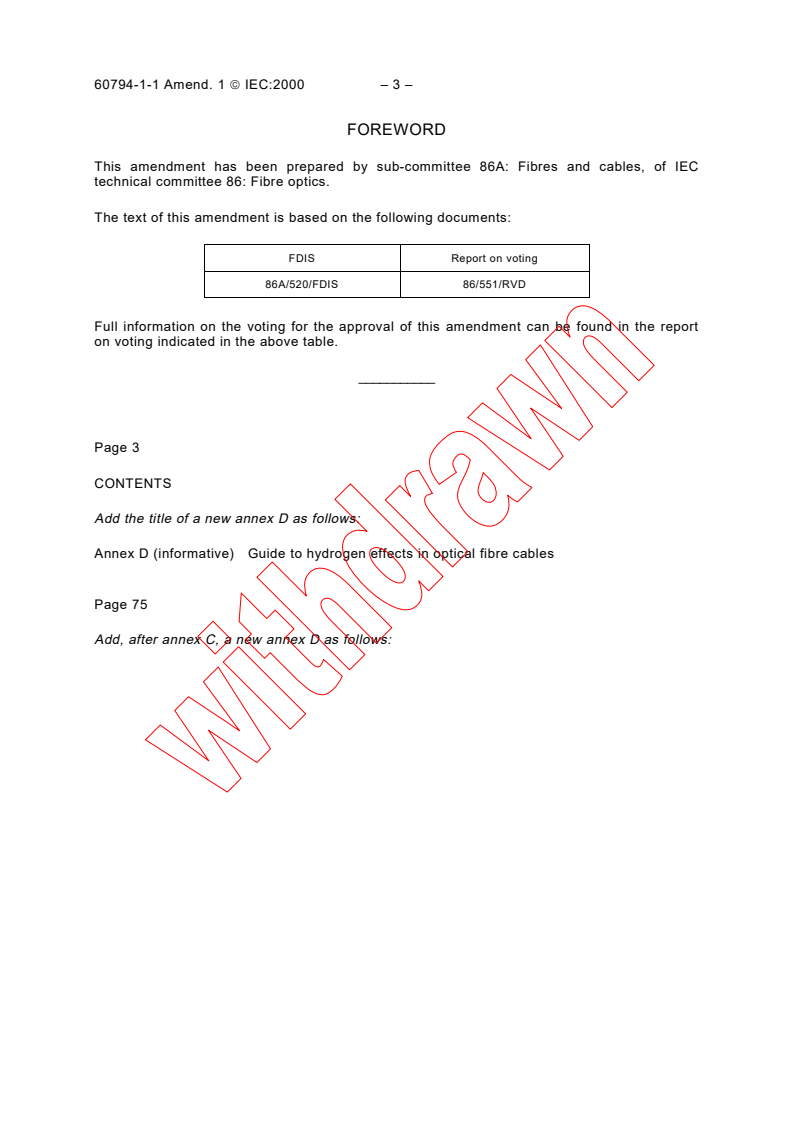
60794-1-1 Amend. 1 IEC:2000 – 3 –
FOREWORD
This amendment has been prepared by sub-committee 86A: Fibres and cables, of IEC
technical committee 86: Fibre optics.
The text of this amendment is based on the following documents:
FDIS Report on voting
86A/520/FDIS 86/551/RVD
Full information on the voting for the approval of this amendment can be found in the report
on voting indicated in the above table.
___________
Page 3
CONTENTS
Add the title of a new annex D as follows:
Annex D (informative) Guide to hydrogen effects in optical fibre cables
Page 75
Add, after annex C, a new annex D as follows:
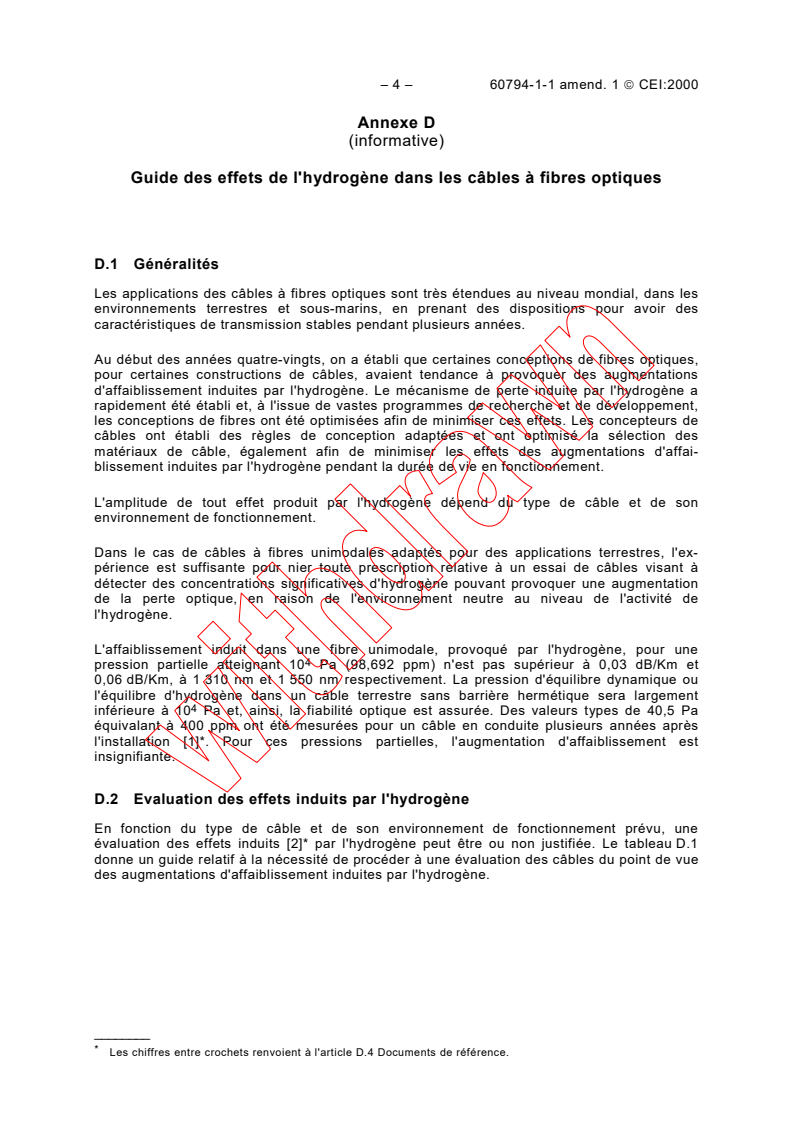
– 4 – 60794-1-1 amend. 1 CEI:2000
Annexe D
(informative)
Guide des effets de l'hydrogène dans les câbles à fibres optiques
D.1 Généralités
Les applications des câbles à fibres optiques sont très étendues au niveau mondial, dans les
environnements terrestres et sous-marins, en prenant des dispositions pour avoir des
caractéristiques de transmission stables pendant plusieurs années.
Au début des années quatre-vingts, on a établi que certaines conceptions de fibres optiques,
pour certaines constructions de câbles, avaient tendance à provoquer des augmentations
d'affaiblissement induites par l'hydrogène. Le mécanisme de perte induite par l'hydrogène a
rapidement été établi et, à l'issue de vastes programmes de recherche et de développement,
les conceptions de fibres ont été optimisées afin de minimiser ces effets. Les concepteurs de
câbles ont établi des règles de conception adaptées et ont optimisé la sélection des
matériaux de câble, également afin de minimiser les effets des augmentations d'affai-
blissement induites par l'hydrogène pendant la durée de vie en fonctionnement.
L'amplitude de tout effet produit par l'hydrogène dépend du type de câble et de son
environnement de fonctionnement.
Dans le cas de câbles à fibres unimodales adaptés pour des applications terrestres, l'ex-
périence est suffisante pour nier toute prescription relative à un essai de câbles visant à
détecter des concentrations significatives d'hydrogène pouvant provoquer une augmentation
de la perte optique, en raison de l'environnement neutre au niveau de l'activité de
l'hydrogène.
L'affaiblissement induit dans une fibre unimodale, provoqué par l'hydrogène, pour une
pression partielle atteignant 10 Pa (98,692 ppm) n'est pas supérieur à 0,03 dB/Km et
0,06 dB/Km, à 1 310 nm et 1 550 nm respectivement. La pression d'équilibre dynamique ou
l'équilibre d'hydrogène dans un câble terrestre sans barrière hermétique sera largement
inférieure à 10 Pa et, ainsi, la fiabilité optique est assurée. Des valeurs types de 40,5 Pa
équivalant à 400 ppm ont été mesurées pour un câble en conduite plusieurs années après
l'installation [1]*. Pour ces pressions partielles, l'augmentation d'affaiblissement est
insignifiante.
D.2 Evaluation des effets induits par l'hydrogène
En fonction du type de câble et de son environnement de fonctionnement prévu, une
évaluation des effets induits [2]* par l'hydrogène peut être ou non justifiée. Le tableau D.1
donne un guide relatif à la nécessité de procéder à une évaluation des câbles du point de vue
des augmentations d'affaiblissement induites par l'hydrogène.
________
*
Les chiffres entre crochets renvoient à l'article D.4 Documents de référence.
60794-1-1 Amend. 1 IEC:2000 – 5 –
Annex D
(informative)
Guide to hydrogen effects in optical fibre cables
D.1 General
There is extensive application of optical fibre cables worldwide both for terrestrial and subsea
environments with the provision of stable transmission characteristics over many years.
In the early 1980’s it was established that some optical fibre designs in certain cable
constructions were prone to hydrogen induced attenuation increases. The mechanism of the
hydrogen induced loss was quickly established and after extensive research and development
programmes, fibre designs were optimized to minimize the effects. Cable designers
established suitable design rules and optimized the selection of cable materials to also
minimize the effects of hydrogen induced attenuation increases during service life.
The magnitude of any hydrogen induced effect depends on the cable type and its operational
environment.
In the case of suitably designed single mode fibre cables for terrestrial applications, there is
sufficient experience to negate any requirement to test cables for significant concentrations of
hydrogen which could cause an increase in optical loss due to the benign environment with
respect to hydrogen activity.
The induced loss for single mode fibre due to hydrogen at a partial pressure of up to 10 Pa
(98,692 ppm) is no greater than 0,03 dB/Km and 0,06 dB/Km, at 1 310 nm and 1 550 nm
respectively. The dynamic equilibrium pressure or balance of hydrogen within a terrestrial
cable with no hermetic barrier will be significantly less than 10 Pa, and therefore, optical
reliability is ensured. Typical values of 40,5 Pa equivalent to 400 ppm have been measured
for duct cable several years after installation [1]*. At these partial pressures, the attenuation
increase is insignificant.
D.2 Evaluation of hydrogen induced effects
Depending on the cable type and its planned operational environment, an evaluation of
hydrogen induced effects [2]* may or may not be warranted. Table D.1 offers a guide to the
necessity to evaluate cables for hydrogen induced attenuation increases.
________
*
Figures in square brackets refer to clause D.4 Reference documents.
– 6 – 60794-1-1 amend. 1 CEI:2000
Tableau D.1 – Critères d'évaluation des câbles à fibres optiques unimodales (SM)
et multimodales (MM)
Application / environnement
Construction Directement Sub-
Conduite Aérien Sous-marin
du câble enterré aquatique*
SM MM SM MM SM MM SM MM SM MM
Métallique
...