

ISO/TS 17796:2013
(Main)Rubber — Trapping and identification of volatile components of rubber fumes with active sampling on a poly(2,6-diphenylphenylene oxide) type sorbent, using thermodesorption and gas chromatographic method with mass spectrometric detection
General Information
- Abstract
ISO/TS 17796: 2013 specifies a qualitative method of thermodesorption ? gas chromatography ? mass spectrometry (TD-GC-MS) for the identification of volatile components in rubber fumes, after trapping on a solid sorbent based on 2,6-diphenylphenylene-oxide polymer resin. It is applicable to a screening of emissions from the processing of rubber compounds in the ambient workplace and storage environment.
- Status
- Published
- Publication Date
- 18-Jun-2013
- Technical Committee
- ISO/TC 45/SC 2 - Testing and analysis
- Drafting Committee
- ISO/TC 45/SC 2/WG 5 - Chemical tests
- Current Stage
- 9093 - International Standard confirmed
- Start Date
- 05-Jan-2024
- Completion Date
- 29-Aug-2026
Buy Documents
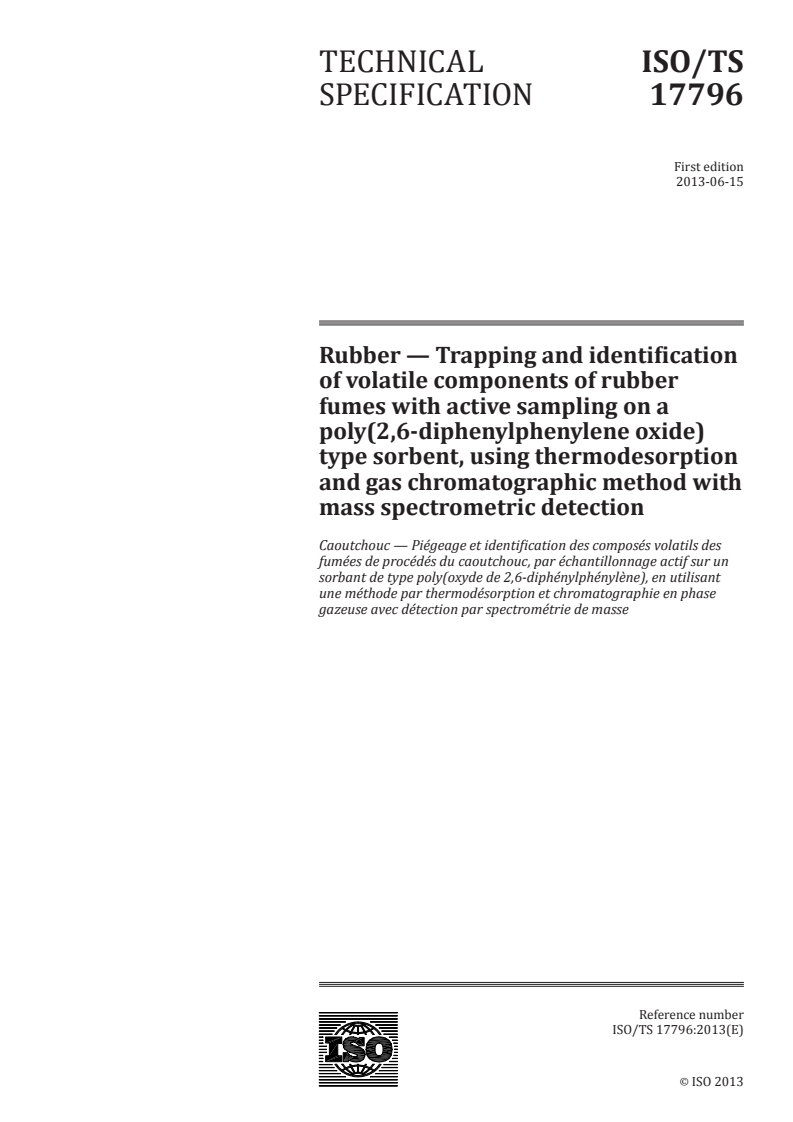
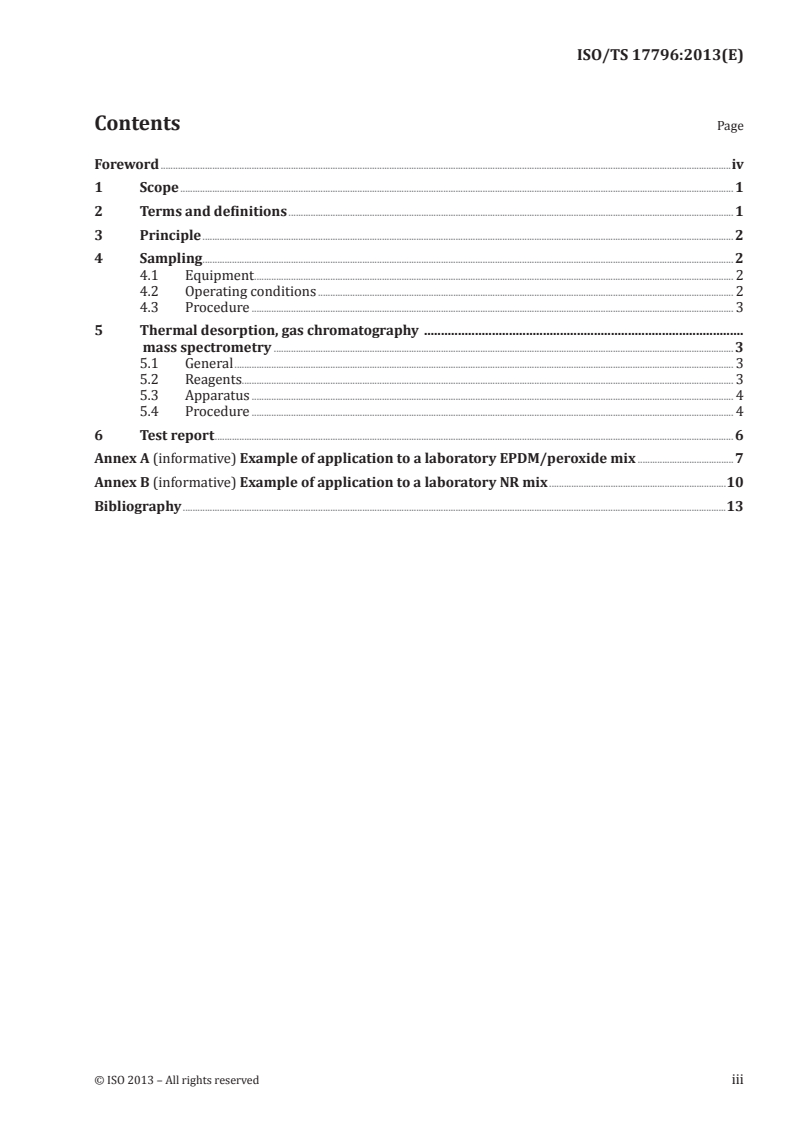
ISO/TS 17796:2013 - Rubber — Trapping and identification of volatile components of rubber fumes with active sampling on a poly(2,6-diphenylphenylene oxide) type sorbent, using thermodesorption and gas chromatographic method with mass spectrometric detection Released:6/19/2013
ISO/TS 17796:2013 - Caoutchouc — Piégeage et identification des composés volatils des fumées de procédés du caoutchouc, par échantillonnage actif sur un sorbant de type poly(oxyde de 2,6-diphénylphénylène), en utilisant une méthode par thermodésorption et chromatographie en phase gazeuse avec détection par spectrométrie de masse Released:8/12/2013
Overview
ISO/TS 17796:2013 specifies a qualitative TD‑GC‑MS method for trapping and identifying volatile and semi‑volatile components of rubber fumes. The technique uses active air sampling on a poly(2,6‑diphenylphenylene oxide)‑type sorbent (example: Tenax TA) followed by thermal desorption (TD) and analysis by gas chromatography–mass spectrometry (GC‑MS). It is intended for screening emissions from rubber compound processing and storage in workplace and ambient environments.
Key topics and technical requirements
- Scope & intent: Qualitative identification of VOCs and SVOCs (C6–C26 range) in rubber fumes; not intended for quantitative analysis. Benzene is not identified reliably by this method.
- Sorbent: Poly(2,6‑diphenylphenylene oxide) trap support - typical quantity 180–200 mg, particle size 0.18–0.25 mm, specific surface 20–35 m2/g. Reconditioning at 300 °C (1–8 h) is required; recondition tubes stored >4 weeks.
- Sampling:
- Flowrate: recommended 50–100 ml/min (maximum 100 ml/min).
- Sample volume: maximum 6 L.
- Use two tubes in parallel during sampling (only one analysed) to guard against breakthrough or failure.
- Seal tubes after sampling; storage at room temperature in emission‑free container up to four weeks.
- Thermal desorption & GC‑MS conditions:
- Desorption: typically 200 °C for 30 min, desorption gas flow ~50 ml/min.
- Cold trap: ≤ −30 °C for analyte focusing; secondary cold trap may be used.
- Transfer line: ≥ 250 °C; cold‑trap high temperature ~300 °C.
- GC column: 5% diphenyl / 95% polydimethylsiloxane (example column dimensions provided).
- MS detection: electron impact (70 eV), quadrupole, scan range ~25–600 m/z, full scan recommended for screening.
- System verification: run laboratory blanks (clean chromatogram expected) and control standard mixes to qualify system sensitivity. Identification relies on mass spectral library matches (visual validation recommended; match index > ~90% indicative).
Applications and users
ISO/TS 17796:2013 is practical for:
- Industrial hygienists and occupational safety professionals screening workplace air for rubber process emissions.
- Analytical laboratories performing qualitative TD‑GC‑MS screening of manufacturing or storage environments.
- Rubber manufacturers and quality/control engineers investigating process off‑gassing, troubleshooting odors, or assessing compound formulations.
- Environmental and research labs studying VOC/SVOC profiles from rubber processing.
Keywords: ISO/TS 17796:2013, TD‑GC‑MS, thermal desorption, Tenax TA, sorbent tube, rubber fumes, VOCs, SVOCs, workplace air monitoring, gas chromatography–mass spectrometry.
Limitations and related considerations
- Method is qualitative - not designed for quantitative compliance limits.
- Very volatile organic compounds (VVOCs) are only partially retained; other sorbents (carbon molecular sieve or multi‑sorbent tubes) may be more appropriate for VVOC sampling.
- Users should be experienced with GC‑MS operation and follow instrument manufacturer instructions.
Buy Documents
ISO/TS 17796:2013 - Rubber — Trapping and identification of volatile components of rubber fumes with active sampling on a poly(2,6-diphenylphenylene oxide) type sorbent, using thermodesorption and gas chromatographic method with mass spectrometric detection Released:6/19/2013
ISO/TS 17796:2013 - Caoutchouc — Piégeage et identification des composés volatils des fumées de procédés du caoutchouc, par échantillonnage actif sur un sorbant de type poly(oxyde de 2,6-diphénylphénylène), en utilisant une méthode par thermodésorption et chromatographie en phase gazeuse avec détection par spectrométrie de masse Released:8/12/2013
Get Certified
Connect with accredited certification bodies for this standard

DIN CERTCO
DIN Group product certification.

Smithers Quality Assessments
US management systems and product certification.
Sponsored listings
Frequently Asked Questions
ISO/TS 17796:2013 is a technical specification published by the International Organization for Standardization (ISO). Its full title is "Rubber — Trapping and identification of volatile components of rubber fumes with active sampling on a poly(2,6-diphenylphenylene oxide) type sorbent, using thermodesorption and gas chromatographic method with mass spectrometric detection". This standard covers: ISO/TS 17796: 2013 specifies a qualitative method of thermodesorption ? gas chromatography ? mass spectrometry (TD-GC-MS) for the identification of volatile components in rubber fumes, after trapping on a solid sorbent based on 2,6-diphenylphenylene-oxide polymer resin. It is applicable to a screening of emissions from the processing of rubber compounds in the ambient workplace and storage environment.
ISO/TS 17796: 2013 specifies a qualitative method of thermodesorption ? gas chromatography ? mass spectrometry (TD-GC-MS) for the identification of volatile components in rubber fumes, after trapping on a solid sorbent based on 2,6-diphenylphenylene-oxide polymer resin. It is applicable to a screening of emissions from the processing of rubber compounds in the ambient workplace and storage environment.
ISO/TS 17796:2013 is classified under the following ICS (International Classification for Standards) categories: 83.060 - Rubber. The ICS classification helps identify the subject area and facilitates finding related standards.
ISO/TS 17796:2013 is available in PDF format for immediate download after purchase. The document can be added to your cart and obtained through the secure checkout process. Digital delivery ensures instant access to the complete standard document.
Standards Content (Sample)
TECHNICAL ISO/TS
SPECIFICATION 17796
First edition
2013-06-15
Rubber — Trapping and identification
of volatile components of rubber
fumes with active sampling on a
poly(2,6-diphenylphenylene oxide)
type sorbent, using thermodesorption
and gas chromatographic method with
mass spectrometric detection
Caoutchouc — Piégeage et identification des composés volatils des
fumées de procédés du caoutchouc, par échantillonnage actif sur un
sorbant de type poly(oxyde de 2,6-diphénylphénylène), en utilisant
une méthode par thermodésorption et chromatographie en phase
gazeuse avec détection par spectrométrie de masse
Reference number
©
ISO 2013
ISO/TS 17796:2013(E)
COPYRIGHT PROTECTED DOCUMENT
© ISO 2013
All rights reserved. Unless otherwise specified, no part of this publication may be reproduced or utilized otherwise in any form
or by any means, electronic or mechanical, including photocopying, or posting on the internet or an intranet, without prior
written permission. Permission can be requested from either ISO at the address below or ISO’s member body in the country of
the requester.
ISO copyright office
Case postale 56 • CH-1211 Geneva 20
Tel. + 41 22 749 01 11
Fax + 41 22 749 09 47
E-mail copyright@iso.org
Web www.iso.org
Published in Switzerland
ii © ISO 2013 – All rights reserved
ISO/TS 17796:2013(E)
Contents Page
Foreword .iv
1 Scope . 1
2 Terms and definitions . 1
3 Principle .2
4 Sampling .2
4.1 Equipment . 2
4.2 Operating conditions . 2
4.3 Procedure . 3
5 Thermal desorption, gas chromatography .
mass spectrometry .3
5.1 General . 3
5.2 Reagents. 3
5.3 Apparatus . 4
5.4 Procedure . 4
6 Test report .6
Annex A (informative) Example of application to a laboratory EPDM/peroxide mix .7
Annex B (informative) Example of application to a laboratory NR mix .10
Bibliography .13
ISO/TS 17796:2013(E)
Foreword
ISO (the International Organization for Standardization) is a worldwide federation of national standards
bodies (ISO member bodies). The work of preparing International Standards is normally carried out
through ISO technical committees. Each member body interested in a subject for which a technical
committee has been established has the right to be represented on that committee. International
organizations, governmental and non-governmental, in liaison with ISO, also take part in the work.
ISO collaborates closely with the International Electrotechnical Commission (IEC) on all matters of
electrotechnical standardization.
The procedures used to develop this document and those intended for its further maintenance are
described in the ISO/IEC Directives, Part 1. In particular the different approval criteria needed for the
different types of ISO documents should be noted. This document was drafted in accordance with the
editorial rules of the ISO/IEC Directives, Part 2. www.iso.org/directives
Attention is drawn to the possibility that some of the elements of this document may be the subject of
patent rights. ISO shall not be held responsible for identifying any or all such patent rights. Details of
any patent rights identified during the development of the document will be in the Introduction and/or
on the ISO list of patent declarations received. www.iso.org/patents
Any trade name used in this document is information given for the convenience of users and does not
constitute an endorsement.
The committee responsible for this document is ISO/TC 45, Rubber and rubber products, Subcommittee
SC 2, Testing and analysis.
iv © ISO 2013 – All rights reserved
TECHNICAL SPECIFICATION ISO/TS 17796:2013(E)
Rubber — Trapping and identification of volatile
components of rubber fumes with active sampling on a
poly(2,6-diphenylphenylene oxide) type sorbent, using
thermodesorption and gas chromatographic method with
mass spectrometric detection
1 Scope
This Technical Specification specifies a qualitative method of thermodesorption – gas chromatography –
mass spectrometry (TD-GC-MS) for the identification of volatile components in rubber fumes, after trapping
on a solid sorbent based on 2,6-diphenylphenylene-oxide polymer resin. It is applicable to a screening of
emissions from the processing of rubber compounds in the ambient workplace and storage environment.
CAUTION — Persons using this Technical Specification should be familiar with the procedures for
gas chromatography – mass spectrometry measurement and analysis. All the operative details
for the application and set-up of the GC-MS are assumed to be in agreement with the operative
instructions provided by the manufacturer. Therefore, the detailed procedure for the operation
is not included in this Technical Specification. This Technical Specification specifies a qualitative
method which is not aimed at quantitative analyses.
2 Terms and definitions
For the purposes of this document, the following terms and definitions apply.
2.1
semi-volatile organic compound
SVOC
organic compound whose boiling point is in the range from (240 to 260) °C to (380 to 400) °C
[4]
Note 1 to entry: This classification has been defined by the World Health Organization.
Note 2 to entry: Boiling points of some compounds are difficult or impossible to determine because they decompose
before they boil at atmospheric pressure. Vapour pressure is another criterion for the classification of compound
volatility that may be used for the classification of organic chemicals. SVOCs have vapour pressures of between
−2 −8
10 kPa and 10 kPa.
2.2
volatile organic compound
VOC
organic compound whose boiling point is in the range from (50 to 100) °C to (240 to 260) °C
[4]
Note 1 to entry: This classification has been defined by the World Health Organization.
Note 2 to entry: Boiling points of some compounds are difficult or impossible to determine because they decompose
before they boil at atmospheric pressure. Vapour pressure is another criterion for the classification of compound
volatility that may be used for the classification of organic chemicals. VOCs generally have saturation vapour
pressures at 25 °C greater than 10 kPa.
2.3
very volatile organic compound
VVOC
organic compound whose boiling point is in the range from <0 °C to (50 to 100) °C
[4]
Note 1 to entry: This classification has been defined by the World Health Organization.
ISO/TS 17796:2013(E)
Note 2 to entry: Boiling points of some compounds are difficult or impossible to determine because they decompose
before they boil at atmospheric pressure. Vapour pressure is another criterion for the classification of compound
volatility that may be used for the classification of organic chemicals. VVOCs typically have vapour pressures of
greater than 15 kPa.
3 Principle
Rubber fumes are sampled on an adsorbent support using a pump. They are recovered from the trap
by thermal desorption and the substances composing the desorbed fume are identified by the mass
spectrometer. The method identifies the components adsorbed on the trap support used, except benzene.
The actual composition of the emissions depends on the selection of ingredients used for compounding
and on the thermal and mechanical conditions applied to the rubber. Moreover, environmental humidity
might interfere with the sorption capability of the sorbent material.
The sorbent tube is used for the trapping of volatile (VOC) (boiling point >50 °C to 100 °C) and semi-
volatile (SVOC) (boiling point >240 °C) organic compounds in the C6 to C26 range, which are chemically
stable against a desorption temperature of 200 °C. Very volatile compounds (VVOC) (boiling point
approximately 50 °C to 100 °C) are only partially retained by the sorbent. Other sorbents based on
carbon molecular sieve or by multi-sorbent bed tube may be more appropriate in this case.
The upper limit of the useful range is set by the sorptive capacity of the sorbent used and by the linear
dynamic range of the gas chromatograph column and detector or by the sample-splitting capability of
the analytical instrumentation used. The sorptive capacity is measured as a breakthrough volume of air,
which determines the maximum air volume that shall not be exceeded when sampling.
NOTE Small amounts of benzene could be created by the thermal decomposition of the sorbent.
4 Sampling
4.1 Equipment
1)
4.1.1 Trap support, poly(2,6-diphenylphenylene oxide) , of quantity 180 mg to 200 mg, of particle
2 2
size 0,18 mm to 0,25 mm (60/80 mesh), and of specific surface 20 m /g to 35 m /g. Another quantity,
particle size or specific surface may be chosen if the test result is proven to be equivalent.
4.1.2 Adsorbent tubes, stainless steel tube.
4.1.3 Calibrated pump
Calibrate the pump with the sorbent tube assembly inline, using a calibrated external flowmeter.
One end of the calibrated flowmeter shall be kept at atmospheric pressure to ensure proper operation.
4.2 Operating conditions
4.2.1 Trap support
Recondition the trap sorbent material before sampling, heating it at 300 °C under inert gas for 1 h
(minimum) to 8 h (maximum). Check the cleaning of the trap support by GC-MS analysis.
Recondition tubes stored for more than four weeks before sampling. ®
1) One example of poly(2,6-diphenylphenylene oxide) is Tenax TA , which is an example of a suitable product
available commercially. This information is given for the convenience of users of this Technical Specification and
does not constitute an endorsement by ISO of this product.
2 © ISO 2013 – All rights reserved
ISO/TS 17796:2013(E)
4.2.2 Sampling flowrate
The sampling flowrate shall be 100 ml/min maximum at room temperature.
4.2.3 Sampling volume
The sampling volume shall be 6 l maximum.
Two sampling tubes should be placed in parallel, in the same location, and operated simultaneously in
case of trap or analysis dysfunction. Only one tube shall be analysed.
4.3 Procedure
When used for fixed-location sampling, a suitable sampling site is to be chosen. The location of sampling
shall be close to the source. Sampling the surrounding atmosphere is also admissible.
Assemble the sampling line. The sampling train includes, in the following order, a sample source, a
sampling tube(s), a flow controller and a pump. Prepare a tube assembly by joining the tubes in series
with a union if more than one tube is used to ensure that the breakthrough volume for the analyte
of interest is not exceeded. Attach the pump to the sorbent tube or tube assembly wi
...
SPÉCIFICATION ISO/TS
TECHNIQUE 17796
Première édition
2013-06-15
Caoutchouc — Piégeage et
identification des composés
volatils des fumées de procédés du
caoutchouc, par échantillonnage actif
sur un sorbant de type poly(oxyde de
2,6-diphénylphénylène), en utilisant
une méthode par thermodésorption et
chromatographie en phase gazeuse avec
détection par spectrométrie de masse
Rubber — Trapping and identification of volatile components of
rubber fumes with active sampling on a poly(2,6-diphenylphenylene
oxide) type sorbent, using thermodesorption and gas
chromatographic method with mass spectrometric detection
Numéro de référence
©
ISO 2013
DOCUMENT PROTÉGÉ PAR COPYRIGHT
© ISO 2013
Droits de reproduction réservés. Sauf indication contraire, aucune partie de cette publication ne peut être reproduite ni utilisée
sous quelque forme que ce soit et par aucun procédé, électronique ou mécanique, y compris la photocopie, l’affichage sur
l’internet ou sur un Intranet, sans autorisation écrite préalable. Les demandes d’autorisation peuvent être adressées à l’ISO à
l’adresse ci-après ou au comité membre de l’ISO dans le pays du demandeur.
ISO copyright office
Case postale 56 • CH-1211 Geneva 20
Tel. + 41 22 749 01 11
Fax + 41 22 749 09 47
E-mail copyright@iso.org
Web www.iso.org
Publié en Suisse
ii © ISO 2013 – Tous droits réservés
Sommaire Page
Avant-propos .iv
1 Domaine d’application . 1
2 Termes et définitions . 1
3 Principe . 2
4 Prélèvement . 2
4.1 Équipement . 2
4.2 Conditions opératoires . 3
4.3 Mode opératoire . 3
5 Désorption thermique, chromatographie en phase gazeuse - spectrométrie de masse .4
5.1 Généralités . 4
5.2 Réactifs . 4
5.3 Appareillage. 4
5.4 Mode opératoire . 4
6 Rapport d’essai . 6
Annexe A (informative) Exemple d’application sur un mélange de laboratoire EPDM/peroxyde .7
Annexe B (informative) Exemple d’application sur un mélange de laboratoire NR .10
Bibliographie .13
Avant-propos
L’ISO (Organisation internationale de normalisation) est une fédération mondiale d’organismes
nationaux de normalisation (comités membres de l’ISO). L’élaboration des Normes internationales est
en général confiée aux comités techniques de l’ISO. Chaque comité membre intéressé par une étude
a le droit de faire partie du comité technique créé à cet effet. Les organisations internationales,
gouvernementales et non gouvernementales, en liaison avec l’ISO participent également aux travaux.
L’ISO collabore étroitement avec la Commission électrotechnique internationale (CEI) en ce qui concerne
la normalisation électrotechnique.
Les procédures utilisées pour élaborer le présent document et celles destinées à sa mise à jour sont
décrites dans les Directives ISO/CEI, Partie 1. Il convient, en particulier, de prendre note des différents
critères d’approbation requis pour les différents types de documents ISO. Le présent document a été
rédigé conformément aux règles de rédaction données dans les Directives ISO/CEI, Partie 2, www.iso.
org/directives.
L’attention est appelée sur le fait que certains des éléments du présent document peuvent faire l’objet de
droits de propriété intellectuelle ou de droits analogues. L’ISO ne saurait être tenue pour responsable
de ne pas avoir identifié de tels droits de propriété et averti de leur existence. Les détails concernant les
références aux droits de propriété intellectuelle ou autres droits analogues identifiés lors de l’élaboration
du document sont indiqués dans l’Introduction et/ou sur la liste ISO des déclarations de brevets reçues,
www.iso.org/brevets.
Les éventuelles appellations commerciales utilisées dans le présent document sont données pour
information à l’intention des utilisateurs et ne constituent pas une approbation ou une recommandation.
Le comité chargé de l’élaboration du présent document est l’ISO/TC 45, Élastomères et produits à base
d’élastomères, sous-comité SC 2, Essais et analyses.
iv © ISO 2013 – Tous droits réservés
SPÉCIFICATION TECHNIQUE ISO/TS 17796:2013(F)
Caoutchouc — Piégeage et identification des composés
volatils des fumées de procédés du caoutchouc, par
échantillonnage actif sur un sorbant de type poly(oxyde
de 2,6-diphénylphénylène), en utilisant une méthode par
thermodésorption et chromatographie en phase gazeuse
avec détection par spectrométrie de masse
1 Domaine d’application
La présente Spécification technique spécifie une méthode qualitative d’identification des composés
volatils des fumées de procédés du caoutchouc par thermodésorption, chromatographie en phase gazeuse
et spectrométrie de masse (TD-GC-MS), après piégeage sur un sorbant solide à base de poly(oxyde de
2,6-diphénylphénylène). Elle est applicable à une cartographie des émissions issues de la transformation des
composés à base de caoutchouc dans l’air ambiant des lieux de travail et des environnements de stockage.
ATTENTION — Il convient que les personnes utilisant la présente Spécification technique
connaissent bien les modes opératoires utilisés pour le mesurage et l’analyse en lien avec la
chromatographie en phase gazeuse et la spectrométrie de masse. Tous les détails opératoires
concernant l’application et le montage des dispositifs de GC-MS sont supposés conformes aux
instructions d’utilisation fournies par le fabricant. Par conséquent, le mode opératoire détaillé
d’exécution n’est pas inclus dans la présente Spécification technique. La présente Spécification
technique spécifie une méthode qualitative ne visant pas les analyses quantitatives.
2 Termes et définitions
Pour les besoins du présent document, les termes et définitions suivants s’appliquent.
2.1
composé organique semi-volatil
COSV
composé organique dont le point d’ébullition se situe entre (240 °C à 260 °C) et (380 °C à 400 °C)
[4]
Note 1 à l’article: Cette classification a été définie par l’Organisation mondiale de la santé .
Note 2 à l’article: Les points d’ébullition de certains composés sont difficiles, voire impossibles, à déterminer
puisque leur décomposition intervient avant l’ébullition à pression atmosphérique. La pression de vapeur constitue
un autre critère de classification de la volatilité des composés pouvant servir dans le cadre de la classification de
−2 −8
produits chimiques organiques. Les COSV ont des pressions de vapeur comprises entre 10 kPa et 10 kPa.
2.2
composé organique volatil
COV
composé organique dont le point d’ébullition se situe entre (50 °C à 100 °C) et (240 °C à 260 °C)
[4]
Note 1 à l’article: Cette classification a été définie par l’Organisation mondiale de la santé .
Note 2 à l’article: Les points d’ébullition de certains composés sont difficiles, voire impossibles, à déterminer puisque
leur décomposition intervient avant l’ébullition à pression atmosphérique. La pression de vapeur constitue un autre
critère de classification de la volatilité des composés pouvant servir dans le cadre de la classification de produits
chimiques organiques. Les COV ont généralement des pressions de vapeur saturante à 25 °C supérieures à 10 kPa.
2.3
composé organique très volatil
COTV
composé organique dont le point d’ébullition se situe entre moins de 0 °C et (50 °C à 100 °C)
[4]
Note 1 à l’article: Cette classification a été définie par l’Organisation mondiale de la santé .
Note 2 à l’article: Les points d’ébullition de certains composés sont difficiles, voire impossibles, à déterminer
puisque leur décomposition intervient avant l’ébullition à pression atmosphérique. La pression de vapeur constitue
un autre critère de classification de la volatilité des composés pouvant servir dans le cadre de la classification de
produits chimiques organiques. Les COTV ont généralement des pressions de vapeur supérieures à 15 kPa.
3 Principe
Les fumées de caoutchouc sont prélevées sur un support adsorbant au moyen d’une pompe. Elles sont
extraites du piège par désorption thermique et les substances qui composent les fumées désorbées sont
identifiées au moyen d’un spectromètre de masse. La méthode identifie les composants adsorbés sur le
support de piégeage utilisé, à l’exception du benzène.
La composition réelle des émissions dépend des ingrédients sélectionnés pour réaliser le mélange et des
conditions thermiques et mécaniques appliquées au caoutchouc. En outre, l’humidité de l’environnement
est susceptible d’interférer avec la capacité d’adsorption du matériau sorbant.
L’adsorbant est utilisé pour piéger des composés organiques volatils (COV) (point d’ébullition > 50 °C à
100 °C) et semi-volatils (COSV) (point d’ébullition > 240 °C) dans la gamme C6 à C26, qui sont chimiquement
stables vis-à-vis d’une température de désorption de 200 °C. Les composés très volatils (COTV) (point
d’ébullition d’environ 50 °C à 100 °C) ne sont que partiellement retenus par l’adsorbant. Dans ce cas,
un tamis moléculaire carboné ou un tube contenant plusieurs lits d’adsorbants peut représenter un
support d’absorption plus adapté.
La limite supérieure de l’étendue d’analyse utile est déterminée par la capacité d’adsorption de l’adsorbant
utilisé et par l’étendue dynamique linéaire de la colonne et du détecteur du chromatographe en phase
gazeuse ou par la capacité de séparation des échantillons des instruments d’analyse utilisés. La capacité
d’adsorption est mesurée en tant que volume de saturation, qui détermine le volume d’air maximal ne
devant pas être dépassé lors de l’échantillonnage.
NOTE La décomposition thermique du sorbant peut engendrer de petites quantités de benzène.
4 Prélèvement
4.1 Équipement
1)
4.1.1 Support de piégeage, poly(oxyde de 2,6-diphénylphénylène) , en quantité de 180 mg à 200 mg,
2 2
de granulométrie de 0,18 mm à 0,25 mm (maille 60/80), et de surface spécifique de 20 m /g à 35 m /g.
Une autre quantité, une autre granulométrie ou une autre surface spécifique peut être choisie si le
résultat de l’essai s’avère équivalent.
4.1.2 Tubes à adsorption, tube en acier inoxydable.
4.1.3 Pompe étalonnée.
Étalonner la pompe avec le système de tubes à adsorption préalablement installé, à l’aide d’un débitmètre
externe étalonné. ®
1) Un exemple de poly(oxide de 2,6-diphénylphénylène) est le Tenax TA , qui est un exemple de produit approprié
disponible commercialement. Cette information est donnée à l’intention des utilisateurs de la présente Spécification
technique et ne signifie nullement que l’ISO approuve ou recommande l’emploi exclusif de ce produit.
2 © ISO 2013 – Tous droits réservés
Une extrémité du débitmètre étalonné doit être maintenue à la pression atmosphérique pour assurer
son bon fonctionnement.
4.2 Conditions opératoires
4.2.1 Support de piégeage
Reconditionner le matériau sorbant du piège avant le prélèvement, en le chauffant à 300 °C sous gaz
inerte pendant 1 h (minimum) à 8 h (maximum). Vérifier la propreté du support de piégeage en procédant
à une analyse GC-MS.
Reconditionner les tubes stockés pendant plus de quatre semaines avant le prélèvement.
4.2.2 Débit de prélèvement
Le débit de prélèvement doit être au maximum de 100 ml/min à température ambiante.
4.2.3 Volume de prélèvement
Le volume de prélèvement doit être de 6 l maximum.
Il convient de réaliser l’essai simultanément avec deux tubes de prélèvement en parallèle, au même
endroit, en cas de dysfonctionnement du piège ou de résultat d’analyse insatisfaisant. Un seul tube doit
être analysé.
4.3 Mode opératoire
Lorsque l’échantillonnage se déroule à un endroit fixe, un site de prélèvement approprié est à choisir.
L’endroit du prélèvement doit être proche de la source. Un prélèvement de l’atmosphère ambiante est
également admissible.
Monter la ligne de prélèvement. La ligne de prélèvement inclut, dans l’ordre suivant, une source
d’échantillons, un (des) tube(s) de prélèvement, un régulateur de débit et une pompe. Si plusieurs tubes
sont utilisés, pour éviter que le volume de saturation de l’analyte étudié soit dépassé, préparer un système
de tubes en les reliant en série à l’aide d’un raccord. Relier la pompe au tube à adsorption ou au système de
tubes à l’aide d’un tuyau plastique (PE ou PTFE) ou en caoutchouc. Démarrer la pompe et régler le débit
de manière que le volume de prélèvement recommandé soit atteint dans le temps imparti. Le volume
d’air à prélever recommandé pour les COV couverts par la présente Spécification technique correspond à
un total de 6 l au maximum. Un débit de prélèvement approprié se situe entre 50 ml/min et 100 ml/min.
Not
...