

ISO 13584-501:2007
(Main)Industrial automation systems and integration — Parts library — Part 501: Reference dictionary for measuring instruments — Registration procedure
General Information
- Abstract
ISO 13584-501:2007 specifies the requirements for an ISO-registered reference dictionary for measuring instruments with their properties and domains of values. ISO 13584-501:2007 also establishes and specifies the behaviour of a registration authority whose role is to develop, maintain and update this ISO-registered reference dictionary for measuring instruments. These measuring instruments include environment measuring instruments and laboratory measuring instruments. The reference dictionaries series of parts of ISO 13584 specifies ontologies for representing the entities of an application domain, together with their descriptive properties and domains of values. Each entity, property or domain of values constitutes an entry of a dictionary that constitutes the formal and computer sensible representation of the specified ontology. It is associated with a computer sensible and human readable definition and with a computer sensible identification. The unique identification of a dictionary entry allows it to be referenced unambiguously from any application. Definitions and identifications of dictionary entries consist of instances of the EXPRESS entity data types defined in the common dictionary schema, or in its extensions defined in the logical series of parts of ISO 13584.
- Status
- Published
- Publication Date
- 09-Jan-2007
- Technical Committee
- ISO/TC 184/SC 4 - Industrial data
- Current Stage
- 9093 - International Standard confirmed
- Start Date
- 07-Dec-2023
- Completion Date
- 29-Aug-2026
Overview
ISO 13584-501:2007 - "Industrial automation systems and integration - Parts library - Part 501: Reference dictionary for measuring instruments - Registration procedure" defines the requirements and processes for an ISO-registered reference dictionary for measuring instruments. The standard specifies how to represent measuring-instrument classes, descriptive properties (data element types) and domains of values as computer-interpretable dictionary entries. It also establishes the role and required behaviour of a registration authority responsible for developing, validating, maintaining and distributing the reference dictionary. Covered instruments include environmental and laboratory measuring instruments.
Key topics and technical requirements
- Reference dictionary structure: each dictionary entry (class, property or domain of values) has a human-readable definition and a computer-sensible unique identifier to allow unambiguous referencing.
- Ontology representation: entries implement ontologies for the measuring-instruments domain; entries are instances of EXPRESS entity data types from the common dictionary schema.
- Classification principles: rules for hierarchical classification (principal identification layers, domains, functions, principles) and auxiliary classifications to ensure consistent indexing.
- Registration authority processes: organization structure, roles (technical committee, validation committee, secretary), decision rules, registration workflow and timeframes for initial registration and updates.
- Computer-sensible description and distribution: requirements for information models, conformance classes, external files, language usage for text attributes, control of intermediate/formal releases, and distribution mechanisms.
- Versioning and maintenance: rules for version and revision numbering, formal release identification, and long-term maintenance procedures.
- Normative annexes: include templates and formats such as information object registration, physical dictionary file layout, class/property definitions and application forms.
Practical applications and users
ISO 13584-501 is used to achieve consistent, interoperable description and exchange of measuring-instrument data across systems. Typical users:
- Manufacturers and suppliers of measuring instruments (environmental and laboratory)
- Metrology and testing laboratories
- Software vendors (PLM, PDM, parts library, CAD) implementing parts libraries and data exchange
- Systems integrators and automation engineers requiring standardized device descriptions
- Procurement, regulatory and compliance teams needing unambiguous identification and properties
Benefits include improved data interoperability, reliable referencing of instrument properties and domains of values, and streamlined cataloguing and exchange of parts and instrumentation data.
Related standards
- ISO 13584-1 (Overview and principles)
- ISO 13584-24, ISO 13584-25 (logical extensions referenced for EXPRESS schema)
- Other ISO 13584 parts in the reference dictionary series (e.g., Part 511 for fasteners)
Keywords: ISO 13584-501, reference dictionary, measuring instruments, registration procedure, registration authority, ontology, EXPRESS, parts library, data exchange, instrumentation metadata.
Get Certified
Connect with accredited certification bodies for this standard

DVS-ZERT GmbH
German welding certification society.
CARES (UK Certification Authority for Reinforcing Steels)
UK certification for reinforcing steels and construction.
EWF/IIW (European/International Welding Federation)
International welding personnel certification.
Sponsored listings
Frequently Asked Questions
ISO 13584-501:2007 is a standard published by the International Organization for Standardization (ISO). Its full title is "Industrial automation systems and integration — Parts library — Part 501: Reference dictionary for measuring instruments — Registration procedure". This standard covers: ISO 13584-501:2007 specifies the requirements for an ISO-registered reference dictionary for measuring instruments with their properties and domains of values. ISO 13584-501:2007 also establishes and specifies the behaviour of a registration authority whose role is to develop, maintain and update this ISO-registered reference dictionary for measuring instruments. These measuring instruments include environment measuring instruments and laboratory measuring instruments. The reference dictionaries series of parts of ISO 13584 specifies ontologies for representing the entities of an application domain, together with their descriptive properties and domains of values. Each entity, property or domain of values constitutes an entry of a dictionary that constitutes the formal and computer sensible representation of the specified ontology. It is associated with a computer sensible and human readable definition and with a computer sensible identification. The unique identification of a dictionary entry allows it to be referenced unambiguously from any application. Definitions and identifications of dictionary entries consist of instances of the EXPRESS entity data types defined in the common dictionary schema, or in its extensions defined in the logical series of parts of ISO 13584.
ISO 13584-501:2007 specifies the requirements for an ISO-registered reference dictionary for measuring instruments with their properties and domains of values. ISO 13584-501:2007 also establishes and specifies the behaviour of a registration authority whose role is to develop, maintain and update this ISO-registered reference dictionary for measuring instruments. These measuring instruments include environment measuring instruments and laboratory measuring instruments. The reference dictionaries series of parts of ISO 13584 specifies ontologies for representing the entities of an application domain, together with their descriptive properties and domains of values. Each entity, property or domain of values constitutes an entry of a dictionary that constitutes the formal and computer sensible representation of the specified ontology. It is associated with a computer sensible and human readable definition and with a computer sensible identification. The unique identification of a dictionary entry allows it to be referenced unambiguously from any application. Definitions and identifications of dictionary entries consist of instances of the EXPRESS entity data types defined in the common dictionary schema, or in its extensions defined in the logical series of parts of ISO 13584.
ISO 13584-501:2007 is classified under the following ICS (International Classification for Standards) categories: 25.040.40 - Industrial process measurement and control. The ICS classification helps identify the subject area and facilitates finding related standards.
ISO 13584-501:2007 is available in PDF format for immediate download after purchase. The document can be added to your cart and obtained through the secure checkout process. Digital delivery ensures instant access to the complete standard document.
Standards Content (Sample)
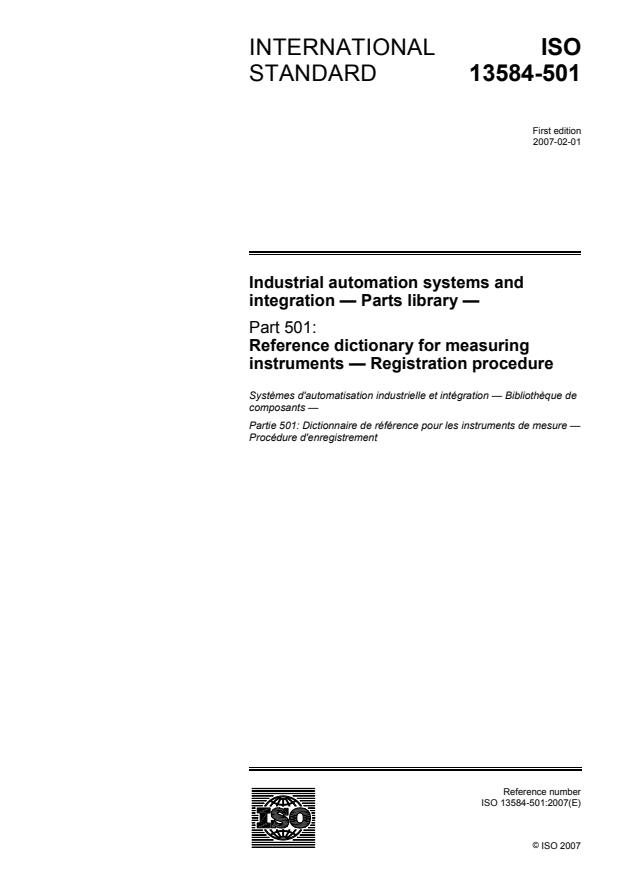
INTERNATIONAL ISO
STANDARD 13584-501
First edition
2007-02-01
Industrial automation systems and
integration — Parts library —
Part 501:
Reference dictionary for measuring
instruments — Registration procedure
Systèmes d'automatisation industrielle et intégration — Bibliothèque de
composants —
Partie 501: Dictionnaire de référence pour les instruments de mesure —
Procédure d'enregistrement
Reference number
©
ISO 2007
PDF disclaimer
This PDF file may contain embedded typefaces. In accordance with Adobe's licensing policy, this file may be printed or viewed but
shall not be edited unless the typefaces which are embedded are licensed to and installed on the computer performing the editing. In
downloading this file, parties accept therein the responsibility of not infringing Adobe's licensing policy. The ISO Central Secretariat
accepts no liability in this area.
Adobe is a trademark of Adobe Systems Incorporated.
Details of the software products used to create this PDF file can be found in the General Info relative to the file; the PDF-creation
parameters were optimized for printing. Every care has been taken to ensure that the file is suitable for use by ISO member bodies. In
the unlikely event that a problem relating to it is found, please inform the Central Secretariat at the address given below.
© ISO 2007
All rights reserved. Unless otherwise specified, no part of this publication may be reproduced or utilized in any form or by any means,
electronic or mechanical, including photocopying and microfilm, without permission in writing from either ISO at the address below or
ISO's member body in the country of the requester.
ISO copyright office
Case postale 56 • CH-1211 Geneva 20
Tel. + 41 22 749 01 11
Fax + 41 22 749 09 47
E-mail copyright@iso.org
Web www.iso.org
Published in Switzerland
ii © ISO 2007 – All rights reserved
Page
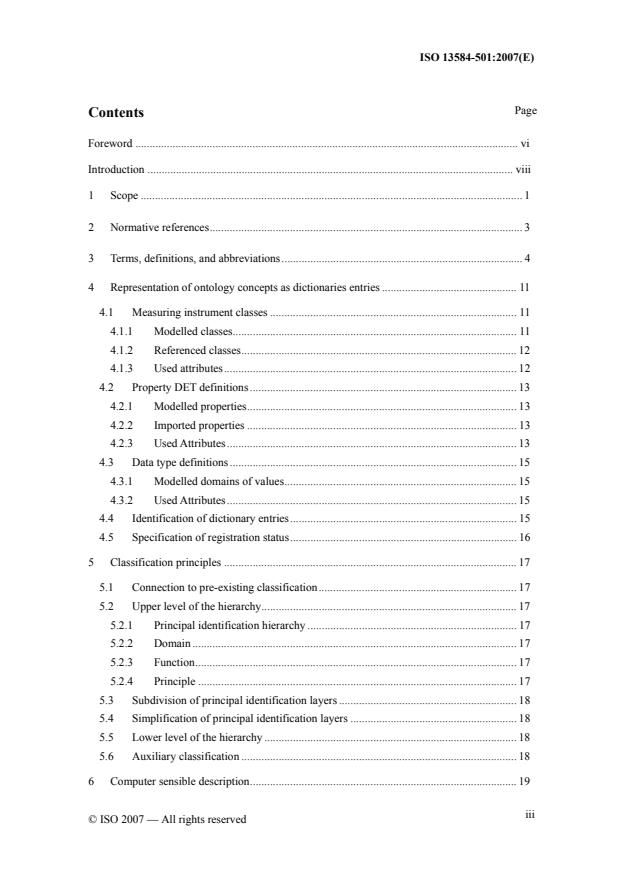
Contents
Foreword . vi
Introduction . viii
1 Scope . 1
2 Normative references. 3
3 Terms, definitions, and abbreviations. 4
4 Representation of ontology concepts as dictionaries entries . 11
4.1 Measuring instrument classes . 11
4.1.1 Modelled classes. 11
4.1.2 Referenced classes. 12
4.1.3 Used attributes. 12
4.2 Property DET definitions. 13
4.2.1 Modelled properties. 13
4.2.2 Imported properties . 13
4.2.3 Used Attributes . 13
4.3 Data type definitions. 15
4.3.1 Modelled domains of values. 15
4.3.2 Used Attributes . 15
4.4 Identification of dictionary entries. 15
4.5 Specification of registration status. 16
5 Classification principles . 17
5.1 Connection to pre-existing classification. 17
5.2 Upper level of the hierarchy. 17
5.2.1 Principal identification hierarchy . 17
5.2.2 Domain . 17
5.2.3 Function. 17
5.2.4 Principle . 17
5.3 Subdivision of principal identification layers . 18
5.4 Simplification of principal identification layers . 18
5.5 Lower level of the hierarchy . 18
5.6 Auxiliary classification . 18
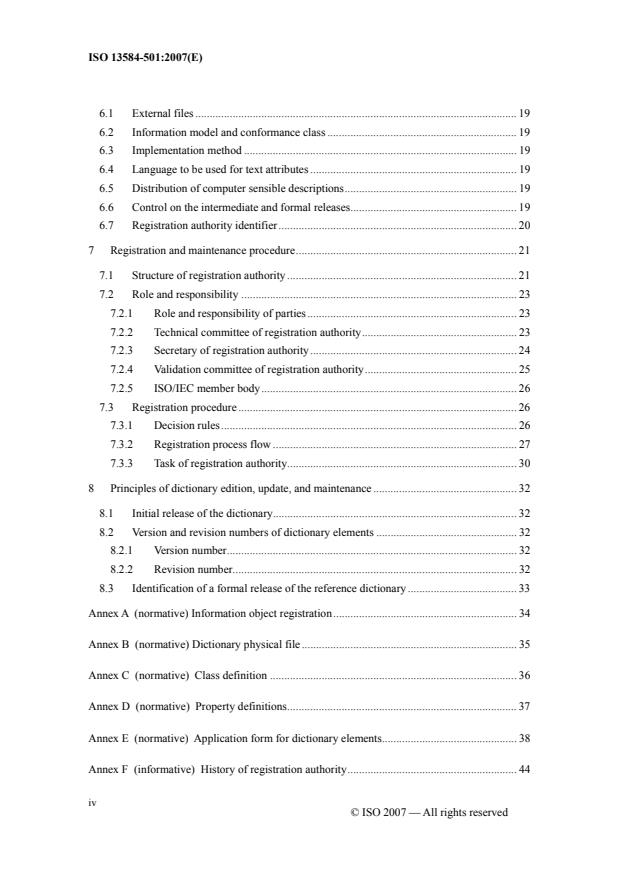
6 Computer sensible description. 19
iii
6.1 External files . 19
6.2 Information model and conformance class . 19
6.3 Implementation method . 19
6.4 Language to be used for text attributes . 19
6.5 Distribution of computer sensible descriptions. 19
6.6 Control on the intermediate and formal releases. 19
6.7 Registration authority identifier . 20
7 Registration and maintenance procedure. 21
7.1 Structure of registration authority . 21
7.2 Role and responsibility . 23
7.2.1 Role and responsibility of parties. 23
7.2.2 Technical committee of registration authority. 23
7.2.3 Secretary of registration authority. 24
7.2.4 Validation committee of registration authority. 25
7.2.5 ISO/IEC member body. 26
7.3 Registration procedure . 26
7.3.1 Decision rules. 26
7.3.2 Registration process flow . 27
7.3.3 Task of registration authority. 30
8 Principles of dictionary edition, update, and maintenance . 32
8.1 Initial release of the dictionary. 32
8.2 Version and revision numbers of dictionary elements . 32
8.2.1 Version number. 32
8.2.2 Revision number. 32
8.3 Identification of a formal release of the reference dictionary . 33
Annex A (normative) Information object registration. 34
Annex B (normative) Dictionary physical file. 35
Annex C (normative) Class definition . 36
Annex D (normative) Property definitions. 37
Annex E (normative) Application form for dictionary elements. 38
Annex F (informative) History of registration authority. 44
iv
Bibliography. 45
Index. 47
Figures
Figure 1 — BSU coding style .16
Figure 2 — Registration time frame .28
Figure 3 — Registration flow diagram .29
Tables
Table 1 — Structure of registration authority and levels of participation.22
Table F. 1 — Historical record of ISO13584-501 registration authorities.44
v
Foreword
ISO (the International Organization for Standardization) is a worldwide federation of national
standards bodies (ISO member bodies). The work of preparing International Standards is
normally carried out through ISO technical committees. Each member body interested in a
subject for which a technical committee has been established has the right to be represented on
that committee. International organizations, governmental and non-governmental, in liaison with
ISO, also take part in the work. ISO collaborates closely with the International Electrotechnical
Commission (IEC) on all matters of electrotechnical standardization.
International Standards are drafted in accordance with the rules given in the ISO/ IEC Directives,
Part 2.
The main task of technical committees is to prepare International Standards. Draft International
Standards adopted by the technical committees are circulated to the member bodies for voting.
Publication as an International Standard requires approval by at least 75 % of the member bodies
casting a vote.
Attention is drawn to the possibility that some of the elements of this part of ISO 13584 may be
the subject of patent rights. ISO shall not be held responsible for identifying any or all such patent
rights.
ISO 13584-501 was prepared by Technical Committee ISO/TC 184, Industrial automation
systems and integration, Subcommittee SC 4 Industrial data.
ISO 13584 consists of the following parts under the general title Industrial automation systems
and integration — Parts library:
— Part 1: Overview and fundamental principles;
— Part 20: Logical resource: Logical model of expressions;
— Part 24: Logical resource: Logical model of supplier library;
— Part 25: Logical resource: Logical model of supplier library with aggregate values and
explicit content;
— Part 26: Logical resource: Information supplier identification;
vi
— Part 31: Implementation resources: Geometric programming interface;
— Part 42: Description methodology: Methodology for structuring part families;
— Part 101: View exchange protocol: Geometric view exchange protocol by parametric
program;
— Part 102: View exchange protocol by ISO 10303 conforming specification;
— Part 501: Reference dictionary for measuring instruments — Registration procedure;
— Part 511: Mechanical systems and components for general use — Reference dictionary for
fasteners.
The structure of the ISO 13584 series is described in ISO 13584-1. The numbering of the
parts of ISO 13584 reflects its structure:
— Parts 10 to 19 specify the conceptual descriptions;
— Parts 20 to 29 specify the logical resources;
— Parts 30 to 39 specify the implementation resources;
— Parts 40 to 49 specify the description methodology;
— Parts 100 to 199 specify the view exchange protocol;
— Parts 500 to 599 specify the reference dictionaries.
A complete list of parts of ISO 13584 is available from the Internet:
http://www.tc184-sc4.org/titles/PLIB_Titles.htm
_______________________________________
vii
Introduction
ISO 13584 is an International Standard for the computer-interpretable representation and
exchange of parts library data. The objective is to provide a neutral mechanism capable of
transferring parts library data, independent of any application that is using a parts library data
system. The nature of this description makes it suitable not only for the exchange of files
containing parts, but also as a basis for implementing and sharing databases of parts library data.
ISO 13584 is organized as a series of parts, each published separately. The parts of ISO 13584 fall
into one of the following series: logical resources, implementation resources, description
methodology, view exchange protocol and reference dictionaries. The series are described in
ISO 13584-1. This part of ISO 13584 is a member of the reference dictionaries series.
Parts of the standardized content series of parts specify ontologies for representing the entities of
an application domain, together with their descriptive properties and domains of values. Each
entity, property or domain of values constitutes an entry of a dictionary and it is associated with a
computer sensible and human readable definition, and with a computer sensible identification.
The unique identification of a dictionary entry allows it to be referenced unambiguously from any
application. Definitions and identifications of dictionary entries are represented as instances of
the EXPRESS entity data types defined in the common dictionary schema, or in its extensions
defined in the logical series of parts of ISO 13584.
This part of ISO 13584 specifies the requirements for an ISO-registered reference dictionary for
representing measuring instruments with their properties and domains of values. This part of ISO
13584 also establishes and specifies the behaviour of a registration authority whose role is to
develop, maintain and update this ISO-registered reference dictionary for measuring instruments.
These measuring instruments include environment measuring instruments and laboratory
measuring instruments.
viii
INTERNATIONAL STANDARD ISO 13584-501:2007(E)
Industrial automation systems and integration —
Parts library —
Part 501:
Reference dictionary for measuring instruments —
Registration procedure
1 Scope
This part of ISO 13584 specifies the requirements for an ISO-registered reference dictionary for
measuring instruments with their descriptive properties and domains of values. The measuring
instruments to be included in the dictionary comprise environment measuring instruments and
laboratory measuring instruments.
This part of ISO 13584 also specifies the procedures of an organization that develops, maintains
and updates the reference dictionary for measuring instruments over a specified period of time.
Such an organization is nominated by ISO and is referenced in this part of ISO 13584 as the
registration authority of the reference dictionary for measuring instruments.
The reference dictionary for measuring instruments contains the following:
— definitions and identifications of classes of measuring instruments, with associated
classification scheme;
— definitions and identifications of data element types that represent properties of measuring
instruments;
— definitions and identifications of domains of values that prove useful for describing the above
data element types.
Each class, property or domain of values of this application domain constitutes an entry of the
reference dictionary for measuring instruments defined by the registration authority. It is
associated with a computer sensible and human readable definition, and with a computer sensible
identification. Each dictionary entry has an identifier that allows it to be referenced
unambiguously from any application.
Definitions and identifications of dictionary entries are defined by means of standard data that
consist of instances of the EXPRESS entity data types defined in the common dictionary schema,
and in its extensions defined in ISO 13584-24 and ISO 13584-25.
The following are within the scope of this part of ISO 13584:
— requirements on the standard data that is used to represent the various classes of measuring
instruments, together with their descriptive properties and domains of values;
NOTE 1 Descriptive properties can include properties concerning regulations on manufacturing,
operation, maintenance, disposal and recycling of the product.
— the process to be followed by the registration authority to propose and validate an initial
version of the reference dictionary for measuring instruments;
— the process to be followed by the registration authority to collect, validate and register new
entries or update entries for the reference dictionary for measuring instruments;
— the process to be followed by the registration authority to distribute the reference dictionary
for measuring instruments.
NOTE 2 The measuring instruments considered in this part of ISO 13584 include those measuring
instruments that are classified in the classes ICS 13 (Environment. Health protection. Safety), ICS 71.040
(Analytical chemistry) and ICS 17.220 (Electricity. Magnetism. Electrical and magnetic measurements).
NOTE 3 The file format with which the standard data registered by the registration authority established
by this part of ISO 13584 can be exchanged is specified in ISO 10303-21.
The following is outside the scope of this part of ISO 13584:
— the standard data themselves that constitute the content of the reference dictionary for
measuring instruments.
NOTE 4 The standard data themselves that constitute the content of the reference dictionary are registered
by an ISO registration authority, but are not ISO-standardized.
NOTE 5 The standard data contain the definitions and properties of measuring instruments specified
above, but they are not necessarily of measuring equipment.The difference in definitions between
measuring equipment and measuring instruments is explained in IEC 60050-351.
2 Normative references
The following referenced documents are indispensable for the application of this document. For
dated references, only the cited edition applies. For undated references, the latest edition of the
referenced document (including any amendments) applies.
ISO 10303-21, Industrial automation systems and integration — Product data representation and
exchange — Part 21: Implementation methods: Clear text encoding of the exchange structure.
ISO 13584-1:2001, Industrial automation systems and integration — Parts library — Part 1:
Overview and fundamental principles.
ISO 13584-24:2003, Industrial automation systems and integration — Parts library — Part 24:
Logical resource: Logical model of supplier library.
ISO 13584-25:2004, Industrial automation systems and integration — Parts library — Part 25:
Logical resource: Logical model of supplier library with aggregate values and explicit content.
ISO 13584-26:2000, Industrial automation systems and integration — Parts library — Part 26:
Logical resource: Information supplier identification.
ISO 13584-42:1998, Industrial automation systems and integration — Parts library — Part 42:
Description methodology: Methodology for structuring part families.
ISO/IEC 6523-1:1998, Information technology — Structure for the identification of organizations
and organization parts — Part 1: Identification of organization identification schemes.
ISO/IEC 6523-2, Information technology — Structure for the identification of organizations and
organization parts — Part 2: Registration of organization identification schemes.
ISO/IEC 8824-1, Information technology — Abstract Syntax Notation One (ASN.1) — Part 1:
Specification of basic notation.
3 Terms, definitions, and abbreviations
For the purposes of this document, the following terms and definitions apply. Some of
these terms and definitions are repeated for convenience from:
— ISO 10303-1:1994;
— ISO 10303-11:1994;
— ISO 13584-1:2001;
— ISO 13584-42:1998;
— ISO 13584-24:2003;
— IEC 60050-300:2001.
3.1
applicable property
a property that is defined for some family of parts and that shall apply to any part that belongs to
this family of parts
[ISO 13584-24:2003]
EXAMPLE For a screw generic family of parts, the threaded diameter is an applicable property:
this characteristic applies to any screw.
3.2
application
a group of one or more processes creating or using product data
[ISO 10303-1:1994, definition 3.2.2]
3.3
assembled item
an item that is defined as a composition of other items
[ISO 13584-42:1998]
3.4
atomic item
an item that is not defined as a composition of other items
[ISO 13584-42:1998]
NOTE A part that consists of several subassemblies can be described as an atomic item if its class
definition does not define its constituent subassemblies.
3.5
basic semantic unit
BSU
the entity that provides an absolute and universal identification of certain objects of the
application domain (for example, classes, data element types)
[ISO 13584-42:1998]
3.6
characteristic of a part
part characteristic
a constant property, characteristic of a part, of which the value is fixed once the part is defined
[ISO 13584-24:2003]
NOTE Changing the value of a characteristic of a part would mean changing the part.
EXAMPLE For a ball bearing, the inner and outer diameters are part characteristics.
3.7
common dictionary schema
the information model for a dictionary, using the information modelling language EXPRESS,
resulting from a joint effort between ISO TC184/SC4/WG2 and IEC SC3D
[ISO 13584-42:1998]
NOTE The common dictionary schema is specified in IEC 61360-2, and its content is provided in the
informative ISO 13584-42:1998, Annex D.
3.8
composite property
collection of properties that can be referenced from a class or classes as a single entity
3.9
data
a representation of facts, concepts, or instructions in a formal manner suitable for communication,
interpretation, or processing by human beings or computers
[ISO 10303-1:1994, definition 3.2.14]
3.10
data element type
DET
a unit of data for which the identification, the description, and value representation have been
specified
[ISO 13584-42:1998]
3.11
data exchange
the storing, accessing, transferring, and archiving of data
[ISO 10303-1:1994, definition 3.2.15]
3.12
data type
a domain of values
[ISO 10303-11:1994]
3.13
dictionary
a table consisting of a series of entries. One meaning corresponds to each entry in the dictionary
and one dictionary entry identifies one single meaning
[ISO 13584-1:2001]
NOTE 1 In ISO 13584, the kinds of meaning intended to constitute dictionary entries are: supplier, class,
property, program library, type, table and document.
NOTE 2 In ISO 13584, the information that represents a dictionary entry is split into three entities: a basic
semantic unit (BSU) that provides for reference, a dictionary element that describes the dictionary entry by
means of attributes, and, possibly, a content item entity that describes the dictionary entry by describing its
content.
3.14
dictionary data
the set of data that describes hierarchies of families of parts and properties of these parts
[ISO 13584-42:1998, definition 3.4.6]
3.15
dictionary element
the set of attributes that constitutes the dictionary description of certain objects of the application
domain (for example, classes, data element types)
[ISO 13584-42:1998, definition 3.4.7]
3.16
entity
a class of information defined by common properties
[ISO 10303-11:1994, definition 3.2.5]
3.17
entity data type
a representation of an entity. An entity data type establishes a domain of values defined by
common attributes and constraints
[ISO 10303-11:1994, definition 3.2.6]
3.18
entity (data type) instance
a named unit of data that represents a unit of information within the class defined by an entity. It is
a member of the domain established by an entity data type
[ISO 10303-11:1994, definition 3.2.7]
3.19
environment measuring instrument
measuring instrument that is used to measure physicochemical properties of the environment, or
of the substance that is released into the environment, such as air pollutants, noises, and water
pollutants, soil contaminants, on spot or on line
3.20
family of parts
a simple or generic family of parts
[ISO 13584-42:1998]
3.21
family of products
simple or generic family of products each of which can have several parts
NOTE In object oriented paradigm, such a family is usually called class.
3.22
feature
an aspect of an item that can be captured by a class structure and set of properties and that cannot
exist independently of the item
[ISO 13584-24:2003]
EXAMPLE In a piping component, an outlet is an aspect of a part that conforms to some
preconceived function stereotype that is associated with properties (for example, its name, its role). It can
be represented as a feature.
3.23
general model of a part
the library data that carries the definition and identity of a part in an integrated library
[ISO 13584-1:2001]
3.24
generic family of parts
a grouping of simple or generic families of parts done for purposes of classification or for
factoring common information
[ISO 13584-24:2003]
3.25
implementation method
a technique used by computers to exchange data that is described using the EXPRESS data
specification language
[ISO 13584-24:2003]
3.26
instance
a named value
[ISO 10303-11:1994, definition 3.2.8]
3.27
is-a relationship
the inheritance relationship defined in the object oriented paradigm
[ISO 13584-24:2003]
NOTE In ISO 13584 the is-a relationship holds between a family of parts and a generic family of parts to
which the former family belongs.
3.28
is-case-of relationship
a relationship providing a formal expression of the fact that an object conforms to the partial
specification defined by another object
[ISO 13584-24:2003]
NOTE In ISO 13584, all the properties and data types visible or applicable for some family of parts can
be imported by all the families of parts that declare to be case-of the former family. These properties and
data types can then be used to describe the latter families.
3.29
is-part-of
the aggregation part/whole relationship
[ISO 13584-24:2003]
NOTE In ISO 13584 the is-part-of relationship holds between a family of constituent parts and a family
of assembled parts to which the constituent parts belongs.
3.30
item
a thing that can be captured by a class structure and a set of properties
[ISO 13584-42:1998/Cor.1:2002]
3.31
laboratory measuring instrument
measuring instrument that is used in a laboratory to measure physicochemical properties of target
objects or samples of such objects that are either placed within a laboratory or brought into a
laboratory, in a state isolated from the production process or from the environment
NOTE Measuring instruments of this category are supposed to have the properties specified by the
standards of classes ICS 17.220 (Electricity. Magnetism. Electrical and magnetic measurements) and/or
ICS 71.040 (Analytical chemistry).
3.32
library data supplier
an organization that delivers a supplier library in the standard format defined in ISO 13584 and is
responsible for its content
[ISO 13584-1:2001]
3.33
library delivery file
a population of EXPRESS entity instances conforming to a library integrated information model
and represented according to one of the implementation methods specified in ISO 10303
[ISO 13584-24:2003]
NOTE A library delivery file specifies the structure and the content of a supplier library. It can reference
library external files.
3.34
library exchange context
the set of one library delivery file and zero, one or several library external files that represent
together a supplier library
[ISO 13584-24:2003]
3.35
library external file
a file, referenced from a library delivery file, that contributes to the definition of a supplier library
[ISO 13584-24:2003]
NOTE The structure and the format of a library external file is specified in the library delivery file that
references it.
3.36
library integrated information model
LIIM
an EXPRESS schema that integrates resource constructs from different EXPRESS schemas for
representing supplier libraries for the purpose of exchange and that is associated with
conformance requirements
[ISO 13584-24:2003]
3.37
measuring equipment
assembly of measuring instruments intended for specified measurement purposes
[IEC 60050-300:2001]
3.38
measuring instrument
device intended to be used to make measurements, alone or in conjunction with supplementary
devices
[IEC 60050-300:2001]
3.39
part
a material or functional element that is intended to constitute a component of different products
[ISO 13584-1:2001, definition 3.1.16]
NOTE 1 A part can be an atomic component, a subsystem or a whole product provided that it can be
reused in various contexts.
NOTE 2 In the ISO 13584 series, a part is characterized by class-belonging and property values.
3.40
product data
a representation of information about a product in a formal manner suitable for communication,
interpretation, or processing by human beings or by computers
[ISO 10303-1:1994, definition 3.2.27]
3.41
property
set of characteristic information that conceptually characterizes a class and can characterize parts
that belong to the class or its subclasses
3.42
RA dictionary
ISO 13584 compliant dictionary whose data elements are registered through RA and which can
include intermediate releases and formal releases of the reference dictionary for measuring
instruments
3.43
reference dictionary
ISO 13584 compliant dictionary whose data elements are registered through and formally released
from the RA established with ISO 13584-501
3.44
registration authority
RA
organization authorized by ISO to register dictionary elements for the reference dictionary for
measuring instruments, and commissioned to maintain and update the dictionary over a specified
period of time
3.45
registration authority identifier
RAI
identifier assigned to a registration authority in accordance with the specification of
ISO 13584-501
NOTE The RAI defined in this part of ISO 13584 is adapted from the one defined in ISO/IEC 11179-6.
3.46
secretary of registration authority
SORA
secretariat of registration authority
organization or a number of officers that are nominated by the hosting organization of the
registration authority for the administration of the registration, and held responsible for the update
and maintenance of the registered dictionary elements, whereas the office of the nominated
officers, or the secretariat of the registration authority, may also be referenced as SORA
3.47
simple family of parts
a set of parts of which each part may be described by the same group of properties
[ISO 13584-24:2003]
3.48
standard data
requirement on a software system defined by means of EXPRESS entity (data type) instances that
are supposed to be recognized by this software system
3.49
supplier library
a set of data, and possibly of programs, for which the supplier is defined and that describes in the
standard format defined in ISO 13584 a set of parts and/or a set of representation of parts
[ISO 13584-1:2001]
NOTE The dictionary defined in this part of ISO 13584 can be exchanged as a supplier library.
3.50
technical committee of registration authority
TCRA
virtual community over the Internet that consists of technical experts in the domain of measuring
instruments and associated data modelling
3.51
technical subcommittee of registration authority
TSRA
subcommittee of TCRA that consists of technical experts in a specific domain of measuring
instruments and associated data modelling
3.52
validation committee of registration authority
VCRA
virtual community over Internet that consists of validation experts nominated by each member
body of ISO and IEC and that agrees to participate in the dictionary registration process of this
registration authority
3.53
visible property
a property that is defined for some family of parts and that may or may not apply to the different
parts of this family of parts
[ISO 13584-24:2003]
EXAMPLE For a generic family of screws, the non-threaded length is a visible property: it is
clearly defined for any screw, but only those screws with a non-threaded part have a value for this property.
NOTE The code of the class where a property is defined as visible is part of the identification of the data
element type that represents this property.
4 Representation of ontology concepts as dictionaries entries
4.1 Measuring instrument classes
4.1.1 Modelled classes
In the reference dictionary for measuring instruments, only item_class shall be used for capturing
the concept of a class of product of measuring instruments. If a product imports some properties
from other classes, item_class_case_of may be used instead of the class mentioned above.
Entities of class such as component_class, material_class, feature_class,
component_class_case_of, material_class_case_of, feature_class_case_of,
functional_model_class, and functional_view_class shall not be used in this reference
dictionary. For the purpose of modelling a concept of composite property which may encompass
a collection of properties, item_class or item_class_case_of shall be used instead of
feature_class and feature_class_case_of. If the concept of the composite property may not stand
alone and shall be embedded in a class, the intent shall be marked with a literal string
“embeddable” in the remark attribute of the item_class or item_class_case_of used for
modelling the property. If the concept of the composite property may be sharable with other
classes as a stand alone concept, this shall be modelled as an item_class or item_class_case_of
without marking in the attribute. This literal marking in the attribute may be substituted or
reinforced by a structural attribute for the same purpose, when a future edition of ISO 13584-42
introduces such an attribute in item_class or item_class_case_of.
4.1.2 Referenced classes
Classes of other ISO 13584-compliant dictionaries shall be referenced whenever possible and
appropriate in this reference dictionary for measuring instruments to avoid duplication of
standardization effort.
4.1.3 Used attributes
In the reference dictionary for measuring instruments, classes shall be defined by the following
information elements specified in ISO 13584-42:
— Code;
— Superclass;
— Preferred Name;
— Synonymous Name;
— Visible Types;
— Applicable Types;
— Visible Properties;
— Applicable Properties;
— Definition;
— Source Document of Definition;
— Note;
— Simplified Drawing;
— Date of Original Definition;
— Date of Current Version;
— Date of Current Revision;
— Version Number;
— Revision Number;
— Remark.
The following information elements specified in ISO 13584-42 shall not be used for defining the
classes specified in this part of ISO 13584:
— Short Name;
— Sub-Class Selection Properties;
— Class Value Assignment.
4.2 Property DET definitions
4.2.1 Modelled properties
No condition_DET or dependent_P_DET shall be used.
4.2.2 Imported properties
Properties defined in other ISO 13584-compliant dictionaries shall be imported whenever
possible by the reference dictionary for measuring instruments to avoid duplication of
standardization effort. Property importation shall be done by means of the case-of relationship.
4.2.3 Used Attributes
In the reference dictionary for measuring instruments, properties shall be defined by the following
information elements specified in ISO 13584-42:
— Code;
— Definition Class;
— Data Type;
— Preferred Name;
— Synonymous Name;
— Definition;
— Source Document of Definition;
— Note;
— Unit;
— Value Format;
— Date of Original Definition;
— Date of Current Version;
— Date of Current Revision;
— Version Number;
— Revision Number;
— Remark.
The following information elements specified in ISO 13584-42 shall not be used for defining the
property DETs specified in this part of ISO 13584:
— Preferred Letter Symbol;
— Short Name;
— Synonymous Letter Symbols;
— Property Type Classification;
— Condition;
— Formula.
4.3 Data type definitions
4.3.1 Modelled domains of values
All the data types allowed in ISO 13584-42 are also allowed for the dictionary elements to be
registered through the registration authority (RA) established by this part of ISO13584. In
addition, aggregate types defined in ISO 13584-25 may be used for property definition.
4.3.2 Used Attributes
This part of ISO 13584 has no used attributes for data type definitions.
4.4 Identification of dictionary entries
As defined in ISO 13584-42, classes, properties and data types are identified by BSUs. The
coding style of BSU is illustrated in the Figure 1. The class_BSU, the property_BSU and the
data_type_BSU defined and used in the Reference Dictionary shall start with capital letters
‘P501_C’ for class_BSUs and ‘P501_P’ for property_BSUs and ‘P501_T’ for data_type_BSUs,
respectively. Imported properties from any other dictionary compliant to ISO13584 data model
shall retain the codes issued by the dictionary supplier of the property. For the properties that
could be presumably imported from a foreign class being outside the scope of this reference
dictionary, but currently no ISO 13584 compliant dictionary is available for such, the first letter of
the third section shall start with ‘F’ to mark that they are of foreign nature. If necessary,
provisional classes are also created for such properties, and shall be assigned a class_BSU whose
third section starts with ‘F’. Thus, when a due reference dictionary with a proper scope is made
for such classes and properties, they may become deprecated but the code themselves shall be
maintained. These provisions are intended to clarify in which part of the standard content series of
ISO13584 or in any other standards, the definitions of these properties can be found. In addition,
a single underscore is inserted between ‘P501’ and ‘C’, between ‘P501’ and ‘P’, or between
‘P501’ and ‘T’ to improve the readability of the codes.
P 5 0 1 _ {C, P, T} [F] X X X X X X
Third section
Second section
First section
Figure 1 — BSU coding style
EXAMPLE Valid codes are P501_C000001, P501_P000001.
4.5 Specification of registration status
For data elements to be registered through the RA to be established by this part of ISO 13584, a
designation of the position in the registration life-cycle of the data element shall be assigned. In
case of a class or a property, the status shall be recorded in the remark attribute of each data
element. The following statuses shall be assigned by the RA for each data element in the process
of implementing the registration procedure established by this part of ISO 13584:
rejected: The data element submitted to the RA did not contain all mandatory attribute
values specified by this part of ISO 13584, and thus does not meet the formality
requirements specified in this or other parts of ISO 13584.
recorded: The registered data element contains all mandatory attribute values, but the
content may not meet the quality requirements specified in this or other parts of
ISO 13584, or may contain technically irrelevant or incorrect information that may
be disapproved by the technical experts of the RA.
certified: The recorded data element has met the quality requirements specified in this or
other parts of ISO 13584 and has been technically approved by the technical
experts of the RA.
validated: The certified data element has been approved by the validation experts of the
validation committee of the RA for the adoption into a new formal release of the
RA dictionary.
deprecated: A recorded, certified, or standardized data element is considered no longer
desirable for describing a product from a certain time on; thus, it is in a phase-out
period. Such a data element might have been superseded by a new data element.
Note that a product described by such a deprecated data element remains in use for
a long time; thus, it is inappropriat
...