


ISO 11249
(Main)Copper-bearing intrauterine contraceptive devices — Guidance on the design, execution, analysis and interpretation of clinical studies
Copper-bearing intrauterine contraceptive devices — Guidance on the design, execution, analysis and interpretation of clinical studies
ISO 11249:2018 provides guidance on the design and conduct of clinical studies to determine the performance characteristics of new intrauterine devices. It also provides advice on the analysis of data when the study is completed, as well as interpretation of these results by manufacturers, researchers and regulatory bodies. ISO 11249:2018 is intended to ensure the scientific conduct of the clinical investigation and the credibility of the clinical investigation results, and to assist sponsors, monitors, investigators, ethics committees, regulatory authorities and other bodies involved in the conformity assessment of medical devices. Certain clinical trial concerns are not addressed in this document, including subject compensation, confidentiality of subjects and their records, use of local ethics committees, etc. These and many other clinical trial design issues are covered in great detail in ISO 14155.
Dispositif intra-utérin au cuivre à but contraceptif — Recommandations relatives à la méthodologie, la réalisation, l'analyse et l'interprétation des résultats des études cliniques
General Information
- Status
- Not Published
- Technical Committee
- ISO/TC 157 - Non-systemic contraceptives and STI barrier prophylactics
- Drafting Committee
- ISO/TC 157/WG 20 - Clinical trials
- Current Stage
- 6000 - International Standard under publication
- Start Date
- 14-Apr-2026
- Completion Date
- 18-Apr-2026
Relations
- Effective Date
- 05-Oct-2024
Overview
ISO/PRF 11249: Copper-bearing intrauterine contraceptive devices - Guidance on the design, execution, analysis and interpretation of clinical studies is an international standard developed by ISO Technical Committee 157. This standard provides comprehensive guidance for the clinical investigation of copper-bearing intrauterine devices (IUDs). Its primary aim is to ensure that clinical studies on IUDs are designed, conducted, analyzed, and interpreted in a scientifically sound and ethically robust manner.
ISO/PRF 11249 supports manufacturers, researchers, regulatory authorities, sponsors, monitors, investigators, and ethics committees in the conformity assessment process for medical devices. By promoting best practices, the standard helps uphold the scientific integrity and credibility of clinical trial results for copper-IUDs, which are widely used for long-term contraception.
Key Topics
Clinical Investigation Planning
Guidance is provided for planning IUD trials according to good clinical practice, referencing ISO 14155 for general principles, responsibilities, and ethical requirements.Ethical Conduct
Considers the rights, safety, and well-being of participants. Emphasis is placed on informed consent and adherence to the Declaration of Helsinki.Description and Identification of Investigational Devices
Specifies requirements for documenting device descriptions, manufacturer details, intended use, accessories, materials, instructions for use, and traceability.Preliminary Investigations
Recommends literature reviews, summaries of preclinical testing, and assessments of prior clinical experience to inform trial design and identify risks and benefits.Objectives and Study Endpoints
Outlines how to define primary and secondary endpoints, including pregnancy rate, expulsion rate, and discontinuation for clinical reasons, in line with ISO 7439.Design and Execution of Clinical Studies
Provides advice on study type, minimizing bias, collecting and analyzing outcome data, and procedures for participant follow-up.Adverse Events and Safety Monitoring
Details the monitoring, recording, and reporting of adverse events and device effects throughout the study.
Applications
ISO/PRF 11249 is a practical tool for:
Manufacturers Developing New IUDs
Ensures that device performance and safety are evaluated under robust clinical conditions. Facilitates regulatory approval and market access by ensuring conformity with international standards.Regulatory Authorities and Ethics Committees
Provides a standardized framework for assessing the credibility, safety, and ethical compliance of clinical studies submitted for regulatory review.Clinical Researchers and Investigators
Guides the development of clinical investigation plans, making sure studies capture all necessary clinical outcomes, manage participant risks, and use appropriate analysis methods.Monitors and Sponsors
Assists in overseeing and supporting clinical trials to maintain quality, consistency, and compliance with international expectations.Global Health Organizations
Supports the harmonization of device evaluation procedures worldwide, enhancing the reliability of clinical evidence for copper-IUDs.
Related Standards
- ISO 14155 - Clinical investigation of medical devices for human subjects - Good clinical practice: Covers broader aspects of medical device trial design, conduct, and ethical considerations.
- ISO 7439 - Copper-bearing contraceptive intrauterine devices - Requirements and test methods: Specifies clinical requirements and test methods for copper-IUDs.
- ISO 14971 - Medical devices - Application of risk management to medical devices: Describes the risk management process pertinent to device design and investigations.
For successful implementation of clinical studies involving copper-bearing intrauterine contraceptive devices, ISO/PRF 11249 should be used alongside these foundational standards.
Keywords: ISO 11249, copper-bearing intrauterine contraceptive devices, IUD clinical trials, clinical study guidance, medical device standards, IUD safety and efficacy, ISO 14155, regulatory compliance, clinical investigation plan, contraceptive device testing
Buy Documents


ISO/PRF 11249 - Copper-bearing intrauterine contraceptive devices — Guidance on the design, execution, analysis and interpretation of clinical studies
REDLINE ISO/PRF 11249 - Copper-bearing intrauterine contraceptive devices — Guidance on the design, execution, analysis and interpretation of clinical studies
Get Certified
Connect with accredited certification bodies for this standard

BSI Group
BSI (British Standards Institution) is the business standards company that helps organizations make excellence a habit.

TÜV Rheinland
TÜV Rheinland is a leading international provider of technical services.

TÜV SÜD
TÜV SÜD is a trusted partner of choice for safety, security and sustainability solutions.
Sponsored listings
Frequently Asked Questions
ISO 11249 is a draft published by the International Organization for Standardization (ISO). Its full title is "Copper-bearing intrauterine contraceptive devices — Guidance on the design, execution, analysis and interpretation of clinical studies". This standard covers: ISO 11249:2018 provides guidance on the design and conduct of clinical studies to determine the performance characteristics of new intrauterine devices. It also provides advice on the analysis of data when the study is completed, as well as interpretation of these results by manufacturers, researchers and regulatory bodies. ISO 11249:2018 is intended to ensure the scientific conduct of the clinical investigation and the credibility of the clinical investigation results, and to assist sponsors, monitors, investigators, ethics committees, regulatory authorities and other bodies involved in the conformity assessment of medical devices. Certain clinical trial concerns are not addressed in this document, including subject compensation, confidentiality of subjects and their records, use of local ethics committees, etc. These and many other clinical trial design issues are covered in great detail in ISO 14155.
ISO 11249:2018 provides guidance on the design and conduct of clinical studies to determine the performance characteristics of new intrauterine devices. It also provides advice on the analysis of data when the study is completed, as well as interpretation of these results by manufacturers, researchers and regulatory bodies. ISO 11249:2018 is intended to ensure the scientific conduct of the clinical investigation and the credibility of the clinical investigation results, and to assist sponsors, monitors, investigators, ethics committees, regulatory authorities and other bodies involved in the conformity assessment of medical devices. Certain clinical trial concerns are not addressed in this document, including subject compensation, confidentiality of subjects and their records, use of local ethics committees, etc. These and many other clinical trial design issues are covered in great detail in ISO 14155.
ISO 11249 is classified under the following ICS (International Classification for Standards) categories: 11.200 - Birth control. Mechanical contraceptives. The ICS classification helps identify the subject area and facilitates finding related standards.
ISO 11249 has the following relationships with other standards: It is inter standard links to ISO 11249:2018. Understanding these relationships helps ensure you are using the most current and applicable version of the standard.
ISO 11249 is available in PDF format for immediate download after purchase. The document can be added to your cart and obtained through the secure checkout process. Digital delivery ensures instant access to the complete standard document.
Standards Content (Sample)
International
Standard
Second edition
Copper-bearing intrauterine
contraceptive devices — Guidance
on the design, execution, analysis
and interpretation of clinical
studies
Dispositif intra-utérin au cuivre à but contraceptif —
Recommandations relatives à la méthodologie, la réalisation,
l'analyse et l'interprétation des résultats des études cliniques
PROOF/ÉPREUVE
Reference number
© ISO 2026
All rights reserved. Unless otherwise specified, or required in the context of its implementation, no part of this publication may
be reproduced or utilized otherwise in any form or by any means, electronic or mechanical, including photocopying, or posting on
the internet or an intranet, without prior written permission. Permission can be requested from either ISO at the address below
or ISO’s member body in the country of the requester.
ISO copyright office
CP 401 • Ch. de Blandonnet 8
CH-1214 Vernier, Geneva
Phone: +41 22 749 01 11
Email: copyright@iso.org
Website: www.iso.org
Published in Switzerland
PROOF/ÉPREUVE
ii
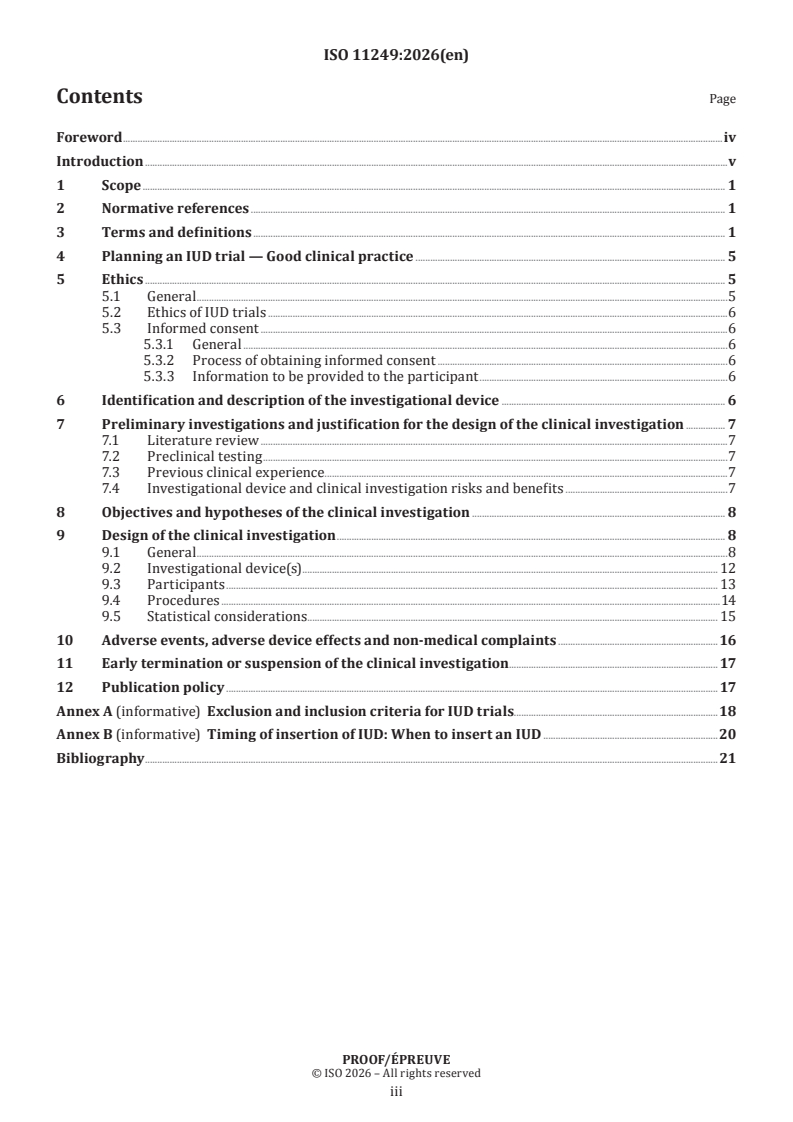
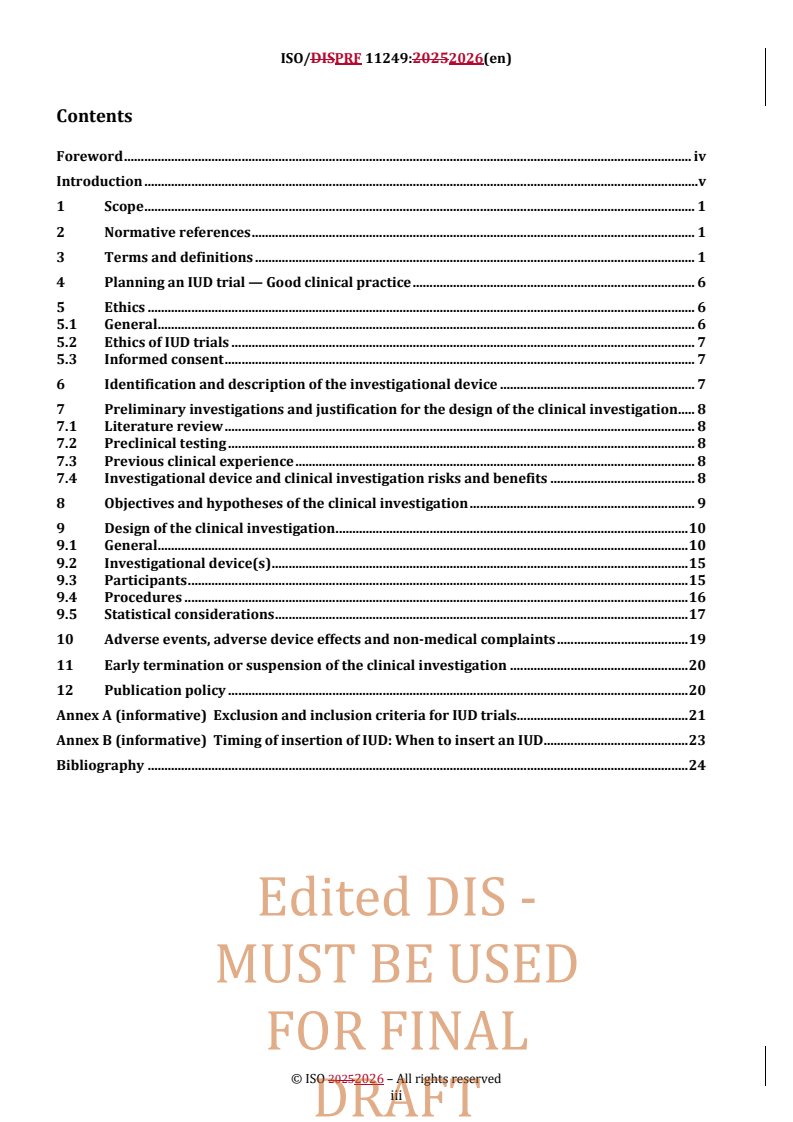
Contents Page
Foreword .iv
Introduction .v
1 Scope . 1
2 Normative references . 1
3 Terms and definitions . 1
4 Planning an IUD trial — Good clinical practice . 5
5 Ethics . 5
5.1 General .5
5.2 Ethics of IUD trials .6
5.3 Informed consent .6
5.3.1 General .6
5.3.2 Process of obtaining informed consent .6
5.3.3 Information to be provided to the participant .6
6 Identification and description of the investigational device . 6
7 Preliminary investigations and justification for the design of the clinical investigation . 7
7.1 Literature review .7
7.2 Preclinical testing .7
7.3 Previous clinical experience.7
7.4 Investigational device and clinical investigation risks and benefits .7
8 Objectives and hypotheses of the clinical investigation . 8
9 Design of the clinical investigation . 8
9.1 General .8
9.2 Investigational device(s) . 12
9.3 Participants . 13
9.4 Procedures .14
9.5 Statistical considerations . 15
10 Adverse events, adverse device effects and non-medical complaints .16
11 Early termination or suspension of the clinical investigation . 17
12 Publication policy . 17
Annex A (informative) Exclusion and inclusion criteria for IUD trials.18
Annex B (informative) Timing of insertion of IUD: When to insert an IUD .20
Bibliography .21
PROOF/ÉPREUVE
iii
Foreword
ISO (the International Organization for Standardization) is a worldwide federation of national standards
bodies (ISO member bodies). The work of preparing International Standards is normally carried out through
ISO technical committees. Each member body interested in a subject for which a technical committee
has been established has the right to be represented on that committee. International organizations,
governmental and non-governmental, in liaison with ISO, also take part in the work. ISO collaborates closely
with the International Electrotechnical Commission (IEC) on all matters of electrotechnical standardization.
The procedures used to develop this document and those intended for its further maintenance are described
in the ISO/IEC Directives, Part 1. In particular, the different approval criteria needed for the different types
of ISO document should be noted. This document was drafted in accordance with the editorial rules of the
ISO/IEC Directives, Part 2 (see www.iso.org/directives).
ISO draws attention to the possibility that the implementation of this document may involve the use of (a)
patent(s). ISO takes no position concerning the evidence, validity or applicability of any claimed patent
rights in respect thereof. As of the date of publication of this document, ISO had not received notice of (a)
patent(s) which may be required to implement this document. However, implementers are cautioned that
this may not represent the latest information, which may be obtained from the patent database available at
www.iso.org/patents. ISO shall not be held responsible for identifying any or all such patent rights.
Any trade name used in this document is information given for the convenience of users and does not
constitute an endorsement.
For an explanation of the voluntary nature of standards, the meaning of ISO specific terms and expressions
related to conformity assessment, as well as information about ISO's adherence to the World Trade
Organization (WTO) principles in the Technical Barriers to Trade (TBT), see www.iso.org/iso/foreword.html.
This document was prepared by Technical Committee ISO/TC 157, Non-systemic contraceptives and STI
barrier prophylactics.
This second edition cancels and replaces the first edition (ISO 11249:2018), which has been technically
revised.
The main changes are as follows:
— this document has been updated for the trial design to match the new requirements of a single arm
study.
Any feedback or questions on this document should be directed to the user’s national standards body. A
complete listing of these bodies can be found at www.iso.org/members.html.
PROOF/ÉPREUVE
iv
Introduction
The clinical study guidance given in this document is intended to help in the design, execution, analysis, and
interpretation of clinical studies conducted in accordance with the requirements of ISO 7439.
Intrauterine devices (IUD) are highly effective at preventing pregnancy. A new device aims at maintaining or
improving the efficacy of intrauterine contraception and/or reducing the side effects associated with IUDs,
such as excessive menstrual bleeding. Trials evaluating new or modified IUDs should be conducted to the
highest standards, and this guidance will help those preparing for an IUD trial.
This document should be read in conjunction with ISO 14155.
It is based on the structure and content of a clinical investigation plan (CIP) as described in ISO 14155 to
assist in the writing of a CIP and includes sections of the CIP that are of special relevance to IUD trials.
This document also draws on the experience gained in preparing the Cochrane systematic review of trials
of copper-containing IUDs, which has been used to inform the updating of the WHO/UNFPA Specification for
TCu380A IUD.
Clinical studies are also subject to local regulations and, in most countries, might require prior approval
from the local regulatory body.
This document helps to ensure the scientific conduct of the clinical investigation and the credibility of
the clinical investigation results, and to assist sponsors, monitors, investigators, ethics committees or
regulatory authorities.
PROOF/ÉPREUVE
v
International Standard ISO 11249:2026(en)
Copper-bearing intrauterine contraceptive devices —
Guidance on the design, execution, analysis and
interpretation of clinical studies
IMPORTANT — Persons designing, running, and analysing clinical studies of new IUDs shall be
familiar with all relevant standards for research designed to protect the rights, safety and well-
being of human participants.
1 Scope
This document provides guidance on the design and conduct of clinical studies to determine the performance
characteristics of new intrauterine devices. It also provides advice on the analysis of data when the study is
completed, as well as interpretation of these results by manufacturers, researchers and regulatory bodies.
Certain clinical trial concerns are not addressed in this document, including participant compensation,
confidentiality of participants and their records, use of local ethics committees, etc. These and many other
clinical trial design issues are covered in great detail in ISO 14155.
2 Normative references
There are no normative references in this document.
3 Terms and definitions
For the purposes of this document, the following terms and definitions apply.
ISO and IEC maintain terminology databases for use in standardization at the following addresses:
— ISO Online browsing platform: available at https:// www .iso .org/ obp
— IEC Electropedia: available at https:// www .electropedia .org/
3.1
adverse device effect
ADE
adverse event (3.2) related to the use of a medical device (3.21)
Note 1 to entry: This includes any adverse event resulting from insufficiencies or inadequacies in the instructions for
use, the deployment, the implantation, the installation, the operation, or any malfunction (3.20) of the medical device.
Note 2 to entry: This includes any event that is a result of a use error or intentional misuse.
3.2
adverse event
AE
any untoward medical occurrence, unintended disease or injury or any untoward clinical signs (including
an abnormal laboratory finding) in participants (3.29), users or other persons whether or not related to the
investigational device (3.24)
Note 1 to entry: This includes events related to the investigational device.
Note 2 to entry: This includes events related to the procedures involved.
Note 3 to entry: For users or other persons, this is restricted to events related to the investigational device.
PROOF/ÉPREUVE
3.3
case report form
CRF
set of printed, optical or electronic documents for each participant (3.29) on which information to be
reported to the sponsor (3.28) is recorded as required by the CIP
Note 1 to entry: There may be more than one case report form per participant.
3.4
clinical investigation
systematic investigation in or on one or more human participants (3.29), undertaken to assess the safety
and/or efficacy of a medical device (3.21)
Note 1 to entry: “Clinical trial” or “clinical study” are synonymous with “clinical investigation”.
3.5
clinical investigation plan
CIP
document that states the rationale, objectives (3.28), design and proposed analysis, methodology, monitoring,
conduct and record-keeping of the clinical investigation (3.4)
Note 1 to entry: The term “protocol” is synonymous to “CIP”. However, protocol has many different meanings, some
not related to clinical investigations, and these can differ from country to country. Therefore, the term CIP is used in
this document.
3.6
clinical performance
behaviour of a medical device (3.21) and/or the response of the participant (3.29) to that medical device in
relation to its intended use when correctly applied to appropriate participants
3.7
deviation
instance(s) of failure to follow, intentionally or unintentionally, the requirements of the CIP
3.8
ectopic pregnancy
pregnancy located outside the uterine cavity
3.9
primary end point
indicator to assess the primary hypothesis (3.13) of a clinical investigation (3.4)
Note 1 to entry: There might be more than one primary end point.
3.10
secondary end point
indicator to assess the secondary hypotheses (3.15) of a clinical investigation (3.5)
Note 1 to entry: There might be more than one secondary end point.
3.11
ethics committee
EC
independent body whose responsibility is to review clinical investigations (3.4), protocols and procedures
in order to protect the rights, safety and well-being of human participants (3.29) participating in a clinical
investigation
Note 1 to entry: For the purposes of this document, “ethics committee” is synonymous with “research ethics
committee”, “independent ethics committee”, or “institutional review board”. The regulatory requirements pertaining
to ethics committees or similar institutions can differ by country or region.
PROOF/ÉPREUVE
3.12
expulsion
inadvertent movement of the IUD into or from the vagina, including partial expulsion, requiring removal of
the IUD from the cervix
3.13
hypothesis
testable biostatistical statement, derived from the study objective (3.22), for evaluating the investigational
device (3.19) safety and/or performance
Note 1 to entry: The hypothesis is used to design the clinical investigation (3.5) and stipulates the statistic(s) used to
accept or reject the results of the clinical investigation.
Note 2 to entry: The primary hypothesis is the determinant of the investigational device safety and/or performance
parameters and is usually used to calculate the sample size. Secondary hypotheses concerning other points of interest
can also be evaluated.
3.14
informed consent
process by which an individual is asked to voluntarily participate in a clinical investigation (3.4) having been
provided with information about the clinical investigation
Note 1 to entry: Informed consent is documented by means of a written, signed and dated informed consent form.
3.15
intrauterine pregnancy
normally sited pregnancy within the uterine cavity
3.16
intrauterine contraceptive device
IUD
device placed in the uterine cavity for the purpose of preventing pregnancy
Note 1 to entry: The abbreviation IUCD may be used in some publications.
3.17
investigator
any individual member of the investigation site (3.18) team designated and supervised by the principal
investigator at an investigation site to perform critical clinical investigation-related procedures and/or to
make important clinical investigation-related decisions
Note 1 to entry: An individual member of the investigation site team can also be called “sub-investigator” or “co-
investigator”.
3.18
investigation site
institution or site where the clinical investigation (3.4) is carried out
Note 1 to entry: For the purpose of this document, “investigation site” is synonymous with “investigation centre”.
3.19
investigational device
medical device (3.21) being sassessed for safety and performance in a clinical investigation (3.4)
Note 1 to entry: This includes marketed medical devices that are being evaluated for new intended uses, new
populations, new materials or design changes.
3.20
malfunction
failure of a device to perform in accordance with its intended purpose when used in accordance with the
instructions for use or CIP
PROOF/ÉPREUVE
3.21
medical device
any instrument, apparatus, implement, machine, appliance, implant, software, material, or other similar or
related article intended by the manufacturer to be used, alone or in combination, for human beings for one
or more of the specific purpose(s) of
— diagnosis, prevention, monitoring, treatment or alleviation of disease,
— diagnosis, monitoring, treatment, alleviation of or compensation for an injury,
— investigation, replacement, modification, or support of the anatomy or of a physiological process,
— supporting or sustaining life,
— control of conception,
— disinfection of medical devices, and
— providing information for medical purposes by means of in vitro examination of specimens derived from
the human body
and which does not achieve its primary intended action in or on the human body by pharmacological,
immunological or metabolic means, but which may be assisted in its intended function by such means
3.22
objective
major purpose(s) for conducting the clinical investigation (3.4)
3.23
perforation
puncture of the uterus, as may be caused by a uterine sound or insertion tube or by an intrauterine
contraceptive device (3.16)
3.24
point of enrolment
date at which, following recruitment (3.25) and signing and dating the informed consent form, a participant
(3.29) is enrolled in a study, often also the point when participants receive the investigational product
3.25
recruitment
active efforts to identify participants (3.29) who might be suitable for enrolment into the clinical investigation
(3.4)
3.26
serious adverse device effect
SADE
adverse device effect (3.1) that has resulted in any of the consequences characteristic of a serious adverse
event (3.27)
3.27
serious adverse event
SAE
adverse event (3.2) that
a) led to a death,
b) led to a serious deterioration in the health of the participant (3.29) that
— resulted in a life-threatening illness or injury,
— resulted in a permanent impairment of a body structure or a body function,
— required in-patient hospitalization or prolongation of existing hospitalization,
PROOF/ÉPREUVE
— resulted in medical or surgical intervention to prevent life threatening illness or injury or permanent
impairment to a body structure or a body function, or
c) led to foetal distress, foetal death or a congenital abnormality or birth defect
Note 1 to entry: A planned hospitalization for pre-existing condition, or a procedure required by the CIP, without a
serious deterioration in health, is not considered to be a serious adverse event.
3.28
sponsor
individual or organization taking responsibility and liability for the initiation and/or implementation of a
clinical investigation (3.4)
Note 1 to entry: When an investigator (3.17) initiates, implements and takes full responsibility for the clinical
investigation, the investigator also assumes the role of the sponsor and is identified as the sponsor-investigator.
3.29
participant
individual who participates in a clinical investigation (3.4)
Note 1 to entry: A participant can be either a healthy volunteer or a patient.
3.30
thread
attachment to an IUD for the purpose of verifying the presence of and enabling the removal of the IUD
Note 1 to entry: The thread is intended to lie in the cervical canal and the vagina when the body of the device is placed
correctly in the uterine cavity.
Note 2 to entry: The thread is often referred to as a string.
3.31
unanticipated serious adverse device effect
USADE
serious adverse device effect (3.26) which by its nature, incidence, severity or outcome has not been identified
in the current version of the risk analysis report
Note 1 to entry: There should be a distinction in the report between anticipated and unanticipated serious adverse
device effects.
4 Planning an IUD trial — Good clinical practice
ISO 14155 addresses good clinical practice for the design, conduct, recording and reporting of clinical
investigations carried out in human participants to assess the safety or performance of medical devices for
regulatory purposes.
The principles set forth in ISO 14155 should apply to all trials conducted on IUDs. ISO 14155 specifies general
requirements intended to protect the rights, safety and well-being of human participants and ensure the
scientific conduct of the clinical investigation and the credibility of the results. It defines the responsibilities
of the sponsor and principal investigator, and assist sponsors, investigators, ethics committees, regulatory
authorities and other bodies involved in the conformity assessment of medical devices.
5 Ethics
5.1 General
Clinical investigations should be conducted in accordance with the ethical principles that have their origin
[24]
in the Declaration of Helsinki . This protects the rights, safety and well-being of clinical investigation
participants, which are the most important considerations and are required by the Declaration to prevail
PROOF/ÉPREUVE
over interests of science and society. This should be understood, observed, and applied at every step in the
clinical investigation.
5.2 Ethics of IUD trials
Trials of a new IUD are justified if they are likely to demonstrate improved performance, whether by
improving efficacy, reducing side-effects or improved bleeding pattern, or potentially reducing costs when
compared to standard IUDs, such as TCu380A.
5.3 Informed consent
5.3.1 General
Informed consent should be obtained and documented before any procedure specific to the clinical
investigation is applied to a participant. The informed consent form consists of an information form and
an informed consent signature form. Documentation may occur by physically signing the consent signature
form or by electronic signature.
5.3.2 Process of obtaining informed consent
The procedures specified in ISO 14155 should be followed when obtaining informed consent.
5.3.3 Information to be provided to the participant
The procedures relating to information to be provided to the participant specified in ISO 14155 should be
followed. The risks relating to pregnancy should be clearly pointed out.
The procedures specified in ISO 14155 should be followed when obtaining informed consent signature. The
participant’s signature should be obtained before enrolling into the study and an IUD is inserted.
6 Identification and description of the investigational device
The clinical investigation plan (CIP) should contain:
a) a summary description of the intrauterine device and its intended purpose;
b) the manufacturer of the device;
c) the model or type name and/or number and accessories, if any, to permit full identification;
d) a description as to how traceability will be achieved during and after the clinical investigation, for
example, assignment of lot numbers, batch numbers, or serial numbers;
e) the intended purpose of the intrauterine device in the proposed clinical investigation. If purposes other
than contraception are intended, these should be described;
f) the populations and indications for which the intrauterine device is intended when in general use;
g) a description of the intrauterine device including any materials that will be in contact with tissues or
body fluids;
h) instructions for insertion and use of the IUD including any necessary storage and handling requirements,
preparation for use and any precautions to be taken after use, e.g. disposal;
General use requirements should be specified in the CIP. The precise wording of the instructions should
be documented separately and submitted to the ethics committee with the CIP.
i) a summary of necessary training and experience (both for participants and for investigators) needed
for the use of the IUD;
PROOF/ÉPREUVE
j) a description of the necessary medical or surgical procedures involved in the insertion, use, and removal
of the investigational device.
7 Preliminary investigations and justification for the design of the clinical
investigation
7.1 Literature review
Although the clinical requirements for copper bearing IUDs are specified in ISO 7439, it is nevertheless
recommended that a literature review is undertaken during the planning stage for any clinical trials on
IUDs.
The CIP should contain:
a) the conclusions of a critical review of the relevant scientific literature and/or unpublished data and
reports;
b) a list of the literature reviewed.
The conclusions from this literature review may impact on the design of the proposed clinical investigations.
The review should be relevant to the intended purpose of the IUD and the proposed method of use. It should
also help in the identification of relevant end-points and confounding factors that should be considered.
7.2 Preclinical testing
The CIP should contain a summary of the relevant preclinical testing that has been performed on the IUD to
justify its use in human participants, together with an evaluation of the results of such testing.
7.3 Previous clinical experience
The CIP should contain:
a) a summary of the results from previous clinical investigations and clinical usage, if any, that are relevant
to the proposed clinical investigation;
b) relevant experience, if any, with the IUD, or medical devices with similar features, including that relating
to other indications for use of the IUD;
c) an assessment of adverse device effects and any history of modification or recall.
7.4 Investigational device and clinical investigation risks and benefits
The CIP should contain:
a) anticipated clinical benefits;
b) residual risks associated with the IUD, as identified in the risk analysis report;
c) risks associated with participation in the clinical investigation;
d) anticipated adverse device effects;
e) possible interactions with concomitant medical treatments;
f) steps that will be taken to control or mitigate the risks;
g) risk/benefit rationale.
NOTE The risk management process, which includes risk analysis, risk/benefit assessment and risk control, is
described in ISO 14971.
PROOF/ÉPREUVE
8 Objectives and hypotheses of the clinical investigation
The CIP should contain:
a) Claims and intended clinical performance of the IUD that should be verified
ISO 7439 describes three requirements that the IUD will be judged against:
1) the upper limit of the 95 % two-sided confidence interval for the one-year pregnancy rate computed
using life table methods (ISO 7439 specifies ≤ 2 %); A one-year pregnancy rate for each subsequent
year of the study, calculated using the same methodology and with the same threshold value, is also
specified in ISO 7439.
2) one-year expulsion rates computed using life table methods (ISO 7439 specifies ≤ 10 %); A one-year
expulsion rate for each subsequent year of the study, calculated using the same methodology and
with the same threshold value, is also specified in ISO 7439.
3) one-year discontinuation rates for clinical reasons computed using life table methods (ISO 7439
specifies ≤ 35 %); A one-year discontinuation rate for each subsequent year of the study, calculated
using the same methodology and with the same threshold value, is also specified in ISO 7439.
NOTE 1 Regulatory bodies from some countries can require analysis of the clinical data in more than
one way in order to evaluate outcomes of interest in different ways. For instance, besides the requirement for
life table analysis, referenced above, a regulatory body can require a primary analysis applying the Kaplan
Meier statistic. The regulatory body can additionally ask that the cumulative Pearl Index be calculated. See
References [16], [17] and [18] for additional information on the use of these various statistics.
NOTE 2 Typically, the life table analysis is used to evaluate each individual year of use, as well as
evaluating the full duration of use covered by the entire study.
NOTE 3 There can be subsets from the data analysis where the limits cited above can be exceeded.
b) Risks and anticipated adverse device effects that should be assessed
See 9.1 c).
NOTE 4 When analysing the outcome of the study, it is useful to report results for specific subsets of the
population such as nulliparous participants.
When calculating discontinuation rates, the discontinuations should be device related only.
9 Design of the clinical investigation
9.1 General
The scientific integrity of, and the validity of, the data from the clinical investigation depend substantially
on its design.
The CIP should contain the following.
a) A description of the type of clinical investigati
...
Date: 2025-09-22
ISO/DISPRF 11249:2025(en)
ISO/TC 157/WG 20
Secretariat: DSM BIS
Date: 2026-03-13
Copper-bearing intrauterine contraceptive devices — Guidance on
the design, execution, analysis and interpretation of clinical studies
Dispositif intra-utérin au cuivre à but contraceptif — Recommandations relatives à la méthodologie, la
réalisation, l’analysel'analyse et l’interprétationl'interprétation des résultats des études cliniques
PROOF
ISO/PRF 11249:2018(E2026(en)
All rights reserved. Unless otherwise specified, or required in the context of its implementation, no part of this publication
may be reproduced or utilized otherwise in any form or by any means, electronic or mechanical, including photocopying,
or posting on the internet or an intranet, without prior written permission. Permission can be requested from either ISO
at the address below or ISO'sISO’s member body in the country of the requester.
ISO Copyright Officecopyright office
CP 401 • Ch. de Blandonnet 8
CH-1214 Vernier, Geneva
Phone: + 41 22 749 01 11
Email: E-mail: copyright@iso.org
Website: www.iso.org
Published in Switzerland.
ii
ii
ISO/DISPRF 11249:20252026(en)
Contents
Foreword . iv
Introduction . v
1 Scope . 1
2 Normative references . 1
3 Terms and definitions . 1
4 Planning an IUD trial — Good clinical practice . 6
5 Ethics . 6
5.1 General . 6
5.2 Ethics of IUD trials . 7
5.3 Informed consent . 7
6 Identification and description of the investigational device . 7
7 Preliminary investigations and justification for the design of the clinical investigation . 8
7.1 Literature review . 8
7.2 Preclinical testing . 8
7.3 Previous clinical experience . 8
7.4 Investigational device and clinical investigation risks and benefits . 8
8 Objectives and hypotheses of the clinical investigation . 9
9 Design of the clinical investigation . 10
9.1 General . 10
9.2 Investigational device(s) . 15
9.3 Participants . 15
9.4 Procedures . 16
9.5 Statistical considerations . 17
10 Adverse events, adverse device effects and non-medical complaints . 19
11 Early termination or suspension of the clinical investigation . 20
12 Publication policy . 20
Annex A (informative) Exclusion and inclusion criteria for IUD trials . 21
Annex B (informative) Timing of insertion of IUD: When to insert an IUD . 23
Bibliography . 24
iii
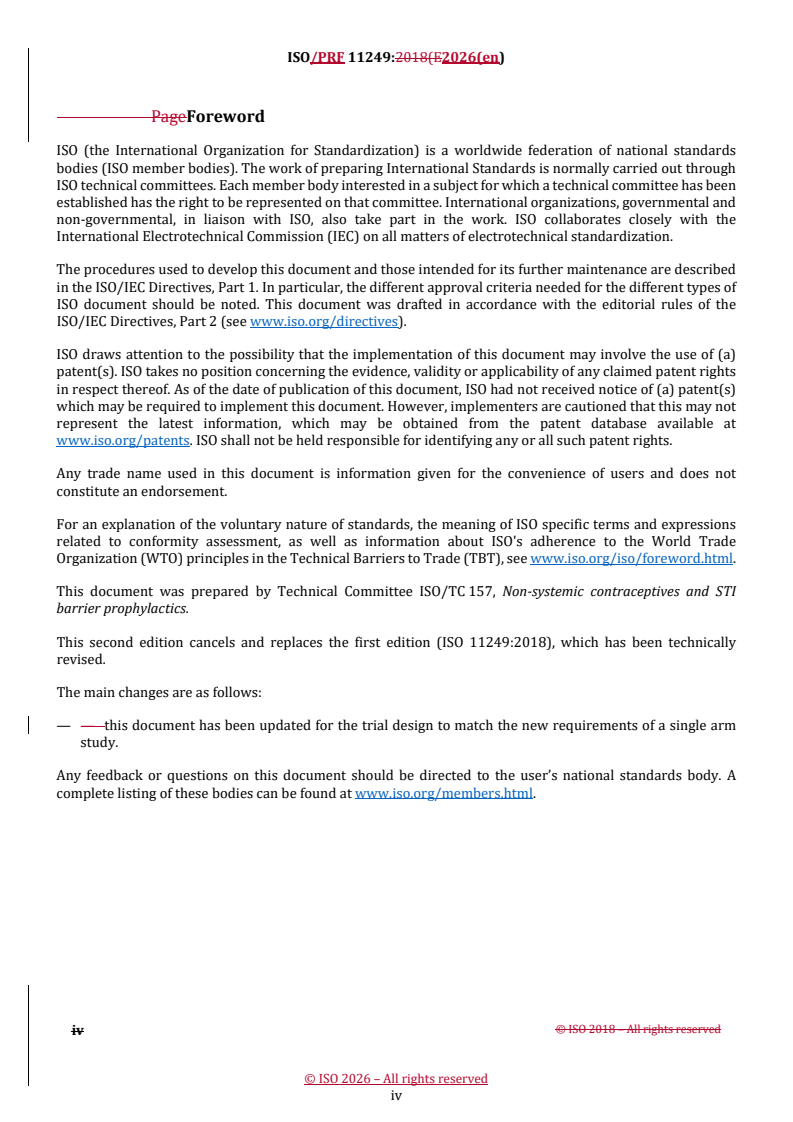
ISO/PRF 11249:2018(E2026(en)
PageForeword
ISO (the International Organization for Standardization) is a worldwide federation of national standards
bodies (ISO member bodies). The work of preparing International Standards is normally carried out through
ISO technical committees. Each member body interested in a subject for which a technical committee has been
established has the right to be represented on that committee. International organizations, governmental and
non-governmental, in liaison with ISO, also take part in the work. ISO collaborates closely with the
International Electrotechnical Commission (IEC) on all matters of electrotechnical standardization.
The procedures used to develop this document and those intended for its further maintenance are described
in the ISO/IEC Directives, Part 1. In particular, the different approval criteria needed for the different types of
ISO document should be noted. This document was drafted in accordance with the editorial rules of the
ISO/IEC Directives, Part 2 (see www.iso.org/directives).
ISO draws attention to the possibility that the implementation of this document may involve the use of (a)
patent(s). ISO takes no position concerning the evidence, validity or applicability of any claimed patent rights
in respect thereof. As of the date of publication of this document, ISO had not received notice of (a) patent(s)
which may be required to implement this document. However, implementers are cautioned that this may not
represent the latest information, which may be obtained from the patent database available at
www.iso.org/patents. ISO shall not be held responsible for identifying any or all such patent rights.
Any trade name used in this document is information given for the convenience of users and does not
constitute an endorsement.
For an explanation of the voluntary nature of standards, the meaning of ISO specific terms and expressions
related to conformity assessment, as well as information about ISO's adherence to the World Trade
Organization (WTO) principles in the Technical Barriers to Trade (TBT), see www.iso.org/iso/foreword.html.
This document was prepared by Technical Committee ISO/TC 157, Non-systemic contraceptives and STI
barrier prophylactics.
This second edition cancels and replaces the first edition (ISO 11249:2018), which has been technically
revised.
The main changes are as follows:
— — this document has been updated for the trial design to match the new requirements of a single arm
study.
Any feedback or questions on this document should be directed to the user’s national standards body. A
complete listing of these bodies can be found at www.iso.org/members.html.
iv
iv
ISO/DISPRF 11249:20252026(en)
Introduction
The clinical study guidance given in this document is intended to help in the design, execution, analysis, and
interpretation of clinical studies conducted in accordance with the requirements of ISO 7439.
Intrauterine devices (IUD) are highly effective at preventing pregnancy. A new device aims at maintaining or
improving the efficacy of intrauterine contraception and/or reducing the side effects associated with IUDs,
such as excessive menstrual bleeding. Trials evaluating new or modified IUDs should be conducted to the
highest standards, and this guidance will help those preparing for an IUD trial.
This document should be read in conjunction with ISO 14155.
It is based on the structure and content of a clinical investigation plan (CIP) as described in ISO 14155 to assist
in the writing of a CIP and includes sections of the CIP that are of special relevance to IUD trials.
This document also draws on the experience gained in preparing the Cochrane systematic review of trials of
copper-containing IUDs, which has been used to inform the updating of the WHO/UNFPA Specification for
TCu380A IUD.
Clinical studies are also subject to local regulations and, in most countries, might require prior approval from
the local regulatory body.
This document helps to ensure the scientific conduct of the clinical investigation and the credibility of the
clinical investigation results, and to assist sponsors, monitors, investigators, ethics committees, or regulatory
authorities.
.
v
DRAFT International Standard ISO/DIS 11249:2025(en)
Copper-bearing intrauterine contraceptive devices — Guidance on the
design, execution, analysis and interpretation of clinical studies
IMPORTANT — Persons designing, running, and analysing clinical studies of new IUDs shall be familiar
with all relevant standards for research designed to protect the rights, safety and well-being of human
participants.
1 Scope
This document provides guidance on the design and conduct of clinical studies to determine the performance
characteristics of new intrauterine devices. It also provides advice on the analysis of data when the study is
completed, as well as interpretation of these results by manufacturers, researchers and regulatory bodies.
Certain clinical trial concerns are not addressed in this document, including participant compensation,
confidentiality of participants and their records, use of local ethics committees, etc. These and many other
clinical trial design issues are covered in great detail in ISO 14155.
2 Normative references
There are no normative references in this document.
3 Terms and definitions
For the purposes of this document, the following terms and definitions apply.
ISO and IEC maintain terminologicalterminology databases for use in standardization at the following
addresses:
— — IEC Electropedia: available at
— — ISO Online browsing platform: available at https://www.iso.org/obp
3.1
— IEC Electropedia: available at https://www.electropedia.org/
3.1
adverse device effect
ADE
adverse event (3.2(3.2)) related to the use of a medical device (3.21(3.26))
Note 1 to entry: This includes any adverse event resulting from insufficiencies or inadequacies in the instructions for use,
the deployment, the implantation, the installation, the operation, or any malfunction (3.20(3.25)) of the medical device.
Note 2 to entry: This includes any event that is a result of a use error or intentional misuse.
ISO/PRF 11249:2018(E2026(en)
3.2 3.2
adverse event
AE
any untoward medical occurrence, unintended disease or injury or any untoward clinical signs (including an
abnormal laboratory finding) in participants (3.29(3.34),), users or other persons whether or not related to
the investigational device (3.24(3.24))
Note 1 to entry: This includes events related to the investigational device.
Note 2 to entry: This includes events related to the procedures involved.
Note 3 to entry: For users or other persons, this is restricted to events related to the investigational device.
3.3 3.3
case report form
CRF
set of printed, optical or electronic documents for each participant (3.29(3.34)) on which information to be
reported to the sponsor (3.28(3.33)) is recorded as required by the CIP
Note 1 to entry: There may be more than one case report form per participant.
3.4 3.4
clinical investigation
systematic investigation in or on one or more human participants (3.29(3.34),), undertaken to assess the
safety and/or efficacy of a medical device (3.21(3.26))
Note 1 to entry: “Clinical trial” or “clinical study” are synonymous with “clinical investigation”.
3.5 3.5
clinical investigation plan
CIP
document that states the rationale, objectives (3.28(3.28),), design and proposed analysis, methodology,
monitoring, conduct and record-keeping of the clinical investigation (3.4(3.5))
Note 1 to entry: The term “protocol” is synonymous to “CIP”. However, protocol has many different meanings, some not
related to clinical investigations, and these can differ from country to country. Therefore, the term CIP is used in this
document.
3.6 3.6
clinical performance
behaviour of a medical device (3.21(3.26)) and/or the response of the participant (3.29(3.34)) to that medical
device in relation to its intended use when correctly applied to appropriate participants
3.7 3.7
deviation
instance(s) of failure to follow, intentionally or unintentionally, the requirements of the CIP
3.8 3.8
ectopic pregnancy
pregnancy located outside the uterine cavity
ISO/DISPRF 11249:20252026(en)
3.9 3.9
primary end point
indicator to assess the primary hypothesis (3.13(3.15)) of a clinical investigation (3.4(3.5))
Note 1 to entry: There might be more than one primary end point.
3.10 3.10
secondary end point
indicator to assess the secondary hypotheses (3.15(3.15)) of a clinical investigation (3.5(3.5))
Note 1 to entry: There might be more than one secondary end point.
3.11 3.11
ethics committee
EC
independent body whose responsibility is to review clinical investigations (3.4(3.5),), protocols and
procedures in order to protect the rights, safety and well-being of human participants (3.29(3.34))
participating in a clinical investigation
Note 1 to entry: For the purposes of this document, “ethics committee” is synonymous with “research ethics committee”,
“independent ethics committee”, or “institutional review board”. The regulatory requirements pertaining to ethics
committees or similar institutions can differ by country or region.
3.12 3.12
expulsion
inadvertent movement of the IUD into or from the vagina, including partial expulsion, requiring removal of
the IUD from the cervix
3.13 3.13
hypothesis
testable biostatistical statement, derived from the study objective (3.22(3.27),), for evaluating the
investigational device (3.19(3.24)) safety and/or performance
Note 1 to entry: The hypothesis is used to design the clinical investigation (3.5(3.5)) and stipulates the statistic(s) used
to accept or reject the results of the clinical investigation.
Note 2 to entry: The primary hypothesis is the determinant of the investigational device safety and/or performance
parameters and is usually used to calculate the sample size. Secondary hypotheses concerning other points of interest
can also be evaluated.
3.14 3.14
informed consent
process by which an individual is asked to voluntarily participate in a clinical investigation (3.4(3.5)) having
been provided with information about the clinical investigation
Note 1 to entry: Informed consent is documented by means of a written, signed and dated informed consent form.
3.15 3.15
intrauterine pregnancy
normally sited pregnancy within the uterine cavity
3.16 3.16
intrauterine contraceptive device
IUD
device placed in the uterine cavity for the purpose of preventing pregnancy
Note 1 to entry: The abbreviation IUCD may be used in some publications.
ISO/PRF 11249:2018(E2026(en)
3.17 3.17
investigator
any individual member of the investigation site (3.18(3.23)) team designated and supervised by the principal
investigator at an investigation site to perform critical clinical investigation-related procedures and/or to
make important clinical investigation-related decisions
Note 1 to entry: An individual member of the investigation site team can also be called “sub-investigator” or “co-
investigator”.
3.18 3.18
investigation site
institution or site where the clinical investigation (3.4(3.5)) is carried out
Note 1 to entry: For the purpose of this document, “investigation site” is synonymous with “investigation centre”.
3.19 3.19
investigational device
medical device (3.21(3.26)) being assessedsassessed for safety and performance in a clinical investigation
(3.4(3.5))
Note 1 to entry: This includes marketed medical devices that are being evaluated for new intended uses, new
populations, new materials or design changes.
3.20 3.20
malfunction
failure of a device to perform in accordance with its intended purpose when used in accordance with the
instructions for use or CIP
3.21 3.21
medical device
any instrument, apparatus, implement, machine, appliance, implant, software, material, or other similar or
related article intended by the manufacturer to be used, alone or in combination, for human beings for one or
more of the specific purpose(s) of
— — diagnosis, prevention, monitoring, treatment or alleviation of disease,
— — diagnosis, monitoring, treatment, alleviation of or compensation for an injury,
— — investigation, replacement, modification, or support of the anatomy or of a physiological process,
— — supporting or sustaining life,
— — control of conception,
— — disinfection of medical devices, and
— — providing information for medical purposes by means of in vitro examination of specimens derived
from the human body
ISO/DISPRF 11249:20252026(en)
and which does not achieve its primary intended action in or on the human body by pharmacological,
immunological or metabolic means, but which may be assisted in its intended function by such means
3.22 3.22
objective
major purpose(s) for conducting the clinical investigation (3.4(3.5))
3.23 3.23
perforation
puncture of the uterus, as may be caused by a uterine sound or insertion tube or by an intrauterine
contraceptive device (3.16(3.20))
3.24 3.24
point of enrolment
date at which, following recruitment (3.25(3.30)) and signing and dating the informed consent form, a
participant (3.29(3.34)) is enrolled in a study, often also the point when participants receive the
investigational product
3.25 3.25
recruitment
active efforts to identify participants (3.29(3.34)) who might be suitable for enrolment into the clinical
investigation (3.4(3.5))
3.26 3.26
serious adverse device effect
SADE
adverse device effect (3.1(3.1)) that has resulted in any of the consequences characteristic of a serious adverse
event (3.27(3.32))
3.27 3.27
serious adverse event
SAE
adverse event (3.2(3.2)) that
a) a) led to a death,
b) b) led to a serious deterioration in the health of the participant (3.29(3.34)) that
— — resulted in a life-threatening illness or injury,
— — resulted in a permanent impairment of a body structure or a body function,
— — required in-patient hospitalization or prolongation of existing hospitalization,
— — resulted in medical or surgical intervention to prevent life threatening illness or injury or
permanent impairment to a body structure or a body function, or
c) c) led to foetal distress, foetal death or a congenital abnormality or birth defect
Note 1 to entry: A planned hospitalization for pre-existing condition, or a procedure required by the CIP, without a
serious deterioration in health, is not considered to be a serious adverse event.
3.28 3.28
sponsor
individual or organization taking responsibility and liability for the initiation and/or implementation of a
clinical investigation (3.4(3.5))
ISO/PRF 11249:2018(E2026(en)
Note 1 to entry: When an investigator (3.17(3.21)) initiates, implements and takes full responsibility for the clinical
investigation, the investigator also assumes the role of the sponsor and is identified as the sponsor-investigator.
3.29 3.29
participant
individual who participates in a clinical investigation (3.4(3.5))
Note 1 to entry: A participant can be either a healthy volunteer or a patient.
3.30 3.30
thread
attachment to an IUD for the purpose of verifying the presence of and enabling the removal of the IUD
Note 1 to entry: The thread is intended to lie in the cervical canal and the vagina when the body of the device is placed
correctly in the uterine cavity.
Note 2 to entry: The thread is often referred to as a string.
3.31 3.31
unanticipated serious adverse device effect
USADE
serious adverse device effect (3.26(3.31)) which by its nature, incidence, severity or outcome has not been
identified in the current version of the risk analysis report
Note 1 to entry: There should be a distinction in the report between anticipated and unanticipated serious adverse device
effects.
4 Planning an IUD trial — Good clinical practice
ISO 14155 addresses good clinical practice for the design, conduct, recording and reporting of clinical
investigations carried out in human participants to assess the safety or performance of medical devices for
regulatory purposes.
The principles set forth in ISO 14155 should apply to all trials conducted on IUDs. ISO 14155 specifies general
requirements intended to protect the rights, safety and well-being of human participants and ensure the
scientific conduct of the clinical investigation and the credibility of the results. It defines the responsibilities
of the sponsor and principal investigator, and assist sponsors, investigators, ethics committees, regulatory
authorities and other bodies involved in the conformity assessment of medical devices.
5 Ethics
5.1 General
Clinical investigations should be conducted in accordance with the ethical principles that have their origin in
[24] [24]
the Declaration of Helsinki . . This protects the rights, safety and well-being of clinical investigation
participants, which are the most important considerations and are required by the Declaration to prevail over
interests of science and society. This should be understood, observed, and applied at every step in the clinical
investigation.
ISO/DISPRF 11249:20252026(en)
5.2 Ethics of IUD trials
Trials of a new IUD are justified if they are likely to demonstrate improved performance, whether by
improving efficacy, reducing side-effects or improved bleeding pattern, or potentially reducing costs when
compared to standard IUDs, such as TCu380A.
5.3 Informed consent
5.3.1 General
Informed consent should be obtained and documented before any procedure specific to the clinical
investigation is applied to a participant. The informed consent form consists of an information form and an
informed consent signature form. Documentation may occur by physically signing the consent signature form
or by electronic signature.
5.3.2 Process of obtaining informed consent
The procedures specified in ISO 14155 should be followed when obtaining informed consent.
5.3.3 Information to be provided to the participant
The procedures relating to information to be provided to the participant specified in ISO 14155 should be
followed. The risks relating to pregnancy should be clearly pointed out.
The procedures specified in ISO 14155 should be followed when obtaining informed consent signature. The
participant’s signature should be obtained before enrolling into the study and an IUD is inserted.
6 Identification and description of the investigational device
The clinical investigation plan (CIP) should contain:
a) a) a summary description of the intrauterine device and its intended purpose;
b) b) the manufacturer of the device;
c) c) the model or type name and/or number and accessories, if any, to permit full identification;
d) d) a description as to how traceability will be achieved during and after the clinical investigation,
for example, assignment of lot numbers, batch numbers, or serial numbers;
e) e) the intended purpose of the intrauterine device in the proposed clinical investigation. If
purposes other than contraception are intended, these should be described;
f) f) the populations and indications for which the intrauterine device is intended when in general
use;
g) g) a description of the intrauterine device including any materials that will be in contact with
tissues or body fluids;
h) h) instructions for insertion and use of the IUD including any necessary storage and handling
requirements, preparation for use and any precautions to be taken after use, e.g. disposal;
General use requirements should be specified in the CIP. The precise wording of the instructions should
be documented separately and submitted to the ethics committee with the CIP.
ISO/PRF 11249:2018(E2026(en)
i) i) a summary of necessary training and experience (both for participants and for investigators)
needed for the use of the IUD;
j) j) a description of the necessary medical or surgical procedures involved in the insertion, use,
and removal of the investigational device.
7 Preliminary investigations and justification for the design of the clinical
investigation
7.1 Literature review
Although the clinical requirements for copper bearing IUDs are specified in ISO 7439, it is nevertheless
recommended that a literature review is undertaken during the planning stage for any clinical trials on IUDs.
The CIP should contain:
a) a) the conclusions of a critical review of the relevant scientific literature and/or unpublished data
and reports;
b) b) a list of the literature reviewed.
The conclusions from this literature review may impact on the design of the proposed clinical investigations.
The review should be relevant to the intended purpose of the IUD and the proposed method of use. It should
also help in the identification of relevant end-points and confounding factors that should be considered.
7.2 Preclinical testing
The CIP should contain a summary of the relevant preclinical testing that has been performed on the IUD to
justify its use in human participants, together with an evaluation of the results of such testing.
7.3 Previous clinical experience
The CIP should contain:
a) a) a summary of the results from previous clinical investigations and clinical usage, if any, that
are relevant to the proposed clinical investigation;
b) b) relevant experience, if any, with the IUD, or medical devices with similar features, including
that relating to other indications for use of the IUD;
c) c) an assessment of adverse device effects and any history of modification or recall.
7.4 Investigational device and clinical investigation risks and benefits
The CIP should contain:
a) a) anticipated clinical benefits;
b) b) residual risks associated with the IUD, as identified in the risk analysis report;
ISO/DISPRF 11249:20252026(en)
c) c) risks associated with participation in the clinical investigation;
d) d) anticipated adverse device effects;
e) e) possible interactions with concomitant medical treatments;
f) f) steps that will be taken to control or mitigate the risks;
g) g) risk/benefit rationale.
NOTE The risk management process, which includes risk analysis, risk/benefit assessment and risk control, is
described in ISO 14971.
8 Objectives and hypotheses of the clinical investigation
The CIP should contain:
a) a) Claims and intended clinical performance of the IUD that are toshould be verified
ISO 7439 describes three requirements that the IUD will be judged against:
1) 1) the upper limit of the 95 % two-sided confidence interval for the one-year pregnancy rate
computed using life table methods (ISO 7439 specifies ≤ 2 %); A one-year pregnancy rate for each
subsequent year of the study, calculated using the same methodology and with the same threshold
value, is also specified in ISO 7439.
2) 2) one-year expulsion rates computed using life table methods (ISO 7439 specifies ≤ 10 %); A
one-year expulsion rate for each subsequent year of the study, calculated using the same methodology
and with the same threshold value, is also specified in ISO 7439.
3) 3) one-year discontinuation rates for clinical reasons computed using life table methods
(ISO 7439 specifies ≤ 35 %); A one-year discontinuation rate for each subsequent year of the study,
calculated using the same methodology and with the same threshold value, is also specified in ISO
7439.
NOTE 1 Regulatory bodies from some countries can require analysis of the clinical data in more than one way in
order to evaluate outcomes of interest in different ways. For instance, besides the requirement for life table analysis,
referenced above, a regulatory body can require a primary analysis applying the Kaplan Meier statistic. The
regulatory body can additionally ask that the cumulative Pearl Index be calculated. See References [16][16], [17]
,[17]and[18] [18] for additional information on the use of these various statistics.
NOTE 2 Typically, the life table analysis is used to evaluate each individual year of use, as well as evaluating the
full duration of use covered by the entire study.
NOTE 3 There can be subsets from the data analysis where the limits cited above can be exceeded.
b) b) Risks and anticipated adverse device effects that are toshould be assessed
See 9.19.1 c).
NOTE 4 When analysing the outcome of the study, it is useful to report results for specific subsets of the
population such as nulliparous participants.
When calculating discontinuation rates, the discontinuations should be device related only.
ISO/PRF 11249:2018(E2026(en)
9 Design of the clinical investigation
9.1 General
The scientific integrity of, and the validity of, the data from the clinical investigation depend substantially on
its design.
The CIP should contain the following.
a) a) A description of the type of clinical investigation to be performed (e.g. comparative, blinded,
parallel design, without a comparator group) with rationale for the choice.
ISO 7439 requires that contraceptive efficacy rates should be determined in a trial with no comparator
device.
b) b) A description of the measures to be taken to minimize or avoid bias. Specifically, as far as is
practical, it is recommended that the type of device should be masked to the participants, those providing
the care at follow-up, and those doing the analysis.
NOTE Depending on the study design, masking is not necessary.
c) c) The primary and secondary end points
1) 1) The primary end points for IUD studies are:
i) i) the upper 95 % confidence level, two-sided confidence interval for the one-year pregnancy;
...
Questions, Comments and Discussion
Ask us and Technical Secretary will try to provide an answer. You can facilitate discussion about the standard in here.
Loading comments...