


ISO/IEC 24789-1:2024
(Main)Identification cards — Card service life — Part 1: Application profiles and requirements
Identification cards — Card service life — Part 1: Application profiles and requirements
This document comprises a methodology for determining a test plan to simulate a card's service life. The methodology defines two parameters of card service life: the expected card service life in years and the average number of uses per day. This document and ISO/IEC 24789-2, together along with ISO/IEC 10373-1 describe the evaluation methods to be used and their criteria. This document was originally developed for ID-1 cards conforming to ISO/IEC 7810 but can be useful in whole or in part for other types and form factors.
Cartes d'identification — Durée de vie des cartes — Partie 1: Profils d'application et exigences
General Information
Relations
Standards Content (Sample)
International
Standard
ISO/IEC 24789-1
Second edition
Identification cards — Card service
2024-01
life —
Part 1:
Application profiles and
requirements
Cartes d'identification — Durée de vie des cartes —
Partie 1: Profils d'application et exigences
Reference number
© ISO/IEC 2024
All rights reserved. Unless otherwise specified, or required in the context of its implementation, no part of this publication may
be reproduced or utilized otherwise in any form or by any means, electronic or mechanical, including photocopying, or posting on
the internet or an intranet, without prior written permission. Permission can be requested from either ISO at the address below
or ISO’s member body in the country of the requester.
ISO copyright office
CP 401 • Ch. de Blandonnet 8
CH-1214 Vernier, Geneva
Phone: +41 22 749 01 11
Email: copyright@iso.org
Website: www.iso.org
Published in Switzerland
© ISO/IEC 2024 – All rights reserved
ii
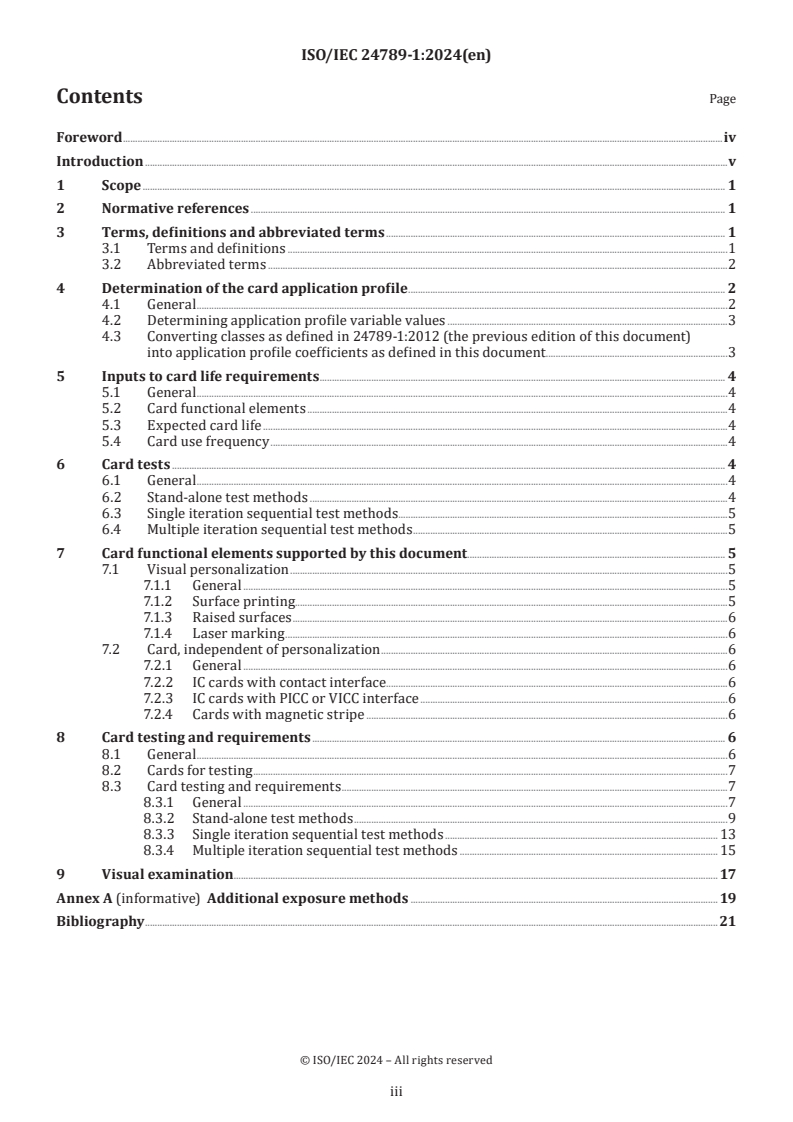
Contents Page
Foreword .iv
Introduction .v
1 Scope . 1
2 Normative references . 1
3 Terms, definitions and abbreviated terms . 1
3.1 Terms and definitions .1
3.2 Abbreviated terms .2
4 Determination of the card application profile . 2
4.1 General .2
4.2 Determining application profile variable values .3
4.3 Converting classes as defined in 24789-1:2012 (the previous edition of this document)
into application profile coefficients as defined in this document .3
5 Inputs to card life requirements . 4
5.1 General .4
5.2 Card functional elements .4
5.3 Expected card life .4
5.4 Card use frequency .4
6 Card tests . 4
6.1 General .4
6.2 Stand-alone test methods .4
6.3 Single iteration sequential test methods .5
6.4 Multiple iteration sequential test methods .5
7 Card functional elements supported by this document .5
7.1 Visual personalization .5
7.1.1 General .5
7.1.2 Surface printing.5
7.1.3 Raised surfaces .6
7.1.4 Laser marking .6
7.2 Card, independent of personalization .6
7.2.1 General .6
7.2.2 IC cards with contact interface.6
7.2.3 IC cards with PICC or VICC interface .6
7.2.4 Cards with magnetic stripe .6
8 Card testing and requirements .6
8.1 General .6
8.2 Cards for testing .7
8.3 Card testing and requirements .7
8.3.1 General .7
8.3.2 Stand-alone test methods .9
8.3.3 Single iteration sequential test methods . 13
8.3.4 Multiple iteration sequential test methods . 15
9 Visual examination. 17
Annex A (informative) Additional exposure methods . 19
Bibliography .21
© ISO/IEC 2024 – All rights reserved
iii
Foreword
ISO (the International Organization for Standardization) and IEC (the International Electrotechnical
Commission) form the specialized system for worldwide standardization. National bodies that are
members of ISO or IEC participate in the development of International Standards through technical
committees established by the respective organization to deal with particular fields of technical activity.
ISO and IEC technical committees collaborate in fields of mutual interest. Other international organizations,
governmental and non-governmental, in liaison with ISO and IEC, also take part in the work.
The procedures used to develop this document and those intended for its further maintenance are described
in the ISO/IEC Directives, Part 1. In particular, the different approval criteria needed for the different types
of document should be noted. This document was drafted in accordance with the editorial rules of the ISO/
IEC Directives, Part 2 (see www.iso.org/directives or www.iec.ch/members_experts/refdocs).
ISO draws attention to the possibility that the implementation of this document may involve the use of (a)
patent(s). ISO takes no position concerning the evidence, validity or applicability of any claimed patent
rights in respect thereof. As of the date of publication of this document, ISO had not received notice of (a)
patent(s) which may be required to implement this document. However, implementers are cautioned that
this may not represent the latest information, which may be obtained from the patent database available at
www.iso.org/patents. ISO shall not be held responsible for identifying any or all such patent rights.
Any trade name used in this document is information given for the convenience of users and does not
constitute an endorsement.
For an explanation of the voluntary nature of standards, the meaning of ISO specific terms and expressions
related to conformity assessment, as well as information about ISO's adherence to the World Trade
Organization (WTO) principles in the Technical Barriers to Trade (TBT) see www.iso.org/iso/foreword.html.
In the IEC, see www.iec.ch/understanding-standards.
This document was prepared by Joint Technical Committee ISO/IEC JTC 1, Information technology,
Subcommittee SC 17, Cards and security devices for personal identification.
This second edition cancels and replaces the first edition (ISO/IEC 24789-1:2012), which has been technically
revised.
The main changes are as follows:
— Test parameters for most methods to be included in the test plan are determined from card functional
elements, the number of uses per day and the expected lifetime in years.
— Test sequences in the test plan have been shortened, a maximum of three methods occur in a sequence
now.
— Test parameter calculations are only based on the number of uses per day and the expected lifetime in
years; the complex calculations of environmental, storage and reader factors have been removed.
A list of all parts in the ISO/IEC 24789 series can be found on the ISO and IEC websites.
Any feedback or questions on this document should be directed to the user’s national standards
body. A complete listing of these bodies can be found at www.iso.org/members.html and
www.iec.ch/national-committees.
© ISO/IEC 2024 – All rights reserved
iv
Introduction
This document defines a methodology for determining a test plan to simulate a card's service life.
Such a test plan consists of a set of stress exposure methods, each simulating specific types of environmental
or mechanical stresses. Most of the stress exposure methods are followed by one or more evaluation
methods to determine to which extent the card has survived exposure to the stress exposure method, while
a few have the evaluation embedded in the stress test method.
Although the equipment and parts of the procedures of certain ISO/IEC 10373-1 test methods are referenced
for employment in the simulation of aging or usage in the ISO/IEC 24789 series, such references are clearly
distinguished from the normal use of ISO/IEC 10373-1. In normal use, these ISO/IEC 10373-1 test methods
are applied to determine conformity to ISO/IEC 7810 and do not explicitly address application-specific
requirements for card service life.
Test methodologies employed by various card industry experts are included in this document. They are
based upon field experience for specific applications and card functional elements. While it is believed that
the field experiences can be generally applied, there is limited field/laboratory correlation data to confirm
this.
Prior to publication of this document, industry experts were given the opportunity to test cards used
successfully in various applications for conformity to this document. There were no instances of participating
card industry experts reporting successfully implemented functional elements failing the criteria in this
document.
While this document attempts to accurately predict card service life, it is possible that some card
constructions can be in conformity with this document while having field issues. It is also possible that some
card constructions will not be in conformity with this document while having adequate field performance.
In either of these cases, the reader of this document is advised to contact their country’s national standards
body (see the Foreword) and share this information so that future editions of this document can be revised
accordingly.
NOTE For the convenience of certain users, non-SI equivalents are given for some quantity values where these are
in common use in the ID card industry. These equivalents appear in parentheses and are for information only.
© ISO/IEC 2024 – All rights reserved
v
International Standard ISO/IEC 24789-1:2024(en)
Identification cards — Card service life —
Part 1:
Application profiles and requirements
1 Scope
This document comprises a methodology for determining a test plan to simulate a card's service life. The
methodology defines two parameters of card service life: the expected card service life in years and the
average number of uses per day.
This document and ISO/IEC 24789-2, together along with ISO/IEC 10373-1 describe the evaluation methods
to be used and their criteria.
This document was originally developed for ID-1 cards conforming to ISO/IEC 7810 but can be useful in
whole or in part for other types and form factors.
2 Normative references
The following documents are referred to in the text in such a way that some or all of their content constitutes
requirements of this document. For dated references, only the edition cited applies. For undated references,
the latest edition of the referenced document (including any amendments) applies.
ISO/IEC 7810, Identification cards — Physical characteristics
ISO/IEC 10373-1, Cards and security devices for personal identification — Test methods — Part 1: General
characteristics
ISO/IEC 24789-2, Identification cards — Card service life — Part 2: Methods of evaluation
3 Terms, definitions and abbreviated terms
3.1 Terms and definitions
For the purposes of this document, the terms and definitions given in ISO/IEC 7810, ISO/IEC 10373-1,
ISO/IEC 24789-2 and the following apply.
ISO and IEC maintain terminology databases for use in standardization at the following addresses:
— ISO Online browsing platform: available at https:// www .iso .org/ obp
— IEC Electropedia: available at https:// www .electropedia .org/
3.1.1
card service life
period for which a card retains the set of characteristics specified for its application under the conditions of
use specified for that application from the time it is issued to the card holder
3.1.2
application profile
set of parameters that, in total, defines the conditions of use specified for an application
© ISO/IEC 2024 – All rights reserved
3.1.3
integrated circuit module width
ICM width
maximum dimension of an ICM's exposed surface, measured parallel to a long edge of the card
3.1.4
integrated circuit module height
ICM height
maximum dimension of an ICM's exposed surface, measured parallel to a short edge of the card
3.1.5
rounded
process of replacing a number with another number in which the last digits have been adjusted up or down
3.1.6
rounded-up
process of replacing a number with another number in which the replacement number is chosen to be either
an exact multiple of a convenient test variable or the next higher multiple of the test variable
3.1.7
visual personalization
information on a card that is visible by eye with ambient and specialized lighting, including protective and
security coatings applied on top of the personalized card
3.1.8
card, independent of personalization
card, with or without personalization
3.1.9
patch
cut film, smaller than the ID-1 card face that is applied over parts of the card surface
3.2 Abbreviated terms
ICM integrated circuit(s) module
PICC proximity integrated circuit card
RH relative humidity
VICC vicinity integrated circuit card
4 Determination of the card application profile
4.1 General
During its service life a card is exposed to a broad range of influences that can degrade and weaken the card
until it is finally no longer fit for purpose.
Examples for such influences are:
— heat and humidity, for example causing breakdown of material within the card;
— temperature changes, for example causing separation of previously well adhering components inside the
card;
— bending, for example causing breakdown of the card material, or causing mechanical failure of an
electrical connection inside the card;
— friction, for example causing text written on the card’s surface to become illegible.
© ISO/IEC 2024 – All rights reserved
Various test methods have been developed to simulate the impact of certain influences onto the card, such
as:
— temperature and humidity storage test, to simulate the impact of heat and humidity;
— temperature cycling to simulate the impact of temperature changes;
— dynamic bending stress test, to simulate the impact of a certain type of bending applied to the card;
— surface wear tests, to simulate the effects of friction on the card’s surface.
Additional informative methods have been documented in the informative Annex A, but are not required to
be included in the test plan.
This document provides a systematic approach to determine a test plan containing a range of test methods
and the related test parameters.
The following necessary indicators shall be determined:
— the functional elements the card contains;
— the application profile variables (according to 4.2).
By applying the rules defined in this document, a test plan based on the above indicators is determined.
4.2 Determining application profile variable values
The usage frequency and the card lifetime in the field have a strong impact on the cumulative stresses the
card will have to withstand. These parameters dictate testing and requirements for determining conformity
to this document. The values for the two variables shall be determined as follows:
— A, the expected card service life in years (whole number, at least 1);
— U, the average number of uses per day (greater than 0).
To reduce the number of combinations of U values resulting in slightly different test plans, the use of one of
the values in Table 1 for U is recommended.
Table 1 — Recommended values for U
Recommended values for U (uses per day)
0,05 0,1 0,2 0,5 1 2 5 10
4.3 Converting classes as defined in 24789-1:2012 (the previous edition of this document)
into application profile coefficients as defined in this document
Table 2 gives approximate values for the age coefficient A and the usage coefficient U as they are used in this
version of ISO/IEC 24789-1, relative to aging class and usage class values as they were used in 24789-1:2012.
Table 2 is not an exact mathematical correlation, but an estimated equivalence. The user of this document
should not assume that A and U derived from Table 2 are automatically representative for their application.
© ISO/IEC 2024 – All rights reserved
Table 2 — Approximate correlation of ISO/IEC 24789-1:2012 (the previous edition of this document)
classes to this document
Aging Usage
ISO/IEC 24789-1:2012 ISO/IEC 24789-1:2012
(the previous edition of This document (the previous edition of This document
this document) this document)
A, the expected card ser- U, the average number of
vice life in years uses per day
Aging class Usage class
(at least 1) (greater than 0)
0 1 A 0,1
1 4 B 0,5
2 7 C 2
3 10 D 10
5 Inputs to card life requirements
5.1 General
Card industry experts believe that card service life testing and requirements must be based upon three key
factors: functional elements on cards, expected card life and card use frequency.
5.2 Card functional elements
Card functional elements dictate what test methods need to be performed on cards. The testing can be
individual test methods, or a series of tests performed sequentially.
5.3 Expected card life
The time a card is expected to be functional after issuance is an obvious factor in determining card
service life. In the case of this document, the expected card life will be used to determine how many times
a test sequence is performed before running conformity testing. It can also be used to determine either
performance metrics or exposure severity of individual test methods, or both.
5.4 Card use frequency
Card use frequency is used to determine test method variables, such as accelerated aging test exposure
times, number of dynamic bendings and other test parameters.
6 Card tests
6.1 General
Cards shall be evaluated for conformity by running test methods that are required for the chosen card
functional elements as per Clause 8 Card testing and requirements. The test methods can be stand-alone,
single iteration sequential or multiple iteration sequential test methods.
6.2 Stand-alone test methods
Stand-alone test methods shall be run on cards using tests from ISO/IEC 10373-1 and ISO/IEC 24789-2.
Variable test parameters shall be used when determined by this document. These parameters are based
upon the expected card life and card use frequency.
© ISO/IEC 2024 – All rights reserved
6.3 Single iteration sequential test methods
Single iteration sequential test methods shall be run using a series of tests from either ISO/IEC 10373-1
or ISO/IEC 24789-2, or both. Variable test parameters can be included in the test conditions and will be a
function of either expected card life or card use frequency, or both. The test sequence shall be run once.
The sequential test method tables are structured such that the testing is done sequentially from top to
bottom of the tables using the parameters listed.
6.4 Multiple iteration sequential test methods
Multiple iteration sequential test methods shall be run using a series of tests from either ISO/IEC 10373-1
or ISO/IEC 24789-2, or both. Variable test parameters can be included in the test conditions and will be a
function of either expected card life or card use frequency, or both.
The number test sequence iterations (i) that shall be run will be based upon expected card life, A (years). In
the case where the test sequences are repeated the following applies:
Number of Iterations, i = 1 + A/3, rounded to the nearest whole number. The number of test iterations
shall be 1 minimum and 4 maximum.
Table 3 — Number of test sequence iterations vs expected card life
Expected card life Number of test
sequence iterations, i
(years)
1 1
2 to 4 2
5 to 7 3
8 and greater 4
The sequential test method tables are structured such that the testing is done sequentially from top to
bottom of the tables using the parameters listed. If the number of test sequence iterations is greater than
1, then the sequential tests are performed again until the number of sequence iterations is equal to the
calculated value.
7 Card functional elements supported by this document
7.1 Visual personalization
7.1.1 General
Information applied to cards using various technologies shall be durable enough so that all the information
is functional for the intended card use during its life.
7.1.2 Surface printing
Cardholder data can be applied by surface printing. Surface printing also includes layers added after
personalization to improve either durability or security, or both.
Surface printing includes, but is not limited to, dye diffusion thermal transfer, resin thermal transfer and ink
jet. The printing can be applied directly to either the card surface or by transferring a printed media to the
card surface, or both.
Protective and security layers on top of the personalization include, but are not limited to, heat transfer
films, ink jet coatings or patch laminates. These elements can include security features designed to dissuade
efforts to either modify card information or to counterfeit the cards, or both.
© ISO/IEC 2024 – All rights reserved
7.1.3 Raised surfaces
Cardholder data can be added to cards by technologies that cause the personalization to be from 0,26 mm
to 0,48 mm above the adjacent card surface. Personalization resulting in raised surfaces include, but are not
limited to, embossing (with or without topping foil), tactile identification mark (TIM) and human readable
or machine-readable raised characters as given in ISO/IEC 7811-1.
7.1.4 Laser marking
Cardholder data can be added to cards by laser marking. The data is typically embedded below the card
surface. Laser marking can also cause minor tactile distortion of the card surface that is typically less
than that for raised surfaces. If laser marking is greater than 0,26 mm above the adjacent surface, then the
personalization shall be considered a raised surface and shall be tested as such.
7.2 Card, independent of personalization
7.2.1 General
The cards, independent of personalization can contain the following functional elements.
7.2.2 IC cards with contact interface
IC cards with contact interface are cards with a contact chip that is positioned and with the electrical
functions given in the ISO/IEC 7816 series.
7.2.3 IC cards with PICC or VICC interface
IC cards with PICC or VICC interface are cards that have contactless chip and antenna positioned according to
antenna class and uses of the electrical functions as given in the ISO/IEC 14443 series and the ISO/IEC 15693
series.
7.2.4 Cards with magnetic stripe
Cards with magnetic stripe are cards where cardholder data can be added via encoding of magnetic stripes.
8 Card testing and requirements
8.1 General
Card functional elements dictate what tests are to be performed for conformity to this document. Expected
card life and card use frequency dictates the severity of the tests and the number of test sequences, when
applicable.
Tables 4 to 18 have five columns:
— Standard: this column references the standard that contains the test method.
— Test conditions:
— This column specifies the variable run conditions that are to be used when performing the test.
...
Questions, Comments and Discussion
Ask us and Technical Secretary will try to provide an answer. You can facilitate discussion about the standard in here.
Loading comments...