


ISO 7211-2
(Main)Textiles — Methods for analysis of woven fabrics construction — Part 2: Determination of number of threads per unit length
Textiles — Methods for analysis of woven fabrics construction — Part 2: Determination of number of threads per unit length
Three methods of determining the number of threads per centimetre are included, any of which may be used, the choice depending on the character of the fabric. The principles are as follows: Method A: A section of fabric of dimension specified is dissected and the number of threads counted. The treads that are to be counted are preferably short, 1 or 2 cm being suitable. Method B: the number of threads visible within the aperture of a defined counting glass is determined. Method C: the number of threads per centimetre of the fabric is determined with the aid of a traversing thread counter.
Textiles — Méthodes d'analyse de la construction des tissus — Partie 2: Détermination du nombre de fils par unité de longueur
General Information
Relations
Buy Standard
Standards Content (Sample)
FINAL DRAFT
International
Standard
ISO/FDIS 7211-2
ISO/TC 38/SC 24
Textiles — Methods for analysis of
Secretariat: AFNOR
woven fabrics construction —
Voting begins on:
2024-06-07
Part 2:
Determination of number of threads
Voting terminates on:
2024-08-02
per unit length
Textiles — Méthodes d'analyse de la construction des tissus —
Partie 2: Détermination du nombre de fils par unité de longueur
RECIPIENTS OF THIS DRAFT ARE INVITED TO SUBMIT,
WITH THEIR COMMENTS, NOTIFICATION OF ANY
RELEVANT PATENT RIGHTS OF WHICH THEY ARE AWARE
AND TO PROVIDE SUPPOR TING DOCUMENTATION.
IN ADDITION TO THEIR EVALUATION AS
BEING ACCEPTABLE FOR INDUSTRIAL, TECHNO-
ISO/CEN PARALLEL PROCESSING LOGICAL, COMMERCIAL AND USER PURPOSES, DRAFT
INTERNATIONAL STANDARDS MAY ON OCCASION HAVE
TO BE CONSIDERED IN THE LIGHT OF THEIR POTENTIAL
TO BECOME STAN DARDS TO WHICH REFERENCE MAY BE
MADE IN NATIONAL REGULATIONS.
Reference number
ISO/FDIS 7211-2:2024(en) © ISO 2024
FINAL DRAFT
ISO/FDIS 7211-2:2024(en)
International
Standard
ISO/FDIS 7211-2
ISO/TC 38/SC 24
Textiles — Methods for analysis of
Secretariat: AFNOR
woven fabrics construction —
Voting begins on:
Part 2:
Determination of number of threads
Voting terminates on:
per unit length
Textiles — Méthodes d'analyse de la construction des tissus —
Partie 2: Détermination du nombre de fils par unité de longueur
RECIPIENTS OF THIS DRAFT ARE INVITED TO SUBMIT,
WITH THEIR COMMENTS, NOTIFICATION OF ANY
RELEVANT PATENT RIGHTS OF WHICH THEY ARE AWARE
AND TO PROVIDE SUPPOR TING DOCUMENTATION.
© ISO 2024
IN ADDITION TO THEIR EVALUATION AS
All rights reserved. Unless otherwise specified, or required in the context of its implementation, no part of this publication may
BEING ACCEPTABLE FOR INDUSTRIAL, TECHNO-
ISO/CEN PARALLEL PROCESSING
LOGICAL, COMMERCIAL AND USER PURPOSES, DRAFT
be reproduced or utilized otherwise in any form or by any means, electronic or mechanical, including photocopying, or posting on
INTERNATIONAL STANDARDS MAY ON OCCASION HAVE
the internet or an intranet, without prior written permission. Permission can be requested from either ISO at the address below
TO BE CONSIDERED IN THE LIGHT OF THEIR POTENTIAL
or ISO’s member body in the country of the requester.
TO BECOME STAN DARDS TO WHICH REFERENCE MAY BE
MADE IN NATIONAL REGULATIONS.
ISO copyright office
CP 401 • Ch. de Blandonnet 8
CH-1214 Vernier, Geneva
Phone: +41 22 749 01 11
Email: copyright@iso.org
Website: www.iso.org
Published in Switzerland Reference number
ISO/FDIS 7211-2:2024(en) © ISO 2024
ii
ISO/FDIS 7211-2:2024(en)
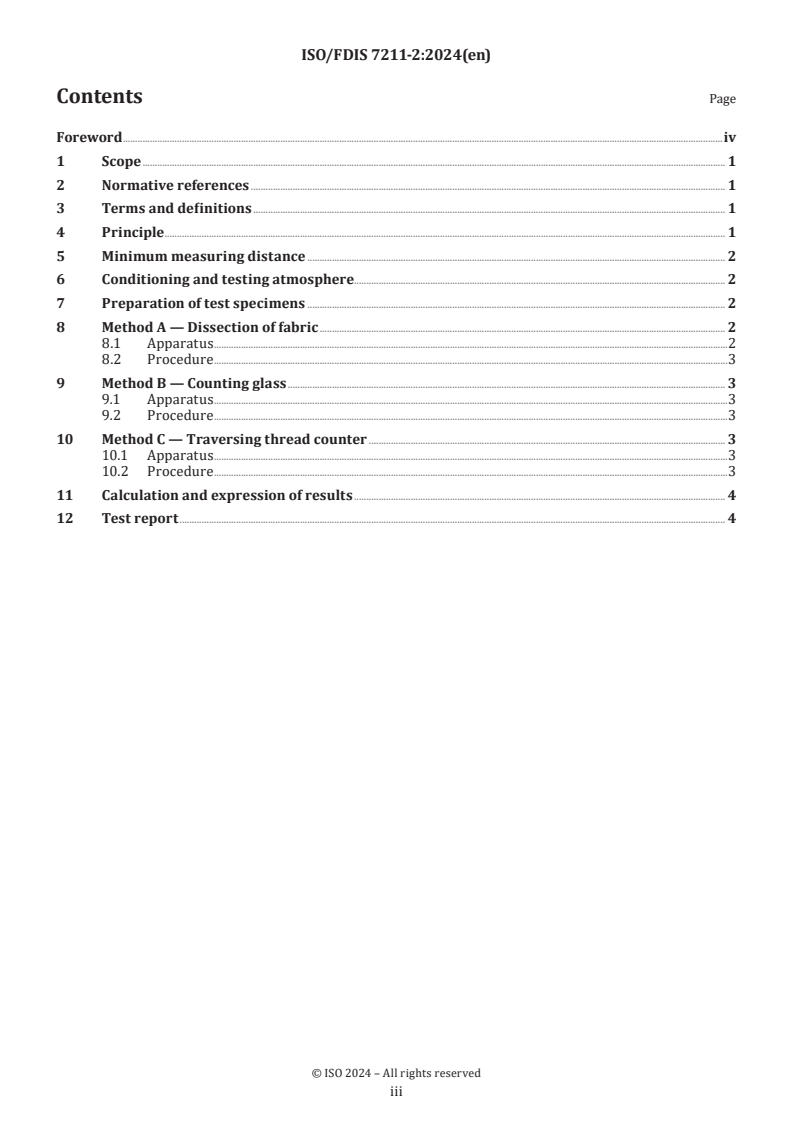
Contents Page
Foreword .iv
1 Scope . 1
2 Normative references . 1
3 Terms and definitions . 1
4 Principle . 1
5 Minimum measuring distance . 2
6 Conditioning and testing atmosphere. 2
7 Preparation of test specimens . 2
8 Method A — Dissection of fabric . 2
8.1 Apparatus .2
8.2 Procedure .3
9 Method B — Counting glass . 3
9.1 Apparatus .3
9.2 Procedure .3
10 Method C — Traversing thread counter . 3
10.1 Apparatus .3
10.2 Procedure .3
11 Calculation and expression of results . 4
12 Test report . 4
iii
ISO/FDIS 7211-2:2024(en)
Foreword
This document was prepared by Technical Committee ISO/TC 38, Textiles, Subcommittee SC 24, Conditioning
atmospheres and physical tests for textile fabrics.
ISO (the International Organization for Standardization) is a worldwide federation of national standards
bodies (ISO member bodies). The work of preparing International Standards is normally carried out through
ISO technical committees. Each member body interested in a subject for which a technical committee
has been established has the right to be represented on that committee. International organizations,
governmental and non-governmental, in liaison with ISO, also take part in the work. ISO collaborates closely
with the International Electrotechnical Commission (IEC) on all matters of electrotechnical standardization.
The procedures used to develop this document and those intended for its further maintenance are described
in the ISO/IEC Directives, Part 1. In particular, the different approval criteria needed for the different types
of ISO document should be noted. This document was drafted in accordance with the editorial rules of the
ISO/IEC Directives, Part 2 (see www.iso.org/directives).
ISO draws attention to the possibility that the implementation of this document may involve the use of (a)
patent(s). ISO takes no position concerning the evidence, validity or applicability of any claimed patent
rights in respect thereof. As of the date of publication of this document, ISO had not received notice of (a)
patent(s) which may be required to implement this document. However, implementers are cautioned that
this may not represent the latest information, which may be obtained from the patent database available at
www.iso.org/patents. ISO shall not be held responsible for identifying any or all such patent rights.
Any trade name used in this document is information given for the convenience of users and does not
constitute an endorsement.
For an explanation of the voluntary nature of standards, the meaning of ISO specific terms and expressions
related to conformity assessment, as well as information about ISO's adherence to the World Trade
Organization (WTO) principles in the Technical Barriers to Trade (TBT), see www.iso.org/iso/foreword.html.
This document was prepared by Technical Committee ISO/TC 38, Textiles, Subcommittee SC 24, Conditioning
atmospheres and physical tests for textile fabrics, in collaboration with the European Committee for
Standardization (CEN) Technical Committee CEN/TC 248, Textiles and textile products, in accordance with
the Agreement on technical cooperation between ISO and CEN (Vienna Agreement).
This second edition cancels and replaces the first edition (ISO 7211-2:1984), which has been technically
revised.
The main changes are as follows:
— in Clause 5, two columns from the former Table have been deleted;
— in Clause 12, ’Test report’’, mandatory items have been added;
— the Annex has been deleted.
A list of all parts in the ISO 7211 series can be found on the ISO website.
Any feedback or questions on this document should be directed to the user’s national standards body. A
complete listing of these bodies can be found at www.iso.org/members.html.
iv
FINAL DRAFT International Standard ISO/FDIS 7211-2:2024(en)
Textiles — Methods for analysis of woven fabrics
construction —
Part 2:
Determination of number of threads per unit length
1 Scope
This document specifies three methods for the determination of the number of threads per centimetre in
woven fabrics. Any of the three methods can be used, the choice depending on
...
ISO/FDIS 7211-2:2024(E)
ISO/TC 38/SC 24
Secretariat: AFNOR
Date: 2024-05-1323
Textiles — Methods for analysis of woven fabrics construction —
Part 2:
Determination of number of threads per unit length
Textiles — Méthodes d'analyse de la construction des tissus — Partie 2: Détermination du nombre de fils par
unité de longueur
Partie 2: Détermination du nombre de fils par unité de longueur
FDIS stage
ISO/FDIS 7211-2:2024(Een)
All rights reserved. Unless otherwise specified, or required in the context of its implementation, no part of this publication
may be reproduced or utilized otherwise in any form or by any means, electronic or mechanical, including photocopying,
or posting on the internet or an intranet, without prior written permission. Permission can be requested from either ISO
at the address below or ISO’s member body in the country of the requester.
ISO copyright office
CP 401 • Ch. de Blandonnet 8
CH-1214 Vernier, Geneva
Phone: + 41 22 749 01 11
E-mail: copyright@iso.org
Website: www.iso.org
Published in Switzerland
ii © ISO 2024 – All rights reserved
ii
ISO/FDIS 7211-2:2024(Een)
Contents
Foreword . iii
Scope . iii
Normative references . iii
Terms and definitions . iii
Principle . iii
Minimum measuring distance . iii
Conditioning and testing atmosphere . iii
Test specimens . iii
Method A - Dissection of fabric . iii
Apparatus . iii
Procedure . iii
Method B - Counting glass . iii
Apparatus . iii
Procedure . iii
Method C - Traversing thread counter . iii
Apparatus . iii
Procedure . iii
Calculation and expression of results . iii
Test report . iiiForeword v
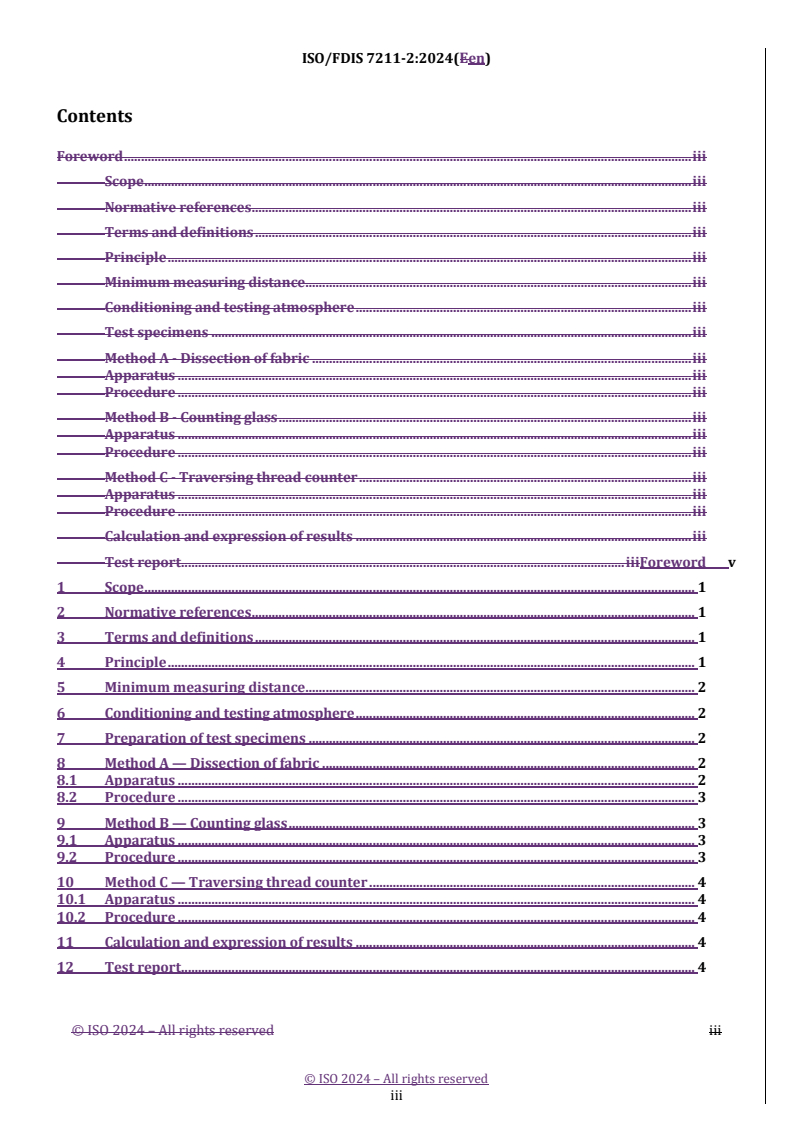
1 Scope . 1
2 Normative references . 1
3 Terms and definitions . 1
4 Principle . 1
5 Minimum measuring distance . 2
6 Conditioning and testing atmosphere . 2
7 Preparation of test specimens . 2
8 Method A — Dissection of fabric . 2
8.1 Apparatus . 2
8.2 Procedure . 3
9 Method B — Counting glass . 3
9.1 Apparatus . 3
9.2 Procedure . 3
10 Method C — Traversing thread counter . 4
10.1 Apparatus . 4
10.2 Procedure . 4
11 Calculation and expression of results . 4
12 Test report . 4
iii
ISO/FDIS 7211-2:2024(Een)
Foreword
This document was prepared by Technical Committee ISO/TC 38, Textiles, Subcommittee SC 24, Conditioning
atmospheres and physical tests for textile fabrics.
ISO (the International Organization for Standardization) is a worldwide federation of national standards
bodies (ISO member bodies). The work of preparing International Standards is normally carried out through
ISO technical committees. Each member body interested in a subject for which a technical committee has been
established has the right to be represented on that committee. International organizations, governmental and
non-governmental, in liaison with ISO, also take part in the work. ISO collaborates closely with the
International Electrotechnical Commission (IEC) on all matters of electrotechnical standardization.
The procedures used to develop this document and those intended for its further maintenance are described
in the ISO/IEC Directives, Part 1. In particular, the different approval criteria needed for the different types of
ISO document should be noted. This document was drafted in accordance with the editorial rules of the
ISO/IEC Directives, Part 2 (see www.iso.org/directives).
ISO draws attention to the possibility that the implementation of this document may involve the use of (a)
patent(s). ISO takes no position concerning the evidence, validity or applicability of any claimed patent rights
in respect thereof. As of the date of publication of this document, ISO had not received notice of (a) patent(s)
which may be required to implement this document. However, implementers are cautioned that this may not
represent the latest information, which may be obtained from the patent database available at
www.iso.org/patents.www.iso.org/patents. ISO shall not be held responsible for identifying any or all such
patent rights.
Any trade name used in this document is information given for the convenience of users and does not
constitute an endorsement.
For an explanation of the voluntary nature of standards, the meaning of ISO specific terms and expressions
related to conformity assessment, as well as information about ISO's adherence to the World Trade
Organization (WTO) principles in the Technical Barriers to Trade (TBT), see
www.iso.org/iso/foreword.htmlwww.iso.org/iso/foreword.html.
This document was prepared by Technical Committee ISO/TC 38, Textiles, Subcommittee SC 24, Conditioning
atmospheres and physical tests for textile fabrics, in collaboration with the European Committee for
Standardization (CEN) Technical Committee CEN/TC 248, Textiles and textile products, in accordance with the
Agreement on technical cooperation between ISO and CEN (Vienna Agreement).
This second edition cancels and replaces the first edition (ISO 7211-2:1984), which has been technically
revised.
The main changes are as follows:
— — In Clause 5,in Clause 5, two columns from the former Table have been deleted;
— — In Clause 12,in Clause 12, ’Test report’’, mandatory items have been added;
— — the Annex has been deleted.
A list of all parts in the ISO 7211 series can be found on the ISO website.
iv © ISO 2024 – All rights reserved
iv
ISO/FDIS 7211-2:2024(Een)
Any feedback or questions on this document should be directed to the user’s national standards body. A
complete listing of these bodies can be found at www.iso.org/members.html.
v
FINAL DRAFT INTERNATIONAL STANDARD ISO/FDIS 7211-2:2024(E)
Textiles — Methods for analysis of woven fabrics construction —
Part 2:
Determination of number of threads per unit length
1 Scope
This document specifies three methods for the determination of the number of threads per centimetre in
woven fabrics. Any of the three methods can be used, the choice depending on the character of the fabric.
However, in case of dispute, method A takes precedence.
−— Method A: Dissection of fabric, suitable for all fabrics. This is the most laborious method but has fewer
limitations than the others; in particular, it is the only one that is really suitable for the examination of
certain folded structures and other complicated weaves.
−— Method B: Counting glass, suitable for fabrics with more than 50 threads per centimetre.
−— Method C: Traversing thread counter, suitable for all fabrics.
Where the number of threads per centimetre is low, it can be convenient to express the results as the number
of threads per decimetre.
2 Normative references
The following documents are referred to in the text in such a way that some or all of their content constitutes
requirements of this document. For dated references, only the edition cited applies. For undated references,
the latest edition of the referenced document (including any amendments) applies.
ISO 139, Textiles — Standard atmospheres for conditioning and testing
3 Terms and definitions
No terms and definitions are listed in this document.
ISO and IEC maintain terminological databases for use in standardization at the following addresses:
— — IEC Electropedia: available at http://www.electropedia.org/
— — ISO Online browsing platform: available at http://www.iso.org/obp
4 Principle
Three methods of determining the number of threads per centimetre are specified, any of which can be used,
the choice depending on the character of the fabric. The principles are as follows:
Method A: A section of fabric of dimensions in accordance with those given in Clause 5Clause 5 is dissected
and the number of threads counted. The threads that are to be counted are preferably short, 10 mm or 20 mm
being suitable.
ISO/FDIS 7211-2:2024(Een)
Method B: The number of threads visible within the aperture of a specified counting glass is determined.
Method C: The number of threads per centimetre of the fabric is determined with the aid of a traversing thread
counter.
5 Minimum measuring distance
Use the appropriate minimum measuring distance specified in Table 1.Table 1.
Table 1 — Minimum measuring distance
Minimum measuring
Number of threads per
distance
centimetre
cm
Less than 10 10
10 to 25 5
25 to 40 3
More than 40 2
For the method A, take test specimens containing at least 100 threads.
For narrow fabrics having a width of 10 cm or less, count all warp threads including the selvedge ends and
express the result as threads per full width.
When fabrics are patterned by areas of large differences in the density of thread spacing, select test specimens
containing at least one weave repeat (see Clause 11).Clause 11).
6 Conditioning and testing atmosphere
The atmosphere for conditioning and testing shall be as specified in ISO 139.
7 Preparation of test specimens
No test specimens shall be select from within 150 mm of either edge of the laboratory sample.
No specially prepared test specimens are required except for method A (see 8.2).8.2). Count the threads in at
least five different places in the fabric so that they do not contain the same yarns (ends and picks) and
represent the fabric as fully as possible. The count of threads is based on number of the individual thread that
are actually present.
Condition the fabric or test specimens in the standard atmosphere (see Clause 6)Clause 6) for a minimum
...
Questions, Comments and Discussion
Ask us and Technical Secretary will try to provide an answer. You can facilitate discussion about the standard in here.