

ISO/TS 22028-5
(Main)Photography and graphic technology — Extended colour encodings for digital image storage, manipulation and interchange — Part 5: High dynamic range and wide colour gamut encoding for still images (HDR/WCG)
Photography and graphic technology — Extended colour encodings for digital image storage, manipulation and interchange — Part 5: High dynamic range and wide colour gamut encoding for still images (HDR/WCG)
Photographie et technologie graphique — Codages par couleurs étendues pour stockage, manipulation et échange d'image numérique — Partie 5: Plage dynamique élevée et codage large de la gamme de couleurs pour les images fixes (HDR/WCG)
General Information
Buy Standard

Standards Content (Sample)
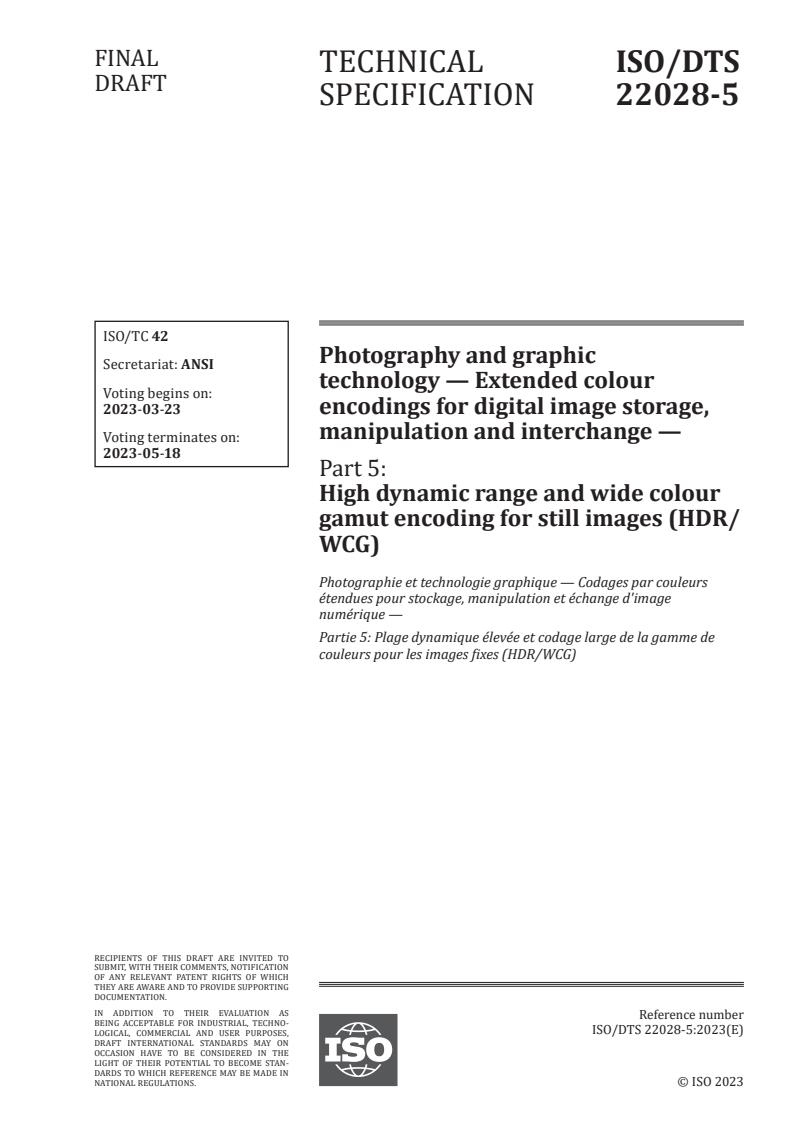
FINAL
TECHNICAL ISO/DTS
DRAFT
SPECIFICATION 22028-5
ISO/TC 42
Photography and graphic
Secretariat: ANSI
technology — Extended colour
Voting begins on:
2023-03-23 encodings for digital image storage,
manipulation and interchange —
Voting terminates on:
2023-05-18
Part 5:
High dynamic range and wide colour
gamut encoding for still images (HDR/
WCG)
Photographie et technologie graphique — Codages par couleurs
étendues pour stockage, manipulation et échange d'image
numérique —
Partie 5: Plage dynamique élevée et codage large de la gamme de
couleurs pour les images fixes (HDR/WCG)
RECIPIENTS OF THIS DRAFT ARE INVITED TO
SUBMIT, WITH THEIR COMMENTS, NOTIFICATION
OF ANY RELEVANT PATENT RIGHTS OF WHICH
THEY ARE AWARE AND TO PROVIDE SUPPOR TING
DOCUMENTATION.
IN ADDITION TO THEIR EVALUATION AS
Reference number
BEING ACCEPTABLE FOR INDUSTRIAL, TECHNO-
ISO/DTS 22028-5:2023(E)
LOGICAL, COMMERCIAL AND USER PURPOSES,
DRAFT INTERNATIONAL STANDARDS MAY ON
OCCASION HAVE TO BE CONSIDERED IN THE
LIGHT OF THEIR POTENTIAL TO BECOME STAN-
DARDS TO WHICH REFERENCE MAY BE MADE IN
NATIONAL REGULATIONS. © ISO 2023
---------------------- Page: 1 ----------------------
ISO/DTS 22028-5:2023(E)
FINAL
TECHNICAL ISO/DTS
DRAFT
SPECIFICATION 22028-5
ISO/TC 42
Photography and graphic
Secretariat: ANSI
technology — Extended colour
Voting begins on:
encodings for digital image storage,
manipulation and interchange —
Voting terminates on:
Part 5:
High dynamic range and wide colour
gamut encoding for still images (HDR/
WCG)
Photographie et technologie graphique — Codages par couleurs
étendues pour stockage, manipulation et échange d'image
numérique —
Partie 5: Plage dynamique élevée et codage large de la gamme de
couleurs pour les images fixes (HDR/WCG)
COPYRIGHT PROTECTED DOCUMENT
© ISO 2023
All rights reserved. Unless otherwise specified, or required in the context of its implementation, no part of this publication may
be reproduced or utilized otherwise in any form or by any means, electronic or mechanical, including photocopying, or posting on
the internet or an intranet, without prior written permission. Permission can be requested from either ISO at the address below
or ISO’s member body in the country of the requester.RECIPIENTS OF THIS DRAFT ARE INVITED TO
ISO copyright office
SUBMIT, WITH THEIR COMMENTS, NOTIFICATION
OF ANY RELEVANT PATENT RIGHTS OF WHICH
CP 401 • Ch. de Blandonnet 8
THEY ARE AWARE AND TO PROVIDE SUPPOR TING
CH-1214 Vernier, Geneva
DOCUMENTATION.
Phone: +41 22 749 01 11
IN ADDITION TO THEIR EVALUATION AS
Reference number
Email: copyright@iso.org
BEING ACCEPTABLE FOR INDUSTRIAL, TECHNO-
ISO/DTS 22028-5:2023(E)
Website: www.iso.org
LOGICAL, COMMERCIAL AND USER PURPOSES,
DRAFT INTERNATIONAL STANDARDS MAY ON
Published in Switzerland
OCCASION HAVE TO BE CONSIDERED IN THE
LIGHT OF THEIR POTENTIAL TO BECOME STAN-
DARDS TO WHICH REFERENCE MAY BE MADE IN
© ISO 2023 – All rights reserved
NATIONAL REGULATIONS. © ISO 2023
---------------------- Page: 2 ----------------------
ISO/DTS 22028-5:2023(E)
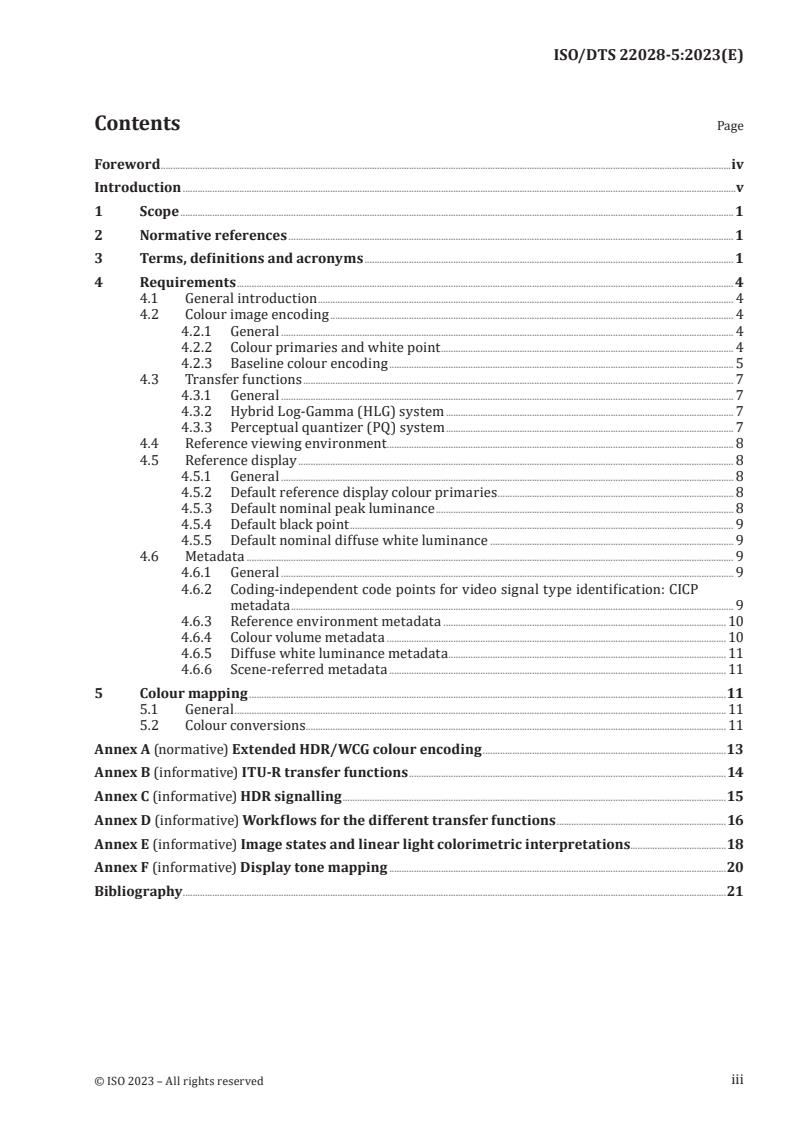
Contents Page
Foreword ........................................................................................................................................................................................................................................iv
Introduction .................................................................................................................................................................................................................................v
1 Scope ................................................................................................................................................................................................................................. 1
2 Normative references ..................................................................................................................................................................................... 1
3 Terms, definitions and acronyms ...................................................................................................................................................... 1
4 Requirements .......................................................................................................................................................................................................... 4
4.1 General introduction ......................................................................................................................................................................... 4
4.2 Colour image encoding .................................................................................................................................................................... 4
4.2.1 General ........................................................................................................................................................................................ 4
4.2.2 Colour primaries and white point ....................................................................................................................... 4
4.2.3 Baseline colour encoding ............................................................................................................................................ 5
4.3 Transfer functions ............................................................................................................................................................................... 7
4.3.1 General ........................................................................................................................................................................................ 7
4.3.2 Hybrid Log-Gamma (HLG) system ..................................................................................................................... 7
4.3.3 Perceptual quantizer (PQ) system ..................................................................................................................... 7
4.4 Reference viewing environment ............................................................................................................................................. 8
4.5 Reference display ................................................................................................................................................................................. 8
4.5.1 General ........................................................................................................................................................................................ 8
4.5.2 Default reference display colour primaries ................................................................................................ 8
4.5.3 Default nominal peak luminance ......................................................................................................................... 8
4.5.4 Default black point ............................................................................................................................................................ 9
4.5.5 Default nominal diffuse white luminance ................................................................................................... 9
4.6 Metadata ...................................................................................................................................................................................................... 9
4.6.1 General ........................................................................................................................................................................................ 9
4.6.2 Coding-independent code points for video signal type identification: CICPmetadata .................................................................................................................................................................................... 9
4.6.3 Reference environment metadata ................................................................................................................... 10
4.6.4 Colour volume metadata .......................................................................................................................................... 10
4.6.5 Diffuse white luminance metadata ................................................................................................................. 11
4.6.6 Scene-referred metadata ......................................................................................................................................... 11
5 Colour mapping ..................................................................................................................................................................................................11
5.1 General ........................................................................................................................................................................................................ 11
5.2 Colour conversions ...................................................................... ..................................................................................................... 11
Annex A (normative) Extended HDR/WCG colour encoding ...................................................................................................13
Annex B (informative) ITU-R transfer functions .................................................................................................................................14
Annex C (informative) HDR signalling ............................................................................................................................................................15
Annex D (informative) Workflows for the different transfer functions .....................................................................16
Annex E (informative) Image states and linear light colorimetric interpretations.......................................18
Annex F (informative) Display tone mapping .........................................................................................................................................20
Bibliography .............................................................................................................................................................................................................................21
iii© ISO 2023 – All rights reserved
---------------------- Page: 3 ----------------------
ISO/DTS 22028-5:2023(E)
Foreword
ISO (the International Organization for Standardization) is a worldwide federation of national standards
bodies (ISO member bodies). The work of preparing International Standards is normally carried out
through ISO technical committees. Each member body interested in a subject for which a technical
committee has been established has the right to be represented on that committee. International
organizations, governmental and non-governmental, in liaison with ISO, also take part in the work.
ISO collaborates closely with the International Electrotechnical Commission (IEC) on all matters of
electrotechnical standardization.The procedures used to develop this document and those intended for its further maintenance are
described in the ISO/IEC Directives, Part 1. In particular, the different approval criteria needed for the
different types of ISO documents should be noted. This document was drafted in accordance with the
editorial rules of the ISO/IEC Directives, Part 2 (see www.iso.org/directives).Attention is drawn to the possibility that some of the elements of this document may be the subject of
patent rights. ISO shall not be held responsible for identifying any or all such patent rights. Details of
any patent rights identified during the development of the document will be in the Introduction and/or
on the ISO list of patent declarations received (see www.iso.org/patents).Any trade name used in this document is information given for the convenience of users and does not
constitute an endorsement.For an explanation of the voluntary nature of standards, the meaning of ISO specific terms and
expressions related to conformity assessment, as well as information about ISO's adherence to
the World Trade Organization (WTO) principles in the Technical Barriers to Trade (TBT), see
www.iso.org/iso/foreword.html.This document was prepared by Technical Committee ISO/TC 42, Photography.
A list of all parts in the ISO 22028 series can be found on the ISO website.
Any feedback or questions on this document should be directed to the user’s national standards body. A
complete listing of these bodies can be found at www.iso.org/members.html.© ISO 2023 – All rights reserved
---------------------- Page: 4 ----------------------
ISO/DTS 22028-5:2023(E)
Introduction
This document has been developed to meet the industry need for a complete, fully documented, publicly
available specification of high dynamic range (HDR) and wide colour gamut (WCG) image encodings for
digital still images.High dynamic range images, that have been produced to look correct on high dynamic range displays,
can provide a better user experience than standard dynamic range images. High dynamic range images
allow a greater range of shadow and highlight detail to be conveyed, with sufficient precision and
acceptable artifacts, including sufficient separation of diffuse white and specular highlights.
Wide colour gamut images, in addition, can represent a wider range of colours and allow for better
colour reproduction. These two features are commonly bundled together. In this document, for
simplicity, we will refer to both such features using the HDR/WCG acronym.ITU-R has published requirements and guidelines for HDR/WCG television production and exchange,
the foundation of the blooming HDR/WCG video and movie ecosystems. There are now a growing
number of HDR/WCG displays (Smartphones, TVs, computer displays) that consumers use in their daily
life, but a limited amount of HDR/WCG still image content is available.In parallel, digital cameras improve over time and capture more and more dynamic range. To overcome
the limitations of sensing technology, HDR images can be generated by fusing several images captured
with different exposures. But so far, the digital still imaging industry has not settled on a reference
HDR/WCG image encoding for consumers.The purpose of this document is to provide requirements and guidelines for colour encoding of HDR/
WCG still images. The digital still imaging industry will benefit from these requirements and guidelines.
They will help establish a standard and open HDR/WCG ecosystem, to take better advantage of HDR
cameras and displays. These colour encoding requirements and guidelines can be leveraged in the
specification of HDR/WCG file formats.The encoding and decoding methods specified in this document are from ITU-R BT.2100-2, to ensure
full compatibility with existing HDR/WCG devices and the associated video and movie ecosystems.
Metadata is specified in this document to support the communication of scene-referred and display-
referred image states in accordance with ISO 22028-1.The outline of this document is as follows. The scope is defined in Clause 1, the normative references
are listed in Clause 2. Clause 3 lists the terms, definitions, and acronyms. Clause 4 covers the colour
image encoding requirements.Annex A (normative) specifies the extended HDR/WCG colour encoding.
Annex B (informative) lists a selection of highly relevant ITU-R Rec. BT.2100-2 tables.
Annex C (informative) lists relevant ISO/IEC 23000-22/Amd.2 tables, that are related to metadata
recommended in this document.Annex D (informative) presents different HDR workflows.
Annex E (informative) provides information about ISO 22028-1 image states and the linear light
interpretations of HDR image signal values specified in ITU-R BT.2100-2.Annex F (informative) presents tone mapping options.
© ISO 2023 – All rights reserved
---------------------- Page: 5 ----------------------
TECHNICAL SPECIFICATION ISO/DTS 22028-5:2023(E)
Photography and graphic technology — Extended colour
encodings for digital image storage, manipulation and
interchange —
Part 5:
High dynamic range and wide colour gamut encoding for
still images (HDR/WCG)
1 Scope
This document defines a set of colour image encodings for use in storage, transmission, and display
of high dynamic range and wide colour gamut (HDR/WCG) digital still images. It defines the colour
encodings, the mandatory and optional metadata, and the reference viewing conditions for HDR/WCG
images.2 Normative references
The following documents are referred to in the text in such a way that some or all of their content
constitutes requirements of this document. For dated references, only the edition cited applies. For
undated references, the latest edition of the referenced document (including any amendments) applies.
ISO 22028-1:2016, Photography and graphic technology — Extended colour encodings for digital image
storage, manipulation and interchange — Part 1: Architecture and requirementsISO/IEC 23091-2:2021/ITU-T H.273, Information technology — Coding-independent code points — Part 2:
VideoISO/IEC/TR 23091-4:2021/ITU-T H.SUPPLEMENT 19, Information technology — Coding-independent
code points — Part 4: Usage of video signal type code pointsRecommendation ITU-R BT 2100-2 (07/2018): Image parameter values for high dynamic range television
for use in production and international programme exchange3 Terms, definitions and acronyms
For the purposes of this document, the following terms and definitions apply.
ISO and IEC maintain terminological databases for use in standardization at the following addresses:
— ISO Online browsing platform: available at https:// www .iso .org/ obp— IEC Electropedia: available at https:// www .electropedia .org/
3.1
coding-independent code points for video signal type identification
CICP
metadata that describes the colour image characteristics of the associated picture
© ISO 2023 – All rights reserved---------------------- Page: 6 ----------------------
ISO/DTS 22028-5:2023(E)
3.2
colour image encoding
digital encoding of the colour values for a digital image, including the specification of a colour space
encoding, together with any information necessary to properly interpret the colour values such as the
image state, the intended image viewing environment, and the reference medium[SOURCE: ISO 22028-1:2016, 3.9, modified — Notes to entry were deleted.]
3.3
colour volume
space of all colours and intensities that a device or signal can reproduce or convey
[SOURCE: ISO/IEC TR 23091-4:2021, 3.6/ITU-T H.SUPPLEMENT 19]3.4
content colour volume
CCV
metadata that describes the colour volume (colour primaries, white point, and luminance range)
characteristics of the associated picture3.5
content light level
CLL
metadata that describes the light level characteristics (maximum and average) of the associated picture
3.6diffuse white
stimulus that an observer adapted to the displayed content in the viewing environment would judge to
be neutral and to have a luminance factor of unity3.7
display light
image values that result from applying the reference EOTF to the encoded image signal values
3.8display viewing colorimetry
colorimetry appropriate for a targeted display with specified viewing conditions
Note 1 to entry: The display viewing colorimetry typically depends on the creative intent for the content.
3.9display referred
image state associated with image data that represents the colour-space coordinates of the elements
of an image that has undergone colour-rendering appropriate for a specified display and viewing
conditions3.10
electrical-electrical transfer function
EETF
transfer function that adjusts the electronic signal, e.g. to tone map it to a lower display range
3.11electro-optical transfer function
EOTF
transfer function which converts the non-linear signal into display light
© ISO 2023 – All rights reserved
---------------------- Page: 7 ----------------------
ISO/DTS 22028-5:2023(E)
3.12
high dynamic range and wide colour gamut encoding
HDR/WCG encoding
Colour image encoding that can contain wider variations in brightness, with a dynamic range
significantly higher than that of a standard dynamic range encoding, and a wider range of colours with
more saturated colours than standard colour gamut encodings3.13
high dynamic range image
HDR image
image that contains wider variations in brightness, with a dynamic range significantly higher than that
of a standard dynamic range image3.14
highlights
image pixels with colorimetric values higher than those of the reference diffuse white
3.15image
data structure that contains pixels and image-related data
[SOURCE: ISO/IEC 12087-1:1995, 3.1.3]
3.16
mastering display
a display that is used or targeted for viewing while authoring the content
3.17
mastering display colour volume
MDCV
metadata that identifies the colour volume (the colour primaries, white point chromaticity, and
luminance range) of a mastering display[SOURCE: SMPTE ST 2086:2018]
3.18
nominal peak luminance
luminance resulting on a display from the specified encoding peak white signal level
Note 1 to entry: The peak white signal level is specified to be lower than the peak signal level for narrow range
encodings.3.19
nominal diffuse white luminance
display luminance a viewer would consider, on average, correspond to a perfectly reflecting diffuser in
the scene when viewing the mastering display3.20
opto-electronic transfer function
OETF
transfer function that converts scene light into non-linear signal values
3.21
opto-optical transfer function
OOTF
transfer function that converts scene light to display light
3.22
nominal diffuse white
diffuse white value typical for the content encoding that is assumed for general purposes, independent
of specified content or other information about the actual diffuse white© ISO 2023 – All rights reserved
---------------------- Page: 8 ----------------------
ISO/DTS 22028-5:2023(E)
3.23
scene light
image values that result from applying the inverse reference OETF to the encoded image signal values
3.24transfer function
single variable, monotonic mathematical function applied individually to one or more colour channels
3.25wide colour gamut
WCG
gamut that has saturated colour primaries and includes a broad range of saturated colours
Note 1 to entry: It is wider than a standard colour gamut such as sRGB.Note 2 to entry: WCG encodings provide a means to encode images with more saturated colours than standard
colour gamut encodings, to represent a wider range of colours and allow for better colour reproduction.
4 Requirements4.1 General introduction
The colour image encodings specified in this document conform to the requirements defined in
ISO 22028-1:2016, Clause 5, and include a colour space representation, associated metadata, a reference
viewing environment, and a reference medium.Colour image encoding and transfer functions are specified in 4.2 and 4.3 respectively. The reference
viewing environment and the reference display are defined in 4.4 and in 4.5 respectively. These
subclauses provide context for interpreting the intended colour appearance of the encoded image
colorimetry. The associated metadata are specified in 4.6. The most relevant ITU-R BT.2100-2
properties are referred to in Annex B of this document.4.2 Colour image encoding
4.2.1 General
Two sets of colour encodings are defined, baseline and extended. Images shall conform either to the
baseline colour encoding defined in 4.2.3, or to the extended colour encoding defined in Annex A. Image
readers shall support the baseline colour encoding, and may support the extended colour encoding.
The baseline colour encoding is recommended for cameras, TVs, and image readers on other consumer
devices. It is fully compatible with ITU-R BT.2100-2 and recommended for image exchanges with wider
viewing compatibility. The extended colour encoding is intended for applications where dedicated
hardware and/or software are used.4.2.2 Colour primaries and white point
Images shall use the colour primaries and white point, as defined in Table 2, System colorimetry, of
ITU-R BT.2100-2.Table 1 reproduces the chromaticity coordinates of the RGB primaries and white point of the colour
encoding space specified in ITU-R BT.2100-2.© ISO 2023 – All rights reserved
---------------------- Page: 9 ----------------------
ISO/DTS 22028-5:2023(E)
Table 1 — Chromaticity coordinates of the RGB primaries and white point of the colour
encoding spaceValues
Chromaticity coordinates
Parameter
(CIE, 1931)
Optical spectrum (informative)
x y
Red primary (R) monochromatic 630 nm 0,708 0,292
Primary
Green primary (G) monochromatic 532 nm 0,170 0,797
colours
Blue primary (B) monochromatic 467 nm 0,131 0,046
Reference white D65 per ISO 11664-2:2007 0,312 7 0,329 0
Colour matching functions CIE 1931
4.2.3 Baseline colour encoding
Images conforming to the baseline colour encoding shall comply with the specifications defined
in Table 9 in ITU-R BT.2100-2. Images shall use the non-constant luminance Y', C' , C' signal format
B Rdefined in Table 6 in ITU-R BT.2100-2.
Table 2 partially reproduces the Table 9 of ITU-R BT.2100-2.
© ISO 2023 – All rights reserved
---------------------- Page: 10 ----------------------
ISO/DTS 22028-5:2023(E)
Table 2 — Baseline colour encoding specification
Parameter Value
Coded signal Y', C' , C'
B R
Coding format n = 10, 12 bits per component
Quantization of Y' Narrow range Full range
(resulting values that exceed the
n−8 n
video data range should be clipped D = Round [(219 × E′ + 16) × 2 ] D = Round [(2 -1) × E′]
to the video data range)Quantization of C' , C'
B R,
(resulting values that exceed the n−8 n n-1
D = Round [(224 × E′ + 128) × 2 ] D = Round [(2 -1) × E′ + 2 ]
video data range should be clipped
to the video data range)
Quantization levels 10-bit coding 12-bit coding 10-bit coding 12-bit coding
Black
(Y' = 0) 64 256 0 0
DY'
Nominal Peak
(Y' = 1) 940 3 760 1 023 4 095
DY'
Achromatic
(C' = C' = 0) 512 2 048 512 2 048
B R
DC' , DC'
B R
Nominal Peak
(C' = C' = +0,5) 960 3 840 1 023 4 095
B R
DC' , DC'
B R
Nominal Peak
(C' = C' = -0,5) 64 256 1 1
B R
DC' , DC'
B R
4 through 16 through 0 through 0 through
Video data range
1 019 4 079 1 023 4 095
Where:
Round( x ) = Sign( x ) * Floor( | x | + 0,5 )
Floor( x ) the largest integer less than or equal to x
10; x>
Sign( x ) = 00; x=
−<10; x
NOTE The narrow range representation is in widespread use in the video and broadcasting industries. The
full range representation is commonly used in the photographic industry.© ISO 2023 – All rights reserved
---------------------- Page: 11 ----------------------
ISO/DTS 22028-5:2023(E)
4.3 Transfer functions
4.3.1 General
Two HDR/WCG colour encodings specified in ITU-R BT.2100-2 are widely adopted by video HDR/WCG
ecosystems: the hybrid log-gamma (HLG) encoding and perceptual quantization (PQ) encoding.
These encodings use the same colour primaries and white point but different transfer functions.
Images conforming to this document shall be encoded using an HLG transfer function (see 4.3.2), or a
PQ transfer function (see 4.3.3). Diagrams of the workflows using the different transfer functions are
provided in Annex D.The HLG and PQ systems are designed to encode images for viewing on HDR/WCG displays: Scene light
captured by the camera may be adjusted to produce a desired image appearance when viewed on a
display.However, in some cases, imaging systems communicate estimated scene-referred colorimetry. This
scene-referred colorimetry should be indicated by using scene-referred metadata (Annex E provides
details).NOTE Scene-referred colorimetry images can be used in applications such as digital archiving, virtual
scenes, photorealistic compositing, some types of medical imaging, and machine vision.
4.3.2 Hybrid Log-Gamma (HLG) systemWhen scene light values are mapped into HLG signal values, this mapping shall be as specified by the
HLG Reference OETF defined in ITU-R BT.2100-2. When values are mapped in the inverse direction, this
mapping shall be according to the inverse of the HLG Reference OETF defined in ITU-R BT.2100-2.
When HLG signal values are mapped into display light values, this mapping shall be as specified by the
HLG Reference EOTF defined in ITU-R BT.2100-2.When values are mapped in the inverse direction, this mapping shall be according to the inverse of the
HLG Reference EOTF defined in ITU-R BT.2100-2.If the MDCV metadata is present, as defined in 4.6.4.2, its minimum and maximum luminance
parameters should be used for the derivation of the EOTF. When the MDCV metadata is not present, the
minimum and maximum luminance parameters of the reference display, as defined in 4.5, should be
used for the derivation of the EOTF.If the HLG signal values represent estimated scene colorimetry, this should be indicated using scene-
referred metadata. The inverse of the reference HLG opto-electronic transfer function (OETF) can be
applied to the encoded scene colorimetry to revert to linear light colorimetry (D.2, D.3, and Annex E
provide details).NOTE While the HLG encoding as defined in ITU-R BT.2100-2 is by default scene-referred, with a fixed
OETF and a variable OOTF/EOTF that adapts to different display dynamic ranges, in practice the OETF might
be adjusted by the content creator based on viewing the resulting image on a display. Alternatively, the OETF
might be adjusted by automatic image tuning algorithms in the camera image processing pipeline or in the
post pr...
ISO/DTS 22028-5:2023(E)
ISO TC 42/WG 23
Date: 2023-02-09XX
Secretariat: ANSI
Photography and graphic technology — Extended colour encodings for digital image storage,
manipulation and interchange — Part 5: High Dynamic Range and Wide Colour Gamut encoding
for still images (HDR/WCG)Photographie et technologie graphique — Codages par couleurs étendues pour stockage, manipulation et
échange d'image numérique — Partie 5: Plage dynamique élevée et codage large de la gamme de couleurs
pour les images fixes (HDR/WCG)---------------------- Page: 1 ----------------------
ISO/DTS 22028-5:2023(E)
© ISO 2023
Formatted: Pattern: Clear
Formatted: Pattern: Clear
All rights reserved. Unless otherwise specified, or required in the context of its implementation, no part
of this publication may be reproduced or utilized otherwise in any form or by any means, electronic or
mechanical, including photocopying, or posting on the internet or an intranet, without prior written
permission. Permission can be requested from either ISO at the address below or ISO’s member body
in the country of the requester.ISO copyright office
CP 401 • Ch. de Blandonnet 8
CH-1214 Vernier, Geneva
Phone: +41 22 749 01 11
Email: copyright@iso.org
Website: www.iso.org
Published in Switzerland
ii © ISO 2023 – All rights reserved
---------------------- Page: 2 ----------------------
ISO/DTS 22028-5:2023(E)
Contents
Foreword ............................................................................................................................................................. 1
Introduction ....................................................................................................................................................... 1
1 Scope ............................................................................................................................................................. 1
2 Normative references .............................................................................................................................. 1
3 Terms, definitions and acronyms ........................................................................................................ 1
4 Requirements ............................................................................................................................................ 1
4.1 General introduction ............................................................................................................................... 1
4.2 Colour image encoding ........................................................................................................................... 1
4.2.1 General ................................................................................................................................................... 1
4.2.2 Colour primaries and white point ................................................................................................. 1
4.2.3 Baseline colour encoding ................................................................................................................. 1
4.3 Transfer functions .................................................................................................................................... 1
4.3.1 General ................................................................................................................................................... 1
4.3.2 Hybrid Log-Gamma (HLG) system ................................................................................................. 1
4.3.3 Perceptual Quantizer (PQ) system................................................................................................ 1
4.4 Reference viewing environment .......................................................................................................... 1
4.5 Reference display ..................................................................................................................................... 1
4.5.1 General ................................................................................................................................................... 1
4.5.2 Default reference display colour primaries ............................................................................... 1
4.5.3 Default nominal peak luminance .................................................................................................. 1
4.5.4 Default black point ............................................................................................................................. 1
4.5.5 Default nominal diffuse white luminance .................................................................................. 1
4.6 Metadata ...................................................................................................................................................... 1
4.6.1 General ................................................................................................................................................... 1
4.6.2 Coding-independent code points for video signal type identification: CICP metadata 1
© ISO 2023 – All rights reserved iii---------------------- Page: 3 ----------------------
ISO/DTS 22028-5:2023(E)
4.6.3 Reference environment metadata ................................................................................................ 1
4.6.4 Colour volume metadata .................................................................................................................. 1
4.6.5 Diffuse white luminance metadata ............................................................................................... 1
4.6.6 Scene-referred metadata ................................................................................................................. 1
5 Colour mapping ......................................................................................................................................... 1
5.1 General ......................................................................................................................................................... 1
5.2 Colour conversions ................................................................................................................................... 1
Annex A (normative) Extended HDR/WCG colour encoding .............................................................. 1
A.1 General ......................................................................................................................................................... 1
A.2 Extended colour encoding ..................................................................................................................... 1
Annex B (informative) ITU-R transfer functions .................................................................................... 1
B.1 General ......................................................................................................................................................... 1
Annex C (informative) HDR signalling ....................................................................................................... 1
C.1 General ......................................................................................................................................................... 1
Annex D (informative) Workflows for the different transfer functions ......................................... 1
D.1 General ......................................................................................................................................................... 1
D.2 Display-viewing colorimetry Hybrid Log-Gamma (HLG) workflow ......................................... 1
D.3 Scene-referred colorimetry Hybrid Log-Gamma (HLG) workflow ........................................... 1
D.4 Display-viewing colorimetry Perceptual Quantizer (PQ) workflow ........................................ 1
D.5 Scene-referred colorimetry Perceptual Quantizer (PQ) workflow .......................................... 1
Annex E (informative) Image states and linear light colorimetric interpretations .................... 1
E.1 General ......................................................................................................................................................... 1
E.2 ISO 22028 image state ............................................................................................................................. 1
E.3 ITU-R BT.2100 “linear light” colorimetric interpretations ......................................................... 1
iv © ISO 2023 – All rights reserved---------------------- Page: 4 ----------------------
ISO/DTS 22028-5:2023(E)
E.4 Display-viewing colorimetry and scene-referred colorimetry .................................................. 1
E.4.1 Display-viewing colorimetry .......................................................................................................... 1
E.4.2 Scene-referred colorimetry ............................................................................................................ 1
Annex F (informative) Display tone mapping ......................................................................................... 1
F.1 General ......................................................................................................................................................... 1
F.2 Tone mapping HLG images with display viewing colorimetry .................................................. 1
F.3 Tone mapping PQ output-referred images ...................................................................................... 1
F.4 Tone mapping to SDR display ............................................................................................................... 1
Bibliography......................................................................................................................................................... 1Fore
word ....................................................................................................................................................... vi
Introduction .................................................................................................................................................... vii
1 Scope ............................................................................................................................................................. 1
2 Normative references .............................................................................................................................. 1
3 Terms, definitions and acronyms ........................................................................................................ 1
4 Requirements ............................................................................................................................................ 4
4.1 General introduction ............................................................................................................................... 4
4.2 Colour image encoding ........................................................................................................................... 4
4.2.1 General ................................................................................................................................................... 4
4.2.2 Colour primaries and white point ................................................................................................. 4
4.2.3 Baseline colour encoding ................................................................................................................. 5
4.3 Transfer functions .................................................................................................................................... 7
4.3.1 General ................................................................................................................................................... 7
4.3.2 Hybrid Log-Gamma (HLG) system ................................................................................................. 7
4.3.3 Perceptual Quantizer (PQ) system................................................................................................ 7
4.4 Reference viewing environment .......................................................................................................... 8
© ISO 2023 – All rights reserved v---------------------- Page: 5 ----------------------
ISO/DTS 22028-5:2023(E)
4.5 Reference display ..................................................................................................................................... 8
4.5.1 General ................................................................................................................................................... 8
4.5.2 Default reference display colour primaries ............................................................................... 9
4.5.3 Default nominal peak luminance................................................................................................... 9
4.5.4 Default black point ............................................................................................................................. 9
4.5.5 Default nominal diffuse white luminance ................................................................................... 9
4.6 Metadata ...................................................................................................................................................... 9
4.6.1 General ................................................................................................................................................... 9
4.6.2 Coding-independent code points for video signal type identification: CICP metadata 9
4.6.3 Reference environment metadata ............................................................................................. 10
4.6.4 Colour volume metadata ............................................................................................................... 11
4.6.5 Diffuse white luminance metadata ............................................................................................ 11
4.6.6 Scene-referred metadata .............................................................................................................. 11
5 Colour mapping ...................................................................................................................................... 11
5.1 General ...................................................................................................................................................... 11
5.2 Colour conversions ................................................................................................................................ 11
Annex A (normative) Extended HDR/WCG colour encoding ........................................................... 13
Annex B (informative) ITU-R transfer functions ................................................................................. 14
Annex C (informative) HDR signalling .................................................................................................... 15
Annex D (informative) Workflows for the different transfer functions ...................................... 16
Annex E (informative) Image states and linear light colorimetric interpretations ................. 18
Annex F (informative) Display tone mapping ...................................................................................... 20
Bibliography .................................................................................................................................................... 21
vi © ISO 2023 – All rights reserved---------------------- Page: 6 ----------------------
ISO/DTS 22028-5:2023(E)
Foreword
ISO (the International Organization for Standardization) is a worldwide federation of national standards
bodies (ISO member bodies). The work of preparing International Standards is normally carried out
through ISO technical committees. Each member body interested in a subject for which a technical
committee has been established has the right to be represented on that committee. International
organizations, governmental and non-governmental, in liaison with ISO, also take part in the work. ISO
collaborates closely with the International Electrotechnical Commission (IEC) on all matters of
electrotechnical standardization.The procedures used to develop this document and those intended for its further maintenance are
described in the ISO/IEC Directives, Part 1. In particular, the different approval criteria needed for the
different types of ISO documents should be noted. This document was drafted in accordance with the
editorial rules of the ISO/IEC Directives, Part 2 (see www.iso.org/directives).Attention is drawn to the possibility that some of the elements of this document may be the subject of
patent rights. ISO shall not be held responsible for identifying any or all such patent rights. Details of any
patent rights identified during the development of the document will be in the Introduction and/or on
the ISO list of patent declarations received (see www.iso.org/patents).Any trade name used in this document is information given for the convenience of users and does not
constitute an endorsement.For an explanation of the voluntary nature of standards, the meaning of ISO specific terms and
expressions related to conformity assessment, as well as information about ISO's adherence to the World
Trade Organization (WTO) principles in the Technical Barriers to Trade (TBT), see
www.iso.org/iso/foreword.html.This document was prepared by Technical Committee ISO/TC 42, Photography.
A list of all parts in the ISO 22028 series can be found on the ISO website.
Formatted: Pattern: Clear
Formatted: Pattern: Clear
Any feedback or questions on this document should be directed to the user’s national standards body. A
Formatted: Pattern: Clearcomplete listing of these bodies can be found at www.iso.org/members.html.
© ISO 2023 – All rights reserved vii
---------------------- Page: 7 ----------------------
ISO/DTS 22028-5:2023(E)
Introduction
This part 5 of ISO 22028document has been developed to meet the industry need for a complete, fully
documented, publicly available specification of high dynamic range (HDR) and wide colour gamut (WCG)
image encodings for digital still images.High dynamic range images, that have been produced to look correct on high dynamic range displays, can
provide a better user experience than standard dynamic range images. High dynamic range images allow
a greater range of shadow and highlight detail to be conveyed, with sufficient precision and acceptable
artifacts, including sufficient separation of diffuse white and specular highlights.
Wide colour gamut images, in addition, can represent a wider range of colours and allow for better colour
reproduction. These two features are commonly bundled together. In this document, for simplicity, we
will refer to both such features using the HDR/WCG acronym.ITU-R has published requirements and guidelines for HDR/WCG television production and exchange, the
foundation of the blooming HDR/WCG video and movie ecosystems. There are now a growing number of
Formatted: Pattern: ClearHDR/WCG displays (Smartphones, TVs, computer displays) that consumers use in their daily life, but a
limited amount of HDR/WCG still image content is available. Formatted: Pattern: Clear
In parallel, digital cameras improve over time and capture more and more dynamic range. To overcome Formatted: Pattern: Clear
the limitations of sensing technology, HDR images can be generated by fusing several images captured
Formatted: Pattern: Clearwith different exposures. But so far, the digital still imaging industry has not settled on a reference
Formatted: Pattern: ClearHDR/WCG image encoding for consumers.
Formatted: Pattern: Clear
The purpose of this document is to provide requirements and guidelines for colour encoding of
Formatted: Pattern: ClearHDR/WCG still images. The digital still imaging industry will benefit from these requirements and
guidelines. They will help establish a standard and open HDR/WCG ecosystem, to take better advantage
Formatted: Pattern: Clearof HDR cameras and displays. These colour encoding requirements and guidelines can be leveraged in
Formatted: Pattern: Clearthe specification of HDR/WCG file formats.
Formatted: Pattern: Clear
The encoding and decoding methods specified in this document are from ITU-R BT.2100-2, to ensure full
Formatted: Pattern: Clearcompatibility with existing HDR/WCG devices and the associated video and movie ecosystems. Metadata
is specified in this document to support the communication of scene-referred and display-referred image
Formatted: Pattern: Clearstates in accordance with ISO 22028-1.
Formatted: Pattern: Clear
The outline of this document is as follows. The scope is defined in clauseClause 1, the normative
Formatted: Pattern: Clearreferences are listed in clauseClause 2. Clause 3 lists the terms, definitions, and acronyms. Clause 4 covers
Formatted: Pattern: Clearthe colour image encoding requirements.
Formatted: Pattern: Clear
Annex A (normative) specifies the extended HDR/WCG colour encoding.
Formatted: Pattern: Clear
Annex B (informative) lists a selection of highly relevant ITU-R Rec. BT.2100-2 tables.
Formatted: Pattern: ClearAnnex C (informative) lists relevant ISO/IEC 23000-22 AMD2/Amd.2 tables, that are related to metadata
Formatted: Pattern: Clearrecommended in this document.
Formatted: Pattern: Clear
Annex D (informative) presents different HDR workflows.
Formatted: Pattern: Clear
Annex E (informative) provides information about ISO 22028-1 image states and the linear light
Formatted: Pattern: Clearinterpretations of HDR image signal values specified in ITU-R BT.2100-2.
Formatted: Pattern: Clear
Annex F (informative) presents tone mapping options.
Formatted: Pattern: Clear
Formatted: Pattern: Clear
Formatted: Pattern: Clear
Formatted: Pattern: Clear
Formatted: Pattern: Clear
Formatted: Pattern: Clear
viii © ISO 2023 – All rights reserved
---------------------- Page: 8 ----------------------
TECHNICAL SPECIFICATION ISO/DTS 22028-5:2023(E)
Formatted: Pattern: Clear
Photography and graphic technology — Extended colour encodings
Formatted: Pattern: Clear
for digital image storage, manipulation and interchange — Part 5:
Formatted: Pattern: Clear
High Dynamic Range and Wide Colour Gamut encoding for still
Formatted: Pattern: Clear
images (HDR/WCG)
Formatted: Pattern: Clear
Commented [eXtyles1]: eXtyles Inline Standards Citation
Match reports that the normative reference
"ISO 22028-1:2016" is not cited in the text.
1 Scope
Commented [eXtyles2]: Invalid reference:
"ISO/IEC 23000-22:2019/AMD 2"
This part 5 of ISO 22028document defines a set of colour image encodings for use in storage,
transmission, and display of high dynamic range and wide colour gamut (HDR/WCG) digital still images. Commented [eXtyles3]: eXtyles Inline Standards Citation
Match reports that the normative referenceIt defines the colour encodings, the mandatory and optional metadata, and the reference viewing
"ISO/IEC 23008-2:2020" is not cited in the text.conditions for HDR/WCG images.
Commented [eXtyles4]: Not found, but similar references
exist
2 Normative references
ISO/IEC 23091-2:2021, Information technology — Coding-
independent code points — Part 2: Video
The following documents are referred to in the text in such a way that some or all of their content
constitutes requirements of this document. For dated references, only the edition cited applies. For
Commented [eXtyles5]: eXtyles Inline Standards CitationMatch reports that the normative reference
undated references, the latest edition of the referenced document (including any amendments) applies.
"ISO/IEC/TR 23091-2:2021" is not cited in the text.ISO 22028-1:2016, Photography and graphic technology — Extended colour encodings for digital
Formatted: French (Switzerland), Pattern: Clearimage storage, manipulation and interchange — Part 1: Architecture and requirements
Formatted: French (Switzerland)ISO/IEC 23000-22:2019/AMD 2, Information technology — Multimedia application format (MPEG-
Formatted: French (Switzerland), Pattern: ClearA) — Part 22: Multi-image application format (MIAF) — Amendment 2: HEVC Advanced HDR profile and
Formatted: French (Switzerland)other clarifications
Formatted: French (Switzerland), Pattern: Clear
ISO/IEC 23008-2:2020, Information technology — High efficiency coding and media delivery in
Formatted: French (Switzerland)heterogeneous environments — Part 2: High efficiency video coding
Formatted: French (Switzerland), Pattern: Clear
ISO/IEC/TR 23091-2:2021, ITU-T H.273, Information technology — Coding-independent code
Formatted: French (Switzerland)points — Part 2: Video
Formatted: French (Switzerland), Pattern: Clear
Formatted
ISO/IEC 23091-2:2021/ITU-T H.273, Information technology — Coding-independent code points —
...Part 2: Video
Formatted
...
Formatted
...
ISO/IEC/TR 23091-4:2021, /ITU-T H .SUPPLEMENT 19, Information technology — Coding-independent
code points — Part 4: Usage of video signal type code pointsFormatted
...
Formatted: French (Switzerland)
Recommendation ITU-R BT.2100-2 (07/2018): Image parameter values for high dynamic
Formatted: French (Switzerland), Pattern: Clearrange television for use in production and international programme exchange
Commented [eXtyles6]: The match came back with a...
SMPTE ST 2086:2018 - SMPTE Standard - Mastering Display Color Volume Metadata Supporting
Commented [eXtyles7]: eXtyles Inline Standards Citation...
High Luminance and Wide Color Gamut Images
Formatted: French (Switzerland)
SMPTE ST 2113:2018 - SMPTE Standard - Colorimetry of P3 Color Spaces
Formatted: Pattern: Clear
Formatted: Pattern: Clear
Formatted: Pattern: Clear
Commented [eXtyles8]: eXtyles Inline Standards Citation
...
© ISO 2023 – All rights reserved 1
---------------------- Page: 9 ----------------------
ISO/DTS 22028-5:2023(E)
3 Terms, definitions and acronyms
For the purposes of this document, the following terms and definitions apply.
ISO and IEC maintain terminological databases for use in standardization at the following addresses:
— ISO Online browsing platform: available at https://www.iso.org/obp— IEC Electropedia: available at https://www.electropedia.org/
3.1
coding-independent code points for video signal type identification
CICP
metadata that describes the colour image characteristics of the associated picture
[SOURCE: ISO/IEC 23091-2:2021/ITU-T H.273]3.2
colour image encoding
digital encoding of the colour values for a digital image, including the specification of a colour space
encoding, together with any information necessary to properly interpret the colour values such as the
image state, the intended image viewing environment, and the reference medium[SOURCE: ISO 22028-1]:2016, 3.9, modified — Notes to entry were deleted.]
Formatted: Pattern: Clear
Formatted: Pattern: Clear
3.3
Formatted: Pattern: Clear
colour volume
space of all colours and intensities that a device or signal can reproduce or convey
[SOURCE: ISO/IEC TR 23091-4:2021], 3.6/ITU-T H.SUPPLEMENT 19]Formatted: Pattern: Clear
Formatted: Pattern: Clear
3.4
Formatted: Pattern: Clear
content colour volume
CCV
Formatted: Pattern: Clear
metadata that describes the colour volume (colour primaries, white point, and luminance range)
Formatted: English (United States)characteristics of the associated picture
[SOURCE: ISO/IEC 23008-2]
Commented [eXtyles9]: ISO/IEC 23008-2: current stage
is 40.60
3.5
content light level
Commented [eXtyles10]: The term "content light level"
has not been used anywhere in this document
CLL
metadata that describes the light level characteristics (maximum and average) of the associated picture
[SOURCE: ISO/IEC 23000-22]3.6
diffuse white
stimulus that an observer adapted to the displayed content in the viewing environment would judge to
be neutral and to have a luminance factor of unity3.7
display light
image values that result from applying the reference EOTF to the encoded image signal values
3.82 © ISO 2023 – All rights reserved
---------------------- Page: 10 ----------------------
ISO/DTS 22028-5:2023(E)
display viewing colorimetry
colorimetry appropriate for a targeted display with specified viewing conditions
Note 1 to entry: The display viewing colorimetry typically depends on the creative intent for the content.
3.9display referred
image state associated with image data that represents the colour-space coordinates of the elements of
an image that has undergone colour-rendering appropriate for a specified display and viewing conditions
3.10electroelectrical-electrical transfer function
EETF
transfer function that adjusts the electronic signal, e.g. to tone map it to a lower display range
3.11electro-optical transfer function
EOTF
transfer function which converts the non-linear signal into display light
3.12
high dynamic range and wide colour gamut encoding
HDR/WCG encoding
Colour image encoding that can contain wider variations in brightness, with a dynamic range significantly
higher than that of a standard dynamic range encoding, and a wider range of colours with more saturated
colours than standard colour gamut encodings3.13
high dynamic range image
HDR image
image that contains wider vari
...
Questions, Comments and Discussion
Ask us and Technical Secretary will try to provide an answer. You can facilitate discussion about the standard in here.