

ISO 21501-2:2019
(Main)Determination of particle size distribution — Single particle light interaction methods — Part 2: Light scattering liquid-borne particle counter
General Information
- Abstract
This document describes a calibration and verification method for a light scattering liquid-borne particle counter (LSLPC), which is used to measure the size and particle number concentration of particles suspended in liquid. The light scattering method described in this document is based on single particle measurements. The typical size range of particles measured by this method is between 0,1 µm and 10 µm in particle size. The method is applicable to instruments used for the evaluation of the cleanliness of pure water and chemicals, as well as the measurement of number and size distribution of particles in various liquids. The measured particle size using the LSLPC depends on the refractive index of particles and medium; therefore, the measured particle size is equivalent to the calibration particles in pure water. The following are within the scope of this document: — size setting error; — counting efficiency; — size resolution; — false count; — maximum particle number concentration; — sampling flow rate error; — sampling time error; — sampling volume error; — calibration interval; — reporting results from test and calibration.
- Status
- Published
- Publication Date
- 20-Nov-2019
- Technical Committee
- ISO/TC 24/SC 4 - Particle characterization
- Drafting Committee
- ISO/TC 24/SC 4/WG 9 - Single particle light interaction methods
- Current Stage
- 9093 - International Standard confirmed
Buy Documents




ISO 21501-2:2019 - Determination of particle size distribution -- Single particle light interaction methods


ISO 21501-2:2019 - Determination of particle size distribution — Single particle light interaction methods — Part 2: Light scattering liquid-borne particle counter/21/2019
Overview
ISO 21501-2:2019 specifies calibration and verification methods for light scattering liquid-borne particle counters (LSLPCs) that measure particle size and number concentration of particles suspended in liquids. The standard covers single-particle light scattering measurements typically in the 0.1 µm to 10 µm size range and is intended to support reproducible, traceable measurements used to evaluate the cleanliness of pure water, chemicals and other liquids.
Key topics and technical requirements
The standard sets performance requirements and test procedures for LSLPCs, including:
- Measurement principle: single-particle detection by light scattering; pulse height relates to scattered light intensity and thus to particle size.
- Calibration particles: use of monodisperse, spherical calibration particles (e.g., PSL) with SI-traceable sizes and known refractive index (~1.59 at 589 nm).
- Size setting error: maximum permissible error (MPE) for size setting is 0.15 (15% of specified size).
- Counting efficiency: required ranges are 0.20–0.80 for particles near the minimum detectable size, and 0.70–1.30 for particles 1.5–3× the minimum detectable size.
- Size resolution: MPE ≤ 0.10 (10% of specified particle size) when evaluated with certified calibration particles.
- False count: determination of false counts per litre and 95% upper confidence limit (UCL); UCL must meet the manufacturer’s specified limit.
- Maximum particle number concentration: manufacturer-specified maximum; coincidence loss at this concentration ≤ 0.1 (10%).
- Sampling errors: evaluation of sampling flow rate, sampling time and sampling volume errors.
- Calibration interval and reporting: requirements for specifying calibration intervals and standardized reporting of test and calibration results.
- Uncertainty evaluation: guidance provided (Annex D) on estimating uncertainties of performance tests; additional informative annexes cover counting efficiency, size resolution and false count.
Note: measured optical particle size depends on the refractive index of particle and medium - results are equivalent to the calibration particles in pure water.
Applications and who uses this standard
ISO 21501-2:2019 is used by:
- Instrument manufacturers for design verification and pre-shipment calibration of LSLPCs.
- Calibration and testing laboratories establishing traceable, repeatable calibration procedures.
- Quality control and contamination-control engineers in industries such as pharmaceuticals, biotechnology, semiconductor manufacturing, precision machining and medical devices.
- Cleanroom and ultrapure-water monitoring programs where liquid-borne particle counts and size distributions are critical.
Practical benefits include improved measurement comparability between instruments, minimized inaccuracies in particle counting/size assignment, and standardized reporting for regulatory and quality systems.
Related standards
- Other parts of the ISO 21501 series (particle size distribution - single particle light interaction methods).
- Technical work by ISO/TC 24 (Particle characterization).
Relations
- Effective Date
- 15-Dec-2017
Buy Documents
ISO 21501-2:2019 - Determination of particle size distribution -- Single particle light interaction methods
ISO 21501-2:2019 - Determination of particle size distribution — Single particle light interaction methods — Part 2: Light scattering liquid-borne particle counter/21/2019
Get Certified
Connect with accredited certification bodies for this standard

IMP NDT d.o.o.
Non-destructive testing services. Radiography, ultrasonic, magnetic particle, penetrant, visual inspection.
Inštitut za kovinske materiale in tehnologije
Institute of Metals and Technology. Materials testing, metallurgical analysis, NDT.
Q Techna d.o.o.
NDT and quality assurance specialist. 30+ years experience. NDT personnel certification per ISO 9712, nuclear and thermal power plant inspections, QA/
Sponsored listings
Frequently Asked Questions
ISO 21501-2:2019 is a standard published by the International Organization for Standardization (ISO). Its full title is "Determination of particle size distribution — Single particle light interaction methods — Part 2: Light scattering liquid-borne particle counter". This standard covers: This document describes a calibration and verification method for a light scattering liquid-borne particle counter (LSLPC), which is used to measure the size and particle number concentration of particles suspended in liquid. The light scattering method described in this document is based on single particle measurements. The typical size range of particles measured by this method is between 0,1 µm and 10 µm in particle size. The method is applicable to instruments used for the evaluation of the cleanliness of pure water and chemicals, as well as the measurement of number and size distribution of particles in various liquids. The measured particle size using the LSLPC depends on the refractive index of particles and medium; therefore, the measured particle size is equivalent to the calibration particles in pure water. The following are within the scope of this document: — size setting error; — counting efficiency; — size resolution; — false count; — maximum particle number concentration; — sampling flow rate error; — sampling time error; — sampling volume error; — calibration interval; — reporting results from test and calibration.
This document describes a calibration and verification method for a light scattering liquid-borne particle counter (LSLPC), which is used to measure the size and particle number concentration of particles suspended in liquid. The light scattering method described in this document is based on single particle measurements. The typical size range of particles measured by this method is between 0,1 µm and 10 µm in particle size. The method is applicable to instruments used for the evaluation of the cleanliness of pure water and chemicals, as well as the measurement of number and size distribution of particles in various liquids. The measured particle size using the LSLPC depends on the refractive index of particles and medium; therefore, the measured particle size is equivalent to the calibration particles in pure water. The following are within the scope of this document: — size setting error; — counting efficiency; — size resolution; — false count; — maximum particle number concentration; — sampling flow rate error; — sampling time error; — sampling volume error; — calibration interval; — reporting results from test and calibration.
ISO 21501-2:2019 is classified under the following ICS (International Classification for Standards) categories: 19.120 - Particle size analysis. Sieving. The ICS classification helps identify the subject area and facilitates finding related standards.
ISO 21501-2:2019 has the following relationships with other standards: It is inter standard links to ISO 21501-2:2007. Understanding these relationships helps ensure you are using the most current and applicable version of the standard.
ISO 21501-2:2019 is available in PDF format for immediate download after purchase. The document can be added to your cart and obtained through the secure checkout process. Digital delivery ensures instant access to the complete standard document.
Standards Content (Sample)
INTERNATIONAL ISO
STANDARD 21501-2
Second edition
2019-11
Determination of particle size
distribution — Single particle light
interaction methods —
Part 2:
Light scattering liquid-borne particle
counter
Détermination de la distribution granulométrique — Méthodes
d'interaction lumineuse de particules uniques —
Partie 2: Compteur de particules en suspension dans un liquide en
lumière dispersée
Reference number
©
ISO 2019
© ISO 2019
All rights reserved. Unless otherwise specified, or required in the context of its implementation, no part of this publication may
be reproduced or utilized otherwise in any form or by any means, electronic or mechanical, including photocopying, or posting
on the internet or an intranet, without prior written permission. Permission can be requested from either ISO at the address
below or ISO’s member body in the country of the requester.
ISO copyright office
CP 401 • Ch. de Blandonnet 8
CH-1214 Vernier, Geneva
Phone: +41 22 749 01 11
Fax: +41 22 749 09 47
Email: copyright@iso.org
Website: www.iso.org
Published in Switzerland
ii © ISO 2019 – All rights reserved
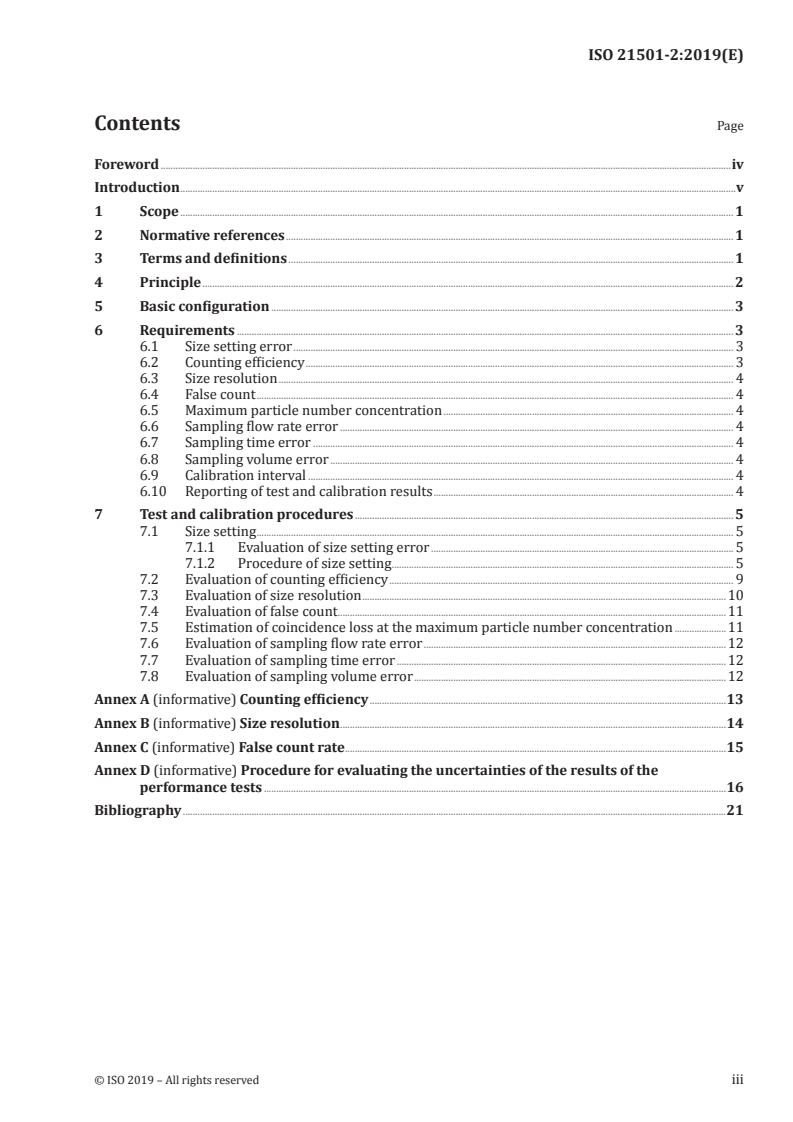
Contents Page
Foreword .iv
Introduction .v
1 Scope . 1
2 Normative references . 1
3 Terms and definitions . 1
4 Principle . 2
5 Basic configuration . 3
6 Requirements . 3
6.1 Size setting error . 3
6.2 Counting efficiency . 3
6.3 Size resolution . 4
6.4 False count . 4
6.5 Maximum particle number concentration . 4
6.6 Sampling flow rate error . 4
6.7 Sampling time error . 4
6.8 Sampling volume error . 4
6.9 Calibration interval . 4
6.10 Reporting of test and calibration results . 4
7 Test and calibration procedures . 5
7.1 Size setting . 5
7.1.1 Evaluation of size setting error . 5
7.1.2 Procedure of size setting . 5
7.2 Evaluation of counting efficiency . 9
7.3 Evaluation of size resolution .10
7.4 Evaluation of false count . .11
7.5 Estimation of coincidence loss at the maximum particle number concentration .11
7.6 Evaluation of sampling flow rate error .12
7.7 Evaluation of sampling time error .12
7.8 Evaluation of sampling volume error .12
Annex A (informative) Counting efficiency .13
Annex B (informative) Size resolution .14
Annex C (informative) False count rate .15
Annex D (informative) Procedure for evaluating the uncertainties of the results of the
performance tests .16
Bibliography .21
Foreword
ISO (the International Organization for Standardization) is a worldwide federation of national standards
bodies (ISO member bodies). The work of preparing International Standards is normally carried out
through ISO technical committees. Each member body interested in a subject for which a technical
committee has been established has the right to be represented on that committee. International
organizations, governmental and non-governmental, in liaison with ISO, also take part in the work.
ISO collaborates closely with the International Electrotechnical Commission (IEC) on all matters of
electrotechnical standardization.
The procedures used to develop this document and those intended for its further maintenance are
described in the ISO/IEC Directives, Part 1. In particular, the different approval criteria needed for the
different types of ISO documents should be noted. This document was drafted in accordance with the
editorial rules of the ISO/IEC Directives, Part 2 (see www .iso .org/ directives).
Attention is drawn to the possibility that some of the elements of this document may be the subject of
patent rights. ISO shall not be held responsible for identifying any or all such patent rights. Details of
any patent rights identified during the development of the document will be in the Introduction and/or
on the ISO list of patent declarations received (see www .iso .org/ patents).
Any trade name used in this document is information given for the convenience of users and does not
constitute an endorsement.
For an explanation of the voluntary nature of standards, the meaning of ISO specific terms and
expressions related to conformity assessment, as well as information about ISO's adherence to the
World Trade Organization (WTO) principles in the Technical Barriers to Trade (TBT), see www .iso .org/
iso/ foreword .html.
This document was prepared by Technical Committee ISO/TC 24., Particle characterization including
sieving, Subcommittee SC 4, Particle characterization.
This second edition cancels and replaces the first edition (ISO 21501-2:2007), which has been technically
revised. The main changes from the previous edition are as follows:
— Clause 4 for “Principle” and Clause 5 for “Basic configuration” have been added;
— “size calibration” and “verification of size setting” have been combined as “size setting error” in the
requirements (Clause 6);
— “Test report” (3.11 in the previous edition) has been changed to 6.10 on “Reporting of test and
calibration results”;
— information about uncertainties has been enriched and is now the subject of Annex D.
A list of all parts in the ISO 21501 series can be found on the ISO website.
Any feedback or questions on this document should be directed to the user’s national standards body. A
complete listing of these bodies can be found at www .iso .org/ members .html.
iv © ISO 2019 – All rights reserved
Introduction
Monitoring particle contamination levels is required in various fields, e.g. in the electronic industry, in
the pharmaceutical industry, in the manufacturing of precision machines and in medical operations.
Particle counters are useful instruments for monitoring particle contamination in liquid. The purpose
of this document is to provide a calibration procedure and verification method for particle counters, so
as to minimize the inaccuracy in the measurement result by a counter, as well as the differences in the
results measured by different instruments.
INTERNATIONAL STANDARD ISO 21501-2:2019(E)
Determination of particle size distribution — Single
particle light interaction methods —
Part 2:
Light scattering liquid-borne particle counter
1 Scope
This document describes a calibration and verification method for a light scattering liquid-borne
particle counter (LSLPC), which is used to measure the size and particle number concentration of
particles suspended in liquid. The light scattering method described in this document is based on single
particle measurements. The typical size range of particles measured by this method is between 0,1 µm
and 10 µm in particle size.
The method is applicable to instruments used for the evaluation of the cleanliness of pure water and
chemicals, as well as the measurement of number and size distribution of particles in various liquids.
The measured particle size using the LSLPC depends on the refractive index of particles and medium;
therefore, the measured particle size is equivalent to the calibration particles in pure water.
The following are within the scope of this document:
— size setting error;
— counting efficiency;
— size resolution;
— false count;
— maximum particle number concentration;
— sampling flow rate error;
— sampling time error;
— sampling volume error;
— calibration interval;
— reporting results from test and calibration.
2 Normative references
There are no normative references in this document.
3 Terms and definitions
For the purposes of this document, the following terms and definitions apply.
ISO and IEC maintain terminological databases for use in standardization at the following addresses:
— IEC Electropedia: available at http:// www .electropedia .org/
— ISO Online browsing platform: available at https:// www .iso .org/ obp
3.1
calibration particles
monodisperse spherical particles with a known mean particle size, e.g. polystyrene latex (PSL)
particles, where the certified size is traceable to the International System of Units (SI), a relative
standard uncertainty equal to or less than 2,5 %, and a refractive index that is approximately 1,59 at
the wavelength of 589 nm (sodium D line)
Note 1 to entry: For spherical particles, the particle size is equal to the diameter.
3.2
counting efficiency
ratio of the number concentration measured by a light scattering liquid-borne particle counter (3.4) to
that measured by a reference instrument for the same sample
3.3
false count
apparent count per unit volume of sample liquid when a sample liquid containing no measurable
particles is measured by the light scattering liquid-borne particle counter (3.4)
3.4
LSLPC
light scattering liquid-borne particle counter
instrument that measures liquid-borne particle numbers by counting the pulses as the particles pass
through the sensing volume, as well as particle size by scattered light intensity
Note 1 to entry: The optical particle size measured by the LSLPC is the light scattering equivalent particle size
and not the geometrical size.
3.5
PHA
pulse height analyser
instrument that analyses the distribution of pulse heights
3.6
size resolution
measure of the ability of an instrument to distinguish between particles of different sizes
3.7
coincidence loss
reduction of particle count caused by multiple particles passing simultaneously through the sensing
volume and/or by the finite processing time of the electronic system
3.8
MPE
maximum permissible error
limit of error
extreme value of measurement error, with respect to a known reference quantity value, permitted by
specifications for a given measurement, measuring instrument, or measuring system
Note 1 to entry: This document uses decimal numbers for the requirements to MPEs to avoid confusions that may
arise when relative uncertainties of test results are reported in percent figures.
4 Principle
The measurement principle of the LSLPC is based on detection of light scattered by a particle when the
particle passes through an incident light beam.
The particle size is determined from the intensity of the scattered light, and the number of particles
from the number of light pulses scattered by individual particles.
2 © ISO 2019 – All rights reserved
More specifically, a sample liquid is drawn from the inlet of the LSLPC at a constant flow rate, and
introduced to the sensing volume of the LSLPC where a light beam is irradiated. When a particle
suspended in the sample liquid passes through the light beam, it scatters the light, emitting a light
pulse. The light pulse is detected by a photo detector and converted to an electrical pulse. The electrical
pulse height is proportional to the scattered light intensity, and depends on the optical system design,
the electronic components used, and the light source. The intensity of the scattered light is dependent
on the size, refractive index and shape of the particle. If the particle is spherical, the scattered light
intensity is described by the Mie theory. In order to establish a relationship between the electrical pulse
height and the particle size, calibration of each LSLPC with use of particles having a well-defined size,
refractive index, and shape is required.
5 Basic configuration
An LSLPC is composed typically of a light source, a sample liquid supply/suction system, a sensing
volume, a photoelectric conversion device, a pulse height analyser, and a display (see Figure 1). Some
LSLPCs do not contain a sample liquid supply/suction system and/or a display.
To make the particle size calibration possible, the LSLPC should be constructed so that pulse height
distributions for calibration particles can be measured.
Figure 1 — Example of basic configuration of LSLPC
6 Requirements
6.1 Size setting error
The MPE for size setting in the minimum detectable particle size and other sizes specified by the
manufacturer of an LSLPC is 0,15 (corresponding to 15 % of the specified size).
Size setting shall be conducted before the LSLPC is shipped from the manufacturer, and when the size
setting error is found not fulfilled in a periodic calibration.
A recommended procedure for size setting is described in 7.1.2. If other methods are used, their
uncertainty shall be evaluated and described.
6.2 Counting efficiency
The counting efficiency shall be within 0,20 to 0,80 [corresponding to (50 ± 30) %] for calibration
particles with a size close to the minimum detectable size, and it shall be within 0,70 to 1,30
[(100 ± 30) %] for calibration particles with the particle size 1,5 to 3 times larger than the minimum
detectable particle size.
When calibration particles with exactly the same size as the minimum detectable particle size are not
available, particles whose size is within ±5 % of the minimum detectable particle size may be used and
the diameter of the calibration particles shall be reported.
6.3 Size resolution
The size resolution shall be less than or equal to 0,10 (corresponding to 10 % of the specified particle
size), when it is evaluated using calibration particles of a certified average size specified by the
manufacturer.
A recommended procedure is described in 7.3. If other methods are used, their uncertainty shall be
evaluated and described.
6.4 False count
The false count per volume in litre and its 95 % upper confidence limit (UCL) shall be determined
according to 7.4. The 95 % UCL shall be less than or equal to the value specified and reported by the
manufacturer of the LSLPC.
6.5 Maximum particle number concentration
The maximum measurable particle number concentration shall be specified by the manufacturer. The
coincidence loss at the maximum particle number concentration of an LSLPC shall be less than or equal
to 0,1 (corresponding to 10 %).
NOTE The probability of occurrence of coincidence loss increases with increasing particle number
concentration.
6.6 Sampling flow rate error
The MPE of the sampling flow rate shall be specified by the manufacturer. The user shall check that the
sampling flow rate is within the range specified by the manufacturer.
6.7 Sampling time error
The MPE in the duration of sampling time shall be 0,01 (corresponding to 1 %) of the preset value.
If the LSLPC does not have a sampling time control system, this subclause does not apply.
6.8 Sampling volume error
The MPE of sampling volume shall be 0,05 (corresponding to 5 %) of the preset value.
This subclause does not apply when the LSLPC is not equipped with a sampling system.
6.9 Calibration interval
The calibration of the LSLPC should be conducted at an interval equal to or shorter than one year. The
requirements should be met during the calibration interval.
6.10 Reporting of test and calibration results
The report shall contain at least the following information:
a) date of test/calibration;
b) test/calibration particles used;
4 © ISO 2019 – All rights reserved
c) results for the parameters:
1) size setting error;
2) counting efficiency;
3) sampling flow rate error;
4) size resolution (with the particle size used);
d) threshold voltage values or channel of the built-in PHA corresponding to the size settings;
e) reference of the test/calibration method used (i.e. ISO 21501-2).
f) report/certificate identification, test/calibration location, title and identification of test/calibration
provider including signature and date;
g) identification of customer and device under test, including how output was obtained for counting
efficiency (e.g. analogue, display or digital output).
A calibration certificate shall furthermore include:
h) identification and — if possible — statement of metrological traceability of all reference equipment
and calibration particles used;
i) relevant environmental conditions (e.g. temperature, air pressure and humidity) under which the
calibration was performed;
j) a stated uncertainty for each result for the parameters 1 to 2 with reference to the calculation
method (e.g. ISO/IEC Guide 98-3) — Annex D gives a recommended procedure for evaluating the
uncertainty of the results of the performance tests.
k) a stated false count at a 95 % confidence limit (see Annex C).
NOTE Calibration certificates issued by ISO/IEC 17025 accredited laboratories and covering all results for
the parameters 1 to 2 are considered to comply with the requirements above.
7 Test and calibration procedures
7.1 Size setting
7.1.1 Evaluation of size setting error
Calculate the size setting error, ε, according to Formula (1).
′
xx−
ii
ε = (1)
x
i
where
x is the size setting specified for the LSLPC;
i
x ' is the actual size setting corresponding to V (see 7.1.2 for the meaning of V ).
i ti ti
7.1.2 Procedure of size setting
By use of a PHA connected to the output terminal for signal pulses of the LSLPC, or by use of a built-in
PHA if one is contained as a part of the LSLPC, obtain a pulse height distribution for a sample liquid
in which calibration particles are suspended. Let V and V denote the lower and upper voltage limits,
l u
respectively, of the range of pulse heights for the calibration particles (see Figure 2). The median voltage
V of the pulse height distribution in the range from V to V , shall be calculated, and is assigned to the
m l u
certified size of the calibration particles, x .
c
When a built-in PHA is used, the abscissa of the pulse height distribution may be given in channel
number instead of voltage. In this case, the term “voltage” above and in relevant descriptions below
should be interpreted as channel number of the PHA.
Key
X pulse height voltage
Y frequency
1 pulse height distribution
V lower voltage limit
l
V median voltage
m
V upper voltage limit
u
Figure 2 — Pulse height distribution for the sample liquid
If a noise distribution is observed in the pulse height distribution, and if it is separated distinctly from
the main peak corresponding to the calibration particles, the voltages V and V shall be chosen so that
l u
the range (V , V ) encompasses only the main peak [see Figure 3 a)]. If the noise distribution overlaps
l u
with the main peak, V and V shall be chosen so that the range (V , V ) corresponds to the full width at
l u l u
half maximum of the main peak [see Figure 3 b)]. The latter way of determining V and V is allowed
l u
only when the height of the valley betw
...
INTERNATIONAL ISO
STANDARD 21501-2
Second edition
2019-11
Determination of particle size
distribution — Single particle light
interaction methods —
Part 2:
Light scattering liquid-borne particle
counter
Détermination de la distribution granulométrique — Méthodes
d'interaction lumineuse de particules uniques —
Partie 2: Compteur de particules en suspension dans un liquide en
lumière dispersée
Reference number
©
ISO 2019
© ISO 2019
All rights reserved. Unless otherwise specified, or required in the context of its implementation, no part of this publication may
be reproduced or utilized otherwise in any form or by any means, electronic or mechanical, including photocopying, or posting
on the internet or an intranet, without prior written permission. Permission can be requested from either ISO at the address
below or ISO’s member body in the country of the requester.
ISO copyright office
CP 401 • Ch. de Blandonnet 8
CH-1214 Vernier, Geneva
Phone: +41 22 749 01 11
Fax: +41 22 749 09 47
Email: copyright@iso.org
Website: www.iso.org
Published in Switzerland
ii © ISO 2019 – All rights reserved
Contents Page
Foreword .iv
Introduction .v
1 Scope . 1
2 Normative references . 1
3 Terms and definitions . 1
4 Principle . 2
5 Basic configuration . 3
6 Requirements . 3
6.1 Size setting error . 3
6.2 Counting efficiency . 3
6.3 Size resolution . 4
6.4 False count . 4
6.5 Maximum particle number concentration . 4
6.6 Sampling flow rate error . 4
6.7 Sampling time error . 4
6.8 Sampling volume error . 4
6.9 Calibration interval . 4
6.10 Reporting of test and calibration results . 4
7 Test and calibration procedures . 5
7.1 Size setting . 5
7.1.1 Evaluation of size setting error . 5
7.1.2 Procedure of size setting . 5
7.2 Evaluation of counting efficiency . 9
7.3 Evaluation of size resolution .10
7.4 Evaluation of false count . .11
7.5 Estimation of coincidence loss at the maximum particle number concentration .11
7.6 Evaluation of sampling flow rate error .12
7.7 Evaluation of sampling time error .12
7.8 Evaluation of sampling volume error .12
Annex A (informative) Counting efficiency .13
Annex B (informative) Size resolution .14
Annex C (informative) False count rate .15
Annex D (informative) Procedure for evaluating the uncertainties of the results of the
performance tests .16
Bibliography .21
Foreword
ISO (the International Organization for Standardization) is a worldwide federation of national standards
bodies (ISO member bodies). The work of preparing International Standards is normally carried out
through ISO technical committees. Each member body interested in a subject for which a technical
committee has been established has the right to be represented on that committee. International
organizations, governmental and non-governmental, in liaison with ISO, also take part in the work.
ISO collaborates closely with the International Electrotechnical Commission (IEC) on all matters of
electrotechnical standardization.
The procedures used to develop this document and those intended for its further maintenance are
described in the ISO/IEC Directives, Part 1. In particular, the different approval criteria needed for the
different types of ISO documents should be noted. This document was drafted in accordance with the
editorial rules of the ISO/IEC Directives, Part 2 (see www .iso .org/ directives).
Attention is drawn to the possibility that some of the elements of this document may be the subject of
patent rights. ISO shall not be held responsible for identifying any or all such patent rights. Details of
any patent rights identified during the development of the document will be in the Introduction and/or
on the ISO list of patent declarations received (see www .iso .org/ patents).
Any trade name used in this document is information given for the convenience of users and does not
constitute an endorsement.
For an explanation of the voluntary nature of standards, the meaning of ISO specific terms and
expressions related to conformity assessment, as well as information about ISO's adherence to the
World Trade Organization (WTO) principles in the Technical Barriers to Trade (TBT), see www .iso .org/
iso/ foreword .html.
This document was prepared by Technical Committee ISO/TC 24., Particle characterization including
sieving, Subcommittee SC 4, Particle characterization.
This second edition cancels and replaces the first edition (ISO 21501-2:2007), which has been technically
revised. The main changes from the previous edition are as follows:
— Clause 4 for “Principle” and Clause 5 for “Basic configuration” have been added;
— “size calibration” and “verification of size setting” have been combined as “size setting error” in the
requirements (Clause 6);
— “Test report” (3.11 in the previous edition) has been changed to 6.10 on “Reporting of test and
calibration results”;
— information about uncertainties has been enriched and is now the subject of Annex D.
A list of all parts in the ISO 21501 series can be found on the ISO website.
Any feedback or questions on this document should be directed to the user’s national standards body. A
complete listing of these bodies can be found at www .iso .org/ members .html.
iv © ISO 2019 – All rights reserved
Introduction
Monitoring particle contamination levels is required in various fields, e.g. in the electronic industry, in
the pharmaceutical industry, in the manufacturing of precision machines and in medical operations.
Particle counters are useful instruments for monitoring particle contamination in liquid. The purpose
of this document is to provide a calibration procedure and verification method for particle counters, so
as to minimize the inaccuracy in the measurement result by a counter, as well as the differences in the
results measured by different instruments.
INTERNATIONAL STANDARD ISO 21501-2:2019(E)
Determination of particle size distribution — Single
particle light interaction methods —
Part 2:
Light scattering liquid-borne particle counter
1 Scope
This document describes a calibration and verification method for a light scattering liquid-borne
particle counter (LSLPC), which is used to measure the size and particle number concentration of
particles suspended in liquid. The light scattering method described in this document is based on single
particle measurements. The typical size range of particles measured by this method is between 0,1 µm
and 10 µm in particle size.
The method is applicable to instruments used for the evaluation of the cleanliness of pure water and
chemicals, as well as the measurement of number and size distribution of particles in various liquids.
The measured particle size using the LSLPC depends on the refractive index of particles and medium;
therefore, the measured particle size is equivalent to the calibration particles in pure water.
The following are within the scope of this document:
— size setting error;
— counting efficiency;
— size resolution;
— false count;
— maximum particle number concentration;
— sampling flow rate error;
— sampling time error;
— sampling volume error;
— calibration interval;
— reporting results from test and calibration.
2 Normative references
There are no normative references in this document.
3 Terms and definitions
For the purposes of this document, the following terms and definitions apply.
ISO and IEC maintain terminological databases for use in standardization at the following addresses:
— IEC Electropedia: available at http:// www .electropedia .org/
— ISO Online browsing platform: available at https:// www .iso .org/ obp
3.1
calibration particles
monodisperse spherical particles with a known mean particle size, e.g. polystyrene latex (PSL)
particles, where the certified size is traceable to the International System of Units (SI), a relative
standard uncertainty equal to or less than 2,5 %, and a refractive index that is approximately 1,59 at
the wavelength of 589 nm (sodium D line)
Note 1 to entry: For spherical particles, the particle size is equal to the diameter.
3.2
counting efficiency
ratio of the number concentration measured by a light scattering liquid-borne particle counter (3.4) to
that measured by a reference instrument for the same sample
3.3
false count
apparent count per unit volume of sample liquid when a sample liquid containing no measurable
particles is measured by the light scattering liquid-borne particle counter (3.4)
3.4
LSLPC
light scattering liquid-borne particle counter
instrument that measures liquid-borne particle numbers by counting the pulses as the particles pass
through the sensing volume, as well as particle size by scattered light intensity
Note 1 to entry: The optical particle size measured by the LSLPC is the light scattering equivalent particle size
and not the geometrical size.
3.5
PHA
pulse height analyser
instrument that analyses the distribution of pulse heights
3.6
size resolution
measure of the ability of an instrument to distinguish between particles of different sizes
3.7
coincidence loss
reduction of particle count caused by multiple particles passing simultaneously through the sensing
volume and/or by the finite processing time of the electronic system
3.8
MPE
maximum permissible error
limit of error
extreme value of measurement error, with respect to a known reference quantity value, permitted by
specifications for a given measurement, measuring instrument, or measuring system
Note 1 to entry: This document uses decimal numbers for the requirements to MPEs to avoid confusions that may
arise when relative uncertainties of test results are reported in percent figures.
4 Principle
The measurement principle of the LSLPC is based on detection of light scattered by a particle when the
particle passes through an incident light beam.
The particle size is determined from the intensity of the scattered light, and the number of particles
from the number of light pulses scattered by individual particles.
2 © ISO 2019 – All rights reserved
More specifically, a sample liquid is drawn from the inlet of the LSLPC at a constant flow rate, and
introduced to the sensing volume of the LSLPC where a light beam is irradiated. When a particle
suspended in the sample liquid passes through the light beam, it scatters the light, emitting a light
pulse. The light pulse is detected by a photo detector and converted to an electrical pulse. The electrical
pulse height is proportional to the scattered light intensity, and depends on the optical system design,
the electronic components used, and the light source. The intensity of the scattered light is dependent
on the size, refractive index and shape of the particle. If the particle is spherical, the scattered light
intensity is described by the Mie theory. In order to establish a relationship between the electrical pulse
height and the particle size, calibration of each LSLPC with use of particles having a well-defined size,
refractive index, and shape is required.
5 Basic configuration
An LSLPC is composed typically of a light source, a sample liquid supply/suction system, a sensing
volume, a photoelectric conversion device, a pulse height analyser, and a display (see Figure 1). Some
LSLPCs do not contain a sample liquid supply/suction system and/or a display.
To make the particle size calibration possible, the LSLPC should be constructed so that pulse height
distributions for calibration particles can be measured.
Figure 1 — Example of basic configuration of LSLPC
6 Requirements
6.1 Size setting error
The MPE for size setting in the minimum detectable particle size and other sizes specified by the
manufacturer of an LSLPC is 0,15 (corresponding to 15 % of the specified size).
Size setting shall be conducted before the LSLPC is shipped from the manufacturer, and when the size
setting error is found not fulfilled in a periodic calibration.
A recommended procedure for size setting is described in 7.1.2. If other methods are used, their
uncertainty shall be evaluated and described.
6.2 Counting efficiency
The counting efficiency shall be within 0,20 to 0,80 [corresponding to (50 ± 30) %] for calibration
particles with a size close to the minimum detectable size, and it shall be within 0,70 to 1,30
[(100 ± 30) %] for calibration particles with the particle size 1,5 to 3 times larger than the minimum
detectable particle size.
When calibration particles with exactly the same size as the minimum detectable particle size are not
available, particles whose size is within ±5 % of the minimum detectable particle size may be used and
the diameter of the calibration particles shall be reported.
6.3 Size resolution
The size resolution shall be less than or equal to 0,10 (corresponding to 10 % of the specified particle
size), when it is evaluated using calibration particles of a certified average size specified by the
manufacturer.
A recommended procedure is described in 7.3. If other methods are used, their uncertainty shall be
evaluated and described.
6.4 False count
The false count per volume in litre and its 95 % upper confidence limit (UCL) shall be determined
according to 7.4. The 95 % UCL shall be less than or equal to the value specified and reported by the
manufacturer of the LSLPC.
6.5 Maximum particle number concentration
The maximum measurable particle number concentration shall be specified by the manufacturer. The
coincidence loss at the maximum particle number concentration of an LSLPC shall be less than or equal
to 0,1 (corresponding to 10 %).
NOTE The probability of occurrence of coincidence loss increases with increasing particle number
concentration.
6.6 Sampling flow rate error
The MPE of the sampling flow rate shall be specified by the manufacturer. The user shall check that the
sampling flow rate is within the range specified by the manufacturer.
6.7 Sampling time error
The MPE in the duration of sampling time shall be 0,01 (corresponding to 1 %) of the preset value.
If the LSLPC does not have a sampling time control system, this subclause does not apply.
6.8 Sampling volume error
The MPE of sampling volume shall be 0,05 (corresponding to 5 %) of the preset value.
This subclause does not apply when the LSLPC is not equipped with a sampling system.
6.9 Calibration interval
The calibration of the LSLPC should be conducted at an interval equal to or shorter than one year. The
requirements should be met during the calibration interval.
6.10 Reporting of test and calibration results
The report shall contain at least the following information:
a) date of test/calibration;
b) test/calibration particles used;
4 © ISO 2019 – All rights reserved
c) results for the parameters:
1) size setting error;
2) counting efficiency;
3) sampling flow rate error;
4) size resolution (with the particle size used);
d) threshold voltage values or channel of the built-in PHA corresponding to the size settings;
e) reference of the test/calibration method used (i.e. ISO 21501-2).
f) report/certificate identification, test/calibration location, title and identification of test/calibration
provider including signature and date;
g) identification of customer and device under test, including how output was obtained for counting
efficiency (e.g. analogue, display or digital output).
A calibration certificate shall furthermore include:
h) identification and — if possible — statement of metrological traceability of all reference equipment
and calibration particles used;
i) relevant environmental conditions (e.g. temperature, air pressure and humidity) under which the
calibration was performed;
j) a stated uncertainty for each result for the parameters 1 to 2 with reference to the calculation
method (e.g. ISO/IEC Guide 98-3) — Annex D gives a recommended procedure for evaluating the
uncertainty of the results of the performance tests.
k) a stated false count at a 95 % confidence limit (see Annex C).
NOTE Calibration certificates issued by ISO/IEC 17025 accredited laboratories and covering all results for
the parameters 1 to 2 are considered to comply with the requirements above.
7 Test and calibration procedures
7.1 Size setting
7.1.1 Evaluation of size setting error
Calculate the size setting error, ε, according to Formula (1).
′
xx−
ii
ε = (1)
x
i
where
x is the size setting specified for the LSLPC;
i
x ' is the actual size setting corresponding to V (see 7.1.2 for the meaning of V ).
i ti ti
7.1.2 Procedure of size setting
By use of a PHA connected to the output terminal for signal pulses of the LSLPC, or by use of a built-in
PHA if one is contained as a part of the LSLPC, obtain a pulse height distribution for a sample liquid
in which calibration particles are suspended. Let V and V denote the lower and upper voltage limits,
l u
respectively, of the range of pulse heights for the calibration particles (see Figure 2). The median voltage
V of the pulse height distribution in the range from V to V , shall be calculated, and is assigned to the
m l u
certified size of the calibration particles, x .
c
When a built-in PHA is used, the abscissa of the pulse height distribution may be given in channel
number instead of voltage. In this case, the term “voltage” above and in relevant descriptions below
should be interpreted as channel number of the PHA.
Key
X pulse height voltage
Y frequency
1 pulse height distribution
V lower voltage limit
l
V median voltage
m
V upper voltage limit
u
Figure 2 — Pulse height distribution for the sample liquid
If a noise distribution is observed in the pulse height distribution, and if it is separated distinctly from
the main peak corresponding to the calibration particles, the voltages V and V shall be chosen so that
l u
the range (V , V ) encompasses only the main peak [see Figure 3 a)]. If the noise distribution overlaps
l u
with the main peak, V and V shall be chosen so that the range (V , V ) corresponds to the full width at
l u l u
half maximum of the main peak [see Figure 3 b)]. The latter way of determining V and V is allowed
l u
only when the height of the valley betw
...