

ISO 26202:2019
(Main)Magnesium and magnesium alloys — Magnesium alloys for cast anodes
General Information
- Abstract
This document specifies the grades and the corresponding requirements for magnesium alloy ingots for anodes and for magnesium alloy cast anodes.
- Status
- Published
- Publication Date
- 30-Oct-2019
- Technical Committee
- ISO/TC 79/SC 5 - Magnesium and alloys of cast or wrought magnesium
- Drafting Committee
- ISO/TC 79/SC 5 - Magnesium and alloys of cast or wrought magnesium
- Current Stage
- 9060 - Close of review
- Completion Date
- 04-Jun-2030
Buy Documents


ISO 26202:2019 - Magnesium and magnesium alloys -- Magnesium alloys for cast anodes
ISO 26202:2019 - Magnesium and magnesium alloys — Magnesium alloys for cast anodes/31/2019
Overview - ISO 26202:2019 (Magnesium alloys for cast anodes)
ISO 26202:2019 specifies grades and delivery requirements for magnesium alloy ingots and cast magnesium anodes used as galvanic (sacrificial) anodes. The standard defines material designations, casting-process symbols, chemical composition limits for each alloy grade, sampling and testing procedures (including electrochemical tests), and requirements for packaging and surface protection.
Key topics and technical requirements
- Material designations: Grades are designated by symbol or number (examples: ISO-MBMgAl3Zn1, ISO-MAMgA3Zn1). Casting-process symbols: S = sand casting, K = permanent mould (gravity), C = continuous casting.
- Chemical composition: Tables set minimum/maximum mass fractions for major elements (Al, Zn, Mn) and limits for impurities (Si, Fe, Cu, Ni, etc.) for both ingots and castings. Example ranges include:
- Mg–Al–Zn alloys (e.g., ISO‑MB/MAMgAl3Zn1 and MgAl6Zn3) with specified Al, Zn, Mn ranges.
- Mg–Mn alloys with defined Mn minimums (e.g., 0.5 % and 1.2 % classes) and tight limits on other elements.
- Potable water specification: For anodes used in drinking water, contaminant limits are required: (As + Pb + Cr(VI) + Ni) ≤ 0.1% and (Cd + Sb + Se + Hg) ≤ 0.01% (mass fraction).
- Sampling and chemical analysis: Samples shall be representative and taken from molten metal at casting. Chemical analysis methods shall follow standardized or validated procedures (note: ASTM B953 and ASTM B954 are identified as acceptable references).
- Electrochemical testing (Annex A & B):
- Annex A: Electrode potential measured in 0.0010 mol·L−1 NaCl at (60 ± 3) °C using galvanostatic polarization; recommended average potential more negative than −0.9 V vs SHE at 50 μA/cm² to avoid passivation.
- Annex B: Mass-loss test in 0.01 mol·L−1 NaCl at (60 ± 3) °C with galvanostatic 50 mA/cm²; mass loss inferred from hydrogen evolution.
- Packaging/surface protection: Manufacturer must provide protection to prevent damage, contamination or corrosion during transport and storage unless otherwise agreed.
Applications and who uses this standard
- Manufacturers and foundries producing magnesium ingots and cast sacrificial anodes for cathodic protection.
- Designers and specifiers in marine, pipeline, underground storage tank, and water utility industries requiring reliable galvanic anodes.
- Quality assurance teams and testing laboratories performing chemical and electrochemical verification.
- Purchasers and procurement specialists ensuring compliance with material grade, casting process, and potable‑water requirements.
Related standards
- EN 1559-1 and EN 1559-5 (technical delivery conditions for castings)
- ISO 80000-1 (quantities and units)
- ASTM B953 / B954 (examples of chemical analysis procedures)
Keywords: ISO 26202:2019, magnesium alloys, cast anodes, chemical composition, electrode potential, mass loss test, galvanic anode, casting processes, potable water anodes, electrochemical testing.
Relations
- Effective Date
- 03-Jun-2017
Buy Documents
ISO 26202:2019 - Magnesium and magnesium alloys -- Magnesium alloys for cast anodes
ISO 26202:2019 - Magnesium and magnesium alloys — Magnesium alloys for cast anodes/31/2019
Get Certified
Connect with accredited certification bodies for this standard

Element Materials Technology
Materials testing and product certification.

Inštitut za kovinske materiale in tehnologije
Institute of Metals and Technology. Materials testing, metallurgical analysis, NDT.
Sponsored listings
Frequently Asked Questions
ISO 26202:2019 is a standard published by the International Organization for Standardization (ISO). Its full title is "Magnesium and magnesium alloys — Magnesium alloys for cast anodes". This standard covers: This document specifies the grades and the corresponding requirements for magnesium alloy ingots for anodes and for magnesium alloy cast anodes.
This document specifies the grades and the corresponding requirements for magnesium alloy ingots for anodes and for magnesium alloy cast anodes.
ISO 26202:2019 is classified under the following ICS (International Classification for Standards) categories: 77.120.20 - Magnesium and magnesium alloys. The ICS classification helps identify the subject area and facilitates finding related standards.
ISO 26202:2019 has the following relationships with other standards: It is inter standard links to ISO 26202:2007. Understanding these relationships helps ensure you are using the most current and applicable version of the standard.
ISO 26202:2019 is available in PDF format for immediate download after purchase. The document can be added to your cart and obtained through the secure checkout process. Digital delivery ensures instant access to the complete standard document.
Standards Content (Sample)
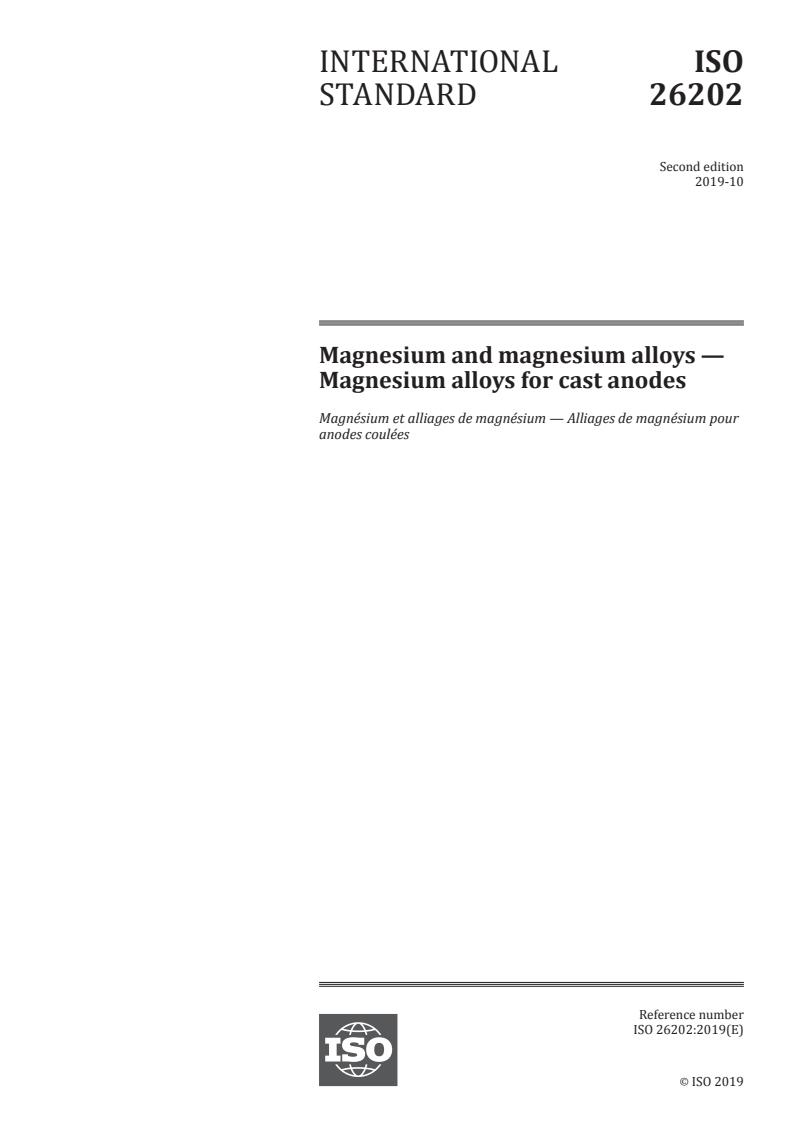
INTERNATIONAL ISO
STANDARD 26202
Second edition
2019-10
Magnesium and magnesium alloys —
Magnesium alloys for cast anodes
Magnésium et alliages de magnésium — Alliages de magnésium pour
anodes coulées
Reference number
©
ISO 2019
© ISO 2019
All rights reserved. Unless otherwise specified, or required in the context of its implementation, no part of this publication may
be reproduced or utilized otherwise in any form or by any means, electronic or mechanical, including photocopying, or posting
on the internet or an intranet, without prior written permission. Permission can be requested from either ISO at the address
below or ISO’s member body in the country of the requester.
ISO copyright office
CP 401 • Ch. de Blandonnet 8
CH-1214 Vernier, Geneva
Phone: +41 22 749 01 11
Fax: +41 22 749 09 47
Email: copyright@iso.org
Website: www.iso.org
Published in Switzerland
ii © ISO 2019 – All rights reserved
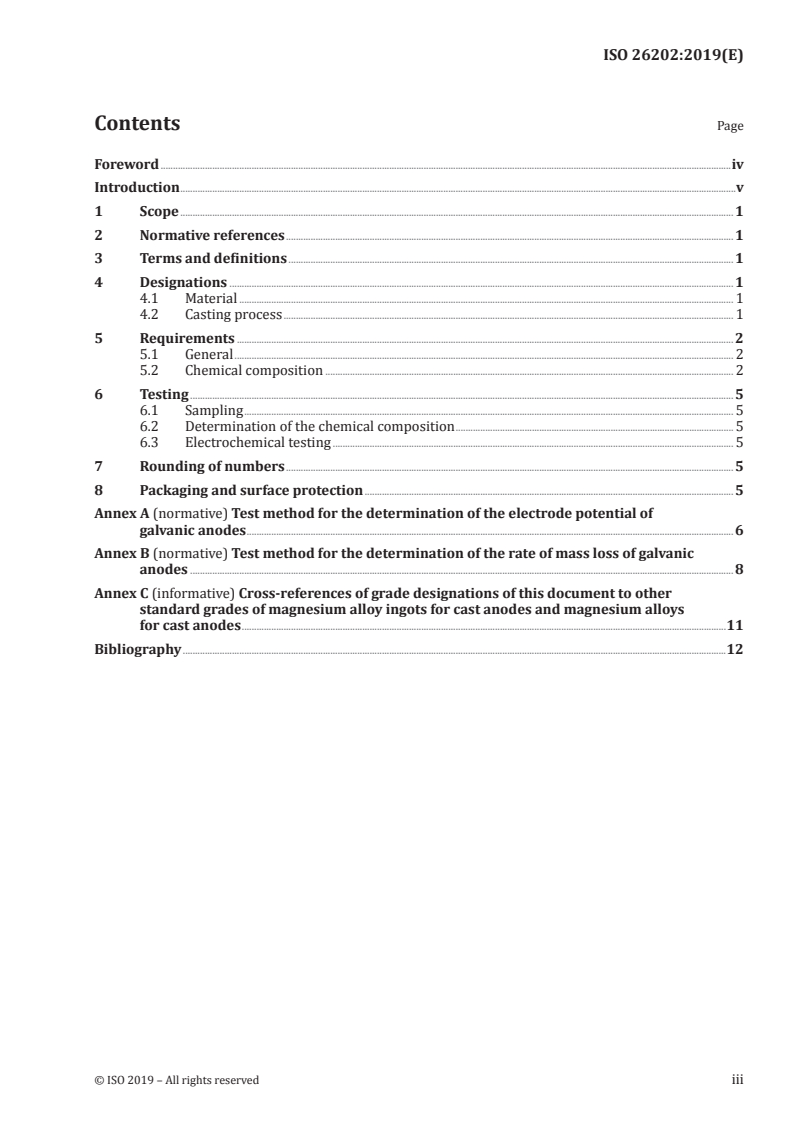
Contents Page
Foreword .iv
Introduction .v
1 Scope . 1
2 Normative references . 1
3 Terms and definitions . 1
4 Designations . 1
4.1 Material . 1
4.2 Casting process . 1
5 Requirements . 2
5.1 General . 2
5.2 Chemical composition . 2
6 Testing . 5
6.1 Sampling . 5
6.2 Determination of the chemical composition . 5
6.3 Electrochemical testing . 5
7 Rounding of numbers . 5
8 Packaging and surface protection . 5
Annex A (normative) Test method for the determination of the electrode potential of
galvanic anodes . 6
Annex B (normative) Test method for the determination of the rate of mass loss of galvanic
anodes . 8
Annex C (informative) Cross-references of grade designations of this document to other
standard grades of magnesium alloy ingots for cast anodes and magnesium alloys
for cast anodes .11
Bibliography .12
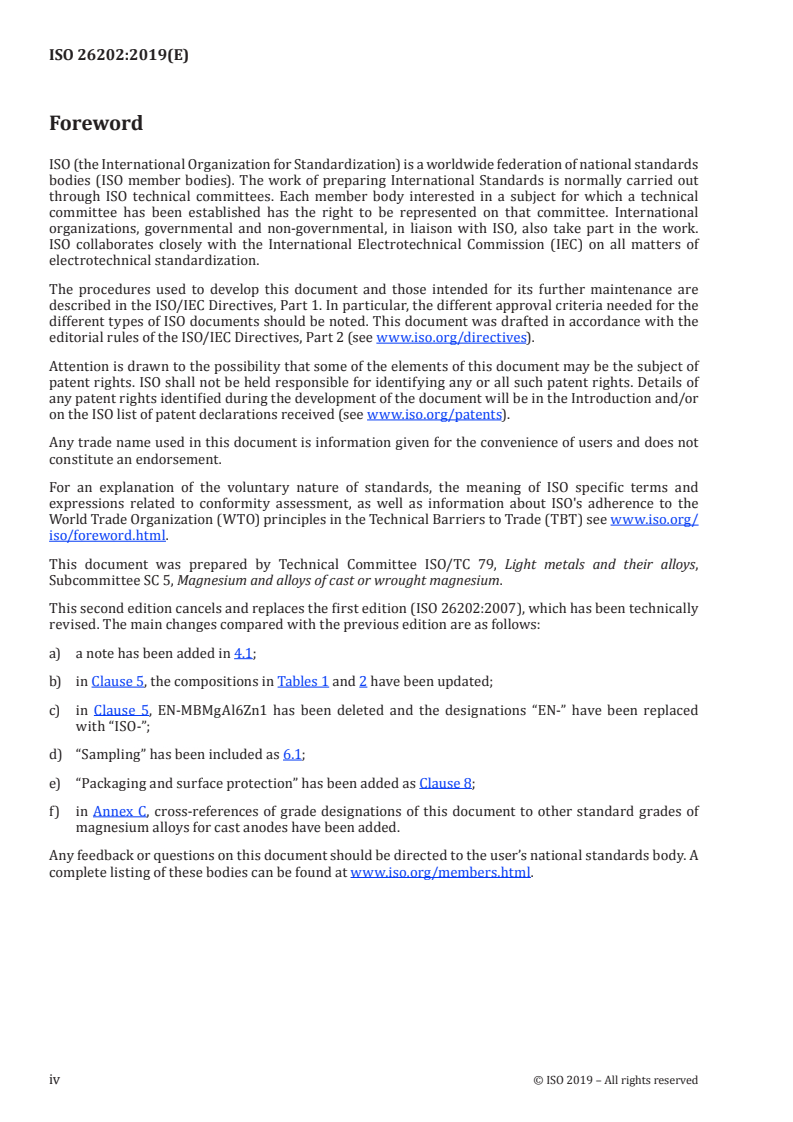
Foreword
ISO (the International Organization for Standardization) is a worldwide federation of national standards
bodies (ISO member bodies). The work of preparing International Standards is normally carried out
through ISO technical committees. Each member body interested in a subject for which a technical
committee has been established has the right to be represented on that committee. International
organizations, governmental and non-governmental, in liaison with ISO, also take part in the work.
ISO collaborates closely with the International Electrotechnical Commission (IEC) on all matters of
electrotechnical standardization.
The procedures used to develop this document and those intended for its further maintenance are
described in the ISO/IEC Directives, Part 1. In particular, the different approval criteria needed for the
different types of ISO documents should be noted. This document was drafted in accordance with the
editorial rules of the ISO/IEC Directives, Part 2 (see www .iso .org/ directives).
Attention is drawn to the possibility that some of the elements of this document may be the subject of
patent rights. ISO shall not be held responsible for identifying any or all such patent rights. Details of
any patent rights identified during the development of the document will be in the Introduction and/or
on the ISO list of patent declarations received (see www .iso .org/ patents).
Any trade name used in this document is information given for the convenience of users and does not
constitute an endorsement.
For an explanation of the voluntary nature of standards, the meaning of ISO specific terms and
expressions related to conformity assessment, as well as information about ISO's adherence to the
World Trade Organization (WTO) principles in the Technical Barriers to Trade (TBT) see www .iso .org/
iso/ foreword .html.
This document was prepared by Technical Committee ISO/TC 79, Light metals and their alloys,
Subcommittee SC 5, Magnesium and alloys of cast or wrought magnesium.
This second edition cancels and replaces the first edition (ISO 26202:2007), which has been technically
revised. The main changes compared with the previous edition are as follows:
a) a note has been added in 4.1;
b) in Clause 5, the compositions in Tables 1 and 2 have been updated;
c) in Clause 5, EN-MBMgAl6Zn1 has been deleted and the designations “EN-” have been replaced
with “ISO-”;
d) “Sampling” has been included as 6.1;
e) “Packaging and surface protection” has been added as Clause 8;
f) in Annex C, cross-references of grade designations of this document to other standard grades of
magnesium alloys for cast anodes have been added.
Any feedback or questions on this document should be directed to the user’s national standards body. A
complete listing of these bodies can be found at www .iso .org/ members .html.
iv © ISO 2019 – All rights reserved
Introduction
This document classifies magnesium alloys for cast anodes into a number of grades suitable for the
applications for which they might be used. Annexes A and B describe methods for electrochemical tests
with corresponding recommended values. Annex C gives cross-references of grade designations of this
document to other standard grades of magnesium alloys for cast anodes.
INTERNATIONAL STANDARD ISO 26202:2019(E)
Magnesium and magnesium alloys — Magnesium alloys for
cast anodes
1 Scope
This document specifies the grades and the corresponding requirements for magnesium alloy ingots
for anodes and for magnesium alloy cast anodes.
2 Normative references
The following documents are referred to in the text in such a way that some or all of their content
constitutes requirements of this document. For dated references, only the edition cited applies. For
undated references, the latest edition of the referenced document (including any amendments) applies.
ISO 80000-1:2009, Quantities and units — Part 1: General
EN 1559-1, Founding — Technical conditions of delivery — Part 1: General
EN 1559-5, Founding — Technical conditions of delivery — Part 5: Additional requirements for magnesium
alloy castings
3 Terms and definitions
No terms and definitions are listed in this document.
ISO and IEC maintain terminological databases for use in standardization at the following addresses:
— ISO Online browsing platform: available at https:// www .iso .org/ obp
— IEC Electropedia: available at http:// www .electropedia .org/
4 Designations
4.1 Material
The material shall be designated either by symbol or by number (see Tables 1 and 2).
NOTE Cross-references of grade designations of this document to other standard grades of magnesium
alloys for cast anodes are given in Annex C.
4.2 Casting process
The following symbols shall be used for the different casting processes:
— S: sand casting;
— K: permanent mould casting (gravity);
— C: continuous casting.
5 Requirements
5.1 General
The requirements for technical delivery conditions given in EN 1559-1 and EN 1559-5 shall apply, and/
or any other technical requirements specified in the order agreed between the purchaser and the
manufacturer.
5.2 Chemical composition
The chemical composition of magnesium alloy ingots for cast anodes shall conform to the requirements
given in Table 1. The chemical composition of magnesium cast anodes shall conform to the requirements
given in Table 2.
2 © ISO 2019 – All rights reserved
Table 1 — Chemical composition of magnesium alloy ingots for anode castings
Material designation Composition in percent (mass fraction)
Alloy
Others Others
...
INTERNATIONAL ISO
STANDARD 26202
Second edition
2019-10
Magnesium and magnesium alloys —
Magnesium alloys for cast anodes
Magnésium et alliages de magnésium — Alliages de magnésium pour
anodes coulées
Reference number
©
ISO 2019
© ISO 2019
All rights reserved. Unless otherwise specified, or required in the context of its implementation, no part of this publication may
be reproduced or utilized otherwise in any form or by any means, electronic or mechanical, including photocopying, or posting
on the internet or an intranet, without prior written permission. Permission can be requested from either ISO at the address
below or ISO’s member body in the country of the requester.
ISO copyright office
CP 401 • Ch. de Blandonnet 8
CH-1214 Vernier, Geneva
Phone: +41 22 749 01 11
Fax: +41 22 749 09 47
Email: copyright@iso.org
Website: www.iso.org
Published in Switzerland
ii © ISO 2019 – All rights reserved
Contents Page
Foreword .iv
Introduction .v
1 Scope . 1
2 Normative references . 1
3 Terms and definitions . 1
4 Designations . 1
4.1 Material . 1
4.2 Casting process . 1
5 Requirements . 2
5.1 General . 2
5.2 Chemical composition . 2
6 Testing . 5
6.1 Sampling . 5
6.2 Determination of the chemical composition . 5
6.3 Electrochemical testing . 5
7 Rounding of numbers . 5
8 Packaging and surface protection . 5
Annex A (normative) Test method for the determination of the electrode potential of
galvanic anodes . 6
Annex B (normative) Test method for the determination of the rate of mass loss of galvanic
anodes . 8
Annex C (informative) Cross-references of grade designations of this document to other
standard grades of magnesium alloy ingots for cast anodes and magnesium alloys
for cast anodes .11
Bibliography .12
Foreword
ISO (the International Organization for Standardization) is a worldwide federation of national standards
bodies (ISO member bodies). The work of preparing International Standards is normally carried out
through ISO technical committees. Each member body interested in a subject for which a technical
committee has been established has the right to be represented on that committee. International
organizations, governmental and non-governmental, in liaison with ISO, also take part in the work.
ISO collaborates closely with the International Electrotechnical Commission (IEC) on all matters of
electrotechnical standardization.
The procedures used to develop this document and those intended for its further maintenance are
described in the ISO/IEC Directives, Part 1. In particular, the different approval criteria needed for the
different types of ISO documents should be noted. This document was drafted in accordance with the
editorial rules of the ISO/IEC Directives, Part 2 (see www .iso .org/ directives).
Attention is drawn to the possibility that some of the elements of this document may be the subject of
patent rights. ISO shall not be held responsible for identifying any or all such patent rights. Details of
any patent rights identified during the development of the document will be in the Introduction and/or
on the ISO list of patent declarations received (see www .iso .org/ patents).
Any trade name used in this document is information given for the convenience of users and does not
constitute an endorsement.
For an explanation of the voluntary nature of standards, the meaning of ISO specific terms and
expressions related to conformity assessment, as well as information about ISO's adherence to the
World Trade Organization (WTO) principles in the Technical Barriers to Trade (TBT) see www .iso .org/
iso/ foreword .html.
This document was prepared by Technical Committee ISO/TC 79, Light metals and their alloys,
Subcommittee SC 5, Magnesium and alloys of cast or wrought magnesium.
This second edition cancels and replaces the first edition (ISO 26202:2007), which has been technically
revised. The main changes compared with the previous edition are as follows:
a) a note has been added in 4.1;
b) in Clause 5, the compositions in Tables 1 and 2 have been updated;
c) in Clause 5, EN-MBMgAl6Zn1 has been deleted and the designations “EN-” have been replaced
with “ISO-”;
d) “Sampling” has been included as 6.1;
e) “Packaging and surface protection” has been added as Clause 8;
f) in Annex C, cross-references of grade designations of this document to other standard grades of
magnesium alloys for cast anodes have been added.
Any feedback or questions on this document should be directed to the user’s national standards body. A
complete listing of these bodies can be found at www .iso .org/ members .html.
iv © ISO 2019 – All rights reserved
Introduction
This document classifies magnesium alloys for cast anodes into a number of grades suitable for the
applications for which they might be used. Annexes A and B describe methods for electrochemical tests
with corresponding recommended values. Annex C gives cross-references of grade designations of this
document to other standard grades of magnesium alloys for cast anodes.
INTERNATIONAL STANDARD ISO 26202:2019(E)
Magnesium and magnesium alloys — Magnesium alloys for
cast anodes
1 Scope
This document specifies the grades and the corresponding requirements for magnesium alloy ingots
for anodes and for magnesium alloy cast anodes.
2 Normative references
The following documents are referred to in the text in such a way that some or all of their content
constitutes requirements of this document. For dated references, only the edition cited applies. For
undated references, the latest edition of the referenced document (including any amendments) applies.
ISO 80000-1:2009, Quantities and units — Part 1: General
EN 1559-1, Founding — Technical conditions of delivery — Part 1: General
EN 1559-5, Founding — Technical conditions of delivery — Part 5: Additional requirements for magnesium
alloy castings
3 Terms and definitions
No terms and definitions are listed in this document.
ISO and IEC maintain terminological databases for use in standardization at the following addresses:
— ISO Online browsing platform: available at https:// www .iso .org/ obp
— IEC Electropedia: available at http:// www .electropedia .org/
4 Designations
4.1 Material
The material shall be designated either by symbol or by number (see Tables 1 and 2).
NOTE Cross-references of grade designations of this document to other standard grades of magnesium
alloys for cast anodes are given in Annex C.
4.2 Casting process
The following symbols shall be used for the different casting processes:
— S: sand casting;
— K: permanent mould casting (gravity);
— C: continuous casting.
5 Requirements
5.1 General
The requirements for technical delivery conditions given in EN 1559-1 and EN 1559-5 shall apply, and/
or any other technical requirements specified in the order agreed between the purchaser and the
manufacturer.
5.2 Chemical composition
The chemical composition of magnesium alloy ingots for cast anodes shall conform to the requirements
given in Table 1. The chemical composition of magnesium cast anodes shall conform to the requirements
given in Table 2.
2 © ISO 2019 – All rights reserved
Table 1 — Chemical composition of magnesium alloy ingots for anode castings
Material designation Composition in percent (mass fraction)
Alloy
Others Others
...