

ISO 549:1981
(Main)Manganese ores — Determination of combined water content — Gravimetric method
General Information
- Abstract
- Status
- Published
- Publication Date
- 30-Nov-1981
- Technical Committee
- ISO/TC 132 - Ferroalloys
- Drafting Committee
- ISO/TC 132 - Ferroalloys
- Current Stage
- 9093 - International Standard confirmed
- Start Date
- 25-Mar-2022
- Completion Date
- 29-Aug-2026
Buy Documents
ISO 549:1981 - Manganese ores — Determination of combined water content — Gravimetric method Released:12/1/1981
ISO 549:1981 - Minerais de manganese — Dosage de l'eau de constitution — Méthode gravimétrique Released:12/1/1981
ISO 549:1981 - Minerais de manganese — Dosage de l'eau de constitution — Méthode gravimétrique Released:12/1/1981
Overview
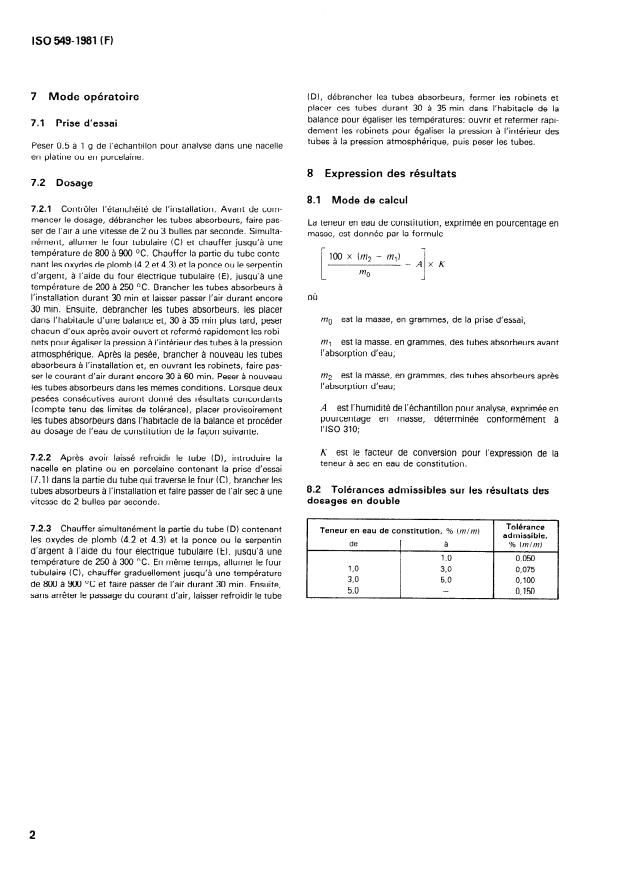
ISO 549:1981 specifies a gravimetric analytical method to determine the combined water content (water of constitution) in manganese ores. The method separates water by heating a prepared test portion in a stream of dry air and collects the evolved water in absorbent traps. It is intended to be read in conjunction with ISO 4297 and used with appropriate sampling and sample preparation procedures (see ISO 4296/1 and ISO 4296/2).
This standard is aimed at laboratories and quality-control teams within mining, mineral processing and analytical services that require repeatable, comparable moisture measurements for manganese ore characterization.
Key Topics
Principle: Separation of combined water from the ore by heating a measured test portion in a current of dry air and gravimetric measurement of the water collected in absorbent tubes.
Apparatus highlights:
- Quartz (or porcelain) tube approx. 500–600 mm long, 18–20 mm internal diameter with a tapered end (50 mm taper, 1–2 mm bore).
- Two tubular electric furnaces to heat different tube zones (one to ca. 800–900 °C, one to lower temperatures for the sample zone).
- Filling materials: mixtures of lead oxide (PbO), lead dioxide (PbO2) and calcined pumice, or alternatively a silver coil in the tube.
- Absorbent traps filled with magnesium perchlorate [Mg(ClO4)2], and a drying train using a wash bottle with sulfuric acid.
Sampling and sample preparation: Use procedures described in ISO 4296/1 and ISO 4296/2 to obtain an analytical test portion (typically ground to <100 µm and air-dried under laboratory conditions).
Typical test portion: 0.5–1 g placed in a platinum or porcelain boat for introduction into the heated zone.
Applications
- Quality control: Determining water of constitution supports ore grading, blending and process control in mining and smelting operations.
- Laboratory analysis: Provides a standardized gravimetric approach for moisture-related characterization used by mineral analysis laboratories.
- Compliance and reporting: Enables consistent reporting of combined water content across suppliers and customers.
Related Standards
- ISO 4296-1: Manganese ores - Sampling - Part 1: Field sampling (guidance for sampling).
- ISO 4296-2: Manganese ores - Sampling - Part 2: Preparation of test samples for analysis.
- ISO 4297: Manganese ores and concentrates - General instructions for chemical analysis methods.
By following ISO 549:1981, laboratories ensure a reproducible gravimetric determination of combined water in manganese ores, improving comparability of moisture data for analytical, commercial and process-control purposes.
Buy Documents
ISO 549:1981 - Manganese ores — Determination of combined water content — Gravimetric method Released:12/1/1981
ISO 549:1981 - Minerais de manganese — Dosage de l'eau de constitution — Méthode gravimétrique Released:12/1/1981
ISO 549:1981 - Minerais de manganese — Dosage de l'eau de constitution — Méthode gravimétrique Released:12/1/1981
Get Certified
Connect with accredited certification bodies for this standard

Bureau Veritas Chile
Bureau Veritas certification services in Chile.
Bureau Veritas Peru
Bureau Veritas certification services in Peru.
BVQI Peru
Bureau Veritas certification in Peru.
Sponsored listings
Frequently Asked Questions
ISO 549:1981 is a standard published by the International Organization for Standardization (ISO). Its full title is "Manganese ores — Determination of combined water content — Gravimetric method". This standard covers: Manganese ores — Determination of combined water content — Gravimetric method
Manganese ores — Determination of combined water content — Gravimetric method
ISO 549:1981 is classified under the following ICS (International Classification for Standards) categories: 73.060.20 - Manganese ores. The ICS classification helps identify the subject area and facilitates finding related standards.
ISO 549:1981 is available in PDF format for immediate download after purchase. The document can be added to your cart and obtained through the secure checkout process. Digital delivery ensures instant access to the complete standard document.
Standards Content (Sample)
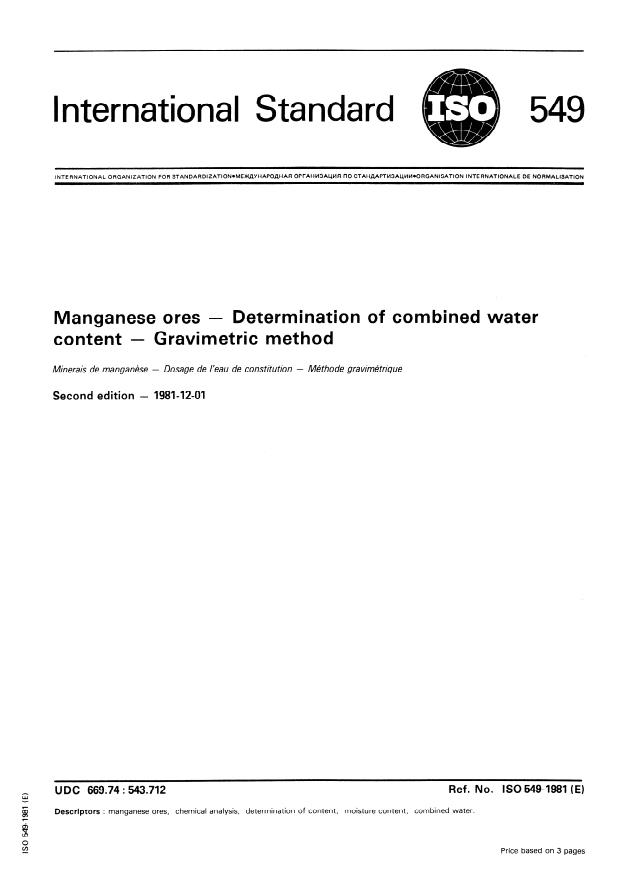
I
International Standard
INTERNATIONAL ORGANIZATION FOR STANDARDIZATlON.ME))(nYHAPOfiHAR OPrAHW3ALiMR IlO CTAHPLAPTM3AL&lM@ORGANlSATlON INTERNATIONALE DE NORMALlSATlON
Manganese ores - Determination of combined water
content - Gravimetric method
Minerais de mangankse - Dosage de l’eau de constitution - M&hode gravim&rique
Second edition - 1981-12-01
UDC 669.74 : 543.712
Ref. No. IS0 549-1981 (E)
Descriptors : manganese ores, chemical analysis, determination of content, moisture content, combined water.
Price based on 3 pages
Foreword
IS0 (the International Organization for Standardization) is a worldwide federation of
national standards institutes (IS0 member bodies). The work of developing lnter-
national Standards is carried out through IS0 technical committees. Every member
body interested in a subject for which a technical committee has been set up has the
right to be represented on that committee. International organizations, governmental
and non-governmental, in liaison with ISO, also take part in the work.
Draft International Standards adopted by the technical committees are circulated to
the member bodies for approval before their acceptance as International Standards by
the IS0 Council.
International Standard IS0 549 was developed by Technical Committee lSO/TC 65,
Manganese and chromium ores.
This second edition was submitted directly to the IS0 Council, in accordance with
clause 5.10.1 of part 1 of the Directives for the technical work of ISO. It cancels and
replaces the first edition (i.e. IS0 5491975), which had been approved by the member
bodies of the following countries :
Australia Hungary Romania
Austria India South Africa, Rep. of
Chile Iran
Spain
Czechoslovakia Ireland United Kingdom
Egypt, Arab Rep. of Italy USSR
France Japan
Yugoslavia
Germany, F. R. Poland
No member body had expressed disapproval of the document.
0 International Organization for Standardization, 1981
Printed in Switzerland
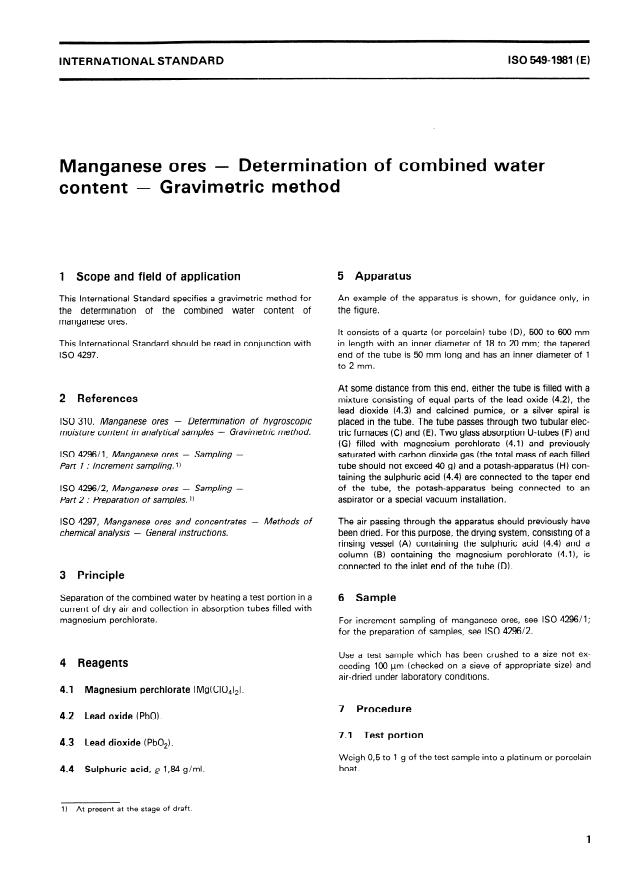
IS0 5494981 (E)
INTERNATIONAL STANDARD
Determination of combined water
Manganese ores -
content - Gravimetric method
5 Apparatus
1 Scope and field of application
An example of the apparatus is shown, for guidance only, in
This International Standard specifies a gravimetric method for
the figure.
the determination of the combined water content of
manganese ores.
It consists of a quartz (or porcelain) tube (D), 500 to 600 mm
This International Standard should be read in conjunction with in length with an inner diameter of 18 to 20 mm; the tapered
IS0 4297. end of the tube is 50 mm long and has an inner diameter of 1
to 2 mm.
At some distance from this end, either the tube is filled with a
2 References
mixture consisting of equal parts of the lead oxide (4.2), the
lead dioxide (4.3) and calcined pumice, or a silver spiral is
IS0 310, Manganese ores - Determination of h ygroscopic
placed in the tube. The tube passes through two tubular elec-
moisture content in analytical samples - Gravimetric method. tric furnaces (C) and (E). Two glass absorption U-tubes (F) and
(G) filled with magnesium perchlorate (4.1) and previously
IS0 429611, Manganese ores - Sampling -
saturated with carbon dioxide gas (the total mass of each filled
Part I : Increment sampling. 1) tube should not exceed 40 g) and a potash-apparatus (H) con-
taining the sulphuric acid (4.4) are connected to the taper end
of the tube, the potash-apparatus being connected to an
IS0 4296/Z, Manganese ores - Sampling -
Part 2 : Preparation of samples. 1) aspirator or a special vacuum installation.
IS0 4297, Manganese ores and concentrates - Methods of The air passing through the apparatus should previously have
chemical analysis - General instructions. been dried. For this purpose, the drying system, consisting of a
rinsing vessel (A) containing the sulphuric acid (4.4) and a
column (B) containing the magnesium perchlorate (4.11, is
connected to the inlet end of the tube (D).
3 Principle
Separation of the combined water by heating a test portion in a
6 Sample
current of dry air and collection in absorption tubes filled with
magnesium perchlorate.
For increment sampling of manganese ores, see IS0 4296/l;
for the preparation
...
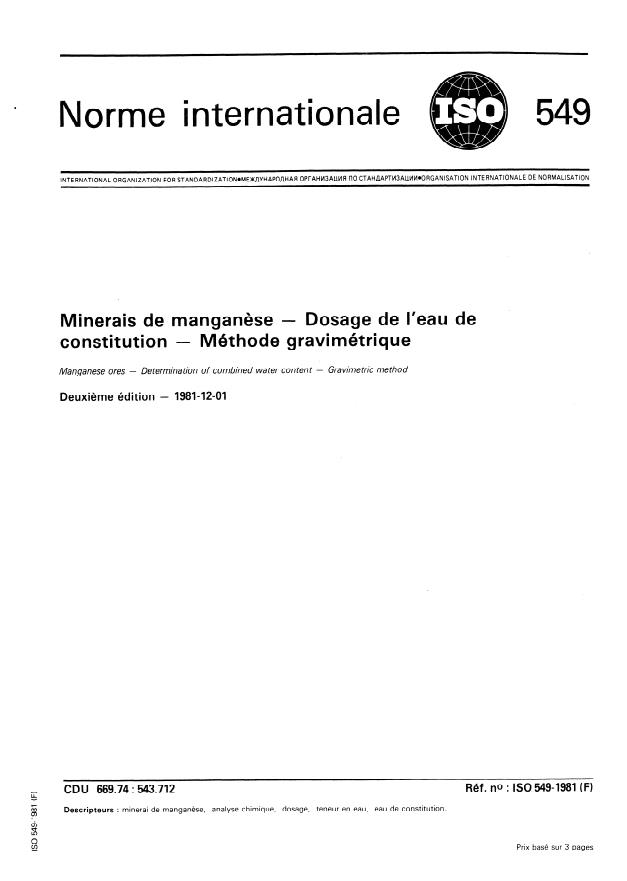
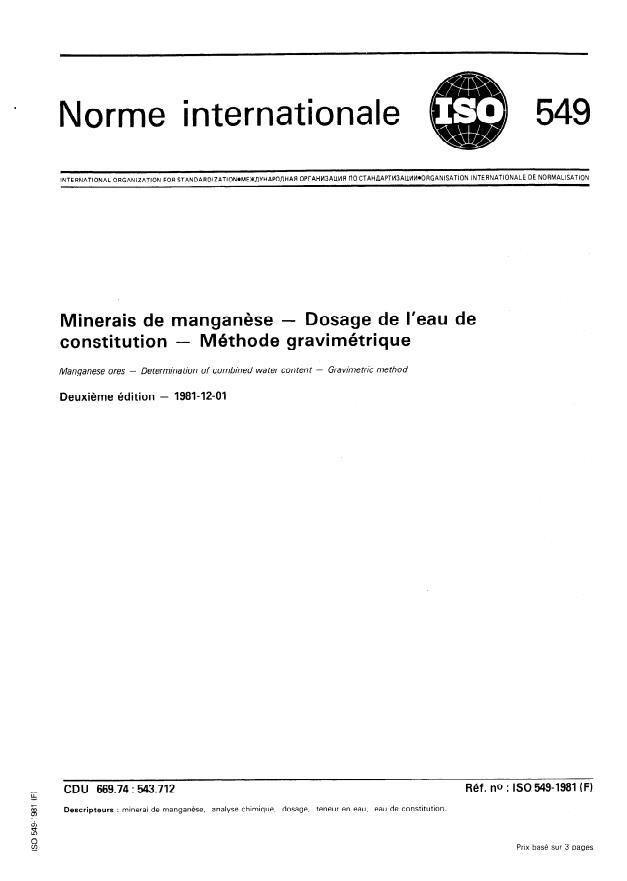
Norme internationale
INTERNATIONAL ORGANIZAJION FOR STANDARDIZATIONoME~YHAPOAHAR OPTAHM3ALWlR Il0 CTAHAAPTt43A~Wl.ORGANISATlON INTERNATIONALE DE NORMALISATION
Minerais de manganèse - Dosage de l’eau de
- Méthode gravimétrique
constitution
Manganese ores - Determina tion of combined wa ter content - Gravimetric method
Deuxième édition - 1981-12-01
CDU 669.74 : 543.712 Réf. no : lSO.!549-1981 (F)
Descripteurs : minerai de manganèse, analyse chimique, dosage, teneur en eau, eau de constitution.
Prix basé sur 3 pages
Avant-propos
L’ISO (Organisation internationale de normalisation) est une fédération mondiale
d’organismes nationaux de normalisation (comités membres de I’ISO). L’élaboration
des Normes internationales est confiée aux comités techniques de I’ISO. Chaque
comité membre intéressé par une étude a le droit de faire partie du comité technique
correspondant. Les organisations internationales, gouvernementales et non gouverne-
mentales, en liaison avec I’ISO, participent également aux travaux.
Les projets de Normes internationales adoptés par les comités techniques sont soumis
aux comités membres pour approbation, avant leur acceptation comme Normes inter-
nationales par le Conseil de I’ISO.
La Norme internationale ISO 549 a été élaborée par le comité technique ISO/TC 65,
Minerais de manganèse et de chrome.
Cette deuxième édition fut soumise directement au Conseil de I’ISO, conformément au
paragraphe 5.10.1 de 1-a partie 1 des Directives pour les travaux techniques de I’ISO.
Elle annule et remplace la *première édition (ISO 549-19751, qui avait été approuvée par
les comités membres des pays suivants :
Afrique du Sud, Rép. d’ France Pologne
Allemagne, R. F. Hongrie Roumanie
Australie Inde Royaume-Uni
Autriche
Iran Tchécoslovaquie
Chili Irlande URSS
Egypte, Rép. arabe d’ Italie Yougoslavie
Espagne Japon
Aucun comité membre ne l’avait désapprouvée.
Organisation internationale de normalisation, 1981
imprimé en Suisse
NORME INTERNATIONALE
ISO 549-1981 (F)
Minerais de manganèse - Dosage de l’eau de
constitution - Methode gravimétrique
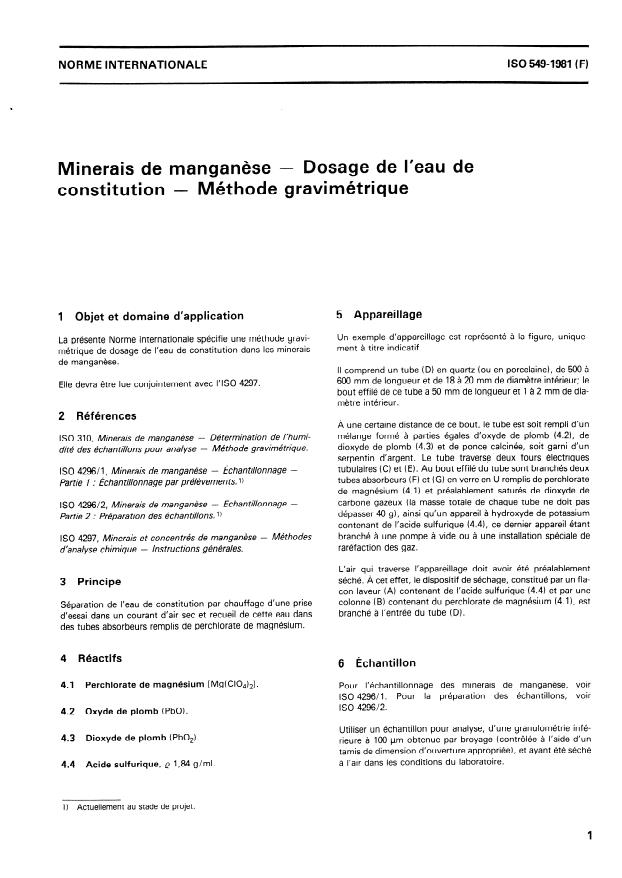
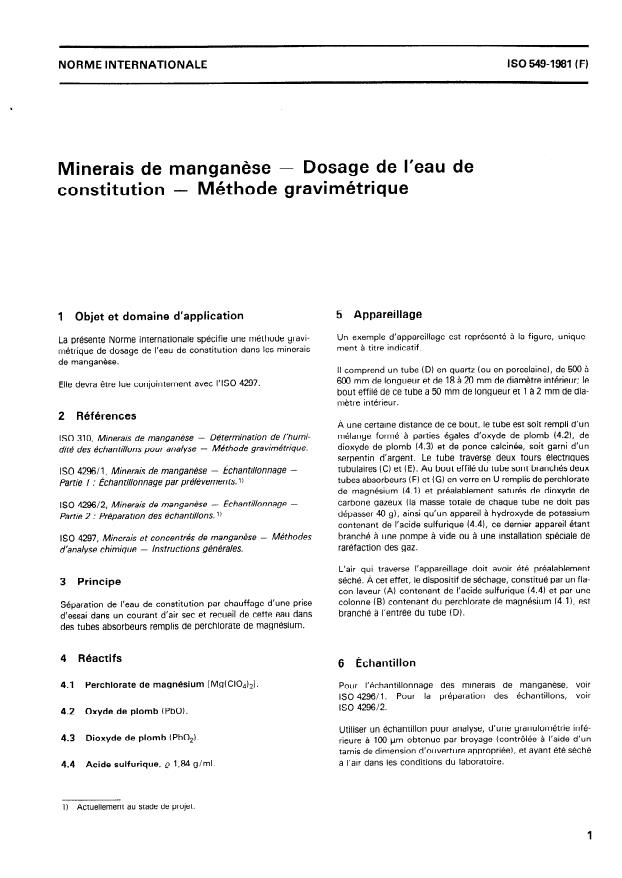
5 Appareillage
1 Objet et domaine d’application
Un exemple d’appareillage est représenté à la figure, unique-
La présente Norme internationale spécifie une méthode gravi-
ment à titre indicatif.
métrique de dosage de l’eau de constitution dans les minerais
de manganèse.
II comprend un tube (D) en quartz (ou en porcelaine), de 500 à
600 mm de longueur et de 18 à 20 mm de diamètre intérieur; le
Elle devra être lue conjointement avec I’ISO 4297.
bout effilé de ce tube a 50 mm de longueur et 1 à 2 mm de dia-
mètre intérieur.
2 Références
A une certaine distance de ce bout, le tube est soit rempli d’un
mélange formé à parties égales d’oxyde de plomb (4.21, de
ISO 310, Minerais de manganèse - Détermination de l’humi-
dioxyde de plomb (4.3) et de ponce calcinée, soit garni d’un
dité des échantillons pour ana/yse - Méthode gravimétrique.
serpentin d’argent. Le tube traverse deux fours électriques
L
tubulaires (C) et (E). Au bout effilé du tube sont branchés deux
I SO 429611, Minerais de manganèse - Échantillonnage -
tubes absorbeurs (F) et (G) en verre en U remplis de perchlorate
Partie I : Échantillonnage par prélèvements. 1)
de magnésium (4.1) et préalablement saturés de dioxyde de
carbone gazeux (la masse totale de chaque tube ne doit pas
ISO 429612, Minerais de manganèse - Échantillonnage -
dépasser 40 g), ainsi qu’un appareil à hydroxyde de potassium
Partie 2 : Préparation des échantillons. 1)
contenant de l’acide sulfurique (4.41, ce dernier appareil étant
branché à une pompe à vide ou à une installation spéciale de
ISO 4297, Minerais et concentrés de manganèse - Méthodes
d’analyse chimique - /ns truc tions générales. raréfaction des gaz.
L’air qui traverse l’appareillage doit avoir été préalablement
séché. A cet effet, le dispositif de séchage, constitué par un fla-
3 Principe
con laveur (A) contenant de l’acide sulfurique (4.4) et par une
colonne (B) contenant du perchlorate de magnésium (4.11, est
Séparation de l’eau de constitution par chauffage d’une prise
branché à l’entrée du tube (D).
d’essai dans un courant d’air sec et recueil de cette eau dans
des tubes absorbeurs remplis de perchlorate de magnésium.
4 Réactifs
6 Échantillon
4.1 Perchlorate de magnésium [Mg(ClO&l.
Pour l’échantillonnage des minerais de manganèse, voir
ISO 4296/1. Pour la préparation des échantillons, voir
ISO 4296/2.
4.2 Oxyde de plomb (PbOL
Utiliser un échantillon pour analyse, d
...
Norme internationale
INTERNATIONAL ORGANIZAJION FOR STANDARDIZATIONoME~YHAPOAHAR OPTAHM3ALWlR Il0 CTAHAAPTt43A~Wl.ORGANISATlON INTERNATIONALE DE NORMALISATION
Minerais de manganèse - Dosage de l’eau de
- Méthode gravimétrique
constitution
Manganese ores - Determina tion of combined wa ter content - Gravimetric method
Deuxième édition - 1981-12-01
CDU 669.74 : 543.712 Réf. no : lSO.!549-1981 (F)
Descripteurs : minerai de manganèse, analyse chimique, dosage, teneur en eau, eau de constitution.
Prix basé sur 3 pages
Avant-propos
L’ISO (Organisation internationale de normalisation) est une fédération mondiale
d’organismes nationaux de normalisation (comités membres de I’ISO). L’élaboration
des Normes internationales est confiée aux comités techniques de I’ISO. Chaque
comité membre intéressé par une étude a le droit de faire partie du comité technique
correspondant. Les organisations internationales, gouvernementales et non gouverne-
mentales, en liaison avec I’ISO, participent également aux travaux.
Les projets de Normes internationales adoptés par les comités techniques sont soumis
aux comités membres pour approbation, avant leur acceptation comme Normes inter-
nationales par le Conseil de I’ISO.
La Norme internationale ISO 549 a été élaborée par le comité technique ISO/TC 65,
Minerais de manganèse et de chrome.
Cette deuxième édition fut soumise directement au Conseil de I’ISO, conformément au
paragraphe 5.10.1 de 1-a partie 1 des Directives pour les travaux techniques de I’ISO.
Elle annule et remplace la *première édition (ISO 549-19751, qui avait été approuvée par
les comités membres des pays suivants :
Afrique du Sud, Rép. d’ France Pologne
Allemagne, R. F. Hongrie Roumanie
Australie Inde Royaume-Uni
Autriche
Iran Tchécoslovaquie
Chili Irlande URSS
Egypte, Rép. arabe d’ Italie Yougoslavie
Espagne Japon
Aucun comité membre ne l’avait désapprouvée.
Organisation internationale de normalisation, 1981
imprimé en Suisse
NORME INTERNATIONALE
ISO 549-1981 (F)
Minerais de manganèse - Dosage de l’eau de
constitution - Methode gravimétrique
5 Appareillage
1 Objet et domaine d’application
Un exemple d’appareillage est représenté à la figure, unique-
La présente Norme internationale spécifie une méthode gravi-
ment à titre indicatif.
métrique de dosage de l’eau de constitution dans les minerais
de manganèse.
II comprend un tube (D) en quartz (ou en porcelaine), de 500 à
600 mm de longueur et de 18 à 20 mm de diamètre intérieur; le
Elle devra être lue conjointement avec I’ISO 4297.
bout effilé de ce tube a 50 mm de longueur et 1 à 2 mm de dia-
mètre intérieur.
2 Références
A une certaine distance de ce bout, le tube est soit rempli d’un
mélange formé à parties égales d’oxyde de plomb (4.21, de
ISO 310, Minerais de manganèse - Détermination de l’humi-
dioxyde de plomb (4.3) et de ponce calcinée, soit garni d’un
dité des échantillons pour ana/yse - Méthode gravimétrique.
serpentin d’argent. Le tube traverse deux fours électriques
L
tubulaires (C) et (E). Au bout effilé du tube sont branchés deux
I SO 429611, Minerais de manganèse - Échantillonnage -
tubes absorbeurs (F) et (G) en verre en U remplis de perchlorate
Partie I : Échantillonnage par prélèvements. 1)
de magnésium (4.1) et préalablement saturés de dioxyde de
carbone gazeux (la masse totale de chaque tube ne doit pas
ISO 429612, Minerais de manganèse - Échantillonnage -
dépasser 40 g), ainsi qu’un appareil à hydroxyde de potassium
Partie 2 : Préparation des échantillons. 1)
contenant de l’acide sulfurique (4.41, ce dernier appareil étant
branché à une pompe à vide ou à une installation spéciale de
ISO 4297, Minerais et concentrés de manganèse - Méthodes
d’analyse chimique - /ns truc tions générales. raréfaction des gaz.
L’air qui traverse l’appareillage doit avoir été préalablement
séché. A cet effet, le dispositif de séchage, constitué par un fla-
3 Principe
con laveur (A) contenant de l’acide sulfurique (4.4) et par une
colonne (B) contenant du perchlorate de magnésium (4.11, est
Séparation de l’eau de constitution par chauffage d’une prise
branché à l’entrée du tube (D).
d’essai dans un courant d’air sec et recueil de cette eau dans
des tubes absorbeurs remplis de perchlorate de magnésium.
4 Réactifs
6 Échantillon
4.1 Perchlorate de magnésium [Mg(ClO&l.
Pour l’échantillonnage des minerais de manganèse, voir
ISO 4296/1. Pour la préparation des échantillons, voir
ISO 4296/2.
4.2 Oxyde de plomb (PbOL
Utiliser un échantillon pour analyse, d
...