


ISO 37100
(Main)Sustainable cities and communities — Vocabulary
Sustainable cities and communities — Vocabulary
ISO 37100:2016 defines terms relating to sustainable development in communities, smart community infrastructure and related subjects.
Villes et communautés territoriales durables — Vocabulaire
L'ISO 37100:2016 définit les termes relatifs au développement durable au sein des communautés territoriales, aux infrastructures territoriales intelligentes et à d'autres sujets associés.
General Information
- Status
- Not Published
- Technical Committee
- ISO/TC 268 - Sustainable cities and communities
- Drafting Committee
- ISO/TC 268 - Sustainable cities and communities
- Current Stage
- 6000 - International Standard under publication
- Start Date
- 02-Apr-2026
- Completion Date
- 04-Apr-2026
Relations
- Effective Date
- 03-Jun-2023
Overview
ISO/FDIS 37100: Sustainable Cities and Communities - Vocabulary offers a comprehensive set of key terms and definitions for sustainable development in cities and communities. Developed by the International Organization for Standardization (ISO), this standard is fundamental for ensuring a unified understanding of concepts related to sustainable urban development, smart community infrastructure, and resilient cities. By harmonizing terminology, ISO 37100 supports effective communication and collaboration among stakeholders ranging from municipal authorities to urban planners and sustainability professionals.
Key Topics
ISO/FDIS 37100 covers vocabulary across the following crucial domains:
Sustainable Development & Resilience
Defines core principles such as sustainability, sustainable development, resilience, planetary boundaries, disaster recovery, and the purpose and issues of sustainability in communities.Smartness & Smart Cities
Clarifies the concept of smartness in urban settings, focusing on how technology, data, and collaboration drive smart city development and improve quality of life.City & Community
Standardizes terminology related to cities, communities, local government, and territorial management to support integrated urban and community planning.Management & Governance
Addresses critical terms involving city management, accountability, leadership, and decision-making structures needed for sustainable development.Quality, Conformity & Indicators
Offers definitions for quality management, conformity assessment, indicators, and metrics to help cities track progress and benchmark sustainability performance.Infrastructure & Services
Establishes common language for smart infrastructure elements and the delivery of essential urban services in the context of sustainability.Environmental & Social Impact
Includes terms related to environmental protection, impact assessment, ecological restoration, life cycle thinking, human rights, and community engagement.
Applications
ISO/FDIS 37100 is highly relevant to a broad audience concerned with the evolution of sustainable cities and communities:
Urban Planners & Local Governments
Use standardized terms to streamline sustainable city development, enable objective assessment, and implement smart technologies effectively.Sustainability Professionals & Consultants
Apply the vocabulary in sustainability assessments, city benchmarking, and compliance reporting to international and local goals, such as the United Nations Sustainable Development Goals (UN SDGs).Smart City Initiatives
Build smart community infrastructure, foster resilience, and enhance city management practices using globally recognized terminology when working with diverse stakeholders.Academia & Research
Adopt a consistent language for teaching materials, research publications, and collaborative studies on city sustainability, resilience, and smart solutions.Technology Providers & Service Companies
Align solutions and services with international standards, clarify deliverables in project contracts, and ensure interoperability in urban projects.
Related Standards
ISO/FDIS 37100 is part of a broader family of standards supporting the creation of sustainable and resilient urban environments:
- ISO 37101 - Sustainable development in communities - Management systems - Requirements with guidance for use
- ISO 37120 - Sustainable cities and communities - Indicators for city services and quality of life
- ISO 26000 - Guidance on social responsibility
- ISO 14001 - Environmental management systems - Requirements with guidance for use
- ISO 22301 - Security and resilience - Business continuity management systems
Adopting ISO/FDIS 37100 helps organizations align their efforts with globally accepted practices for smart, resilient, and sustainable communities and cities, supporting effective communication and the achievement of long-term sustainability goals.
Buy Documents

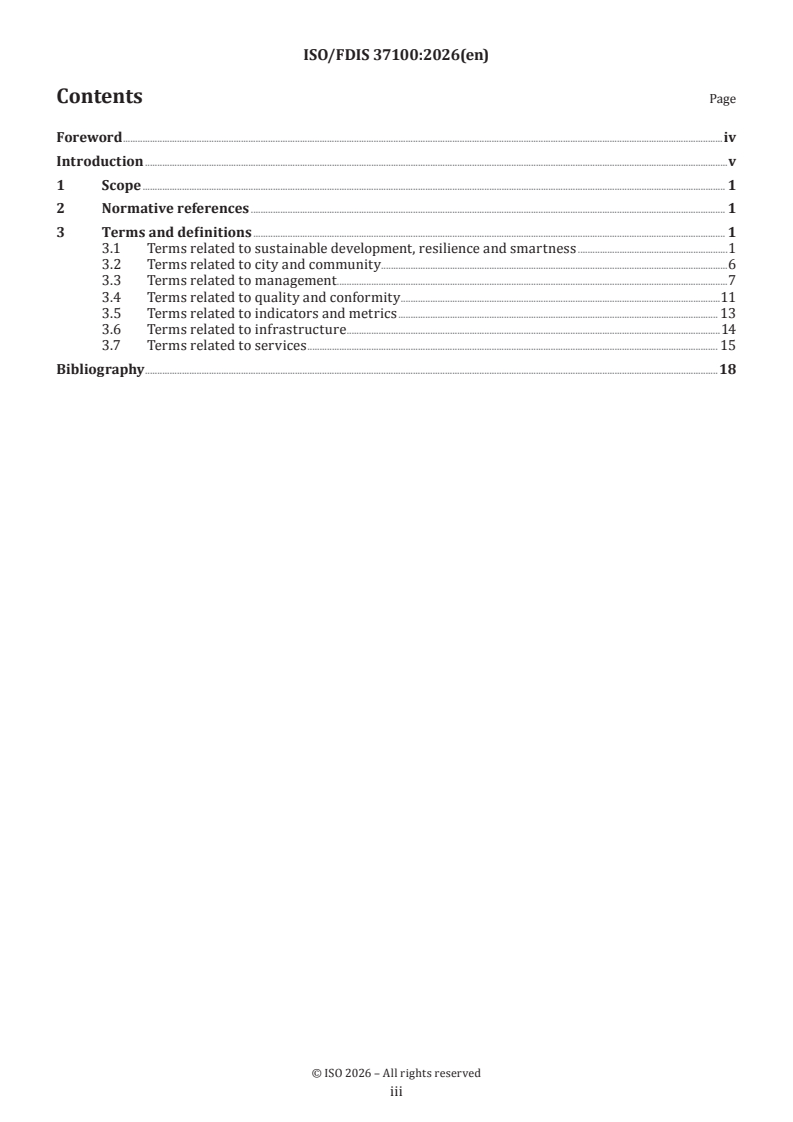
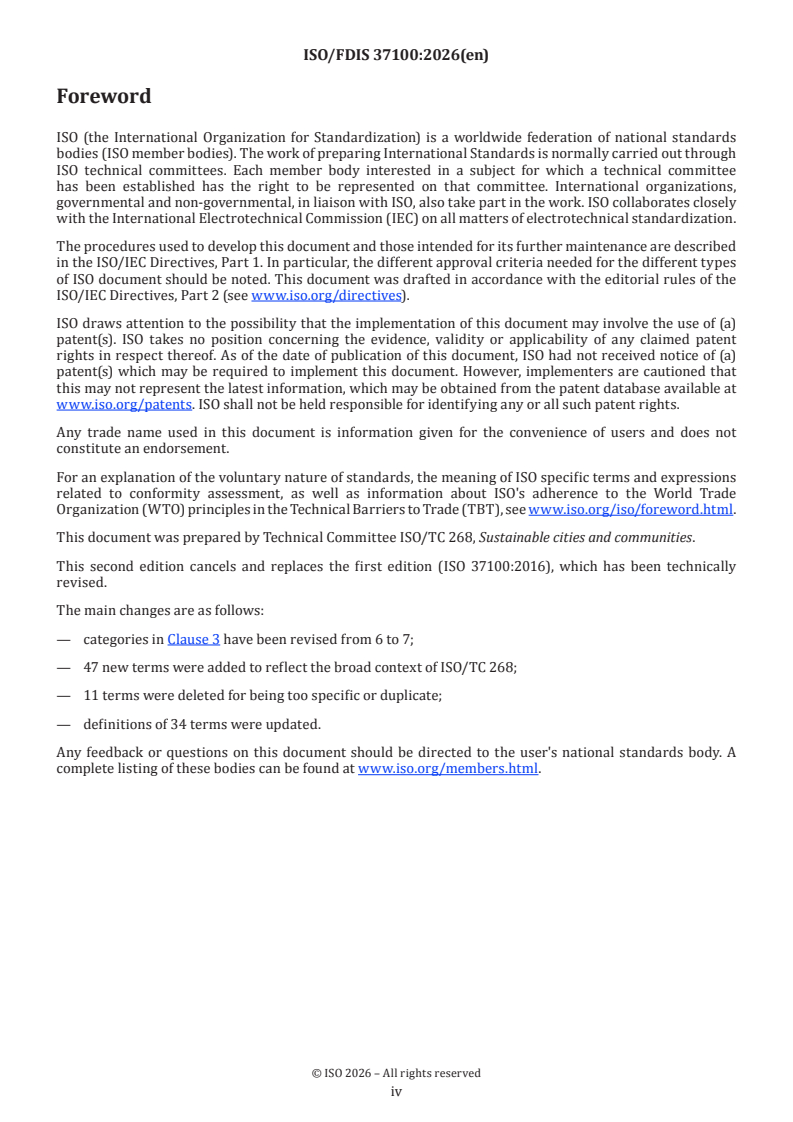
ISO/FDIS 37100 - Sustainable cities and communities — Vocabulary Released:21. 01. 2026
REDLINE ISO/FDIS 37100 - Sustainable cities and communities — Vocabulary Released:21. 01. 2026
Get Certified
Connect with accredited certification bodies for this standard

BSI Group
BSI (British Standards Institution) is the business standards company that helps organizations make excellence a habit.

Bureau Veritas
Bureau Veritas is a world leader in laboratory testing, inspection and certification services.

DNV
DNV is an independent assurance and risk management provider.
Sponsored listings
Frequently Asked Questions
ISO 37100 is a draft published by the International Organization for Standardization (ISO). Its full title is "Sustainable cities and communities — Vocabulary". This standard covers: ISO 37100:2016 defines terms relating to sustainable development in communities, smart community infrastructure and related subjects.
ISO 37100:2016 defines terms relating to sustainable development in communities, smart community infrastructure and related subjects.
ISO 37100 is classified under the following ICS (International Classification for Standards) categories: 01.040.13 - Environment. Health protection. Safety (Vocabularies); 13.020.20 - Environmental economics. Sustainability. The ICS classification helps identify the subject area and facilitates finding related standards.
ISO 37100 has the following relationships with other standards: It is inter standard links to ISO 37100:2016. Understanding these relationships helps ensure you are using the most current and applicable version of the standard.
ISO 37100 is available in PDF format for immediate download after purchase. The document can be added to your cart and obtained through the secure checkout process. Digital delivery ensures instant access to the complete standard document.
Standards Content (Sample)
FINAL DRAFT
International
Standard
ISO/FDIS 37100
ISO/TC 268
Sustainable cities and
Secretariat: AFNOR
communities — Vocabulary
Voting begins on:
Villes et communautés territoriales durables — Vocabulaire 2026-02-04
Voting terminates on:
2026-04-01
RECIPIENTS OF THIS DRAFT ARE INVITED TO SUBMIT,
WITH THEIR COMMENTS, NOTIFICATION OF ANY
RELEVANT PATENT RIGHTS OF WHICH THEY ARE AWARE
AND TO PROVIDE SUPPOR TING DOCUMENTATION.
IN ADDITION TO THEIR EVALUATION AS
BEING ACCEPTABLE FOR INDUSTRIAL, TECHNO
LOGICAL, COMMERCIAL AND USER PURPOSES, DRAFT
INTERNATIONAL STANDARDS MAY ON OCCASION HAVE
TO BE CONSIDERED IN THE LIGHT OF THEIR POTENTIAL
TO BECOME STAN DARDS TO WHICH REFERENCE MAY BE
MADE IN NATIONAL REGULATIONS.
Reference number
ISO/FDIS 37100:2026(en) © ISO 2026
FINAL DRAFT
ISO/FDIS 37100:2026(en)
International
Standard
ISO/FDIS 37100
ISO/TC 268
Sustainable cities and
Secretariat: AFNOR
communities — Vocabulary
Voting begins on:
Villes et communautés territoriales durables — Vocabulaire
Voting terminates on:
RECIPIENTS OF THIS DRAFT ARE INVITED TO SUBMIT,
WITH THEIR COMMENTS, NOTIFICATION OF ANY
RELEVANT PATENT RIGHTS OF WHICH THEY ARE AWARE
AND TO PROVIDE SUPPOR TING DOCUMENTATION.
© ISO 2026
IN ADDITION TO THEIR EVALUATION AS
All rights reserved. Unless otherwise specified, or required in the context of its implementation, no part of this publication may
BEING ACCEPTABLE FOR INDUSTRIAL, TECHNO
LOGICAL, COMMERCIAL AND USER PURPOSES, DRAFT
be reproduced or utilized otherwise in any form or by any means, electronic or mechanical, including photocopying, or posting on
INTERNATIONAL STANDARDS MAY ON OCCASION HAVE
the internet or an intranet, without prior written permission. Permission can be requested from either ISO at the address below
TO BE CONSIDERED IN THE LIGHT OF THEIR POTENTIAL
or ISO’s member body in the country of the requester.
TO BECOME STAN DARDS TO WHICH REFERENCE MAY BE
MADE IN NATIONAL REGULATIONS.
ISO copyright office
CP 401 • Ch. de Blandonnet 8
CH-1214 Vernier, Geneva
Phone: +41 22 749 01 11
Email: copyright@iso.org
Website: www.iso.org
Published in Switzerland Reference number
ISO/FDIS 37100:2026(en) © ISO 2026
ii
ISO/FDIS 37100:2026(en)
Contents Page
Foreword .iv
Introduction .v
1 Scope . 1
2 Normative references . 1
3 Terms and definitions . 1
3.1 Terms related to sustainable development, resilience and smartness .1
3.2 Terms related to city and community .6
3.3 Terms related to management .7
3.4 Terms related to quality and conformity .11
3.5 Terms related to indicators and metrics . 13
3.6 Terms related to infrastructure .14
3.7 Terms related to services . 15
Bibliography .18
iii
ISO/FDIS 37100:2026(en)
Foreword
ISO (the International Organization for Standardization) is a worldwide federation of national standards
bodies (ISO member bodies). The work of preparing International Standards is normally carried out through
ISO technical committees. Each member body interested in a subject for which a technical committee
has been established has the right to be represented on that committee. International organizations,
governmental and non-governmental, in liaison with ISO, also take part in the work. ISO collaborates closely
with the International Electrotechnical Commission (IEC) on all matters of electrotechnical standardization.
The procedures used to develop this document and those intended for its further maintenance are described
in the ISO/IEC Directives, Part 1. In particular, the different approval criteria needed for the different types
of ISO document should be noted. This document was drafted in accordance with the editorial rules of the
ISO/IEC Directives, Part 2 (see www.iso.org/directives).
ISO draws attention to the possibility that the implementation of this document may involve the use of (a)
patent(s). ISO takes no position concerning the evidence, validity or applicability of any claimed patent
rights in respect thereof. As of the date of publication of this document, ISO had not received notice of (a)
patent(s) which may be required to implement this document. However, implementers are cautioned that
this may not represent the latest information, which may be obtained from the patent database available at
www.iso.org/patents. ISO shall not be held responsible for identifying any or all such patent rights.
Any trade name used in this document is information given for the convenience of users and does not
constitute an endorsement.
For an explanation of the voluntary nature of standards, the meaning of ISO specific terms and expressions
related to conformity assessment, as well as information about ISO's adherence to the World Trade
Organization (WTO) principles in the Technical Barriers to Trade (TBT), see www.iso.org/iso/foreword.html.
This document was prepared by Technical Committee ISO/TC 268, Sustainable cities and communities.
This second edition cancels and replaces the first edition (ISO 37100:2016), which has been technically
revised.
The main changes are as follows:
— categories in Clause 3 have been revised from 6 to 7;
— 47 new terms were added to reflect the broad context of ISO/TC 268;
— 11 terms were deleted for being too specific or duplicate;
— definitions of 34 terms were updated.
Any feedback or questions on this document should be directed to the user's national standards body. A
complete listing of these bodies can be found at www.iso.org/members.html.
iv
ISO/FDIS 37100:2026(en)
Introduction
This document provides terms and concepts related to sustainable development in cities and communities. It
serves as a fundamental reference for the documents on this subject developed by ISO/TC 268, by enabling:
— a common understanding of the terminology used;
— supporting communication among stakeholders implementing sustainable development initiatives; and
— facilitating the benchmarking of community sustainability practices.
The terms and concepts presented in this document are comprehensive and generic, focusing on terms
relating to the concepts of sustainable, resilient, and smart cities.
This document also encompasses terms addressing key issues relevant to documents developed by
ISO/TC 268, including management, compliance, governance, environmental and social responsibilities.
This document is arranged in subclauses, each representing a specific sub-domain and addresses different
aspects of the sustainable development of cities and communities, namely sustainable development,
resilience and smartness, city and community, management, quality and conformity, indicators and metrics,
infrastructure, and services.
It is important to keep in mind that terms provided by ISO 37100 are compatible and aligned, where
appropriate, with the United Nations Sustainable Development Goals (UN SDGs), reinforcing its relevance
in the context of international efforts to address pressing global challenges and promote sustainable and
inclusive development. In addition to the Goal 11 (Sustainable Cities and Communities), terms closely
relating to the sustainable development of cities and communities that contribute to the rest of the UN SDGs
are marked in Notes.
v
FINAL DRAFT International Standard ISO/FDIS 37100:2026(en)
Sustainable cities and communities — Vocabulary
1 Scope
This document defines terms relating to sustainable development in communities, smart community
infrastructure and related subjects.
2 Normative references
There are no normative references in this document.
3 Terms and definitions
ISO and IEC maintain terminology databases for use in standardization at the following addresses:
— ISO Online browsing platform: available at https:// www .iso .org/ obp
— IEC Electropedia: available at https:// www .electropedia .org/
3.1 Terms related to sustainable development, resilience and smartness
3.1.1
sustainability
state of the global system, including environmental, social and economic aspects, in which the needs of the
present are met without compromising the ability of future generations to meet their own needs
Note 1 to entry: The environmental, social and economic aspects interact, are interdependent and are often referred
to as the three dimensions of sustainability.
Note 2 to entry: Sustainability is the goal of sustainable development (3.1.2).
[SOURCE: ISO Guide 82:2019, 3.1]
3.1.2
sustainable development
development that meets the environmental, social and economic needs of the present without compromising
the ability of future generations to meet their own needs
Note 1 to entry: Derived from the Brundtland Report.
Note 2 to entry: The Aalborg Charter provides further information on sustainable development in communities.
[SOURCE: ISO Guide 82:2019, 3.2, modified — Note 2 to entry has been added.]
3.1.3
purpose of sustainability
long-term sustainability (3.1.1) aspect that a city (3.2.2) considers to understand its context
Note 1 to entry: One of the uses of the purpose of sustainability is in combination with the sustainability issues (3.1.4)
in a cross analysis to understand the context.
3.1.4
sustainability issue
area of action related to city (3.2.2) services that:
ISO/FDIS 37100:2026(en)
— can have strategic, operational and competitive implications; and
— helps organizing bodies such as local governments (3.2.6) to achieve the purposes of sustainability (3.1.3)
3.1.5
smartness
quality of contributing to sustainable development (3.1.2) and resilience (3.1.24), through soundly based
decision making and the adoption of a long-and short-term perspective
Note 1 to entry: Smartness is embedded in the process (3.3.13) of sustainable development (3.1.2), i.e. sustainable
development (3.1.2) is the overarching process (3.3.13), while smartness is a characteristic. It implies a holistic
approach, including good governance and adequate organization (3.3.1), processes (3.3.13) and behaviour, and
appropriate innovative use of techniques, technologies and natural resources (3.1.23).
Note 2 to entry: Smartness is addressed in terms of performance (3.4.9), relevant to technologically implementable
solutions.
3.1.6
accountability
obligation to another for the fulfilment of a responsibility
Note 1 to entry: The obligation includes the duty to inform and to explain the manner in which the responsibility was
fulfilled.
Note 2 to entry: The non-fulfilment of a responsibility has consequences that can be enforced on the accountable party.
[SOURCE: ISO 37000:2021, 3.2.2]
3.1.7
cultural heritage
legacy of physical objects and intangible attributes of a group or a society that are inherited from past
generations, maintained and protected in the present and preserved for future generations
[SOURCE: ISO 18461:2016, 2.1.3]
3.1.8
disaster
situation where widespread human, material, economic or environmental losses have occurred that
exceeded the ability of the affected organization (3.3.1), community (3.2.3) or society to respond and recover
using its own resources
[SOURCE: ISO 22300:2025, 3.1.24]
3.1.9
ecosystem
dynamic complex of plant, animal and micro-organism communities (3.2.3) and their non-living environment
(3.1.12) interacting as a functional entity
EXAMPLE
Deserts, coral reefs, wetlands, rain forests, boreal forests, grasslands, urban parks, cultivated farmlands.
Note 1 to entry: Ecosystems can be influenced by human activity.
[SOURCE: ISO 14008:2019, 3.1.6]
3.1.10
ecosystem service
benefit people obtain from ecosystems (3.1.9)
Note 1 to entry: Benefits include provisioning services such as food and water; regulating services such as flood and
disease control; cultural services such as spiritual, recreational, and cultural benefits; and supporting services, such
as nutrient cycling, that maintain the conditions for life on Earth.
ISO/FDIS 37100:2026(en)
[SOURCE: ISO 14055-1:2017, 3.1.2]
3.1.11
ecological restoration
activity or process (3.3.13) that assists in initiating or accelerating the recovery of the health, structure,
integrity, resilience (3.1.24) and stability of an ecosystem (3.1.9) or habitat (3.1.21) that has been degraded,
damaged, or destroyed
Note 1 to entry: By addressing ecosystem (3.1.9) integrity, ecological restoration can reverse the loss of species by
growing their population or reducing the population of alien invasive species.
[SOURCE: ISO 17298:2025, 3.1.6]
3.1.12
environment
surroundings in which an organization (3.3.1) operates, including air, water, land, natural resources (3.1.23),
flora, fauna, humans and their interrelationships
Note 1 to entry: Surroundings can extend from within an organization (3.3.1) to the local, regional and global system.
Note 2 to entry: Surroundings can be described in terms of biodiversity, ecosystems (3.1.9), climate or other
characteristics.
[SOURCE: ISO 14001:2015, 3.2.1]
3.1.13
environmental impact
change to the environment (3.1.12), whether adverse or beneficial, wholly or partially resulting from an
organization's (3.3.1) environmental aspects
[SOURCE: ISO 14001:2015, 3.2.4]
3.1.14
environmental protection
eco-conscious design, practices and selection of materials and resources to minimize the environmental
impact (3.1.13) by man-made structures and human activities
3.1.15
hazard
potential source of harm
[SOURCE: ISO/IEC Guide 51:2014, 3.2]
3.1.16
impact
positive or negative change to society, economy or the environment (3.1.12), wholly or partially resulting
from an organization's (3.3.1) past and present decisions and activities
[SOURCE: ISO 26000:2010, 2.9]
3.1.17
life cycle
consecutive and interlinked stages from raw material acquisition or generation from natural resources
(3.1.23) to final disposal
[SOURCE: ISO 14050:2020, 3.6.1]
ISO/FDIS 37100:2026(en)
3.1.18
life cycle costing
LCC
method for calculating the costs of goods or services throughout their life cycle (3.1.17)
Note 1 to entry: To have a better understanding of this term, refer to Figure 1 for an explanation and context that will
enhance comprehension and application.
Figure 1 — Overview of life cycle costing (LCC)
[SOURCE: ISO 20400:2017, 3.14, modified — Note 1 to entry has been added.]
3.1.19
life cycle thinking
consideration of the sustainability (3.1.1) aspects relating to a product, process (3.3.13) or service during its
entire life cycle (3.1.17)
[SOURCE: ISO 14050:2020, 3.6.33, modified — “sustainability (3.1.1)” has replaced “environmental”, and
“process (3.3.13) or service” was added.]
3.1.20
planetary boundaries
safe and just limits, in relation to the climate, the terrestrial biosphere, freshwater, nutrients and air
pollution, within which a functioning Earth system can be maintained without incurring significant harm to
people
Note 1 to entry: These limits define how to maintain a stable and resilient Earth system while minimizing risks (3.4.11)
to life and ecosystems (3.1.9).
Note 2 to entry: Scarcity and fragility of natural resources (3.1.23) constrain their consumption in an urban setting.
3.1.21
habitat
place or type of site where an organism or population naturally occurs
[SOURCE: ISO 14055-1:2017, 3.1.6]
3.1.22
human rights
set of equal and inalienable rights of all members of the human family
[38]
Note 1 to entry: Human rights are specified in the Universal Declaration of Human Rights (1948), the International
[37]
Convention on Economic Social and Cultural Rights (1966), and other conventions, treaties and national laws.
[SOURCE: ISO 34101-1:2019, 3.29]
ISO/FDIS 37100:2026(en)
3.1.23
natural resource
part of nature that provides benefits to humans or underpins human well-being
[SOURCE: ISO 14050:2020, 3.2.5]
3.1.24
resilience
adaptive capacity of an organization (3.3.1) in a complex and changing environment (3.1.12)
[SOURCE: ISO 31073:2022, 3.3.39]
3.1.25
resilient city
city (3.2.2) able to prepare for, recover from and adapt to shocks and stresses
Note 1 to entry: A resilient city can resist, absorb, accommodate, adapt to, transform and recover from the effects
of disasters (3.1.8) and shocks in a timely and efficient manner, including through the preservation and restoration
of essential basic structures and services in a sustainable way, and through risk-management practices. It involves
interested parties and especially citizens in disaster (3.1.8)risk (3.4.11) reduction through co-creation processes
(3.3.13); reduces vulnerability and exposure to natural and human-made disasters (3.1.8); and increases its capacity
to respond to disasters (3.1.8), shocks and other unforeseen chronic stresses through enhanced preparedness.
Note 2 to entry: A resilient city is still able to thrive regardless of the hazards (3.1.15), shocks and stresses it faces. It
has a focus on lesson learning, continuous improvement and building back better after disasters (3.1.8).
3.1.26
smart city
intelligent networked city (3.2.2) that increases the pace at which it provides social, economic and
environmental sustainability (3.1.1) outcomes and responds to challenges such as climate change, rapid
population growth, and political and economic instability by fundamentally improving how it engages
society, applies collaborative leadership methods, works across disciplines and city (3.2.2) systems, and uses
data (3.5.1), information and modern technologies to deliver better services and quality of life to those in the
city (3.2.2) (residents, businesses, visitors), now and for the foreseeable future, without unfair disadvantage
of others or degradation of the natural environment (3.1.12)
Note 1 to entry: A smart city (3.2.2) also faces the challenge of respecting planetary boundaries (3.1.20) and taking into
account the limitations these boundaries impose.
Note 2 to entry: There are numerous definitions of a smart city (3.2.2), however, the definition that is used within
ISO/TC 268 is the official one agreed to by the ISO Technical Management Board.
3.1.27
smart citizens services
services that increase city (3.2.2)sustainability (3.1.1), smartness (3.1.5) and resilience (3.1.24), by using
appropriate technologies, data (3.5.1) integration and exchange between them and focus on user-orientation
3.1.28
sponge city
approach used in urban planning and a construction process (3.3.13) to control urban drainage
Note 1 to entry: Examples of the technical measures that can be used are infiltration, stagnation, storage, purification,
use and drainage.
3.1.29
strategy for sustainable development
strategic framework which supports a city's overall policy (3.3.12) for sustainable development
(3.1.2)
ISO/FDIS 37100:2026(en)
3.1.30
urban ecosystem
largely artificial ecosystem (3.1.9) dominated by human activities including settlements, commercial and
industrial areas that have changed the structure, transformed the material cycle and partially changed the
energy conversion process (3.3.13)
3.2 Terms related to city and community
3.2.1
urban settlement
built-up area with residential population and infrastructure of built environment that contain parts or all
the society's functions
Note 1 to entry: Usually the general classification of urban settlements globally is the size of population, and
administrative setup and occupational composition, as to fit the local context of each country.
Note 2 to entry: Urban settlements can include cities (3.2.2) and their surroundings, peri-urban and rural areas, such
as urban districts, towns, counties and neighbourhoods. It can be applicable to villages depending on the situation in
different contexts.
Note 3 to entry: The society's functions can include, for example, administrative, cultural, residential and religious.
3.2.2
city
urban community (3.2.3) falling under a specific administrative boundary
3.2.3
community
group of people with an arrangement of responsibilities, activities and relationships
Note 1 to entry: In many, but not all, contexts, a community has a defined geographical boundary.
Note 2 to entry: A city is a type of community.
3.2.4
business district
delimited area of a community (3.2.3) with business services as the predominant economic activity
Note 1 to entry: A business district can combine working, living and social spaces, natural spaces, comprising
constructed elements, public, semi-public as well as private areas and infrastructures, that contribute to its unity,
resilience (3.1.24) and user-friendliness, in which context, the semi-public areas are private areas opened to the public.
Note 2 to entry: A business district typically features high-density business activities and commercial space,
requiring an efficient supply of municipal, transportation and public services, and having a governing body with clear
responsibility.
Note 3 to entry: Frequently business districts present in some countries large building density, high floor area ratio,
dense population and the number of working population higher than that of residents, with significant incoming and
outgoing flows of people and services.
Note 4 to entry: A business district could have some form of governance.
3.2.5
citizen-centric
driven by the needs of citizens rather than the functional structures of a city's silos to design and delivery of
city (3.2.2) services
Note 1 to entry: The term citizen in this context includes residents, visitors and businesses within the city (3.2.2).
ISO/FDIS 37100:2026(en)
3.2.6
local government
part of government in a country or nation that is typically closest to the population, is in charge of managing,
governing and promoting development of a local area, and is responsible for the definition, design,
development and institutionalization of its public policies (3.3.12) expressed in the provision of services to
its citizens
Note 1 to entry: The basis for a local government can be, for example, a territorial division and the political and
administrative organizations (3.3.1) that are closest to the population.
Note 2 to entry: It is typically a public entity formed by territory, population, government and legislation.
Note 3 to entry: It normally has specific legal capacity and scope to determine its own political, administrative,
cultural and historical heritage and regulatory capability.
3.2.7
national park
protected area (3.2.8) typically of at least 10 square kilometres, conserved in a natural state, with the
purpose to protect the area’s large-scale ecological processes (3.3.13) and its characteristic complement
of species and ecosystems (3.1.9), which can also serve as a foundation for spiritual, scientific, educational,
recreational opportunities that are environmentally and culturally compatible
Note 1 to entry: The area is often recognized for its scenic, ecological, and recreational value, and it plays a crucial role
in conservation, tourism, and education. It is usually part of national legislation.
3.2.8
protected area
clearly defined geographical space, recognised, dedicated and managed, through legal or other effective
means, to achieve the long term conservation of nature with associated ecosystem (3.1.9) services and
cultural values
[SOURCE: ISO 34101-2:2019, 3.18]
3.2.9
social responsibility
responsibility of an organization (3.3.1) for the impacts (3.1.16) of its decisions and activities on society and
the environment (3.1.12), through transparent and ethical behaviour that:
— contributes to sustainable development (3.1.2), including health, safety (3.4.12) and the welfare of society;
— takes into account the expectations of stakeholders (3.3.14);
— is in compliance with applicable law and consistent with international norms of behaviour; and
— is integrated throughout the organization (3.3.1) and practiced in its relationships
Note 1 to entry: Activities include products, services and processes (3.3.13).
Note 2 to entry: Relationships refer to an organization's (3.3.1) activities within its sphere of influence.
[SOURCE: ISO 26000:2010, 2.18, modified — “safety (3.4.12)” has been added.]
3.3 Terms related to management
3.3.1
organization
person or group of people that has its own functions with responsibilities, authorities and relationships to
achieve its objectives (3.3.10)
Note 1 to entry: The concept of organization includes, but is not limited to, sole-trader, company, corporation, firm,
enterprise, authority, partnership, charity or institution, or part or combination thereof, whether incorporated or not,
public or private.
ISO/FDIS 37100:2026(en)
Note 2 to entry: This constitutes one of the common terms and core definitions for ISO management system standards
given in Annex SL of the Consolidated ISO Supplement to the ISO/IEC Directives, Part 1. The original definition has
been modified by modifying Note 1 to entry.
[SOURCE: ISO 9000:2015, 3.2.1, modified — Note 1 to entry has been modified by deleting “association”.]
3.3.2
management system
set of interrelated or interacting elements of an organization (3.3.1) to establish policies (3.3.12) and
objectives (3.3.10), and processes (3.3.13) to achieve those objectives (3.3.10)
Note 1 to entry: A management system can address a single discipline or several disciplines.
Note 2 to entry: The system elements include an organization's (3.3.1) structure, roles and responsibilities, planning
and operation.
Note 3 to entry: The scope of a management system can include the whole organization (3.3.1), specific and identified
functions of the organization (3.3.1), specific and identified sections of the organization (3.3.1), or one or more
functions across a group
...
ISO/DISFDIS 37100:2025(en)
ISO/TC 268
Secretariat: AFNOR
Date: 2025-122026-01-20
Sustainable cities and communities — Vocabulary
Villes et communautés territoriales durables — Vocabulaire
FDIS stage
ISO/FDIS 37100:2026(en)
All rights reserved. Unless otherwise specified, or required in the context of its implementation, no part of this publication
may be reproduced or utilized otherwise in any form or by any means, electronic or mechanical, including photocopying,
or posting on the internet or an intranet, without prior written permission. Permission can be requested from either ISO
at the address below or ISO'sISO’s member body in the country of the requester.
ISO copyright office
CP 401 • Ch. de Blandonnet 8
CH-1214 Vernier, Geneva
Phone: + 41 22 749 01 11
EmailE-mail: copyright@iso.org
Website: www.iso.org
Published in Switzerland
ii
ISO/FDIS 37100:2026(en)
Contents
Foreword . iv
Introduction . v
1 Scope . 1
2 Normative references . 1
3 Terms and definitions . 1
3.1 Terms related to sustainable development, resilience and smartness . 1
3.2 Terms related to city and community . 6
3.3 Terms related to management . 8
3.4 Terms related to quality and conformity . 12
3.5 Terms related to indicators and metrics . 15
3.6 Terms related to infrastructure . 15
3.7 Terms related to services . 17
Bibliography . 20
iii
ISO/FDIS 37100:2026(en)
Foreword
ISO (the International Organization for Standardization) is a worldwide federation of national standards
bodies (ISO member bodies). The work of preparing International Standards is normally carried out through
ISO technical committees. Each member body interested in a subject for which a technical committee has been
established has the right to be represented on that committee. International organizations, governmental and
non-governmental, in liaison with ISO, also take part in the work. ISO collaborates closely with the
International Electrotechnical Commission (IEC) on all matters of electrotechnical standardization.
The procedures used to develop this document and those intended for its further maintenance are described
in the ISO/IEC Directives, Part 1. In particular, the different approval criteria needed for the different types of
ISO document should be noted. This document was drafted in accordance with the editorial rules of the
ISO/IEC Directives, Part 2 (see www.iso.org/directives).
ISO draws attention to the possibility that the implementation of this document may involve the use of (a)
patent(s). ISO takes no position concerning the evidence, validity or applicability of any claimed patent rights
in respect thereof. As of the date of publication of this document, ISO had not received notice of (a) patent(s)
which may be required to implement this document. However, implementers are cautioned that this may not
represent the latest information, which may be obtained from the patent database available at
www.iso.org/patents. ISO shall not be held responsible for identifying any or all such patent rights.
Any trade name used in this document is information given for the convenience of users and does not
constitute an endorsement.
For an explanation of the voluntary nature of standards, the meaning of ISO specific terms and expressions
related to conformity assessment, as well as information about ISO's adherence to the World Trade
Organization (WTO) principles in the Technical Barriers to Trade (TBT), see www.iso.org/iso/foreword.html.
This document was prepared by Technical Committee ISO/TC 268, Sustainable cities and communities.
This second edition cancels and replaces the first edition (ISO 37100:2016), which has been technically
revised. The main changes are as follows:
The main changes are as follows:Categories
— categories in Clause 3Clause 3 have been revised from 6 to 7;
— 47 new terms were added to reflect the broad context related toof ISO/TC 268;
— 11 terms were deleted asfor being identified as too specific or duplicate;
— Definitionsdefinitions of 34 terms were updated since last edition.
Any feedback or questions on this document should be directed to the user's national standards body. A
complete listing of these bodies can be found at www.iso.org/members.html.
iv
ISO/FDIS 37100:2026(en)
Introduction
This document provides terms and concepts related to sustainable development in cities and communities. It
serves as a fundamental reference for the documents on this subject developed by ISO/TC 268, by enabling:
— a common understanding of the terminology used, ;
— supporting communication among stakeholders implementing sustainable development initiatives,; and
— facilitating the benchmarking of community sustainability practices.
The terms and concepts presented in this document are comprehensive and generic, focusing on terms
relating to the concepts of sustainable, resilient, and smart cities.
This document also encompasses terms addressing key issues relevant to the family of standardsdocuments
developed by ISO/TC 268, including management, compliance, governance, environmental and social
responsibilities.
This document is arranged in subclauses, each representing a specific sub-domain and addresses different
aspects of the sustainable development of cities and communities, namely sustainable development, resilience
and smartness, city and community, management, quality and conformity, indicators and metrics,
infrastructure, and services.
It is important to keep in mind that terms provided by ISO 37100 are compatible and aligned, where
appropriate, with the United Nations Sustainable Development Goals (UN SDGs), reinforcing its relevance in
the context of international efforts to address pressing global challenges and promote sustainable and
inclusive development. In addition to the Goal 11 (Sustainable Cities and Communities), terms closely relating
to the sustainable development of cities and communities that contribute to the rest of the UN SDGs are
marked in Notes.
v
ISO/FDIS 37100:2026(en)
Sustainable cities and communities — Vocabulary
1 Scope
This document defines terms relating to sustainable development in communities, smart community
infrastructure and related subjects.
2 Normative references
There are no normative references in this document.
3 Terms and definitions
ISO and IEC maintain terminology databases for use in standardization at the following addresses:
— — ISO Online browsing platform: available at https://www.iso.org/obp
— — IEC Electropedia: available at https://www.electropedia.org/
3.1 Terms related to sustainable development, resilience and smartness
3.1.1 3.1.1
sustainability
state of the global system, including environmental, social and economic aspects, in which the needs of the
present are met without compromising the ability of future generations to meet their own needs
Note 1 to entry: The environmental, social and economic aspects interact, are interdependent and are often referred to
as the three dimensions of sustainability.
Note 2 to entry: Sustainability is the goal of sustainable development (3.1.2(3.1.2).).
[SOURCE: ISO Guide 82:2019, 3.1]
3.1.2 3.1.2
sustainable development
development that meets the environmental, social and economic needs of the present without compromising
the ability of future generations to meet their own needs
Note 1 to entry: Derived from the Brundtland Report.
Note 2 to entry: The Aalborg Charter provides further information on sustainable development in communities.
[SOURCE: ISO Guide 82:2019, 3.2, modified — Note 2 to entry has been added.]
3.1.3 3.1.3
purpose of sustainability
long-term sustainability (3.1.1(3.1.1)) aspect that a city (3.2.2(3.2.2)) considers to understand its context
Note 1 to entry: One of the uses of the purpose of sustainability is in combination with the sustainability issues (3.1.4
(3.1.4)) in a cross analysis to understand the context.
3.1.4 3.1.4
sustainability issue
) services that:
area of action related to city (3.2.2(3.2.2)
ISO/FDIS 37100:2026(en)
— — can have strategic, operational and competitive implications; and
— — helps organizing bodies such as local governments (3.2.6(3.2.6)) to achieve the purposes of sustainability
(3.1.3(3.1.3))
3.1.5 3.1.5
smartness
quality of contributing to sustainable development (3.1.2(3.1.2)) and resilience (3.1.24(3.1.24),), through
soundly based decision making and the adoption of a long-and short-term perspective
Note 1 to entry: Smartness is embedded in the process (3.3.13(3.3.13)) of sustainable development (3.1.2(3.1.2),), i.e.
sustainable development (3.1.2(3.1.2)) is the overarching process (3.3.13(3.3.13),), while smartness is a characteristic. It
implies a holistic approach, including good governance and adequate organization (3.3.1(3.3.1),), processes
(3.3.13(3.3.13)) and behaviour, and appropriate innovative use of techniques, technologies and natural resources
(3.1.23(3.1.23).).
Note 2 to entry: Smartness is addressed in terms of performance (3.4.9(3.4.9),), relevant to technologically
implementable solutions.
3.1.6 3.1.6
accountability
obligation to another for the fulfilment of a responsibility
Note 1 to entry: The obligation includes the duty to inform and to explain the manner in which the responsibility was
fulfilled.
Note 2 to entry: The non-fulfilment of a responsibility has consequences that can be enforced on the accountable party.
[SOURCE: ISO 37000:2021, 3.2.2]
3.1.7 3.1.7
cultural heritage
legacy of physical objects and intangible attributes of a group or a society that are inherited from past
generations, maintained and protected in the present and preserved for future generations
[SOURCE: ISO 18461:2016, 2.1.3]
3.1.8 3.1.8
disaster
situation where widespread human, material, economic or environmental losses have occurred that exceeded
the ability of the affected organization (3.3.1(3.3.1),), community (3.2.3(3.2.3)) or society to respond and
recover using its own resources
[SOURCE: ISO 22300:2025, 3.1.24]
3.1.9 3.1.9
ecosystem
dynamic complex of plant, animal and micro-organism communities (3.2.3(3.2.3)) and their non-living
environment (3.1.12(3.1.12)) interacting as a functional entity
EXAMPLE :
Deserts, coral reefs, wetlands, rain forests, boreal forests, grasslands, urban parks, cultivated farmlands.
Note 1 to entry: Ecosystems can be influenced by human activity.
[SOURCE: ISO 14008:2019, 3.1.6]
ISO/FDIS 37100:2026(en)
3.1.10 3.1.10
ecosystem service
benefit people obtain from ecosystems (3.1.9 (3.1.9))
Note 1 to entry: Benefits include provisioning services such as food and water; regulating services such as flood and
disease control; cultural services such as spiritual, recreational, and cultural benefits; and supporting services, such as
nutrient cycling, that maintain the conditions for life on Earth.
[SOURCE: ISO 14055-1:2017, 3.1.2]
3.1.11 3.1.11
ecological restoration
activity or process (3.3.13(3.3.13)) that assists in initiating or accelerating the recovery of the health, structure,
integrity, resilience (3.1.24(3.1.24)) and stability of an ecosystem (3.1.9(3.1.9)) or habitat (3.1.21(3.1.21)) that
has been degraded, damaged, or destroyed
Note 1 to entry: By addressing ecosystem (3.1.9(3.1.9)) integrity, ecological restoration can reverse the loss of species by
growing their population or reducing the population of alien invasive species.
[SOURCE: ISO 17298:2025, 3.1.6]
3.1.12 3.1.12
environment
surroundings in which an organization (3.3.1(3.3.1)) operates, including air, water, land, natural resources
(3.1.23(3.1.23),), flora, fauna, humans and their interrelationships
Note 1 to entry: Surroundings can extend from within an organization (3.3.1(3.3.1)) to the local, regional and global
system.
Note 2 to entry: Surroundings can be described in terms of biodiversity, ecosystems (3.1.9(3.1.9),), climate or other
characteristics.
[SOURCE: ISO 14001:2015, 3.2.1]
3.1.13 3.1.13
environmental impact
change to the environment (3.1.12(3.1.12),), whether adverse or beneficial, wholly or partially resulting from
an organization's (3.3.1(3.3.1)) environmental aspects
[SOURCE: ISO 14001:2015, 3.2.4]
3.1.14 3.1.14
environmental protection
eco-conscious design, practices and selection of materials and resources to minimize the environmental impact
(3.1.13(3.1.13)) by man-made structures and human activities
3.1.15 3.1.15
hazard
potential source of harm
[SOURCE: ISO/IEC Guide 51:2014, 3.2]
3.1.16 3.1.16
impact
positive or negative change to society, economy or the environment (3.1.12(3.1.12),), wholly or partially
resulting from an organization's (3.3.1(3.3.1)) past and present decisions and activities
ISO/FDIS 37100:2026(en)
[SOURCE: ISO 26000:2010, 2.9]
3.1.17 3.1.17
life cycle
consecutive and interlinked stages from raw material acquisition or generation from natural resources
(3.1.23(3.1.23)) to final disposal
[SOURCE: ISO 14050:2020, 3.6.1]
3.1.18 3.1.18
life cycle costing
LCC
method for calculating the costs of goods or services throughout their life cycle (3.1.17(3.1.17))
Note 1 to entry: To have a better understanding of this term, refer to Figure 1Figure 1 for an explanation and context that
will enhance comprehension and application.
Figure 1 — Overview of life cycle costing (LCC)
[SOURCE: ISO 20400:2017, 3.14, modified — Note 1 to entry has been added.]
3.1.19 3.1.19
life cycle thinking
consideration of the sustainability (3.1.1(3.1.1)) aspects relating to a product, process (3.3.13(3.3.13)) or
service during its entire life cycle (3.1.17(3.1.17))
ISO/FDIS 37100:2026(en)
[SOURCE: ISO 14050:2020, 3.6.33, modified — “sustainability (3.1.1)” has replaced “environmental”, and
“process (3.3.13) or service” was added.]
3.1.20 3.1.20
planetary boundaries
define safe and just limits –, in relation to the climate, the terrestrial biosphere, freshwater, nutrients and air
pollution –, within which a functioning Earth system can be maintained without incurring significant harm to
people
Note 1 to entry: These limits define how to maintain a stable and resilient Earth system while minimizing risks
(3.4.11(3.4.11)) to life and ecosystems (3.1.9(3.1.9).).
Note 2 to entry: Scarcity and fragility of natural resources (3.1.23(3.1.23)) constrain their consumption in an urban
setting.
3.1.21 3.1.21
habitat
place or type of site where an organism or population naturally occurs
[SOURCE: ISO 14055-1:2017, 3.1.6]
3.1.22 3.1.22
human rights
set of equal and inalienable rights of all members of the human family
[38 [38] ]
Note 1 to entry: Human rights are specified in the Universal Declaration of Human Rights (1948), ) , the International
[37 [37] ]
Convention on Economic Social and Cultural Rights (1966), ) , and other conventions, treaties and national laws.
[SOURCE: ISO 34101-1:2019, 3.29]
3.1.23 3.1.23
natural resource
part of nature that provides benefits to humans or underpins human well-being
[SOURCE: ISO 14050:2020, 3.2.5]
3.1.24 3.1.24
resilience
adaptive capacity of an organization (3.3.1(3.3.1)) in a complex and changing environment (3.1.12(3.1.12))
[SOURCE: ISO 31073:2022, 3.3.39]
3.1.25 3.1.25
resilient city
city (3.2.2(3.2.2)) able to prepare for, recover from and adapt to shocks and stresses
Note 1 to entry: A resilient city can resist, absorb, accommodate, adapt to, transform and recover from the effects of
disasters (3.1.8(3.1.8)) and shocks in a timely and efficient manner, including through the preservation and restoration
of essential basic structures and services in a sustainable way, and through risk-management practices. It involves
interested parties and especially citizens in disaster (3.1.8(3.1.8) )risk (3.4.11(3.4.11)) reduction through co-creation
processes (3.3.13(3.3.13);); reduces vulnerability and exposure to natural and human-made disasters (3.1.8(3.1.8);); and
increases its capacity to respond to disasters (3.1.8(3.1.8),), shocks and other unforeseen chronic stresses through
enhanced preparedness.
Note 2 to entry: A resilient city is still able to thrive regardless of the hazards (3.1.15(3.1.15),), shocks and stresses it
faces. It has a focus on lesson learning, continuous improvement and building back better after disasters (3.1.8(3.1.8).).
ISO/FDIS 37100:2026(en)
3.1.26 3.1.26
smart city
intelligent networked city (3.2.2(3.2.2)) that increases the pace at which it provides social, economic and
environmental sustainability (3.1.1(3.1.1)) outcomes and responds to challenges such as climate change, rapid
population growth, and political and economic instability by fundamentally improving how it engages society,
applies collaborative leadership methods, works across disciplines and city (3.2.2(3.2.2)) systems, and uses
data (3.5.1(3.5.1),), information and modern technologies to deliver better services and quality of life to those
in the city (3.2.2(3.2.2)) (residents, businesses, visitors), now and for the foreseeable future, without unfair
disadvantage of others or degradation of the natural environment (3.1.12(3.1.12))
Note 1 to entry: A smart city (3.2.2(3.2.2)) also faces the challenge of respecting planetary boundaries (3.1.20(3.1.20))
and taking into account the limitations these boundaries impose.
Note 2 to entry: There are numerous definitions of a smart city (3.2.2(3.2.2) ,), however, the definition that is used within
ISO/TC 268 is the official one agreed to by the ISO Technical Management Board.
3.1.27 3.1.27
smart citizens services
services that increase city (3.2.2(3.2.2) )sustainability (3.1.1(3.1.1),), smartness (3.1.5(3.1.5)) and resilience
(3.1.24(3.1.24),), by using appropriate technologies, data (3.5.1(3.5.1)) integration and exchange between
them and focus on user-orientation
3.1.28 3.1.28
sponge city
approach used in urban planning and a construction process (3.3.13(3.3.13)) to control urban drainage
Note 1 to entry: Examples of the technical measures that can be used are infiltration, stagnation, storage, purification, use
and drainage.
3.1.29 3.1.29
strategy for sustainable development [for
> strategic framework which supports a city's overall policy (3.3.12(3.3.12)) for sustainable development
(3.1.2(3.1.2) )
3.1.30 3.1.30
urban ecosystem
largely artificial ecosystem (3.1.9(3.1.9)) dominated by human activities including settlements, commercial
and industrial areas that have changed the structure, transformed the material cycle and partially changed the
energy conversion process (3.3.13(3.3.13))
3.2 Terms related to city and community
3.2.1 3.2.1
urban settlement
built-up area with residential population and infrastructure of built environment that contain parts or all the
society's functions (e.g. administrative, cultural, residential and religious)
Note 1 to entry: Usually the general classification of urban settlements globally is the size of population, and
administrative setup and occupational composition, as to fit the local context of each country.
Note 2 to entry: Urban settlements can include cities (3.2.2(3.2.2)) and their surroundings, peri-urban and rural areas,
such as urban districts, towns, counties and neighbourhoods. It can be applicable to villages depending on the situation
in different contexts.
ISO/FDIS 37100:2026(en)
3.2.2
city
Note 3 to entry: The society's functions can include, for example, administrative, cultural, residential and religious.
3.2.2
city
urban community (3.2.3(3.2.3)) falling under a specific administrative boundary
3.2.23.2.3 3.2.3
community
group of people with an arrangement of responsibilities, activities and relationships
Note 1 to entry: In many, but not all, contexts, a community has a defined geographical boundary.
Note 2 to entry: A city is a type of community.
3.2.33.2.4 3.2.4
business district
delimited area of a community (3.2.3(3.2.3)) with business services as the predominant economic activity
Note 1 to entry: A business district can combine working, living and social spaces, natural spaces, comprising constructed
elements, public, semi-public as well as private areas and infrastructures, that contribute to its unity, resilience
(3.1.24(3.1.24)) and user-friendliness, in which context, the semi-public areas are private areas opened to the public.
Note 2 to entry: A business district typically features high-density business activities and commercial space, requiring an
efficient supply of municipal, transportation and public services, and having a governing body with clear responsibility.
Note 3 to entry: Frequently business districts present in some countries large building density, high floor area ratio,
dense population and the number of working population higher than that of residents, with significant incoming and
outgoing flows of people and services.
Note 4 to entry: A business district could have some form of governance.
3.2.43.2.5 3.2.5
citizen-centric
driven by the needs of citizens rather than the functional structures of a city's silos to design and delivery of
city (3.2.2(3.2.2)) services
Note 1 to entry: The term citizen in this context includes residents, visitors and businesses within the city (3.2.2(3.2.2).).
3.2.53.2.6 3.2.6
local government
part of government in a country or nation that is typically closest to the population, is in charge of managing,
governing and promoting development of a local area, and is responsible for the definition, design,
development and institutionalization of its public policies (3.3.12(3.3.12)) expressed in the provision of
services to its citizens
Note 1 to entry: The basis for a local government can be, for example, a territorial division and the political and
administrative organizations (3.3.1(3.3.1)) that are closest to the population.
Note 2 to entry: It is typically a public entity formed by territory, population, government and legislation.
Note 3 to entry: It normally has specific legal capacity and scope to determine its own political, administrative, cultural
and historical heritage and regulatory capability.
ISO/FDIS 37100:2026(en)
3.2.63.2.7 3.2.7
national park
protected area (3.2.8(3.2.8)) typically of at least 10 square kilometres, conserved in a natural state, with the
purpose to protect the area’s large-scale ecological processes (3.3.13(3.3.13)) and its characteristic
complement of species and ecosystems (3.1.9(3.1.9),), which can also serve as a foundation for spiritual,
scientific, educational, recreational opportunities that are environmentally and culturally compatible
Note 1 to entry: The area is often recognized for its scenic, ecological, and recreational value, and it plays a crucial role in
conservation, tourism, and education. It is usually part of national legislation.
3.2.73.2.8 3.2.8
protected area
clearly defined geographical space, recognised, dedicated and managed, through legal or other effective
means, to achieve the long term conservation of nature with associated ecosystem (3.1.9) services and cultural
values
[SOURCE: ISO 34101-2:2019, 3.18]
3.2.83.2.9 3.2.9
social responsibility
responsibility of an organization (3.3.1(3.3.1)) for the impacts (3.1.16(3.1.16)) of its decisions and activities
on society and the environment (3.1.12(3.1.12),), through transparent and ethical behaviour that:
— — contributes to sustainable development (3.1.2(3.1.2),), including health, safety (3.4.12(3.4.12)) and the
welfare of society;
— — takes into account the expectations of stakeholders (3.3.14(3.3.14););
— — is in compliance with applicable law and consistent with international norms of behaviour; and
— — is integrated throughout the organization (3.3.1(3.3.1)) and practiced in its relationships
Note 1 to entry: Activities include products, services and processes (3.3.13(3.3.13).).
Note 2 to entry: Relationships refer to an organization's (3.3.1(3.3.1)) activities within its sphere of influence.
[SOURCE: ISO 26000:2010, 2.18, modified — “safety (3.4.12)” has been added.]
3.3 Terms related to management
3.3.1 3.3.1
organization
person or group of people that has its own functions with responsibilities, authorities and relationships to
achieve its objectives (3.3.10(3.3.10))
Note 1 to entry: The concept of organization includes, but is not limited to, sole-trader, company, corporation, firm,
enterprise, authority, partnership, charity or institution, or part or combination thereof, whether incorporated or not,
public or private.
Note 2 to entry: This constitutes one of the common terms and core definitions for ISO management system standards
given in Annex SL of the Consolidated ISO Supplement to the ISO/IEC Directives, Part 1. The original definition has been
modified by modifying Note 1 to entry.
[SOURCE: ISO 9000:2015, 3.2.1, modified — Note 1 to entry has been modified by deleting “association”.]
ISO/FDIS 37100:2026(en)
3.3.2 3.3.2
management system
set of interrelated or interacting elements of an organization (3.3.1(3.3.1)) to establish policies
(3.3.12(3.3.12)) and objectives (3.3.10(3.3.10),), and processes (3.3.13(3.3.13)) to achieve those objectives
(3.3.10(3.3.10))
Note 1 to entry: A management system can address a single discipline or several disciplines.
Note 2 to entry: The system elements include an organization's (3.3.1(3.3.1)) structure, roles and responsibilities,
planning and operation.
Note 3 to entry: The scope of a management system can include the whole organization (3.3.1(3.3.1),), specific and
identified functions of the organization (3.3.1(3.3.1),), specific and identified sections of the organization (3.3.1(3.3.1),),
or one or more functions across a group of organizations (3.3.1(3.3.1).).
Note 4 to entry: This constitutes one of the common terms and core definitions for ISO management system standards
given in Annex SL of the Consolidated ISO Supplement to the ISO/IEC Directives, Part 1. The original definition has been
modified by modifying Notes 1 to 3 to entry.
[SOURCE: ISO 9000:2015, 3.5.3, modified — Notes 1 and 2 to entry have been modified.]
3.3.3 3.3.3
top management
person or group of people who directs and controls an organization (3.3.1(3.3.1)) at the highest level
Note 1 to entry: Top management has the power to delegate authority and to provide resources within the organization
(3.3.1(3.3.1).).
Note 2 to entry: If the scope of the management system (3.3.2(3.3.2)) covers only part of an organization (3.3.1(3.3.1),),
then top management refers to those
...
Questions, Comments and Discussion
Ask us and Technical Secretary will try to provide an answer. You can facilitate discussion about the standard in here.
Loading comments...