

ISO/TS 16601:2026
(Main)Health informatics — Patient, intervention, comparison and outcomes (PICO) information model of traditional Chinese medicine (TCM) clinical studies
General Information
- Abstract
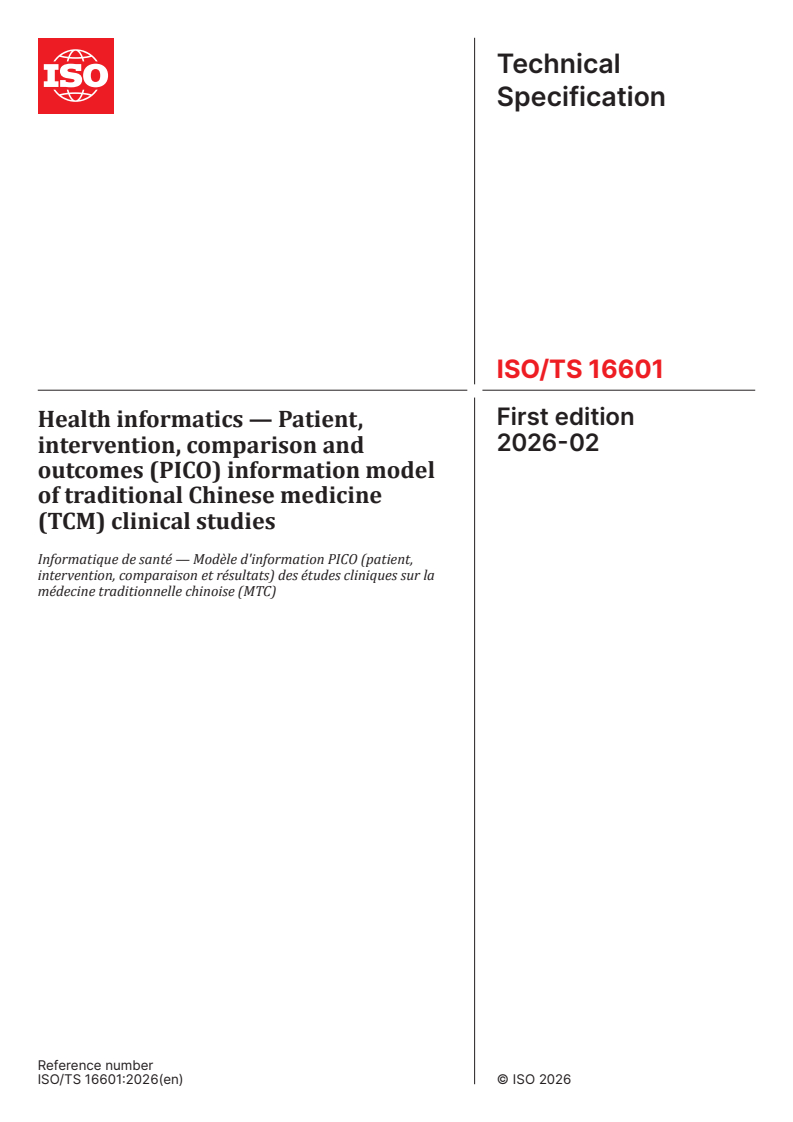
This document establishes the information model of traditional Chinese medicine (TCM) clinical studies by defining categories and their attributes designed to extract patient, intervention, comparison and outcomes (PICO) data elements from the reports of TCM clinical studies.
- Status
- Published
- Publication Date
- 05-Feb-2026
- Technical Committee
- ISO/TC 215 - Health informatics
- Drafting Committee
- ISO/TC 215 - Health informatics
- Current Stage
- 6060 - International Standard published
- Start Date
- 06-Feb-2026
- Due Date
- 14-May-2027
- Completion Date
- 06-Feb-2026
Overview
ISO/TS 16601:2026 - Health informatics - Patient, intervention, comparison and outcomes (PICO) information model of traditional Chinese medicine (TCM) clinical studies establishes an information model specifically designed for TCM clinical research. This international technical specification provides a standardized approach to structuring and extracting Patient, Intervention, Comparison, and Outcomes (PICO) data elements from reports of TCM clinical studies, promoting evidence-based healthcare and improving the development and evaluation of clinical practice guidelines.
By defining core categories and their attributes, this standard supports guideline authors, researchers, and healthcare IT professionals in ensuring that TCM clinical trial data is consistent, accessible, and analytically valuable. The model promotes clarity and comparability when evaluating the effectiveness of various TCM interventions, facilitating better decision-making and evidence synthesis within health informatics.
Key Topics
Main Elements of the PICO Information Model:
- Patient: Includes disease name, sample size, mean age, sex ratio, course of disease, diagnostic criteria, TCM pattern diagnosis, and inclusion criteria.
- Intervention: Covers TCM therapies such as acupuncture, decoction pieces formulas, other TCM therapies, traditional Chinese medicinal products, and integrative medicine, defining attributes like name, method, dose, frequency, and duration.
- Comparison: Describes the comparative group, which may involve Western medicine therapies, chemical drugs, or alternative TCM approaches, with details on treatment methods and frequencies.
- Outcomes: Details quantitative and qualitative measures including analyzed sample size, mean value, standard deviation, dropouts, adverse events, and levels of statistical significance.
- Study Design: Outlines types of clinical studies, randomization processes, blinding/masking, follow-up period, and assessment criteria.
Additional Categories:
- Evaluation: Incorporates economic analysis and patient willingness factors.
- TCM Clinical Study Attributes: Includes publication details like title, author, year, and abstract.
Applications
ISO/TS 16601:2026 benefits diverse stakeholders across health informatics, TCM research, and clinical practice:
- Guideline Development: Streamlines evidence extraction for creating and updating clinical practice guidelines based on TCM, relying on robust PICO elements for transparency and reproducibility.
- Clinical Studies and Evidence Synthesis: Enables systematic reviews and meta-analyses of TCM clinical trials by providing a uniform data structure, making comparisons and aggregations more straightforward.
- Healthcare Informatics Systems: Facilitates integration of TCM study data into electronic health records (EHRs), health databases, and decision support systems, strengthening interoperability and data sharing.
- Quality Assessment and Research Automation: Supports the use of tools such as GRADE in rating the quality of evidence and enables future developments in automated data extraction for systematic review workflows.
- Policy and Research Funding: Assists policymakers and research funders in evaluating the efficacy and value of traditional medicine interventions within healthcare systems.
Related Standards
- ISO/TS 5044: Information model for quality control of traditional Chinese medicinal products
- ISO 16843-1 & ISO 16843-2: Categorial structures for the representation of acupuncture points and needling
- ISO 11616: Identification of medicinal products and data elements for pharmaceutical information exchange
- ISO 14155: Standards for the clinical investigation of medical devices
- ISO 24153: Guidelines for random sampling and randomization procedures
- ISO/TS 22990: Categories of clinical terminological systems for integration of TCM and Western medicine
- ISO/IEC 19763-12: Metamodel framework for interoperability regarding information model registration
These standards collectively offer support for adhering to best practices in clinical data management, research methodology, and health informatics, further enhancing the value and utility of the PICO information model for TCM clinical studies.
Keywords: Health informatics, PICO, TCM clinical studies, ISO 16601, traditional Chinese medicine, evidence-based healthcare, information model, clinical practice guidelines, standardization, systematic review
Get Certified
Connect with accredited certification bodies for this standard

BSI Group
BSI (British Standards Institution) is the business standards company that helps organizations make excellence a habit.

NYCE
Mexican standards and certification body.
Sponsored listings
Frequently Asked Questions
ISO/TS 16601:2026 is a technical specification published by the International Organization for Standardization (ISO). Its full title is "Health informatics — Patient, intervention, comparison and outcomes (PICO) information model of traditional Chinese medicine (TCM) clinical studies". This standard covers: This document establishes the information model of traditional Chinese medicine (TCM) clinical studies by defining categories and their attributes designed to extract patient, intervention, comparison and outcomes (PICO) data elements from the reports of TCM clinical studies.
This document establishes the information model of traditional Chinese medicine (TCM) clinical studies by defining categories and their attributes designed to extract patient, intervention, comparison and outcomes (PICO) data elements from the reports of TCM clinical studies.
ISO/TS 16601:2026 is classified under the following ICS (International Classification for Standards) categories: 35.240.80 - IT applications in health care technology. The ICS classification helps identify the subject area and facilitates finding related standards.
ISO/TS 16601:2026 is available in PDF format for immediate download after purchase. The document can be added to your cart and obtained through the secure checkout process. Digital delivery ensures instant access to the complete standard document.
Standards Content (Sample)
Technical
Specification
ISO/TS 16601
First edition
Health informatics — Patient,
2026-02
intervention, comparison and
outcomes (PICO) information model
of traditional Chinese medicine
(TCM) clinical studies
Informatique de santé — Modèle d'information PICO (patient,
intervention, comparaison et résultats) des études cliniques sur la
médecine traditionnelle chinoise (MTC)
Reference number
© ISO 2026
All rights reserved. Unless otherwise specified, or required in the context of its implementation, no part of this publication may
be reproduced or utilized otherwise in any form or by any means, electronic or mechanical, including photocopying, or posting on
the internet or an intranet, without prior written permission. Permission can be requested from either ISO at the address below
or ISO’s member body in the country of the requester.
ISO copyright office
CP 401 • Ch. de Blandonnet 8
CH-1214 Vernier, Geneva
Phone: +41 22 749 01 11
Email: copyright@iso.org
Website: www.iso.org
Published in Switzerland
ii
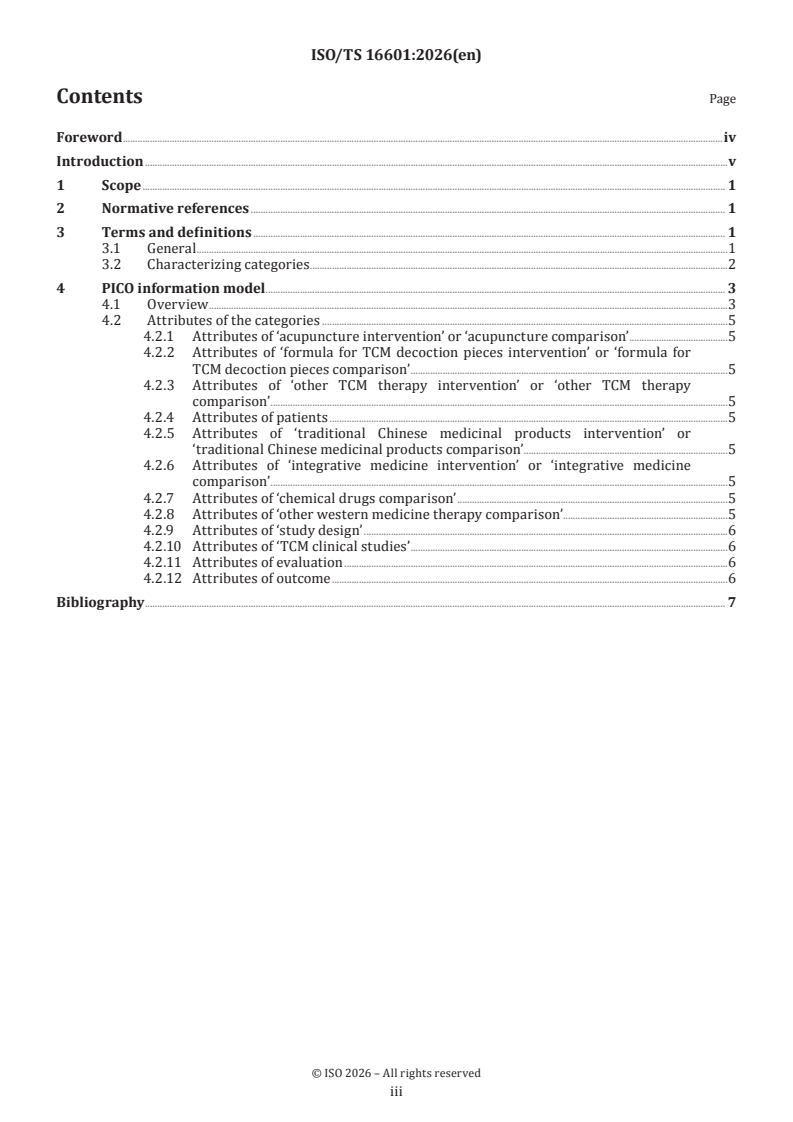
Contents Page
Foreword .iv
Introduction .v
1 Scope . 1
2 Normative references . 1
3 Terms and definitions . 1
3.1 General .1
3.2 Characterizing categories .2
4 PICO information model . . 3
4.1 Overview .3
4.2 Attributes of the categories .5
4.2.1 Attributes of ‘acupuncture intervention’ or ‘acupuncture comparison’ .5
4.2.2 Attributes of ‘formula for TCM decoction pieces intervention’ or ‘formula for
TCM decoction pieces comparison’ .5
4.2.3 Attributes of ‘other TCM therapy intervention’ or ‘other TCM therapy
comparison’ .5
4.2.4 Attributes of patients .5
4.2.5 Attributes of ‘traditional Chinese medicinal products intervention’ or
‘traditional Chinese medicinal products comparison’ . .5
4.2.6 Attributes of ‘integrative medicine intervention’ or ‘integrative medicine
comparison’ .5
4.2.7 Attributes of ‘chemical drugs comparison’ .5
4.2.8 Attributes of ‘other western medicine therapy comparison’.5
4.2.9 Attributes of ‘study design’ .6
4.2.10 Attributes of ‘TCM clinical studies’ .6
4.2.11 Attributes of evaluation .6
4.2.12 Attributes of outcome .6
Bibliography . 7
iii
Foreword
ISO (the International Organization for Standardization) is a worldwide federation of national standards
bodies (ISO member bodies). The work of preparing International Standards is normally carried out through
ISO technical committees. Each member body interested in a subject for which a technical committee
has been established has the right to be represented on that committee. International organizations,
governmental and non-governmental, in liaison with ISO, also take part in the work. ISO collaborates closely
with the International Electrotechnical Commission (IEC) on all matters of electrotechnical standardization.
The procedures used to develop this document and those intended for its further maintenance are described
in the ISO/IEC Directives, Part 1. In particular, the different approval criteria needed for the different types
of ISO documents should be noted. This document was drafted in accordance with the editorial rules of the
ISO/IEC Directives, Part 2 (see www.iso.org/directives).
ISO draws attention to the possibility that the implementation of this document may involve the use of (a)
patent(s). ISO takes no position concerning the evidence, validity or applicability of any claimed patent
rights in respect thereof. As of the date of publication of this document, ISO had not received notice of (a)
patent(s) which may be required to implement this document. However, implementers are cautioned that
this may not represent the latest information, which may be obtained from the patent database available at
www.iso.org/patents. ISO shall not be held responsible for identifying any or all such patent rights.
Any trade name used in this document is information given for the convenience of users and does not
constitute an endorsement.
For an explanation of the voluntary nature of standards, the meaning of ISO specific terms and expressions
related to conformity assessment, as well as information about ISO ’s adherence to the World Trade
Organization (WTO) principles in the Technical Barriers to Trade (TBT), see www.iso.org/iso/foreword.html.
This document was prepared by Technical Committee ISO/TC 215, Health Informatics, in collaboration with
ISO/TC 249, Traditional medicine.
Any feedback or questions on this document should be directed to the user’s national standards body. A
complete listing of these bodies can be found at www.iso.org/members.html.
iv
Introduction
Clinical practice guidelines (CPGs) are recommendations to provide the best health care for patients
based on systematic evaluation of evidence and to balance the advantages and disadvantages of different
interventions. In the formulation of clinical practice guidelines, the patient, intervention, comparison and
outcome (PICO) principle is often used to help express clinical issues in a standardized manner. Systematic
review is significant for evidence collection, evidence evaluation and decision making in clinical practice
guidelines.
PICO is a mnemonic process used to describe the elements of a clinical question in evidence-based medicine,
and it includes:
— participants, patients or population;
— intervention;
— comparison, control or comparator;
— outcome.
The purpose of this document is to establish an information model (conceptual model, not a database
implementation) based on the well-recognized PICO principle for constructing research questions. The
model can support data extraction of the PICO element from traditional Chinese medicine (TCM) clinical
trials and studies to facilitate the development of clinical guidelines, decision support, metadata analysis
of researches, information exchange and consistency of data structure within TCM. TCM clinical trials and
studies include pharmacological interventions and non-pharmacological interventions such as acupuncture,
tiuna, tai chi, and other TCM therapies.
This document can help to rapidly identify, extract, evaluate and share key elements of evidence in clinical
trials and studies, especially randomized clinical trials (RCTs), to save time and labour costs and provide a
reference for the evidence classification stage of the guidelines.
Information models of TCM clinical studies can make the process efficient and consistent by:
— helping guideline developers to quickly obtain the required information, understand and use basic PICO
information, and providing a reference for TCM clinical questions;
— providing normalized reference model for various mainstream scales and tools (i.e. Grading of
Recommendations Assessment, Development and Evaluation, GRADE), avoiding repeated reading of
articles;
— improving efficiency and provide support for subsequent automatic information extraction of clinical
questions from clinical trials and guidelines.
v
Technical Specification ISO/TS 16601:2026(en)
Health informatics — Patient, intervention, comparison and
outcomes (PICO) information model of traditional Chinese
medicine (TCM) clinical studies
1 Scope
This document establishes the information model of traditional Chinese medicine (TCM) clinical studies by
defining categories and their attributes designed to extract patient, intervention, comparison and outcomes
(PICO) data elements from the reports of TCM clinical studies.
2 Normative references
ISO 3534-1, Statistics — Vocabulary and symbols — Part 1: General statistical terms and terms used in
probability
ISO 11249, Copper-bearing intrauterine contraceptive devices — Guidance on the design, execution, analysis
and interpretation of clinical studies
ISO 14155, Clinical investigation of medical devices for human subjects — Good clinical practice
ISO 24153, Random sampling and randomization procedures
3 Terms and definitions
For the purposes of this document, the following terms and definitions apply.
ISO and IEC maintain terminology databases for use in standardization at the following addresses:
— ISO Online browsin
...