


ISO 10303-105:1996
(Main)Industrial automation systems and integration — Product data representation and exchange — Part 105: Integrated application resource: Kinematics
Industrial automation systems and integration — Product data representation and exchange — Part 105: Integrated application resource: Kinematics
Describes an information model for the kinematic aspects of a mechanical product as required for the communication between CAD systems and kinematic analysis systems, and among dissimilar kinematic analysis systems.
Systèmes d'automatisation industrielle et intégration — Représentation et échange de données de produits — Partie 105: Ressource d'application intégrée: Cinématique
General Information
- Status
- Withdrawn
- Publication Date
- 18-Dec-1996
- Withdrawal Date
- 18-Dec-1996
- Technical Committee
- ISO/TC 184/SC 4 - Industrial data
- Drafting Committee
- ISO/TC 184/SC 4/WG 12 - STEP product modelling and resources
- Current Stage
- 9599 - Withdrawal of International Standard
- Start Date
- 02-Dec-2014
- Completion Date
- 12-Feb-2026
Relations
- Effective Date
- 06-Jun-2022
- Effective Date
- 15-Apr-2008

Get Certified
Connect with accredited certification bodies for this standard

National Aerospace and Defense Contractors Accreditation Program (NADCAP)
Global cooperative program for special process quality in aerospace.
CARES (UK Certification Authority for Reinforcing Steels)
UK certification for reinforcing steels and construction.
DVS-ZERT GmbH
German welding certification society.
Sponsored listings
Frequently Asked Questions
ISO 10303-105:1996 is a standard published by the International Organization for Standardization (ISO). Its full title is "Industrial automation systems and integration — Product data representation and exchange — Part 105: Integrated application resource: Kinematics". This standard covers: Describes an information model for the kinematic aspects of a mechanical product as required for the communication between CAD systems and kinematic analysis systems, and among dissimilar kinematic analysis systems.
Describes an information model for the kinematic aspects of a mechanical product as required for the communication between CAD systems and kinematic analysis systems, and among dissimilar kinematic analysis systems.
ISO 10303-105:1996 is classified under the following ICS (International Classification for Standards) categories: 25.040.40 - Industrial process measurement and control. The ICS classification helps identify the subject area and facilitates finding related standards.
ISO 10303-105:1996 has the following relationships with other standards: It is inter standard links to ISO 10303-105:1996/Cor 1:2000; is excused to ISO 10303-105:1996/Cor 1:2000. Understanding these relationships helps ensure you are using the most current and applicable version of the standard.
ISO 10303-105:1996 is available in PDF format for immediate download after purchase. The document can be added to your cart and obtained through the secure checkout process. Digital delivery ensures instant access to the complete standard document.
Standards Content (Sample)
INTERNATIONAL
IS0
STANDARD 10303-105
First edition
1996-12-15
Industrial automation systems and
integration - Product data representation
and exchange -
Part 105:
Integrated application resource: Kinematics
S ys tt2mes d ‘automa tisa bon indus tie//e et in t6gra tion - Rep&en ta bon et
&change de don&es de prod&s -
Partie 105: Ressource d ‘applica tion in tegrke: Cinbma tique
Reference number
IS0 10303-105:1996(E)
1S010303=105:1996(E)
Page
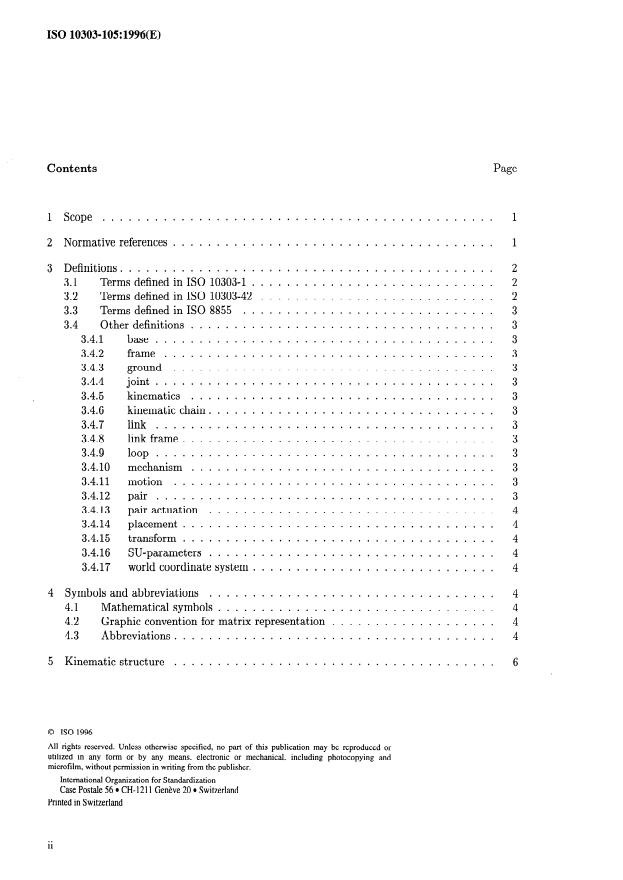
Contents
.....................................
1 Scope . . . . . . . .
.....................................
2 Normative references
3 Definitions. . . . . .
In ISb ‘103bii .
. Terms defined
in IS0 10303-42 .
32 . Terms defined
in IS0 8855 .
33 . Terms defined
. Other definitions . . . . . . . . . . . . . . . . . . . . . . . . . . . . . . . . . . .
base. .
3.4.1
frame .
3.4.2
3.4.3 ground .
joint .
3.4.4
kinematics .
3.4.5
kinematic chain. .
3.4.6
link .
3.4.7
linkframe .
3.4.8
loop .
3.4.9
................................... 3
3.4.10 mechanism
motion .
3.4.11
3.4.12 pair .
.................................
3.4.13 pair actuation
placement .
3.4.14
3.4.15 transform .
.................................
3.4.16 SU-parameters
............................
3.4.17 world coordinate system
4 Symbols and abbreviations . . . . . . . . . . . . . . . . . . . . . . . . . . . . . . . . .
41 . Mathematical symbols . . . . . . . . . . . . . . . . . . . . . . . . . . . . . . . .
42 . Graphic convention for matrix representation . . . . . . . . . . . . . . . . . . .
43 . Abbreviations . . . . . . . . . . . . . . . . . . . . . . . . . . . . . . . . . . . . .
5 Kinematic structure . . . . . . . . . . . . . . . . . . . . . . . . . . . . . . . . . . . . .
0 IS0 1996
All rights reserved. Unless otherwise specified, no part of this publication may be reproduced or
utilized in any form or by any means, electronic or mechanical, including photocopying and
microfilm, without permission in writing from the publisher.
International Organization for Standardization
Case Postale 56 l CH-1211 Geneve 20 l Switzerland
Printed in Switzerland
IS0 10303=105:1996(E)
@IS0
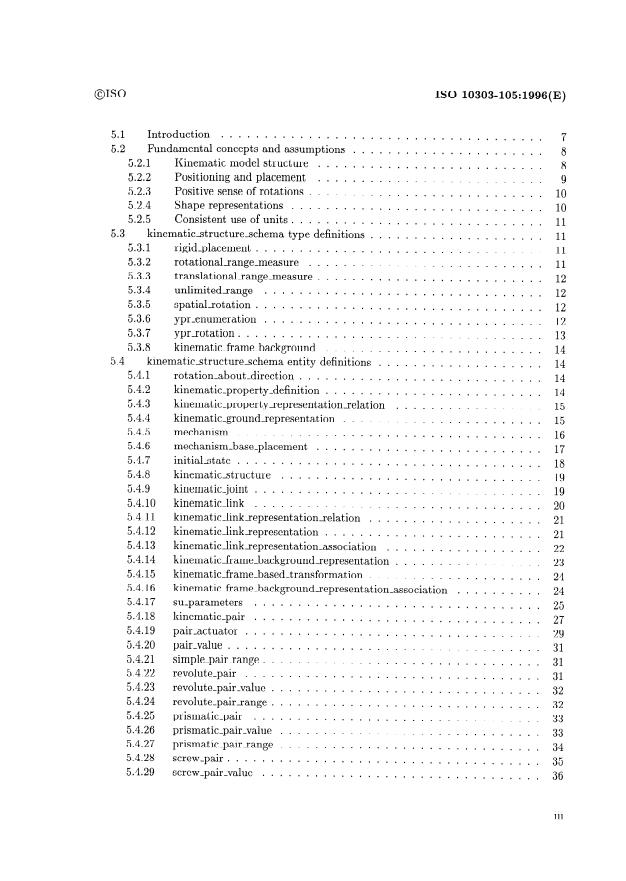
Introduction 7
51 .
.....................................
Fundamental concepts and assumptions
52 . 8
......................
5.2.1 Kinematic model structure 8
..........................
Positioning and placement 9
5.2.2
..........................
Positive sense of rotations 10
5.2.3
...........................
Shape representations 10
5.2.4
.............................
Consistent use of units. 11
5.2.5
............................
. kinematicstructure-schema type definitions 11
53 .
rigid-placement 11
5.3.1
.................................
rotationalsange-measure 11
5.3.2
...........................
5.3.3 translationalrange-measure 12
..........................
unlimitedrange 12
5.3.4
................................
spatialrotation 12
5.3.5
.................................
5.3.6 ypr-enumeration 12
................................
yprrotation. 13
5.3.7
..................................
5.3.8 kinematic-frame-background 14
.........................
54 . kinematic-structure-schema entity definitions 14
...................
5.4.1 rotation-about-direction, 14
............................
kinematic-property-definition
5.4.2 14
.........................
kinematic-propertyrepresentationrelation
5.4.3 15
.................
5.4.4 kinematic-ground-representation 15
.......................
mechanism
5.4.5 16
...................................
mechanism-base-placement
5.4.6 17
..........................
initial-state
54 . 7 18
...................................
kinematic-structure
5’4 . . 8 19
..............................
kinematic-joint
5.4.9 19
.................................
kinematic-link
5.4.10 20
.................................
kinematic-link-representation-relation
5.4.11 21
....................
5.4.12 kinematic-link-representation 21
.........................
kinematic-linkrepresentationassociation
5.4.13 22
..................
5.4.14 kinematic-frame-background-representation
................. 23
kinematic-frame-based-transformation
5.4.15
.................... 24
5.4.16 kinematic-frame-backgroundrepresentation-association
.......... 24
5.4.17 su-parameters 25
.................................
kinematic-pair
5.4.18 27
.................................
pair-actuator
5.4.19 29
..................................
5.4.20 pair-value 31
....................................
simple-pairrange
5.4.21 31
................................
5.4.22 revolute-pair 31
..................................
5.4.23 revolute-pair-value 32
...............................
5.4.24 revolute-pair-range
...............................
5.4.25 prismatic-pair 33
.................................
prismatic-pair-value
5.4.26 33
..............................
5.4.27 prismatic-pairrange 34
..............................
screw-pair.
5.4.28 35
...................................
5.4.29 screw-pair-value 36
................................
..m
@IS0
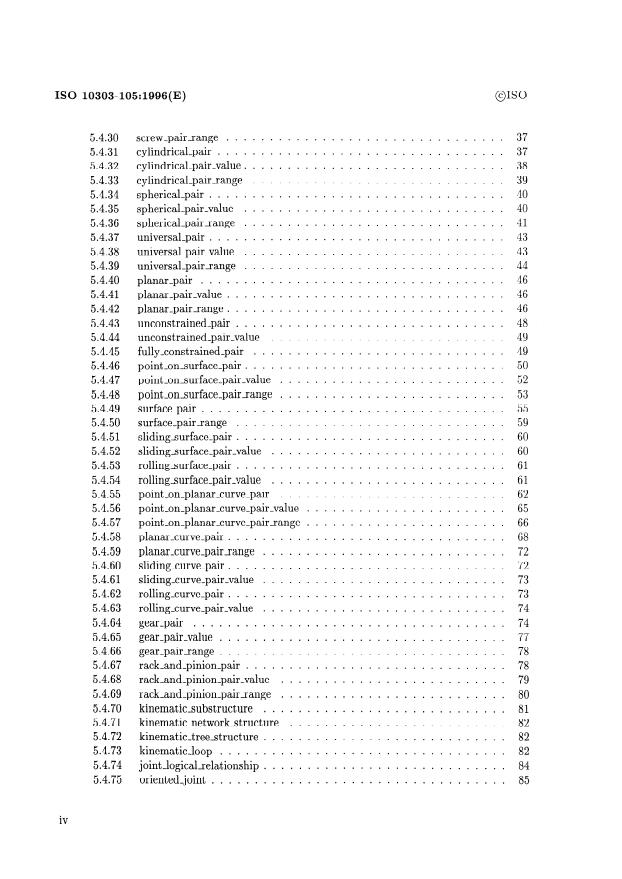
IS0 10303-105:1996(E)
................................
5.4.30 screw-pair-range
cylindrical-pair .
5.4.31
..............................
cylindrical-pair-value
5.4.32
cylindrical-pair-range .
5.4.33
spherical-pair .
5.4.34
..............................
5.4.35 spherical-pair-value
spherical-pairrange .
5.4.36
5.4.37 universal-pair .
universal-pair-value .
5.4.38
..............................
universal-pairrange
5.4.39
...................................
5.4.40 planar-pair
planar-pair-value .
5.4.41
................................ 46
5.4.42 planar-pair-range
unconstrained-pair .
5.4.43
unconstrained-pair-value .
5.4.44
.............................
5.4.45 fully-constrained-pair
point-on-surface-pair .
5.4.46
..........................
5.4.47 point-on-surface-pair-value
..........................
5.4.48 point-on-surface-pairrange
5.4.49 surface-pair .
...............................
5.4.50 surface-pairrange
slidingsurface-pair .
5.4.51
5.4.52 slidingsurface-pair-value .
6 1
...............................
5.4.53 rollingsurface-pair
6 1
5.4.54 rollingsurface-pair-value .
..........................
5.4.55 point -on-planar-curve-pair
point-on-planar-curve-pair-value .
5.4.56
.......................
5.4.57 point-on-planar-curve-pairrange
................................
5.4.58 planar-curve-pair
planar-curve-pairrange .
5.4.59
................................
5.4.60 sliding-curve-pair
............................
5.4.61 sliding-curve-pair-value
5.4.62 rolling-curve-pair .
............................
5.4.63 rolling-curve-pair-value
5.4.64 gear-pair .
5.4.65 gear-pair-value .
.................................
5.4.66 gear-pair-range
5.4.67 rack-and-pinion-pair .
..........................
5.4.68 rack-and-pinion-pair-value
rack-and-pinionpairrange .
5.4.69
5.4.70 kinematic-substructure .
.........................
5.4.71 kinematic-network-structure
5.4.72 kinematic-tree-structure .
5.4.73 kinematic-loop . . . . . . . . . . . . . . . . . . . . . . . . . . . . . . . . . 82
joint-logical-relationship .
5.4.74
5.4.75 oriented-joint .
iv
@IS0 IS0 10303-105:1996(E)
oriented-joint-in-tree
5.4.76 86
..............................
advent-oriented-joint
5.4.77 86
..............................
. kinematicstructure-schema function definitions
55 . 86
5.5.1 yprindex
.................................... 86
representation-of-link
5.5.2 87
.............................
5.5.3 suitably-based-mechanism
........................... 87
uniquelinkusage
5.5.4 89
................................
5.5.5 coordinated-pairlinkrepresentation
..................... 90
5.5.6 frame-associated-to-background
....................... 90
plane-angle-for-pairinsadian
5.5.7 92
.........................
5.5.8 convert -plane-angle-for-pairfromradian
................... 94
convert-spatial-to-yprrotation
5.5.9 96
........................
5.5.10 assign-directedlink
..............................
5.5.11 connected-insimpleloop
........................... 101
6 Kinematic motion representation
.............................. 102
61 . Introduction
.....................................
Fundamental concepts and assumptions
62 .
...................... 102
. kinematicmotionsepresentation-schema type definition: motionparameter--
measure
........................................
. kinematiclnotionrepresentationschema entity definitions
............ 103
6.4.1 translation
...................................
6.4.2 transform
.................................... 103
6.4.3 path-node.
...................................
6.4.4 kinematic-path
.................................
path-element-connection
6.4.5 104
............................
6.4.6 composite-path
.................................
path-element
6.4.7 106
..................................
6.4.8 point-to-point-path
..............................
6.4.9 circular-path
.................................. 107
linear-path
6.4.10 107
...................................
6.4.11 curve-based-path
................................
65 . kinematicmotionrepresentation-schema function definitions
.......... 108
connected-insimple-path
6.5.1 108
...........................
6.5.2 compare-unit-components
...........................
6.5.3 increasingmeasure-value
........................... 110
non-coincident-coordinates
6.5.4 111
..........................
7 Kinematic analysis control and result . . . . . . . . . . . . . . . . . . . . . . . . . . . . 112
. Introduction . . . . . . . . . . . . . . . . . . . . . . . . . . . . . . . . . . . . . 112
72 . Fundamental concepts and assumptions . . . . . . . . . . . . . . . . . . . . . . 113
73 . kinematic-analysis-control-andresultschema type definitions . . . . . . . . . . 113
interpolation-type . . . . . . . . . . . . . . . . . . . . . . . . . . . . . . . 113
7.3.1
7.3.2 kinematic-analysis-definition . . . . . . . . . . . . . . . . . . . . . . . . . 114
kinematicresult . . . . . . . . . . . . . . . . . . . . . . . . . . . . . . . . 114
7.3.3
74 . kinematic-analysis-control-and-result-schema entity definitions . . . . . . . . . 114
V
@IS0
IS0 10303405:1996(E)
.......................... 114
7.4.1 configuration-interpolation
...............................
7.4.2 kinematic-control.
............................ 115
founded-kinematic-path
7.4.3
............................
7.4.4 motion-linkrelationship
configuration-definition .
7.4.5
.....................
7.4.6 interpolated-configurationsequence
prescribed-path .
7.4.7
...........................
kinematic-analysisresult
7.4.8
kinematic-analysis-consistency .
7.4.9
resulting-path .
7.4.10
Annexes
................................... 120
A Short names of entities
Information object registration .
B
Document identification .
Bl
................................
B’2 . Schema identification
B.2.1 kinematic-structure-schema identification .
...........
B.2.2 kinematic-motion-representation-schema identification
........
kinematic-analysis-control-andresultschema identification 123
B.2.3
EXPRESS listing .
C
..................................... 125
D EXPRESS-G figures
Rotation matrix corresponding to yprrotation . 135
E
....................... 135
El Matrix representation of yprrotation
EXPRESS function compute-rotation-matrixfrom-yprsotation .
Em2 .
................... 138
F Replacement of DH-Parameters by SU-Parameters
G Bibliography .
Index . . . . . . . . . . . . . . . . . . . . . . . . . . . . . . . . . . . . . . . . . . . . . . . 141
Figures
The relationships between the three schemas of IS0 10303-105: Kinematics . . . . . xv
2 Definition of the su-parameters . . . . . . . . . . . . . . . . . . . . . . . . . . . . . . 26
3 Placement relationships of the pair frames relative to the mating links . . . . . . . .
4 Example of a joint representing a revolute pair . . . . . . . . . . . . . . . . . . . . .
5 Example of a joint representing a prismatic pair . . . . . . . . . . . . . . . . . . . .
6 Example of a joint representing a screw pair . . . . . . . . . . . . . . . . . . . . . .
. . . . . . . . . . . . . . . . . . . 38
7 Example of a joint representing a cylindrical pair
0 J . 0 0 . D . . . u D . 0 D . 0 0 0 D 41
8 Example of a joint representing a spherical pair
9 Example of a joint representing a universal pair . . . . . . . . . . . . . . . . . . . .
10 Example of a joint representing a planar pair . . . . . . . . . . . . . . . . . . . . . . 47
IS0 10303=105:1996(E)
@IS0
11 Example of a point on surface pair . . . . . . . . . . . . . . . . . . . . . . . . . . . . 51
12 Example of a surface pair. . . . . . . . . . . . . . . . . . . . . . . . . . . . . . . . . . 56
13 Example of a point on planar curve pair . 63
.............................. 69
14 Example of a planar curve pair.
15 Examples of gear pairs in different situations. . . . . . . . . . . . . . . . . . . . . . . 75
16 Example of a rack and pinion pair in the reference situation . . . . . . . . . . . . . . 79
17 Example of a kinematic network structure . . . . . . . . . . . . . . . . . . . . . . . . 83
18 Example of a kinematic tree structure . . . . . . . . . . . . . . . . . . . . . . . . . . 83
II.1 Graphical notation of the major aspects of the kinematicstructureschema - diagram
lof7 . . . . . . . . . . . . . . . . . . . . . . . . . . . . . . . . . . . . . . . . . .126
D.2 Graphical notation of the major aspects of the kinematicstructureschema - diagram
2of7 . . . . . . . . . . . . . . . . . . . . . . . . . . . . . . . . . . . . . . . . . .127
D.3 Graphical notation of the major aspects of the kinematicstructureschema - diagram
3of7 . . . . . . . . . . . . . . . . . . . . . . . . . . . . . . . . . . . . . . . . . .128
D.4 Graphical notation of the major aspects of the kinematicstructureschema - diagram
4of7 . . . . . . . . . . . . . . . . . . . . . . . . . . . . . . . . . . . . . . . . . .129
D.5 Graphical notation of the major aspects of the kinematicstructureschema - diagram
5of7 . . . . . . . . . . . . . . . . . . . . . . . . . . . . . . . . . . . . . . . . . . .13o
D.6 Graphical notation of the major aspects of the kinematicstructureschema - diagram
6of7 . . . . . . . . . . . . . . . . . . . . . . . . . . . . . . . . . . . . . . . . . .131
D.7 Graphical notation of the major aspects of the kinematicstructureschema - diagram
7of7 . . . . . . . . . . . . . . . . . . . . . . . . . . . . . . . . . . . . . . . . . .132
D.8 Graphical notation of the major aspects of the kinematic-motionsepresentation-
schema . . . . . . . . . . . . . . . . . . . . . . . . . . . . . . . . . . . . . . . . . . . 133
D.9 Graphical notation of the major aspects of the kinematic-analysiscontrol-andresult--
schema . . . . . . . . . . . . . . . . . . . . . . . . . . . . . . . . . . . . . . . . . . . 134
Tables
1 Mathematical symbology . . . . . . . . . . . . . . . . . . . . . . . . . . . . . . . . . 5
A.1 Short names of entities . . . . . . . . . . . . . . . . . . e . . . . . . . . . . . 0 0 . . 0 120
vii
@IS0
IS0 10303=105:1996(E)
Foreword
The International Organization for Standardization (ISO) is a worldwide federation of national
standards bodies (IS0 member bodies). The work of preparing International Standards is nor-
Each member body interested in a subject
mally carried out through IS0 technical committees.
.
for which a technical committee has been established has the right to be represented on that
committee. International organizations, governmental and non-governmental7 in liaison with
ISO, also take part in the work. IS0 collaborates closely with t,he Intlernational Electrotechnical
Commission (IEC) on all matters of electroteclmical standardization.
Draft International Standards adopted by technical committees are circulated to the member
bodies for voting. Publication as an International Standard requires approval by at least 75%
of the member bodies casting a vote.
International Standard IS0 10303-105 was prepared by Technical Committee ISO/TC 184,
Industrial automation systems and integration, Subcommittee SC4, Industrial data.
IS0 10303 consists of the following parts under the general title Industrial automation systems
and integration - Product data representation and exchange:
- Part 1, Overview and fundamental principles;
-
Part 11, Description methods: The EXPRESS language reference manual;
-
Part 12, Description method: The EXPRESS-I language reference manual;
-
Part 21, Implementation methods: Clear text encoding of the exchange structure;
-
Part 22, Implementation method: Standard data access interface specification;
- Part 23, Implementation method: C++ language binding to the standard data access
interface;
- Part 24, Implementation method: C language binding to the standard data access
interface;
Interface definition language binding to the standard
- Part 26, Implementation method:
data access interface;
- Part 31, Conformance testing methodology and framework: General concepts;
framework: irements on testing
- Part 32, Conformance testing methodology and Requ
laboratories and clients;
framework: Structure and use of ab-
- Part 33, Conformance testing methodology and
stract test suites;
-
Part 34, Conformance testing methodology and framework: Abstract test methods;
. . .
Vlll
IS0 10303-105:1996(E)
@ISO
-
Part 35, Conformance testing methodology and framework: Abstract test methods for
SDAI implement at ions;
Fundamentals of product description and support;
- Part 41, Integrated generic resources:
Geometric and topological representation;
- Part 42, Integrated generic resources:
- Part 43, Integrated generic resources: Representation structures;
-
Product structure configuration;
Part 44, Wegrated generic resources:
-
Part 45, Integrated generic resource: Materials;
- Part 46, Integrated generic resource: Visual presentation;
- Part 47, Integrated generic resource: Shape variation tolerances;
Process structure and properties;
- Part 49, Integrated generic resource:
-
Part 101, Integrated application resource: Draughting;
- Part 104, Integrated application resource: Finite element analysis;
-
Part 105, Integrated application resource: Kinematics;
-
Building construction core model;
Part 106, Integrated application resource:
-
Part 201, Application protocol: Explicit draughting;
-
Part 202, Application protocol: Associative draughting;
-
Part 203, Application protocol: Configuration controlled design;
-
Part 204, Application protocol: Mechanical design using boundary representation;
-
Part 205, Application protocol: Mechanical design using surface representation;
-
Part 207, Application protocol: Sheet metal die planning and design;
-
Part 208, Application protocol: Life cycle management - Change process;
-
Part 209, Application protocol: Composite and metallic structural analysis and related
design;
-
Part 210, Application protocol: Design of layered electronic products;
ix
@IS0
IS0 10303-105:1996(E)
- Part 211, Application protocol: Electronics test diagnostics and remanufacture;
-
Part 212, Application protocol: Electrotechnical design and installation;
-
Part 213, Application protocol: Numerical control process plans for machined parts;
-
Part 214, Application protocol: Core data for automotive mechanical design;
-
Part 215, Application protocol: Ship arrangement;
-
Part 216, Application protocol: Ship moulded forms;
- Part 217, Application protocol: Ship piping;
- Part 218, Application protocol: Ship structures;
- Part 220. Application protocol: Process planning, manufacture, and assembly of layered
I
electronic product’s;
Functional data and their schematic representation for
- Part 221, Application protocol:
process plant;
Exchange of product data for composite structures;
- Part 222, Application protocol:
Exchange of design and manufacturing product infor-
- Part 223, Application protocol:
mation for cast parts;
Mechanical product definition for process plans using
- Part 224, Application protocol:
mechanical feature;
Building elements using explicit shape representation;
- Part 225, Application protocol:
Ship mechanical systems;
- Part 226, Application protocol:
- Part 227, Application protocol: Plant spatial configuration;
- Part 228, Application protocol: Building services: Heating, ventilation, and air condi-
t ioning;
- Part 229, Application protocol: Exchange of design and manufacturing product infor-
mation for forged parts;
- Part 230, Application protocol: Building structural frame: Steelwork;
- Part 231, Application protocol: Process engineering data: Process design and process
specification of major equipment;
X
IS0 10303=105:1996(E)
@IS0
-
Part 232, Application protocol: Technical data package;
-
Part 301, Abstract test suite: Explicit draughting;
-
Part 302, Abstract test suite: Associative draughting;
-
Part 303, Abstract test suite: Configuration controlled design;
-
Part 304, Abstract test suite: Mechanical design using boundary representation;
-
Part 305, Abstract test suite: Mechanical design using surface representation;
-
Part 307, Abstract test suite: Sheet metal die planning and design;
-
Part 308, Abstract test suite: Life cycle management - Change process;
-
Part 309, Abstract test suite: Composite and metallic structural analysis and related
design;
-
Part 310, Abstract test suite: Design of layered electronic products;
- Part 311, Abstract test suite: Electronics test diagnostics and remanufacture;
-
Part 312, Abstract test suite: Electrotechnical design and installation;
Part 313, Abstract test suite: Numerical control process plans for machined parts;
-
-
Part 314, Abstract test suite: Core data for automotive mechanical design;
-
Part 315, Abstract test suite: Ship arrangement;
-
Part 316, Abstract test suite: Ship moulded forms;
-
Part 317, Abstract test suite: Ship piping;
- Part 318, Abstract test suite: Ship structures;
- Part 320, Abstract test suite: Process planning, manufacture, and assembly of layered
electronic products;
- Part 321, Abstract test suite: Functional data and their schematic representation for
process plant;
-
Part 322, Abstract test suite: Exchange of product data for composite structures;
-
Part 323, Abstract test suite: Exchange of design and manufacturing product informa-
tion for cast parts;
xi
@IS0
ISo 10303=105:1996(E)
-
Part 324, Abstract test suite: Mechanical product definition for process plans using
mechanical features;
Building elements using explicit shape representation;
- Part 325, Abstract test suite:
Ship mechanical systems;
- Part 326, Abstract test suite:
Plant spatial configuration;
- Part 327, Abstract test suite:
Building services: Heating, ventilation, and air condition-
- Part 328, Abstract test suite:
Exchange of design and manufacturing product informa-
- Part 329, Abstract test suite:
tion for forged parts;
Building structural frame: Steelwork;
- Part 330, Abstract test suite:
-
Part 331, Abstract test suite: Process engineering data: Process design and process
specification of major equipment;
-
Part 332, Abstract test suite: Technical data package;
-
Part 501, Application interpreted construct: Edge-based wireframe;
-
Part 502, Application interpreted construct: Shell-based wireframe;
-
Part 503, Application interpreted construct: Geometrically bounded 2D wireframe;
- Part 504, Application interpreted construct: Draughting annotation;
- Part 505, Application interpreted construct: Drawing structure and administration;
- Part 506, Application interpreted construct: Draughting elements;
- Part 507, Application interpreted construct: Geometrically bounded surface;
- Part 508, Application interpreted construct: Non-manifold surface;
- Part 509, Application interpreted construct: Manifold surface;
- Part 510, Application interpreted construct: Geometrically bounded wireframe;
- Part 511, Application interpreted construct: Togologically bounded surface;
- Part 512, Application interpreted construct: Faceted boundary representation;
- Part 513, Application interpreted construct: Elementary boundary representation;
xii
IS0 10303-105:1996(E)
@IS0
- Part 514, Application interpreted construct: Advanced boundary representation;
- Part 515, Application interpreted construct: Constructive solid geometry;
- Part 517, Application interpreted construct: Mechanical design geometric presentation;
- Part 518, Application interpreted construct: Mechanical design shaded representation.
The structure of this International Standard is described in IS0 10303-l. The numbering of the
parts of this International Standard reflects its structure:
- Parts 11 to 13 specify the description methods,
- Parts 21 to 26 specify the implementation methods,
- Parts 31 to 35 specify the conformance testing methodology and framework,
- Parts 41 to 49 specify the integrated generic resources,
- Parts 101 to 106 specify the integrated application resources,
- Parts 201 to 232 specify the application protocols,
- Parts 301 to 332 specify the abstract test suites, and
- Parts 501 to 518 specify the application interpreted constructs.
Should further parts be published, they will follow the same numbering pattern.
Annexes A and B are an integral part of this part of IS0 10303. Annexes C, D, E, F, and G
are for information only.
. . .
x111
IS0 10303405:1996(E) @IS0
Introduction
IS0 10303 is an International Standard for the computer-interpretable representation and ex-
change of product data. The objective is to provide a neutral mechanism capable of describing
product data throughout the life cycle of a product independent from any particular system.
The nature of this description makes it suitable not only for neutral file exchange, but also as a
basis for implementing and sharing product databases and archiving.
This International Standard is organized as a series of parts, each published separately. The
parts of IS0 10303 fall into one of the following series: description methods, integrated resources,
application interpreted constructs, application protocols, abstract test suites, implementation
The series are described in IS0 10303-l. This part of
methods, and conformance testing.
IS0 10303 is a member of the integrated resources series. Major subdivisions of this Interna-
tional Standard are:
- kinematic structure;
- kinematic motion representation;
- kinematic analysis control and results.
This part of IS0 10303 specifies an information model for the kinematic aspects of a mechanical
product as required for the communication between CAD systems and kinematic analysis sys-
Kinematic information in the context
tems, and among dissimilar kinematic analysis systems.
of this part of IS0 10303 may be used in:
-
early design stages, where detailed component shape is yet undetermined. The pur-
pose of the kinematic description in these stages is to develop the conceptual model of the
mechanical product to understand its motion characteristics;
- detail design stage where detailed shapes of components are determined. The purpose
of the kinematic description in that stage is to verify the performance of the kinematic
characteristics of a mechanical product using the final shape of its components, e.g., by
means of collision checking.
The kinematic structure in this part of IS0 10303 is composed of rigid components related by
kinematic pairs along a surface, on a curve, or at a point.
The kinematic structure schema defines the kinematic structure of rigid objects in terms of
links, pairs, and joints. A link is the rigid part of a kinematic object. A pair represents the
geometric aspects of the kinematic constraints of motion of these objects, and a joint represents
the topological aspects of these constraints. The kinematic structures are represented by graphs
in which the vertices of the graph correspond to the links, and the edges of the graph correspond
to the joints.
The kinematic motion representation schema specifies the motion of a mechanical product by
using a parametric path definition.
The kinematic analysis control and result schema specifies configurations of kinematic structures
and the interpolation between configurations. This schema describes prescribed paths for a
kinematic analysis and paths resulting from such a kinematic analysis.
xiv
IS0 10303=105:1996(E)
@IS0
Figure 1 illustrates these three schemas and the types and entities that are defined in one schema
and referenced by another.
kinematic-path
rotation-about-direction
spatial-rotation motion~parameter~measure
ypr-rotation
kinematic motion
- -
kinematic analysis
kinematic structure representation-schema
control-and-result-
----
---
I_
kinematicjoint
kinematic-link-representation
mechanism
pair-value
rigid-placement
Figure 1 - The relationships between the three schemas of
IS0 10303405: Kinematics
xv
This page intentionally left blank
INTERNATIONAL STANDARD @IS0 IS0 10303-105:1996(E)
Industrial automation systems and integration -
Product data representation and exchange -
Part 105 :
Integrated application resource: Kinematics
1 Scope
This part of IS0 10303 specifies the resource constructs for the representation of the kinematic
aspects of a mechanical product.
The following are within the scope of this part of IS0 10303:
- definition of kinematic relationships between rigid objects called links;
-
representation of the topology for a kinematic structure;
- definition of a kinematic motion as a sequence of discretised positions and orientations;
-
representation of the input to and the result of a kinematic analysis.
The following are outside the scope of this part of IS0 10303:
- description of tolerances and clearances in kinematic structures;
- description of motion parameters in terms of a continuous time variable;
-
representation of intermittent joints with variable constraints on motion;
-
represent at ion of dynamic mechanical assemblies;
-
representation of force, mass, and friction.
2 Normative references
The following standards contain provisions which, through reference in this text, constitute
provisions of this part of IS0 10303. At the time of publication, the editions indicated were
valid. All standards are subject to revision, and parties to agreements based on this part of
IS0 10303 are encouraged to investigate the possibility of applying the most recent editions of
the standards indicated below. Members of IEC and IS0 maintain registers of currently valid
International Standards.
@ISO
IS0 10303405:1996(E)
ISO/IEC 8824-1:1995, Information technology - Abstract Syntax Notation One (ASN.1): Spec-
ification of basic notation.
IS0 8855:1991, Road vehicles - Vehicle dynamics and road-holding ability - Vocabulary.
IS0 10303-1:1994, Industrial automation systems and inteqratioh - Prboduct data representation
Part 1: Overview and fundamental principles.
and exchange -
IS0 10303-11:1994, Industrial automation systems and integration - Product data representation
and exchange - Part 11: Description methods: The EXPRESS language reference manual.
IS0 10303-21:1994, Industrial automation systems and integration - Product data representation
and exchange - Part 21: Implementation methods: Clear text encoding of the exchange structure.
- Product data representation
IS0 10303-41:1994, Industrial automation systems and integration
Part 41: Integrated generic resources: Fundamentals of product description an/d
and exchange -
support.
IS0 10303-42:1994, Industrial automation systems and integration - Product data representation
and exchange - Part 42: Integrated generic resources: Geometric and topological representation.
IS0 10303-43:1994, Industrial automation systems and integration - Product data representation
and exchange - Part 43: Integrated generic resources: Representation structures.
3 Definitions
3.1 Terms defined in IS0 103034
This part of IS0 10303 makes use of the following terms defined in IS0 10303-L
-
application resource;
- data;
- generic resource;
-
informat ion;
-
integrated resource;
- product.
3.2 Terms defined in IS0 l-0303-42
This part of IS0 10303 makes use of the following terms defined in IS0 10303-42:
- geometric coordinate system;
IS0 10303=105:1996(E)
@IS0
-
geometrically founded;
- graph.
3.3 Terms defined in IS0 8855
This part of IS0 10303 makes use of the following terms defined in IS0 8855:
-
pitch angle;
-
roll angle;
- yaw angle.
3.4 Other definitions
For the purposes of this part of IS0 10303, the following definitions apply.
3.4.1 base: a link which is fixed to the ground or whose motion is prescribed along a defined
path.
3.4.2 frame: a coordinate system used in kinematic representations.
3.4.3 ground: the immobile part of a mechanical product in the world coordinate system.
3.4.4 joint: the topological aspect of an ordered connection or motion constraint between two
and only two links.
structures consisting of joints and
3.4.5 kinemat its: the description of movable mechanical
links including the number, location, and orientation of the joints.
3.4.6 kinematic chain: a sequence of kinematic links connected by joints.
3.4.7 link: a rigid kinematic object whose motion is constrained by one or more joints.
3.4.8 link frame: the local coordinate system of a link, implicitly defined as the geometric
context of the link, with respect to which all geometric definitions of the link are defined.
3.4.9 loop: a part of a mechanical structure whose joints and links together a closed
kinematic chain.
3.4.10 mechanism: a mechanical product whose motion is constrained by joints.
3.4.11 motion: change of position and orientation of a rigid body.
3.4.12 pair: the geometric aspect of either an ordered connection or motion constraint between
two and only two links.
@IS0
IS0 10303--105:1996(E)
the assignment of a pair value to a kinematic pair by an application.
3.4.13 pair actuation:
3.4.14 placement: the location and orientation of a frame.
3.4.15 transform: a representation of a placement that is specified with respect to an inde-
pendent reference frame.
the parameters that specify the placement between a pair of frames.
3.4.16 SU-parameters:
3.4.17 world coordinate system: the initial coordinate system from which all other frames
are defined.
4 Symbols and abbreviations
For the purposes of this part of IS0 10303, the following symbols and abbreviations apply.
4.1 Mathematical symbols
The mathematical symbol convention used in this part of IS0 10303 is given in table 1.
4.2 Graphic convention for matrix representation
In mathematical formulas, a transform representation (three position values and three rotation
values) is written as BOLD capital letters.
4.3 Abbreviations
su Sheth-Uicker
rotation angles called yaw, pitch, and roll.
YPr
IS0 10303=105:1996(E)
@IS0
Table 1 - Mat hemat ical symbology
Symbol Definition
a Scalar quantity a
a Vector quantity G
x, y, x Coordinate axes
Z, y, x Unit vectors along coordinate axes
F Matrix F
F-l The inverse of the matrix F
x Vector (cross) product
l Scalar product
f(u> Parametric curve f
U = f (up) Value of f(u) at the point denoted by p
f( I/
u=up
v Derivative of f(u) with respect to u
f (24, v) Parametric surface f
Value of f (u, vj at the point denoted by p
f( u,v I/
u=up,v=vp
af(u,v> Partial differential of f with respect to u
dU
x E ]a, b] x is element of the range between a (excluded) and b (included)
sign(x) Function returns the sign of the argument x
11 Absolute value, or magnitude, or determinant
R m m-dimensional real space
@IS0
IS0 10303=105:1996(E)
5 Kinematic structure
The following EXPRESS declaration begins the kinematic-structure-schema and identifies
the necessary references l
EXPRESS specification:
*>
SCHEMA kinematic-structure-schema;
REFERENCE FROM geometry-schema
(axis2_placement_3d,
cartesian_transformation_operator_3d,
curve,
direction,
geometric-representation-context,
normalise,
point,
point-on-curve,
point-on-surface,
surface,
rectangular-trimmed-surface,
trimmed-curve);
REFERENCE FROM measure-schema
(conversion-based-unit,
global-unit-assigned-context,
length-measure,
plane-angle-measure,
sirprefix,
si-unit,
si-unit-name,
unit);
REFERENCE FROM product-property-definition-schema
(characterized-definition,
property-definition);
REFERENCE FROM product-property-representation-schema
(property-definition-representation);
REFERENCE FROM representation-schema
(functionally-defined-transformation,
item-defined-transformation,
representation,
representation-context,
representation-item,
representation-relationship,
representation-relationship-with_transformation);
REFERENCE FROM support-resource-schema
(bag-to-set,
IS0 10303=105:1996(E)
@IS0
label) ;
(*
NOTES
1 - The schemas referenced above can be found in the following parts of IS0 10303:
IS0 10303-42
geometry-schema
IS0 10303-41
measure-schema
product-property-definition-schema IS0 10303-41
product-propertyrepresentationschema IS0 10303-41
IS0 10303-43
representation-schema
IS0 10303-41
support-resource-schema
2 - See annex D for a graphical representation of this schema using the EXPRESS-G notation.
5.1 Introduction
The subject of the kinematic-structure-schema is the description of the kinematic informa-
tion of a mechanical product defining its motion capabilities.
Motion in this part of IS0 10303 comprises both free, unconstrained motion of objects in a
Cartesian coordinate system and motion constrained by kinematic joints and pairs.
This part of IS0 10303 covers the following types of pairs.
revolute pair;
1)
prismatic pair;
2)
screw pair;
3)
4) cylindrical pair;
5) spherical pair;
universal pair;
6)
planar pair;
7)
8) gear pair;
rack and pinion pair;
unconstrained pair;
fully constrained pair;
12) point on surface pair;
@IS0
IS0 10303=105:1996(E)
sliding surface pair;
13)
rolling surface pair;
point on planar curve pair;
15)
sliding curve pair;
16)
rolling curve pair.
17)
Pair types 1 through 11 are called low order pairs and the remaining pair types are called high
order pairs.
NOTE - Pair types 1 through 11 do not require explicit geometric information to describe their
kinematic behaviour. Pair types 12 through 17 require a reference to a surface or to a curve in order
to be defined kinematically.
For surface pairs and curve pairs, two specialisations are distinguished: the sliding and rolling
subtypes. A rolling pair is constrained in the relative motion of the two surfaces or curves such
that they cannot slide on each other.
EXAMPLE 1 - High levels of friction between two surfaces or curves may be the cause for relative
motion to be constrained to rolling.
For sliding pairs such a constraint does not exist.
Low order pairs can be represented as sliding high order pairs. If a pair can be represented as
a low order pair, it should be so represented and not as a high order pair.
5.2 Fundamental concepts and assumptions
5.2.1 Kinematic model structure
Mechanical products with kinematic representations may have arbitrary topological structures.
The topological structures are not constrained to simple chains (i.e., open kinematic chains
without branches) or to tree-type structures; they may include loops or a network structure.
NOTE - Every kinematic structure can be described in terms of its joints and links. Joints constrain
the motion between two rigid objects called links. Joints and links are sufficient to describe the
topology of kinematic structures, but for computation it is meaningful to introduce additional levels
of structure based on graph theory. Information related to the graph representation of a kinematic
structure is given in 5.4.70.
EXAMPLES
Simple chains are suitable kinematic structures for many industrial robots or cranes. Tree-type
2-
structures are used to represent multi-arm manipulators.
-
example
3 Network structures occur in industrial products. One is the mechanism used for wind-
screen wipers.
@IS0 IS0 10303=105:1996(E)
In this part of IS0 10303, kinematic structures are represented by graphs where the links rep-
resent the vertices of the graph, and the joints represent the edges. The rigid objects with
kinematic representations are defined kinematically in terms of links and geometrically in terms
of their associated shape representation. All coordinate systems related to a kinematic link are
founded in the link frame, which is the geometric context of the related link representation.
These coordinate systems are called frames in this part of IS0 10303. For the purpose of repre-
senting the kinematic aspect of a mechanism, the shape of the link is represented by the relative
location and orientation of all its pair frames with respect to its link frame.
5.2.2 Positioning and placement
Whenever constraints are imposed on the relative motion of two kinematic links, this fact i
...
Questions, Comments and Discussion
Ask us and Technical Secretary will try to provide an answer. You can facilitate discussion about the standard in here.
Loading comments...