

ISO 513:2012
(Main)Classification and application of hard cutting materials for metal removal with defined cutting edges — Designation of the main groups and groups of application
General Information
- Abstract
ISO 513:2012 specifies the classification and application of hard cutting materials, including hardmetals, ceramics, diamond and boron nitride, for machining by chip removal, and establishes their application. It is not applicable to other uses (mining and other percussion tools, wire drawing dies, tools operating by deformation of the metal and comparator contact tips, etc.).
- Status
- Published
- Publication Date
- 04-Nov-2012
- Current Stage
- 9060 - Close of review
- Completion Date
- 02-Dec-2028
Buy Documents
ISO 513:2012 - Classification and application of hard cutting materials for metal removal with defined cutting edges — Designation of the main groups and groups of application Released:11/5/2012
ISO 513:2012 - Classification et application des matériaux durs de coupe pour enlevement de métal avec aretes coupantes définies — Définition des groupes principaux et des groupes d'application Released:11/5/2012
ISO 513:2012 - Classification and application of hard cutting materials for metal removal with defined cutting edges — Designation of the main groups and groups of application Released:11/14/2017
Overview
ISO 513:2012 is an international standard established by the International Organization for Standardization (ISO) that provides a classification system and application guidelines for hard cutting materials used in metal removal processes involving defined cutting edges. This standard specifically covers materials such as hardmetals (carbides), ceramics, diamond, and boron nitride. The key focus of ISO 513:2012 is to standardize the designation of main groups and application groups to facilitate the selection and classification of cutting materials for machining by chip removal, thereby promoting clarity and consistency across the manufacturing sector.
The standard excludes applications unrelated to chip removal, such as mining tools, wire drawing dies, and tools that operate by deformation rather than cutting.
Key Topics
Classification of Hard Cutting Materials
ISO 513 divides hard cutting materials into four main categories:- Carbides (uncoated and coated variants, including cermets)
- Ceramics (including aluminum oxide-based and silicon nitride-based ceramics)
- Diamond (monocrystalline and polycrystalline types with or without binders)
- Boron Nitride (cubic crystalline forms with varying boron nitride content)
Designation System
Each material group is designated by specific letter symbols (e.g., HW for tungsten carbide with grain size ≥ 1 μm) combined with a code indicating the main group of application and a detailed group of application classification number.Main Groups of Application
These are categorized into six groups based on the workpiece material to be machined:- P (blue): Steel and cast steel (excluding certain stainless steels)
- M (yellow): Stainless steels (austenitic, ferritic, cast steel variants)
- K (red): Cast irons
- N (green): Non-ferrous metals and non-metallic materials
- S (brown): Superalloys and titanium alloys
- H (grey): Hardened steel and hardened cast iron
Wear Resistance and Toughness Rating
Groups are further subdivided with classification numbers reflecting the balance between wear resistance and toughness, helping to optimize tool material choice depending on machining conditions such as feed rates and cutting speeds.Standardized Color Coding and Symbols
The use of color marking and standardized letter codes ensures practical and rapid identification and communication about cutting materials and their intended applications across industries.
Applications
ISO 513:2012 plays a critical role in industries requiring precision metal machining by defining a clear and universally accepted nomenclature for tool materials. Key applications include:
Manufacturing and Metalworking
Helps manufacturers select appropriate cutting materials for turning, milling, drilling, and other chip removal operations, optimizing tool life and machining efficiency.Toolmakers and Suppliers
Provides a standardized language for categorizing tool grades based on the substrate machinability, enabling better communication between producers and users.Quality Control and Procurement
Assists in specifying and verifying cutting tool materials according to internationally recognized categories and application groups to ensure consistent performance.Design of Cutting Tools
Guides engineering decisions about suitable cutting materials for specific metal types, balancing factors like hardness, toughness, wear resistance, and cost-effectiveness.
Related Standards
To complement ISO 513:2012, users may refer to related documents for broader insights on tooling and materials:
- ISO 3685 – Tool life testing of hard cutting materials
- ISO 4957 – Tool steels specification used in cutting tools
- ISO 8688 – Test methods for metal cutting tools
- ISO 3611 – Designations for cemented carbides and cermets
Together, these standards ensure a comprehensive framework supporting the design, classification, testing, and application of cutting tools and materials.
Keywords: ISO 513 classification, hard cutting materials, hardmetals, ceramics, diamond cutting tools, boron nitride, machining classification, metal removal, cutting edge designation, tool material classification, machining standards, chip removal tools, cutting tool identification, steel machining, cast iron cutting, non-ferrous metals machining, superalloys machining, tool wear resistance, tool toughness, tool designation system.
Relations
- Effective Date
- 25-Aug-2026
- Effective Date
- 25-Jun-2011
Buy Documents
ISO 513:2012 - Classification and application of hard cutting materials for metal removal with defined cutting edges — Designation of the main groups and groups of application Released:11/5/2012
ISO 513:2012 - Classification et application des matériaux durs de coupe pour enlevement de métal avec aretes coupantes définies — Définition des groupes principaux et des groupes d'application Released:11/5/2012
ISO 513:2012 - Classification and application of hard cutting materials for metal removal with defined cutting edges — Designation of the main groups and groups of application Released:11/14/2017
Get Certified
Connect with accredited certification bodies for this standard

DVS-ZERT GmbH
German welding certification society.
CARES (UK Certification Authority for Reinforcing Steels)
UK certification for reinforcing steels and construction.
EWF/IIW (European/International Welding Federation)
International welding personnel certification.
Sponsored listings
Frequently Asked Questions
ISO 513:2012 is a standard published by the International Organization for Standardization (ISO). Its full title is "Classification and application of hard cutting materials for metal removal with defined cutting edges — Designation of the main groups and groups of application". This standard covers: ISO 513:2012 specifies the classification and application of hard cutting materials, including hardmetals, ceramics, diamond and boron nitride, for machining by chip removal, and establishes their application. It is not applicable to other uses (mining and other percussion tools, wire drawing dies, tools operating by deformation of the metal and comparator contact tips, etc.).
ISO 513:2012 specifies the classification and application of hard cutting materials, including hardmetals, ceramics, diamond and boron nitride, for machining by chip removal, and establishes their application. It is not applicable to other uses (mining and other percussion tools, wire drawing dies, tools operating by deformation of the metal and comparator contact tips, etc.).
ISO 513:2012 is classified under the following ICS (International Classification for Standards) categories: 25.100.01 - Cutting tools in general. The ICS classification helps identify the subject area and facilitates finding related standards.
ISO 513:2012 has the following relationships with other standards: It is inter standard links to EN ISO 8049:2016, ISO 513:2004. Understanding these relationships helps ensure you are using the most current and applicable version of the standard.
ISO 513:2012 is available in PDF format for immediate download after purchase. The document can be added to your cart and obtained through the secure checkout process. Digital delivery ensures instant access to the complete standard document.
Standards Content (Sample)
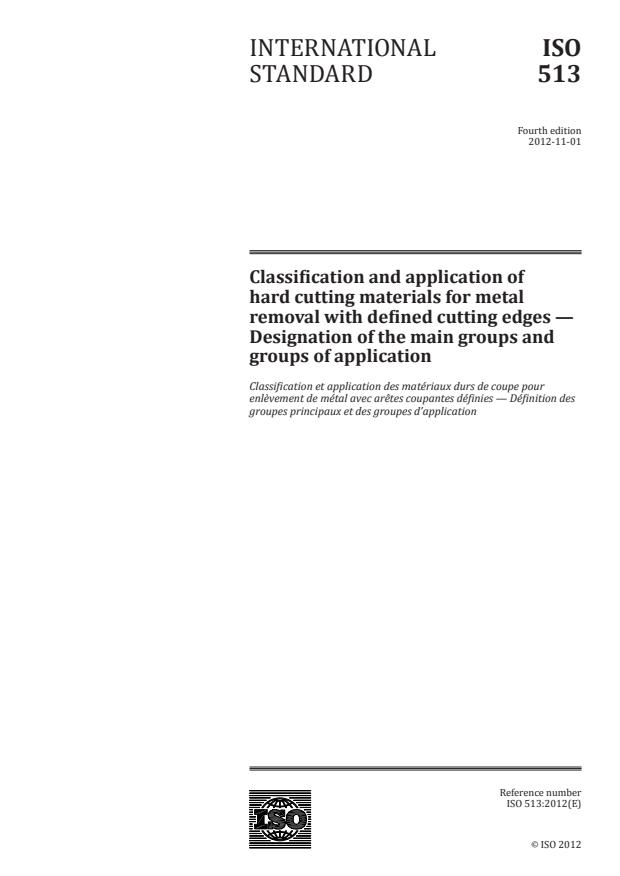
INTERNATIONAL ISO
STANDARD 513
Fourth edition
2012-11-01
Classification and application of
hard cutting materials for metal
removal with defined cutting edges —
Designation of the main groups and
groups of application
Classification et application des matériaux durs de coupe pour
enlèvement de métal avec arêtes coupantes définies — Définition des
groupes principaux et des groupes d’application
Reference number
©
ISO 2012
© ISO 2012
All rights reserved. Unless otherwise specified, no part of this publication may be reproduced or utilized in any form or by any
means, electronic or mechanical, including photocopying and microfilm, without permission in writing from either ISO at the
address below or ISO’s member body in the country of the requester.
ISO copyright office
Case postale 56 • CH-1211 Geneva 20
Tel. + 41 22 749 01 11
Fax + 41 22 749 09 47
E-mail copyright@iso.org
Web www.iso.org
Published in Switzerland
ii © ISO 2012 – All rights reserved
Contents Page
Foreword .iv
Introduction .v
1 Scope .1
2 Designation .1
3 Classification .4
3.1 Main groups of application . 4
3.2 Groups of application . 4
4 Important remarks .4
Foreword
ISO (the International Organization for Standardization) is a worldwide federation of national standards
bodies (ISO member bodies). The work of preparing International Standards is normally carried out
through ISO technical committees. Each member body interested in a subject for which a technical
committee has been established has the right to be represented on that committee. International
organizations, governmental and non-governmental, in liaison with ISO, also take part in the work.
ISO collaborates closely with the International Electrotechnical Commission (IEC) on all matters of
electrotechnical standardization.
International Standards are drafted in accordance with the rules given in the ISO/IEC Directives, Part 2.
The main task of technical committees is to prepare International Standards. Draft International
Standards adopted by the technical committees are circulated to the member bodies for voting.
Publication as an International Standard requires approval by at least 75 % of the member bodies
casting a vote.
Attention is drawn to the possibility that some of the elements of this document may be the subject of
patent rights. ISO shall not be held responsible for identifying any or all such patent rights.
ISO 513 was prepared by Technical Committee ISO/TC 29, Small tools, Subcommittee SC 9, Tools with
cutting edges made of hard cutting materials.
This fourth edition cancels and replaces the third edition (ISO 513:2004), which has been technically revised.
iv © ISO 2012 – All rights reserved
Introduction
The variety of ways in which different manufacturers produce hard cutting materials with differing
characteristics makes it impossible at the time of publication to standardize hard cutting materials
graded in accordance with these characteristics.
This International Standard is, therefore, limited to a classification of hard cutting materials based on
their application and to a method of designation (colour marking and distinguishing symbols) for the
main groups of application and the groups of application which constitute this classification.
INTERNATIONAL STANDARD ISO 513:2012(E)
Classification and application of hard cutting materials for
metal removal with defined cutting edges — Designation of
the main groups and groups of application
1 Scope
This International Standard specifies the cla
...
NORME ISO
INTERNATIONALE 513
Quatrième édition
2012-11-01
Classification et application des
matériaux durs de coupe pour
enlèvement de métal avec arêtes
coupantes définies — Définition des
groupes principaux et des groupes
d’application
Classification and application of hard cutting materials for metal
removal with defined cutting edges — Designation of the main groups
and groups of application
Numéro de référence
©
ISO 2012
DOCUMENT PROTÉGÉ PAR COPYRIGHT
© ISO 2012
Droits de reproduction réservés. Sauf prescription différente, aucune partie de cette publication ne peut être reproduite ni utilisée
sous quelque forme que ce soit et par aucun procédé, électronique ou mécanique, y compris la photocopie et les microfilms, sans
l’accord écrit de l’ISO à l’adresse ci-après ou du comité membre de l’ISO dans le pays du demandeur.
ISO copyright office
Case postale 56 • CH-1211 Geneva 20
Tel. + 41 22 749 01 11
Fax + 41 22 749 09 47
E-mail copyright@iso.org
Web www.iso.org
Publié en Suisse
ii © ISO 2012 – Tous droits réservés
Sommaire Page
Avant-propos .iv
Introduction .v
1 Domaine d’application .1
2 Désignation .1
3 Classification .3
3.1 Principaux groupes d’application . 3
3.2 Groupes d’application . 4
4 Remarques importantes .4
Avant-propos
L’ISO (Organisation internationale de normalisation) est une fédération mondiale d’organismes
nationaux de normalisation (comités membres de l’ISO). L’élaboration des Normes internationales est
en général confiée aux comités techniques de l’ISO. Chaque comité membre intéressé par une étude
a le droit de faire partie du comité technique créé à cet effet. Les organisations internationales,
gouvernementales et non gouvernementales, en liaison avec l’ISO participent également aux travaux.
L’ISO collabore étroitement avec la Commission électrotechnique internationale (CEI) en ce qui concerne
la normalisation électrotechnique.
Les Normes internationales sont rédigées conformément aux règles données dans les Directives
ISO/CEI, Partie 2.
La tâche principale des comités techniques est d’élaborer les Normes internationales. Les projets de
Normes internationales adoptés par les comités techniques sont soumis aux comités membres pour vote.
Leur publication comme Normes internationales requiert l’approbation de 75 % au moins des comités
membres votants.
L’attention est appelée sur le fait que certains des éléments du présent document peuvent faire l’objet de
droits de propriété intellectuelle ou de droits analogues. L’ISO ne saurait être tenue pour responsable de
ne pas avoir identifié de tels droits de propriété et averti de leur existence.
L’ISO 513 a été élaborée par le comité technique ISO/TC 29, Petit outillage, sous-comité SC 9, Outils
coupants à arête en matériaux durs de coupe.
Cette quatrième édition annule et remplace la troisième édition (ISO 513:2004), dont elle constitue une
révision technique.
iv © ISO 2012 – Tous droits réservés
Introduction
La diversité des voies dans lesquelles s’est poursuivie, chez les différents fabricants, la création des
nuances de matériaux durs de coupe fait qu’une normalisation de ces nuances n’est plus possible au
moment de la publication.
C’est pourquoi la présente Norme internationale se borne à une classification des matériaux durs de
coupe en fonction de leur application et au mode de désignation (couleurs de marquage et symboles
distinctifs) des groupes principaux d’application et des groupes d’application qui constituent cette
classification.
NORME INTERNATIONALE ISO 513:2012(F)
Classification et application des matériaux durs de
coupe pour enlèvement de métal avec arêtes coupantes
définies — Définition des groupes principaux et des
groupes d’application
1 Domaine d’application
La présente Norme internationale spécifie la classification et l’application des matériaux durs de
coupe, qui incluent les métaux-durs, les céramiques, le diamant et le nitrure de bore, pour usinage par
enlèvement de copeaux, et établit leur application.
Elle n’est pas applicable à d’autre
...
МЕЖДУНАРОДНЫЙ
ISO
СТАНДАРТ
Четвертое издание
2012-11-01
Материалы твердые режущие для
снятия стружки с определенными
режущими кромками. Классификация и
применение. Обозначение основных
групп по снятию стружки и групп по
применению
Classification and application of hard cutting materials for metal
removal with defined cutting edges — Designation of the main groups
and groups of application
Ответственность за подготовку русской версии несёт GOST
(Российская Федерация) в соответствии со статьёй 18.1 Устава ISO
Ссылочный номер
©
ISO 2012
ДОКУМЕНТ ЗАЩИЩЕН АВТОРСКИМ ПРАВОМ
© ISO 2012
Все права сохраняются. Если не указано иное, никакую часть настоящей публикации нельзя копировать или использовать в
какой-либо форме или каким-либо электронным или механическим способом, включая фотокопии и микрофильмы, без
предварительного письменного согласия ISO по адресу ниже или членов ISO в стране регистрации пребывания.
ISO copyright office
Case postale 56 CH-1211 Geneva 20
Tel. + 41 22 749 01 11
Fax + 41 22 749 09 47
E-mail copyright@iso.org
Web www.iso.org
Опубликовано в Швейцарии
ii © ISO 2012 – Все права сохраняются
Содержание Страница
Предисловие . iv
Введение . v
1 Область применения . 1
2 Обозначение . 1
3 Классификация . 4
3.1 Основные (главные) группы применения . 4
3.2 Группы применения . 4
4 Важные замечания . 4
Предисловие
Международная организация по стандартизации (ISO) является всемирной федерацией национальных
организаций по стандартизации (комитетов-членов ISO). Разработка международных стандартов
обычно осуществляется техническими комитетами ISO. Каждый комитет-член, заинтересованный в
деятельности, для которой был создан технический комитет, имеет право быть представленным в этом
комитете. Международные организации, правительственные и неправительственные, имеющие связи
с ISO, также принимают участие в работах. Что касается стандартизации в области электротехники, то
ISO работает в тесном сотрудничестве с Международной электротехнической комиссией (IEC).
Проекты международных стандартов разрабатываются в соответствии с правилами Директив ISO/IEC,
Часть 2.
Основной задачей технических комитетов является разработка международных стандартов. Проекты
международных стандартов, принятые техническими комитетами, рассылаются комитетам-членам на
голосование. Для опубликования их в качестве международного стандарта требуется одобрение не
менее 75 % комитетов-членов, принимающих участие в голосовании.
Следует иметь в виду, что некоторые элементы настоящего международного стандарта могут быть
объектом патентных прав. Международная организация по стандартизации не может нести
ответственность за идентификацию какого-либо одного или всех патентных прав.
Международный стандарт ISO 513 подготовлен Техническим комитетом ISO/TC 29, Ручной
инструмент, Подкомитетом SC 9, Инструменты с режущими кромками, изготовленными из
твердых материалов.
Настоящее четвертое издание отменяет и замещает третье (ISO 513:2004), которое было технически
пересмотрено.
iv © ISO 2012 – Все права сохраняются
Введение
Разнообразие способов, которыми разные производители изготавливают твердые режущие материалы
с различными характеристиками, делает невозможным к моменту публикации стандартизовать
твердые режущие материалы по классам в соответствии с этими характеристиками.
Поэтому данный международный стандарт ограничивается классификацией твердых режущих
материалов на базе их применения и методом обозначения (цветовая маркировка и отличительные
символы) для основных применяемых групп и групп применения, которые входят в эту классификацию.
МЕЖДУНАРОДНЫЙ СТАНДАРТ ISO 513:2012(R)
Материалы твердые режущие для снятия стружки с
определенными режущими кромками. Классификация и
применение. Обозначение основных групп по снятию
стружки и групп по применению
1 Область применения
Настоящий международный стандарт устанавливает классификацию и применение твердых режущих
материалов, включая твердые сплавы, керамику, алмаз и нитрид бора, для обработки снятием стружки,
а также устанавливает их назначения.
Стандарт не применяется для других целей использования (горно
...