

ISO/IEC 25437:2012
(Main)Information technology — Telecommunications and information exchange between systems — WS-Session — Web services for application session services
General Information
- Abstract
ISO/IEC 25437:2012 specifies Web Services (in WSDL, in Clause 5) and SOAP bindings (in Clause 6) for the Application Session Services defined in ISO/IEC 22534. The Application Session Services allow Applications to create and maintain a relationship with Servers termed Application Session. The Web services specified herein, allow Service Requesters (Applications in ISO/IEC 22534) and Service Providers (Servers in ISO/IEC 22534) to create and maintain such Application Sessions. ISO/IEC 25437:2012 builds upon and imports the XML schema definitions from ISO/IEC 22534. The method of making the WSDL description of the specified services available to Service Provider and Requester is out of the scope of ISO/IEC 25437:2012. The Notification WSDL specifies the ApplicationSessionTerminated operation. The operation specifies one input message for the event notification that Service Requesters receive from the Service Provider. Service Requesters may also receive the event notifications from web services, e.g. ECMA-348, that use ISO/IEC 25437:2012 for session management.
- Status
- Published
- Publication Date
- 15-Nov-2012
- Current Stage
- 9093 - International Standard confirmed
- Start Date
- 06-Jan-2025
- Completion Date
- 29-Aug-2026
Overview
ISO/IEC 25437:2012 - WS-Session specifies Web services (WSDL) and SOAP bindings to support the Application Session Services defined in ISO/IEC 22534. The standard defines how Service Requesters (applications) and Service Providers (servers) create, maintain and terminate application-level sessions (ApplicationSession). It imports the XML schema definitions from ISO/IEC 22534 and focuses on WSDL 1.1 interfaces, SOAP 1.1 bindings, and event subscription/notification mechanisms for reliable session management.
Key technical topics and requirements
- Abstract WSDL definitions
- Provider WSDL: interface that Service Providers must implement (Start/Stop/Reset ApplicationSession operations).
- Notification WSDL: interface that Service Requesters must implement to receive session event notifications (e.g., ApplicationSessionTerminated).
- SOAP bindings
- SOAP 1.1 bindings for Provider and Notification WSDLs, including sessionID handling and SOAP fault message formats.
- Event subscription and notification
- WS-Eventing is the mandatory eventing mechanism for session notifications.
- WS-BaseNotification is supported as an option.
- Supports synchronous subscription responses and an optional asynchronous response mode (Annex C).
- Conformance rules
- Service Providers must publish Provider and Notification WSDLs and implement required operations (including Annex A).
- Service Requesters must implement the Notification WSDL to receive events.
- Reusable content and examples
- Normative and informative annexes provide XML schema imports, SOAP XML templates, WSDL binding examples, and WS-Eventing/WS-BaseNotification templates (Annexes A–G).
Practical applications and who would use this standard
ISO/IEC 25437:2012 is useful for architects and developers building interoperable Web services that require application-level session lifecycle management. Typical users include:
- Telecom and network equipment vendors implementing session-aware services.
- Middleware and application server vendors that provide session management APIs via Web services.
- System integrators and enterprise architects needing standardized session creation, timeout/reset, termination, and notification flows.
- Standards engineers implementing interoperable eventing channels using WS-Eventing or WS-BaseNotification for session events.
Practical benefits include standardized WSDL/SOAP interfaces for session lifecycle operations, interoperable event notifications (ApplicationSessionTerminated), and clear conformance rules that enable multi-vendor deployments and integration.
Related standards
- ISO/IEC 22534 (Application Session Services) - XML schemas and message definitions used by this standard
- WS-Eventing (W3C) - mandatory event subscription mechanism
- WS-BaseNotification (OASIS) - optional notification mechanism
- WSDL 1.1, SOAP 1.1, XML Schema, WS-Addressing - referenced protocol and schema standards
Keywords: ISO/IEC 25437, WS-Session, application session services, WSDL, SOAP bindings, session management, WS-Eventing, WS-BaseNotification, ISO/IEC 22534.
Relations
- Effective Date
- 24-Dec-2011
Get Certified
Connect with accredited certification bodies for this standard

BSI Group
BSI (British Standards Institution) is the business standards company that helps organizations make excellence a habit.

NYCE
Mexican standards and certification body.
Sponsored listings
Frequently Asked Questions
ISO/IEC 25437:2012 is a standard published by the International Organization for Standardization (ISO). Its full title is "Information technology — Telecommunications and information exchange between systems — WS-Session — Web services for application session services". This standard covers: ISO/IEC 25437:2012 specifies Web Services (in WSDL, in Clause 5) and SOAP bindings (in Clause 6) for the Application Session Services defined in ISO/IEC 22534. The Application Session Services allow Applications to create and maintain a relationship with Servers termed Application Session. The Web services specified herein, allow Service Requesters (Applications in ISO/IEC 22534) and Service Providers (Servers in ISO/IEC 22534) to create and maintain such Application Sessions. ISO/IEC 25437:2012 builds upon and imports the XML schema definitions from ISO/IEC 22534. The method of making the WSDL description of the specified services available to Service Provider and Requester is out of the scope of ISO/IEC 25437:2012. The Notification WSDL specifies the ApplicationSessionTerminated operation. The operation specifies one input message for the event notification that Service Requesters receive from the Service Provider. Service Requesters may also receive the event notifications from web services, e.g. ECMA-348, that use ISO/IEC 25437:2012 for session management.
ISO/IEC 25437:2012 specifies Web Services (in WSDL, in Clause 5) and SOAP bindings (in Clause 6) for the Application Session Services defined in ISO/IEC 22534. The Application Session Services allow Applications to create and maintain a relationship with Servers termed Application Session. The Web services specified herein, allow Service Requesters (Applications in ISO/IEC 22534) and Service Providers (Servers in ISO/IEC 22534) to create and maintain such Application Sessions. ISO/IEC 25437:2012 builds upon and imports the XML schema definitions from ISO/IEC 22534. The method of making the WSDL description of the specified services available to Service Provider and Requester is out of the scope of ISO/IEC 25437:2012. The Notification WSDL specifies the ApplicationSessionTerminated operation. The operation specifies one input message for the event notification that Service Requesters receive from the Service Provider. Service Requesters may also receive the event notifications from web services, e.g. ECMA-348, that use ISO/IEC 25437:2012 for session management.
ISO/IEC 25437:2012 is classified under the following ICS (International Classification for Standards) categories: 35.100.60 - Presentation layer. The ICS classification helps identify the subject area and facilitates finding related standards.
ISO/IEC 25437:2012 has the following relationships with other standards: It is inter standard links to ISO/IEC 25437:2009. Understanding these relationships helps ensure you are using the most current and applicable version of the standard.
ISO/IEC 25437:2012 is available in PDF format for immediate download after purchase. The document can be added to your cart and obtained through the secure checkout process. Digital delivery ensures instant access to the complete standard document.
Standards Content (Sample)
INTERNATIONAL ISO/IEC
STANDARD 25437
Third edition
2012-11-15
Information technology —
Telecommunications and information
exchange between systems — WS-
Session — Web services for application
session services
Technologies de l'information — Télécommunications et échange
d'information entre systèmes — Session WS — Services web pour
services de session d'application
Reference number
©
ISO/IEC 2012
© ISO/IEC 2012
All rights reserved. Unless otherwise specified, no part of this publication may be reproduced or utilized in any form or by any means,
electronic or mechanical, including photocopying and microfilm, without permission in writing from either ISO at the address below or
ISO's member body in the country of the requester.
ISO copyright office
Case postale 56 CH-1211 Geneva 20
Tel. + 41 22 749 01 11
Fax + 41 22 749 09 47
E-mail copyright@iso.org
Web www.iso.org
Published in Switzerland
ii © ISO/IEC 2012 – All rights reserved
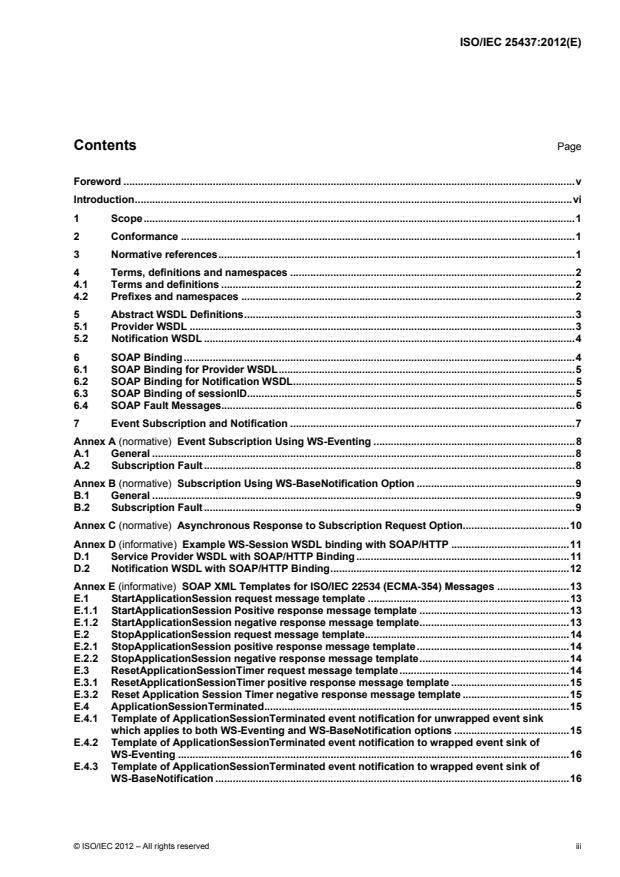
Contents Page
Foreword . v
Introduction . vi
1 Scope . 1
2 Conformance . 1
3 Normative references . 1
4 Terms, definitions and namespaces . 2
4.1 Terms and definitions . 2
4.2 Prefixes and namespaces . 2
5 Abstract WSDL Definitions . 3
5.1 Provider WSDL . 3
5.2 Notification WSDL . 4
6 SOAP Binding . 4
6.1 SOAP Binding for Provider WSDL . 5
6.2 SOAP Binding for Notification WSDL . 5
6.3 SOAP Binding of sessionID. 5
6.4 SOAP Fault Messages . 6
7 Event Subscription and Notification . 7
Annex A (normative) Event Subscription Using WS-Eventing . 8
A.1 General . 8
A.2 Subscription Fault . 8
Annex B (normative) Subscription Using WS-BaseNotification Option . 9
B.1 General . 9
B.2 Subscription Fault . 9
Annex C (normative) Asynchronous Response to Subscription Request Option . 10
Annex D (informative) Example WS-Session WSDL binding with SOAP/HTTP . 11
D.1 Service Provider WSDL with SOAP/HTTP Binding . 11
D.2 Notification WSDL with SOAP/HTTP Binding . 12
Annex E (informative) SOAP XML Templates for ISO/IEC 22534 (ECMA-354) Messages . 13
E.1 StartApplicationSession request message template . 13
E.1.1 StartApplicationSession Positive response message template . 13
E.1.2 StartApplicationSession negative response message template . 13
E.2 StopApplicationSession request message template . 14
E.2.1 StopApplicationSession positive response message template . 14
E.2.2 StopApplicationSession negative response message template . 14
E.3 ResetApplicationSessionTimer request message template . 14
E.3.1 ResetApplicationSessionTimer positive response message template . 15
E.3.2 Reset Application Session Timer negative response message template . 15
E.4 ApplicationSessionTerminated . 15
E.4.1 Template of ApplicationSessionTerminated event notification for unwrapped event sink
which applies to both WS-Eventing and WS-BaseNotification options . 15
E.4.2 Template of ApplicationSessionTerminated event notification to wrapped event sink of
WS-Eventing . 16
E.4.3 Template of ApplicationSessionTerminated event notification to wrapped event sink of
WS-BaseNotification . 16
© ISO/IEC 2012 – All rights reserved iii
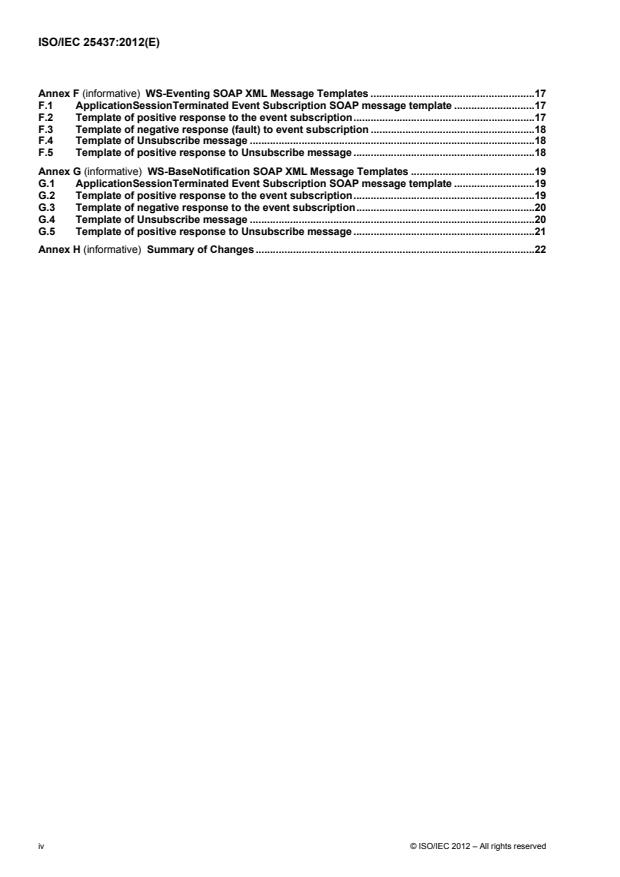
Annex F (informative) WS-Eventing SOAP XML Message Templates .17
F.1 ApplicationSessionTerminated Event Subscription SOAP message template .17
F.2 Template of positive response to the event subscription .17
F.3 Template of negative response (fault) to event subscription .18
F.4 Template of Unsubscribe message .18
F.5 Template of positive response to Unsubscribe message .18
Annex G (informative) WS-BaseNotification SOAP XML Message Templates .19
G.1 ApplicationSessionTerminated Event Subscription SOAP message template .19
G.2 Template of positive response to the event subscription .19
G.3 Template of negative response to the event subscription .20
G.4 Template of Unsubscribe message .20
G.5 Template of positive response to Unsubscribe message .21
Annex H (informative) Summary of Changes .22
iv © ISO/IEC 2012 – All rights reserved
Foreword
ISO (the International Organization for Standardization) and IEC (the International Electrotechnical
Commission) form the specialized system for worldwide standardization. National bodies that are members of
ISO or IEC participate in the development of International Standards through technical committees
established by the respective organization to deal with particular fields of technical activity. ISO and IEC
technical committees collaborate in fields of mutual interest. Other international organizations, governmental
and non-governmental, in liaison with ISO and IEC, also take part in the work. In the field of information
technology, ISO and IEC have established a joint technical committee, ISO/IEC JTC 1.
International Standards are drafted in accordance with the rules given in the ISO/IEC Directives, Part 2.
The main task of the joint technical committee is to prepare International Standards. Draft International
Standards adopted by the joint technical committee are circulated to national bodies for voting. Publication as
an International Standard requires approval by at least 75 % of the national bodies casting a vote.
Attention is drawn to the possibility that some of the elements of this document may be the subject of patent
rights. ISO and IEC shall not be held responsible for identifying any or all such patent rights.
ISO/IEC 25437 was prepared by Ecma International (as ECMA-366) and was adopted, under a special “fast-
track procedure”, by Joint Technical Committee ISO/IEC JTC 1, Information technology, Subcommittee SC 6,
Telecommunications and information exchange between systems, in parallel with its approval by national
bodies of ISO and IEC.
This third edition cancels and replaces the second edition (ISO/IEC 25437:2009), which has been technically
revised.
© ISO/IEC 2012 – All rights reserved v
Introduction
ISO/IEC 22534, Application Session Services, specifies XML protocols that can be used to create and
manage application sessions that are independent of the transport layer protocols. This International
Standard (WS-Session) specifies Web services for ISO/IEC 22534.
For Service Requester to receive the event notification from the Service Provider and from web
services (e.g. ECMA-348) that use this International Standard for session management, this
International Standard introduces WS-Eventing as the mandatory mechanism and WS-BaseNotification
as an Option to manage the event channel. This International Standard uses the approach in A.2 of
WS-Eventing to specify the ApplicationSessionTerminated as an operation in the Notification WSDL.
rd
Since WS-Eventing has advanced to a W3C Proposed Recommendation at W3C, the 3 edition of this
International Standard incorporates and complies with the latest edition of WS-Eventing.
Heeding the guidance in the WS-I Profiles that WS-Eventing adopted, this Standard only uses a subset
of WSDL Services, in particular, this Standard does not use the WSDL 1.1 Notification and Solicit-
response operations.
vi © ISO/IEC 2012 – All rights reserved
INTERNATIONAL STANDARD ISO/IEC 25437:2012(E)
Information technology — Telecommunications and information
exchange between systems — WS-Session — Web services for
application session services
1 Scope
This International Standard specifies Web Services (in WSDL, in Clause 5) and SOAP bindings (in Clause 6)
for the Application Session Services defined in ISO/IEC 22534. The Application Session Services allow
Applications to create and maintain a relationship with Servers termed Application Session. The Web services
specified herein, allow Service Requesters (Applications in ISO/IEC 22534) and Service Providers (Servers in
ISO/IEC 22534) to create and maintain such Application Sessions.
This International Standard builds upon and imports the XML schema definitions from ISO/IEC 22534. The
method of making the WSDL description of the specified services available to Service Provider and Requester
is out of the scope of this International Standard.
The Notification WSDL specifies the ApplicationSessionTerminated operation. The operation specifies one
input message for the event notification that Service Requesters receive from the Service Provider. Service
Requesters may also receive the event notifications from web services, e.g. ECMA-348, that use this
International Standard for session management.
2 Conformance
The Service Requester and Service Provider conform to the Application and Server conformance specified in
ISO/IEC 22534, using the WSDL definitions, SOAP bindings, and event subscription and notification specified
in Clause 5, 6 and 7 respectively.
The Service Provider implements and publishes the operations in the Provider WSDL in 5.1 and the
Notification WSDL in 5.2. The Service Provider implements and publishes the required operations from Annex
A and it may additionally implement and publish operations from Annex B.
The Service Requester implements the operation in the Notification WSDL in 5.2.
The Service Provider supports synchronous responses to Event Subscriptions and may also implement the
asynchronous response Option specified in Annex C.
3 Normative references
The following referenced documents are indispensable for the application of this document. For dated
references, only the edition cited applies. For undated references, the latest edition of the referenced
document (including any amendments) applies.
ISO/IEC 22534:2005 (ECMA-354), Information technology — Telecommunications and information exchange
between systems — Application session services
SOAP 1.1 Simple Object Access Protocol 1.1, W3C Note 08 May 2000
© ISO/IEC 2012 – All rights reserved 1
WSDL 1.1 Web Service Description Language 1.1, W3C Note 15 March 2001
XML Schema 1.0: XML Schema Language Part 1: Structure, W3C Recommendation 28 October 2004
XML Schema Language Part 2: Data Types, W3C Recommendation 28 October 2004
WS-Addressing 1.0 Web Services Addressing 1.0 – Core W3C Recommendation (ISO/IEC 40240:2011)
Web Services Addressing 1.0 - SOAP Binding W3C Recommendation
(ISO/IEC 40250:2011)
Web Services Addressing 1.0 – Metadata, W3C (ISO/IEC 40260:2011)
Web Services Eventing (WS-Eventing), W3C Recommendation 13 December 2011, http://www.w3.org/TR/ws-
eventing/
WS-BaseNotification 1.3 Web Services Base Notification 1.3 (WS-BaseNotification) OASIS Standard,
1 October 2006
4 Terms, definitions and namespaces
4.1 Terms and definitions
For the purposes of this document, the terms and definitions given in ISO/IEC 22534 and the following apply.
4.1.1
Service Requester
Web Service equivalent of Application in ISO/IEC 22534
4.1.2
Service Provider
Web Service equivalent of Server in ISO/IEC 22534
4.2 Prefixes and namespaces
This International Standard uses the following Ecma prefixes and namespaces.
1. aps (http://www.ecma-international.org/standards/ecma-354/appl_session): This International Standard
imports all XML messages defined in ISO/IEC 22534 from the aps namespace.
2. wss (http://www.ecma-international.org/standards/ecma-366/ws-session/ed3): The WSDL target
namespace for this International Standard.
This International Standard refers to these other prefixes and namespaces.
1. wsdl (http://schemas.xmlsoap.org/wsdl/): This contains the W3C WSDL 1.1 schema.
2. xs (http://www.w3.org/2001/XMLSchema): This contains the W3C XML Schema definition.
3. S (http://schemas.xmlsoap.org/wsdl/soap): This contains the W3C SOAP 1.1 bindings for WSDL 1.1.
4. wsa (http://www.w3.org/2005/08/addressing): The namespace for WS-Addressing 1.0.
5. wse (http://www.w3.org/2011/03/ws-evt): The target namespace for WS-Eventing.
6. wsnt (http://docs.oasis-open.org/wsn/b-2): The target namespace for WS-BaseNotfication 1.3.
2 © ISO/IEC 2012 – All rights reserved
5 Abstract WSDL Definitions
This Clause specifies the abstract WSDL definitions to support the services specified in ISO/IEC 22534. There
are two abstract WSDL definitions and both of them are specified by the Service Provider: 1) “Provider WSDL”
that specifies the interface the Service Provider shall implement; 2) “Notification WSDL” that specifies the
interface the Service Requester shall implement in order to receive the event in a particular format using
Annex A and the Option in Annex B.
5.1 Provider WSDL
xmlns:aps="http://www.ecma-international.org/standards/ecma-354/appl_session"
xmlns:wss="http://www.ecma-international.org/standards/ecma-366/ws-session/ed3"
targetNamespace="http://www.ecma-international.org/standards/ecma-366/ws-session/ed3">
schemaLocation="http://www.ecma-international.org/standards/ecma-354/appl_session/start-application-session.xsd"/>
schemaLocation="http://www.ecma-international.org/standards/ecma-354/appl_session/stop-application-session.xsd"/>
schemaLocation="http://www.ecma-international.org/standards/ecma-354/appl_session/reset-application-session-timer.xsd"/>
© ISO/IEC 2012 – All rights reserved 3
5.2 Notification WSDL
xmlns:aps="http://www.ecma-international.org/standards/ecma-354/appl_session"
xmlns:wss="http://www.ecma-international.org/standards/ecma-366/ws-session/ed3"
targetNamespace="http://www.ecma-international.org/standards/ecma-366/ws-session/ed3">
schemaLocation="http://www.ecma-international.org/standards/ecma-354/appl_session/application-session-terminated.xsd"/>
6 SOAP Binding
This Clause specifies the binding templates of the abstract WSDL definitions in Clause 5 with SOAP
Messages without a specific transport protocol. Any SOAP binding to transport shall contain elements and
attributes in this binding template.
4 © ISO/IEC 2012 – All rights reserved
6.1 SOAP Binding for Provider WSDL
xmlns:soap="http://schemas.xmlsoap.org/wsdl/soap/"
xmlns:aps="http://www.ecma-international.org/standards/ecma-354/appl_session"
xmlns:wss="http://www.ecma-international.org/standards/ecma-354/ws-session/ed3"
targetNamespace="http://www.ecma-international.org/standards/ecma-366/ws-session/ed3">
location="http://www.ecma-international.org/standards/ecma-366/ws-session/ed3/abstract-provider.wsdl" />
6.2 SOAP Binding for Notification WSDL
xmlns:soap="http://schemas.xmlsoap.org/wsdl/soap/"
xmlns:aps="http://www.ecma-international.org/standards/ecma-354/appl_session"
xmlns:wss="http://www.ecma-international.org/standards/ecma-354/ws-session/ed3"
targetNamespace="http://www.ecma-international.org/standards/ecma-366/ws-session/ed3">
location="http://www.ecma-international.org/standards/ecma-366/ws-session/ed3/abstract-
notification.wsdl" />
6.3 SOAP Binding of sessionID
The aps:sessionID element shall be included as a direct child element of the SOAP header for each
application SOAP message, such as event notification message, exchanged over the application session. The
recipient (Service Provider or Requester) of the application message shall verify that the sessionID is valid;
otherwise it shall ignore the message or send a fault.
© ISO/IEC 2012 – All rights reserved 5
6.4 SOAP Fault Messages
The negative responses from Service Providers shall be bound to the SOAP 1.1 fault properties: faultcode,
faultstring and detail, using the following template.
xmlns:S="http://schemas.xmlsoap.org/soap/envelope/"
xmlns:aps="http://www.ecma-international.org/standards/ecma-354/appl_session">
[faultcode]
[faultstring]
[detail]
The contents of fault properties are defined by the following table for each type of negative response.
Table 1 — Fault names and properties for WS-Session services
Fault Name StartFault
ISO/IEC 22534 defined standard error names: invalidApplicationInfo,
faultcode
requestedProtocolVersionNotSupported, serverResourcesBusy, maxNumberSessions, or
application error name.
For ISO/IEC
...