

ISO/IEC 23092-6:2023
(Main)Information technology — Genomic information representation — Part 6: Coding of genomic annotations
General Information
- Abstract
This document provides specifications for the normative representation of the following types of genomic information: — variants with genotyping information — functional annotations — tracks — expression matrices — contact matrices (from Hi-C experiments or similar).
- Status
- Published
- Publication Date
- 13-Nov-2023
- Technical Committee
- ISO/IEC JTC 1/SC 29 - Coding of audio, picture, multimedia and hypermedia information
- Drafting Committee
- ISO/IEC JTC 1/SC 29/WG 8 - MPEG Genomic coding
- Current Stage
- 6060 - International Standard published
- Start Date
- 14-Nov-2023
- Due Date
- 09-Feb-2023
- Completion Date
- 14-Nov-2023

Overview
ISO/IEC 23092-6:2023 - "Information technology - Genomic information representation - Part 6: Coding of genomic annotations" defines a normative representation and coding model for genomic annotations. The standard covers structured encoding for multiple annotation types including variants with genotyping information, functional annotations, genome browser tracks, expression matrices, and contact matrices (from Hi‑C or similar experiments). It specifies data structures, descriptors, attribute semantics, compression/decompression transforms and decoding/output formats to enable interoperable storage, transmission and processing of genomic annotation data.
Key topics and technical requirements
- Scope and terminology: formal terms, conventions and abbreviated terms used across the standard.
- Data structures: annotation parameter sets, tile configuration, descriptor configuration, attribute parameter sets, annotation access units and block layout for efficient representation and access.
- Descriptors & attributes: semantic definitions for genomic intervals, variants, functional annotations, contact matrices and typed attributes used to describe annotation content.
- Compression/transforms: specification of inverse transforms and decompression building blocks (e.g., Lempel‑Ziv‑Welch, binarization, sparse transform, delta transform, run‑length encoding, serialization).
- Decompression algorithms: guidance on decoding using algorithms listed in the standard (for example, Context‑Adaptive Binary Arithmetic Coding, Lempel‑Ziv‑Markov Chain Algorithm, Zstandard, JBIG, block sorting coder).
- Decoding process: step‑by‑step procedures for decoding access units and descriptors (variant access units, functional annotation access units, expression and contact matrix access units).
- Output formats: standardized output record definitions (variant site records, genotype records) including semantics and initialization procedures.
- Semantics and data types: clear rules for typed data, order of operations, logical/arithmetic operators and precise semantics for consistent interpretation.
Applications and who should use it
- Bioinformatics tool developers building variant callers, annotation pipelines, genome browsers and visualization tools.
- Sequencing centers, clinical genomics labs and data repositories needing standardized storage, compression, and exchange of large annotation datasets.
- Software vendors and standards bodies implementing interoperable genomic data formats for research, clinical and population genomics.
- Data engineers optimizing long‑term archival and high‑performance retrieval of genomic annotations, expression matrices and Hi‑C contact maps.
Related standards
- Other parts of the ISO/IEC 23092 series (genomic information representation) for complementary specifications on container formats and metadata.
- Industry and community formats (e.g., VCF, BAM/CRAM, BED) - ISO/IEC 23092‑6 focuses on a normative binary coding model useful for high‑efficiency exchange and storage.
Keywords: ISO/IEC 23092-6:2023, genomic annotations, genomic information representation, coding of genomic annotations, variants, expression matrices, contact matrices, Hi‑C, compression, decompression codecs, descriptors, access units.
Get Certified
Connect with accredited certification bodies for this standard

BSI Group
BSI (British Standards Institution) is the business standards company that helps organizations make excellence a habit.

NYCE
Mexican standards and certification body.
Sponsored listings
Frequently Asked Questions
ISO/IEC 23092-6:2023 is a standard published by the International Organization for Standardization (ISO). Its full title is "Information technology — Genomic information representation — Part 6: Coding of genomic annotations". This standard covers: This document provides specifications for the normative representation of the following types of genomic information: — variants with genotyping information — functional annotations — tracks — expression matrices — contact matrices (from Hi-C experiments or similar).
This document provides specifications for the normative representation of the following types of genomic information: — variants with genotyping information — functional annotations — tracks — expression matrices — contact matrices (from Hi-C experiments or similar).
ISO/IEC 23092-6:2023 is classified under the following ICS (International Classification for Standards) categories: 35.040.99 - Other standards related to information coding. The ICS classification helps identify the subject area and facilitates finding related standards.
ISO/IEC 23092-6:2023 is available in PDF format for immediate download after purchase. The document can be added to your cart and obtained through the secure checkout process. Digital delivery ensures instant access to the complete standard document.
Standards Content (Sample)
INTERNATIONAL ISO/IEC
STANDARD 23092-6
First edition
2023-11
Information technology — Genomic
information representation —
Part 6:
Coding of genomic annotations
Reference number
© ISO/IEC 2023
© ISO/IEC 2023
All rights reserved. Unless otherwise specified, or required in the context of its implementation, no part of this publication may
be reproduced or utilized otherwise in any form or by any means, electronic or mechanical, including photocopying, or posting on
the internet or an intranet, without prior written permission. Permission can be requested from either ISO at the address below
or ISO’s member body in the country of the requester.
ISO copyright office
CP 401 • Ch. de Blandonnet 8
CH-1214 Vernier, Geneva
Phone: +41 22 749 01 11
Email: copyright@iso.org
Website: www.iso.org
Published in Switzerland
ii
© ISO/IEC 2023 – All rights reserved
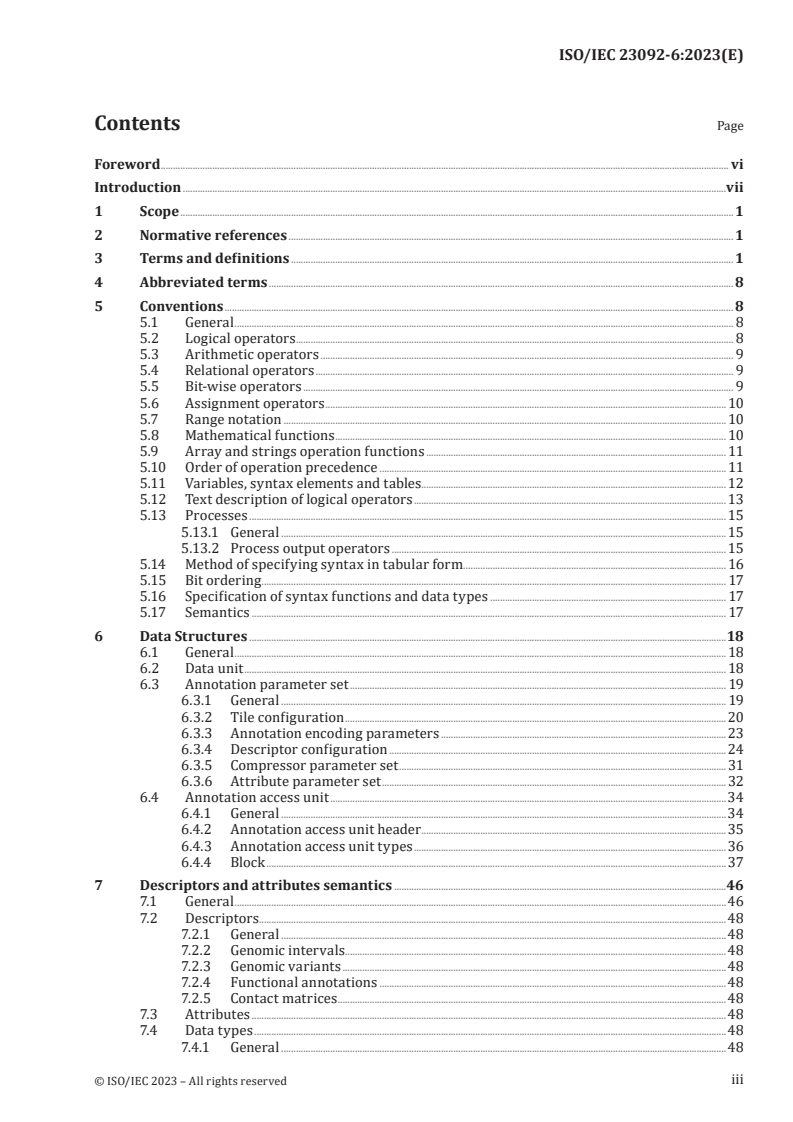
Contents Page
Foreword . vi
Introduction .vii
1 Scope . 1
2 Normative references . 1
3 Terms and definitions . 1
4 Abbreviated terms . 8
5 Conventions . 8
5.1 General . 8
5.2 Logical operators . 8
5.3 Arithmetic operators . 9
5.4 Relational operators . 9
5.5 Bit-wise operators . 9
5.6 Assignment operators . 10
5.7 Range notation . 10
5.8 Mathematical functions . 10
5.9 Array and strings operation functions . 11
5.10 Order of operation precedence . 11
5.11 Variables, syntax elements and tables.12
5.12 Text description of logical operators . 13
5.13 Processes . 15
5.13.1 General .15
5.13.2 Process output operators . 15
5.14 Method of specifying syntax in tabular form . . 16
5.15 Bit ordering . 17
5.16 Specification of syntax functions and data types . 17
5.17 Semantics . 17
6 Data Structures .18
6.1 General . 18
6.2 Data unit . 18
6.3 Annotation parameter set . 19
6.3.1 General . 19
6.3.2 Tile configuration . 20
6.3.3 Annotation encoding parameters . 23
6.3.4 Descriptor configuration . 24
6.3.5 Compressor parameter set . 31
6.3.6 Attribute parameter set . 32
6.4 Annotation access unit .34
6.4.1 General .34
6.4.2 Annotation access unit header . 35
6.4.3 Annotation access unit types .36
6.4.4 Block . 37
7 Descriptors and attributes semantics .46
7.1 General .46
7.2 Descriptors.48
7.2.1 General .48
7.2.2 Genomic intervals . .48
7.2.3 Genomic variants .48
7.2.4 Functional annotations .48
7.2.5 Contact matrices .48
7.3 Attributes .48
7.4 Data types .48
7.4.1 General .48
iii
© ISO/IEC 2023 – All rights reserved
7.4.2 Typed data .49
8 Decompression codecs .50
8.1 General .50
8.2 Inverse transformation algorithms . 52
8.2.1 General . 52
8.2.2 Lempel-Ziv-Welch transform . 52
8.2.3 Binarization transform. 53
8.2.4 Sparse transform .54
8.2.5 Delta transform .55
8.2.6 Run-Length Encoding transform . 57
8.2.7 Serialization transform . 57
8.3 Decompression algorithms.58
8.3.1 General .58
8.3.2 Context-Adaptive Binary Arithmetic Coding . 59
8.3.3 Lempel-Ziv-Markov Chain Algorithm . 59
8.3.4 Zstandard. 59
8.3.5 JBIG . 59
8.3.6 Block Sorting Coder .60
9 Decoding process .60
9.1 General .60
9.2 Access Units decoding process .60
9.2.1 General .60
9.2.2 Genomic variant access units . 62
9.2.3 Functional annotation Access Units .64
9.2.4 Gene expression Access Units .65
9.2.5 Position-to-position contact intensity Access Units .66
9.2.6 Genome browser track Access Units.66
9.3 Descriptors decoding process . 67
9.3.1 General . 67
9.3.2 Common descriptors . .68
9.3.3 Variant site information descriptors . 70
9.3.4 Functional annotation descriptors .73
9.3.5 Genotype descriptor .75
9.3.6 Likelihood descriptor .84
9.3.7 Contact matrix descriptor .87
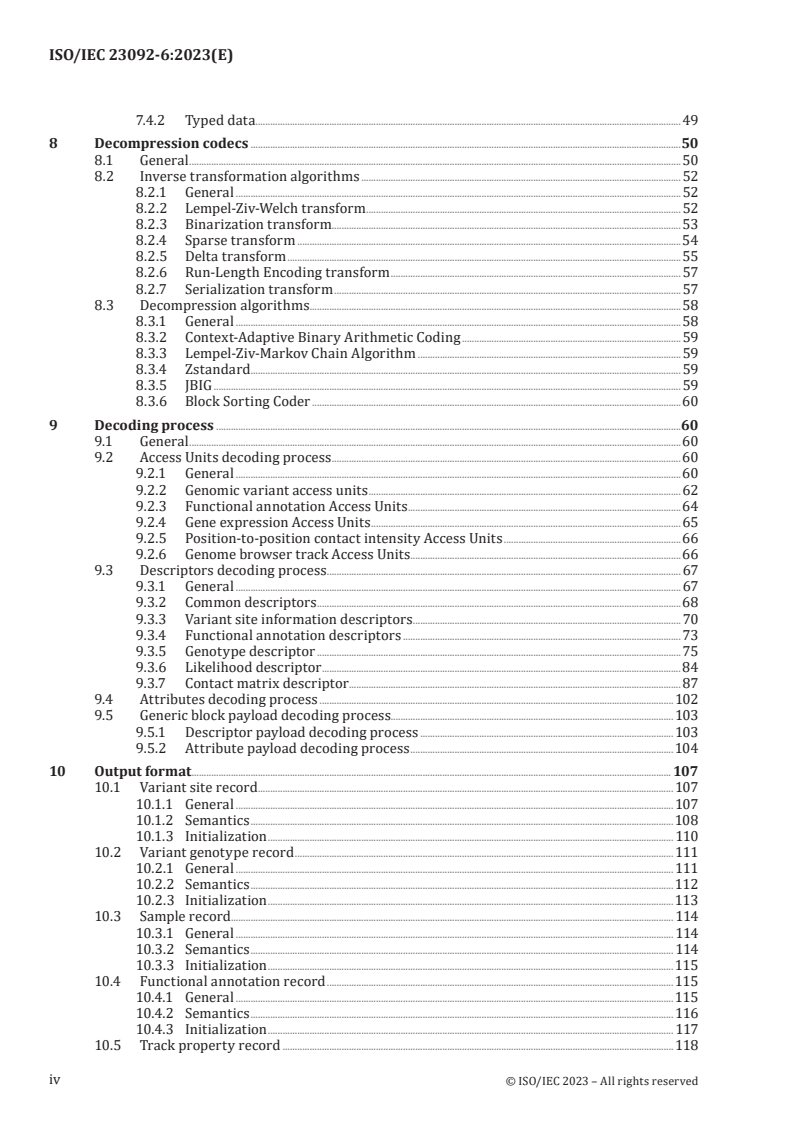
9.4 Attributes decoding process .102
9.5 Generic block payload decoding process.103
9.5.1 Descriptor payload decoding process .103
9.5.2 Attribute payload decoding process .104
10 Output format . . 107
10.1 Variant site record .107
10.1.1 General .107
10.1.2 Semantics .108
10.1.3 Initialization . 110
10.2 Variant genotype record . 111
10.2.1 General . 111
10.2.2 Semantics .112
10.2.3 Initialization .113
10.3 Sample record. 114
10.3.1 General . 114
10.3.2 Semantics . 114
10.3.3 Initialization .115
10.4 Functional annotation record .115
10.4.1 General .115
10.4.2 Semantics . 116
10.4.3 Initialization . 117
10.5 Track property record .118
iv
© ISO/IEC 2023 – All rights reserved
10.5.1 General .118
10.5.2 Semantics . 119
10.5.3 Initialization . 119
10.6 Track data record .120
10.6.1 General .120
10.6.2 Semantics .121
10.6.3 Initialization .121
10.7 Expression record .122
10.7.1 General .122
10.7.2 Semantics .123
10.7.3 Initialization .123
10.8 Feature record .124
10.8.1 General .124
10.8.2 Semantics .125
10.8.3 Initialization .125
10.9 Contact matrix record .126
10.9.1 General .126
10.9.2 Semantics .127
10.9.3 Initialization .128
Bibliography . 129
v
© ISO/IEC 2023 – All rights reserved
Foreword
ISO (the International Organization for Standardization) and IEC (the International Electrotechnical
Commission) form the specialized system for worldwide standardization. National bodies that are
members of ISO or IEC participate in the development of International Standards through technical
committees established by the respective organization to deal with particular fields of technical
activity. ISO and IEC technical committees collaborate in fields of mutual interest. Other international
organizations, governmental and non-governmental, in liaison with ISO and IEC, also take part in the
work.
The procedures used to develop this document and those intended for its further maintenance
are described in the ISO/IEC Directives, Part 1. In particular, the different approval criteria
needed for the different types of document should be noted. This document was drafted in
accordance with the editorial rules of the ISO/IEC Directives, Part 2 (see www.iso.org/directives or
www.iec.ch/members_experts/refdocs).
ISO and IEC draw attention to the possibility that the implementation of this document may involve the
use of (a) patent(s). ISO and IEC take no position concerning the evidence, validity or applicability of
any claimed patent rights in respect thereof. As of the date of publication of this document, ISO and IEC
had not received notice of (a) patent(s) which may be required to implement this document. However,
implementers are cautioned that this may not represent the latest information, which may be obtained
from the patent database available at www.iso.org/patents and https://patents.iec.ch. ISO and IEC shall
not be held responsible for identifying any or all such patent rights.
Any trade name used in this document is information given for the convenience of users and does not
constitute an endorsement.
For an explanation of the voluntary nature of standards, the meaning of ISO specific terms and
expressions related to conformity assessment, as well as information about ISO's adherence to
the World Trade Organization (WTO) principles in the Technical Barriers to Trade (TBT) see
www.iso.org/iso/foreword.html. In the IEC, see www.iec.ch/understanding-standards.
This document was prepared by Joint Technical Committee ISO/IEC JTC 1, Information technology,
Subcommittee SC 29, Coding of audio, picture, multimedia and hypermedia information.
A list of all parts in the ISO/IEC 23092 series can be found on the ISO and IEC websites.
Any feedback or questions on this document should be directed to the user’s national standards
body. A complete listing of these bodies can be found at www.iso.org/members.html and
www.iec.ch/national-committees.
vi
© ISO/IEC 2023 – All rights reserved
Introduction
While ISO/IEC 23092-1 to ISO/IEC 23092-5 (MPEG-G) deal with the representation of genomic
information derived from the primary analysis of high-throughput sequencing (HTS) data – sequencing
reads and qualities, and their alignment to a reference genome – which is only the first step in a long
series. In particular, the results of primary analysis are usually processed further in order to obtain
higher-level information. Such a process of aggregating information deduced from single reads and
their alignments to the genome into more complex results is generally known as secondary analysis. In
most HTS-based biological studies, the output of secondary analysis is usually represented as different
types of annotations associated to one or more genomic intervals on the reference sequences.
Biological studies typically produce genomic annotation data such as mapping statistics, quantitative
browser tracks, variants, genome functional annotations, gene expression data and Hi-C contact
matrices. These diverse types of downstream genomic data are currently represented in different
formats such as VCF, BED, WIG, etc., with loosely defined semantics, leading to issues with
interoperability, the need for frequent conversions between formats, difficulty in the visualization of
multi-modal data and complicated information exchange. Figure 1 depicts a typical pipeline for the
primary and secondary analyses of HTS data, the file formats involved and the scopes of different parts
of the ISO/IEC 23092 series.
Furthermore, the lack of a single format has stifled the work on compression algorithms and has
led to the widespread use of general compression algorithms with suboptimum performance. These
algorithms do not exploit the fact the annotation data typically comprises of multiple fields (attributes)
with different statistical characteristics and instead compress them together. Therefore, while these
algorithms support efficient random access with respect to genomic position, they do not allow
extraction of specific fields without decompressing all the whole file.
In response to the aforementioned challenges, this document details a unified data format for the
efficient representation and compression of diverse genomic annotation data for file storage or data
transport. The benefits are manifold: reducing the cost of data storage, improving the speed of random
data access and processing, providing support for data security and privacy in selective genomic
regions, and creating linkages across different types of genomic annotation and sequencing data. The
ultimate goal is to enable the secured and seamless sharing, processing and analysis of multi-modal
genomic data in order to reduce the burden of data manipulation and management, so scientists can
focus on biological interpretation and discovery.
vii
© ISO/IEC 2023 – All rights reserved
Key
sequencing generates raw reads
read alignment
variant calling
variants annotations
analysis
Figure 1 — Typical pipeline for the primary and secondary analyses of HTS data
viii
© ISO/IEC 2023 – All rights reserved
INTERNATIONAL STANDARD ISO/IEC 23092-6:2023(E)
Information technology — Genomic information
representation —
Part 6:
Coding of genomic annotations
1 Scope
This document provides specifications for the normative representation of the following types of
genomic information:
— variants with genotyping information
— functional annotations
— tracks
— expression matrices
— contact matrices (from Hi-C experiments or similar).
2 Normative references
The following documents are referred to in the text in such a way that some or all of their content
constitutes requirements of this specification. For dated references, only the edition cited applies. For
undated references, the latest edition of the referenced document (including any amendments) applies.
ISO/IEC 10646, Information technology — Universal coded character set (UCS)
ISO/IEC 11544, Information technology — Coded representation of picture and audio information —
Progressive bi-level image compression
ISO/IEC 23092-1, Information technology — Genomic information representation — Part 1: Transport and
storage of genomic information
ISO/IEC 23092-2, Information technology — Genomic Information Representation — Part 2: Coding of
Genomic Information
3 Terms and definitions
For the purposes of this document, the following terms and definitions apply.
ISO and IEC maintain terminology databases for use in standardization at the following addresses:
— ISO Online browsing platform: available at https:// www .iso .org/ obp
— IEC Electropedia: available at https:// www .electropedia .org/
3.1
access unit
logical data structure containing a coded representation of genomic information to facilitate bit stream
access and manipulation
© ISO/IEC 2023 – All rights reserved
3.2
access unit start position
position of the leftmost mapped base among the first alignments of all genomic records contained in
the access unit, irrespective of the strand
3.3
access unit end position
position of the rightmost mapped base among the first alignments of all genomic records contained in
the access unit, irrespective of the strand
3.4
access unit range
genomic range comprised between the access unit start position and the rightmost genomic record
position among all genomic records contained in the access unit
3.5
access unit covered region
genomic range comprised between the access unit start position and the access unit end position
inclusive
3.6
alignment
information describing the similarity between a sequence (typically a sequencing read) and a reference
sequence (for instance, a reference genome)
Note 1 to entry: An alignment is described in terms of a position within the reference, the strand of the reference,
and a set of edit operations (matches, mismatches, insertions and deletions, clipping of the sequence ends and
splicing information) needed to turn the first sequence into the second.
3.7
allele
each of one or more alternative sequences for a genomic segment
Note 1 to entry: There can be more than one either because the genome contains more than one, almost identical,
copies of the same genomic material (2 in the case of humans for all chromosomes from 1 to 22), and/or because
one is considering more than one individual in the population.
3.8
annotation record
record
data structure representing a tuple of annotation information (e.g. the properties associated to a
variant, a genomic feature or a generic range; it is used also to identify a ”row” when data have matrix
format)
3.9
base
base pair
synonymous of nucleotide
3.10
base position
number of bases between a base and the leftmost mapped base belonging to the same genomic segment.
3.11
CIGAR string
CIGAR
textual way of representing an alignment
Note 1 to entry: Several definitions have been used by different programs, the ones referred to here is the one
used in the SAM format. It encodes a set of edit operations (matches, mismatches, insertions and deletions,
clipping of the sequence ends and splicing information) needed to turn the sequencing read into the reference.
© ISO/IEC 2023 – All rights reserved
3.12
cluster
aggregation of genomic records
3.13
cluster signature
signature
sequence of nucleotides that is common to most or all genomic records belonging to a cluster
3.14
contig
set of overlapping DNA segments, sequenced and assembled, that together represent a consensus region
of DNA
Note 1 to entry: the term “contig” derives from “contiguous”.
3.15
dataset
compression unit containing one or more of: reference sequences; sequencing reads; and alignment
information
Note 1 to entry: Datasets are specified in ISO/IEC 23092-1.
3.16
deletion
contiguous removal of one or more bases from a genomic sequence
3.17
E-CIGAR
extended CIGAR syntax specified as a superset of the CIGAR syntax
Note 1 to entry: Among other things, E-CIGAR enables the unambiguous representation of substitutions, spliced
reads and splice strandedness.
3.18
edit operation
modification of a sequence of nucleotides by means of a substitution, deletion, insertion or clip
3.19
FASTA
GIR that includes a name and a nucleotide sequence for each sequencing read
Note 1 to entry: Additional information is usually encoded in the read identifier by bioinformatics tools (such as
database information, and base calling information).
3.20
FASTQ
GIR that includes FASTA and quality values
3.21
first end
end 1
read 1
first segment of a paired-end template
Note 1 to entry: Illumina platforms usually store first and second ends in two separate files and in the same order
– i.e. the n-th read of the first FASTQ file and the n-th read of the second FASTQ file belong to the same template.
© ISO/IEC 2023 – All rights reserved
3.22
genomic descriptor
descriptor
element of the syntax used to represent a feature of a genomic sequencing read or associated information
such as alignment information or quality values
3.23
genomic information representation
way to describe a sequence and some information associated with it
Note 1 to entry: Which information is represented varies depending on the GIR.
3.24
genomic position
position
integer number representing the zero-based position of a nucleotide within a reference sequence
3.25
genomic range
range
interval of positions on a reference sequence specified by a start position s and an end position e such
that s ≤ e
Note 1 to entry: The start and the end positions of a genomic range are always included in the range.
3.26
genomic record
record
data structure representing a tuple optionally associated with alignment information, read identifier
and quality values
3.27
genomic record index
position of a genomic record in the sequence of genomic records encoded in an access unit
3.28
genomic record position
0-based position of the leftmost mapped base on the reference genome of the first alignment contained
in a genomic record
Note 1 to entry: A base present in the aligned read and not present in the reference sequence (insertion) and
bases preserved by the alignment process but not mapped on the reference sequence (soft clips) do not have
mapping positions.
3.29
genomic reference
reference
collection of reference sequences
Note 1 to entry: Typical examples are a reference genome or a reference transcriptome.
3.30
genomic segment
segment
contiguous sequence of nucleotides
Note 1 to entry: Typically output of the sequencing process, and sequenced from one strand of a template.
© ISO/IEC 2023 – All rights reserved
3.31
genomic variant
variant
one of the possible sequences for a genomic segment whenever more than one allele for that segment is
present
Note 1 to entry: The variant can span one nucleotide (and is then usally called single nucleotide polymorphism)
or more (structural variants can involve changes in thousands of contiguous bases or more). A variant can consist
of an indel.
3.32
genotype
sequence of a genomic segment for a specified copy of the genome or individual whenever more than
one allele for that segment is present
3.33
genotype matrix
metrix specifying which genotype is present in each copy of the genome or individual
3.34
hard clip
one or more bases originally present at either side of a read, and removed from it following alignment
Note 1 to entry: The bases are no longer present in the sequence of the read.
3.35
indel
contiguous stretch of nucleotides that, when aligning two sequences, are inserted into one sequence, or
alternatively deleted from the other, in order to make the two sequences the same
Note 1 to entry: From “insertion or deletion”.
3.36
insertion
contiguous addition of one or more bases into a genomic sequence
3.37
leftmost read end
leftmost read
sequencing read generated by a paired-end sequencing run and mapped at a position on the reference
sequence which is smaller than the mapping position of the other read in the pair
3.38
mapped base
base of the aligned read that either matches the corresponding base on the reference sequence or can
be turned into the corresponding base on the reference sequence via a substitution
3.39
nucleotide
monomer of a nucleic acid polymer such as DNA or RNA
Note 1 to entry: Nucleotides are denoted as letters (‘A’ for adenine; ‘C’ for cytosine; ‘G’ for guanine; ‘T’ for thymine
which only occurs in DNA; and ‘U’ for uracil which only occurs in RNA). The chemical formula for a specific
DNA or RNA molecule is given by the sequence of its nucleotides, which can be represented as a string over the
alphabet (‘A’, ’C’, ’G’, ‘T’) in the case of DNA, and a string over the alphabet (‘A’, ‘C’, ‘G’, ‘U’) in the case of RNA. Bases
with unknown molecular composition are denoted with ‘N’.
3.40
output annotation record
annotation record produced as output of the decoding process of an annotation table or a portion of it
© ISO/IEC 2023 – All rights reserved
3.41
paired-end reads
paired-end template
tuple made of two segments
Note 1 to entry: Typically, the segments correspond to the beginning and the end of the same nucleic acid
molecule.
3.42
pileup
textual representation of sequencing reads aligned to a reference sequence
3.43
ploidy
number of equivalent alleles present at each position of the genome
3.44
phased genotyping
information about consecutive genotypes along the genome which keeps information about the
different copies of the genome (or different individuals) separate, whenever multiple alleles are present
3.45
quality value
quality score
number assigned to each nucleotide base call in automated sequencing processes
Note 1 to entry: Quality values express the base-call accuracy, i.e. the probability (or a related measure) for a
nucleotide in the sequence to have been incorrectly determined.
3.46
read group
set of reads having some property in common
3.47
read identifier
read header
read name
text string associated with each sequencing read stored in GIRs such as FASTA, FASTQ and SAM
Note 1 to entry: The read identifier is usually unique within its dataset, and may contain additional information
as encoded by bioinformatics tools (such as database information, and base calling information).
3.48
reference genome
representative example of the sequences for a species’ genetic material
Note 1 to entry: Representative of the sequences of the DNA molecules present in a typical cell of that species.
3.49
reference sequence
nucleic acid sequence with biological relevance
Note 1 to entry: Each reference sequence is indexed by a one-dimensional integer coordinate system whereby
each integer within range identifies a single nucleotide. Coordinate values can only be equal to or larger than
zero. The coordinate system in the context of this standard is zero-based (i.e. the first nucleotide has coordinate
0 and it is said to be at position 0) and linearly increasing within the string from left to right.
3.50
rightmost read end
rightmost read
sequencing read generated by a paired-end sequencing run and mapped at a position on the reference
sequence which is greater than the mapping position of the other read in the pair
© ISO/IEC 2023 – All rights reserved
3.51
SAM
GIR that is human readable and includes FASTQ plus alignment and analysis information
Note 1 to entry: From “Sequence Alignment/Map format”. SAM originates from the 1000 Genome Sequencing
Project. It is represented in plain ASCII, extensible by users and includes sequence, quality, alignment and
analysis information.
3.52
second end
read 2
second segment of a paired-end template
Note 1 to entry: Se
...