

ISO 25841:2017
(Main)Female condoms — Requirements and test methods
General Information
- Abstract
ISO 25841:2017 specifies the minimum requirements and test methods for female condoms that are supplied to consumers for contraceptive purposes and for assisting in the prevention of sexually transmitted infections (STIs).
- Status
- Published
- Publication Date
- 13-Aug-2017
- Technical Committee
- ISO/TC 157 - Non-systemic contraceptives and STI barrier prophylactics
- Drafting Committee
- ISO/TC 157/WG 18 - Female condoms and diaphragms
- Current Stage
- 9093 - International Standard confirmed
- Start Date
- 07-Dec-2023
- Completion Date
- 29-Aug-2026
Buy Documents



ISO 25841:2017 - Female condoms -- Requirements and test methods

ISO 25841:2017 - Female condoms — Requirements and test methods/14/2017
Overview - ISO 25841:2017 (Female condoms - Requirements and test methods)
ISO 25841:2017 is the international standard that defines the minimum requirements and test methods for female condoms supplied to consumers for contraception and STI (sexually transmitted infection) prevention. Published as the third edition in 2017, the standard addresses product design, barrier performance, biocompatibility, microbiological quality, packaging, labelling and stability/shelf‑life evaluation to ensure consistent safety and performance of female condoms.
Key technical topics and requirements
ISO 25841:2017 covers both design and verification, with normative and informative annexes that provide detailed test methods:
- Design and physical features: requirements for product insertion features, retention features, lubrication, and dimensional specifications (length, width, thickness) with defined tolerances.
- Barrier properties: methods to confirm non‑porous film performance and resistance to pathogen passage.
- Biocompatibility: evaluation per medical device biological testing principles to avoid toxic, sensitizing or irritating effects.
- Microbial contamination (bioburden): guidance for periodic monitoring and limits for total viable counts on finished products.
- Mechanical performance: bursting volume and pressure testing, freedom‑from‑holes inspections, and visible defect criteria to reduce clinical failure.
- Stability and shelf life: procedures for real‑time and accelerated stability studies and guidance for estimating shelf life.
- Packaging and labelling: individual container integrity tests, consumer labelling requirements, symbols and inspection protocols.
- Sampling and quality verification: sampling plans for lot inspection, including plans for isolated and continuing lots (annexes), and limits on maximum lot size.
- Clinical investigations: recommendations for human use studies to assess retention, failure modes and overall safety/effectiveness.
Normative references include ISO 4074 (male condoms), ISO 10993 series (biocompatibility), ISO 2859‑1 (sampling) and quality management standards such as ISO 9001 and ISO 13485.
Practical applications - who uses ISO 25841:2017?
- Female condom manufacturers - to design products that meet international safety and performance benchmarks and to define internal QC/test procedures.
- Test laboratories - to apply harmonized, reproducible test methods (burst, holes, bacteriophage barrier tests, packaging integrity).
- Regulatory authorities and procurement agencies - to assess conformity, approve products and verify shelf‑life claims.
- Public health organizations and NGOs - to select reliable products for distribution programs focused on contraception and STI prevention.
- Quality and regulatory affairs teams - to integrate requirements into quality management, risk assessment and labelling controls.
Related standards
- ISO 4074 - Natural rubber latex male condoms - requirements and test methods
- ISO 10993 series - Biological evaluation of medical devices
- ISO 2859‑1 - Sampling procedures for inspection by attributes
- ISO 9001, ISO 13485, ISO 14971 - Quality and risk management for medical devices
Using ISO 25841:2017 helps stakeholders ensure female condoms are consistently safe, effective and correctly labelled - supporting public health goals in contraception and STI prevention.
Relations
- Effective Date
- 25-Dec-2021
- Effective Date
- 31-May-2014
Buy Documents
ISO 25841:2017 - Female condoms -- Requirements and test methods
ISO 25841:2017 - Female condoms — Requirements and test methods/14/2017
Get Certified
Connect with accredited certification bodies for this standard

BSI Group
BSI (British Standards Institution) is the business standards company that helps organizations make excellence a habit.

TÜV Rheinland
TÜV Rheinland is a leading international provider of technical services.

TÜV SÜD
TÜV SÜD is a trusted partner of choice for safety, security and sustainability solutions.
Sponsored listings
Frequently Asked Questions
ISO 25841:2017 is a standard published by the International Organization for Standardization (ISO). Its full title is "Female condoms — Requirements and test methods". This standard covers: ISO 25841:2017 specifies the minimum requirements and test methods for female condoms that are supplied to consumers for contraceptive purposes and for assisting in the prevention of sexually transmitted infections (STIs).
ISO 25841:2017 specifies the minimum requirements and test methods for female condoms that are supplied to consumers for contraceptive purposes and for assisting in the prevention of sexually transmitted infections (STIs).
ISO 25841:2017 is classified under the following ICS (International Classification for Standards) categories: 11.200 - Birth control. Mechanical contraceptives. The ICS classification helps identify the subject area and facilitates finding related standards.
ISO 25841:2017 has the following relationships with other standards: It is inter standard links to ISO 25841:2017/Amd 1:2020, ISO 25841:2014. Understanding these relationships helps ensure you are using the most current and applicable version of the standard.
ISO 25841:2017 is available in PDF format for immediate download after purchase. The document can be added to your cart and obtained through the secure checkout process. Digital delivery ensures instant access to the complete standard document.
Standards Content (Sample)
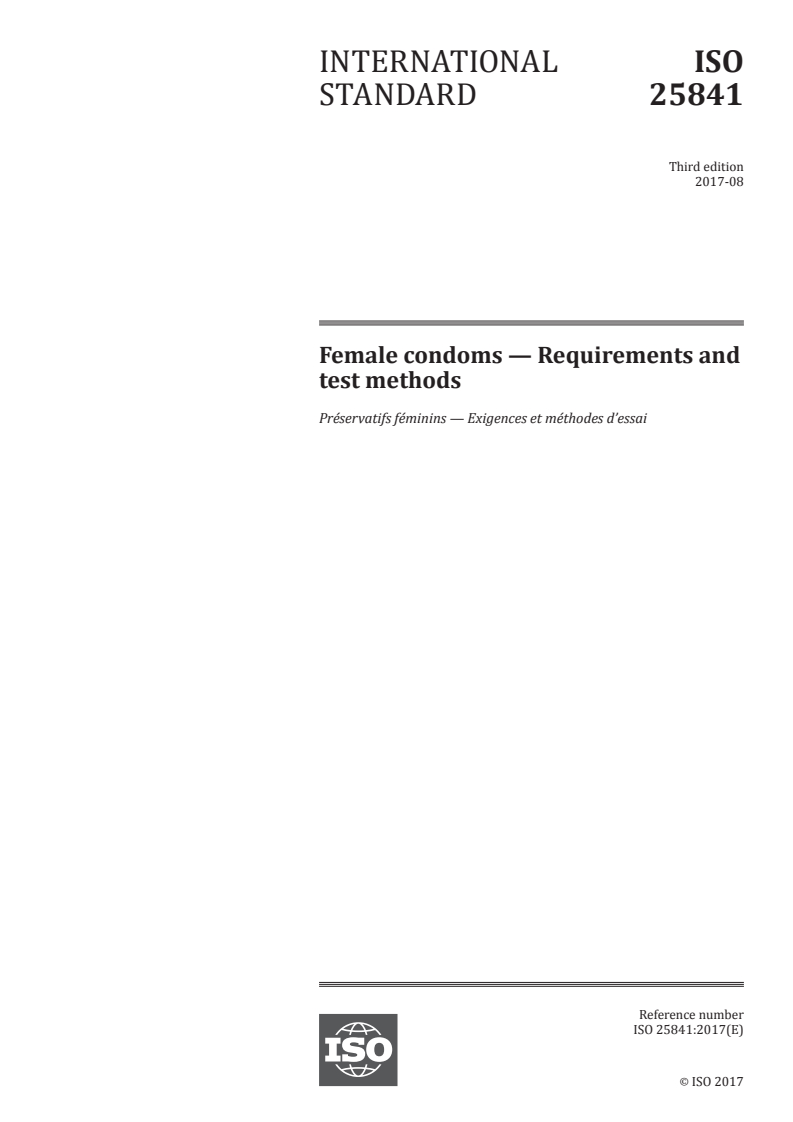
INTERNATIONAL ISO
STANDARD 25841
Third edition
2017-08
Female condoms — Requirements and
test methods
Préservatifs féminins — Exigences et méthodes d’essai
Reference number
©
ISO 2017
© ISO 2017, Published in Switzerland
All rights reserved. Unless otherwise specified, no part of this publication may be reproduced or utilized otherwise in any form
or by any means, electronic or mechanical, including photocopying, or posting on the internet or an intranet, without prior
written permission. Permission can be requested from either ISO at the address below or ISO’s member body in the country of
the requester.
ISO copyright office
Ch. de Blandonnet 8 • CP 401
CH-1214 Vernier, Geneva, Switzerland
Tel. +41 22 749 01 11
Fax +41 22 749 09 47
copyright@iso.org
www.iso.org
ii © ISO 2017 – All rights reserved
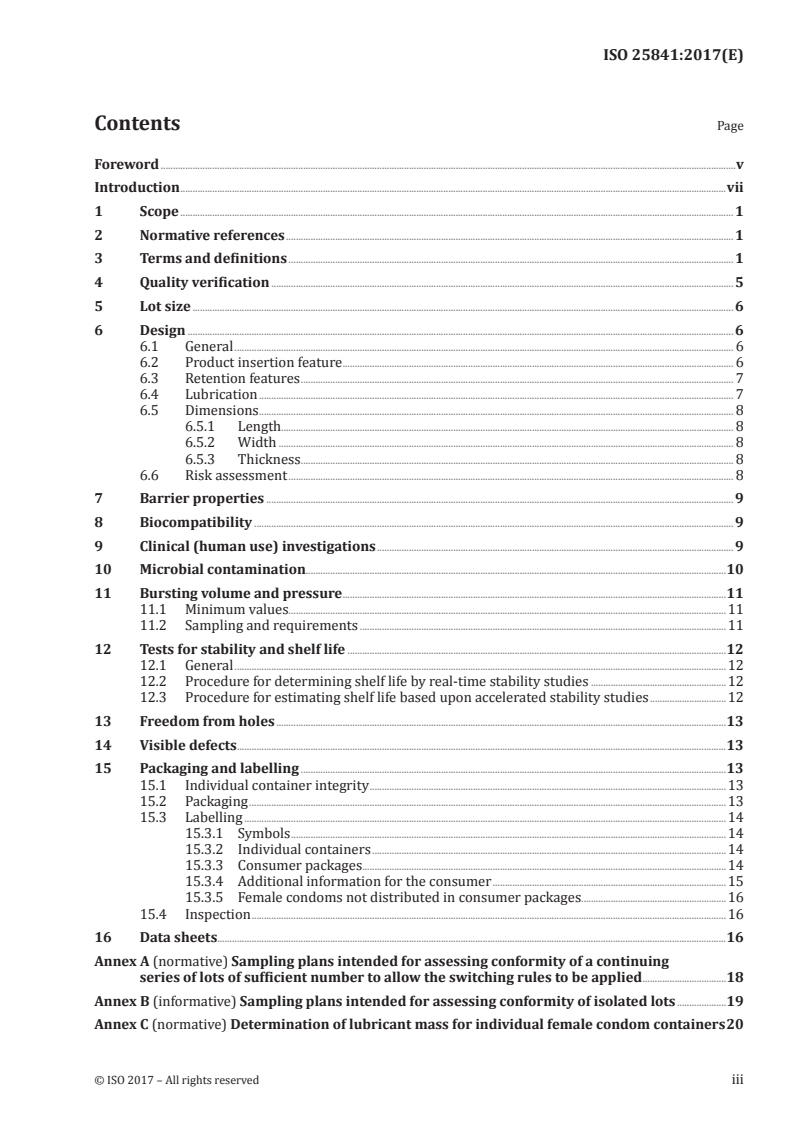
Contents Page
Foreword .v
Introduction .vii
1 Scope . 1
2 Normative references . 1
3 Terms and definitions . 1
4 Quality verification . 5
5 Lot size . 6
6 Design . 6
6.1 General . 6
6.2 Product insertion feature . 6
6.3 Retention features . 7
6.4 Lubrication . 7
6.5 Dimensions . 8
6.5.1 Length. 8
6.5.2 Width . 8
6.5.3 Thickness . 8
6.6 Risk assessment . 8
7 Barrier properties . 9
8 Biocompatibility . 9
9 Clinical (human use) investigations . 9
10 Microbial contamination.10
11 Bursting volume and pressure .11
11.1 Minimum values.11
11.2 Sampling and requirements .11
12 Tests for stability and shelf life .12
12.1 General .12
12.2 Procedure for determining shelf life by real-time stability studies .12
12.3 Procedure for estimating shelf life based upon accelerated stability studies .12
13 Freedom from holes .13
14 Visible defects.13
15 Packaging and labelling .13
15.1 Individual container integrity .13
15.2 Packaging .13
15.3 Labelling .14
15.3.1 Symbols .14
15.3.2 Individual containers .14
15.3.3 Consumer packages . .14
15.3.4 Additional information for the consumer .15
15.3.5 Female condoms not distributed in consumer packages.16
15.4 Inspection .16
16 Data sheets.16
Annex A (normative) Sampling plans intended for assessing conformity of a continuing
series of lots of sufficient number to allow the switching rules to be applied .18
Annex B (informative) Sampling plans intended for assessing conformity of isolated lots .19
Annex C (normative) Determination of lubricant mass for individual female condom containers 20
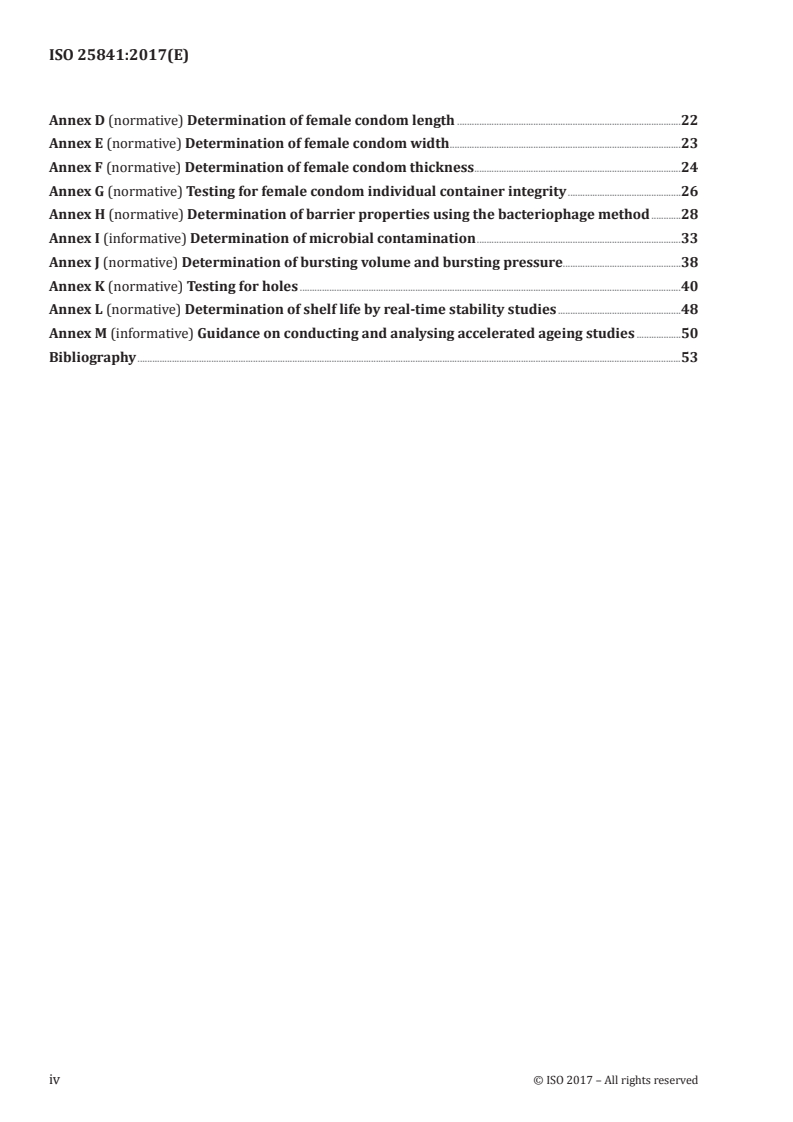
Annex D (normative) Determination of female condom length .22
Annex E (normative) Determination of female condom width .23
Annex F (normative) Determination of female condom thickness .24
Annex G (normative) Testing for female condom individual container integrity .26
Annex H (normative) Determination of barrier properties using the bacteriophage method .28
Annex I (informative) Determination of microbial contamination .33
Annex J (normative) Determination of bursting volume and bursting pressure.38
Annex K (normative) Testing for holes .40
Annex L (normative) Determination of shelf life by real-time stability studies .48
Annex M (informative) Guidance on conducting and analysing accelerated ageing studies .50
Bibliography .53
iv © ISO 2017 – All rights reserved
Foreword
ISO (the International Organization for Standardization) is a worldwide federation of national standards
bodies (ISO member bodies). The work of preparing International Standards is normally carried out
through ISO technical committees. Each member body interested in a subject for which a technical
committee has been established has the right to be represented on that committee. International
organizations, governmental and non-governmental, in liaison with ISO, also take part in the work.
ISO collaborates closely with the International Electrotechnical Commission (IEC) on all matters of
electrotechnical standardization.
The procedures used to develop this document and those intended for its further maintenance are
described in the ISO/IEC Directives, Part 1. In particular the different approval criteria needed for the
different types of ISO documents should be noted. This document was drafted in accordance with the
editorial rules of the ISO/IEC Directives, Part 2 (see www .iso .org/ directives).
Attention is drawn to the possibility that some of the elements of this document may be the subject of
patent rights. ISO shall not be held responsible for identifying any or all such patent rights. Details of
any patent rights identified during the development of the document will be in the Introduction and/or
on the ISO list of patent declarations received (see www .iso .org/ patents).
Any trade name used in this document is information given for the convenience of users and does not
constitute an endorsement.
For an explanation on the voluntary nature of standards, the meaning of ISO specific terms and
expressions related to conformity assessment, as well as information about ISO’s adherence to the
World Trade Organization (WTO) principles in the Technical Barriers to Trade (TBT) see the following
URL: w w w . i s o .org/ iso/ foreword .html.
This document was prepared by Technical Committee ISO/TC 157, Non-systemic contraceptives and STI
barrier prophylactics.
This third edition cancels and replaces the second edition (ISO 25841:2014) which has been technically
revised.
The modifications are as follows:
— clinical failure mode definitions have been harmonized with ISO 29943-2;
— tolerances have been specified for the amount of lubricant applied to the female condom and the
length, width and sheath thickness of the female condom. These tolerances are to be applied to the
nominal values specified by the manufacturers for these design features;
— manufacturers are required to specify female condom width and thickness at three locations along
the length of the female condom sheath;
— manufacturers are required to identify specifications and test methods as appropriate to verify
the design and to ensure the quality and consistency of components and materials used for the
retention features and any insertion feature used with the female condom;
— manufacturers are recommended to establish procedures for the periodic monitoring of microbial
contamination (bioburden) as part of their quality management system including requirements for
the absence of specific pathogens and limits for total viable counts on finished female condoms;
methods of determining bioburden levels on female condoms are given in Annex I;
— detailed changes have been made to the test methods for determining freedom from holes and
airburst properties to improve the reproducibility of female condom testing between laboratories
and accommodate female condoms made from a wider range of sheath materials including sheaths
made from natural rubber latex;
— a greater degree of harmonization with ISO 4074 has been achieved for common requirements and
definitions;
— for female condoms with sheaths made from natural rubber latex, reference is included in the
procedures for estimating provisional shelf lives from accelerated stability studies given in ISO 4074;
— the maximum lot size for female condoms has been limited to 500 000;
— labelling requirements have been revised and updated.
vi © ISO 2017 – All rights reserved
Introduction
A female condom is a sheath that completely lines the vaginal canal and is designed to be retained
in the vagina during sexual intercourse and after withdrawal of the penis to prevent pregnancy and
transmission of sexually transmitted infections (STIs).
A female condom is distinguished from a male condom in that it is retained in the vagina after withdrawal
of the penis. The external component of the device can provide some coverage to the external female
genitalia. Nonporous, intact, polymer films can be effective barriers to human immunodeficiency
virus (HIV), other infectious agents responsible for the transmission of STIs and spermatozoa. Female
condoms made from polymer films that are free from holes and defects, have adequate physical
properties so as not to break during use, are correctly packaged to protect them during storage and are
correctly labelled to facilitate their correct use, can be effective for contraceptive purposes and in the
prevention of sexually transmitted infections (STIs).
To be safe, it is essential that the female condom and any lubricant, additive, dressing, individual
packaging material or powder applied to it neither contain nor liberate substances in amounts that are
toxic, sensitizing, locally irritating or otherwise harmful under normal conditions of storage or use.
Female condoms are non-sterile medical devices but manufacturers are advised to take appropriate
precautions to minimize microbiological contamination of the product during manufacture and
packaging. To ensure high quality products, it is essential that female condoms be designed and
produced under a good quality management system. Reference can be made, for example, to ISO 9000,
ISO 9004, ISO 9001, ISO 13485 and ISO 14971. To estimate the shelf life of any new or modified female
condom, the manufacturer conducts stability tests before the product is placed on the market. This
ensures that manufacturers have adequate data to support shelf-life claims and that these data are
available for review by regulatory authorities, test laboratories and purchasers. They are also intended
to limit the need for third parties to conduct long-term stability studies. Real-time shelf-life studies are
also initiated, but not necessarily completed, prior to placing the product on the market.
Because female condoms are a relatively new class of device and designs of female condoms vary
considerably, clinical investigations in humans are necessary to continue to build evidence of safety
and efficacy. These investigations enable an assessment of the overall performance of internal and
external retention features, failure modes, safety and effectiveness of female condoms. This document
represents minimal requirements and test methods and acknowledges that new designs can require
further due rigour of retention and other features as well as additional definition of specifications and
test methods by the manufacturer.
All of these issues are addressed in this document.
INTERNATIONAL STANDARD ISO 25841:2017(E)
Female condoms — Requirements and test methods
1 Scope
This document specifies the minimum requirements and test methods for female condoms that are
supplied to consumers for contraceptive purposes and for assisting in the prevention of sexually
transmitted infections (STIs).
2 Normative references
The following documents are referred to in the text in such a way that some or all of their content
constitutes requirements of this document. For dated references, only the edition cited applies. For
undated references, the latest edition of the referenced document (including any amendments) applies.
ISO 2859-1:1999, Sampling procedures for inspection by attributes — Part 1: Sampling schemes indexed by
acceptance quality limit (AQL) for lot-by-lot inspection
ISO 4074, Natural rubber latex male condoms — Requirements and test methods
ISO 10993-1, Biological evaluation of medical devices — Part 1: Evaluation and testing within a risk
management process
ISO 10993-5, Biological evaluation of medical devices — Part 5: Tests for in vitro cytotoxicity
ISO 10993-10, Biological evaluation of medical devices — Part 10: Tests for irritation and skin sensitization
ISO 14155, Clinical investigation of medical devices for human subjects — Good clinical practice
ISO 14971, Medical devices — Application of risk management to medical devices
ISO 15223 (all parts), Medical devices — Symbols to be used with medical device labels, labelling and
information to be supplied
ISO 29943-2, Female condoms — Guidance on the design, execution, analysis and interpretation of clinical
failure mode studies
3 Terms and definitions
For the purposes of this document, the terms and definitions given in ISO 2859-1 and the following apply.
ISO and IEC maintain terminological databases for use in standardization at the following addresses:
— IEC Electropedia: available at http:// www .electropedia .org/
— ISO Online browsing platform: available at http:// www .iso .org/ obp
3.1 General terms
3.1.1
acceptable quality limit
AQL
quality level that is the worst tolerable process average when a continuing series of lots (3.1.9) is
submitted for acceptance sampling
[SOURCE: ISO 2859-1:1999, 3.1.26]
3.1.2
consumer package
package intended for distribution to a consumer, containing one or more individual container(s) (3.1.7)
of female condom (3.1.5)
3.1.3
date of manufacture
date of formation of the female condom (3.1.5) sheath or the date the female condoms are packed in
their individual containers (3.1.7) provided, in the latter case, a maximum period of bulk storage is
specified and shelf-life studies have been conducted on female condoms that have been subjected to the
maximum bulk storage period
3.1.4
expiry date
date after which the female condom (3.1.5) should not be used
3.1.5
female condom
sheath that completely lines the vaginal canal and is designed to be retained in the vagina during sexual
intercourse and after withdrawal of the penis to prevent pregnancy and transmission of sexually
transmitted infections
3.1.6
identification number
number, or combination of numbers, symbols or letters used by a manufacturer on consumer packages
(3.1.2) to uniquely identify the lot numbers (3.1.10) of individual female condoms contained in that
package and from which it is possible to trace those lots (3.1.9) through all stages of manufacturing,
packaging and distribution
Note 1 to entry: When the consumer package contains only one kind of female condom, then the identification
number can be the same as the lot number. However, if the consumer package contains several different types of
female condoms, for instance, female condoms of different shapes or colours, then the identification number will
be different from the lot number.
3.1.7
individual container
primary package containing a single female condom (3.1.5)
3.1.8
inspection level
index of the relative amount of inspection of an acceptance sampling scheme, chosen in advance and
relating the sample size to the lot size
[SOURCE: ISO 3534-2:2006, 4.3.5]
3.1.9
lot
collection of female condoms (3.1.5) of the same design, colour, shape, size and formulation, manufactured
at essentially the same time, using the same process, raw materials of the same specifications, common
equipment and packed with the same lubricant and any other additive or dressing in the same type of
individual container (3.1.7)
3.1.10
lot number
number or combination of numerals, symbols or letters used by the manufacturer to identify a lot (3.1.9)
of individually packaged female condoms (3.1.5) and from which it is possible to trace that lot through
all stages of manufacture up to packaging
2 © ISO 2017 – All rights reserved
3.1.11
non-visible hole
hole in a female condom (3.1.5) that is not visible under normal or corrected vision but is detected by a
suitable water leakage test
Note 1 to entry: Leakage during testing can be detected, for instance, by rolling a female condom on
absorbent paper.
Note 2 to entry: Suitable tests are specified in this document.
3.1.12
sampling plan
specific plan which indicates the number of units of product from each lot (3.1.9) that are to be inspected
(sample size or series of sample sizes) and the associated criteria for determining the acceptability of
the lot (acceptance and rejection numbers)
3.1.13
shelf life
period from date of manufacture (3.1.3) to the claimed expiry date (3.1.4) during which female condoms
(3.1.5) are required to conform to the requirements for bursting pressure, bursting volume, freedom
from holes and package integrity specified in this document
3.1.14
visible hole
hole or tear in the female condom (3.1.5) that is visible under normal or corrected vision before the
condom is filled with water during the test for freedom from holes
3.1.15
visible defects
broken, missing or severely distorted retention features, permanent
crease with adhesion of the film or unintentional adhesion of the film to retention features including
defect particles from female condoms (3.1.5) or other materials embedded in the female condom wall
3.1.16
visible defects
empty, leaking, damaged or dirty containers, illegible or missing information
or absence of a notch or other device to facilitate opening the container without damaging the female
condom (3.1.5) or rendering illegible any important information printed on the container
Note 1 to entry: Important information includes lot number (3.1.10), expiry date (3.1.4) and any instructions for
use printed on the container.
3.2 Terms related to female condom failure modes
3.2.1
acute failure event
female condom (3.1.5) failure identified by the risk analysis conducted in accordance with ISO 14971
3.2.2
clinical breakage
female condom (3.1.5) breaks or tears during intercourse or withdrawal of the female condom from
the vagina
Note 1 to entry: This might not be noticed until after inspection of the female condom following intercourse.
3.2.3
clinical breakage rate
number of female condom (3.1.5) broken or torn during sexual intercourse or withdrawal divided by the
number of female condoms used during sexual intercourse
Note 1 to entry: Typically reported as a percentage.
3.2.4
non-clinical breakage
female condom (3.1.5) breakage that does not potentially expose the vagina to semen or other penile
discharge
Note 1 to entry: An example of a non-clinical breakage is tearing a female condom while opening the package.
3.2.5
non-clinical breakage rate
number of female condom (3.1.5) broken that do not potentially expose the vagina to semen or other
penile discharge divided by the number of female condom packages opened
Note 1 to entry: Typically reported as a percentage.
3.2.6
total breakage
sum of female condom clinical (3.2.2) and non-clinical breakages (3.2.4)
3.2.7
total breakage rate
number of clinical (3.2.2) and non-clinical breakages (3.2.4) divided by the number of female condom
packages opened
Note 1 to entry: Typically reported as a percentage.
Note 2 to entry: The total breakage rate will not be the sum of the clinical breakage rate (3.2.3) and the non-
clinical breakage rate (3.2.5). The clinical breakage rate has a different denominator than the other two rates.
3.2.8
clinical slippage
situation where the condom slips completely out of the vagina during sexual intercourse
3.2.9
clinical slippage rate
number of female condoms (3.1.5) that slipped divided by the number of female condoms used during
sexual intercourse
Note 1 to entry: Typically reported as a percentage.
3.2.10
clinical misdirection
situation where the penis is inserted between the female condom (3.1.5) and the vaginal wall
3.2.11
clinical misdirection rate
number of female condoms (3.1.5) that misdirect divided by the number of female condoms used during
sexual intercourse
Note 1 to entry: Typically reported as a percentage.
3.2.12
clinical invagination
external retention feature of the female condom (3.1.5) is partially or fully pushed into the vagina
during sexual intercourse
3.2.13
clinical invagination rate
number of female condoms (3.1.5) that invaginate divided by the number of female condoms used during
sexual intercourse
Note 1 to entry: Typically reported as a percentage.
4 © ISO 2017 – All rights reserved
3.2.14
total clinical failure
number of female condoms (3.1.5) with at least one acute failure event (3.2.1) that results in potential
vaginal exposure to semen and other penile discharge
Note 1 to entry: Any female condom which experiences multiple clinical failure events only counts as a single
clinical failure
Note 2 to entry: Includes female condoms with the following failures: clinical breakage (3.2.2), slippage (3.2.8),
misdirection (3.2.10), invagination (3.2.12) or any failure event(s) in the risk assessment as described in 6.6.
3.2.15
total clinical failure rate
number of female condoms (3.1.5) with clinical failure divided by the number of female condoms used
during sexual intercourse
Note 1 to entry: Typically reported as a percentage.
3.2.16
total female condom failure
female condom (3.1.5) with any type of clinical failure event or non-clinical failure event
3.2.17
total female condom failure rate
number of female condoms (3.1.5) with a clinical failure event or a non-clinical failure event divided by
the number of female condom packages opened
Note 1 to entry: Typically reported as a percentage.
4 Quality verification
Female condoms are mass-produced articles manufactured in large quantities. Inevitably, there will
be some variation between individual female condoms, and a small proportion of female condoms
in each production run might not meet the requirements in this document. Further, the majority of
the test methods described in this document are destructive. For these reasons, the only practicable
method of assessing conformity with this document is by testing a representative sample from a lot or
series of lots. Basic sampling plans are given in ISO 2859-1. Reference should be made to ISO/TR 8550-
1 and ISO/TR 8550-2 for guidance on the use of acceptance sampling system, scheme or plan for the
inspection of discrete items in lots. For testing purposes, sampling shall be conducted by lot number,
not by identification number.
When ongoing verification is required of the quality of female condoms, it is suggested that, instead of
concentrating solely on evaluation of the final product, attention is also directed at the manufacturer’s
quality system. In this connection, it should be noted that ISO 13485 covers the provision of an
integrated quality system for the manufacture of medical devices.
Sampling plans shall be selected to provide an acceptable level of consumer protection. Suitable
sampling plans are given in Annex A and Annex B.
— Annex A describes sampling plans based on ISO 2859-1 and is most applicable to manufacturers
or purchasers assessing the conformity of a continuing series of lots. The full level of consumer
protection available depends upon the switch to tightened inspection if deterioration in quality
is detected. The switching rules, described in ISO 2859-1:1999, Clause 9, cannot offer their full
protection for the first two lots tested but become progressively more effective as the number of
lots in a series increases. The sampling plans in Annex A are recommended when five or more lots
are being tested.
— Annex B describes sampling plans, based on ISO 2859-1, that are recommended for the assessment
of isolated lots. The sampling plans in Annex B provide approximately the same level of consumer
protection as those given in Annex A when used with the switching rules. It is recommended that
these sampling plans are used for the assessment of fewer than five lots, for example, in cases
of dispute, for referee purposes, for type testing, for qualification purposes or for short runs of
continuing lots.
It is necessary to know the lot size in order to derive from ISO 2859-1 the number of condoms to
be tested. The lot size will vary between manufacturers and is regarded as part of the process and
quality controls used by the manufacturer. If the lot size is not known or cannot be confirmed by the
manufacturer, then a lot size of 500 000 condoms shall be assumed for determining the sample sizes for
testing.
5 Lot size
The maximum individual lot size for production shall be 500 000 condoms.
This document does not specify the size of a lot, but it is possible for a purchaser to do so as part of the
purchasing contract. Purchasers are encouraged to specify a lot size compatible with the manufacturer’s
quality management system.
6 Design
6.1 General
Female condoms shall be designed to prevent pregnancy and STIs during vaginal intercourse. A female
condom is distinguished from a male condom in that it has an internal retention feature to prevent
slippage and retain the female condom in the vagina after insertion and after withdrawal of the penis. A
female condom also shall have an external retention feature to prevent invagination. A female condom
may be made from natural rubber latex or synthetic materials.
The design of a female condom shall take into consideration the following:
a) product insertion into the vagina;
b) product retention and prevention of slippage during sexual intercourse or penile removal;
c) penile misdirection during sexual intercourse;
d) invagination of the female condom during sexual intercourse;
e) safe product removal after sexual intercourse;
f) the safety of all materials used in the construction of the female condom including the risk of any
interaction between the materials;
g) the impermeability of the of the film to microorganisms;
h) the risk of breakage of the female condom during insertion, use and withdrawal.
6.2 Product insertion feature
Designs for female condoms shall include either a feature or tool to aid in the proper insertion and
deployment of the female condom or methods for insertion of the female condom without such
additional aids.
The insertion feature design, materials and/or method shall be evaluated for function as part of design
validation and clinical evaluation of the finished female condom device described in Clause 9.
The insertion feature materials shall be evaluated for biocompatibility (irritation, sensitization,
cytotoxicity and acute systemic toxicity) as an integrated feature of the finished female condom device
in accordance with Clause 8.
6 © ISO 2017 – All rights reserved
Specifications and test methods as appropriate to verify the design and to ensure the quality and
consistency of components and materials used for each insertion feature consistent with those used in
the clinical trial described in Clause 9 shall be identified.
Examples of specifications the manufacturer should consider include critical dimensions, durometer
(hardness), stiffness (modulus) and density.
6.3 Retention features
Designs for female condoms shall incorporate intra-vaginal retention features to retain the female
condom within the vagina during sexual intercourse and permit safe withdrawal after use. Intra-
vaginal retention features might be affixed on or placed within the sheath. Examples of intra-vaginal
retention mechanisms include, but are not limited to, elastomeric rings and open or closed cell foam
components.
Designs for female condoms shall incorporate external retention features to keep the open end of the
female condom open during sexual intercourse, prevent misdirection of the penis and prevent female
condom invagination. External retention features include but are not limited to annular, triangular or
other-shaped components affixed to the open end of the female condom.
Retention feature designs, materials and/or methods shall be evaluated for function as part of design
validation and clinical evaluation of the finished female condom device described in Clause 9 of this
document. They shall also be evaluated in this manner to ensure the features stay affixed to the sheath
or are retained within the sheath so that they remain intact during sexual intercourse and during
product withdrawal, so that the features are completely removed from the vagina when the female
condom is removed from the vagina.
Retention feature materials shall be evaluated for biocompatibility (irritation, sensitization,
cytotoxicity and acute systemic toxicity) as an integrated feature of the finished female condom device
in accordance with Clause 8.
The specifications and test methods required to verify the design and to ensure the quality and
consistency of components and materials used for each retention feature shall be specified.
Examples of specifications that should be considered include critical dimensions, durometer (hardness),
stiffness (modulus), bonding between the retention features and the sheath (if appropriate) and density.
Any of the critical requirements for the retention features that can change between lots shall be
specified and appropriate test methods shall be described. The conformity level shall be an AQL of 2,5.
The sampling plan shall be S-2.
6.4 Lubrication
The design of a female condom may include lubrication in any of the following manners:
a) lubricant pre-applied directly on the packaged female condom as supplied;
b) lubricant supplied in a separate container to be applied to the female condom by the user;
c) both pre-applied and as a separate container.
The type and amount of lubricant is unique to each female condom design. The nominal amount of
lubricant consistent with amount of lubricant used in the clinical trial described in Clause 9 shall be
specified. The specified amount of lubricant shall be based on the amount recovered using the test
method specified in Annex C. This amount can differ significantly from the amount of lubricant added
during manufacture, particularly if the internal retention feature is a sponge. The tolerance for the
amount of lubricant shall be within ±15 % of the specified nominal amount.
When tested in accordance with the method given in Annex C, taking 13 female condoms from each lot,
no female condom lubricant mass measurement shall be outside the specified range.
The specifications and test methods required to verify the design and to ensure the quality and
consistency of the lubricant shall be specified. Examples of specifications the manufacturer should
consider include viscosity.
Any lubricant supplied with or applied to the female condom in manufacture shall be compatible with
the components used to manufacture the female condom. The compatibility of the female condom with
representative examples of commonly used types of personal lubricants shall be evaluated and the
product labelling or information provided with the female condom shall warn users of any common
lubricant types that are not compatible with the female condom.
The lubricant shall be evaluated for biocompatibility (irritation, sensitization, cytotoxicity and acute
systemic toxicity) as an integrated feature of the finished female condom device in accordance with
Clause 8.
6.5 Dimensions
6.5.1 Length
The length of a female condom is unique to each design. The nominal length for the female condom,
which shall be consistent with the length of the female condoms used in the clinical trial described in
Clause 9, shall be specified. The maximum tolerance for length shall be ±5 mm if the nominal length is
150 mm or less, or ±10 mm if the nominal length is greater than 150 mm. When tested in accordance
with the method given in Annex D, taking 13 female condoms from each lot, no female condom length
measurement shall be outside the appropriate tolerance for the manufacturer’s specified nominal length.
6.5.2 Width
The width of a female condom is unique to each design. The nominal width of the female condom, which
shall be consistent with the width of the female condoms used in the clinical trial described in Clause 9,
shall be specified. The nominal width shall be specified at positions 25 %, 50 % and 75 % along the
length of the female condom from the closed end (based on the manufacturer’s specified nominal length
for the female condom). If because of the shape of the female condom it is not practical to determine the
width at one or more of the specified positions, then the manufacturer may specify alternative positions
that are as close as is practicably possible to these specified positions. The maximum tolerance for
width requirements shall be ±2 mm. When tested in accordance with the method given in Annex E,
taking 13 female condoms from each lot, no female condom width measurement shall be outside the
manufacturer’s tolerance for nominal width specified by the manufacture at each location.
6.5.3 Thickness
The thickness of a female condom is unique to each design. The nominal thickness of the female condom
shall be specified. The nominal thickness shall be based upon the female condoms that were used in the
clinical trial described in Clause 9. The nominal thickness shall be specified at positions 25 %, 50 % and
75 % along the length of the female condom from the closed end (based on the manufacturer’s specified
nominal length for the condom). If because of the shape of the female condom it is not practical to
determine the thickness at one or more of the specified positions, then the manufacturer may specify
alternative positions that are as close as is practicably possible to these specified positions. When tested
by the method given in Annex F, taking 13 female condoms from each lot, the average thickness of each
condom at each of the three locations along the length of the female condom shall be within ±15 % of
the nominal thickness specified by the manufacturer for each of the three locations.
6.6 Risk assessment
A risk assessment for the product shall be conducted in accordance with ISO 14971. The assessment
shall identify all potential failure modes for the device as well as any other safety and efficacy concerns.
Failure modes identified in the risk analysis shall be compared to those listed in 3.2. In addition to
these known failure modes, any new failure modes shall be assessed in the design and execution of
any pre-clinical or clinical investigations of the female condom. The risk assessment shall include an
8 © ISO 2017 – All rights reserved
evaluation of compatibility of the female condom with representative types of commonly available
personal lubricants.
7 Barrier properties
The barrier properties of the female condom shall be established by viral penetration studies using
a suitable surrogate virus, for example, bacteriophage Phi-X174. When tested in accordance with the
method given in Annex H, viral penetration properties shall be compared with those of a male latex
condom that meets the requirements of ISO 4074 and exceeds 0,055 mm in thickness. Alternatively, a
marketed female condom conforming to the requirements for 9.2 may be used as a comparator.
Studies conducted on male latex condoms having a minimum thickness of 0,055 mm that have been
made by conventional dipping processes have confirmed that these products have effective barrier
properties. Female condoms having a sheath made from natural rubber latex by conventional dipping
processes with a thickness equal to or greater than 0,055 mm can be assumed to have acceptable viral
barrier penetration resistance and are exempt from testing for conformity with this clause.
8 Biocompatibility
Biocompatibility for the finished product including any lubricant, additive, dressing material or
powder applied to it shall be evaluated, as well as all retention or insertion devices whether affixed or
removable. The individual components of the female condom may be assessed separately or the whole
device may be assessed as a unit. If the individual components are assessed separately, then the final
assessment of the finished female condom should be based on a weighted contribution to toxicity from
each component.
Since the female condom is in repeat contact with surface mucosa and possibly compromised tissue
surfaces, the testing shall be conducted to demonstrate that the materials are not cy
...
INTERNATIONAL ISO
STANDARD 25841
Third edition
2017-08
Female condoms — Requirements and
test methods
Préservatifs féminins — Exigences et méthodes d’essai
Reference number
©
ISO 2017
© ISO 2017, Published in Switzerland
All rights reserved. Unless otherwise specified, no part of this publication may be reproduced or utilized otherwise in any form
or by any means, electronic or mechanical, including photocopying, or posting on the internet or an intranet, without prior
written permission. Permission can be requested from either ISO at the address below or ISO’s member body in the country of
the requester.
ISO copyright office
Ch. de Blandonnet 8 • CP 401
CH-1214 Vernier, Geneva, Switzerland
Tel. +41 22 749 01 11
Fax +41 22 749 09 47
copyright@iso.org
www.iso.org
ii © ISO 2017 – All rights reserved
Contents Page
Foreword .v
Introduction .vii
1 Scope . 1
2 Normative references . 1
3 Terms and definitions . 1
4 Quality verification . 5
5 Lot size . 6
6 Design . 6
6.1 General . 6
6.2 Product insertion feature . 6
6.3 Retention features . 7
6.4 Lubrication . 7
6.5 Dimensions . 8
6.5.1 Length. 8
6.5.2 Width . 8
6.5.3 Thickness . 8
6.6 Risk assessment . 8
7 Barrier properties . 9
8 Biocompatibility . 9
9 Clinical (human use) investigations . 9
10 Microbial contamination.10
11 Bursting volume and pressure .11
11.1 Minimum values.11
11.2 Sampling and requirements .11
12 Tests for stability and shelf life .12
12.1 General .12
12.2 Procedure for determining shelf life by real-time stability studies .12
12.3 Procedure for estimating shelf life based upon accelerated stability studies .12
13 Freedom from holes .13
14 Visible defects.13
15 Packaging and labelling .13
15.1 Individual container integrity .13
15.2 Packaging .13
15.3 Labelling .14
15.3.1 Symbols .14
15.3.2 Individual containers .14
15.3.3 Consumer packages . .14
15.3.4 Additional information for the consumer .15
15.3.5 Female condoms not distributed in consumer packages.16
15.4 Inspection .16
16 Data sheets.16
Annex A (normative) Sampling plans intended for assessing conformity of a continuing
series of lots of sufficient number to allow the switching rules to be applied .18
Annex B (informative) Sampling plans intended for assessing conformity of isolated lots .19
Annex C (normative) Determination of lubricant mass for individual female condom containers 20
Annex D (normative) Determination of female condom length .22
Annex E (normative) Determination of female condom width .23
Annex F (normative) Determination of female condom thickness .24
Annex G (normative) Testing for female condom individual container integrity .26
Annex H (normative) Determination of barrier properties using the bacteriophage method .28
Annex I (informative) Determination of microbial contamination .33
Annex J (normative) Determination of bursting volume and bursting pressure.38
Annex K (normative) Testing for holes .40
Annex L (normative) Determination of shelf life by real-time stability studies .48
Annex M (informative) Guidance on conducting and analysing accelerated ageing studies .50
Bibliography .53
iv © ISO 2017 – All rights reserved
Foreword
ISO (the International Organization for Standardization) is a worldwide federation of national standards
bodies (ISO member bodies). The work of preparing International Standards is normally carried out
through ISO technical committees. Each member body interested in a subject for which a technical
committee has been established has the right to be represented on that committee. International
organizations, governmental and non-governmental, in liaison with ISO, also take part in the work.
ISO collaborates closely with the International Electrotechnical Commission (IEC) on all matters of
electrotechnical standardization.
The procedures used to develop this document and those intended for its further maintenance are
described in the ISO/IEC Directives, Part 1. In particular the different approval criteria needed for the
different types of ISO documents should be noted. This document was drafted in accordance with the
editorial rules of the ISO/IEC Directives, Part 2 (see www .iso .org/ directives).
Attention is drawn to the possibility that some of the elements of this document may be the subject of
patent rights. ISO shall not be held responsible for identifying any or all such patent rights. Details of
any patent rights identified during the development of the document will be in the Introduction and/or
on the ISO list of patent declarations received (see www .iso .org/ patents).
Any trade name used in this document is information given for the convenience of users and does not
constitute an endorsement.
For an explanation on the voluntary nature of standards, the meaning of ISO specific terms and
expressions related to conformity assessment, as well as information about ISO’s adherence to the
World Trade Organization (WTO) principles in the Technical Barriers to Trade (TBT) see the following
URL: w w w . i s o .org/ iso/ foreword .html.
This document was prepared by Technical Committee ISO/TC 157, Non-systemic contraceptives and STI
barrier prophylactics.
This third edition cancels and replaces the second edition (ISO 25841:2014) which has been technically
revised.
The modifications are as follows:
— clinical failure mode definitions have been harmonized with ISO 29943-2;
— tolerances have been specified for the amount of lubricant applied to the female condom and the
length, width and sheath thickness of the female condom. These tolerances are to be applied to the
nominal values specified by the manufacturers for these design features;
— manufacturers are required to specify female condom width and thickness at three locations along
the length of the female condom sheath;
— manufacturers are required to identify specifications and test methods as appropriate to verify
the design and to ensure the quality and consistency of components and materials used for the
retention features and any insertion feature used with the female condom;
— manufacturers are recommended to establish procedures for the periodic monitoring of microbial
contamination (bioburden) as part of their quality management system including requirements for
the absence of specific pathogens and limits for total viable counts on finished female condoms;
methods of determining bioburden levels on female condoms are given in Annex I;
— detailed changes have been made to the test methods for determining freedom from holes and
airburst properties to improve the reproducibility of female condom testing between laboratories
and accommodate female condoms made from a wider range of sheath materials including sheaths
made from natural rubber latex;
— a greater degree of harmonization with ISO 4074 has been achieved for common requirements and
definitions;
— for female condoms with sheaths made from natural rubber latex, reference is included in the
procedures for estimating provisional shelf lives from accelerated stability studies given in ISO 4074;
— the maximum lot size for female condoms has been limited to 500 000;
— labelling requirements have been revised and updated.
vi © ISO 2017 – All rights reserved
Introduction
A female condom is a sheath that completely lines the vaginal canal and is designed to be retained
in the vagina during sexual intercourse and after withdrawal of the penis to prevent pregnancy and
transmission of sexually transmitted infections (STIs).
A female condom is distinguished from a male condom in that it is retained in the vagina after withdrawal
of the penis. The external component of the device can provide some coverage to the external female
genitalia. Nonporous, intact, polymer films can be effective barriers to human immunodeficiency
virus (HIV), other infectious agents responsible for the transmission of STIs and spermatozoa. Female
condoms made from polymer films that are free from holes and defects, have adequate physical
properties so as not to break during use, are correctly packaged to protect them during storage and are
correctly labelled to facilitate their correct use, can be effective for contraceptive purposes and in the
prevention of sexually transmitted infections (STIs).
To be safe, it is essential that the female condom and any lubricant, additive, dressing, individual
packaging material or powder applied to it neither contain nor liberate substances in amounts that are
toxic, sensitizing, locally irritating or otherwise harmful under normal conditions of storage or use.
Female condoms are non-sterile medical devices but manufacturers are advised to take appropriate
precautions to minimize microbiological contamination of the product during manufacture and
packaging. To ensure high quality products, it is essential that female condoms be designed and
produced under a good quality management system. Reference can be made, for example, to ISO 9000,
ISO 9004, ISO 9001, ISO 13485 and ISO 14971. To estimate the shelf life of any new or modified female
condom, the manufacturer conducts stability tests before the product is placed on the market. This
ensures that manufacturers have adequate data to support shelf-life claims and that these data are
available for review by regulatory authorities, test laboratories and purchasers. They are also intended
to limit the need for third parties to conduct long-term stability studies. Real-time shelf-life studies are
also initiated, but not necessarily completed, prior to placing the product on the market.
Because female condoms are a relatively new class of device and designs of female condoms vary
considerably, clinical investigations in humans are necessary to continue to build evidence of safety
and efficacy. These investigations enable an assessment of the overall performance of internal and
external retention features, failure modes, safety and effectiveness of female condoms. This document
represents minimal requirements and test methods and acknowledges that new designs can require
further due rigour of retention and other features as well as additional definition of specifications and
test methods by the manufacturer.
All of these issues are addressed in this document.
INTERNATIONAL STANDARD ISO 25841:2017(E)
Female condoms — Requirements and test methods
1 Scope
This document specifies the minimum requirements and test methods for female condoms that are
supplied to consumers for contraceptive purposes and for assisting in the prevention of sexually
transmitted infections (STIs).
2 Normative references
The following documents are referred to in the text in such a way that some or all of their content
constitutes requirements of this document. For dated references, only the edition cited applies. For
undated references, the latest edition of the referenced document (including any amendments) applies.
ISO 2859-1:1999, Sampling procedures for inspection by attributes — Part 1: Sampling schemes indexed by
acceptance quality limit (AQL) for lot-by-lot inspection
ISO 4074, Natural rubber latex male condoms — Requirements and test methods
ISO 10993-1, Biological evaluation of medical devices — Part 1: Evaluation and testing within a risk
management process
ISO 10993-5, Biological evaluation of medical devices — Part 5: Tests for in vitro cytotoxicity
ISO 10993-10, Biological evaluation of medical devices — Part 10: Tests for irritation and skin sensitization
ISO 14155, Clinical investigation of medical devices for human subjects — Good clinical practice
ISO 14971, Medical devices — Application of risk management to medical devices
ISO 15223 (all parts), Medical devices — Symbols to be used with medical device labels, labelling and
information to be supplied
ISO 29943-2, Female condoms — Guidance on the design, execution, analysis and interpretation of clinical
failure mode studies
3 Terms and definitions
For the purposes of this document, the terms and definitions given in ISO 2859-1 and the following apply.
ISO and IEC maintain terminological databases for use in standardization at the following addresses:
— IEC Electropedia: available at http:// www .electropedia .org/
— ISO Online browsing platform: available at http:// www .iso .org/ obp
3.1 General terms
3.1.1
acceptable quality limit
AQL
quality level that is the worst tolerable process average when a continuing series of lots (3.1.9) is
submitted for acceptance sampling
[SOURCE: ISO 2859-1:1999, 3.1.26]
3.1.2
consumer package
package intended for distribution to a consumer, containing one or more individual container(s) (3.1.7)
of female condom (3.1.5)
3.1.3
date of manufacture
date of formation of the female condom (3.1.5) sheath or the date the female condoms are packed in
their individual containers (3.1.7) provided, in the latter case, a maximum period of bulk storage is
specified and shelf-life studies have been conducted on female condoms that have been subjected to the
maximum bulk storage period
3.1.4
expiry date
date after which the female condom (3.1.5) should not be used
3.1.5
female condom
sheath that completely lines the vaginal canal and is designed to be retained in the vagina during sexual
intercourse and after withdrawal of the penis to prevent pregnancy and transmission of sexually
transmitted infections
3.1.6
identification number
number, or combination of numbers, symbols or letters used by a manufacturer on consumer packages
(3.1.2) to uniquely identify the lot numbers (3.1.10) of individual female condoms contained in that
package and from which it is possible to trace those lots (3.1.9) through all stages of manufacturing,
packaging and distribution
Note 1 to entry: When the consumer package contains only one kind of female condom, then the identification
number can be the same as the lot number. However, if the consumer package contains several different types of
female condoms, for instance, female condoms of different shapes or colours, then the identification number will
be different from the lot number.
3.1.7
individual container
primary package containing a single female condom (3.1.5)
3.1.8
inspection level
index of the relative amount of inspection of an acceptance sampling scheme, chosen in advance and
relating the sample size to the lot size
[SOURCE: ISO 3534-2:2006, 4.3.5]
3.1.9
lot
collection of female condoms (3.1.5) of the same design, colour, shape, size and formulation, manufactured
at essentially the same time, using the same process, raw materials of the same specifications, common
equipment and packed with the same lubricant and any other additive or dressing in the same type of
individual container (3.1.7)
3.1.10
lot number
number or combination of numerals, symbols or letters used by the manufacturer to identify a lot (3.1.9)
of individually packaged female condoms (3.1.5) and from which it is possible to trace that lot through
all stages of manufacture up to packaging
2 © ISO 2017 – All rights reserved
3.1.11
non-visible hole
hole in a female condom (3.1.5) that is not visible under normal or corrected vision but is detected by a
suitable water leakage test
Note 1 to entry: Leakage during testing can be detected, for instance, by rolling a female condom on
absorbent paper.
Note 2 to entry: Suitable tests are specified in this document.
3.1.12
sampling plan
specific plan which indicates the number of units of product from each lot (3.1.9) that are to be inspected
(sample size or series of sample sizes) and the associated criteria for determining the acceptability of
the lot (acceptance and rejection numbers)
3.1.13
shelf life
period from date of manufacture (3.1.3) to the claimed expiry date (3.1.4) during which female condoms
(3.1.5) are required to conform to the requirements for bursting pressure, bursting volume, freedom
from holes and package integrity specified in this document
3.1.14
visible hole
hole or tear in the female condom (3.1.5) that is visible under normal or corrected vision before the
condom is filled with water during the test for freedom from holes
3.1.15
visible defects
broken, missing or severely distorted retention features, permanent
crease with adhesion of the film or unintentional adhesion of the film to retention features including
defect particles from female condoms (3.1.5) or other materials embedded in the female condom wall
3.1.16
visible defects
empty, leaking, damaged or dirty containers, illegible or missing information
or absence of a notch or other device to facilitate opening the container without damaging the female
condom (3.1.5) or rendering illegible any important information printed on the container
Note 1 to entry: Important information includes lot number (3.1.10), expiry date (3.1.4) and any instructions for
use printed on the container.
3.2 Terms related to female condom failure modes
3.2.1
acute failure event
female condom (3.1.5) failure identified by the risk analysis conducted in accordance with ISO 14971
3.2.2
clinical breakage
female condom (3.1.5) breaks or tears during intercourse or withdrawal of the female condom from
the vagina
Note 1 to entry: This might not be noticed until after inspection of the female condom following intercourse.
3.2.3
clinical breakage rate
number of female condom (3.1.5) broken or torn during sexual intercourse or withdrawal divided by the
number of female condoms used during sexual intercourse
Note 1 to entry: Typically reported as a percentage.
3.2.4
non-clinical breakage
female condom (3.1.5) breakage that does not potentially expose the vagina to semen or other penile
discharge
Note 1 to entry: An example of a non-clinical breakage is tearing a female condom while opening the package.
3.2.5
non-clinical breakage rate
number of female condom (3.1.5) broken that do not potentially expose the vagina to semen or other
penile discharge divided by the number of female condom packages opened
Note 1 to entry: Typically reported as a percentage.
3.2.6
total breakage
sum of female condom clinical (3.2.2) and non-clinical breakages (3.2.4)
3.2.7
total breakage rate
number of clinical (3.2.2) and non-clinical breakages (3.2.4) divided by the number of female condom
packages opened
Note 1 to entry: Typically reported as a percentage.
Note 2 to entry: The total breakage rate will not be the sum of the clinical breakage rate (3.2.3) and the non-
clinical breakage rate (3.2.5). The clinical breakage rate has a different denominator than the other two rates.
3.2.8
clinical slippage
situation where the condom slips completely out of the vagina during sexual intercourse
3.2.9
clinical slippage rate
number of female condoms (3.1.5) that slipped divided by the number of female condoms used during
sexual intercourse
Note 1 to entry: Typically reported as a percentage.
3.2.10
clinical misdirection
situation where the penis is inserted between the female condom (3.1.5) and the vaginal wall
3.2.11
clinical misdirection rate
number of female condoms (3.1.5) that misdirect divided by the number of female condoms used during
sexual intercourse
Note 1 to entry: Typically reported as a percentage.
3.2.12
clinical invagination
external retention feature of the female condom (3.1.5) is partially or fully pushed into the vagina
during sexual intercourse
3.2.13
clinical invagination rate
number of female condoms (3.1.5) that invaginate divided by the number of female condoms used during
sexual intercourse
Note 1 to entry: Typically reported as a percentage.
4 © ISO 2017 – All rights reserved
3.2.14
total clinical failure
number of female condoms (3.1.5) with at least one acute failure event (3.2.1) that results in potential
vaginal exposure to semen and other penile discharge
Note 1 to entry: Any female condom which experiences multiple clinical failure events only counts as a single
clinical failure
Note 2 to entry: Includes female condoms with the following failures: clinical breakage (3.2.2), slippage (3.2.8),
misdirection (3.2.10), invagination (3.2.12) or any failure event(s) in the risk assessment as described in 6.6.
3.2.15
total clinical failure rate
number of female condoms (3.1.5) with clinical failure divided by the number of female condoms used
during sexual intercourse
Note 1 to entry: Typically reported as a percentage.
3.2.16
total female condom failure
female condom (3.1.5) with any type of clinical failure event or non-clinical failure event
3.2.17
total female condom failure rate
number of female condoms (3.1.5) with a clinical failure event or a non-clinical failure event divided by
the number of female condom packages opened
Note 1 to entry: Typically reported as a percentage.
4 Quality verification
Female condoms are mass-produced articles manufactured in large quantities. Inevitably, there will
be some variation between individual female condoms, and a small proportion of female condoms
in each production run might not meet the requirements in this document. Further, the majority of
the test methods described in this document are destructive. For these reasons, the only practicable
method of assessing conformity with this document is by testing a representative sample from a lot or
series of lots. Basic sampling plans are given in ISO 2859-1. Reference should be made to ISO/TR 8550-
1 and ISO/TR 8550-2 for guidance on the use of acceptance sampling system, scheme or plan for the
inspection of discrete items in lots. For testing purposes, sampling shall be conducted by lot number,
not by identification number.
When ongoing verification is required of the quality of female condoms, it is suggested that, instead of
concentrating solely on evaluation of the final product, attention is also directed at the manufacturer’s
quality system. In this connection, it should be noted that ISO 13485 covers the provision of an
integrated quality system for the manufacture of medical devices.
Sampling plans shall be selected to provide an acceptable level of consumer protection. Suitable
sampling plans are given in Annex A and Annex B.
— Annex A describes sampling plans based on ISO 2859-1 and is most applicable to manufacturers
or purchasers assessing the conformity of a continuing series of lots. The full level of consumer
protection available depends upon the switch to tightened inspection if deterioration in quality
is detected. The switching rules, described in ISO 2859-1:1999, Clause 9, cannot offer their full
protection for the first two lots tested but become progressively more effective as the number of
lots in a series increases. The sampling plans in Annex A are recommended when five or more lots
are being tested.
— Annex B describes sampling plans, based on ISO 2859-1, that are recommended for the assessment
of isolated lots. The sampling plans in Annex B provide approximately the same level of consumer
protection as those given in Annex A when used with the switching rules. It is recommended that
these sampling plans are used for the assessment of fewer than five lots, for example, in cases
of dispute, for referee purposes, for type testing, for qualification purposes or for short runs of
continuing lots.
It is necessary to know the lot size in order to derive from ISO 2859-1 the number of condoms to
be tested. The lot size will vary between manufacturers and is regarded as part of the process and
quality controls used by the manufacturer. If the lot size is not known or cannot be confirmed by the
manufacturer, then a lot size of 500 000 condoms shall be assumed for determining the sample sizes for
testing.
5 Lot size
The maximum individual lot size for production shall be 500 000 condoms.
This document does not specify the size of a lot, but it is possible for a purchaser to do so as part of the
purchasing contract. Purchasers are encouraged to specify a lot size compatible with the manufacturer’s
quality management system.
6 Design
6.1 General
Female condoms shall be designed to prevent pregnancy and STIs during vaginal intercourse. A female
condom is distinguished from a male condom in that it has an internal retention feature to prevent
slippage and retain the female condom in the vagina after insertion and after withdrawal of the penis. A
female condom also shall have an external retention feature to prevent invagination. A female condom
may be made from natural rubber latex or synthetic materials.
The design of a female condom shall take into consideration the following:
a) product insertion into the vagina;
b) product retention and prevention of slippage during sexual intercourse or penile removal;
c) penile misdirection during sexual intercourse;
d) invagination of the female condom during sexual intercourse;
e) safe product removal after sexual intercourse;
f) the safety of all materials used in the construction of the female condom including the risk of any
interaction between the materials;
g) the impermeability of the of the film to microorganisms;
h) the risk of breakage of the female condom during insertion, use and withdrawal.
6.2 Product insertion feature
Designs for female condoms shall include either a feature or tool to aid in the proper insertion and
deployment of the female condom or methods for insertion of the female condom without such
additional aids.
The insertion feature design, materials and/or method shall be evaluated for function as part of design
validation and clinical evaluation of the finished female condom device described in Clause 9.
The insertion feature materials shall be evaluated for biocompatibility (irritation, sensitization,
cytotoxicity and acute systemic toxicity) as an integrated feature of the finished female condom device
in accordance with Clause 8.
6 © ISO 2017 – All rights reserved
Specifications and test methods as appropriate to verify the design and to ensure the quality and
consistency of components and materials used for each insertion feature consistent with those used in
the clinical trial described in Clause 9 shall be identified.
Examples of specifications the manufacturer should consider include critical dimensions, durometer
(hardness), stiffness (modulus) and density.
6.3 Retention features
Designs for female condoms shall incorporate intra-vaginal retention features to retain the female
condom within the vagina during sexual intercourse and permit safe withdrawal after use. Intra-
vaginal retention features might be affixed on or placed within the sheath. Examples of intra-vaginal
retention mechanisms include, but are not limited to, elastomeric rings and open or closed cell foam
components.
Designs for female condoms shall incorporate external retention features to keep the open end of the
female condom open during sexual intercourse, prevent misdirection of the penis and prevent female
condom invagination. External retention features include but are not limited to annular, triangular or
other-shaped components affixed to the open end of the female condom.
Retention feature designs, materials and/or methods shall be evaluated for function as part of design
validation and clinical evaluation of the finished female condom device described in Clause 9 of this
document. They shall also be evaluated in this manner to ensure the features stay affixed to the sheath
or are retained within the sheath so that they remain intact during sexual intercourse and during
product withdrawal, so that the features are completely removed from the vagina when the female
condom is removed from the vagina.
Retention feature materials shall be evaluated for biocompatibility (irritation, sensitization,
cytotoxicity and acute systemic toxicity) as an integrated feature of the finished female condom device
in accordance with Clause 8.
The specifications and test methods required to verify the design and to ensure the quality and
consistency of components and materials used for each retention feature shall be specified.
Examples of specifications that should be considered include critical dimensions, durometer (hardness),
stiffness (modulus), bonding between the retention features and the sheath (if appropriate) and density.
Any of the critical requirements for the retention features that can change between lots shall be
specified and appropriate test methods shall be described. The conformity level shall be an AQL of 2,5.
The sampling plan shall be S-2.
6.4 Lubrication
The design of a female condom may include lubrication in any of the following manners:
a) lubricant pre-applied directly on the packaged female condom as supplied;
b) lubricant supplied in a separate container to be applied to the female condom by the user;
c) both pre-applied and as a separate container.
The type and amount of lubricant is unique to each female condom design. The nominal amount of
lubricant consistent with amount of lubricant used in the clinical trial described in Clause 9 shall be
specified. The specified amount of lubricant shall be based on the amount recovered using the test
method specified in Annex C. This amount can differ significantly from the amount of lubricant added
during manufacture, particularly if the internal retention feature is a sponge. The tolerance for the
amount of lubricant shall be within ±15 % of the specified nominal amount.
When tested in accordance with the method given in Annex C, taking 13 female condoms from each lot,
no female condom lubricant mass measurement shall be outside the specified range.
The specifications and test methods required to verify the design and to ensure the quality and
consistency of the lubricant shall be specified. Examples of specifications the manufacturer should
consider include viscosity.
Any lubricant supplied with or applied to the female condom in manufacture shall be compatible with
the components used to manufacture the female condom. The compatibility of the female condom with
representative examples of commonly used types of personal lubricants shall be evaluated and the
product labelling or information provided with the female condom shall warn users of any common
lubricant types that are not compatible with the female condom.
The lubricant shall be evaluated for biocompatibility (irritation, sensitization, cytotoxicity and acute
systemic toxicity) as an integrated feature of the finished female condom device in accordance with
Clause 8.
6.5 Dimensions
6.5.1 Length
The length of a female condom is unique to each design. The nominal length for the female condom,
which shall be consistent with the length of the female condoms used in the clinical trial described in
Clause 9, shall be specified. The maximum tolerance for length shall be ±5 mm if the nominal length is
150 mm or less, or ±10 mm if the nominal length is greater than 150 mm. When tested in accordance
with the method given in Annex D, taking 13 female condoms from each lot, no female condom length
measurement shall be outside the appropriate tolerance for the manufacturer’s specified nominal length.
6.5.2 Width
The width of a female condom is unique to each design. The nominal width of the female condom, which
shall be consistent with the width of the female condoms used in the clinical trial described in Clause 9,
shall be specified. The nominal width shall be specified at positions 25 %, 50 % and 75 % along the
length of the female condom from the closed end (based on the manufacturer’s specified nominal length
for the female condom). If because of the shape of the female condom it is not practical to determine the
width at one or more of the specified positions, then the manufacturer may specify alternative positions
that are as close as is practicably possible to these specified positions. The maximum tolerance for
width requirements shall be ±2 mm. When tested in accordance with the method given in Annex E,
taking 13 female condoms from each lot, no female condom width measurement shall be outside the
manufacturer’s tolerance for nominal width specified by the manufacture at each location.
6.5.3 Thickness
The thickness of a female condom is unique to each design. The nominal thickness of the female condom
shall be specified. The nominal thickness shall be based upon the female condoms that were used in the
clinical trial described in Clause 9. The nominal thickness shall be specified at positions 25 %, 50 % and
75 % along the length of the female condom from the closed end (based on the manufacturer’s specified
nominal length for the condom). If because of the shape of the female condom it is not practical to
determine the thickness at one or more of the specified positions, then the manufacturer may specify
alternative positions that are as close as is practicably possible to these specified positions. When tested
by the method given in Annex F, taking 13 female condoms from each lot, the average thickness of each
condom at each of the three locations along the length of the female condom shall be within ±15 % of
the nominal thickness specified by the manufacturer for each of the three locations.
6.6 Risk assessment
A risk assessment for the product shall be conducted in accordance with ISO 14971. The assessment
shall identify all potential failure modes for the device as well as any other safety and efficacy concerns.
Failure modes identified in the risk analysis shall be compared to those listed in 3.2. In addition to
these known failure modes, any new failure modes shall be assessed in the design and execution of
any pre-clinical or clinical investigations of the female condom. The risk assessment shall include an
8 © ISO 2017 – All rights reserved
evaluation of compatibility of the female condom with representative types of commonly available
personal lubricants.
7 Barrier properties
The barrier properties of the female condom shall be established by viral penetration studies using
a suitable surrogate virus, for example, bacteriophage Phi-X174. When tested in accordance with the
method given in Annex H, viral penetration properties shall be compared with those of a male latex
condom that meets the requirements of ISO 4074 and exceeds 0,055 mm in thickness. Alternatively, a
marketed female condom conforming to the requirements for 9.2 may be used as a comparator.
Studies conducted on male latex condoms having a minimum thickness of 0,055 mm that have been
made by conventional dipping processes have confirmed that these products have effective barrier
properties. Female condoms having a sheath made from natural rubber latex by conventional dipping
processes with a thickness equal to or greater than 0,055 mm can be assumed to have acceptable viral
barrier penetration resistance and are exempt from testing for conformity with this clause.
8 Biocompatibility
Biocompatibility for the finished product including any lubricant, additive, dressing material or
powder applied to it shall be evaluated, as well as all retention or insertion devices whether affixed or
removable. The individual components of the female condom may be assessed separately or the whole
device may be assessed as a unit. If the individual components are assessed separately, then the final
assessment of the finished female condom should be based on a weighted contribution to toxicity from
each component.
Since the female condom is in repeat contact with surface mucosa and possibly compromised tissue
surfaces, the testing shall be conducted to demonstrate that the materials are not cy
...