

ISO 18250-8:2018
(Main)Medical devices — Connectors for reservoir delivery systems for healthcare applications — Part 8: Citrate-based anticoagulant solution for apheresis applications
General Information
- Abstract
This document specifies dimensions and requirements for the design and functional performance of apheresis anticoagulant (AC) reservoir connectors. This document does not specify the dimensions and requirements for the medical devices or accessories that use these connectors. Such requirements are given in particular International Standards for specific medical devices or accessories. The following examples of medical devices are intended to use the connectors of this document: — Apheresis tubing sets and mating reservoirs containing citrate-based anticoagulant solution. — Apheresis tubing sets may include, but are not limited to those for use in blood collection, therapeutic applications, and plasma collection. Some apheresis sets are manufactured with a pre-connected reservoir containing citrate-based anticoagulant solution. These medical devices are not intended to use the connectors of this document. NOTE Manufacturers are encouraged to incorporate the connectors specified in this document into apheresis devices or accessories, even if not currently required by the particular medical device standards. It is expected that when the particular medical device standards are revised, requirements for apheresis AC reservoir connectors, will be included.
- Status
- Published
- Publication Date
- 20-Aug-2018
- Technical Committee
- ISO/TC 210 - Quality management and corresponding general aspects for medical devices
- Drafting Committee
- ISO/TC 210/WG 5 - Connectors for reservoir delivery systems
- Current Stage
- 9093 - International Standard confirmed
- Start Date
- 04-Mar-2025
- Completion Date
- 29-Aug-2026
Buy Documents

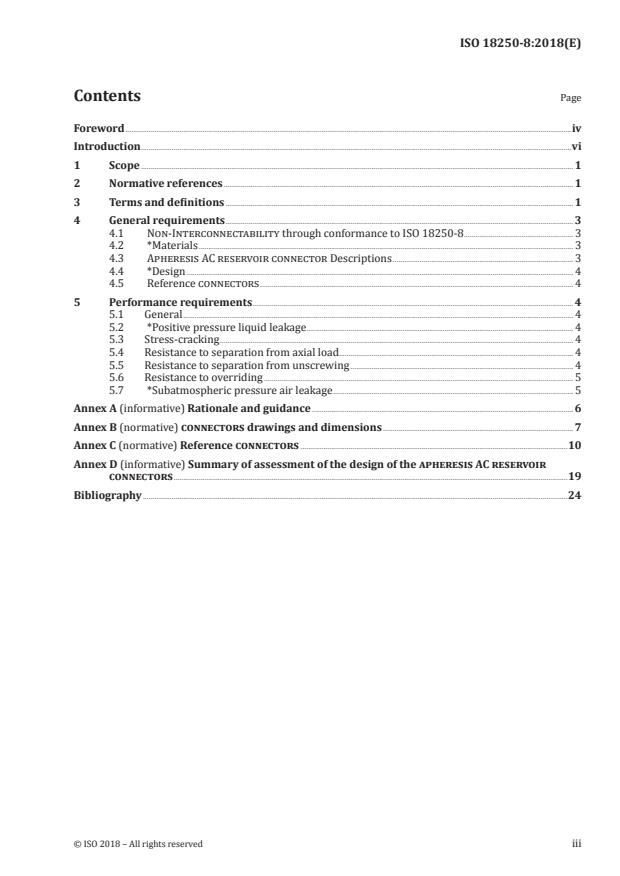

ISO 18250-8:2018 - Medical devices -- Connectors for reservoir delivery systems for healthcare applications

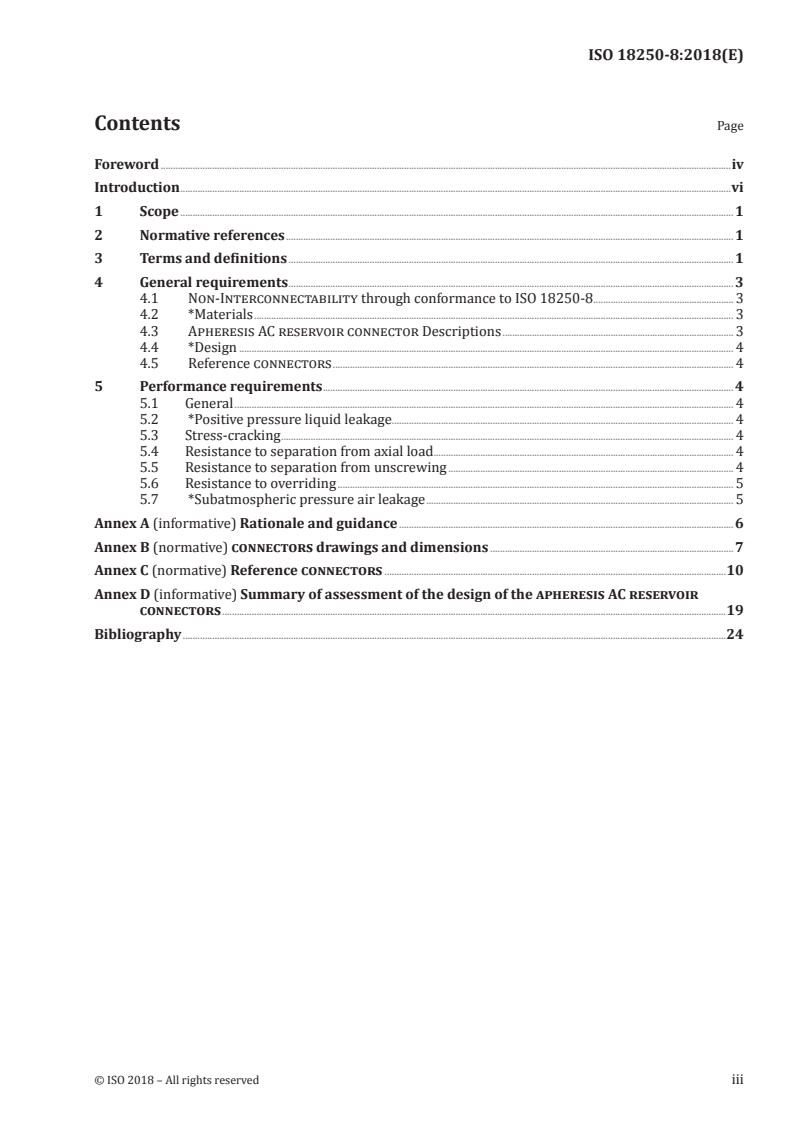
ISO 18250-8:2018 - Medical devices — Connectors for reservoir delivery systems for healthcare applications — Part 8: Citrate-based anticoagulant solution for apheresis applications/21/2018
Overview
ISO 18250-8:2018 specifies the dimensions, design and functional performance requirements for apheresis anticoagulant (AC) reservoir connectors used with citrate‑based anticoagulant solutions. It defines the male and female connector interfaces (male on the apheresis tubing set; female on the reservoir) and establishes tests and acceptance criteria to reduce the risk of misconnections while ensuring reliable fluid delivery. This document applies to the connector interfaces only - not to complete medical devices or accessories that use them.
Key topics and technical requirements
- Connector geometry and drawings: Normative dimensions and tolerances for male and female apheresis AC reservoir connectors are provided (see Annex B).
- Materials: Connectors shall use materials conforming to ISO 18250‑1 requirements; material compatibility and testing are required.
- Non‑interconnectability: Design criteria to prevent unintended connections with non‑apheresis clinical devices are specified to reduce misconnection risk.
- Performance tests (type tests) (examples from the standard):
- Positive pressure liquid leakage - no dripping under an applied pressure of 50–60 kPa for 30–35 s (reference connector from Annex C).
- Stress‑cracking - connectors must show no stress‑cracking when subjected to leakage testing and related procedures.
- Resistance to axial separation - connectors must not separate under a specified disconnection axial force (32–35 N) over 10–15 s.
- Other evaluated properties include resistance to unscrewing, overriding, and subatmospheric air leakage.
- Reference connectors: Annex C specifies metal reference connectors used for testing (corrosion‑resistant, Ra ≤ 0.8 µm on critical surfaces).
Practical applications
- Standardizes connectors for apheresis tubing sets and pre‑filled reservoirs containing citrate‑based anticoagulants used in blood collection, plasma collection, and therapeutic apheresis.
- Intended to be used by manufacturers to design connectors that are non‑interconnectable with other clinical systems, lowering patient safety risks from misconnections.
- Test laboratories can adopt the specified test methods to certify connector performance.
Who should use this standard
- Medical device manufacturers (apheresis systems, tubing sets, reservoirs)
- Component and connector suppliers
- Regulatory compliance and quality engineers
- Test laboratories and conformity assessors
- Standards developers and procurement specialists focused on clinical safety and connector interoperability
Related standards
- ISO 18250‑1 - General requirements and common test methods for reservoir delivery system connectors
- ISO 80369‑20:2015 - Common test methods for small‑bore healthcare connectors
- Other parts of the ISO 18250 series covering reservoir connector applications
Using ISO 18250‑8:2018 helps manufacturers ensure consistent connector design, improve patient safety by preventing misconnections, and simplify conformity assessment for apheresis anticoagulant reservoir interfaces.
Buy Documents
ISO 18250-8:2018 - Medical devices -- Connectors for reservoir delivery systems for healthcare applications
ISO 18250-8:2018 - Medical devices — Connectors for reservoir delivery systems for healthcare applications — Part 8: Citrate-based anticoagulant solution for apheresis applications/21/2018
Get Certified
Connect with accredited certification bodies for this standard

BSI Group
BSI (British Standards Institution) is the business standards company that helps organizations make excellence a habit.

TÜV Rheinland
TÜV Rheinland is a leading international provider of technical services.

TÜV SÜD
TÜV SÜD is a trusted partner of choice for safety, security and sustainability solutions.
Sponsored listings
Frequently Asked Questions
ISO 18250-8:2018 is a standard published by the International Organization for Standardization (ISO). Its full title is "Medical devices — Connectors for reservoir delivery systems for healthcare applications — Part 8: Citrate-based anticoagulant solution for apheresis applications". This standard covers: This document specifies dimensions and requirements for the design and functional performance of apheresis anticoagulant (AC) reservoir connectors. This document does not specify the dimensions and requirements for the medical devices or accessories that use these connectors. Such requirements are given in particular International Standards for specific medical devices or accessories. The following examples of medical devices are intended to use the connectors of this document: — Apheresis tubing sets and mating reservoirs containing citrate-based anticoagulant solution. — Apheresis tubing sets may include, but are not limited to those for use in blood collection, therapeutic applications, and plasma collection. Some apheresis sets are manufactured with a pre-connected reservoir containing citrate-based anticoagulant solution. These medical devices are not intended to use the connectors of this document. NOTE Manufacturers are encouraged to incorporate the connectors specified in this document into apheresis devices or accessories, even if not currently required by the particular medical device standards. It is expected that when the particular medical device standards are revised, requirements for apheresis AC reservoir connectors, will be included.
This document specifies dimensions and requirements for the design and functional performance of apheresis anticoagulant (AC) reservoir connectors. This document does not specify the dimensions and requirements for the medical devices or accessories that use these connectors. Such requirements are given in particular International Standards for specific medical devices or accessories. The following examples of medical devices are intended to use the connectors of this document: — Apheresis tubing sets and mating reservoirs containing citrate-based anticoagulant solution. — Apheresis tubing sets may include, but are not limited to those for use in blood collection, therapeutic applications, and plasma collection. Some apheresis sets are manufactured with a pre-connected reservoir containing citrate-based anticoagulant solution. These medical devices are not intended to use the connectors of this document. NOTE Manufacturers are encouraged to incorporate the connectors specified in this document into apheresis devices or accessories, even if not currently required by the particular medical device standards. It is expected that when the particular medical device standards are revised, requirements for apheresis AC reservoir connectors, will be included.
ISO 18250-8:2018 is classified under the following ICS (International Classification for Standards) categories: 11.040.25 - Syringes, needles an catheters. The ICS classification helps identify the subject area and facilitates finding related standards.
ISO 18250-8:2018 is available in PDF format for immediate download after purchase. The document can be added to your cart and obtained through the secure checkout process. Digital delivery ensures instant access to the complete standard document.
Standards Content (Sample)
INTERNATIONAL ISO
STANDARD 18250-8
First edition
2018-08
Medical devices — Connectors
for reservoir delivery systems for
healthcare applications —
Part 8:
Citrate-based anticoagulant solution
for apheresis applications
Dispositifs médicaux — Connecteurs pour systèmes de livraison de
réservoir pour des applications de soins de santé —
Partie 8: Solution anticoagulante à base de citrate pour les
applications d'aphérèse
Reference number
©
ISO 2018
© ISO 2018
All rights reserved. Unless otherwise specified, or required in the context of its implementation, no part of this publication may
be reproduced or utilized otherwise in any form or by any means, electronic or mechanical, including photocopying, or posting
on the internet or an intranet, without prior written permission. Permission can be requested from either ISO at the address
below or ISO’s member body in the country of the requester.
ISO copyright office
CP 401 • Ch. de Blandonnet 8
CH-1214 Vernier, Geneva
Phone: +41 22 749 01 11
Fax: +41 22 749 09 47
Email: copyright@iso.org
Website: www.iso.org
Published in Switzerland
ii © ISO 2018 – All rights reserved
Contents Page
Foreword .iv
Introduction .vi
1 Scope . 1
2 Normative references . 1
3 Terms and definitions . 1
4 General requirements . 3
4.1 Non-Interconnectability through conformance to ISO 18250-8 . 3
4.2 *Materials . 3
4.3 Apheresis AC reservoir connector Descriptions . 3
4.4 *Design . 4
4.5 Reference connectors . 4
5 Performance requirements . 4
5.1 General . 4
5.2 *Positive pressure liquid leakage. 4
5.3 Stress-cracking . 4
5.4 Resistance to separation from axial load. 4
5.5 Resistance to separation from unscrewing . 4
5.6 Resistance to overriding . 5
5.7 *Subatmospheric pressure air leakage . 5
Annex A (informative) Rationale and guidance . 6
Annex B (normative) connectors drawings and dimensions . 7
Annex C (normative) Reference connectors .10
Annex D (informative) Summary of assessment of the design of the apheresis AC reservoir
connectors .19
Bibliography .24
Foreword
ISO (the International Organization for Standardization) is a worldwide federation of national standards
bodies (ISO member bodies). The work of preparing International Standards is normally carried out
through ISO technical committees. Each member body interested in a subject for which a technical
committee has been established has the right to be represented on that committee. International
organizations, governmental and non-governmental, in liaison with ISO, also take part in the work.
ISO collaborates closely with the International Electrotechnical Commission (IEC) on all matters of
electrotechnical standardization.
The procedures used to develop this document and those intended for its further maintenance are
described in the ISO/IEC Directives, Part 1. In particular, the different approval criteria needed for the
different types of ISO documents should be noted. This document was drafted in accordance with the
editorial rules of the ISO/IEC Directives, Part 2 (see www .iso .org/directives).
Attention is drawn to the possibility that some of the elements of this document may be the subject of
patent rights. ISO shall not be held responsible for identifying any or all such patent rights. Details of
any patent rights identified during the development of the document will be in the Introduction and/or
on the ISO list of patent declarations received (see www .iso .org/patents).
Any trade name used in this document is information given for the convenience of users and does not
constitute an endorsement.
For an explanation of the voluntary nature of standards, the meaning of ISO specific terms and
expressions related to conformity assessment, as well as information about ISO's adherence to the
World Trade Organization (WTO) principles in the Technical Barriers to Trade (TBT) see www .iso
.org/iso/foreword .html.
This document was prepared by Technical Committee ISO/TC 210, Quality management and
corresponding general aspects for medical devices.
A list of all parts in the ISO 18250 series can be found on the ISO website.
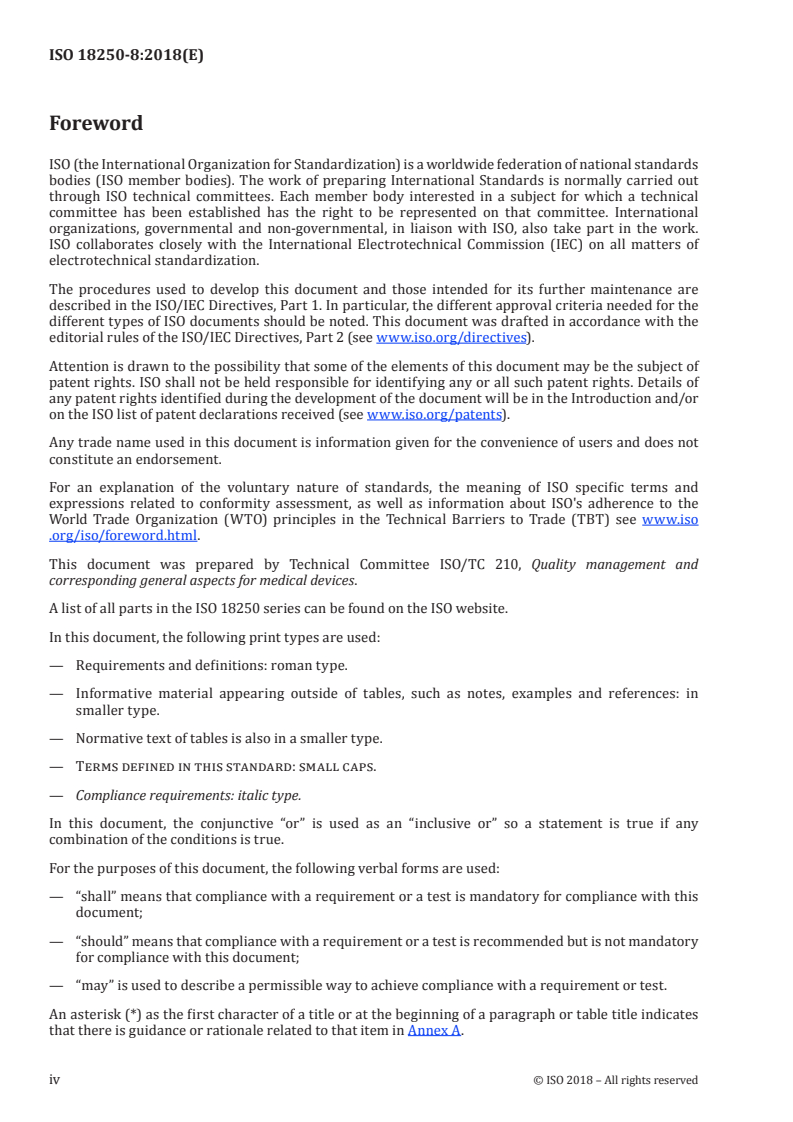
In this document, the following print types are used:
— Requirements and definitions: roman type.
— Informative material appearing outside of tables, such as notes, examples and references: in
smaller type.
— Normative text of tables is also in a smaller type.
— Terms defined in this standard: small caps.
— Compliance requirements: italic type.
In this document, the conjunctive “or” is used as an “inclusive or” so a statement is true if any
combination of the conditions is true.
For the purposes of this document, the following verbal forms are used:
— “shall” means that compliance with a requirement or a test is mandatory for compliance with this
document;
— “should” means that compliance with a requirement or a test is recommended but is not mandatory
for compliance with this document;
— “may” is used to describe a permissible way to achieve compliance with a requirement or test.
An asterisk (*) as the first character of a title or at the beginning of a paragraph or table title indicates
that there is guidance or rationale related to that item in Annex A.
iv © ISO 2018 – All rights reserved
Any feedback or questions on this document should be directed to the user’s national standards body. A
complete listing of these bodies can be found at www .iso .org/members .html.
Introduction
During the development of the series of standards for small-bore connectors for liquids and gases in
healthcare applications (see ISO 80369) it became clear that the risk of misconnections was not limited
to the patient access connectors and that the whole reservoir system needed to be considered. The
possible misconnection between apheresis AC reservoir connectors and spikes was also reviewed.
However, as apheresis AC reservoir connectors are not exactly within the definition of small-
bore connectors it was decided to develop this separate standard for these connectors, taking into
account the risks of misconnections with other devices such as IV bags, and blood pressure cuffs that
are likely to be used on the same patient.
This document, therefore, defines the apheresis AC reservoir connectors in geometry, material,
and performance to permit them being analyzed (and avoided) by other connectors intended for non-
apheresis applications (i.e. the other application parts of the ISO 18250 series).
This document is not a device standard as it specifies only the dimensions of the interfaces for the
apheresis AC reservoir connectors used on the disposable tubing sets and solution reservoirs.
vi © ISO 2018 – All rights reserved
INTERNATIONAL STANDARD ISO 18250-8:2018(E)
Medical devices — Connectors for reservoir delivery
systems for healthcare applications —
Part 8:
Citrate-based anticoagulant solution for apheresis
applications
1 Scope
This document specifies dimensions and requirements for the design and functional performance of
apheresis anticoagulant (AC) reservoir connectors.
This document does not specify the dimensions and requirements for the medical devices or
accessories that use these connectors. Such requirements are given in particular International
Standards for specific medical devices or accessories.
The following examples of medical devices are intended to use the connectors of this document:
— Apheresis tubing sets and mating reservoirs containing citrate-based anticoagulant solution.
— Apheresis tubing sets may include, but are not limited to those for use in blood collection, therapeutic
applications, and plasma collection.
Some apheresis sets are manufactured with a pre-connected reservoir containing citrate-based
anticoagulant solution. These medical devices are not intended to use the connectors of this
document.
NOTE Manufacturers are encouraged to incorporate the connectors specified in this document into
apheresis devices or accessories, even if not currently required by the particular medical device standards.
It is expected that when the particular medical device standards are revised, requirements for apheresis AC
reservoir connectors, will be included.
2 Normative references
The following documents are referred to in the text in such a way that some or all of their content
constitutes requirements of this document. For dated references, only the edition cited applies. For
undated references, the latest edition of the referenced document (including any amendments) applies.
1)
ISO 18250-1:— , Medical devices — Connectors for reservoir delivery systems for healthcare applications —
Part 1: General requirements and common test methods
ISO 80369-20:2015, Small-bore connectors for liquids and gases in healthcare applications — Part 20:
Common test methods
3 Terms and definitions
3.1
accessory
additional part(s) for use with medical device (3.7) in order to:
— achieve the intended use,
1) Under preparation. Stage at the time of publication: ISO/FDIS 18250-1.
— adapt it to some special use,
— facilitate its use,
— enhance its performance, or
— enable its functions to be integrated with those of other medical devices (3.7)
2)
[SOURCE: ISO 80369-1:— , definition 3.1]
3.2
apheresis
procedure in which blood is drawn from a donor or patient and separated into its components, some of
which are retained and the remainder returned by transfusion to the donor or patient
3.3
apheresis anticoagulant reservoir connector
apheresis AC reservoir connector
connector (3.6) for citrate-based anticoagulant (3.4) solutions for apheresis (3.2) applications
3.4
citrate-based anticoagulant
citrate, in the form of sodium citrate or acid-citrate-dextrose, added to the blood as it is drawn from the
subject’s circulation which binds or chelates ionised calcium within the blood, impeding those steps of
the coagulation pathway that are dependent on the presence of ionised calcium
3.5
connection
union or joining of mating halves of a connector (3.6)
[SOURCE: ISO 80369-1:—, definition 3.4]
3.6
connector
mechanical device, consisting of one of two mating halves and designed to join a conduit to convey
liquids or gases
[SOURCE: ISO 80369-1:—, definition 3.5]
3.7
medical device
instrument, apparatus, implement, machine, appliance, implant, in vitro reagent or calibrator, software,
material or other similar or related article, intended by the manufacturer to be used, alone or in
combination, for human beings for one or more of the specific purpose(s) of
— diagnosis, prevention, monitoring, treatment or alleviation of disease,
— diagnosis, monitoring, treatment, alleviation of or compensation for an injury,
— investigation, replacement, modification, or support of the anatomy or of a physiological process,
— supporting or sustaining life,
— control of conception,
— disinfection of medical devices, or
— providing information for medical purposes by means of in vitro examination of specimens derived
from the human body,
2) To be published. Revision of ISO 80369-1:2010.
2 © ISO 2018 – All rights reserved
and which does not achieve its primary intended action in or on the human body by pharmacological,
immunological or metabolic means, but which may be assisted in its function by such means
Note 1 to entry: Products which might be considered to be medical devices in some jurisdictions but not in
others include:
— disinfection substances;
— aids for persons with disabilities;
— devices incorporating animal or human tissues;
— devices for in-vitro fertilization or assisted reproduction technologies.
[SOURCE: Based on GHTF/SG1/N071 2012, definition 5.1]
3.8
misconnection
connection (3.5) between connectors (3.6) intended for different applications or from different
designs within the same application and not intended to connect
3.9
non-interconnectable
having characteristics which incorporate geometries or other characteristics that prevent different
connectors (3.6) from being connected
3.10
reservoir
fluid container within medical device (3.7) or pharmaceutical fields
4 General requirements
4.1 Non-Interconnectability through conformance to ISO 18250-8
Conformance to 4.2, 4.4 and Clause 5 of this document is sufficient to demonstrate conformance to
ISO 18250-1 (i.e. non-interconnectability with clinical applications other than apheresis).
NOTE 1 A summary of the evaluation and residual risks of the non-interconnectable characteristics of the
designs for this document is included in Annex D.
NOTE 2 The non-interconnectable criteria used in this document deviates from the ISO 18250-1:—,
Annex B in that the risk of misconnections between applications that will connect but do not permit transfer of
fluids is deemed acceptable.
4.2 *Materials
apheresis AC reservoir connectors shall be made of materials as speci
...
INTERNATIONAL ISO
STANDARD 18250-8
First edition
2018-08
Medical devices — Connectors
for reservoir delivery systems for
healthcare applications —
Part 8:
Citrate-based anticoagulant solution
for apheresis applications
Dispositifs médicaux — Connecteurs pour systèmes de livraison de
réservoir pour des applications de soins de santé —
Partie 8: Solution anticoagulante à base de citrate pour les
applications d'aphérèse
Reference number
©
ISO 2018
© ISO 2018
All rights reserved. Unless otherwise specified, or required in the context of its implementation, no part of this publication may
be reproduced or utilized otherwise in any form or by any means, electronic or mechanical, including photocopying, or posting
on the internet or an intranet, without prior written permission. Permission can be requested from either ISO at the address
below or ISO’s member body in the country of the requester.
ISO copyright office
CP 401 • Ch. de Blandonnet 8
CH-1214 Vernier, Geneva
Phone: +41 22 749 01 11
Fax: +41 22 749 09 47
Email: copyright@iso.org
Website: www.iso.org
Published in Switzerland
ii © ISO 2018 – All rights reserved
Contents Page
Foreword .iv
Introduction .vi
1 Scope . 1
2 Normative references . 1
3 Terms and definitions . 1
4 General requirements . 3
4.1 Non-Interconnectability through conformance to ISO 18250-8 . 3
4.2 *Materials . 3
4.3 Apheresis AC reservoir connector Descriptions . 3
4.4 *Design . 4
4.5 Reference connectors . 4
5 Performance requirements . 4
5.1 General . 4
5.2 *Positive pressure liquid leakage. 4
5.3 Stress-cracking . 4
5.4 Resistance to separation from axial load. 4
5.5 Resistance to separation from unscrewing . 4
5.6 Resistance to overriding . 5
5.7 *Subatmospheric pressure air leakage . 5
Annex A (informative) Rationale and guidance . 6
Annex B (normative) connectors drawings and dimensions . 7
Annex C (normative) Reference connectors .10
Annex D (informative) Summary of assessment of the design of the apheresis AC reservoir
connectors .19
Bibliography .24
Foreword
ISO (the International Organization for Standardization) is a worldwide federation of national standards
bodies (ISO member bodies). The work of preparing International Standards is normally carried out
through ISO technical committees. Each member body interested in a subject for which a technical
committee has been established has the right to be represented on that committee. International
organizations, governmental and non-governmental, in liaison with ISO, also take part in the work.
ISO collaborates closely with the International Electrotechnical Commission (IEC) on all matters of
electrotechnical standardization.
The procedures used to develop this document and those intended for its further maintenance are
described in the ISO/IEC Directives, Part 1. In particular, the different approval criteria needed for the
different types of ISO documents should be noted. This document was drafted in accordance with the
editorial rules of the ISO/IEC Directives, Part 2 (see www .iso .org/directives).
Attention is drawn to the possibility that some of the elements of this document may be the subject of
patent rights. ISO shall not be held responsible for identifying any or all such patent rights. Details of
any patent rights identified during the development of the document will be in the Introduction and/or
on the ISO list of patent declarations received (see www .iso .org/patents).
Any trade name used in this document is information given for the convenience of users and does not
constitute an endorsement.
For an explanation of the voluntary nature of standards, the meaning of ISO specific terms and
expressions related to conformity assessment, as well as information about ISO's adherence to the
World Trade Organization (WTO) principles in the Technical Barriers to Trade (TBT) see www .iso
.org/iso/foreword .html.
This document was prepared by Technical Committee ISO/TC 210, Quality management and
corresponding general aspects for medical devices.
A list of all parts in the ISO 18250 series can be found on the ISO website.
In this document, the following print types are used:
— Requirements and definitions: roman type.
— Informative material appearing outside of tables, such as notes, examples and references: in
smaller type.
— Normative text of tables is also in a smaller type.
— Terms defined in this standard: small caps.
— Compliance requirements: italic type.
In this document, the conjunctive “or” is used as an “inclusive or” so a statement is true if any
combination of the conditions is true.
For the purposes of this document, the following verbal forms are used:
— “shall” means that compliance with a requirement or a test is mandatory for compliance with this
document;
— “should” means that compliance with a requirement or a test is recommended but is not mandatory
for compliance with this document;
— “may” is used to describe a permissible way to achieve compliance with a requirement or test.
An asterisk (*) as the first character of a title or at the beginning of a paragraph or table title indicates
that there is guidance or rationale related to that item in Annex A.
iv © ISO 2018 – All rights reserved
Any feedback or questions on this document should be directed to the user’s national standards body. A
complete listing of these bodies can be found at www .iso .org/members .html.
Introduction
During the development of the series of standards for small-bore connectors for liquids and gases in
healthcare applications (see ISO 80369) it became clear that the risk of misconnections was not limited
to the patient access connectors and that the whole reservoir system needed to be considered. The
possible misconnection between apheresis AC reservoir connectors and spikes was also reviewed.
However, as apheresis AC reservoir connectors are not exactly within the definition of small-
bore connectors it was decided to develop this separate standard for these connectors, taking into
account the risks of misconnections with other devices such as IV bags, and blood pressure cuffs that
are likely to be used on the same patient.
This document, therefore, defines the apheresis AC reservoir connectors in geometry, material,
and performance to permit them being analyzed (and avoided) by other connectors intended for non-
apheresis applications (i.e. the other application parts of the ISO 18250 series).
This document is not a device standard as it specifies only the dimensions of the interfaces for the
apheresis AC reservoir connectors used on the disposable tubing sets and solution reservoirs.
vi © ISO 2018 – All rights reserved
INTERNATIONAL STANDARD ISO 18250-8:2018(E)
Medical devices — Connectors for reservoir delivery
systems for healthcare applications —
Part 8:
Citrate-based anticoagulant solution for apheresis
applications
1 Scope
This document specifies dimensions and requirements for the design and functional performance of
apheresis anticoagulant (AC) reservoir connectors.
This document does not specify the dimensions and requirements for the medical devices or
accessories that use these connectors. Such requirements are given in particular International
Standards for specific medical devices or accessories.
The following examples of medical devices are intended to use the connectors of this document:
— Apheresis tubing sets and mating reservoirs containing citrate-based anticoagulant solution.
— Apheresis tubing sets may include, but are not limited to those for use in blood collection, therapeutic
applications, and plasma collection.
Some apheresis sets are manufactured with a pre-connected reservoir containing citrate-based
anticoagulant solution. These medical devices are not intended to use the connectors of this
document.
NOTE Manufacturers are encouraged to incorporate the connectors specified in this document into
apheresis devices or accessories, even if not currently required by the particular medical device standards.
It is expected that when the particular medical device standards are revised, requirements for apheresis AC
reservoir connectors, will be included.
2 Normative references
The following documents are referred to in the text in such a way that some or all of their content
constitutes requirements of this document. For dated references, only the edition cited applies. For
undated references, the latest edition of the referenced document (including any amendments) applies.
1)
ISO 18250-1:— , Medical devices — Connectors for reservoir delivery systems for healthcare applications —
Part 1: General requirements and common test methods
ISO 80369-20:2015, Small-bore connectors for liquids and gases in healthcare applications — Part 20:
Common test methods
3 Terms and definitions
3.1
accessory
additional part(s) for use with medical device (3.7) in order to:
— achieve the intended use,
1) Under preparation. Stage at the time of publication: ISO/FDIS 18250-1.
— adapt it to some special use,
— facilitate its use,
— enhance its performance, or
— enable its functions to be integrated with those of other medical devices (3.7)
2)
[SOURCE: ISO 80369-1:— , definition 3.1]
3.2
apheresis
procedure in which blood is drawn from a donor or patient and separated into its components, some of
which are retained and the remainder returned by transfusion to the donor or patient
3.3
apheresis anticoagulant reservoir connector
apheresis AC reservoir connector
connector (3.6) for citrate-based anticoagulant (3.4) solutions for apheresis (3.2) applications
3.4
citrate-based anticoagulant
citrate, in the form of sodium citrate or acid-citrate-dextrose, added to the blood as it is drawn from the
subject’s circulation which binds or chelates ionised calcium within the blood, impeding those steps of
the coagulation pathway that are dependent on the presence of ionised calcium
3.5
connection
union or joining of mating halves of a connector (3.6)
[SOURCE: ISO 80369-1:—, definition 3.4]
3.6
connector
mechanical device, consisting of one of two mating halves and designed to join a conduit to convey
liquids or gases
[SOURCE: ISO 80369-1:—, definition 3.5]
3.7
medical device
instrument, apparatus, implement, machine, appliance, implant, in vitro reagent or calibrator, software,
material or other similar or related article, intended by the manufacturer to be used, alone or in
combination, for human beings for one or more of the specific purpose(s) of
— diagnosis, prevention, monitoring, treatment or alleviation of disease,
— diagnosis, monitoring, treatment, alleviation of or compensation for an injury,
— investigation, replacement, modification, or support of the anatomy or of a physiological process,
— supporting or sustaining life,
— control of conception,
— disinfection of medical devices, or
— providing information for medical purposes by means of in vitro examination of specimens derived
from the human body,
2) To be published. Revision of ISO 80369-1:2010.
2 © ISO 2018 – All rights reserved
and which does not achieve its primary intended action in or on the human body by pharmacological,
immunological or metabolic means, but which may be assisted in its function by such means
Note 1 to entry: Products which might be considered to be medical devices in some jurisdictions but not in
others include:
— disinfection substances;
— aids for persons with disabilities;
— devices incorporating animal or human tissues;
— devices for in-vitro fertilization or assisted reproduction technologies.
[SOURCE: Based on GHTF/SG1/N071 2012, definition 5.1]
3.8
misconnection
connection (3.5) between connectors (3.6) intended for different applications or from different
designs within the same application and not intended to connect
3.9
non-interconnectable
having characteristics which incorporate geometries or other characteristics that prevent different
connectors (3.6) from being connected
3.10
reservoir
fluid container within medical device (3.7) or pharmaceutical fields
4 General requirements
4.1 Non-Interconnectability through conformance to ISO 18250-8
Conformance to 4.2, 4.4 and Clause 5 of this document is sufficient to demonstrate conformance to
ISO 18250-1 (i.e. non-interconnectability with clinical applications other than apheresis).
NOTE 1 A summary of the evaluation and residual risks of the non-interconnectable characteristics of the
designs for this document is included in Annex D.
NOTE 2 The non-interconnectable criteria used in this document deviates from the ISO 18250-1:—,
Annex B in that the risk of misconnections between applications that will connect but do not permit transfer of
fluids is deemed acceptable.
4.2 *Materials
apheresis AC reservoir connectors shall be made of materials as speci
...