


ISO/TS 22107:2021
(Main)Dispersibility of solid particles into a liquid
Dispersibility of solid particles into a liquid
This document establishes a generally applicable (i.e. not application specific) definition for dispersibility. It identifies significant characteristics for evaluating dispersibility and lists examples of methods used to characterize dispersibility in various applications. This document applies to processes that disperse powders into a liquid continuous phase while reducing the size of agglomerates or flocs down to the intended level, that homogenize an existing dispersed solid phase of a suspension or the mixture of two suspensions, or that exchange the original continuous phase in a suspension for another. Specific methods to disperse particles and to characterize the state of dispersion and/or homogeneity are only referenced, if necessary, for context. This document is applicable to nano- and micro-sized particles across a range of product applications.
Dispersibilité de particules solides dans un liquide
General Information
- Status
- Published
- Publication Date
- 12-Oct-2021
- Technical Committee
- ISO/TC 24/SC 4 - Particle characterization
- Current Stage
- 9093 - International Standard confirmed
- Start Date
- 21-Mar-2025
- Completion Date
- 13-Dec-2025
Overview
ISO/TS 22107:2021 - Dispersibility of solid particles into a liquid - is a technical specification that provides a generic, application‑agnostic definition of dispersibility and a framework for evaluating how readily particulate materials can be dispersed into a liquid continuous phase. Published as the first edition in 2021, the document addresses dispersion processes that (a) reduce agglomerate/floc size to an intended level, (b) homogenize an existing dispersed solid phase, or (c) exchange the continuous phase of a suspension. It applies to nano‑ and micro‑sized particles across a wide range of product applications.
Key Topics
- Generic definition of dispersibility: A qualitative or quantitative property assessing the ease with which a particulate source material can be dispersed into a liquid; includes homogeneity and particle size endpoints.
- Core terminology: Clear definitions for terms such as agglomerate, aggregate, floc, particle, primary particle, homogeneity, dispersion stability and dispersing agent-ensuring consistent use in characterization and reporting.
- Fundamental aspects of the dispersion process: Objectives such as wetting the powder, achieving uniform distribution (homogeneity), and reducing agglomerate size to application‑specific criteria; distinction from comminution (size reduction of primary particles).
- Characteristics to evaluate dispersibility: Includes end‑point criteria like particle size distribution and spatial uniformity; notes the role of process parameters (e.g., energy density, dispersing agents) in performance.
- Methods overview: A compilation and examples of characterization techniques and sample preparation approaches used to assess dispersibility (methods are referenced for context rather than prescribed).
- Scope limits: The specification does not address long‑term aging, secondary destabilization, shelf life or stability phenomena in depth-these are covered by other ISO guidance.
Applications
ISO/TS 22107:2021 is valuable for:
- R&D and formulation teams in paints, inks, coatings, cosmetics, pharmaceuticals, and polishing or conductive materials who need standardized language and evaluation criteria for dispersion quality.
- Quality control and analytical laboratories preparing suspensions for particle characterization or comparison across batches and suppliers.
- Regulatory and risk‑assessment professionals evaluating nano‑enabled products where the state of dispersion affects performance and safety.
- Manufacturers and suppliers establishing acceptance criteria or test protocols for particle dispersibility or homogeneity in liquid systems.
Related Standards (examples)
- ISO/TR 13097 (dispersion terminology and stability context)
- ISO/TR 18811 (stability and shelf life references)
- Annex A of ISO/TS 22107 lists national and international standards commonly used in dispersion characterization.
Keywords: ISO/TS 22107:2021, dispersibility, dispersion process, particle dispersibility, suspension, nano and micro particles, dispersion characterization, homogeneity, dispersion stability.
Frequently Asked Questions
ISO/TS 22107:2021 is a technical specification published by the International Organization for Standardization (ISO). Its full title is "Dispersibility of solid particles into a liquid". This standard covers: This document establishes a generally applicable (i.e. not application specific) definition for dispersibility. It identifies significant characteristics for evaluating dispersibility and lists examples of methods used to characterize dispersibility in various applications. This document applies to processes that disperse powders into a liquid continuous phase while reducing the size of agglomerates or flocs down to the intended level, that homogenize an existing dispersed solid phase of a suspension or the mixture of two suspensions, or that exchange the original continuous phase in a suspension for another. Specific methods to disperse particles and to characterize the state of dispersion and/or homogeneity are only referenced, if necessary, for context. This document is applicable to nano- and micro-sized particles across a range of product applications.
This document establishes a generally applicable (i.e. not application specific) definition for dispersibility. It identifies significant characteristics for evaluating dispersibility and lists examples of methods used to characterize dispersibility in various applications. This document applies to processes that disperse powders into a liquid continuous phase while reducing the size of agglomerates or flocs down to the intended level, that homogenize an existing dispersed solid phase of a suspension or the mixture of two suspensions, or that exchange the original continuous phase in a suspension for another. Specific methods to disperse particles and to characterize the state of dispersion and/or homogeneity are only referenced, if necessary, for context. This document is applicable to nano- and micro-sized particles across a range of product applications.
ISO/TS 22107:2021 is classified under the following ICS (International Classification for Standards) categories: 19.120 - Particle size analysis. Sieving. The ICS classification helps identify the subject area and facilitates finding related standards.
You can purchase ISO/TS 22107:2021 directly from iTeh Standards. The document is available in PDF format and is delivered instantly after payment. Add the standard to your cart and complete the secure checkout process. iTeh Standards is an authorized distributor of ISO standards.
Standards Content (Sample)
TECHNICAL ISO/TS
SPECIFICATION 22107
First edition
2021-10
Dispersibility of solid particles into a
liquid
Dispersibilité de particules solides dans un liquide
Reference number
© ISO 2021
All rights reserved. Unless otherwise specified, or required in the context of its implementation, no part of this publication may
be reproduced or utilized otherwise in any form or by any means, electronic or mechanical, including photocopying, or posting on
the internet or an intranet, without prior written permission. Permission can be requested from either ISO at the address below
or ISO’s member body in the country of the requester.
ISO copyright office
CP 401 • Ch. de Blandonnet 8
CH-1214 Vernier, Geneva
Phone: +41 22 749 01 11
Email: copyright@iso.org
Website: www.iso.org
Published in Switzerland
ii
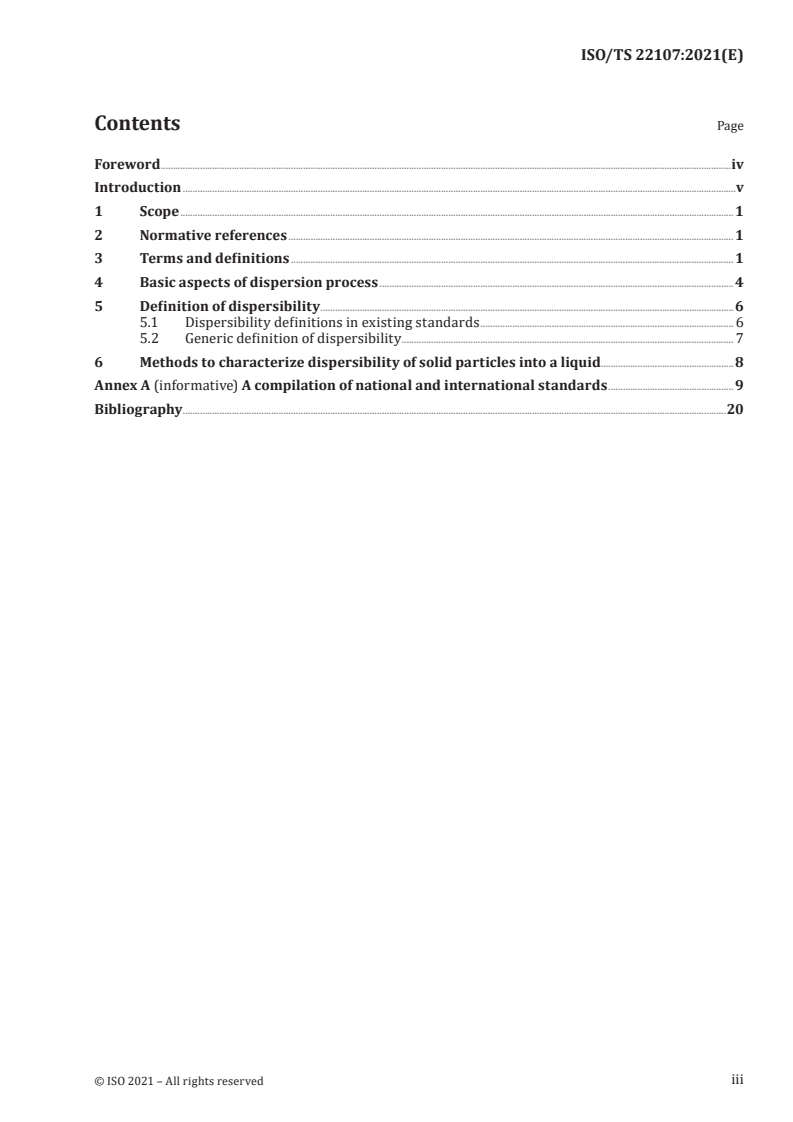
Contents Page
Foreword .iv
Introduction .v
1 Scope . 1
2 Normative references . 1
3 Terms and definitions . 1
4 Basic aspects of dispersion process .4
5 Definition of dispersibility .6
5.1 Dispersibility definitions in existing standards . 6
5.2 Generic definition of dispersibility . 7
6 Methods to characterize dispersibility of solid particles into a liquid .8
Annex A (informative) A compilation of national and international standards .9
Bibliography .20
iii
Foreword
ISO (the International Organization for Standardization) is a worldwide federation of national standards
bodies (ISO member bodies). The work of preparing International Standards is normally carried out
through ISO technical committees. Each member body interested in a subject for which a technical
committee has been established has the right to be represented on that committee. International
organizations, governmental and non-governmental, in liaison with ISO, also take part in the work.
ISO collaborates closely with the International Electrotechnical Commission (IEC) on all matters of
electrotechnical standardization.
The procedures used to develop this document and those intended for its further maintenance are
described in the ISO/IEC Directives, Part 1. In particular, the different approval criteria needed for the
different types of ISO documents should be noted. This document was drafted in accordance with the
editorial rules of the ISO/IEC Directives, Part 2 (see www.iso.org/directives).
Attention is drawn to the possibility that some of the elements of this document may be the subject of
patent rights. ISO shall not be held responsible for identifying any or all such patent rights. Details of
any patent rights identified during the development of the document will be in the Introduction and/or
on the ISO list of patent declarations received (see www.iso.org/patents).
Any trade name used in this document is information given for the convenience of users and does not
constitute an endorsement.
For an explanation of the voluntary nature of standards, the meaning of ISO specific terms and
expressions related to conformity assessment, as well as information about ISO's adherence to
the World Trade Organization (WTO) principles in the Technical Barriers to Trade (TBT), see
www.iso.org/iso/foreword.html.
This document was prepared by Technical Committee ISO/TC 24, Particle characterization including
sieving, Subcommittee SC 4, Particle characterization.
Any feedback or questions on this document should be directed to the user’s national standards body. A
complete listing of these bodies can be found at www.iso.org/members.html.
iv
Introduction
Dispersing particles is crucial for many end-use product properties such as colour, sensorial quality,
polishing, film homogeneity, conductivity, therapeutic efficacy, opacity of paints and inks, as well as
UV protection in cosmetics. Dispersions are evaluated over the life-cycle of a product, beginning in the
design stage, through production and for the end product. Additionally, some type of dispersion process
is a prerequisite for many routine particle characterization methods. Finally, the state of dispersion is an
[37]
important issue for risk evaluation of fine particles and for classification of nano-enabled products .
However, the ease with which a particulate material is dispersed in a liquid phase to meet established
or desired criteria, commonly referred to as dispersibility, is not well defined; and its common usage
varies widely across different fields and applications. Most existing definitions are application or
product specific. Therefore, the need exists for a document that summarizes the common practice, and
which also clearly defines dispersibility in a generic manner that is not application dependent. This
document addresses that stated need.
The definition for dispersibility is established based on a survey of existing standards of national and
international organisations as well as standardized procedures of industry in different application
fields. With respect to the final product in different applications, the state of dispersion can be
characterized according to the uniformity of the dispersed phase over the entire volume and according
to the mean particle size or size distribution with respect to application specific criteria.
This document does not address intermediate- or long-term alterations including aging of a suspension
following processing, nor does it address secondary destabilization phenomena. Stability and shelf life
are considered in specific standards such as ISO/TR 13097 and ISO/TR 18811.
v
TECHNICAL SPECIFICATION ISO/TS 22107:2021(E)
Dispersibility of solid particles into a liquid
1 Scope
This document establishes a generally applicable (i.e. not application specific) definition for
dispersibility. It identifies significant characteristics for evaluating dispersibility and lists examples of
methods used to characterize dispersibility in various applications.
This document applies to processes that disperse powders into a liquid continuous phase while reducing
the size of agglomerates or flocs down to the intended level, that homogenize an existing dispersed
solid phase of a suspension or the mixture of two suspensions, or that exchange the original continuous
phase in a suspension for another. Specific methods to disperse particles and to characterize the state
of dispersion and/or homogeneity are only referenced, if necessary, for context.
This document is applicable to nano- and micro-sized particles across a range of product applications.
2 Normative references
There are no normative references in this document.
3 Terms and definitions
For the purposes of this document, the following terms and definitions apply.
ISO and IEC maintain terminology databases for use in standardization at the following addresses:
— ISO Online browsing platform: available at https:// www .iso .org/ obp
— IEC Electropedia: available at http:// www .electropedia .org/
3.1
agglomerate
loosely coherent assembly of particles (3.12) and/or aggregates (3.2) held together by weak physical
interactions, with a total surface area virtually equal to the sum of the surface areas of the constituent
particles (3.13)
Note 1 to entry: The transitive verb “agglomerate” means “to gather into a cluster”, and the process by which the
cluster or assembly is formed is generally called “agglomeration”.
Note 2 to entry: Agglomeration can be a reversible process.
3.2
aggregate
assemblage of particles (3.12) into rigidly joined structures
Note 1 to entry: Formation of aggregates is usually an irreversible process.
Note 2 to entry: The forces holding an aggregate together are strong, for example covalent bonds or those
resulting from sintering or complex physical entanglement.
Note 3 to entry: In common use, the terms aggregate and agglomerate (also aggregation and agglomeration) are
sometimes applied interchangeably, but this practice is deprecated since the terms are not synonymous.
Note 4 to entry: The transitive verb “aggregate” means “to gather into a mass or whole”, and the process by which
the structure is formed is generally called “aggregation”.
[SOURCE: ISO/TR 13097:2013, 2.2, modified — The term has been changed from "aggregation" to
"aggregate"; notes 1 and 3 to entry has been updated; note 4 to entry has been added.]
3.3
comminution
operation of reducing particle (3.12) size by crushing, grinding or pulverisation
[SOURCE: ISO 12743:2021, 3.14]
3.4
dispersing agent
dispersant
substance capable of promoting the formation of a dispersion (3.7)
[SOURCE: ISO 862:1984, 82, modified — The admitted term "dispersant" has been added.]
3.5
disperse
distribute particles (3.12) homogeneously throughout a continuous phase, often by means of reducing
the size of agglomerates (3.1)
3.6
dispersibility
qualitative or quantitative characteristic or property of a particulate source material assessing the
ease with which said material can be dispersed (3.5) within a continuous phase
Note 1 to entry: Spatially uniform distribution (homogeneity (3.11)) of the dispersed phase is considered an
integral part of the desired end point.
Note 2 to entry: Particle (3.12) size or particle size distribution is often used as an end point relative to defined
criteria specific to the application.
Note 3 to entry: Dispersibility refers to a specific dispersion (3.7) process and specific process time.
Note 4 to entry: Dispersion stability (3.8), though a related phenomenon, should not be confused with dispersibility.
3.7
dispersion
multi-phase system in which discontinuities of any state (solid, liquid or gas) are homogeneously
distributed in a continuous phase of a different composition or state
Note 1 to entry: If solid particles (3.12) are dispersed (3.5) in a liquid, the dispersion is referred to as a suspension.
If the dispersion consists of two or more immiscible liquid phases, it is termed an emulsion.
Note 2 to entry: This term can also refer to the act or process of producing a dispersion, but in this context the
term “dispersion process” shall be used.
[SOURCE: ISO/TR 13097: 2013, 2.5, modified — The words "in general, microscopic" have been
removed from the begining of the definition; "discontinous phase" has been remove from the within the
parentheses; "dispersed" has been replaced by "homogeneously distributed"; note 1 to entry has been
updated; note 2 to entry has been added.]
3.8
dispersion stability
ability to resist change or variation in the initial properties (state) of a dispersion (3.7) over time, in
other words, the quality of a dispersion in being free from alterations over a given time scale
Note 1 to entry: In this context, for instance agglomeration or segregation represents a loss of dispersion stability.
[SOURCE: ISO/TR 13097:2013, 2.6, modified — In note 1 to entry, "creaming" has been replaced by
"segregation".]
3.9
energy density
amount of energy per unit volume of sample applied to a material
3.10
floc
ensemble of particles (3.12) that form a loosely coherent structure with high void fraction
Note 1 to entry: Flocs are held together by weak particle-particle attraction or by the osmotic pressure of a
continuous phase containing polymers not adsorbing to dispersed (3.5) particles (loss of configurational entropy
of polymers, depletion flocculation).
Note 2 to entry: The term floc may be used to denote an agglomerate (3.1) produced by addition of a flocculating
agent (e.g., a polyelectrolyte), but flocs can also form spontaneously.
3.11
homogeneity
degree to which a property or a constituent is uniformly distributed throughout a quantity of material
[38]
[SOURCE: IUPAC Gold Book ]
3.12
particle
minute piece of matter with defined physical boundaries
Note 1 to entry: A physical boundary can also be described as an interface.
Note 2 to entry: A particle can move as a unit.
[SOURCE: ISO 14644-5:2004, 3.1.7, modified — The original note to entry has been replaced by 2 new
notes to entry.]
3.13
constituent particle
identifiable, integral component of a larger particle (3.12)
[SOURCE: ISO/TS 80004-2:2015, 3.3, modified — Note 1 to entry has been removed.]
3.14
primary particle
original source particle (3.12) of agglomerates (3.1) or aggregates (3.2) or mixtures of the two
Note 1 to entry: Although a primary particle is often a constituent particle (3.13), a constituent particle is not
necessarily a primary particle.
[SOURCE: ISO 26824:2013, 1.4, modified — The 2 original notes to entry have been replaced by a new
note to entry.]
3.15
sedimentation
settling (separation) of the dispersed (3.5) phase due to the higher density of the dispersed particles
(3.12) compared to the continuous phase
Note 1 to entry: The accumulation of the dispersed phase at the bottom of the container is evidence that
sedimentation has taken place.
Note 2 to entry: Particles with a lower density compared to the continuous phase float rather than sink.
Note 3 to entry: Sedimentation leads to a loss of homogeneity (3.11).
[SOURCE: ISO/TR 13097:2013, 2.13, modified — The second sentence in the definition has been moved
to note 1 to entry; the original note 1 to entry has been removed; notes 2 and 3 to entry have been
added.]
3.16
surfactant
substance that lowers the interfacial energy of a material in contact with a liquid
Note 1 to entry: This term is a contraction of surface-active agent.
[SOURCE: ISO 18115-1:2013, 4.464, modified — The words "or the surface energy of that liquid" have
been removed at the end of the definition; the 2 original notes to entry have been replaced by a new
note to entry.]
4 Basic aspects of dispersion process
Dispersing particulate matter into a liquid continuous phase in the context of processing is a common
method to produce suspension-based products in many industrial fields and to prepare samples
for analysis (e.g. particle size analysis). In this document, the term “dispersion process” is used in
1)
the context of processing (dispersing a material) . A dispersion process may start from dry source
material or a pre-existing suspension. Dispersions can be created by mixing particles into a liquid to
achieve a uniform distribution throughout the entire volume, and additionally tailoring the size or
size distribution by mechanical or chemical means. Comminution, the size reduction of aggregates or
primary particles by milling, for example, is not considered here. Furthermore, the dispersion process
results in a multiphase system and not a solution.
The performance of a dispersion process, and therefore the quality/state of the final suspension,
depends on the source materials, the liquid continuous phase, the type and conditions of processing,
and is application-dependent and often quantified by reference specifications or criteria.
There are numerous textbooks, scientific papers, national and international standards, etc., dealing
with different aspects of dispersing particles and characterization of achieved results (see ISO 8780-
2)
1, ISO 14887, ISO/TS 27687 and References [39] to [43]). Relevant ISO documents are included in the
Bibliography and Annex A.
Various terms are introduced to compare or to quantify the success of the dispersion process, such as
“dispersibility”, “level of dispersion”, “ease of dispersion”, “dispersibility index”, “degree of dispersity”,
“re-dispersibility”, focussing often on a specific, mostly application driven aspect. These broad views
and discussions reflect the practical need to characterize the suspension with regard to different
sample preparation or manufacturing processes, as well as the supplied raw materials of different
suppliers or batches from the same supplier. On the other hand, comparison or evaluation of the
outcome is difficult due to the use of different terms and definitions. To arrive at a generic definition
for material “dispersibility”, it is appropriate to define the starting point of a (liquid-based) dispersion
process.
To disperse powder, the process starts with powder consisting of particles, aggregates and/or
agglomerates and has the following objectives (see ISO 14887):
— wet the powder (source material) with the liquid (continuous phase);
— obtain a uniform distribution of mass throughout the liquid volume (primarily for mixing, not size
reduction);
— decrease (reduce) the size of agglomerates of the source material to the application specific criteria
for size or size distribution, or down to constituent particles or primary particles if desired.
In practice, these procedures are often combined intentionally with additional appropriate measures
to prevent the occurrence of spatial inhomogeneities in volume concentration (e.g. due to separation
or sedimentation) and any re-association of dispersed particles impacting the specified size or size
distribution, respectively. These latter phenomena concern the stability of the dispersion state (ISO/
1) In literature the term “dispersion” and its derivatives (disperse, dispersed, dispersing) can be used both as an
active verb (as in “to disperse” something) and in reference to the material itself (as in “a colloidal dispersion”).
2) Withdrawn.
TR 13097 and ISO/TR 18811) with respect to time, which is beyond the scope of this document. ISO/
TR 13097 provides guidelines to characterize dispersion stability.
To disperse pre-existing suspensions, the process starts with a liquid suspension of the source material
that has degraded over time due to destabilization phenomena or requires, for its ultimate purpose,
an exchange or alteration of the continuous phase or further processing to achieve product-specific
criteria. In this case the objective may be one or more of the following:
— re-disperse agglomerated particles and sediments of a destabilized (e.g. aged) suspension;
— disperse the particles into a different liquid matrix or formulation (e.g. exchange of solvents);
— disperse two or more different types of source material to form a single suspension;
— reduce the size of agglomerated particles to the required size or size distribution for a specific
application or end-use.
According to the above description, dispersion processes may be theoretically divided into distributive
and disruptive processes, as depicted in Figure 1. These processes often occur in parallel.
Distributive processing involves the mixing of particles throughout the continuous phase volume, often
called homogenisation, to obtain uniformly distributed particles throughout the entire suspension
volume. This process may not involve size reduction, if the energy input is insufficient to break apart
existing agglomerates. In this case, the cohesive forces between particles are stronger than the applied
disruptive forces.
Disruptive processing involves the reduction in size of the source material (such as agglomerates, flocs)
and is often called dispersive processing, deagglomeration or simply dispersion. Success is attained
when the disruptive forces necessary to separate an agglomerate’s constituent particles overcome
the attractive forces between them. It should be noted that achievement of product specified fineness
(endpoint of disruptive processing) does not necessarily correspond with attainment of constituent
particles, nor does it necessarily mean that a uniform spatial distribution has been achieved.
Key
X level of disruptive process
Y level of distributive process
[40]
Figure 1 — Schematic illustration of distributive and disruptive processes
Three independent factors influence the success of the distributive or disruptive process:
a) the inherent chemical and physical properties of the source materials, for example, dry or wet,
particle size and size distribution, shape, brittleness or state of agglomeration;
b) the interaction between the particle surface and the continuous phase; this factor depends, for
instance, on wettability, electrostatic interactions, depletion forces, van der Waals forces, polarity
interaction, and hydrogen bonding;
c) the dispersion process itself; time, energy, intensity and mechanism (mechanical principle) have an
influence on the success of the distributive or disruptive process.
Therefore, to describe dispersibility all three factors shall be considered (multidimensional approach).
Each of these independent factors can be characterized by a number of different attributes and
quantified by suitable metrics.
5 Definition of dispersibility
5.1 Dispersibility definitions in existing standards
The concept of dispersibility has been used across a wide range of applications and industries for a
substantial period of time; however, its interpretation and usage vary widely even among existing
international and national standards. Therefore, a survey of existing standards and published
references was conducted in order to identify commonalities and differences.
Annex A consists of an annotated listing of relevant standards. According to those standards,
dispersibility can refer to the ease with which one can incorporate a powder into a suspension or
achieve deagglomeration (breaking or peptization of agglomerates or flocs into constituent particles).
The process of dispersion frequently results in both outcomes, as in the use of ultrasonication. In ISO/
TR 13329 (pertaining to nanotechnology), dispersibility is defined as the level of dispersion when it
has become constant under defined conditions, a definition adapted from ISO 8780-1. In the latter
context, the “level of dispersion” is understood as the extent to which particles have been separated
and stabilized by milling in a binder system under defined conditions (taken from ISO 8780-1).
As described in brief above (for details refer to Annex A), there is a broad variety of descriptions that
are often very specific, but, on the other hand, also connected with general product behaviour (quality).
Summing up the existing definitions and common usage, dispersibility is related to:
— ease of the dispersion process, e.g. energy input, process time, necessary equipment;
— quality of the dispersed end-product, e.g. stability, tinting strength, gloss development, rheological
behaviour, opacity/appearance;
— geometrical particle characteristics, e.g. fineness or coarseness, target particle size, target size
distribution, specific surface area, particle shape;
[46],[47]
— assessment of characteristics of processing outcome, dispersion hardness filtering, sieving,
amount of dry matter that can be dispersed, suspension viscosity
Stability of the processed suspension or end product, strictly speaking, shall be distinguished from
“dispersibility”, despite the fact that they are interconnected in practice. Dispersibility is related to the
dispersion process, while stability is the capacity for such a suspension to maintain its state over a
specified period of time. Although beyond the scope of the present document, it can be necessary to
apply additional process steps or stabilizing agents (dispersing agents, surfactants) to ensure long term
stability of the suspension state (e.g. against agglomeration, flocculation) or to prevent loss of spatial
uniformity (e.g. sediment formation by particle sedimentation) of the dispersed phase over time.
5.2 Generic definition of dispersibility
Based on literature sources and other considerations discussed above, dispersibility is defined
generically as stated in 3.6.
Dispersibility of a specific source material in a specific liquid application therefore depends upon:
— mass or volume ratio of particulate material to continuous phase;
— density of the particle(s);
— wettability of dry powders;
— primary or constituent particle size and initial state of agglomeration;
— surface/interfacial properties of the dispersed material;
— properties of the continuous phase in which the material is dispersed;
— specified product fineness to be achieved (i.e., the “endpoint” of deagglomeration, which does not
necessarily correspond to the primary particle size);
— type and conditions of the dispersion process (e.g. ultrasonication, high pressure or rotor-stator-
equipment, pH, temperature);
— energy density applied to the material.
6 Methods to characterize dispersibility of solid particles into a liquid
There are different points of departure for a dispersion process and correspondingly distinctive
meanings of dispersibility. Specific topics of characterization methods are dealt with in numerous
standards and, in more detail, listed in Annex A.
When the raw particulate material is a powder, "dispersibility" is often used to indicate the ease of
bringing a powder into a dispersion by achieving uniform spatial particle distribution and, if aimed,
"deagglomeration”. In this context, dispersibility can be quantified as the “percentage by mass of the
dry matter of the sample that can be dispersed in water”, determined by the procedure specified” (ISO/
TS 17758). It is also common in this case to characterize dispersibility based on the capacity to achieve
a specified particle size or size distribution via deagglomeration of the powder.
On the other hand, if the raw material is already in suspension, the task consists of transferring the
dispersed particles into another continuous phase or matrix, of reducing the particle size or achieving
a necessary size distribution, of mixing one type of dispersed material with a different type, or of re-
dispersing separated or re-associated particles (e.g. in an aged dispersion). In this context, dispersibility
is characterized primarily by the degree of uniformity and/or the particle size that can be achieved in
the suspension.
Homogeneity (uniformity) can be assessed using methods based on imaging the entire sample or
optical scanning, for instance. Metrics based on particle size can utilize a wide range of sizing methods.
Indirectly, suspension viscosity, opacity, or other property measurands that relate to the degree to
which size has been reduced can also be used as proxies for dispersibility.
Alternatively, some standards focus on the assessment of product quality to define dispersibility. For
example, ISO 105-Z04 states that dispersibility is the degree to which particles can be broken down to
some minimum size such that they will pass through the interstices of a reference filter media. A similar
definition is given for instant dried milk relating dispersibility of a powder in water to its ability to
break down into particles passing through a 150 µm sieve. Dispersion hardness is another description
[24]
to characterize the amount of work required to achieve the tinting strength of a coloured pigment
(EN 13900-2). There is a well-known, strong power-law correlation between the mean particle size and
[44],[45]
the applied energy density of the dispersion technique The obtained exponent of energy density
is used as a measure of dispersibility.
For any experimental assessment of dispersibility, particular attention shall be paid to sampling,
sample preparation, if necessary, and the time of analysis following sample preparation, which shall
be conducted during or immediately after processing. Measurement methods that require dilution,
mixing, stirring, sonication or any other mechanical or chemical treatment of samples are deprecated
since they may induce changes in the dispersion state.
Annex A
(informative)
A compilation of national and international standards
A.1 General
This annex is a list of available standards that address definitions and measurement procedures of
dispersibility within specific applications. Some of these standards are not directly relevant to the
scope of this document, but they are included as examples of alternative methods of characterising
dispersibility and related quantities.
A.2 ISO documents
ISO 105-Z04
Textiles — Tests for colour fastness — Part Z04: Dispersibility of disperse dyes
Scope Describes a method for determining the dispersibility
Objective of dis- Degree and kinetics of dispersing disperse dye in aqueous media
persibility
Definition of dis- Dispersibility = degree to which particles can be broken down to some minimum
persibility size such that they will pass through the interstices of a reference filter paper
Quantification of i) Dispersion at 70 °C in aqueous solution (acidic or alkaline) with magnetic
dispersibility stirrer for a defined time
ii) Filtration through filter paper (8 µm and 25 µm)
iii) Evaluation of filtration time or visible filter-residue
Relevance for Hardly relevant; dye is supposed to dissolve in water; the test essentially evalu-
this document ates the kinetics of the dissolution process
ISO 105-Z11
Textiles — Tests for colour fastness — Part Z11: Evaluation of speckiness of colorant dispersions
Scope Describes a test method to determine speckiness primarily of disperse dye, vat
dye and pigment dispersions
Objective of dis- Instead of dispersibility or state of dispersion, the test quantifies “speckiness”,
persibility which is considered due to coarse agglomerates or undissolved particles
Definition of dis- No definiti
...
The article discusses the ISO/TS 22107:2021 standard, which focuses on the dispersibility of solid particles into a liquid. The document provides a general definition for dispersibility that is not specific to any particular application. It also outlines important characteristics for evaluating dispersibility and gives examples of methods that can be used to assess dispersibility in different applications. The standard applies to processes that involve dispersing powders into a liquid phase while reducing the size of agglomerates, homogenizing a solid phase, or replacing the continuous phase in a suspension. While the document mentions specific methods for dispersing particles and characterizing dispersion and homogeneity, these are only referenced if necessary for context. The standard is applicable to particles of nano- and micro-size in various product applications.
Questions, Comments and Discussion
Ask us and Technical Secretary will try to provide an answer. You can facilitate discussion about the standard in here.
Loading comments...