


ISO/IEC 10279:1991/Amd 1:1994
(Amendment)Information technology — Programming languages — Full BASIC — Amendment 1: Modules and single character input enhancement
Information technology — Programming languages — Full BASIC — Amendment 1: Modules and single character input enhancement
Establishes the syntax of programs written using individual character input, or modules, or both; the semantic rules for interpreting the meaning of a BASIC program that uses individual character input, or modules, or both; errors and exceptional circumstances to be detected and also the manner in which such errors and exceptional circumstances are to be handled.
Technologies de l'information — Langages de programmation — Full BASIC — Amendement 1: Mise en valeur d'entrée de modules et de caractère unique
General Information
- Status
- Published
- Publication Date
- 21-Dec-1994
- Current Stage
- 6060 - International Standard published
- Start Date
- 22-Dec-1994
- Completion Date
- 12-Feb-2026
Relations
- Effective Date
- 06-Jun-2022
- Effective Date
- 15-Apr-2008
Overview
ISO/IEC 10279:1991/Amd 1:1994 is an important amendment to the international standard for Full BASIC programming language, focusing on enhancing the language with Modules and Single Character Input capabilities. Developed jointly by ISO and IEC under the ISO/IEC JTC 1 technical committee, this amendment ensures standardized syntax and semantics for programs utilizing individual character input and modular programming in BASIC. The amendment supports a broad range of automatic data processing systems, enhancing the interchangeability and portability of BASIC programs across platforms.
This enhancement builds upon the original ISO/IEC 10279:1991 standard, aligning with American National Standard X3.113A-1989, and aims to define clear rules for program structure, error handling, and runtime semantic interpretation.
Key Topics
Syntax Enhancements
Defines precise syntax rules for writing BASIC programs that use:- Individual character input (allowing fine-grained input handling)
- Modular programming structures (enabling reusable code components)
Semantic Rules
Specifies how programs using these new features should be interpreted, ensuring consistent execution behavior across compliant implementations.Error Handling and Exceptional Circumstances
Details the detection of errors related to modules and character input, along with standardized procedures for handling exceptions to improve program robustness.Conformance Modules
Introduces four new conformance modules catering to:- Individual Character Input Module and Subset Module
- Modules Module and Subset Module
These modules help implementers verify compliance with both the amendment and the original Full BASIC standard.
Interoperability Focus
Supports seamless program interchange across different systems, making it easier for developers to port BASIC programs that leverage modules and character input.
Applications
Software Development
Enables developers to write more modular and maintainable BASIC programs, enhancing code reuse and clarity.Legacy Systems Modernization
Facilitates updating older BASIC applications by standardizing the handling of character input and modules, helping to integrate legacy code into modern environments.Cross-Platform Compatibility
Assures that BASIC programs with modular structures and character input behave consistently on various hardware and software platforms, reducing vendor lock-in.Embedded and Automated Systems
The enhanced character input handling allows for better control in systems requiring precise and immediate input processing, such as embedded controllers or automation scripts.
Related Standards
ISO/IEC 10279:1991
The base Full BASIC programming language standard to which this amendment is applied.ANSI X3.113A-1989
The American National Standard Addendum from which the amendment derives its technical content on modules and character input.ANSI X3.113-1987
The original ANSI BASIC standard referenced in the amendment for conformance subsets.ECMA-116
ECMA's BASIC standard, mentioned for comparison, although it does not cover modules or individual character input like this amendment.
Summary
ISO/IEC 10279:1991/Amd 1:1994 establishes essential extensions to the Full BASIC programming language, focusing on modularity and enhanced input capabilities. By defining sound syntax, semantic interpretation, and error handling rules, this amendment promotes interoperability and maintainability of BASIC programs. It is especially valuable for developers working in multi-platform environments, supporting legacy code integration, and creating robust data processing applications in BASIC.
Keywords: ISO/IEC 10279 amendment, Full BASIC, programming languages, BASIC modules, single character input, programming standard, BASIC syntax, semantic rules, error handling, conformance modules, interoperability, legacy systems, software portability.



Get Certified
Connect with accredited certification bodies for this standard

BSI Group
BSI (British Standards Institution) is the business standards company that helps organizations make excellence a habit.

NYCE
Mexican standards and certification body.
Sponsored listings
Frequently Asked Questions
ISO/IEC 10279:1991/Amd 1:1994 is a standard published by the International Organization for Standardization (ISO). Its full title is "Information technology — Programming languages — Full BASIC — Amendment 1: Modules and single character input enhancement". This standard covers: Establishes the syntax of programs written using individual character input, or modules, or both; the semantic rules for interpreting the meaning of a BASIC program that uses individual character input, or modules, or both; errors and exceptional circumstances to be detected and also the manner in which such errors and exceptional circumstances are to be handled.
Establishes the syntax of programs written using individual character input, or modules, or both; the semantic rules for interpreting the meaning of a BASIC program that uses individual character input, or modules, or both; errors and exceptional circumstances to be detected and also the manner in which such errors and exceptional circumstances are to be handled.
ISO/IEC 10279:1991/Amd 1:1994 is classified under the following ICS (International Classification for Standards) categories: 35.060 - Languages used in information technology. The ICS classification helps identify the subject area and facilitates finding related standards.
ISO/IEC 10279:1991/Amd 1:1994 has the following relationships with other standards: It is inter standard links to ISO/IEC 10279:1991; is excused to ISO/IEC 10279:1991. Understanding these relationships helps ensure you are using the most current and applicable version of the standard.
ISO/IEC 10279:1991/Amd 1:1994 is available in PDF format for immediate download after purchase. The document can be added to your cart and obtained through the secure checkout process. Digital delivery ensures instant access to the complete standard document.
Standards Content (Sample)
lSO/IEC
INTERNATIONAL
STANDARD
First edition
1991-10-15
AMENDMENT 1
1994-12-15
Information technology - Programming
languages - Full BASIC
AMENDMENT 1: Modules and Single Character
input enhancement
Technologies de I’information - Langages de programmation - Full BASIC
AMENDEMENT 7: Mise en Valeur d’entree de modules et de caractkre unique
Reference number
ISO/IEC 10279:1991/Am6.1:1994(E)
ISO/IEC 10279:199l/Amd.l:1994(E)
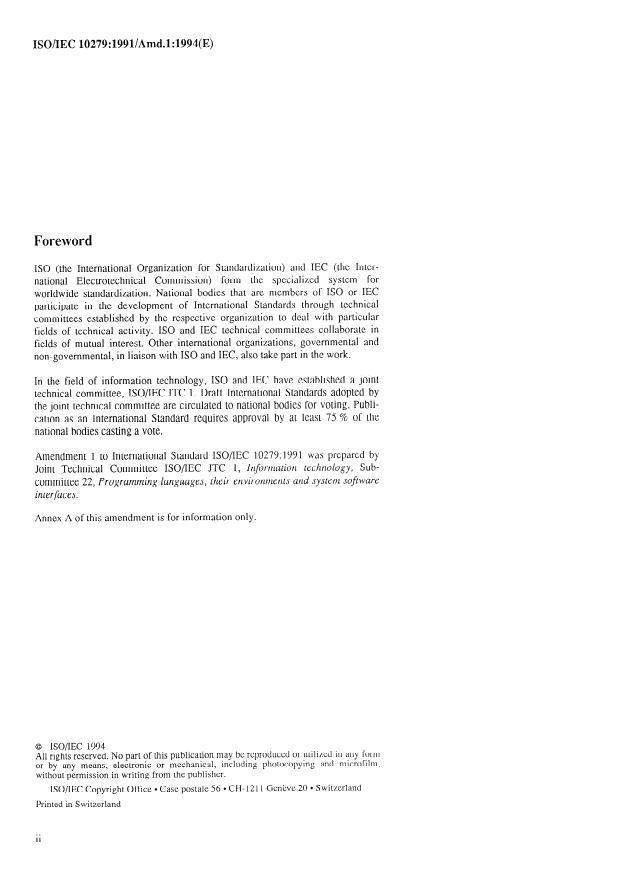
Foreword
ISO (the International Organization for Standardization) and IEC (the Intcr-
\
national Electrotechnical Commission) form the specializcd System for
worldwide standardization. National bodies that are members of ISO or IEC
participate in the development of International Standards through technical
committees established by the respective organization to deal with particular
fields of technical activity. ISO and IEC technical committees collaborate in
fields of mutual interest. Other international organizations, governmental and
non-governmental, in liaison with ISO and IEC, also take part in the work.
In the field of information technology, ISO and IEC have established a joint
technical committee, ISO/IEC JTC 1. Draft International Standards adopted by
the joint technical committee are circulated to national bodies for voting. Publi-
cation as an International Standard requires approval by at least 75 % OP the
national bodies casting a vote.
Amendment 1 to International Standard ISO/IEC 10279: 1991 was prcpared by
Joint Technical Committee ISO/IEC JTC 1, Informnfion technology, Sub-
.
committee 22, Programming languages, their environments and system Software
in terfaces.
Annex A of this amendment is for information only.
0 ISO/IEC 1994
All rights reserved. No part of this publication may be rcyroduced or utilized in any ferm
or by any means, electronie or mechanical, including photocopying and microfilm,
without permission in writing from the publisher.
ISO/IEC Copyright Office l Case postale 56 l CH-121 1 Cknkve 20 l Switzcrland
Printed in S witzerland
ISO/IEC 10279: 199UAmd.l: 1994(E)
0 ISO/IEC
Introduction
This amendment is designed to promote the interchangeability of BASIC programs among
a variety of automatic data processing Systems that utilize the individual Character input and
module features. It is an enhancement to ISO/IEC 10279 and shall be used in conjunction
with ISO/IEC 10279. This amendment is derived from the American National Standard
X3.113A-1989.
This page intentionaliy left blank
0 ISO/IEC
ISO/IEC 10279: 199UAmd.l: 1994(E)
Information technology - Programming languages -
Full BASIC -
AMENDMENT 1: Modules and Single Character input
enhancement
1 Scope
This Amendment establis
...
Questions, Comments and Discussion
Ask us and Technical Secretary will try to provide an answer. You can facilitate discussion about the standard in here.
Loading comments...