


ISO 7870-3:2020
(Main)Control charts - Part 3: Acceptance control charts
Control charts - Part 3: Acceptance control charts
This document gives guidance on the uses of acceptance control charts and establishes general procedures for determining sample sizes, action limits and decision criteria. An acceptance control chart should be used only when: a) the within subgroup variation is in-control and the variation is estimated efficiently; b) a high level of process capability has been achieved. An acceptance control chart is typically used when the process variable under study is normally distributed; however, it can be applied to a non-normal distribution. The examples provided in this document illustrate a variety of circumstances in which this technique has advantages; these examples provide details of the determination of the sample size, the action limits and the decision criteria.
Cartes de contrôle — Partie 3: Cartes de contrôle pour acceptation
General Information
Relations
Overview
ISO 7870-3:2020 - "Control charts - Part 3: Acceptance control charts" provides guidance for designing and using acceptance control charts to make process acceptance decisions. The standard establishes general procedures for determining sample sizes, action (acceptance) limits and decision criteria, and explains when acceptance control charts are appropriate. It complements Shewhart-type control chart practice by combining elements of acceptance sampling with process control to judge whether a process is acceptable for continued production.
Key technical topics and requirements
- When to use: Only where the within-subgroup variation is in-control and estimated efficiently, and a high level of process capability already exists.
- Distribution assumptions: Typically applied when the process variable is normally distributed, but the method can be adapted to non‑normal distributions.
- Design elements: Procedures for selecting subgroup sample size (n), setting acceptance control limits (ACLs), and specifying decision criteria and operating characteristics (probability of acceptance).
- Plotting and interpretation: Guidance on plotting acceptance control charts and interpreting chart signals in the context of process acceptance rather than only product disposition.
- Preconditions: A preliminary Shewhart study (e.g., X–R or X–s charts) is required to verify inherent stability of within‑subgroup variability.
- Calculation procedures and examples: Detailed steps for selection of element pairs (APL and RPL), sampling frequency, and worked examples illustrating sample-size, action-limit, and decision‑rule determination.
- Supplementary material: Factors for acceptance control limits, modified acceptance control charts and nomographs (Annex A) for chart design.
- Normative references: Relies on statistical terminology and symbols from ISO 3534‑1 and ISO 3534‑2.
Practical applications
- Use ISO 7870-3:2020 when you want to accept a process based on the risk that a specified proportion of items will meet specifications - e.g., where slight shifts in process level are tolerable and costly over‑control should be avoided.
- Typical applications include manufacturing operations with batch-to-batch location shifts (material batches, tool wear), high‑capability processes in automotive, aerospace, medical device, pharmaceuticals, and precision components.
- The standard helps quality engineers and statisticians design control strategies that balance economy and assurance of product conformity.
Who should use this standard
- Quality/control engineers, SPC practitioners, process statisticians and auditors
- Manufacturing engineers and production managers seeking robust acceptance rules
- Consultants and trainers designing SPC programs and acceptance-control procedures
Related standards
- ISO 3534‑1 and ISO 3534‑2 (statistical vocabulary and symbols)
- ISO 7870 series (other parts on Shewhart control charts and related SPC practices)
Keywords: ISO 7870-3:2020, acceptance control charts, control charts, statistical process control, sample size, action limits, decision criteria, process capability, Shewhart.
Standards Content (Sample)
INTERNATIONAL ISO
STANDARD 7870-3
Second edition
2020-05
Control charts —
Part 3:
Acceptance control charts
Cartes de contrôle —
Partie 3: Cartes de contrôle pour acceptation
Reference number
©
ISO 2020
© ISO 2020
All rights reserved. Unless otherwise specified, or required in the context of its implementation, no part of this publication may
be reproduced or utilized otherwise in any form or by any means, electronic or mechanical, including photocopying, or posting
on the internet or an intranet, without prior written permission. Permission can be requested from either ISO at the address
below or ISO’s member body in the country of the requester.
ISO copyright office
CP 401 • Ch. de Blandonnet 8
CH-1214 Vernier, Geneva
Phone: +41 22 749 01 11
Fax: +41 22 749 09 47
Email: copyright@iso.org
Website: www.iso.org
Published in Switzerland
ii © ISO 2020 – All rights reserved
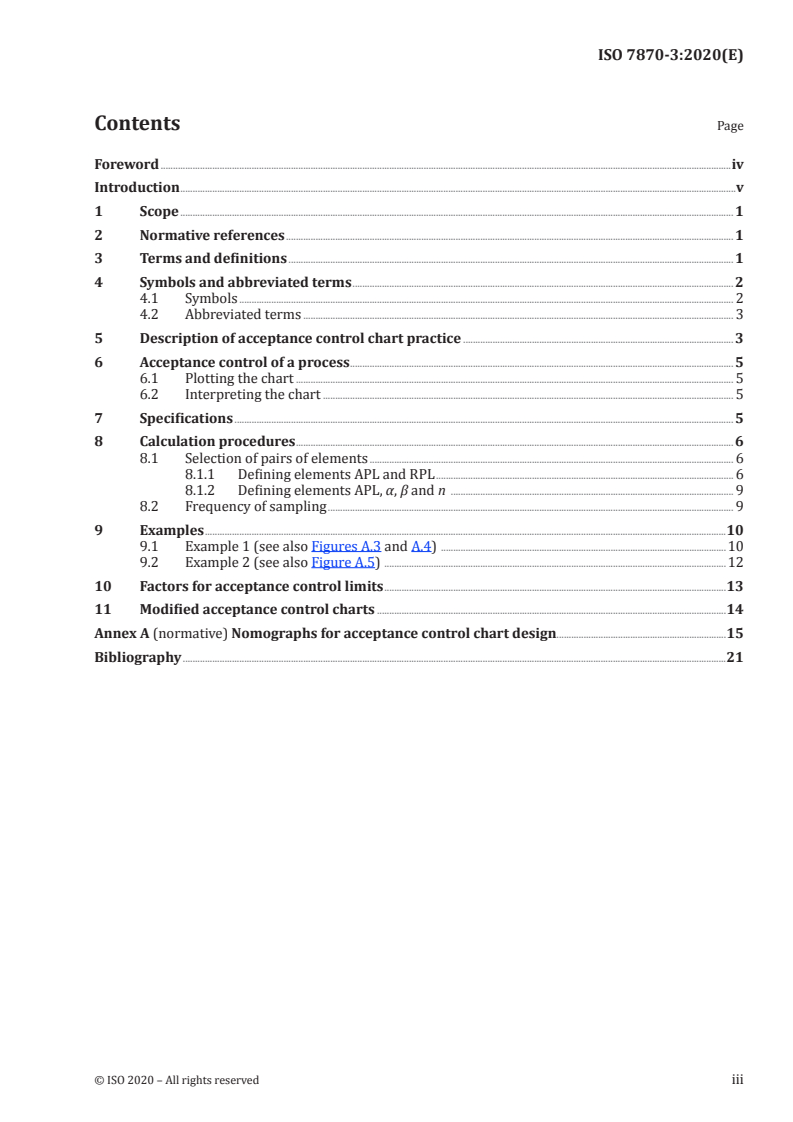
Contents Page
Foreword .iv
Introduction .v
1 Scope . 1
2 Normative references . 1
3 Terms and definitions . 1
4 Symbols and abbreviated terms . 2
4.1 Symbols . 2
4.2 Abbreviated terms . 3
5 Description of acceptance control chart practice . 3
6 Acceptance control of a process . 5
6.1 Plotting the chart . 5
6.2 Interpreting the chart . 5
7 Specifications . 5
8 Calculation procedures . 6
8.1 Selection of pairs of elements . 6
8.1.1 Defining elements APL and RPL . 6
8.1.2 Defining elements APL, α, β and n . 9
8.2 Frequency of sampling . 9
9 Examples .10
9.1 Example 1 (see also Figures A.3 and A.4) .10
9.2 Example 2 (see also Figure A.5) .12
10 Factors for acceptance control limits .13
11 Modified acceptance control charts .14
Annex A (normative) Nomographs for acceptance control chart design .15
Bibliography .21
Foreword
ISO (the International Organization for Standardization) is a worldwide federation of national standards
bodies (ISO member bodies). The work of preparing International Standards is normally carried out
through ISO technical committees. Each member body interested in a subject for which a technical
committee has been established has the right to be represented on that committee. International
organizations, governmental and non-governmental, in liaison with ISO, also take part in the work.
ISO collaborates closely with the International Electrotechnical Commission (IEC) on all matters of
electrotechnical standardization.
The procedures used to develop this document and those intended for its further maintenance are
described in the ISO/IEC Directives, Part 1. In particular, the different approval criteria needed for the
different types of ISO documents should be noted. This document was drafted in accordance with the
editorial rules of the ISO/IEC Directives, Part 2 (see www .iso .org/ directives).
Attention is drawn to the possibility that some of the elements of this document may be the subject of
patent rights. ISO shall not be held responsible for identifying any or all such patent rights. Details of
any patent rights identified during the development of the document will be in the Introduction and/or
on the ISO list of patent declarations received (see www .iso .org/ patents).
Any trade name used in this document is information given for the convenience of users and does not
constitute an endorsement.
For an explanation of the voluntary nature of standards, the meaning of ISO specific terms and
expressions related to conformity assessment, as well as information about ISO's adherence to the
World Trade Organization (WTO) principles in the Technical Barriers to Trade (TBT), see www .iso .org/
iso/ foreword .html.
This document was prepared by Technical Committee ISO/TC 69, Applications of statistical methods,
Subcommittee SC 4, Applications of statistical methods in process management.
This second edition cancels and replaces the first edition (ISO 7870-3:2012), of which it constitutes a
minor revision with the following changes:
— typo corrections in 9.1, example 1;
— editorial updates.
A list of all parts in the ISO 7870 series can be found on the ISO website.
Any feedback or questions on this document should be directed to the user’s national standards body. A
complete listing of these bodies can be found at www .iso .org/ members .html.
iv © ISO 2020 – All rights reserved
Introduction
An acceptance control chart combines consideration of control implications with elements of acceptance
sampling. It is an appropriate tool for helping to make decisions with respect to process acceptance.
The bases for the decisions may be defined in terms of
a) whether or not a designated percentage of units of a product or service derived from that process
will satisfy specification requirements;
b) whether or not a process has shifted beyond some allowable zone of process level locations.
A difference from most acceptance sampling approaches is the emphasis on process acceptability rather
than on product disposition decisions.
A difference from usual control chart approaches is that the concept of process acceptance is introduced
in the process control. The process usually does not need to be in control about a single standard
process level; as long as the within-subgroup variability remains in control and is much smaller than
the tolerance spread, it can (for the purpose of acceptance) run at any level or levels within a zone of
process levels which would be acceptable in terms of tolerance requirements. Thus, it is assumed that
some assignable causes will create shifts in the process levels which are small enough in relation to
requirements that it would be uneconomical to attempt to control them too tightly for the purpose of
mere acceptance.
The use of an acceptance control chart does not, however, rule out the possibility of identifying and
removing assignable causes for the purpose of continuing process improvement.
A check on the inherent stability of the process is required. Therefore, variables are monitored using
Shewhart-type range or sample standard deviation control charts to confirm that the variability
inherent within rational subgroups remains in a steady state. Supplementary examinations of the
distribution of the encountered process levels form an additional source of control information. A
preliminary Shewhart control chart study should be conducted to verify the validity of using an
acceptance control chart.
INTERNATIONAL STANDARD ISO 7870-3:2020(E)
Control charts —
Part 3:
Acceptance control charts
1 Scope
This document gives guidance on the uses of acceptance control charts and establishes general
procedures for determining sample sizes, action limits and decision criteria. An acceptance control
chart should be used only when:
a) the within subgroup variation is in-control and the variation is estimated efficiently;
b) a high level of process capability has been achieved.
An acceptance control chart is typically used when the process variable under study is normally
distributed; however, it can be applied to a non-normal distribution. The examples provided in this
document illustrate a variety of circumstances in which this technique has advantages; these examples
provide details of the determination of the sample size, the action limits and the decision criteria.
2 Normative references
The following documents are referred to in the text in such a way that some or all of their content
constitutes requirements of this document. For dated references, only the edition cited applies. For
undated references, the latest edition of the referenced document (including any amendments) applies.
ISO 3534-1, Statistics — Vocabulary and symbols — Part 1: General statistical terms and terms used in
probability
ISO 3534-2, Statistics — Vocabulary and symbols — Part 2: Applied statistics
3 Terms and definitions
For the purposes of this document, the terms and definitions given in ISO 3534-1, ISO 3534-2 and the
following apply.
ISO and IEC maintain terminological databases for use in standardization at the following addresses:
— ISO Online browsing platform: available at https:// www .iso .org/ obp
— IEC Electropedia: available at http:// www .electropedia .org/
3.1
acceptable process
process which is represented by a Shewhart control chart with a central line within the acceptable
process zone
Note 1 to entry: Ideally, the average value X of such a control chart would be at the target value.
Note 2 to entry: The acceptable process zone is shown in Figure 1. Information on the Stewhart control chart can
be found in ISO 7870-2.
Key
1 rejectable processes
2 indifference zone
3 acceptable processes
4 target level
upper RPL line
R
PL
U
upper APL line
A
PL
U
lower APL line
A
PL
L
lower RPL line
R
PL
L
Figure 1 — Two-sided specification limits: Upper and lower APL and RPL lines in relation to
processes of acceptable, rejectable, and indifference (borderline) quality
4 Symbols and abbreviated terms
NOTE The ISO/IEC Directives makes it necessary to depart from common SPC usage in respect to the
differentiation between abbreviated terms and symbols. An abbreviated term and its symbol can differ in
appearance in two ways: by font and by layout. To distinguish between abbreviated terms and symbols,
abbreviated terms are given in Arial upright and symbols in Times New Roman or Greek italics, as applicable.
Whereas abbreviated terms can contain multiple letters, symbols consist only of a single letter. For example, the
conventional abbreviation of acceptable process limit, APL, is valid but its symbol in equations becomes A . The
PL
reason for this is to avoid misinterpretation of compound letters as an indication of multiplication.
4.1 Symbols
A acceptance control limits
CL
A acceptable process level
PL
L lower specification limit
n subgroup sample size
p acceptable proportion nonconforming items
p rejectable proportion nonconforming items
P probability of acceptance
a
2 © ISO 2020 – All rights reserved
R rejectable process level or non-acceptable process zone
PL
T target value, i.e. the optimum value of the characteristic
U upper specification limit
average value of the variable X plotted on a control chart
X
z variable that has a normal distribution with zero mean and unit standard deviation
z ′ normal deviate that is exceeded by 100p′ % of the deviate in a specified direction (similarly for
p
z , z , etc.)
α β
α risk of not accepting a process centred at the APL
β risk of not rejecting a process centred at the RPL
μ process mean
σ within-subgroup standard deviation corresponding to the inherent process variability
w
σ standard deviation of the subgroup average corresponding to the inherent process varia-
X
bility: σσ= / n
w
X
4.2 Abbreviated terms
ACL acceptance control limits
APL acceptable process level
L lower specification limit (used as a subscript)
OC operating characteristic
RPL rejectable process level or non-acceptable process zone
U upper specification limit (used as a subscript)
5 Description of acceptance control chart practice
In the pursuit of an acceptable product or service, there often is room for some latitude in the ability
to centre a process around its target level. The contribution to overall variation of such location
factors is additional to the inherent random variability of individual elements around a given process
level. In most cases, some shifts in process level must be expected and can be tolerated. These shifts
usually result from an assignable cause that cannot be eliminated because of engineering or economic
considerations. They often enter the system at infrequent or irregular intervals, but can rarely be
treated as random components of variance.
There are several seemingly different approaches to treating these location factors contributing
variation beyond that of inherent variability. At one extreme is the approach in which all variability
that results in deviations from the target value must be minimized. Supporters of such an approach
seek to improve the capability to maintain a process within tighter tolerance limits so that there is
greater potential for process or product quality improvement.
At the other extreme is the approach that if a high level of process capability has been achieved, it is
not only uneconomic and wasteful of resources, but it can also be counterproductive to try to improve
the capability of the process. This often is the result of the introduction of pressures which encourage
“tampering” with the process (over-control) by people qualified to work on control aspects but not
product or process quality improvement programmes.
The acceptance control chart is a useful tool for covering this wide range of approaches in a logical
and simple manner. It distinguishes between the inherent variability components randomly occurring
throughout the process and the additional location factors which contribute at less frequent intervals.
When shifts appear, the process may then stabilize at a new level until the next such event occurs.
Between such disturbances, the process runs in control with respect to inherent variability.
An illustration of this situation is a process using large uniform batches of raw material. The within-
batch variability could be considered to be the inherent variability. When a new batch of material is
introduced, its deviation from the target may differ from that of the previous batch. The between-batch
variation component enters the system at discrete intervals.
An example of this within- and between-batch variation can very well occur in a situation where a
blanking die is blanking a machine part. The purpose of the chart is to determine when the die has worn
to a point where it must be repaired or reworked. The rate of wear is dependent upon the hardness of
the successive batches of material and is therefore not readily predictable. It will be seen that the use of
an acceptance control chart makes it possible to judge the appropriate time to service the blanking die.
The acceptance control chart is based on the Shewhart control chart (i.e. X – R chart or X – s chart)
but is set up so that the process mean can shift outside of control limits of the Shewhart control chart if
the specifications are sufficiently wide, or be confined to narrower limits if the inherent variability of
the process is comparatively large or a large fraction of the total tolerance spread.
What is required is protection against a process that has shifted so far from the target value that it will
yield some predetermined undesirable percentage of items falling outside the specification limits, or
exhibits an excessive degree of process level shift.
When a chart of the average value of data sets from a process is plotted, in sequence of the production,
one notices a continual variation in average values. In a central zone (acceptable process, Figure 1),
there is a product that is indisputably acceptable. Data in the outer zones (Figure 1) represent a process
that is producing product that is indisputably not acceptable.
Between the inner and the outer zones are zones where the product is acceptable but there is an
indication that the process should be watched and, as the outer zone is approached, corrective action
may be taken. These criteria are the basic concepts for the acceptance control chart. The description in
this document is designed to provide practices for the establishment of appropriate action lines for one-
and two-sided specification situations.
Since it is impossible to have a single dividing line that can sharply distinguish a good from an
unsatisfactory quality level, one must define a process level that represents a process that should be
accepted almost always (1 − α). This is called the acceptable process level (APL), and it marks the outer
boundary of the acceptable process zone located about the target value (see Figure 1).
Any process centred closer to the target value than the APL will have a risk smaller than α of not being
accepted. So the closer the process is to the target, the smaller the likelihood that a satisfactory process
will not be accepted.
It is also necessary to define the process level that represents processes that should almost never be
accepted (1 − β). This undesirable process level is labelled the rejectable process level (RPL). Any process
located further away from the target value than the RPL will have a risk of acceptance smaller than β.
The process levels lying between the APL and RPL would yield a product of borderline quality. That
is, process levels falling between the APL and RPL would represent quality which is not so good that it
would be a waste of time, or represent over-control, if the process were adjusted, and not so bad that
the product could not be used if no shift in level were made. This region is often called the “indifference
zone”. The width of this zone is a function of the requirements for a particular process and the risks one
is willing to take in connection with it. The narrower the zone, i.e. the closer the APL and RPL are to
each other, the larger the sample size will have to be. This approach will permit a realistic appraisal of
the effectiveness of any acceptance control system, and will provide a descriptive method for showing
just what any given control system is intended to do.
4 © ISO 2020 – All rights reserved
As with any acceptance sampling system, the four elements required for the definition of an acceptance
control chart are:
a) an acceptable process level (APL) associated with a one-sided α-risk;
b) a rejectable process level (RPL) associated with a one-sided β-risk;
c) an action criterion or acceptance control limit (ACL);
d) the sample size (n).
NOTE Generally, the defined risks are one-sided in this document. In the case of two-sided specifications,
the risks are either a 5 % risk to go above an upper limit or a 5 % risk to go below a lower limit. This results in a
5 % (not 10 %) total risk.
S
...
Frequently Asked Questions
ISO 7870-3:2020 is a standard published by the International Organization for Standardization (ISO). Its full title is "Control charts - Part 3: Acceptance control charts". This standard covers: This document gives guidance on the uses of acceptance control charts and establishes general procedures for determining sample sizes, action limits and decision criteria. An acceptance control chart should be used only when: a) the within subgroup variation is in-control and the variation is estimated efficiently; b) a high level of process capability has been achieved. An acceptance control chart is typically used when the process variable under study is normally distributed; however, it can be applied to a non-normal distribution. The examples provided in this document illustrate a variety of circumstances in which this technique has advantages; these examples provide details of the determination of the sample size, the action limits and the decision criteria.
This document gives guidance on the uses of acceptance control charts and establishes general procedures for determining sample sizes, action limits and decision criteria. An acceptance control chart should be used only when: a) the within subgroup variation is in-control and the variation is estimated efficiently; b) a high level of process capability has been achieved. An acceptance control chart is typically used when the process variable under study is normally distributed; however, it can be applied to a non-normal distribution. The examples provided in this document illustrate a variety of circumstances in which this technique has advantages; these examples provide details of the determination of the sample size, the action limits and the decision criteria.
ISO 7870-3:2020 is classified under the following ICS (International Classification for Standards) categories: 03.120.30 - Application of statistical methods. The ICS classification helps identify the subject area and facilitates finding related standards.
ISO 7870-3:2020 has the following relationships with other standards: It is inter standard links to ISO 7870-3:2012. Understanding these relationships helps ensure you are using the most current and applicable version of the standard.
You can purchase ISO 7870-3:2020 directly from iTeh Standards. The document is available in PDF format and is delivered instantly after payment. Add the standard to your cart and complete the secure checkout process. iTeh Standards is an authorized distributor of ISO standards.
Questions, Comments and Discussion
Ask us and Technical Secretary will try to provide an answer. You can facilitate discussion about the standard in here.
Loading comments...