

ISO/IEC TR 24772-2:2020
(Main)Programming languages — Guidance to avoiding vulnerabilities in programming languages — Part 2: Ada
General Information
- Abstract
This document specifies software programming language vulnerabilities to be avoided in the development of systems where assured behaviour is required for security, safety, mission-critical and business-critical software. In general, this document is applicable to the software developed, reviewed or maintained for any application. Vulnerabilities described in this document present the way that the vulnerability described in ISO/IEC TR 24772-1 are manifested in Ada.
- Status
- Published
- Publication Date
- 01-Apr-2020
- Technical Committee
- ISO/IEC JTC 1/SC 22 - Programming languages, their environments and system software interfaces
- Drafting Committee
- ISO/IEC JTC 1/SC 22/WG 23 - Programming Language Vulnerabilities
- Current Stage
- 6060 - International Standard published
- Start Date
- 02-Apr-2020
- Due Date
- 20-Sep-2019
- Completion Date
- 02-Apr-2020
Buy Documents
ISO/IEC TR 24772-2:2020 - Programming languages — Guidance to avoiding vulnerabilities in programming languages — Part 2: Ada Released:4/2/2020
ISO/IEC TR 24772-2:2020 - Programming languages — Guidance to avoiding vulnerabilities in programming languages — Part 2: Ada/2/2020
Overview
ISO/IEC TR 24772-2:2020 - Programming languages: Guidance to avoiding vulnerabilities in programming languages - Part 2: Ada provides targeted guidance on how language-level vulnerabilities described in Part 1 manifest in the Ada programming language. The technical report identifies common software vulnerabilities relevant to security, safety, mission-critical and business-critical systems and explains Ada-specific applicability and avoidance techniques. It is intended for any software developed, reviewed or maintained where assured behaviour is required.
Key Topics
The report maps general vulnerability classes to Ada and offers practical guidance. Major technical topics include:
- Type system issues and user-defined types
- Bit representation and representation attributes
- Floating-point arithmetic pitfalls and conversions
- Enumerator and conversion errors
- String termination and buffer boundary violation (buffer overflow)
- Unchecked array indexing and copying
- Pointer issues: pointer type conversions, pointer arithmetic, null pointer dereference, dangling references to heap
- Arithmetic wrap-around and misuse of bit shifts for arithmetic
- Pragma and implementation-defined features (Atomic, Pack, Volatile, Import/Export, Unchecked_Union, etc.)
- Storage pool and separate compilation concerns
- Unsafe programming constructs and compiler directives
- Coding quality topics: naming, dead stores, unused variables, identifier reuse, initialization, operator precedence, side-effects, likely incorrect expressions, dead code, switch statements, loop control and off-by-one errors
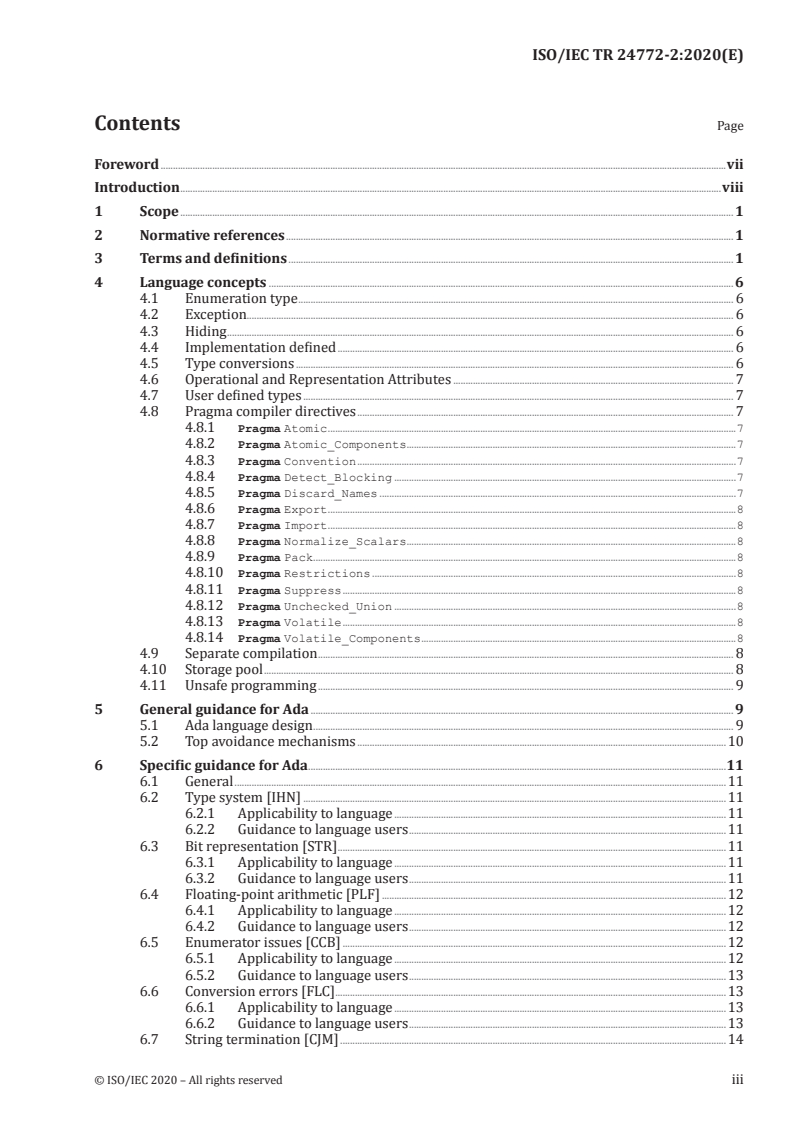
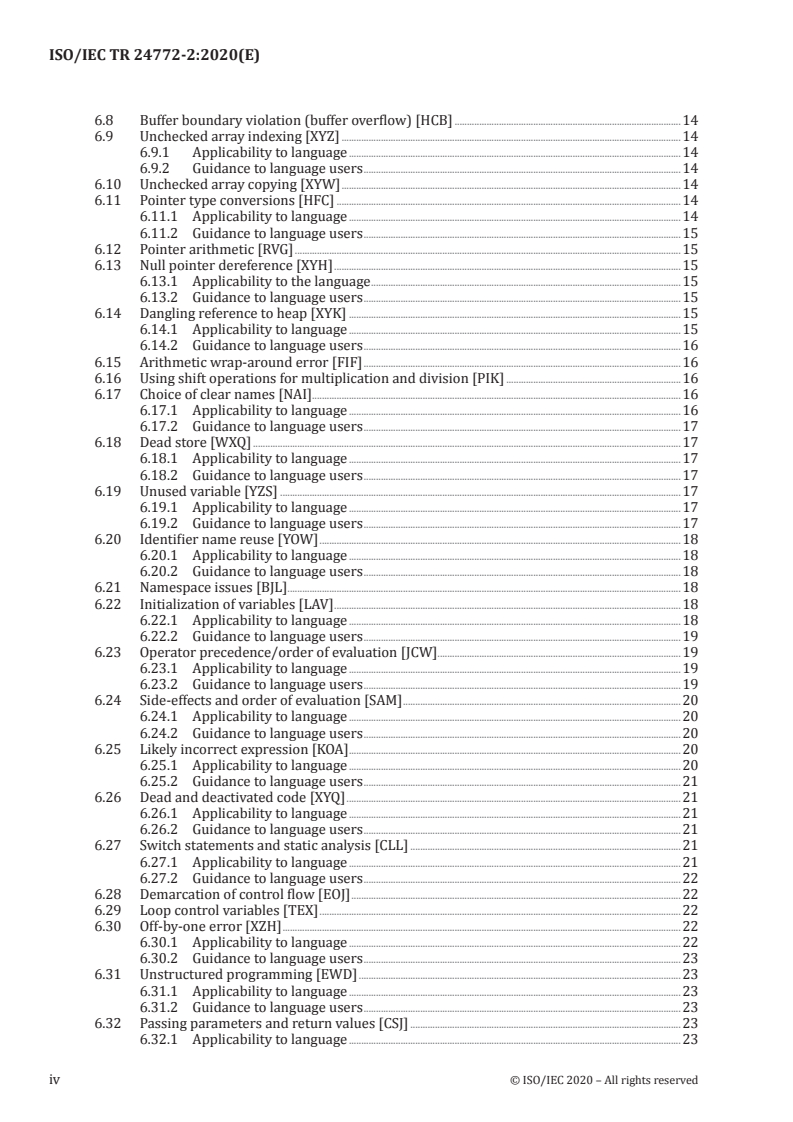
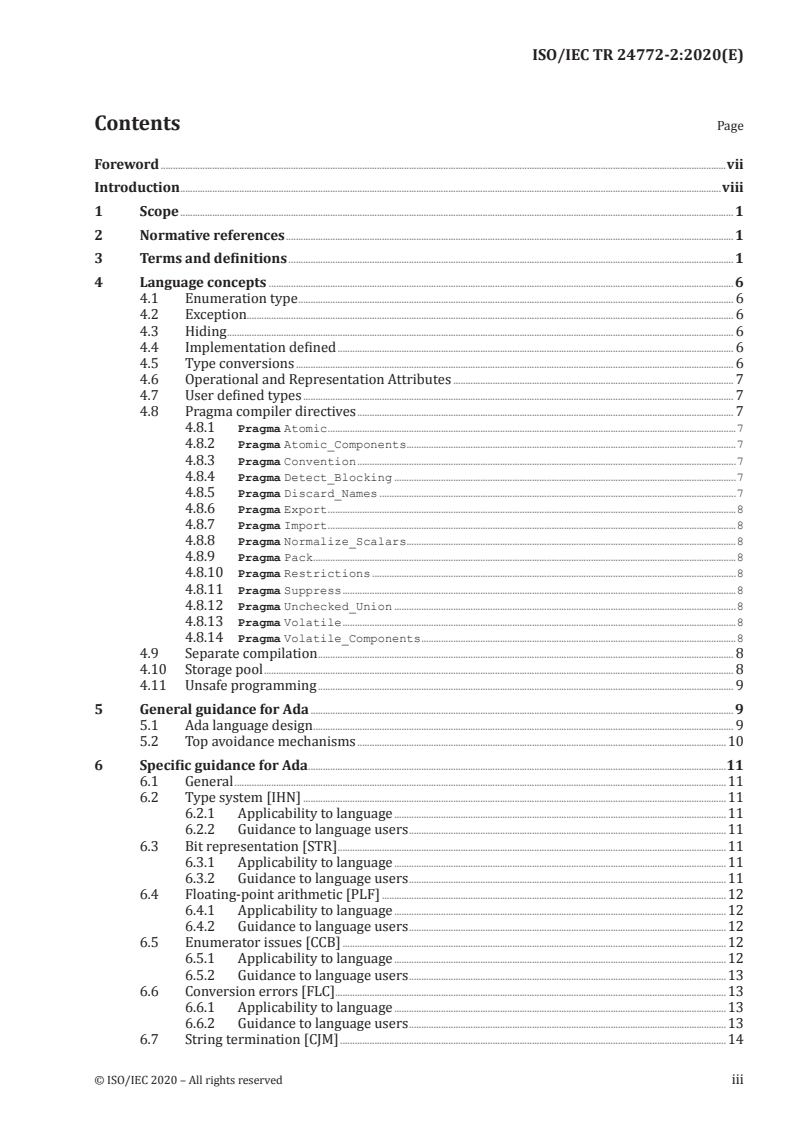
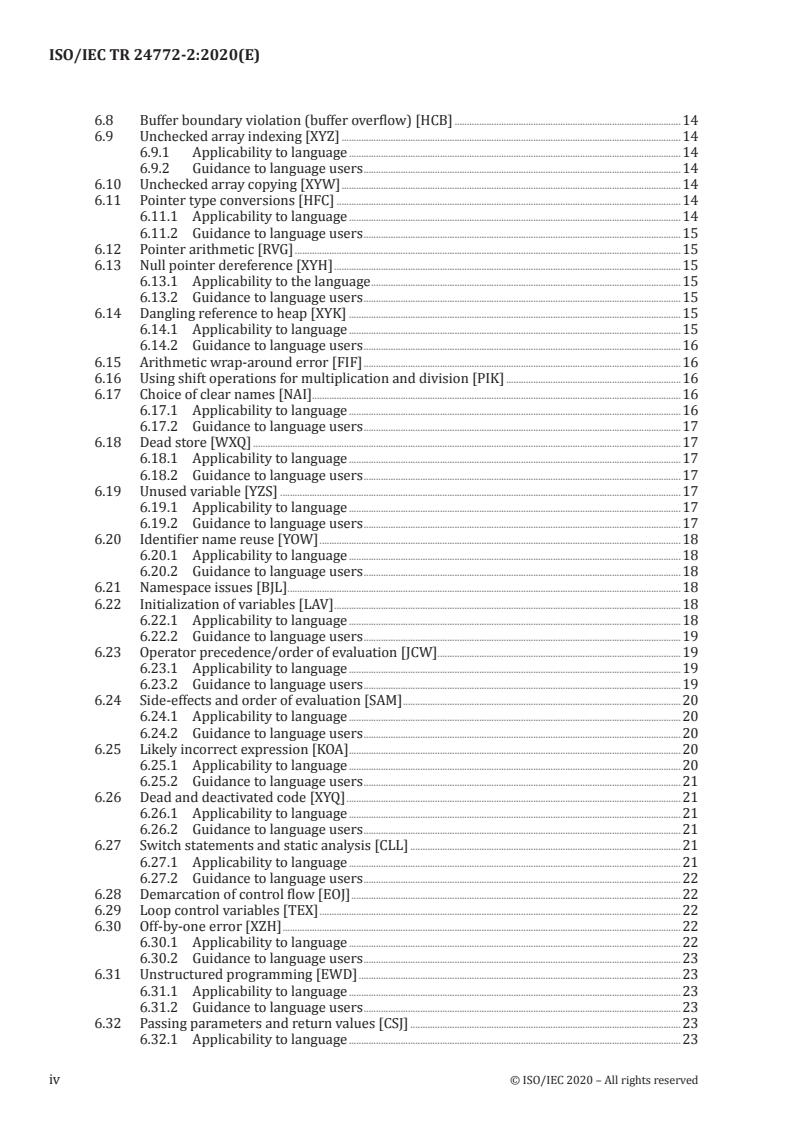
The table of contents shows the document organizes each topic with sections on applicability to Ada and guidance to language users, making it practical for developers and reviewers.
Applications and Who Would Use It
ISO/IEC TR 24772-2:2020 is useful for:
- Ada developers implementing safety- or security-critical systems
- Software architects and system engineers choosing language features and compiler options
- Code reviewers and security auditors performing vulnerability assessments and secure code reviews
- Certification teams working on assurance cases for avionics, rail, medical, or industrial control software
- Static-analysis and tool vendors adapting checks to Ada-specific vulnerabilities
- Trainers and educators teaching secure Ada programming practices
Typical applications include secure coding standards, static-analysis rule sets, code hardening, and guidance for certification and compliance in safety-critical projects.
Related Standards
- ISO/IEC TR 24772-1 - General guidance on vulnerabilities in programming languages (the parent document that defines vulnerability classes referenced in Part 2)
Keywords: ISO/IEC TR 24772-2:2020, Ada, programming languages, vulnerabilities, secure coding, safety-critical, buffer overflow, pointer safety, static analysis.
Relations
- Effective Date
- 06-Jun-2022
- Effective Date
- 09-Apr-2016
Buy Documents
ISO/IEC TR 24772-2:2020 - Programming languages — Guidance to avoiding vulnerabilities in programming languages — Part 2: Ada Released:4/2/2020
ISO/IEC TR 24772-2:2020 - Programming languages — Guidance to avoiding vulnerabilities in programming languages — Part 2: Ada/2/2020
Get Certified
Connect with accredited certification bodies for this standard

BSI Group
BSI (British Standards Institution) is the business standards company that helps organizations make excellence a habit.

NYCE
Mexican standards and certification body.
Sponsored listings
Frequently Asked Questions
ISO/IEC TR 24772-2:2020 is a technical report published by the International Organization for Standardization (ISO). Its full title is "Programming languages — Guidance to avoiding vulnerabilities in programming languages — Part 2: Ada". This standard covers: This document specifies software programming language vulnerabilities to be avoided in the development of systems where assured behaviour is required for security, safety, mission-critical and business-critical software. In general, this document is applicable to the software developed, reviewed or maintained for any application. Vulnerabilities described in this document present the way that the vulnerability described in ISO/IEC TR 24772-1 are manifested in Ada.
This document specifies software programming language vulnerabilities to be avoided in the development of systems where assured behaviour is required for security, safety, mission-critical and business-critical software. In general, this document is applicable to the software developed, reviewed or maintained for any application. Vulnerabilities described in this document present the way that the vulnerability described in ISO/IEC TR 24772-1 are manifested in Ada.
ISO/IEC TR 24772-2:2020 is classified under the following ICS (International Classification for Standards) categories: 35.060 - Languages used in information technology. The ICS classification helps identify the subject area and facilitates finding related standards.
ISO/IEC TR 24772-2:2020 has the following relationships with other standards: It is inter standard links to ISO 16628:2022, ISO/IEC TR 24772:2013. Understanding these relationships helps ensure you are using the most current and applicable version of the standard.
ISO/IEC TR 24772-2:2020 is available in PDF format for immediate download after purchase. The document can be added to your cart and obtained through the secure checkout process. Digital delivery ensures instant access to the complete standard document.
Standards Content (Sample)
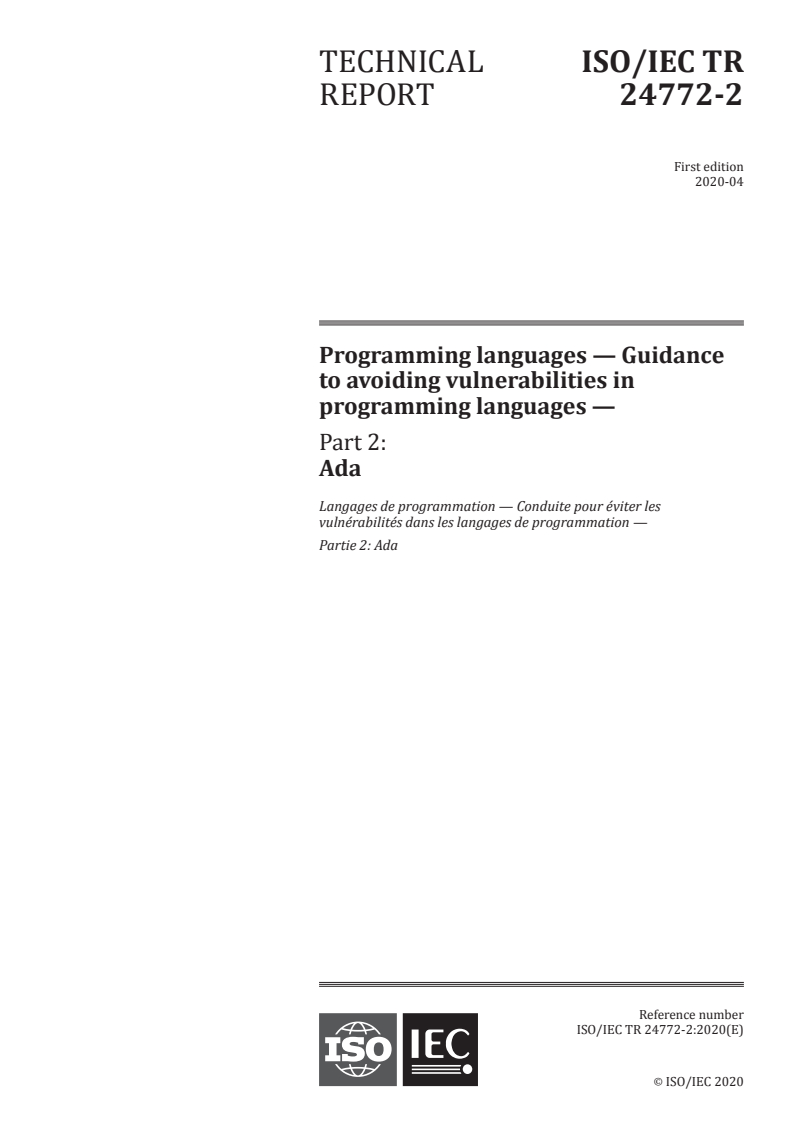
TECHNICAL ISO/IEC TR
REPORT 24772-2
First edition
2020-04
Programming languages — Guidance
to avoiding vulnerabilities in
programming languages —
Part 2:
Ada
Langages de programmation — Conduite pour éviter les
vulnérabilités dans les langages de programmation —
Partie 2: Ada
Reference number
©
ISO/IEC 2020
© ISO/IEC 2020
All rights reserved. Unless otherwise specified, or required in the context of its implementation, no part of this publication may
be reproduced or utilized otherwise in any form or by any means, electronic or mechanical, including photocopying, or posting
on the internet or an intranet, without prior written permission. Permission can be requested from either ISO at the address
below or ISO’s member body in the country of the requester.
ISO copyright office
CP 401 • Ch. de Blandonnet 8
CH-1214 Vernier, Geneva
Phone: +41 22 749 01 11
Fax: +41 22 749 09 47
Email: copyright@iso.org
Website: www.iso.org
Published in Switzerland
ii © ISO/IEC 2020 – All rights reserved
Contents Page
Foreword .vii
Introduction .viii
1 Scope . 1
2 Normative references . 1
3 Terms and definitions . 1
4 Language concepts . 6
4.1 Enumeration type . 6
4.2 Exception. 6
4.3 Hiding . 6
4.4 Implementation defined . 6
4.5 Type conversions . 6
4.6 Operational and Representation Attributes . 7
4.7 User defined types . 7
4.8 Pragma compiler directives . 7
4.8.1 Pragma Atomic .7
4.8.2 Pragma Atomic_Components .7
4.8.3 Pragma Convention .7
4.8.4 Pragma Detect_Blocking .7
4.8.5 Pragma Discard_Names .7
4.8.6 Pragma Export .8
4.8.7 Pragma Import .8
4.8.8 Pragma Normalize_Scalars .8
4.8.9 Pragma Pack .8
4.8.10 Pragma Restrictions .8
4.8.11 Pragma Suppress .8
4.8.12 Pragma Unchecked_Union .8
4.8.13 Pragma Volatile .8
4.8.14 Pragma Volatile_Components .8
4.9 Separate compilation . 8
4.10 Storage pool . 8
4.11 Unsafe programming . 9
5 General guidance for Ada . 9
5.1 Ada language design . 9
5.2 Top avoidance mechanisms .10
6 Specific guidance for Ada .11
6.1 General .11
6.2 Type system [IHN] .11
6.2.1 Applicability to language .11
6.2.2 Guidance to language users .11
6.3 Bit representation [STR] .11
6.3.1 Applicability to language .11
6.3.2 Guidance to language users .11
6.4 Floating-point arithmetic [PLF] .12
6.4.1 Applicability to language .12
6.4.2 Guidance to language users .12
6.5 Enumerator issues [CCB] .12
6.5.1 Applicability to language .12
6.5.2 Guidance to language users .13
6.6 Conversion errors [FLC] .13
6.6.1 Applicability to language .13
6.6.2 Guidance to language users .13
6.7 String termination [CJM] .14
© ISO/IEC 2020 – All rights reserved iii
6.8 Buffer boundary violation (buffer overflow) [HCB] .14
6.9 Unchecked array indexing [XYZ] .14
6.9.1 Applicability to language .14
6.9.2 Guidance to language users .14
6.10 Unchecked array copying [XYW] .14
6.11 Pointer type conversions [HFC] .14
6.11.1 Applicability to language .14
6.11.2 Guidance to language users .15
6.12 Pointer arithmetic [RVG] .15
6.13 Null pointer dereference [XYH] .15
6.13.1 Applicability to the language .15
6.13.2 Guidance to language users .15
6.14 Dangling reference to heap [XYK] .15
6.14.1 Applicability to language .15
6.14.2 Guidance to language users .16
6.15 Arithmetic wrap-around error [FIF] .16
6.16 Using shift operations for multiplication and division [PIK] .16
6.17 Choice of clear names [NAI].16
6.17.1 Applicability to language .16
6.17.2 Guidance to language users .17
6.18 Dead store [WXQ] .17
6.18.1 Applicability to language .17
6.18.2 Guidance to language users .17
6.19 Unused variable [YZS] .17
6.19.1 Applicability to language .17
6.19.2 Guidance to language users .17
6.20 Identifier name reuse [YOW] .18
6.20.1 Applicability to language .18
6.20.2 Guidance to language users .18
6.21 Namespace issues [BJL].18
6.22 Initialization of variables [LAV] .18
6.22.1 Applicability to language .18
6.22.2 Guidance to language users .19
6.23 Operator precedence/order of evaluation [JCW].19
6.23.1 Applicability to language .19
6.23.2 Guidance to language users .19
6.24 Side-effects and order of evaluation [SAM] .20
6.24.1 Applicability to language .20
6.24.2 Guidance to language users .20
6.25 Likely incorrect expression [KOA] .20
6.25.1 Applicability to language .20
6.25.2 Guidance to language users .21
6.26 Dead and deactivated code [XYQ] .21
6.26.1 Applicability to language .21
6.26.2 Guidance to language users .21
6.27 Switch statements and static analysis [CLL] .21
6.27.1 Applicability to language .21
6.27.2 Guidance to language users .22
6.28 Demarcation of control flow [EOJ] .22
6.29 Loop control variables [TEX] .22
6.30 Off-by-one error [XZH] .22
6.30.1 Applicability to language .22
6.30.2 Guidance to language users .23
6.31 Unstructured programming [EWD] .23
6.31.1 Applicability to language .23
6.31.2 Guidance to language users .23
6.32 Passing parameters and return values [CSJ] .23
6.32.1 Applicability to language .23
iv © ISO/IEC 2020 – All rights reserved
6.32.2 Guidance to language users .23
6.33 Dangling references to stack frames [DCM] .23
6.33.1 Applicability to language .23
6.33.2 Guidance to language users .24
6.34 Subprogram signature mismatch [OTR] .24
6.34.1 Applicability to language .24
6.34.2 Guidance to language users .24
6.35 Recursion [GDL] .25
6.35.1 Applicability to language .25
6.35.2 Guidance to language users .25
6.36 Ignored error status and unhandled exceptions [OYB] .25
6.36.1 Applicability to language .25
6.36.2 Guidance to language users .25
6.37 Type-breaking reinterpretation of data [AMV] .25
6.37.1 Applicability to language .25
6.37.2 Guidance to language users .26
6.38 Deep vs. shallow copying [YAN] .26
6.38.1 Applicability to language .26
6.38.2 Guidance to language users .26
6.39 Memory leak and heap fragmentation [XYL] .26
6.39.1 Applicability to language .26
6.39.2 Guidance to language users .27
6.40 Templates and generics [SYM] .27
6.41 Inheritance [RIP] .27
6.41.1 Applicability to language .27
6.41.2 Guidance to language users .27
6.42 Violations of the Liskov substitution principle or the contract model [BLP] .28
6.42.1 Applicability to language .28
6.42.2 Guidance to language users .28
6.43 Redispatching [PPH] .28
6.43.1 Applicability to language .28
6.43.2 Guidance to language users .28
6.44 Polymorphic variables [BKK] .29
6.44.1 Applicability to language .29
6.44.2 Guidance to language users .29
6.45 Extra intrinsics [LRM] .29
6.46 Argument passing to library functions [TRJ .29
6.46.1 Applicability to language .29
6.46.2 Guidance to language users .30
6.47 Inter-language calling [DJS] .30
6.47.1 Applicability to language .30
6.47.2 Guidance to language users .30
6.48 Dynamically-linked code and self-modifying code [NYY] .30
6.49 Library signature [NSQ] .30
6.49.1 Applicability to language .30
6.49.2 Guidance to language users .31
6.50 Unanticipated exceptions from library routines [HJW] .31
6.50.1 Applicability to language .31
6.50.2 Guidance to language users .31
6.51 Pre-processor directives [NMP] .31
6.52 Suppression of language-defined run-time checking [MXB].31
6.52.1 Applicability to Language .31
6.52.2 Guidance to language users .32
6.53 Provision of inherently unsafe operations [SKL] .32
6.53.1 Applicability to Language .32
6.53.2 Guidance to language users .32
6.54 Obscure language features [BRS] .32
6.54.1 Applicability to language .32
© ISO/IEC 2020 – All rights reserved v
6.54.2 Guidance to language users .32
6.55 Unspecified behaviour [BQF] .32
6.55.1 Applicability to language .32
6.55.2 Guidance to language users .33
6.56 Undefined behaviour [EWF].33
6.56.1 Applicability to language .33
6.56.2 Guidance to language users .34
6.57 Implementation-defined behaviour [FAB] .34
6.57.1 Applicability to language .34
6.57.2 Guidance to language users .35
6.58 Deprecated language features [MEM] .35
6.58.1 Applicability to language .35
6.58.2 Guidance to language users .35
6.59 Concurrency — Activation [CGA] .35
6.59.1 Applicability to language .35
6.59.2 Guidance to language users .35
6.60 Concurrency — Directed termination [CGT] .36
6.60.1 Applicability to language .36
6.60.2 Guidance to language users .36
6.61 Concurrent data access [CGX] .36
6.61.1 Applicability to language .36
6.61.2 Guidance to language users .36
6.62 Concurrency — Premature termination [CGS] .36
6.62.1 Applicability to language .36
6.62.2 Guidance to language users .36
6.63 Protocol lock errors [CGM] .37
6.63.1 Applicability to language .37
6.63.2 Guidance to language users .37
6.64 Reliance on external format strings [SHL] .37
7 Language-specific vulnerabilities for Ada .37
8 Implications for standardization .37
Bibliography .39
Index .41
vi © ISO/IEC 2020 – All rights reserved
Foreword
ISO (the International Organization for Standardization) is a worldwide federation of national standards
bodies (ISO member bodies). The work of preparing International Standards is normally carried out
through ISO technical committees. Each member body interested in a subject for which a technical
committee has been established has the right to be represented on that committee. International
organizations, governmental and non-governmental, in liaison with ISO, also take part in the work.
ISO collaborates closely with the International Electrotechnical Commission (IEC) on all matters of
electrotechnical standardization.
The procedures used to develop this document and those intended for its further maintenance are
described in the ISO/IEC Directives, Part 1. In particular, the different approval criteria needed for the
different types of ISO documents should be noted. This document was drafted in accordance with the
editorial rules of the ISO/IEC Directives, Part 2 (see www .iso .org/ directives).
Attention is drawn to the possibility that some of the elements of this document may be the subject of
patent rights. ISO shall not be held responsible for identifying any or all such patent rights. Details of
any patent rights identified during the development of the document will be in the Introduction and/or
on the ISO list of patent declarations received (see www .iso .org/ patents).
Any trade name used in this document is information given for the convenience of users and does not
constitute an endorsement.
For an explanation of the voluntary nature of standards, the meaning of ISO specific terms and
expressions related to conformity assessment, as well as information about ISO's adherence to the
World Trade Organization (WTO) principles in the Technical Barriers to Trade (TBT), see www .iso .org/
iso/ foreword .html.
This document was prepared by Joint Technical Committee ISO/IEC JTC 1, Information technology,
Subcommittee SC 22, Programming languages, their environments and system software interfaces.
This first edition cancels and replaces ISO/IEC TR 24772:2013, which has been split into several parts.
This document is intended to be used with ISO/IEC TR 24772-1, which discusses programming language
vulnerabilities in a language independent fashion.
A list of all parts in the ISO/IEC 24772 series can be found on the ISO website.
Any feedback or questions on this document should be directed to the user’s national standards body. A
complete listing of these bodies can be found at www .iso .org/ members .html.
© ISO/IEC 2020 – All rights reserved vii
Introduction
This document provides guidance for the programming language Ada so that application developers
considering Ada or using Ada can better avoid the programming constructs that lead to vulnerabilities
in software written in the Ada language and their attendant consequences. This guidance can also
be used by developers to select source code evaluation tools that can discover and eliminate some
constructs that can lead to vulnerabilities in their software. This document can also be used in
comparison with companion documents and with the language-independent ISO/IEC TR 24772-1,
to select a programming language that provides the appropriate level of confidence that anticipated
problems can be avoided.
It should be noted that this document is inherently incomplete. It is not possible to provide a complete
list of programming language vulnerabilities because new weaknesses are discovered continually.
Any such report can only describe those that have been found, characterized and determined to have
sufficient probability and consequence.
viii © ISO/IEC 2020 – All rights reserved
TECHNICAL REPORT ISO/IEC TR 24772-2:2020(E)
Programming languages — Guidance to avoiding
vulnerabilities in programming languages —
Part 2:
Ada
1 Scope
This document specifies software programming language vulnerabilities to be avoided in the
development of systems where assured behaviour is required for security, safety, mission-critical and
business-critical software. In general, this document is applicable to the software developed, reviewed
or maintained for any application.
Vulnerabilities described in this document present the way that the vulnerability described in
ISO/IEC TR 24772-1 are manifested in Ada.
2 Normative references
The following documents are referred to in the text in such a way that some or all of their content
constitutes requirements of this document. For dated references, only the edition cited applies. For
undated references, the latest edition of the referenced document (including any amendments) applies.
ISO/IEC 2382, Information technology — Vocabulary
ISO/IEC 8652, Information technology — Programming languages — Ada
ISO/IEC TR 24772-1, Programming languages — Guidance to avoiding vulnerabilities in programming
languages — Part 1: Language-independent guidance
3 Terms and definitions
For the purposes of this document, the terms and definitions given in ISO/IEC 2382, ISO/IEC 8652,
ISO/IEC TR 24772-1 and the following apply.
ISO and IEC maintain terminological databases for use in standardization at the following addresses:
— ISO Online browsing platform: available at https:// www .iso .org/ obp
— IEC Electropedia: available at http:// www .electropedia .org/
3.1
abnormal representation
representation of an object that is incomplete or that does not represent any valid value of the
object’s subtype
3.2
access-to-object
pointer to an object
3.3
access-to-subprogram
pointer to a subprogram (function or procedure)
© ISO/IEC 2020 – All rights reserved 1
3.4
access type
type for objects that designate (point to) objects or subprograms
Note 1 to entry: This is often called a pointer (3.38) type in other languages.
3.5
access value
value of an access type (3.4) that is either null or designates another object or subprogram
3.6
allocator
construct that allocates storage from the heap or from a storage pool (3.45)
3.7
aspect specification
mechanism used to specify assertions about the behaviour of subprograms, types and objects as well as
operational and representational attributes (3.9) of various kinds of entities
3.8
atomic
characteristic of an object that guarantees that every access to an object is an indivisible access to the
entity in memory instead of possibly partial, repeated manipulation of a local or register copy
3.9
attribute
characteristic of a declaration that can be queried by special syntax to return a value corresponding to
the requested attribute
3.10
bit ordering
implementation defined (3.32) value that is either High_Order_First or Low_Order_First that permits
the specification or query of the way that bits are represented in memory within a single memory unit
3.11
bounded error
error that does not need to be detected either prior to or during run time, but if not detected falls within
a bounded range of possible effects
3.12
case statement
statement that provides multiple paths of execution dependent on the value of the selecting expression,
but which have only one of the alternative sequences selected
Note 1 to entry: A selecting expression is understood to be an expression that is part of a case statement or case
expression (3.13) and that determines which choice is taken in executing the case statement or evaluating the
case expression; it is of discrete type (3.19).
3.13
case expression
expression that provides multiple paths of execution dependent on the value of the selecting expression,
but which have only one of the alternative dependent expressions evaluated
Note 1 to entry: A selecting expression is understo
...
TECHNICAL ISO/IEC TR
REPORT 24772-2
First edition
2020-04
Programming languages — Guidance
to avoiding vulnerabilities in
programming languages —
Part 2:
Ada
Langages de programmation — Conduite pour éviter les
vulnérabilités dans les langages de programmation —
Partie 2: Ada
Reference number
©
ISO/IEC 2020
© ISO/IEC 2020
All rights reserved. Unless otherwise specified, or required in the context of its implementation, no part of this publication may
be reproduced or utilized otherwise in any form or by any means, electronic or mechanical, including photocopying, or posting
on the internet or an intranet, without prior written permission. Permission can be requested from either ISO at the address
below or ISO’s member body in the country of the requester.
ISO copyright office
CP 401 • Ch. de Blandonnet 8
CH-1214 Vernier, Geneva
Phone: +41 22 749 01 11
Fax: +41 22 749 09 47
Email: copyright@iso.org
Website: www.iso.org
Published in Switzerland
ii © ISO/IEC 2020 – All rights reserved
Contents Page
Foreword .vii
Introduction .viii
1 Scope . 1
2 Normative references . 1
3 Terms and definitions . 1
4 Language concepts . 6
4.1 Enumeration type . 6
4.2 Exception. 6
4.3 Hiding . 6
4.4 Implementation defined . 6
4.5 Type conversions . 6
4.6 Operational and Representation Attributes . 7
4.7 User defined types . 7
4.8 Pragma compiler directives . 7
4.8.1 Pragma Atomic .7
4.8.2 Pragma Atomic_Components .7
4.8.3 Pragma Convention .7
4.8.4 Pragma Detect_Blocking .7
4.8.5 Pragma Discard_Names .7
4.8.6 Pragma Export .8
4.8.7 Pragma Import .8
4.8.8 Pragma Normalize_Scalars .8
4.8.9 Pragma Pack .8
4.8.10 Pragma Restrictions .8
4.8.11 Pragma Suppress .8
4.8.12 Pragma Unchecked_Union .8
4.8.13 Pragma Volatile .8
4.8.14 Pragma Volatile_Components .8
4.9 Separate compilation . 8
4.10 Storage pool . 8
4.11 Unsafe programming . 9
5 General guidance for Ada . 9
5.1 Ada language design . 9
5.2 Top avoidance mechanisms .10
6 Specific guidance for Ada .11
6.1 General .11
6.2 Type system [IHN] .11
6.2.1 Applicability to language .11
6.2.2 Guidance to language users .11
6.3 Bit representation [STR] .11
6.3.1 Applicability to language .11
6.3.2 Guidance to language users .11
6.4 Floating-point arithmetic [PLF] .12
6.4.1 Applicability to language .12
6.4.2 Guidance to language users .12
6.5 Enumerator issues [CCB] .12
6.5.1 Applicability to language .12
6.5.2 Guidance to language users .13
6.6 Conversion errors [FLC] .13
6.6.1 Applicability to language .13
6.6.2 Guidance to language users .13
6.7 String termination [CJM] .14
© ISO/IEC 2020 – All rights reserved iii
6.8 Buffer boundary violation (buffer overflow) [HCB] .14
6.9 Unchecked array indexing [XYZ] .14
6.9.1 Applicability to language .14
6.9.2 Guidance to language users .14
6.10 Unchecked array copying [XYW] .14
6.11 Pointer type conversions [HFC] .14
6.11.1 Applicability to language .14
6.11.2 Guidance to language users .15
6.12 Pointer arithmetic [RVG] .15
6.13 Null pointer dereference [XYH] .15
6.13.1 Applicability to the language .15
6.13.2 Guidance to language users .15
6.14 Dangling reference to heap [XYK] .15
6.14.1 Applicability to language .15
6.14.2 Guidance to language users .16
6.15 Arithmetic wrap-around error [FIF] .16
6.16 Using shift operations for multiplication and division [PIK] .16
6.17 Choice of clear names [NAI].16
6.17.1 Applicability to language .16
6.17.2 Guidance to language users .17
6.18 Dead store [WXQ] .17
6.18.1 Applicability to language .17
6.18.2 Guidance to language users .17
6.19 Unused variable [YZS] .17
6.19.1 Applicability to language .17
6.19.2 Guidance to language users .17
6.20 Identifier name reuse [YOW] .18
6.20.1 Applicability to language .18
6.20.2 Guidance to language users .18
6.21 Namespace issues [BJL].18
6.22 Initialization of variables [LAV] .18
6.22.1 Applicability to language .18
6.22.2 Guidance to language users .19
6.23 Operator precedence/order of evaluation [JCW].19
6.23.1 Applicability to language .19
6.23.2 Guidance to language users .19
6.24 Side-effects and order of evaluation [SAM] .20
6.24.1 Applicability to language .20
6.24.2 Guidance to language users .20
6.25 Likely incorrect expression [KOA] .20
6.25.1 Applicability to language .20
6.25.2 Guidance to language users .21
6.26 Dead and deactivated code [XYQ] .21
6.26.1 Applicability to language .21
6.26.2 Guidance to language users .21
6.27 Switch statements and static analysis [CLL] .21
6.27.1 Applicability to language .21
6.27.2 Guidance to language users .22
6.28 Demarcation of control flow [EOJ] .22
6.29 Loop control variables [TEX] .22
6.30 Off-by-one error [XZH] .22
6.30.1 Applicability to language .22
6.30.2 Guidance to language users .23
6.31 Unstructured programming [EWD] .23
6.31.1 Applicability to language .23
6.31.2 Guidance to language users .23
6.32 Passing parameters and return values [CSJ] .23
6.32.1 Applicability to language .23
iv © ISO/IEC 2020 – All rights reserved
6.32.2 Guidance to language users .23
6.33 Dangling references to stack frames [DCM] .23
6.33.1 Applicability to language .23
6.33.2 Guidance to language users .24
6.34 Subprogram signature mismatch [OTR] .24
6.34.1 Applicability to language .24
6.34.2 Guidance to language users .24
6.35 Recursion [GDL] .25
6.35.1 Applicability to language .25
6.35.2 Guidance to language users .25
6.36 Ignored error status and unhandled exceptions [OYB] .25
6.36.1 Applicability to language .25
6.36.2 Guidance to language users .25
6.37 Type-breaking reinterpretation of data [AMV] .25
6.37.1 Applicability to language .25
6.37.2 Guidance to language users .26
6.38 Deep vs. shallow copying [YAN] .26
6.38.1 Applicability to language .26
6.38.2 Guidance to language users .26
6.39 Memory leak and heap fragmentation [XYL] .26
6.39.1 Applicability to language .26
6.39.2 Guidance to language users .27
6.40 Templates and generics [SYM] .27
6.41 Inheritance [RIP] .27
6.41.1 Applicability to language .27
6.41.2 Guidance to language users .27
6.42 Violations of the Liskov substitution principle or the contract model [BLP] .28
6.42.1 Applicability to language .28
6.42.2 Guidance to language users .28
6.43 Redispatching [PPH] .28
6.43.1 Applicability to language .28
6.43.2 Guidance to language users .28
6.44 Polymorphic variables [BKK] .29
6.44.1 Applicability to language .29
6.44.2 Guidance to language users .29
6.45 Extra intrinsics [LRM] .29
6.46 Argument passing to library functions [TRJ .29
6.46.1 Applicability to language .29
6.46.2 Guidance to language users .30
6.47 Inter-language calling [DJS] .30
6.47.1 Applicability to language .30
6.47.2 Guidance to language users .30
6.48 Dynamically-linked code and self-modifying code [NYY] .30
6.49 Library signature [NSQ] .30
6.49.1 Applicability to language .30
6.49.2 Guidance to language users .31
6.50 Unanticipated exceptions from library routines [HJW] .31
6.50.1 Applicability to language .31
6.50.2 Guidance to language users .31
6.51 Pre-processor directives [NMP] .31
6.52 Suppression of language-defined run-time checking [MXB].31
6.52.1 Applicability to Language .31
6.52.2 Guidance to language users .32
6.53 Provision of inherently unsafe operations [SKL] .32
6.53.1 Applicability to Language .32
6.53.2 Guidance to language users .32
6.54 Obscure language features [BRS] .32
6.54.1 Applicability to language .32
© ISO/IEC 2020 – All rights reserved v
6.54.2 Guidance to language users .32
6.55 Unspecified behaviour [BQF] .32
6.55.1 Applicability to language .32
6.55.2 Guidance to language users .33
6.56 Undefined behaviour [EWF].33
6.56.1 Applicability to language .33
6.56.2 Guidance to language users .34
6.57 Implementation-defined behaviour [FAB] .34
6.57.1 Applicability to language .34
6.57.2 Guidance to language users .35
6.58 Deprecated language features [MEM] .35
6.58.1 Applicability to language .35
6.58.2 Guidance to language users .35
6.59 Concurrency — Activation [CGA] .35
6.59.1 Applicability to language .35
6.59.2 Guidance to language users .35
6.60 Concurrency — Directed termination [CGT] .36
6.60.1 Applicability to language .36
6.60.2 Guidance to language users .36
6.61 Concurrent data access [CGX] .36
6.61.1 Applicability to language .36
6.61.2 Guidance to language users .36
6.62 Concurrency — Premature termination [CGS] .36
6.62.1 Applicability to language .36
6.62.2 Guidance to language users .36
6.63 Protocol lock errors [CGM] .37
6.63.1 Applicability to language .37
6.63.2 Guidance to language users .37
6.64 Reliance on external format strings [SHL] .37
7 Language-specific vulnerabilities for Ada .37
8 Implications for standardization .37
Bibliography .39
Index .41
vi © ISO/IEC 2020 – All rights reserved
Foreword
ISO (the International Organization for Standardization) is a worldwide federation of national standards
bodies (ISO member bodies). The work of preparing International Standards is normally carried out
through ISO technical committees. Each member body interested in a subject for which a technical
committee has been established has the right to be represented on that committee. International
organizations, governmental and non-governmental, in liaison with ISO, also take part in the work.
ISO collaborates closely with the International Electrotechnical Commission (IEC) on all matters of
electrotechnical standardization.
The procedures used to develop this document and those intended for its further maintenance are
described in the ISO/IEC Directives, Part 1. In particular, the different approval criteria needed for the
different types of ISO documents should be noted. This document was drafted in accordance with the
editorial rules of the ISO/IEC Directives, Part 2 (see www .iso .org/ directives).
Attention is drawn to the possibility that some of the elements of this document may be the subject of
patent rights. ISO shall not be held responsible for identifying any or all such patent rights. Details of
any patent rights identified during the development of the document will be in the Introduction and/or
on the ISO list of patent declarations received (see www .iso .org/ patents).
Any trade name used in this document is information given for the convenience of users and does not
constitute an endorsement.
For an explanation of the voluntary nature of standards, the meaning of ISO specific terms and
expressions related to conformity assessment, as well as information about ISO's adherence to the
World Trade Organization (WTO) principles in the Technical Barriers to Trade (TBT), see www .iso .org/
iso/ foreword .html.
This document was prepared by Joint Technical Committee ISO/IEC JTC 1, Information technology,
Subcommittee SC 22, Programming languages, their environments and system software interfaces.
This first edition cancels and replaces ISO/IEC TR 24772:2013, which has been split into several parts.
This document is intended to be used with ISO/IEC TR 24772-1, which discusses programming language
vulnerabilities in a language independent fashion.
A list of all parts in the ISO/IEC 24772 series can be found on the ISO website.
Any feedback or questions on this document should be directed to the user’s national standards body. A
complete listing of these bodies can be found at www .iso .org/ members .html.
© ISO/IEC 2020 – All rights reserved vii
Introduction
This document provides guidance for the programming language Ada so that application developers
considering Ada or using Ada can better avoid the programming constructs that lead to vulnerabilities
in software written in the Ada language and their attendant consequences. This guidance can also
be used by developers to select source code evaluation tools that can discover and eliminate some
constructs that can lead to vulnerabilities in their software. This document can also be used in
comparison with companion documents and with the language-independent ISO/IEC TR 24772-1,
to select a programming language that provides the appropriate level of confidence that anticipated
problems can be avoided.
It should be noted that this document is inherently incomplete. It is not possible to provide a complete
list of programming language vulnerabilities because new weaknesses are discovered continually.
Any such report can only describe those that have been found, characterized and determined to have
sufficient probability and consequence.
viii © ISO/IEC 2020 – All rights reserved
TECHNICAL REPORT ISO/IEC TR 24772-2:2020(E)
Programming languages — Guidance to avoiding
vulnerabilities in programming languages —
Part 2:
Ada
1 Scope
This document specifies software programming language vulnerabilities to be avoided in the
development of systems where assured behaviour is required for security, safety, mission-critical and
business-critical software. In general, this document is applicable to the software developed, reviewed
or maintained for any application.
Vulnerabilities described in this document present the way that the vulnerability described in
ISO/IEC TR 24772-1 are manifested in Ada.
2 Normative references
The following documents are referred to in the text in such a way that some or all of their content
constitutes requirements of this document. For dated references, only the edition cited applies. For
undated references, the latest edition of the referenced document (including any amendments) applies.
ISO/IEC 2382, Information technology — Vocabulary
ISO/IEC 8652, Information technology — Programming languages — Ada
ISO/IEC TR 24772-1, Programming languages — Guidance to avoiding vulnerabilities in programming
languages — Part 1: Language-independent guidance
3 Terms and definitions
For the purposes of this document, the terms and definitions given in ISO/IEC 2382, ISO/IEC 8652,
ISO/IEC TR 24772-1 and the following apply.
ISO and IEC maintain terminological databases for use in standardization at the following addresses:
— ISO Online browsing platform: available at https:// www .iso .org/ obp
— IEC Electropedia: available at http:// www .electropedia .org/
3.1
abnormal representation
representation of an object that is incomplete or that does not represent any valid value of the
object’s subtype
3.2
access-to-object
pointer to an object
3.3
access-to-subprogram
pointer to a subprogram (function or procedure)
© ISO/IEC 2020 – All rights reserved 1
3.4
access type
type for objects that designate (point to) objects or subprograms
Note 1 to entry: This is often called a pointer (3.38) type in other languages.
3.5
access value
value of an access type (3.4) that is either null or designates another object or subprogram
3.6
allocator
construct that allocates storage from the heap or from a storage pool (3.45)
3.7
aspect specification
mechanism used to specify assertions about the behaviour of subprograms, types and objects as well as
operational and representational attributes (3.9) of various kinds of entities
3.8
atomic
characteristic of an object that guarantees that every access to an object is an indivisible access to the
entity in memory instead of possibly partial, repeated manipulation of a local or register copy
3.9
attribute
characteristic of a declaration that can be queried by special syntax to return a value corresponding to
the requested attribute
3.10
bit ordering
implementation defined (3.32) value that is either High_Order_First or Low_Order_First that permits
the specification or query of the way that bits are represented in memory within a single memory unit
3.11
bounded error
error that does not need to be detected either prior to or during run time, but if not detected falls within
a bounded range of possible effects
3.12
case statement
statement that provides multiple paths of execution dependent on the value of the selecting expression,
but which have only one of the alternative sequences selected
Note 1 to entry: A selecting expression is understood to be an expression that is part of a case statement or case
expression (3.13) and that determines which choice is taken in executing the case statement or evaluating the
case expression; it is of discrete type (3.19).
3.13
case expression
expression that provides multiple paths of execution dependent on the value of the selecting expression,
but which have only one of the alternative dependent expressions evaluated
Note 1 to entry: A selecting expression is understo
...