


ISO 15901-2:2022
(Main)Pore size distribution and porosity of solid materials by mercury porosimetry and gas adsorption — Part 2: Analysis of nanopores by gas adsorption
Pore size distribution and porosity of solid materials by mercury porosimetry and gas adsorption — Part 2: Analysis of nanopores by gas adsorption
This document describes a method for the evaluation of porosity and pore size distribution by physical adsorption (or physisorption). The method is limited to the determination of the quantity of a gas adsorbed per unit mass of sample as a function of pressure at a controlled, constant temperature[1]-[9]. Commonly used adsorptive gases for physical adsorption characterization include nitrogen, argon, krypton at the temperatures of liquid nitrogen and argon (77 K and 87 K respectively) as well as CO2 (at 273 K). Traditionally, nitrogen and argon adsorption at 77 K and 87 K, respectively, allows one to assess pores in the approximate range of widths 0,45 nm to 50 nm, although improvements in temperature control and pressure measurement allow larger pore widths to be evaluated. CO2 adsorption at 273 K – 293 K can be applied for the microporous carbon materials exhibiting ultramicropores. Krypton adsorption at 77 K and 87 K is used to determine the surface area or porosity of materials with small surface area or for the analysis of thin porous films. The method described is suitable for a wide range of porous materials. This document focuses on the determination of pore size distribution from as low as 0,4 nm up to approximately 100 nm. The determination of surface area is described in ISO 9277. The procedures which have been devised for the determination of the amount of gas adsorbed may be divided into two groups: — those which depend on the measurement of the amount of gas removed from the gas phase, i.e. manometric (volumetric) methods; — those which involve the measurement of the uptake of the gas by the adsorbent (i.e. direct determination of increase in mass by gravimetric methods). In practice, static or dynamic techniques can be used to determine the amount of gas adsorbed. However, the static manometric method is generally considered the most suitable technique for undertaking physisorption measurements with nitrogen, argon and krypton at cryogenic temperatures (i.e. 77 K and 87 K, the boiling temperature of nitrogen and argon, respectively) with the goal of obtaining pore volume and pore size information. This document focuses only on the application of the manometric method.
Distribution des dimensions des pores et porosité des matériaux solides par porosimétrie au mercure et par adsorption de gaz — Partie 2: Analyse des nanopores par adsorption de gaz
General Information
- Status
- Published
- Publication Date
- 20-Jan-2022
- Technical Committee
- ISO/TC 24/SC 4 - Particle characterization
- Drafting Committee
- ISO/TC 24/SC 4/WG 3 - Pore size distribution, porosity
- Current Stage
- 6060 - International Standard published
- Start Date
- 21-Jan-2022
- Due Date
- 18-Dec-2021
- Completion Date
- 21-Jan-2022
Relations
- Effective Date
- 07-Aug-2021
- Effective Date
- 11-Oct-2014
Overview - What ISO 15901-2:2022 covers
ISO 15901-2:2022 specifies a standardized method for evaluating porosity and pore size distribution of solid materials by physical adsorption (physisorption). The document focuses on the manometric (volumetric) gas adsorption technique to measure the quantity of gas adsorbed per unit mass as a function of pressure at controlled temperature. It is intended for characterization of nanopores (pore widths from about 0.4 nm up to ≈100 nm), covering micropores and mesopores, and complements mercury porosimetry (see ISO 15901‑1) for larger pores. Surface area determination is defined elsewhere (ISO 9277).
Key technical topics and requirements
- Measurement principle: Static manometric (volumetric) physisorption is recommended for nitrogen, argon and krypton at cryogenic temperatures (77 K and 87 K) and CO2 at ~273 K for ultramicropores.
- Pore size range: Focus on nanopore analysis from approximately 0.4 nm to 100 nm; micropore/mesopore/macropore classification follows IUPAC guidance.
- Gases and temperatures: Common adsorptives include N2 (77 K), Ar (87 K), Kr (77 K/87 K) and CO2 (273–293 K); krypton is highlighted for low-surface-area materials and thin films.
- Procedures covered: Sampling, sample pretreatment, measurement protocol, apparatus verification, calibration and reporting requirements.
- Analysis methods: Classical macroscopic thermodynamic approaches for micro/mesopore evaluation and advanced microscopic methods such as density functional theory (DFT) and molecular simulation (e.g., NLDFT kernels) for improved pore-size distributions.
- Scope limits: Closed (isolated) pores are not characterized by this method. This Part 2 focuses on the manometric approach and excludes gravimetric technique details.
Practical applications and users
ISO 15901-2 is directly applicable to laboratories and organizations that require robust nanopore characterization:
- Materials scientists and R&D groups developing adsorbents, catalysts, porous carbons, zeolites, membranes and battery electrodes.
- Pharmaceutical developers concerned with controlled drug release and porous carriers.
- Environmental and process engineers working on gas separation, filtration and pollution control.
- Quality control and metrology laboratories performing routine porosity and pore-size distribution testing.
- Instrument manufacturers and service providers validating or calibrating gas adsorption instrumentation.
Practical benefits include standardized, reproducible pore-size distributions, guidance on adsorptive selection (N2, Ar, Kr, CO2), and advanced analysis options (DFT/NLDFT) for more accurate nanopore characterization.
Related standards
- ISO 15901-1 - Mercury porosimetry (macropore analysis)
- ISO 9277 - Specific surface area by gas adsorption (BET method)
- ISO 3165, ISO 8213, ISO 14488 - Sampling and sample-handling guidance
Keywords: ISO 15901-2, pore size distribution, porosity, gas adsorption, physisorption, manometric method, nanopores, BET, DFT, NLDFT, nitrogen adsorption, argon adsorption, CO2 adsorption.

Get Certified
Connect with accredited certification bodies for this standard

IMP NDT d.o.o.
Non-destructive testing services. Radiography, ultrasonic, magnetic particle, penetrant, visual inspection.
Inštitut za kovinske materiale in tehnologije
Institute of Metals and Technology. Materials testing, metallurgical analysis, NDT.
Q Techna d.o.o.
NDT and quality assurance specialist. 30+ years experience. NDT personnel certification per ISO 9712, nuclear and thermal power plant inspections, QA/
Sponsored listings
Frequently Asked Questions
ISO 15901-2:2022 is a standard published by the International Organization for Standardization (ISO). Its full title is "Pore size distribution and porosity of solid materials by mercury porosimetry and gas adsorption — Part 2: Analysis of nanopores by gas adsorption". This standard covers: This document describes a method for the evaluation of porosity and pore size distribution by physical adsorption (or physisorption). The method is limited to the determination of the quantity of a gas adsorbed per unit mass of sample as a function of pressure at a controlled, constant temperature[1]-[9]. Commonly used adsorptive gases for physical adsorption characterization include nitrogen, argon, krypton at the temperatures of liquid nitrogen and argon (77 K and 87 K respectively) as well as CO2 (at 273 K). Traditionally, nitrogen and argon adsorption at 77 K and 87 K, respectively, allows one to assess pores in the approximate range of widths 0,45 nm to 50 nm, although improvements in temperature control and pressure measurement allow larger pore widths to be evaluated. CO2 adsorption at 273 K – 293 K can be applied for the microporous carbon materials exhibiting ultramicropores. Krypton adsorption at 77 K and 87 K is used to determine the surface area or porosity of materials with small surface area or for the analysis of thin porous films. The method described is suitable for a wide range of porous materials. This document focuses on the determination of pore size distribution from as low as 0,4 nm up to approximately 100 nm. The determination of surface area is described in ISO 9277. The procedures which have been devised for the determination of the amount of gas adsorbed may be divided into two groups: — those which depend on the measurement of the amount of gas removed from the gas phase, i.e. manometric (volumetric) methods; — those which involve the measurement of the uptake of the gas by the adsorbent (i.e. direct determination of increase in mass by gravimetric methods). In practice, static or dynamic techniques can be used to determine the amount of gas adsorbed. However, the static manometric method is generally considered the most suitable technique for undertaking physisorption measurements with nitrogen, argon and krypton at cryogenic temperatures (i.e. 77 K and 87 K, the boiling temperature of nitrogen and argon, respectively) with the goal of obtaining pore volume and pore size information. This document focuses only on the application of the manometric method.
This document describes a method for the evaluation of porosity and pore size distribution by physical adsorption (or physisorption). The method is limited to the determination of the quantity of a gas adsorbed per unit mass of sample as a function of pressure at a controlled, constant temperature[1]-[9]. Commonly used adsorptive gases for physical adsorption characterization include nitrogen, argon, krypton at the temperatures of liquid nitrogen and argon (77 K and 87 K respectively) as well as CO2 (at 273 K). Traditionally, nitrogen and argon adsorption at 77 K and 87 K, respectively, allows one to assess pores in the approximate range of widths 0,45 nm to 50 nm, although improvements in temperature control and pressure measurement allow larger pore widths to be evaluated. CO2 adsorption at 273 K – 293 K can be applied for the microporous carbon materials exhibiting ultramicropores. Krypton adsorption at 77 K and 87 K is used to determine the surface area or porosity of materials with small surface area or for the analysis of thin porous films. The method described is suitable for a wide range of porous materials. This document focuses on the determination of pore size distribution from as low as 0,4 nm up to approximately 100 nm. The determination of surface area is described in ISO 9277. The procedures which have been devised for the determination of the amount of gas adsorbed may be divided into two groups: — those which depend on the measurement of the amount of gas removed from the gas phase, i.e. manometric (volumetric) methods; — those which involve the measurement of the uptake of the gas by the adsorbent (i.e. direct determination of increase in mass by gravimetric methods). In practice, static or dynamic techniques can be used to determine the amount of gas adsorbed. However, the static manometric method is generally considered the most suitable technique for undertaking physisorption measurements with nitrogen, argon and krypton at cryogenic temperatures (i.e. 77 K and 87 K, the boiling temperature of nitrogen and argon, respectively) with the goal of obtaining pore volume and pore size information. This document focuses only on the application of the manometric method.
ISO 15901-2:2022 is classified under the following ICS (International Classification for Standards) categories: 19.120 - Particle size analysis. Sieving. The ICS classification helps identify the subject area and facilitates finding related standards.
ISO 15901-2:2022 has the following relationships with other standards: It is inter standard links to ISO 15901-3:2007, ISO 15901-2:2006. Understanding these relationships helps ensure you are using the most current and applicable version of the standard.
ISO 15901-2:2022 is available in PDF format for immediate download after purchase. The document can be added to your cart and obtained through the secure checkout process. Digital delivery ensures instant access to the complete standard document.
Standards Content (Sample)
INTERNATIONAL ISO
STANDARD 15901-2
Second edition
2022-01
Pore size distribution and porosity
of solid materials by mercury
porosimetry and gas adsorption —
Part 2:
Analysis of nanopores by gas
adsorption
Distribution des dimensions des pores et porosité des matériaux
solides par porosimétrie au mercure et par adsorption de gaz —
Partie 2: Analyse des nanopores par adsorption de gaz
Reference number
© ISO 2022
All rights reserved. Unless otherwise specified, or required in the context of its implementation, no part of this publication may
be reproduced or utilized otherwise in any form or by any means, electronic or mechanical, including photocopying, or posting on
the internet or an intranet, without prior written permission. Permission can be requested from either ISO at the address below
or ISO’s member body in the country of the requester.
ISO copyright office
CP 401 • Ch. de Blandonnet 8
CH-1214 Vernier, Geneva
Phone: +41 22 749 01 11
Email: copyright@iso.org
Website: www.iso.org
Published in Switzerland
ii
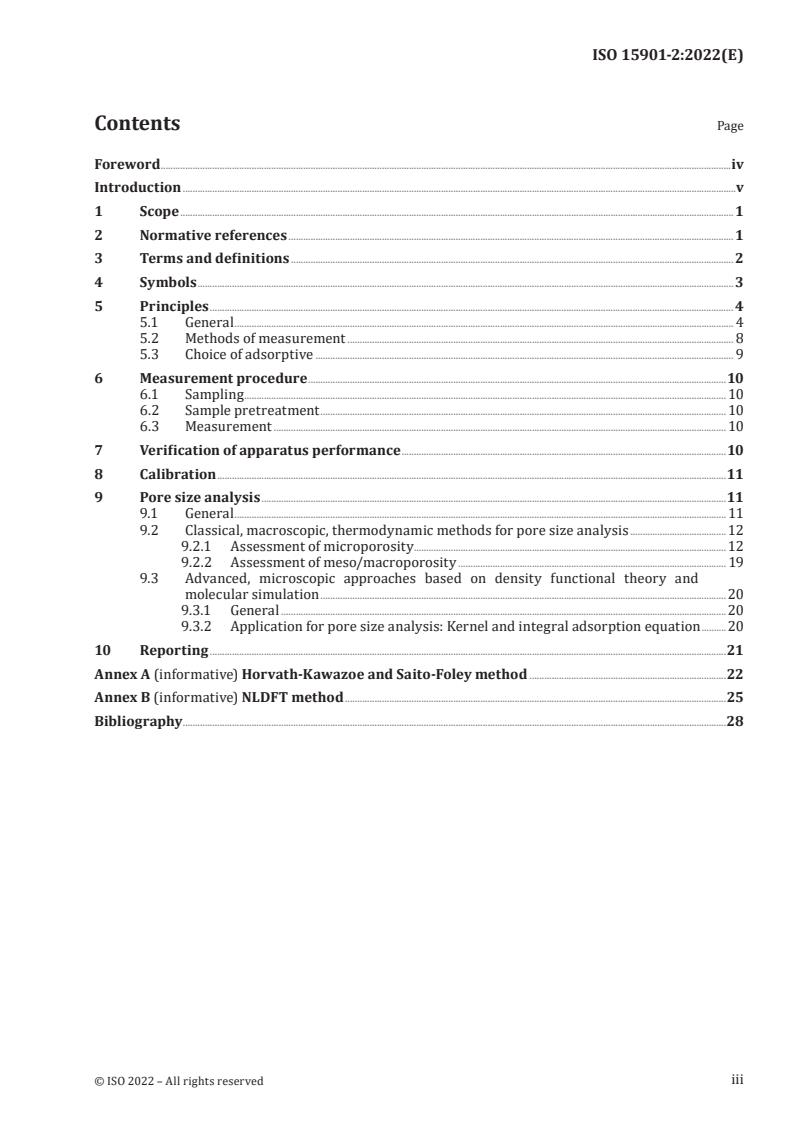
Contents Page
Foreword .iv
Introduction .v
1 Scope . 1
2 Normative references . 1
3 Terms and definitions . 2
4 Symbols . 3
5 Principles . 4
5.1 General . 4
5.2 Methods of measurement . 8
5.3 Choice of adsorptive . 9
6 Measurement procedure .10
6.1 Sampling . 10
6.2 Sample pretreatment . 10
6.3 Measurement . 10
7 Verification of apparatus performance .10
8 Calibration .11
9 Pore size analysis .11
9.1 General . 11
9.2 Classical, macroscopic, thermodynamic methods for pore size analysis .12
9.2.1 Assessment of microporosity .12
9.2.2 Assessment of meso/macroporosity . 19
9.3 Advanced, microscopic approaches based on density functional theory and
molecular simulation . 20
9.3.1 General .20
9.3.2 Application for pore size analysis: Kernel and integral adsorption equation .20
10 Reporting .21
Annex A (informative) Horvath-Kawazoe and Saito-Foley method .22
Annex B (informative) NLDFT method .25
Bibliography .28
iii
Foreword
ISO (the International Organization for Standardization) is a worldwide federation of national standards
bodies (ISO member bodies). The work of preparing International Standards is normally carried out
through ISO technical committees. Each member body interested in a subject for which a technical
committee has been established has the right to be represented on that committee. International
organizations, governmental and non-governmental, in liaison with ISO, also take part in the work.
ISO collaborates closely with the International Electrotechnical Commission (IEC) on all matters of
electrotechnical standardization.
The procedures used to develop this document and those intended for its further maintenance are
described in the ISO/IEC Directives, Part 1. In particular, the different approval criteria needed for the
different types of ISO documents should be noted. This document was drafted in accordance with the
editorial rules of the ISO/IEC Directives, Part 2 (see www.iso.org/directives).
Attention is drawn to the possibility that some of the elements of this document may be the subject of
patent rights. ISO shall not be held responsible for identifying any or all such patent rights. Details of
any patent rights identified during the development of the document will be in the Introduction and/or
on the ISO list of patent declarations received (see www.iso.org/patents).
Any trade name used in this document is information given for the convenience of users and does not
constitute an endorsement.
For an explanation of the voluntary nature of standards, the meaning of ISO specific terms and
expressions related to conformity assessment, as well as information about ISO's adherence to
the World Trade Organization (WTO) principles in the Technical Barriers to Trade (TBT), see
www.iso.org/iso/foreword.html.
This document was prepared by Technical Committee ISO/TC 24, Particle characterization including
sieving, Subcommittee SC 4, Particle characterization.
This second edition cancels and replaces ISO 15901-2:2006 and ISO 15901-3:2007, which have been
technically revised. It also incorporates the Technical Corrigendum ISO 15901-2:2006/Cor.1:2007.
The main changes compared to the previous edition are as follows:
— the analysis of nanopores by gas adsorption which combines the characterization of both micro-
and mesopores is now addressed;
— the classification of adsorption isotherms and hysteresis loops has been updated.
A list of all parts in the ISO 15901 series can be found on the ISO website.
Any feedback or questions on this document should be directed to the user’s national standards body. A
complete listing of these bodies can be found at www.iso.org/members.html.
iv
Introduction
In general, different types of pores may be pictured as apertures, channels, or cavities within a solid
body or as the space (i.e. interstices or voids) between solid particles in a bed, compact or aggregate.
Porosity is a term which is often used to indicate the porous nature of solid material and is more
precisely defined as the ratio of the volume of accessible pores and voids to the total volume occupied
[1]
by a given amount of the solid. According to the 2015 IUPAC recommendations , nanopores are defined
as pores with internal widths of equal or less than 100 nm and are divided into several subgroups
dependent on their pore width:
— pores with width greater than about 50 nm are called macropores;
— pores of widths between 2 nm and 50 nm are called mesopores;
— pores with width of about 2 nm and less are called micropores;
Further, IUPAC suggested a subclassification of micropores into supermicropores (pore width 0,7 nm
to 2 nm), and ultramicropores (pore width < 0,7 nm). In addition to the accessible pores, a solid may
contain closed pores which are isolated from the external surface and into which fluids are not able to
penetrate. The characterization of closed pores, i.e. cavities with no access to an external surface, is not
covered in this document.
Porous materials may take the form of fine or coarse powders, compacts, extrudates, sheets or
monoliths. Their characterization usually involves the determination of the pore size distribution as
well as the total pore volume or porosity. For some purposes it is also necessary to study the pore shape
and interconnectivity, and to determine the internal and external surface area.
Porous materials have great technological importance, e.g. in the context of the following:
a) controlled drug release;
b) catalysis;
c) gas separation;
d) filtration including sterilization;
e) materials technology;
f) environmental protection and pollution control;
g) natural reservoir rocks;
h) building material properties;
i) polymer and ceramic industries.
It is well established that the performance of a porous solid (e.g. its strength, reactivity, permeability
or adsorbent power) is dependent on its pore structure. Many different methods have been developed
for the characterization of pore structure. The choice of the most appropriate method depends on the
application of the porous solid, its chemical and physical nature and the range of pore size.
Different methods for the characterization of nanopores are available, including spectroscopy, electron
and tunnel microscopy and sorption methods. In view of the complexity of most porous solids, it is not
surprising that the results obtained are not always in agreement and that no single technique can be
relied upon to provide a complete picture of the pore structure. Among these, mercury porosimetry (see
ISO 15901-1) and gas adsorption are popular ones because by combining both it is possible to assess a
wide range of pore sizes from below 0,5 nm up to 400 µm. While mercury porosimetry is the standard
technique for macropore analysis, gas adsorption techniques allow to assess pores up to approximately
100 nm. In this case, physical adsorption can be conveniently used, is not destructive, and is not that
cost intensive as compared to some of the above-mentioned methods. Particularly, with regard to the
v
application of microporous material as specific sorbents, molecular sieves and carriers for catalysts
and biological active material, the field-proven methods of gas sorption are of special value.
The measuring techniques of the method described in this document are similar to those described in
ISO 9277 for the measurement of gas adsorption at low temperature. However, in order to assess the
full range of pore sizes including microporosity, adsorption experiments have to be performed over a
wide range of pressures from the ultralow pressure range (e.g. turbomolecular pump vacuum) up to
atmospheric pressure (0,1 MPa).
vi
INTERNATIONAL STANDARD ISO 15901-2:2022(E)
Pore size distribution and porosity of solid materials by
mercury porosimetry and gas adsorption —
Part 2:
Analysis of nanopores by gas adsorption
1 Scope
This document describes a method for the evaluation of porosity and pore size distribution by physical
adsorption (or physisorption). The method is limited to the determination of the quantity of a gas
[1]-[9]
adsorbed per unit mass of sample as a function of pressure at a controlled, constant temperature .
Commonly used adsorptive gases for physical adsorption characterization include nitrogen, argon,
krypton at the temperatures of liquid nitrogen and argon (77 K and 87 K respectively) as well as CO (at
273 K). Traditionally, nitrogen and argon adsorption at 77 K and 87 K, respectively, allows one to assess
pores in the approximate range of widths 0,45 nm to 50 nm, although improvements in temperature
control and pressure measurement allow larger pore widths to be evaluated. CO adsorption at
273 K – 293 K can be applied for the microporous carbon materials exhibiting ultramicropores. Krypton
adsorption at 77 K and 87 K is used to determine the surface area or porosity of materials with small
surface area or for the analysis of thin porous films.
The method described is suitable for a wide range of porous materials. This document focuses on
the determination of pore size distribution from as low as 0,4 nm up to approximately 100 nm. The
determination of surface area is described in ISO 9277. The procedures which have been devised for the
determination of the amount of gas adsorbed may be divided into two groups:
— those which depend on the measurement of the amount of gas removed from the gas phase, i.e.
manometric (volumetric) methods;
— those which involve the measurement of the uptake of the gas by the adsorbent (i.e. direct
determination of increase in mass by gravimetric methods).
In practice, static or dynamic techniques can be used to determine the amount of gas adsorbed. However,
the static manometric method is generally considered the most suitable technique for undertaking
physisorption measurements with nitrogen, argon and krypton at cryogenic temperatures (i.e. 77 K
and 87 K, the boiling temperature of nitrogen and argon, respectively) with the goal of obtaining pore
volume and pore size information. This document focuses only on the application of the manometric
method.
2 Normative references
The following documents are referred to in the text in such a way that some or all of their content
constitutes requirements of this document. For dated references, only the edition cited applies. For
undated references, the latest edition of the referenced document (including any amendments) applies.
ISO 3165, Sampling of chemical products for industrial use — Safety in sampling
ISO 8213, Chemical products for industrial use — Sampling techniques — Solid chemical products in the
form of particles varying from powders to coarse lumps
ISO 9277, Determination of the specific surface area of solids by gas adsorption — BET method
ISO 14488, Particulate materials — Sampling and sample splitting for the determination of particulate
properties
3 Terms and definitions
For the purposes of this document, the following terms and definitions apply.
ISO and IEC maintain terminological databases for use in standardization at the following addresses:
— ISO Online browsing platform: available at https:// www .iso .org/ obp
— IEC Electropedia: available at https:// www .electropedia .org/
3.1
adsorbate
adsorbed gas
3.2
adsorption
enrichment of the adsorptive at the external and accessible internal surfaces of a solid
3.3
adsorptive
gas or vapour to be adsorbed
3.4
adsorbent
solid material on which adsorption occurs
3.5
adsorption isotherm
relationship between the amount of gas adsorbed and the equilibrium pressure of the gas at constant
temperature
3.6
adsorbed amount
amount of gas adsorbed at a given pressure, p, and temperature, T
3.7
equilibrium adsorption pressure
pressure of the adsorptive in equilibrium with the adsorbate
3.8
monolayer amount
amount of the adsorbate that forms a monomolecular layer over the surface of the adsorbent
3.9
monolayer capacity
volumetric equivalent of monolayer amount expressed as gas at standard conditions of temperature
and pressure (STP)
3.10
nanopore
pore with width of 100 nm or less
3.11
macropore
pore with width greater than about 50 nm
3.12
mesopore
pore with width between approximately 2 nm and 50 nm
3.13
micropore
pore with width of about 2 nm or less
3.14
supermicropore
pore with width between approximately 0,7 nm and 2 nm
3.15
ultramicropore
pore with width of approximately < 0,7 nm
3.16
physisorption
weak bonding of the adsorbate, reversible by small changes in pressure or temperature
3.17
pore size
pore width, i.e. diameter of cylindrical pore or distance between opposite walls of slit
3.18
pore volume
volume of pores as determined by stated method
3.19
relative pressure
ratio of the equilibrium adsorption pressure, p, to the saturation vapour pressure, p , at analysis
temperature
3.20
saturation vapour pressure
vapour pressure of the bulk liquefied adsorptive at the temperature of adsorption
3.21
volume adsorbed
volumetric equivalent of the amount adsorbed, expressed as gas at standard conditions of temperature
and pressure (STP), or expressed as the adsorbed liquid volume of the adsorbate
4 Symbols
For the purposes of this document, the following symbols apply, together with their units. All specific
dimensions are related to sample mass, in grams.
Symbol Description Unit
A Kirkwood-Mueller constant of adsorptive J·cm
a
A Kirkwood-Mueller constant of adsorbent J·cm
s
2 −1
a specific surface area m ·g
s
2 −1
a specific surface area of reference sample m ·g
s,ref
α polarizability of adsorptive cm
a
a
α normalized adsorption 1
s
α polarizability of adsorbent cm
s*
−1
c speed of light m·s
d diameter of an adsorptive molecule nm
a
d diameter of hard spheres nm
HS
a
According to ISO 80000-1, the coherent SI unit for any quantity of dimension one (at present commonly determined
“dimensionless”) is the unit one, symbol 1.
Symbol Description Unit
d pore diameter (cylindrical pore) nm
p
d diameter of an adsorbent molecule nm
s
d d = (d + d )/2, distance between adsorptive and adsorbent molecules nm
0 0 s a
ε /k well depth parameter of gas-gas Lennard Jones potential K
ff B
ε /k well depth parameter of gas-solid Lennard Jones potential K
sf B
−23 −1
k Boltzmann constant (1,381 × 10 ) J K
B
l nuclei-nuclei pore width nm
m * mass adsorbed g
a
m mass of an electron kg
e
23 −1
N Avogadro's constant (6,022 × 10 ) mol
A
2 −2
N number of atoms per unit area (m ) of monolayer m
a
2 −2
N number of atoms per unit area (m ) of adsorbent m
s
−1
n specific amount adsorbed mol·g
a
P pressure of the adsorptive in equilibrium with the adsorbate Pa
p saturation vapour pressure of the adsorptive Pa
a
p/p relative pressure of the adsorptive 1
−1 −1
R ideal gas constant (8,314) Jmol K
−3
ρ gas density g·cm
g
−3
ρ gas density at STP (273,15 K; 101,3 kPa) g·cm
g,STP
−3
ρ liquid density g·cm
l
σ distance between two molecules at zero interaction energy nm
σ distance parameter of gas-gas Lennard Jones potential nm
ff
σ distance parameter of gas-solid Lennard Jones potential nm
sf
T temperature K
T critical temperature K
cr
t statistical layer thickness nm
3 −1
V specific volume of the adsorbate cm ·g
a
3 −1
V specific adsorbed gas volume at STP (273,15 K; 101,3 kPa) cm ·g
g
3 −1
V micropore volume cm ·g
micro
W pore width (slit pore) nm
χ diamagnetic susceptibility of adsorptive cm
a
χ diamagnetic susceptibility of adsorbent cm
s
a
According to ISO 80000-1, the coherent SI unit for any quantity of dimension one (at present commonly determined
“dimensionless”) is the unit one, symbol 1.
5 Principles
5.1 General
Physisorption is a general phenomenon and occurs whenever an adsorbable gas (the adsorptive) is
brought into contact with the surface of a solid (the adsorbent). The forces involved are the van der
Waals forces. Physisorption in porous materials is governed by the interplay between the strength of
fluid-wall and fluid-fluid interactions as well as the effects of confined pore space on the state of fluids
in narrow pores. The effect of pore width on the interaction potential is demonstrated schematically in
[8]
Figure 1 .
(a) (b) (c)
Figure 1 — Schematic illustration of adsorption potential, ε, on (a) planar, nonporous surface;
(b) mesopore; (c) micropore
The interplay between the strength of attractive adsorptive-adsorbent interactions and the effect
of confinement (as controlled by pore size/geometry) affect the shape of adsorption isotherm, as
[1]
demonstrated in the IUPAC classification of adsorption isotherms as shown in Figure 2.
Key
X relative pressure
Y amount adsorbed
Figure 2 — Standard isotherm types (IUPAC 2015)
Reversible Type I isotherms are given by microporous solids having relatively small external surfaces
(e.g. some activated carbons, molecular sieve zeolites and certain porous oxides). Because the pore size
is similar to the molecule diameter, the choice of the gas is decisive, i.e. the size of the gas molecule
controls the accessibility of the pores, and hence affects the obtained porosity information. A Type
I isotherm is concave to the relative pressure (i.e. p/p axis) and the amount adsorbed approaches a
limiting value. This limiting uptake is governed by the accessible micropore volume rather than by
the internal surface area. A steep uptake at very low p/p is due to enhanced adsorbent-adsorptive
interactions in narrow micropores (micropores of molecular dimensions), resulting in micropore
filling at very low p/p . Type I(a) isotherms are given by microporous materials having mainly narrow
micropores (of width ≤ 1 nm), which includes ultramicropores). A significant portion of the micropores
is indicated by a large and steep increase of the isotherm near its origin and subsequent bending to a
plateau. Type I(b) isotherms are found with materials having pore size distributions over a broader
range including wider micropores (including supermicropores).
Type II isotherms are typically produced by solids which are non-porous or macroporous. Point B is
often taken as indicative of the completion of the monolayer capacity.
Type III isotherms are distinguished by a convexity towards the relative pressure axis. These isotherms
are found when weak gas-solid interactions occur on non-porous or macroporous solids (e.g. water
adsorption on carbon surfaces).
Type IV isotherms are found for mesoporous solids. Type IV isotherms are given by mesoporous
adsorbents (e.g. many oxide gels, industrial adsorbents and mesoporous molecular sieves). The
adsorption behaviour in mesopores is determined by the adsorbent-adsorptive interactions and by
the interactions between the molecules in the condensed state. In this case, the initial monolayer-
multilayer adsorption on the mesopore walls, which takes the same path as the corresponding part of
a Type II isotherm, is followed by pore condensation. Pore condensation is the phenomenon whereby a
gas condenses to a liquid-like phase in a pore at a pressure p less than the saturation pressure p of the
bulk liquid. This leads to the appearance of a Type IV adsorption isotherm. A typical feature of Type IV
isotherms is a final saturation plateau, of variable length (sometimes reduced to a mere inflexion point).
In the case of a Type IV(a) isotherm, capillary condensation is accompanied by hysteresis. This occurs
when the pore width exceeds a certain critical width, which is dependent on the adsorption system and
temperature (e.g. for nitrogen and argon adsorption in cylindrical pores at 77 K and 87 K, respectively,
hysteresis starts to occur for pores wider than ~ 4 nm). With adsorbents having mesopores of smaller
width, completely reversible Type IV(b) isotherms are observed. In principle, Type IV(b) isotherms are
also given by conical and cylindrical mesopores that are closed at the tapered end.
Type V isotherms are characterized by a convexity to the relative pressure axis. Unlike Type III
isotherms there occurs a point of inflection at higher relative pressures. Type V isotherms result from
weak gas-solid interactions on microporous and mesoporous solids (e.g. water adsorption on micro-or
mesoporous carbons).
Type VI isotherms are notable for the step-like nature of the sorption process. The steps result from
sequential multilayer adsorption or uniform non-porous surfaces. Amongst the best examples of Type VI
isotherms are those obtained with argon or krypton at low temperature on graphitized carbon blacks.
There are various phenomena which contribute to the occurrence of hysteresis, and this is also reflected
[1]
in the IUPAC classification of hysteresis loops shown in Figure 3.
Type H1 hysteresis loops are observed for mesoporous materials with relatively narrow pore size
distributions as for instance in ordered mesoporous silicas (e.g. MCM-41, MCM-48, SBA-15), some
controlled pore glasses and ordered, mesoporous carbons, and materials with mesoporous cylindrical
pores and for agglomerates of spheroidal particles of uniform size. Usually, network effects are minimal
and occurrence of Type H1 hysteresis is often a clear sign that hysteresis is entirely caused by delayed
condensation, i.e. a metastable adsorption branch.
Hysteresis loops of Type H2 are given by more complex pore structures in which network effects are
[10]
important . The very steep desorption branch, which is a characteristic feature of H2(a) loops, can
be attributed either to pore-blocking/percolation in a narrow range of pore necks or to cavitation-
induced evaporation, as well as for some 2-dimensional materials with slit-shaped pores. H2(a) loops
are for instance given by many silica gels, some porous glasses (e.g. vycor) as well as some ordered
mesoporous materials (e.g. SBA-16 and KIT-5 silicas). The Type H2(b) loop is also associated with pore
blocking, but the size distribution of neck widths is now much larger. Examples of this type of hysteresis
loops have been observed with mesocellular silica foams and certain mesoporous ordered silicas after
hydrothermal treatment.
A distinctive feature of Type H3 is that the lower limit of the desorption branch is normally located at
the cavitation-induced p/p . Loops of this type are given for instance by non-rigid aggregates of plate-
like particles (e.g. certain clays), but also if the pore network consists of macropores which are not
completely filled with pore condensate. Capillary condensation between small particles can also lead to
Type H3 hysteresis.
Hysteresis of Type H4 is somewhat similar to Type H3, but the adsorption branch shows a more
pronounced uptake at low p/p being associated with the filling of micropores. H4 loops are often found
with aggregated crystals of zeolites, some mesoporous zeolites, and micro-mesoporous carbons.
Type H5 hysteresis has a distinctive form associated with certain pore structures containing both open
and partially blocked mesopores (e.g. plugged hexagonal templated silicas). Over an appreciable range,
the isotherm shape is very similar to that of H4, but there is now a well-defined plateau at high p/p .
As already indicated, the common feature of H3, H4 and H5 loops is the sharp step-down of the
desorption branch, indicative of cavitation induced evaporation. Generally, this is located in a narrow
range of p/p for the particular adsorptive and temperature (e.g. at p/p ~ 0,4 – 0,5 for nitrogen at
0 0
[10]
temperatures of 77 K) .
Key
X relative pressure
Y amount adsorbed
Figure 3 — Standard types of hysteresis loop (IUPAC 2015)
5.2 Methods of measurement
The experimental data required to establish an adsorption/desorption (sorption) isotherm may be
obtained by volumetric (manometric) or gravimetric methods, by measurements either at stepwise,
varied pressure with observation of the equilibrium value of pressure or mass, respectively, or at a
continuously varied pressure. Because adsorption/desorption equilibrium can take a long time, the
stepwise manometric method is recommended to ensure the measurement of equilibrium values.
The manometric (volumetric) method is based on calibrated volumes and pressure measurements
(see ISO 9277). The volume adsorbed is calculated as the difference between the quantity of gas
admitted and the quantity of gas filling the void volume (free space in the sample container including
connections) by application of the general gas equation. Equilibrium is observed by monitoring
the pressure in the free space. It is necessary to take special care in the pressure measurements for
micropores as physical adsorption occurs at relative pressures substantially lower than in the case of
sorption phenomena in mesopores and can span a broad spectrum of pressures (up to seven orders of
magnitude in pressure). Consequently, contrary to the situation for mesopore measurements (pores fill
here at relative pressures greater than approximately 0,15 for nitrogen and argon adsorption at 77 K
and 87 K, respectively) more than one pressure transducer is necessary to measure the equilibrium
pressure with sufficient accuracy. In order to study the adsorption of gases like nitrogen and argon
−7
(at their boiling temperatures) within a relative pressure range of 10 < p/p < 1 with sufficiently
high accuracy, it is desirable to use a combination of different transducers with maximum ranges of
1)
0,133 kPa (1 Torr ), 1,33 kPa (10 Torr) and 133 kPa (1 000 Torr). In addition, one needs to ensure
1) Torr is a deprecated unit.
that the sample cell and the manifold can be evacuated to pressures as low as possible, which
requires a proper high-vacuum pumping system. The desired low pressure can be achieved by using
−5
a turbomolecular pump. For gas pressures below about 1,3 Pa (i.e. p/p < 10 for nitrogen and argon
adsorption at 77 K and 87 K, respectively), it is necessary to take into account the pressure differences
along the capillary of the sample bulb caused by the Knudsen effect (i.e. one needs to apply a correction
for thermal transpiration).
Care shall also be taken to properly select the equilibration conditions. Too short of an equilibration
time may lead to under-equilibrated data and isotherms shifted to too high relative pressures. Under-
equilibration is often an issue in the very low relative pressure region of the isotherm, since equilibration
in narrow micropores tends to be very slow. For highest accuracy the saturation pressure p should be
recorded for every data point (by means of a dedicated saturation pressure transducer), i.e. this is most
important for providing acceptable accuracy in the measurement of p/p at high pressures, which is
particularly important for evaluation of the size distribution of larger mesopores.
5.3 Choice of adsorptive
The proper choice of adsorptive is also crucial for an accurate and comprehensive pore structural
analysis. For many years, nitrogen adsorption at 77 K has been generally accepted as the standard
method for both micropore and mesopore size analysis, but for several reasons it has become evident
that nitrogen is not a good choice for assessing the micropore size distribution. It is well known that the
quadrupole of the nitrogen molecule is largely responsible for the specific interaction with a variety
of surface functional groups and exposed ions. This not only affects the orientation of the adsorbed
nitrogen molecule on the adsorbent surface [which will affect the reliability of applying the Brunauer-
[1]
Emmett-Teller (BET) method for surface area analysis ], but it also strongly affects the micropore
filling pressure. For example, for many zeolites and metal-organic frameworks (MOFs), the initial stage
−7
of physisorption is shifted to extremely low pressures (to ~10 ) where the rate of diffusion is extremely
slow, making it difficult to measure equilibrated adsorption isotherms. Specific interactions with
surface functional groups cause the problem that the pore filling pressure is not correlated with the pore
size in a straightforward way. In contrast to nitrogen at 77 K argon at 87 K (liquid argon temperature)
does not exhibit specific interactions with surface functional groups. As a consequence of this and the
slightly higher temperature, argon at 87 K fills micropores of dimensions between 0,5 nm and 1 nm at
significantly higher relative pressures compared to nitrogen at 77 K, leading to accelerated diffusion
and faster equilibration time. The pore filling pressure of argon (87 K) is often shifted 1 to 1,5 decades
in relative pressure as compared to nitrogen. Hence, argon adsorption at 87 K allows one to obtain high
resolution adsorption isotherms in order to resolve small differences in texture; in fact, such argon
(87 K) isotherms can be considered a fingerprint of the pore structure. Hence, it is beneficial to analyse
[1]
microporous materials by using argon as the adsorptive at 87 K . However, if one is only interested in
the determination of mesoporosity nitrogen adsorption at 77 K will give satisfactory results (the effect
of quadrupole interactions is more severe for filling of micropore at ultralow pressures), although even
for mesopore analysis argon adsorption at 87 K is preferable because of higher sensitivity in detecting
small amounts of mesoporosity.
Despite the advantages which argon adsorption at 87 K offers, there exists the well-known problem
of restricted diffusion in various ultramicroporous carbon materials, which prevents nitrogen and
also argon molecules from entering the narrowest micropores – pores of width < 0,45 nm. Here it is
advantageous to use CO as adsorptive at 273,15 K. The saturation pressure at this temperature is
about 3,48 MPa, i.e. in order to achieve the small relative pressures required to monitor the micropore
filling, a turbomolecular pump-level vacuum is not necessary. At these relatively high temperatures and
pressures, significant diffusion limitations no longer exist, which leads to the situation that equilibrium
is achieved much faster relative to low-temperature nitrogen and argon experiments. It is therefore
possible to reliably assess pores as small as 0,4 nm. With CO adsorption up to 101,3 kPa (1 atm), one
can detect pores from the narrowest micropores up to about 1 nm.
6 Measurement procedure
6.1 Sampling
Sampling shall be performed in accordance with ISO 3165, ISO 8213, and ISO 14488. The sample for
test shall be representative of the bulk material and should be of an appropriate quantity. Repeated
measurements using a second sample are recommended.
6.2 Sample pretreatment
The sample should be degassed in vacuum better than 1 Pa at elevated temperature to remove
physisorbed material. During this process, irreversible changes of the surface structure (revealed,
for example, by a colour change) should be avoided. The highest temperature that can be applied is
favourably determined by means of thermogravimetry (see ISO 9277:2010 Figure 3). Otherwise,
repeated measurements should be carried out by varying the time and the temperature (see
ISO 9277:2010, Figure 4). In addition, the temperatures at which materials are evolved from the
sample can be determined by means of differential scanning calorimetry and the gas can be analysed.
To obtain reproducible isotherms, it is necessary to carefully control the outgassing conditions. With
sensitive samples, a pressure-controlled procedure together with a dedicated heating programme is
recommended.
Alternatively to vacuum outgassing, the sample is degassed at an elevated temperature by flushing
with a high-quality inert gas, e.g. helium or nitrogen. Complete degassing is indicated by a constant
mass or constant pressure, respectively, for a period of 15 min to 30 min. The mass of the dry sample
should be determined, recorded to the nearest 0,1 mg.
However, for microporous materials, outgassing under vacuum is recommended as the adsorption
−7
measurements often start at relative pressures as low as 10 . This can be achieved by using a
turbomolecular pump which, if coupled with a diaphragm roughing pump, allows the sample to be
outgassed even in a completely oil free system.
6.3 Measurement
Adsorption measurements shall be carried out as described in detail in ISO 9277. Here, the importance
of the determination of the free space (i.e. the effective void volume) in the manometric method is
described, but for micropore measurements which start at very low relative pressures, special caution
needs to be applied. The standard procedure uses a non-adsorbing gas such as helium to measure the
free space under the operational conditions. However, the use of helium for the free space calibration
may be problematic because nanoporous solids with very narrow micropores (e.g. some zeolites,
activated carbons) may adsorb non-negligible amounts of helium at cryogenic temperatures (so-
called helium entrapment) when - in contrast to helium – the entry of nitrogen or argon molecules is
restricted, due to diffusion limitations. If the entrapped helium is not removed prior to the analysis, this
can affect significantly the shape of the adsorption isotherm in the ultra-low pressure range. Therefore,
if helium is used, the sample should be outgassed after exposure of the sample to helium – at least at
room temperature - before continuing the manometric analysis. If possible, it is advantageous to avoid
the use of helium for ultramicroporous materials. One way to avoid this problem is to determine the
volume of the empty sample cell at ambient temperature using the adsorptive (e.g. nitrogen), followed
by the measurement of a calibration curve (with the empty sample cell) performed under the same
operational conditions as the adsorption measurements. This calibration curve essentially represents
a multipoint free space determination; the necessary correction for the sample volume can be made by
means of the skeletal density of the sample.
7 Verification of apparatus performance
A certified reference material selected by the user shall be tested on a regular basis to monitor
instrument calibration and performance. In case local reference materials which are offered by a
number of national standard bodies are used, they shall be traceable to a certified reference material.
8 Calibration
The calibration of individual components should be carried out according to the manufacturer’s
recommendations. Typically, calibration of pressure transducers and temperature sensors is
accomplished with reference to standard pressure and temperature measuring devices that have
calibrations traceable to national standards. Manifold volume calibration is achieved through
appropriate pressure and temperature measurements, using constant temperature volumetric spaces
or solids of known, traceable volume. Analysis tube calibration is generally accomplished through
determination of free space described in ISO 9277.
9 Pore size analysis
9.1 General
The recommended display of adsorption isotherm data depends on whether the focus of the analysis is
on assessing microporosity or mesoporosity, For nonporous, macroporous and mesoporous materials
the isotherm should be presented in a linear form (see Figure 4), while for microporous samples,
favourably, the isotherm V =f(p/p ) or m = f(p/p ) is represented on a logarithmic scale of the relative
a 0 T a 0 T
pressure (see Figure 5 ).This allows one to even visually inspect the quality of the experimental data
and the effect of micropore structure on the shape of the adsorption isotherm.
Key
X p/p
3 -1
Y V (cm g STP)
g
Figure 4 — Linear plot of the isotherm (Ar on zeolite at 87,3 K)
Key
X p/p
3 -1
Y V (cm g STP)
g
Figure 5 — Semi-logarithmic plot of the isotherm (Ar on zeolite at 87,3 K)
In order to obtain surface area, pore size distribution, pore volume and other structural information of
nanoporous materials from the analysis of gas adsorption isotherms it is necessary to understand the
underlying, often quite complex, adsorption mechanisms. This is being addressed in methods available
for pore size analysis, which can be divided into so-called classical, macroscopic thermodynamic
methods and microscopic methods based on statistical mechanics which describe the adsorbate (e.g.
adsorbed layer) on a molecular level.
The state-of-the-art (at the time of publication) for obtaining accurate and reliable pore size
distributions over the complete nanopore range is the application of methods based on statistical
mechanics and molecular simulation such as methods based on density functional theory (DFT) (e.g.
non local density functional theory, NLDFT) and molecular simulation (e.g. grand canonical Monte Carlo
simulation, GCMC). Methods for pore size analysis based on DFT and molecular simulation are widely
used, commercially available for many important adsorptive/adsorbent systems and recommended
by Reference [1]. DFT methods accurately describe adsorption and phase behaviour of fluids confined
in pores structures and it has been shown that the application of DFT methods allows one to obtain
reliable pore size distributions over the complete range of micro- and mesopores. Classical methods
for pore size an
...
Questions, Comments and Discussion
Ask us and Technical Secretary will try to provide an answer. You can facilitate discussion about the standard in here.
Loading comments...