


Electricity Supply System Standards: Ensuring Safety and Future-Ready Installations in Construction
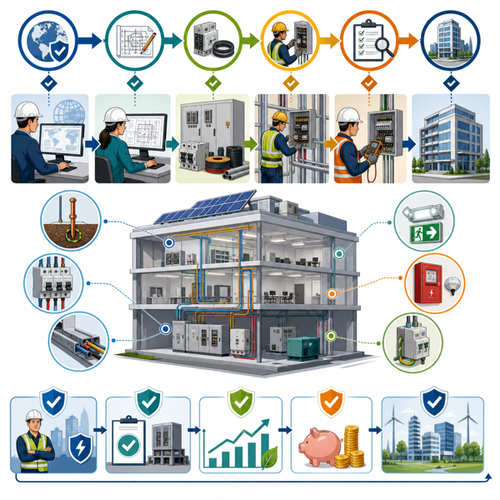
When constructing or upgrading any building, safety, reliability, and scalability of the electricity supply system are crucial concerns. The latest international standards provide comprehensive guidance to protect people, assets, and infrastructure from electrical hazards and to ensure seamless integration of new energy solutions. In this article, we unpack two essential standards for low-voltage electrical installations: SIST HD 60364-4-43:2023/oprAA:2025, which focuses on protection against overcurrent, and SIST HD 60364-8-2:2019/A12:2021, addressing the evolving needs of prosumer's low-voltage installations. Understanding and applying these standards is indispensable for businesses aiming to increase productivity, ensure security, and scale their operations efficiently and safely.
Overview / Introduction
The construction industry is witnessing rapid advancements in electrical infrastructure, driven by growing energy demands, greater emphasis on safety, and the transition to smarter grids. Adhering to robust standards for electricity supply systems is fundamental to meeting regulatory requirements, safeguarding occupants, and optimizing facility performance.
Why do these standards matter? For businesses and facility owners, compliance means reduced risk of fire and electrical failure, improved operational uptime, and readiness for future technologies such as distributed generation and smart controls. This guide will walk you through the specific aims, requirements, and benefits of two key international standards that are now must-haves in the world of modern electrical installations.
What you will learn:
- The operational scope and main requirements of each standard
- Who should implement these standards and why
- Practical benefits for businesses and construction professionals
- Best practices for successful adoption and compliance
Detailed Standards Coverage
SIST HD 60364-4-43:2023/oprAA:2025 – Protection for Safety: Overcurrent Protection
Low-voltage electrical installations - Part 4-43: Protection for safety - Protection against overcurrent
This standard delivers a comprehensive framework for preventing electrical hazards due to overcurrents in low-voltage installations—an absolute necessity in construction and facility management.
What does this standard cover?
SIST HD 60364-4-43:2023/oprAA:2025 establishes safety requirements for protecting live conductors—including PEN, PEM, and PEL conductors—against detrimental effects caused by overcurrent (including both overload and short-circuit situations). Overcurrents can lead to fires, electrical breakdowns, and fatal accidents; thus, implementing this standard is critical for all low-voltage electrical supply systems.
Key requirements & specifications
- Automatic disconnection of supply is the preferred and primary method for overcurrent protection.
- Protection measures other than automatic disconnection are permitted only in certain applications and under restricted conditions, detailed in new normative annexes (Annex A, B, and E).
- Enhanced attention to protection of the neutral or mid-point conductor, especially considering harmonic currents that affect these conductors.
- Installation of overcurrent protection devices at the origin of each circuit or at locations where conductor current-carrying capacity is reduced.
- Special positioning rules for overcurrent devices in areas with elevated risks (e.g., locations with fire or explosion hazards).
- The standard includes updates to terminology and improved structuring for clarity and usability.
Who needs to comply?
- Electrical engineers and contractors involved in new and refurbished building projects.
- Facility managers responsible for the safety and maintenance of electrical systems.
- Regulatory bodies and inspection authorities in the construction sector.
Practical implications
- Properly installing overcurrent protection devices drastically lowers the chance of fire and equipment damage.
- Compliance supports insurance requirements and legal obligations in most jurisdictions.
- Following the updated normative annexes ensures suitability for specialized or high-risk environments.
Key highlights:
- Restructured requirements for easier navigation and compliance.
- Strong preference for "automatic disconnection of supply" as the default protection.
- Expanded requirements for conductor protection, especially in harmonic-prone installations.
Access the full standard:View SIST HD 60364-4-43:2023/oprAA:2025 on iTeh Standards
SIST HD 60364-8-2:2019/A12:2021 – Prosumer's Low-Voltage Electrical Installations
Low-voltage electrical installations - Part 8-2: Prosumer's low-voltage electrical installations
The move towards decentralization and sustainable energy creates new challenges for electricity supply systems. This standard provides the latest specifications for installations where users both consume and produce energy—the so-called "prosumers."
What does this standard cover?
While the official scope is not detailed in the public extracts, SIST HD 60364-8-2:2019/A12:2021 aligns with IEC standards addressing the safe and efficient design and management of low-voltage systems in buildings where generation (e.g., solar panels, battery storage) and consumption are integrated. Its requirements enable prosumers to safely connect with the grid, manage energy flows, and maximize self-consumption or export to the utility network.
Key requirements & specifications
- Definition and integration requirements for distributed energy resources (DERs) such as photovoltaic systems and home energy storage.
- Safety guidelines for connecting to the public grid, including requirements for anti-islanding and system protection.
- Provisions for bi-directional energy flows, smart metering, and grid interaction.
- Recommendations for energy management to maximize self-consumption and efficiency in prosumer installations.
Who needs to comply?
- Building owners and developers implementing energy-generating solutions (e.g., solar, wind, battery storage).
- Electrical engineers, system integrators, and installers focused on distributed and renewable energy projects.
- Utility companies and grid operators interfacing with distributed prosumer installations.
Practical implications
- Ensures the safety of occupants and grid stability as more buildings adopt energy production and storage.
- Streamlines integration of new energy solutions, making future upgrades or expansions simpler and quicker.
- Reduces operational risks, legal liability, and maintenance costs for building owners and facility managers.
Key highlights:
- Sets clear requirements for integrating distributed energy resources.
- Facilitates compliant connection with the public utility grid.
- Supports smarter, more resilient building electrical systems through efficient energy management.
Access the full standard:View SIST HD 60364-8-2:2019/A12:2021 on iTeh Standards
Industry Impact & Compliance
Electricity supply systems are evolving rapidly—from simple power distribution to complex, digital, and interactive networks. State-of-the-art standards such as SIST HD 60364-4-43:2023/oprAA:2025 and SIST HD 60364-8-2:2019/A12:2021 support this evolution by raising the bar for safety, flexibility, and technological readiness.
How do these standards affect businesses?
- Enhanced safety: Reduction in electrical incidents, equipment damages, and liability risks by enforcing proven protection mechanisms.
- Future-proofed operations: Compatibility with smart grid technologies, distributed energy, and growing loads.
- Operational scalability: Clear guidelines allow installations to scale as business energy demands grow without sacrificing safety or compliance.
- Efficiency and productivity: Well-defined protection schemes minimize unplanned downtime, boosting productivity in commercial and industrial settings.
Compliance considerations
- Non-compliance can lead to major risks: fires, insurance claims repudiation, regulatory penalties, and lost business reputation.
- Regular updates to legislation and local codes tend to align with these international standards, making early compliance a solid long-term investment.
Benefits of adopting these standards
- Lower total cost of ownership due to optimized protection and minimized risk of failure.
- Increased asset value and marketability for compliant buildings.
- Stronger bargaining position with insurers and lenders.
- Reliable support for new technologies and energy sources.
Risks of non-compliance
- Potential for catastrophic electrical incidents, with risks to life and property.
- Increased legal and financial exposure for facility managers and contractors.
- Barriers to grid connection or energy export for prosumer installations.
Implementation Guidance
Implementing best practices from electricity supply system standards starts at planning and design and continues through construction, commissioning, and ongoing management.
Common implementation approaches
- Engage qualified professionals: Work with certified electricians, engineers, and system integrators familiar with the latest requirements.
- Early planning: Integrate standard requirements at the earliest design stages to avoid costly rework.
- Regular training: Ensure all team members are updated on standards and changes in electrical codes.
- Commissioning tests: Always test overcurrent protection systems and distributed generation interfaces as required by the standard.
Best practices for adopting these standards
- Documentation: Maintain clear records of all system designs, protection schemes, and modifications.
- Ongoing maintenance: Schedule regular inspections and performance assessments for overcurrent devices and distributed energy assets.
- Future readiness: Design installations to accommodate new DERs or further expansion without redoing protection systems.
Resources for organizations
- Full standard texts: Always consult the official standard documents hosted on authoritative platforms such as iTeh Standards for comprehensive technical details.
- Industry seminars and training: Attend industry events and training sessions focused on electrical safety, prosumer integration, and grid interaction.
- Consultation with regulatory bodies: Establish dialogue with local inspection authorities for clarification and compliance updates.
Conclusion / Next Steps
The landscape of electricity supply systems in construction is at a turning point, demanding both safety and innovation. With the latest updates through SIST HD 60364-4-43:2023/oprAA:2025 for overcurrent protection and SIST HD 60364-8-2:2019/A12:2021 for prosumer installations, organizations gain the tools needed to future-proof their facilities and projects.
Key takeaways:
- Adopting these standards ensures safety, legal compliance, and scalable building operations.
- Overcurrent protection is foundational to minimizing fire and accident risks in any low-voltage setup.
- Prosumer installations offer opportunities for energy savings and revenue—but only when properly standardized.
Recommendations:
- Review your current electricity supply system design against these international standards.
- Train your teams and update company policies for ongoing compliance and best practices.
- Leverage iTeh Standards for authoritative documents, updates, and resources to help you stay ahead of electrical safety and smart energy trends.
Proactive adoption of international standards is more than regulatory—it’s a competitive advantage. Keep your facilities safe, productive, and ready for the future by making these standards a cornerstone of your business strategy.
Categories
- Latest News
- New Arrivals
- Generalities
- Services and Management
- Natural Sciences
- Health Care
- Environment
- Metrology and Measurement
- Testing
- Mechanical Systems
- Fluid Systems
- Manufacturing
- Energy and Heat
- Electrical Engineering
- Electronics
- Telecommunications
- Information Technology
- Image Technology
- Precision Mechanics
- Road Vehicles
- Railway Engineering
- Shipbuilding
- Aircraft and Space
- Materials Handling
- Packaging
- Textile and Leather
- Clothing
- Agriculture
- Food technology
- Chemical Technology
- Mining and Minerals
- Petroleum
- Metallurgy
- Wood technology
- Glass and Ceramics
- Rubber and Plastics
- Paper Technology
- Paint Industries
- Construction
- Civil Engineering
- Military Engineering
- Entertainment