


Electronics Standards Update: Key Safety and Component Changes in May 2026
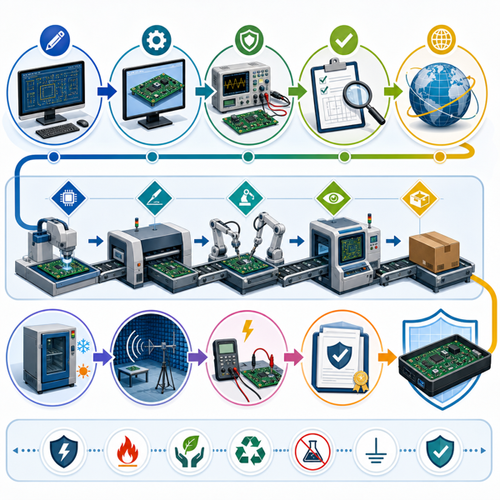
The electronics industry faces pivotal updates with the publication of four critical international standards in May 2026. These new guidelines address advances in optical communication safety, high-performance circuit board materials, cutting-edge sensor technologies, and the latest connector specifications. Ensuring safety, reliability, and interoperability in increasingly sophisticated systems, these standards impact manufacturers, designers, compliance officers, and engineers across a broad swath of the industry. In this article, we break down each new standard, its technical requirements, and what compliance means for your organization.
Overview / Introduction
Electronics underpin innovation across industrial, commercial, medical, and consumer sectors. With the field rapidly evolving, up-to-date standards are vital for ensuring product safety, quality, and interoperability. International standards not only guide manufacturers and designers in best practices but also support regulatory compliance and global market access.
In May 2026, four major standards were published to address key advancements and persistent challenges in optical communications, material sciences for circuit boards, chemical/biochemical sensing, and connector engineering. This article explores:
- The scope and technical demands of each standard
- Who needs to comply and why
- How these changes affect product development and compliance strategies
Whether you oversee quality, lead R&D, or manage technical procurement, this guide will help you navigate these pivotal updates and maintain your competitive edge.
Detailed Standards Coverage
EN IEC 60825-12:2026 – Safety of Free Space Optical Communication Systems
Safety of laser products – Part 12: Safety of free space optical communication systems used for transmission of information
This standard sets requirements for products emitting laser radiation for free space optical data transmission. It excludes medical, material processing, and explosive environment applications, focusing strictly on information transfer systems.
The standard introduces a comprehensive framework for:
- Access level assessment (determines exposure risk across installation locations: unrestricted, restricted, and controlled)
- Classification and evaluation of access levels (with detailed requirements for each hazard tier from low-risk to highest-risk classes)
- Manufacturer responsibilities for labeling, markings, and user guidance
- Requirements for installation/service organizations and operational practices
Notable technical changes compared to the previous version include:
- Updated aperture stop and distance parameters for access level determination
- Additional limitations for specific infrared wavelengths for enhanced skin safety
- Detailed guidance on time base use and expanded labeling requirements
- Annex additions covering rationale, access level meaning, application examples, and unmanned aerial system (UAS) scenarios
Who must comply:
- Manufacturers of free-space optical communication systems using lasers
- Designers and installers in telecom infrastructure, industrial automation, aerospace, and smart city deployments
- Maintenance and operational service providers responsible for FSOCS
Implications:
- Coordinated safety between manufacturers, installation and service contractors, and end users
- Clearer requirements for organizational safety protocols and training
- More rigorous evaluation and documentation of hazard levels for every installation environment
Key highlights:
- Access level methodology updated for wavelength and biological risks
- Expanded guidance for safe deployment, including remote/UAS use cases
- Enhanced organizational and operational safety requirements
Access the full standard:View EN IEC 60825-12:2026 on iTeh Standards
IEC 61249-3-6:2026 – PTFE-Filled Laminate Sheets for Circuit Boards
Materials for circuit boards and other interconnecting structures – Part 3-6: Sectional specification set for unreinforced base materials clad and unclad – Polytetrafluoroethylene (PTFE) filled laminate sheets of defined flammability (vertical burning test), copper-clad
This specification covers the properties and test requirements for PTFE (polytetrafluoroethylene) filled, unreinforced laminated sheets—copper-clad or unclad—used in high-reliability circuit boards. These materials are notable for their excellent dielectric properties, thermal stability, and flame resistance as defined by a vertical burning test.
Key focuses include:
- Material construction: PTFE or modified PTFE with fillers to achieve target electrical/thermal performance, copper foils as specified by IEC 61249-5-1
- Flammability: stringent vertical burning test definitions ensuring fire safety
- Electrical properties: minimum surface/volume resistivity, breakdown voltages, dielectric strength, and specified dissipation factors for high-frequency applications
- Dimensional stability and mechanical tests: requirements on bow, twist, and mechanical processing suitability
- Quality assurance regime: detailed inspection, conformance certification, and packaging/marking rules
Who must comply:
- Manufacturers and users of advanced printed circuit boards (PCBs) for aerospace, telecom, microwave, and automotive electronics
- Material suppliers serving high-frequency and high-reliability sectors
Implications:
- Enhanced quality and consistency for critical PCB materials
- Improved fire safety in final electronic assemblies
- Supports advanced device miniaturization and reliability at GHz frequencies
Key highlights:
- Strict vertical burning test for flammability resistance
- Comprehensive test specifications for electrical and mechanical properties
- Detailed quality certification and conformance inspection requirements
Access the full standard:View IEC 61249-3-6:2026 on iTeh Standards
FprEN IEC 63041-2:2025 – Piezoelectric Chemical and Biochemical Sensors
Piezoelectric sensors – Part 2: Chemical and biochemical sensors
This evolving standard defines specifications and technical requirements for piezoelectric chemical and biochemical sensors. These are rapidly gaining importance in environmental monitoring, medical diagnostics, industrial process control, and laboratory automation.
Scope and content highlights:
- Comprehensive definitions of sensor types, including bulk acoustic wave (BAW) and surface acoustic wave (SAW) configurations
- Detailed specification points for sensitive/receptive layers (target recognition materials), interface layers, and performance parameters
- Guidance on minimizing non-specific or unselective reactions, improving selectivity and accuracy
- Outlines for calibration, measurement procedures, and technical documentation
- Quality and reliability testing protocols ensuring ruggedness and repeatability
Who must comply:
- Sensor manufacturers developing piezo-based chemical/biochemical sensors
- Device integrators and OEMs using such sensors in healthcare, food, pharma, and industrial sectors
- Testing and calibration laboratories
Implications:
- Enables the design of highly selective and reliable sensors for next-gen applications
- Assures consistent measurement and reporting performance in regulated industries
- Facilitates broader standardization of new sensor types and use cases
Key highlights:
- Comprehensive coverage of BAW and SAW piezo sensor designs
- Focus on target recognition and mitigation of nonspecific interference
- Standardizes calibration and technical documentation requirements
Access the full standard:View FprEN IEC 63041-2:2025 on iTeh Standards
prEN IEC 63171-1:2025 – Type 1 Copper LC Style Connectors
Connectors for electrical and electronic equipment – Part 1: Detail specification for 2-way, shielded or unshielded, free and fixed connectors – Mechanical mating information, pin assignment and additional requirements for Type 1 (copper LC style)
This detail specification covers the popular Type 1 connectors engineered for balanced single-pair data transmission—essential for next-generation industrial Ethernet, IoT infrastructure, and building automation. It addresses performance up to 600 MHz and a current capacity of 2.0 A at 60°C.
Technical highlights include:
- Mating requirements for free (cable-mounted) and fixed (PCB/bulkhead-mounted) connector configurations
- Mechanical, electrical, and environmental characteristic definitions
- Pin assignments, contact geometry, and compatibility with shielded or unshielded cabling
- Transmission characteristics (insertion loss, return loss, propagation delay, crosstalk, and shielding effectiveness)
- Reliability, mechanical operation (including polarizing methods and dynamic stress performance), and scheduled testing/procedures
Who must comply:
- Manufacturers and integrators of industrial automation and edge computing equipment
- Product designers and procurement specialists specifying next-gen connectors
- Test labs and quality managers in electronics manufacturing
Implications:
- Supports deployment of high-reliability, high-speed data links for digital/connected infrastructure
- Facilitates interoperability across manufacturers and suppliers
- Reduces risks of mismatched connectors and wiring in complex environments
Key highlights:
- Updated contact, shielding, and mechanical specifications for rugged use
- Schedules and requirements harmonized with IEC 63171 and latest industry practice
- Emphasis on reliability, polarization, and dynamic stress criteria
Access the full standard:View prEN IEC 63171-1:2025 on iTeh Standards
Industry Impact & Compliance
These new and revised standards collectively drive a higher bar for product safety, reliability, and interoperability in the electronics sector. Organizations involved in the design, production, installation, or servicing of electronic systems must:
- Review product portfolios and update design documentation per new requirements
- Train teams on new safety, marking, and operational guidance (especially for laser safety)
- Upgrade quality management and inspection processes to align with the detailed specifications, particularly for material suppliers and PCB fabricators
- Collaborate with suppliers and clients to ensure end-to-end compliance
Timelines:
- EN IEC 60825-12:2026 and IEC 61249-3-6:2026 are effective upon publication, but implementation lead times may be agreed contractually or mandated by local regulations
- Early adoption is advisable for manufacturers wishing to maintain or expand market access and minimize supply chain risks
Benefits:
- Enhanced safety for workers, users, and the public
- Greater assurance of product quality and longevity
- Streamlined certification and ease of regulatory approvals
- Increased trust and market competitiveness for compliant brands
Risks of non-compliance:
- Exposure to regulatory penalties or restrictions
- Potential recall and liability costs in case of safety or performance failures
- Loss of customer trust and missed business opportunities
Technical Insights
Common Requirements:
- All standards feature rigorous requirements for materials, labeling, testing, and documentation
- Emphasis on traceability and conformance documentation—crucial for international trade
Implementation Tips:
- Gap Analysis: Start by mapping current products and processes against the new clauses and tables in each standard
- Stakeholder Alignment: Involve compliance, development, purchasing, and service teams early
- Testing & Certification: Update test protocols and verify equipment capabilities against the latest requirements (e.g., flammability for PCBs, optical hazard assessment for lasers, environmental/mechanical tests for connectors)
- Supplier Management: Share key updates and demand updated certifications from material and subcomponent suppliers
Certification Considerations:
- Independent testing and notified body approvals may be required, particularly for equipment exported to regulated markets
- Maintain up-to-date records and certificates of conformity as prescribed (see quality assurance and marking sections in each standard)
Conclusion / Next Steps
With these May 2026 standards, the electronics industry steps forward in managing evolving risks and meeting market expectations for safety, quality, and performance. Organizations that invest in prompt, thorough adoption will be better positioned for regulatory compliance, customer confidence, and innovation.
Recommendations:
- Review each standard in full using the provided iTeh Standards links
- Conduct a cross-functional impact assessment
- Prioritize staff training and supplier engagement
- Stay alert for further updates in related domains
Stay ahead of compliance, reduce your risk, and capture new opportunities as electronics standards continue to shape the technology landscape.
Categories
- Latest News
- New Arrivals
- Generalities
- Services and Management
- Natural Sciences
- Health Care
- Environment
- Metrology and Measurement
- Testing
- Mechanical Systems
- Fluid Systems
- Manufacturing
- Energy and Heat
- Electrical Engineering
- Electronics
- Telecommunications
- Information Technology
- Image Technology
- Precision Mechanics
- Road Vehicles
- Railway Engineering
- Shipbuilding
- Aircraft and Space
- Materials Handling
- Packaging
- Textile and Leather
- Clothing
- Agriculture
- Food technology
- Chemical Technology
- Mining and Minerals
- Petroleum
- Metallurgy
- Wood technology
- Glass and Ceramics
- Rubber and Plastics
- Paper Technology
- Paint Industries
- Construction
- Civil Engineering
- Military Engineering
- Entertainment