


A Practical Guide to Key Application Layer Standards for Secure and Scalable IT Systems
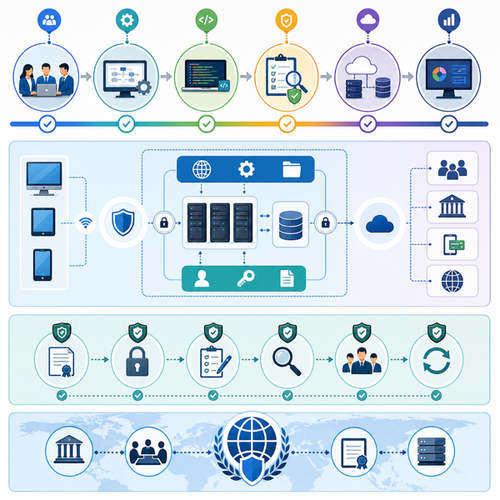
In today's digital-first business environment, the application layer forms the vital connection between people, processes, and IT systems. With escalating demands for secure data exchange, privacy protection, and operational agility, compliance with internationally recognized standards is more crucial than ever. This guide explores four essential information technology standards—ISO/IEC 9594-11:2025, ISO/IEC 9594-12:2025, ISO/IEC 9594-2:2020/Amd 2:2025, and ISO/IEC 9594-6:2020/Amd 1:2025—that shape the future of secure, scalable, and interoperable application layer solutions.
Adopting these standards is no longer an option but a necessity for organizations aiming to implement new technologies—be it cloud migration, IoT integration, or enterprise-wide security modeling. By aligning to international best practices, businesses unlock measurable productivity gains, enhance data security, and establish the scalable infrastructures vital to digital transformation and regulatory compliance. Below, discover what each of these key standards covers, why they matter, and how they drive competitive advantage.
Overview: The Application Layer in Modern IT
The application layer serves as the interface between user-facing applications and underlying network or system infrastructure. Modern enterprise systems depend on robust, standards-based protocols to enable reliable interactions among distributed components, manage complex access rights, and safeguard digital assets. Standards in this domain ensure:
- Interoperability across heterogeneous platforms
- Consistent security policies and cryptographic protocols
- Smooth integration of identity, directory, and public-key infrastructure (PKI)
- The agility to migrate to future-proof, quantum-resistant solutions
Whether you’re responsible for IT governance, cloud architecture, or operational security, understanding and leveraging these standards is key to responsive, future-ready digital business.
What you’ll learn:
- The unique role of each standard in building secure directory services, managing digital identities, and establishing resilient PKIs
- How to integrate these specifications to support enterprise scaling, compliance, and innovation
- Practical insights for implementation and compliance
Detailed Standards Coverage
ISO/IEC 9594-11:2025 – Protocol Specifications for Secure Operations
Information technology — Open systems interconnection directory — Part 11: Protocol specifications for secure operations
This standard provides comprehensive guidance and protocol details for implementing secure operations within the application layer, focusing on the seamless migration and management of cryptographic algorithms—including those needed to be quantum-safe in the near future. At its core, it introduces a wrapper protocol designed to protect other protocols through robust authentication, integrity, and confidentiality mechanisms.
Scope and Key Specifications
- Defines auxiliary cryptographic algorithms and a general wrapper protocol for secure protocol enhancement
- Enables stepwise migration from legacy to stronger, quantum-resistant cryptography with minimal disruption
- Supports protocols relating to public-key infrastructure (PKI), such as certificate authority subscriptions and trust broker operations
- Details error handling, protocol handshake, session management, and information flow mechanisms
Who Should Comply
Organizations that operate critical IT infrastructures, especially those handling confidential communication, digital identities, or large-scale directory services require compliance. This includes:
- Financial institutions
- Cloud service providers
- Enterprises implementing PKI or federated security
Practical Implications
Implementers can secure existing and new application-layer protocols by wrapping them with consistently managed authentication and encryption—without directly burdening each protocol with cryptographic logic. This modular approach ensures:
- Simplified future upgrades to crypto algorithms
- Streamlined compliance with security best practices and evolving regulations
- Enhanced interoperability for multi-vendor environments
Notable Features
- Built-in migration path for cryptographic transitions (classic to post-quantum)
- Supports both symmetric-key (e.g., AES, Camellia) and key establishment algorithms (Diffie-Hellman variants)
- Modular error handling and secure handshake procedures
Key highlights:
- Quantum-safe cryptographic migration
- Wrapper protocol for layered security
- Secure, scalable support for PKI protocols
Access the full standard:View ISO/IEC 9594-11:2025 on iTeh Standards
ISO/IEC 9594-12:2025 – Key Management and Public-Key Infrastructure Establishment and Maintenance
Information technology — Open systems interconnection — Part 12: The Directory: Key management and public-key infrastructure establishment and maintenance
This new addition to the ISO/IEC 9594 family dives deep into the establishment and management of PKI ecosystems, with a unique emphasis on supporting emerging domains such as IoT (Internet of Things) and smart grids. It elaborates on best practices for cryptographic algorithm selection (including post-quantum readiness) and provides structures for PKI setup in distributed, machine-to-machine contexts.
Scope and Key Specifications
- Supplements and extends previous works (e.g., ITU-T X.509) with detailed PKI establishment and maintenance guidelines
- Explains cryptographic algorithm selection, migration strategies, and the fundamentals behind each algorithm’s mathematics
- Focuses on practical PKI deployments for IoT, smart grids, and non-traditional environments
- Introduces guidance for certificate lifecycle management, trust establishment, and hardware security modules
Who Should Comply
- Organizations deploying or managing PKI, especially:
- Utilities and smart grid operators
- Industrial automation and IoT solution integrators
- Enterprises looking to modernize their identity and trust infrastructure
Practical Implications
By adopting this standard, IT leaders can confidently design, roll out, and maintain PKI systems that support secure authentication, digital signature, and encrypted communication—even as internal and external threat landscapes evolve. The focus on future-proof strategies (crypto agility and post-quantum migration) makes this especially valuable for long-lived or critical systems.
Notable Features
- Outlines cybersecurity considerations for large ICT networks
- Provides a formal framework for PKI establishment, including cross-domain trust and federation
- Includes practical checklists, lifecycle management routines, and migration to quantum-resistant protocols
Key highlights:
- Practical PKI for IoT and smart grid use cases
- Best practices for end-to-end certificate and key management
- Preparation for post-quantum security
Access the full standard:View ISO/IEC 9594-12:2025 on iTeh Standards
ISO/IEC 9594-2:2020/Amd 2:2025 – The Directory: Models — Miscellaneous Enhancements
Information technology — Open systems interconnection — Part 2: The Directory: Models — Amendment 2: Miscellaneous enhancements
This amendment provides crucial updates for the underlying data models used in directory services, focusing primarily on improving modularity and facilitating future enhancements. Key changes involve the reorganization of widely used ASN.1 data types and modules, separating cybersecurity and directory definitions for ease of maintenance and adaptability.
Scope and Key Specifications
- Clarifies the separation between ASN.1 modules for cybersecurity purposes and those strictly for directory modeling
- Moves many core information object classes (such as Attribute, AttributeType, Context) to a new UsefulDefinitions module, allowing shared usage between security and directory service specifications
- Provides updated object identifiers, improved references, and enhances the extensibility of directory services
Who Should Comply
- Software and systems engineers developing or maintaining directory-based applications (e.g., LDAP, X.500, enterprise IAM)
- Organizations aiming for future-proof integration across security modules and directory frameworks
Practical Implications
With these enhancements, integration of security protocols and identity management becomes more streamlined. System architects can now:
- Implement clean separation of concerns between security layers and core directory models
- Simplify upgrades and integration of third-party security services
- More easily comply with regulatory and interoperability demands
Notable Features
- Consolidation of reusable ASN.1 type definitions
- Clear object identifier (OID) structures for better governance
- Enhanced module extensibility—future enhancements can be implemented with minimal disruption
Key highlights:
- Streamlined directory model updates
- Simplified modular integration of security and directory functions
- Improved future extensibility for enterprise directories
Access the full standard:View ISO/IEC 9594-2:2020/Amd 2:2025 on iTeh Standards
ISO/IEC 9594-6:2020/Amd 1:2025 – The Directory: Selected Attribute Types — Amendment 1
Information technology — Open systems interconnection — Part 6: The Directory: Selected attribute types — Amendment 1
This amendment focuses on the centralization and rationalization of selected attribute type definitions used within directory services and cybersecurity protocols. By moving foundational ASN.1 symbols and definitions into a shared module (UsefulDefinitions), it supports unified attribute management and greater protocol interoperability.
Scope and Key Specifications
- Adds references and updates to accommodate using common data types across both cybersecurity and directory domains
- Moves attribute types (e.g.,
commonName,dnsName,objectIdentifier) to UsefulDefinitions for more versatile usage - Provides standardized interfaces for password policies, matching rules, syntaxes, and attribute representations
Who Should Comply
- Developers of directory servers (LDAP, X.500) and cybersecurity frameworks
- Enterprises adopting identity governance and access management platforms
Practical Implications
Centralizing ASN.1 definitions enables:
- Easier alignment between cybersecurity modules and directory systems
- Less duplication of type definitions across protocol layers
- More robust management and validation of identity and security-related attributes
Notable Features
- Unified, cross-domain attribute definitions
- Standardized handling of directory strings, object classes, and matching rules
- Updated references for enhanced interoperability
Key highlights:
- Stronger, more consistent attribute typing for directory and security protocols
- Simplified schema integration and updates
- Greater reusability across IT infrastructure components
Access the full standard:View ISO/IEC 9594-6:2020/Amd 1:2025 on iTeh Standards
Industry Impact & Compliance
In today's landscape of cyber threats and digital complexity, these application layer standards are a must-have, not a nice-to-have:
How Do These Standards Affect Businesses?
- Security: Provide a solid, standards-based foundation for encrypted communication, access control, and robust digital identity management
- Scalability: Enable organizations to build modular, extensible systems that can scale across departments or geographies, and adapt to new technologies like IoT or cloud
- Interoperability: Foster seamless data and identity exchange between diverse systems, vendors, and partners, reducing vendor lock-in risk
- Regulatory Compliance: Meet essential privacy, audit, and security requirements mandated by regulations such as GDPR, HIPAA, and financial sector guidelines
Benefits of Adopting These Standards
- Productivity Gains: Reduced manual effort in user management, easier onboarding/offboarding, and automatic key lifecycle handling
- Reduced Risk: Lower exposure to breaches through standardized security models and cryptography migration paths
- Future-Proofing: Stay one step ahead by enabling migration to quantum-safe cryptographic protocols
Risks of Non-Compliance
- Higher likelihood of security incidents, breaches, and data loss
- Increased costs and delays from incompatible systems, manual workarounds, or compliance violations
- Missed business opportunities due to inability to integrate with partners or new technologies
Implementation Guidance
Successfully implementing these IT application layer standards requires practical planning and an incremental approach:
Common Implementation Approaches
- Baseline Assessment: Evaluate current systems for compliance gaps, focusing on crypto agility, directory structure, and PKI maturity
- Pilot Projects: Begin with a pilot—such as wrapping a legacy protocol with the new secure wrapper standard or introducing centralized ASN.1 modules for attribute definitions
- Phased Roll-Out: Incrementally integrate the standards across business units, ensuring minimal disruption to operations
- Ongoing Review: Regularly revisit and update cryptographic practices as best practices and regulatory requirements evolve
Best Practices for Adoption
- Engage all stakeholders, from IT leadership to business users, to ensure understanding and buy-in
- Leverage open-source and commercial toolkits implementing these standards to accelerate migration
- Document policies and procedures for PKI management, directory schema updates, and cryptographic transitions
- Train IT staff on application layer standards and new operational protocols
- Regularly consult the latest versions and amendments to respond to future changes or enhancements
Resources for Organizations
- Standard bodies’ official documentation (ISO, IEC, ITU-T)
- Vendor implementation guides and SDKs aligned with ISO/IEC 9594 series
- Community forums and best practice networks (e.g., PKI, IAM, cybersecurity groups)
Conclusion / Next Steps
These four ISO/IEC standards form the backbone of contemporary application layer security, identity, and interoperability. As information systems become more distributed, interconnected, and security-critical, aligning with these standards is a cornerstone of sustainable, scalable IT strategy.
Key takeaways:
- Enable robust, future-ready security for directories, PKI, and digital identities
- Simplify scaling and integration for cloud, IoT, and cross-domain systems
- Meet business, regulatory, and customer expectations for trust, privacy, and operational resilience
Recommendations:
- Start by reading the detailed specifications for each standard
- Assess your current architectures for alignment and gaps
- Design an incremental path to standards-based operations, with special attention to crypto-migration and attribute standardization
- Stay updated with future amendments and new protocols as technology and threats evolve
Ready to build secure, scalable, and future-proof application architectures? Explore each standard in detail or consult the iTeh Standards platform for the latest, authoritative guidance.
Categories
- Latest News
- New Arrivals
- Generalities
- Services and Management
- Natural Sciences
- Health Care
- Environment
- Metrology and Measurement
- Testing
- Mechanical Systems
- Fluid Systems
- Manufacturing
- Energy and Heat
- Electrical Engineering
- Electronics
- Telecommunications
- Information Technology
- Image Technology
- Precision Mechanics
- Road Vehicles
- Railway Engineering
- Shipbuilding
- Aircraft and Space
- Materials Handling
- Packaging
- Textile and Leather
- Clothing
- Agriculture
- Food technology
- Chemical Technology
- Mining and Minerals
- Petroleum
- Metallurgy
- Wood technology
- Glass and Ceramics
- Rubber and Plastics
- Paper Technology
- Paint Industries
- Construction
- Civil Engineering
- Military Engineering
- Entertainment