


Automatic Identification and Data Capture: Key Standards for Secure, Scalable IT Solutions
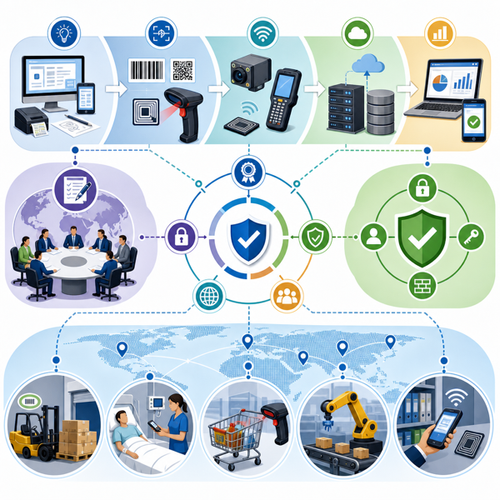
Today, as digital transformation accelerates, automatic identification and data capture (AIDC) techniques are the backbone of secure, productive, and scalable business operations across manufacturing, logistics, healthcare, and retail. Whether tracking shipments with barcodes, enabling seamless interoperability between data registries, or protecting RFID communications against cyber threats, these techniques are orchestrated by robust international standards. In this article, we unpack four authoritative standards that shape the global AIDC landscape—what they require, why they matter, and how compliance enhances business efficiency, security, and scaling potential in a technology-driven era.
Overview / Introduction
Automatic identification and data capture techniques comprise the core systems underpinning digital supply chains, traceable packaging, secure RFID communications, and interoperable metadata management in today’s Information Technology infrastructure. As organizations expand their digital footprints, clarity and harmonization around marking, labeling, securing, and exchanging data are vital. Not only do these standards for automatic identification and data capture enable reliable operations and compliance, but they also directly support innovation, cost reduction, and global market access.
In this guide, readers will:
- Gain foundational understanding of AIDC standards and their scope
- See how each specification applies across industries
- Learn about compliance, productivity, and security advantages
- Discover best practices for successful implementation
- Link directly to the authoritative standard at iTeh Standards
Detailed Standards Coverage
ISO 28219:2026 - Packaging Labelling and Direct Product Marking
Packaging — Labelling and direct product marking with linear bar code and two-dimensional symbols
ISO 28219:2026 defines the global requirements for labelling and direct marking of parts, products, and components using linear barcodes and two-dimensional symbols (like Data Matrix or QR codes). This standard establishes both machine-readable and human-readable content, ensuring that items can be scanned efficiently in various manufacturing and supply chain environments, including by business partners and at all customer touch points.
Key requirements include:
- Methods for encoding unique item, lot, or batch identification
- Precise data formatting using application or data identifiers for interoperability
- Guidelines on label layout, symbology choices, and locations for machine-readable symbols
- Robustness criteria, like adhesive and mark durability, to withstand real-world logistics
ISO 28219:2026 references symbology and quality standards (e.g., ISO/IEC 15415, ISO/IEC 15416, ISO/IEC 16022), making it a cornerstone for traceability, anti-counterfeiting, and automated quality assurance. It is essential for sectors relying on global commerce and supply chain transparency—such as manufacturing, aerospace, automotive, healthcare, and retail. By adopting this standard, businesses enhance product visibility, facilitate recall management, and reduce manual errors, all while complying with domestic and international regulations.
Key highlights:
- Comprehensive guidelines for barcoding and symbol-based marking
- Easy integration with existing industry conventions (GS1, ANSI, etc.)
- Enables automation in inventory, quality control, and lifecycle management
Access the full standard:View ISO 28219:2026 on iTeh Standards
ISO/IEC 11179-3:2023/Amd 1:2026 - Enhancements to Item Mapping (Metadata Registries)
Information technology — Metadata registries (MDR) — Part 3: Metamodel for registry common facilities — Amendment 1: Enhancements to Item Mapping
Amendment 1 to ISO/IEC 11179-3:2023 introduces critical enhancements to item mapping and related functions in metadata registries, which are crucial for organizations that store, manage, and exchange complex data definitions—particularly across disparate information systems or business units.
Major updates include:
- New and revised definitions for data, metadata, and context to improve communication between registries
- Expansion of data type handling (e.g. BLOB for binary objects)
- Extended registry specification attributes for better description and classification
- Addition of Registry Conformance features to formally declare adherence to relevant standards
- A refined Item Mapping package for mapping, transforming, and reviewing registry items, including structured transformation rules and provenance tracking
Industries deploying advanced data integration, data governance, or regulatory reporting systems rely on this standard to align terminology, guarantee data integrity, and enable semantic interoperability. This amendment is particularly beneficial for government agencies, healthcare systems, and multinational corporations managing massive, federated data landscapes. By enhancing item mapping, organizations can bridge data silos, migrate legacy systems, and power analytics or AI initiatives with harmonized metadata.
Key highlights:
- Streamlines mapping and transformation of metadata items across registries
- Supports regulatory compliance with robust conformance and provenance features
- Enables federation and interoperability—critical for large enterprises and public sector databases
Access the full standard:View ISO/IEC 11179-3:2023/Amd 1:2026 on iTeh Standards
ISO/IEC 19583-26:2026 - XML Representation of Metadata Registries
Information technology — Concepts and usage of metadata — Part 26: XML for representation of ISO/IEC 11179-3:2013 content
ISO/IEC 19583-26:2026 provides the formal structure (in W3C XML Schema) to represent content from ISO/IEC 11179-3:2013-compliant metadata registries. This schema is designed for seamless exchange of metadata registry content between compliant systems, supporting use cases including:
- Registry-to-registry synchronization
- Integration with configurable information systems
- Database implementations that require standards-based, portable metadata
The standard lays out:
- Class and attribute vocabularies for mapping registry content into XML
- Conformance guidance for both strict and flexible implementations
- Modelling principles that ensure deterministic, unambiguous data exchange
By applying this XML schema, organizations minimize integration effort when exchanging metadata between partners, platforms, or regulatory agencies—even if software solutions differ. The approach favors interoperability, reduces manual data mapping, and underpins open innovation in data-driven projects by making metadata portable, verifiable, and machine-readable.
Key highlights:
- Complete, standards-based XML schema for metadata interchange
- Supports strict conformance for validation and regulatory purposes
- Accelerates onboarding of new IT systems or cloud services through common metadata vocabulary
Access the full standard:View ISO/IEC 19583-26:2026 on iTeh Standards
ISO/IEC 29167-13:2026 - Crypto Suite Grain-128A Security Services for RFID
Information technology — Automatic identification and data capture techniques — Part 13: Crypto suite Grain-128A security services for air interface communications
As the volume of networked RFID devices surges in logistics, payment, healthcare, and asset tracking, securing air interface communications is paramount. ISO/IEC 29167-13:2026 defines security mechanisms for RFID device communication, specifically the Grain-128A crypto suite—a lightweight, hardware-friendly stream cipher providing essential confidentiality, authentication, and integrity services for RFID tags and readers (interrogators).
Highlights of the security suite:
- Models multiple authentication scenarios: tag authentication, interrogator authentication, and mutual authentication
- Details crypto-commands and state diagrams for robust session control
- Allows for Message Authentication Code (MAC) generation, enhancing tamper detection and trust
- Supports system manufacturers in selecting and declaring supported security features clearly
Compliance with this standard enables businesses to mitigate data interception and cloning risks, safeguard sensitive logistics or personal data, and assure customers and regulators of the security posture of their IoT and RFID-enabled operations. It is a critical pillar for future-proofing supply chains, frictionless retail, and automated production environments.
Key highlights:
- Robust yet lightweight security for constrained RFID environments
- Flexible options for one-way or mutual authentication, tailored to business needs
- Supports compliance with supply chain security policies and privacy regulations
Access the full standard:View ISO/IEC 29167-13:2026 on iTeh Standards
Industry Impact & Compliance
The adoption of automatic identification and data capture standards is now non-negotiable for digitally advanced businesses. With mass customization, globalization, and rising regulatory demands, only companies leveraging these standards can guarantee product traceability, cross-system compatibility, and cyber-resilient supply chains.
Compliance matters for:
- Ensuring seamless data exchange and integrity between partners
- Meeting sector-specific traceability or safety regulations
- Protecting intellectual property and personal data during AIDC processes
- Accelerating product recalls and quality interventions through standardized item identification
Benefits of standard adoption:
- Increased productivity through process automation and error reduction
- Improved security via authenticated communications and validated metadata exchange
- Powerful scalability, enabling rapid integration of new partners or technologies
- Reduced total cost of ownership due to harmonized workflows and tools
- Enhanced credibility and global market eligibility
Risks of non-compliance:
- Regulatory and contractual penalties
- Compromised data security and business continuity
- Customer and partner dissatisfaction
- Incompatibility with modern IT systems, resulting in technical debt
Implementation Guidance
Best practices for successful implementation:
- Assessment: Review your operational requirements and regulatory obligations to select the applicable standards.
- Gap Analysis: Compare your current systems and labeling/data processes against standard specifications.
- Technological Integration: Use certified hardware and software—barcode printers, RFID tags/readers, metadata registry solutions—proven to implement the standards accurately.
- Process Adaptation: Update policies, staff training, and supplier agreements to reflect best practices in data capture, security, and traceability.
- Testing and Validation: Use industry-approved quality and conformance testing tools (e.g., for barcode print quality or cryptographic protocol validation).
- Continuous Improvement: Stay abreast of amendments and evolving standard versions through platforms like iTeh Standards, and conduct periodic compliance audits.
Resources:
- Official standard documents (see direct links above)
- Implementation guides for industry-specific adaptations
- Vendor conformance certificates
- Consultation with standards bodies or expert advisors
Conclusion / Next Steps
In a world where digital ecosystems and physical supply chains are increasingly intertwined, robust standards for automatic identification and data capture are the foundation of secure, scalable, and efficient operations. ISO 28219:2026, ISO/IEC 29167-13:2026, ISO/IEC 11179-3:2023/Amd 1:2026, and ISO/IEC 19583-26:2026 each address a vital pillar—product traceability, interoperable metadata, and secure RFID—empowering organizations to harness innovation while controlling risk.
Key takeaways:
- Adopting these standards future-proofs your business against market and regulatory shifts
- Productivity, data security, and seamless scalability are direct outcomes of standards-compliant AIDC initiatives
- Expert implementation leverages official resources, vendor-certified technologies, and ongoing compliance reviews
Recommendation: Begin with an internal assessment of your AIDC and data governance processes. Leverage the links above on iTeh Standards to explore each standard, access full specifications, and stay ahead in the evolving landscape of automatic identification and data capture. With these standards as your foundation, your organization is poised for safe, efficient, and globally compatible growth.
Categories
- Latest News
- New Arrivals
- Generalities
- Services and Management
- Natural Sciences
- Health Care
- Environment
- Metrology and Measurement
- Testing
- Mechanical Systems
- Fluid Systems
- Manufacturing
- Energy and Heat
- Electrical Engineering
- Electronics
- Telecommunications
- Information Technology
- Image Technology
- Precision Mechanics
- Road Vehicles
- Railway Engineering
- Shipbuilding
- Aircraft and Space
- Materials Handling
- Packaging
- Textile and Leather
- Clothing
- Agriculture
- Food technology
- Chemical Technology
- Mining and Minerals
- Petroleum
- Metallurgy
- Wood technology
- Glass and Ceramics
- Rubber and Plastics
- Paper Technology
- Paint Industries
- Construction
- Civil Engineering
- Military Engineering
- Entertainment