


August 2026: Information Technology Standards Advance with Digital Twins, Geodesy, and IoT Interoperability
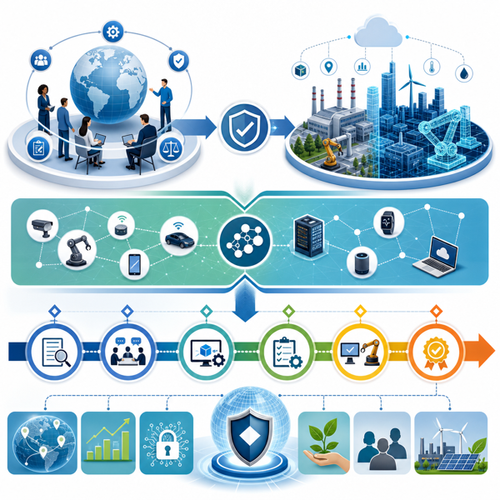
August 2026 brings a significant wave of progress across Information Technology and Office Equipment standards. Five new and revised international standards were published, each contributing unique frameworks, governance models, and technical specifications in geographic information systems, industrial automation, secure financial communications, healthcare data management, and the Internet of Things (IoT). For industry professionals, adopting these standards means bolstered interoperability, compliance assurance, and a competitive edge in ever-evolving technological environments.
Overview / Introduction
In the dynamic sphere of Information Technology and Office Equipment, standards underpin data integrity, system interoperability, and cross-industry trust. As digital transformation accelerates, new specifications ensure that diverse systems can reliably exchange, interpret, and secure data — from global geodetic reference frameworks to industrial digital twins and medical product vocabularies. This article unpacks five recent standards released in August 2026, detailing the scope, requirements, and impact areas for each. Readers will discover critical updates essential for regulatory compliance, quality management, procurement, and strategic technology planning.
Detailed Standards Coverage
EN ISO 19127:2026 - Geographic Information — Geodetic Register
Geographic information — Geodetic register (ISO 19127:2026)
What It Covers & Scope: EN ISO 19127:2026 defines the structure, governance, and management of the ISO Geodetic Register, aligning with ISO/DIS 19135 on register management and ISO 19111 on geodetic referencing by coordinates. It sets out roles, responsibilities, and operational processes for entities maintaining or utilizing geodetic reference information, including proposal, approval, modification, and retirement of register items.
Key Requirements & Specifications:
- Standardizes the structure and content of global geodetic reference data
- Emphasizes roles (register owner, manager, control body, system manager, proposer, user)
- Outlines processes for adding, modifying, or retiring register items
- Integrates with ISO 19111 for coordinate reference systems, allowing for accurate spatial data mapping
Who Needs to Comply: Geospatial data providers, mapping agencies, spatial data infrastructure custodians, surveying organizations, and GIS solution vendors.
Practical Implications: Organizations must adopt these requirements to maintain harmonized geodetic data, ensure credibility and traceability of spatial information, and support interoperability in international mapping or location-based services.
Notable Changes:
- Major revision incorporating updates from ISO 19111:2019 and ISO/DIS 19135
- Enhanced best practices for register content, metadata, and system governance
Key highlights:
- Unified register governance aligned with global best practices
- Processes for robust proposal, approval, content management, and appeal
- Extended support for metadata and aliases referencing other systems
Access the full standard:View EN ISO 19127:2026 on iTeh Standards
ISO/TS 25271:2026 - Automation Systems and Integration — Industrial Digital Twin Interface Architecture
Automation systems and integration — Industrial digital twin interface architecture
What It Covers & Scope: ISO/TS 25271:2026 specifies the foundational architecture for industrial digital twin systems, including the digital twin, the physical twin, and the interface linking the two. It clarifies terminology, system structure, and the types of data exchange essential for robust digital mirroring of physical assets in manufacturing, energy, automotive, and other industrial environments.
Key Requirements & Specifications:
- Defines roles for industrial digital twin (IDTw), physical twin (PTw), and twinning interface
- Outlines feedback control loops, simulation, and mutual augmentation
- Includes lifecycle considerations and use cases in implementation
- Differentiates digital twin systems from cyber-physical systems and alternative digitalization/AR frameworks
Who Needs to Comply: Manufacturers, automation solution developers, system integrators, and industrial IoT vendors seeking standardized approaches for digital twin adoption.
Practical Implications: Enables clear communication between stakeholders, modular system design, and easier integration. Supports traceable, accurate, and real-time data interchange between physical assets and their digital counterparts, fostering predictive maintenance, process optimization, and lifecycle insights.
Notable Changes:
- First edition establishing baseline terminology and architecture
- Direct comparison with assets administration shell (AAS), cyber-physical systems, and metaverse frameworks
Key highlights:
- Clear separation of digital and physical twin responsibilities
- Interoperable three-element architecture for scalable implementation
- Use case-driven guidance for industry-specific adoption
Access the full standard:View ISO/TS 25271:2026 on iTeh Standards
ISO 20038:2026 - Banking and Related Financial Services — Key Wrap Using Advanced Encryption Standard (AES)
Banking and related financial services — Key wrap using advanced encryption standard (AES)
What It Covers & Scope: ISO 20038:2026 defines a secure method for packaging (wrapping) cryptographic keys for transfer and storage using AES (Advanced Encryption Standard). This specification is a critical component in securing electronic transactions in banking, financial services, and payment infrastructures.
Key Requirements & Specifications:
- Mandates AES as the wrapping cipher for confidentiality and integrity protection
- Details structure and format for key blocks, including header, algorithm, and usage constraints
- Provides sample implementations for symmetric and asymmetric key scenarios (including ECC and RSA)
- Specifies mechanisms for key binding, validation, derivation, exportability, and versioning
- Aligns with ANSI X9.143-2022 for interoperability
Who Needs to Comply: Financial institutions, payment processors, transaction network operators, and solution vendors providing secure key management platforms.
Practical Implications: Facilitates secure key transport and storage, ensures integrity across interconnected platforms, and is a prerequisite for audit, compliance, and fraud prevention in regulated environments.
Notable Changes:
- Major update to achieve compatibility with ANSI X9.143-2022
- Expanded coverage for use in asymmetric cryptosystems and exportability management
Key highlights:
- Unified approach to key wrapping for multi-vendor ecosystems
- Strong alignment with industry best practices and compliance mandates
- Reduces cryptographic vulnerabilities through standardized methods
Access the full standard:View ISO 20038:2026 on iTeh Standards
ISO 22532:2026 - Health Informatics — Identification of Medicinal Products — Core Vocabulary
Health informatics — Identification of medicinal products — Core vocabulary
What It Covers & Scope: ISO 22532:2026 delivers a harmonized set of definitions and controlled vocabulary for the Identification of Medicinal Products (IDMP). The standard ensures linguistic and semantic consistency across technical specifications and related standards in health informatics.
Key Requirements & Specifications:
- Provides core (ontology-based) definitions for pharmaceutical product identification
- Clarifies context-specific homonyms, hierarchical term relationships, and semantic triples for ontology mapping
- Ensures interoperability and consistency across all IDMP standards and applications
Who Needs to Comply: Regulatory agencies, pharmaceutical manufacturers, healthcare software developers, researchers, and standards implementers.
Practical Implications: Reduces ambiguity in the regulatory identification of medicines, supports reliable electronic health record integration, enables global harmonization, and accelerates regulatory submissions.
Notable Changes:
- Consolidates definitions from previous and parallel IDMP standards
- Sets a foundation for evolving health data standards and semantic web applications
Key highlights:
- Single source for IDMP-related controlled terms
- Improves consistency, reduces misalignment and compliance risk
- Supports automated processing and ontology-driven health IT systems
Access the full standard:View ISO 22532:2026 on iTeh Standards
ISO/IEC 30178:2026 - Internet of Things (IoT) — Data Format, Value and Coding for Interoperability
Internet of Things (IoT) — Data format, value and coding for interoperability
What It Covers & Scope: ISO/IEC 30178:2026 sets out the core data formats, coding methodologies, and value expression rules needed for achieving seamless interoperability between IoT systems. The standard spans sensor data structures, measurement units, metadata, and conversion mechanisms to ensure accurate, scalable, and interpretable machine-to-machine communication.
Key Requirements & Specifications:
- Defines sensor value metadata (resolution, precision, sampling rates, units, types)
- Supports canonical and contextual representations of physical quantities
- Lays out mechanisms for data translation, type inference, and semantic mapping
- Addresses system integration, scalability, human/machine readability, and error handling
Who Needs to Comply: IoT platform providers, smart device manufacturers, application developers, and systems integrators deploying multi-vendor environments.
Practical Implications: Mitigates the complexity of integrating heterogeneous sensors and platforms, enhances data capital value, facilitates regulatory alignment, and enables large-scale, reliable IoT deployments in smart cities, manufacturing, and logistics.
Key highlights:
- Enables unified treatment of measurement and sensor data across systems
- Provides technical foundation for robust, future-proof IoT solutions
- Reduces costly custom API and data mapping work
Access the full standard:View ISO/IEC 30178:2026 on iTeh Standards
Industry Impact & Compliance
These standards have wide-ranging implications:
- For GIS and spatial professionals: Guaranteed data integrity and exchange through robust geodetic reference registers.
- In manufacturing/industrial automation: Clear and interoperable digital twin architectures foster innovation, simulation, and lifecycle management.
- Banking and finance: Secure key exchange methods safeguard transactions, meet compliance mandates, and build consumer trust.
- Pharmaceutical and healthcare IT: Reliable medicinal product identification is essential for safety, interoperability, and global regulatory compliance.
- IoT and smart infrastructure: Interoperable data exchange unleashes the economic and operational value of vast sensor networks.
Compliance Considerations: Many standards specify conformance and validation clauses or abstract test suites (e.g., ISO 19127 Annex A) for implementation. Organizations should:
- Review impacted business processes
- Update internal procedures and training
- Align product development and procurement specifications
- Monitor regulatory timelines for mandated adoption
Benefits of Adopting These Standards:
- Enhanced data interoperability and reduced vendor lock-in
- Improved quality, safety, and user confidence
- Faster, more cost-effective integration and rollout
- Mitigated non-compliance risks, including legal or reputational damage
Risks of Non-Compliance:
- System incompatibility or data loss
- Regulatory fines or certification barriers
- Increased integration costs and vendor lock-in
- Loss of market access for products/services
Technical Insights
Across these standards, common technical themes emerge:
- Modular architecture: Facilitates ongoing evolution and upgrades
- Semantic consistency and ontologies: Enable automation and smarter data analytics
- Unified data formats and metadata structures (e.g., sensor metadata, geodetic register entries, health informatics vocabularies)
- Testing and Certification: Many standards provide or reference conformance suites and implementation guidelines, helping organizations validate products before market launch
- Best Practices for Implementation:
- Map your current systems against new requirements
- Engage relevant experts or standards bodies for clarification
- Pilot new compliance workflows or interfaces before full rollout
- Leverage official abstract test suites or case examples for verification
- Regularly monitor for revisions and updates
Conclusion / Next Steps
The August 2026 set of Information Technology standards lays a strong technological and operational foundation for a wide range of industries, shaping futureproof digital ecosystems. Organizations across sectors should:
- Analyze which standards apply to their activities
- Prioritize swift adoption to secure interoperability, compliance, and market leadership
- Leverage resources like iTeh Standards to access authoritative documents and stay abreast of ongoing developments
For industry professionals—engineers, compliance managers, IT architects, and policy makers—staying informed is crucial. Regularly consult the latest international standards to ensure your organization remains both competitive and compliant in a rapidly changing digital world.
Categories
- Latest News
- New Arrivals
- Generalities
- Services and Management
- Natural Sciences
- Health Care
- Environment
- Metrology and Measurement
- Testing
- Mechanical Systems
- Fluid Systems
- Manufacturing
- Energy and Heat
- Electrical Engineering
- Electronics
- Telecommunications
- Information Technology
- Image Technology
- Precision Mechanics
- Road Vehicles
- Railway Engineering
- Shipbuilding
- Aircraft and Space
- Materials Handling
- Packaging
- Textile and Leather
- Clothing
- Agriculture
- Food technology
- Chemical Technology
- Mining and Minerals
- Petroleum
- Metallurgy
- Wood technology
- Glass and Ceramics
- Rubber and Plastics
- Paper Technology
- Paint Industries
- Construction
- Civil Engineering
- Military Engineering
- Entertainment