


June 2026: New Standards Advance Efficiency, AI, and Security in Information Technology
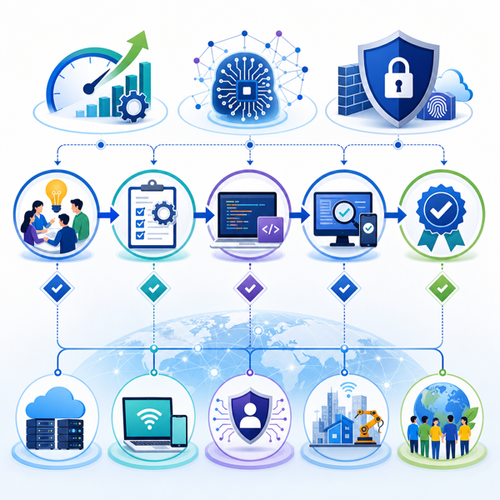
The Information Technology and Office Equipment sector welcomes impactful new international standards this June 2026, aimed at enhancing energy efficiency, operational consistency, AI optimization, digital security, and data management. These five newly published standards offer IT professionals, quality managers, engineers, and compliance officers robust frameworks to address current and future industry demands. Each standard brings essential updates—ranging from networked standby power measurement protocols to guidelines for onboarding personal identification data in European digital identities.
Overview / Introduction
Information Technology and Office Equipment standards are foundational to digital transformation, regulatory compliance, and marketplace trust. From smarter devices and artificial intelligence to sophisticated data management and secure digital identities, standards ensure interoperability, sustainability, and security. In this article, industry professionals will gain insights into the practical requirements, implementation implications, and compliance pathways for the latest standards in June 2026.
Whether your focus is energy-efficient office ecosystems, AI development, transport communications, print technology, or digital identity, these standards deliver updated best practices and technical specifications to guide successful adoption. Read on for detailed coverage of each publication and its significance.
Detailed Standards Coverage
IEC 63474:2026 - Networked Standby Power Measurement for Edge Equipment
Electrical and electronic household and office equipment - Measurement of networked standby power of edge equipment
The updated IEC 63474:2026 standard delivers a comprehensive set of methodologies for measuring the electrical power consumption of edge equipment in networked standby modes. This edition introduces critical revisions, expanding measurement protocols to battery-operated products and harmonizing terminology with related standards. The document details precise conditions for testing, including configuration of network ports, wireless management, and uncertainty of measurements, ensuring accurate reporting and repeatability across manufacturers and laboratories.
Key requirements outlined include:
- Applicability to devices powered by low-voltage AC, DC, or internal batteries (covering up to 1,000 V AC and 50 V DC).
- Strict measurement procedures for devices in standby, including wireless reactivation and auxiliary batteries.
- Exclusion of active modes, battery charging (outside of maintenance mode), and non-networked standby conditions.
This standard targets manufacturers of household appliances, office equipment, audio/video devices, digital radio receivers, and gas-burning equipment with electronic components. The new edition’s extended scope means compliance is mandatory for most network-enabled devices found in smart homes and offices.
Practical implications include the need for updated test protocols in compliance laboratories, product design to minimize standby losses, and improved energy labeling transparency for end users.
Key highlights:
- Expands coverage to battery-powered edge devices.
- Updates and aligns measurement terms/conditions with IEC 62301 (Edition 3).
- Horizontal publication status, applicable across multiple device categories.
Access the full standard:View IEC 63474:2026 on iTeh Standards
ISO/TR 19312:2026 - Predicting Print Image Quality for High-Speed Inkjet Printing
Graphic technology — Analysis of a method for predicting print image quality for prints from high-speed inkjet printing system from combinations of paper properties
ISO/TR 19312:2026 analyzes and reports on statistical models to predict print image quality for high-speed inkjet systems based on measured paper properties. Unlike traditional print standards, this technical report introduces a 'black box approach'—using combinations of properties like contact angle, hygroexpansivity, liquid penetration, silicon content, and surface roughness, rather than single-criterion analysis.
The document outlines step-by-step procedures for paper property assessment, references pertinent ISO standards for each property, and presents calculation methods for image quality predictions. This approach enables manufacturers to optimize print substrate selection and compatibility, reducing costly trial-and-error and accelerating production workflows.
The primary audiences are high-speed inkjet press manufacturers, paper suppliers, and industrial print providers aiming to ensure quality and consistency without extensive on-site print trials.
Implementation means developing or updating in-house quality testing processes, data-driven paper selection tools, and providing improved technical communication between equipment manufacturers, paper producers, and end users.
Key highlights:
- Introduces data-driven prediction models for print image quality.
- Details linkage of paper properties to ISO measurement standards.
- Supports use with conventional papers and advanced inkjet systems.
Access the full standard:View ISO/TR 19312:2026 on iTeh Standards
ISO/TS 24854-5:2026 - Intelligent Transport Systems Facilities Layer: Message Sets
Intelligent transport systems — Facilities layer services — Part 5: Message sets
ISO/TS 24854-5:2026 defines the technical requirements and guidelines for creating, using, and managing 'message sets' (ITS-MsgSets) within intelligent transport system (ITS) station facilities layers. These message sets enable interoperability between various ITS solutions by providing a common method for the unique identification, versioning, and concatenation of transport protocol data units (ITS-MsgSetPDUs).
The specification emphasizes ASN.1-based architecture for message formatting, global unique IDs for message sets, and efficient encoding/transmission protocols. It interfaces with other core ITS standards, such as ISO 21217 and ISO 17419, providing a unified framework for message management in complex transport environments.
This standard is essential for developers and system integrators working on ITS infrastructures, including vehicle-to-infrastructure (V2I), vehicle-to-vehicle (V2V), urban mobility services, public transport management, and traffic safety systems.
Adoption provides significant benefits in channel load reduction, message security, dynamic PDU creation, and compliance with global ITS registries (RITSI).
Key highlights:
- Defines globally unique ITS message set identifiers (ITS-MsgSetID).
- Offers methods for concatenation, versioning, and encoding of transport messages.
- Interfaces seamlessly with existing ISO ITS-architecture standards.
Access the full standard:View ISO/TS 24854-5:2026 on iTeh Standards
ISO/IEC TS 42112:2026 - Guidance on Machine Learning Model Training Efficiency
Information technology — Artificial intelligence — Guidance on machine learning model training efficiency optimization
ISO/IEC TS 42112:2026 offers a structured framework for optimizing the efficiency of machine learning (ML) model training. It presents practical strategies across the ML pipeline, focusing on data quality, feature engineering, algorithm selection, parallelization, resource management, and communication optimization. The document summarizes best practices and outlines performance metrics, enabling AI providers and producers to benchmark, compare, and iterate on ML training protocols.
While not prescribing hardware-specific acceleration mechanisms, the guidance is highly relevant to software engineers, data scientists, and IT managers responsible for scalable AI deployments—balancing resource usage, time-to-market, and model quality.
Key domain requirements include continuous monitoring, automated anomaly detection, communication optimization, hierarchical checkpointing, and adaptive resource management—all geared towards cutting costs and speeding solution delivery.
Adopting this specification can help organizations reduce infrastructure expenses, minimize training times, and improve model robustness at scale.
Key highlights:
- Comprehensive optimization strategies for ML training phases.
- Covers data, algorithm, hardware, and system resource considerations.
- Provides comparative framework for different ML workflow strategies.
Access the full standard:View ISO/IEC TS 42112:2026 on iTeh Standards
CEN/TS 18098:2026 - Onboarding Personal Data in European Digital Identity Wallets
Guidelines for the onboarding of user personal identification data within European Digital Identity Wallets
CEN/TS 18098:2026 delivers in-depth guidance for onboarding personal identification data (PID) in European Digital Identity Wallets, fully aligned with eIDAS (electronic Identification, Authentication and trust Services) regulation. The document specifies roles, responsibilities, identity proofing workflows, assurance levels, cryptographic binding of credentials, and PID metadata requirements for natural and legal persons.
By addressing use cases ranging from individuals controlling their own PID to legal representatives, the standard provides scalable onboarding models and high-assurance requirements for legal compliance. Noteworthy features include privacy and data protection by design, mapping to the ISO/IEC 23220 series, and detailed workflows for issuance, credential management, and key attestation.
This is a must-have reference for European wallet providers, national identity authorities, IT architects, compliance managers, and any stakeholder integrating or relying on digital identity systems for access control, electronic transactions, or regulatory compliance.
Key highlights:
- Aligns onboarding process with EU eIDAS and national law requirements.
- Comprehensive workflow coverage for PID collection, proofing, and credential provisioning.
- Strong focus on identity assurance, privacy, and cryptographic security.
Access the full standard:View CEN/TS 18098:2026 on iTeh Standards
Industry Impact & Compliance
The June 2026 standards advance the state-of-practice across every facet of Information Technology and Office Equipment:
- Manufacturers must update their design and compliance documentation for edge devices and digital wallets.
- AI/ML practitioners gain new optimization guidelines to lower operational costs in model training.
- Quality management teams will benefit from more precise, repeatable testing and reporting protocols.
- IT systems integrators can ensure interoperability and legal conformance, especially for digital identity solutions and smart transport infrastructure.
With many of these standards introducing revised or extended scopes, organizations should assess compliance readiness early, redesign affected processes or workflows, and equip teams with the updated technical documentation.
The benefits are substantial: improved product differentiation, easier certification/market access, reduced energy and resource consumption, higher information security, and enhanced customer trust. Non-compliance, conversely, may result in regulatory penalties, market exclusion, or reputational risk.
Organizations are advised to set transition timelines aligned with relevant local and international requirements, leveraging the full documentation and support from iTeh Standards.
Technical Insights
Across the five standards covered, several technical synergies and best practices emerge:
- Measurement Consistency: Testing procedures (especially for energy and performance) must now include expanded configurations (batteries, wireless), require traceable reporting, and are subject to tighter instrument and environment controls.
- Data-Driven Quality: Whether in printing, ML, or digital identity, the move toward predictive, statistically robust, and data-rich approaches enables smarter product selection, improved user experience, and scalable automation.
- Security and Privacy by Design: Credential management, cryptographic binding, and lawful control over personal data are now baseline requirements for any digital identity platform.
- Resource Optimization: AI standards formalize multi-level approaches—including feature selection, parallelism, and adaptive resource management—to meet demanding cost and performance benchmarks.
Implementation best practices:
- Maintain clear process documentation aligning organizational policies with standard requirements.
- Conduct gap analyses to compare legacy protocols with new standard provisions.
- Build or update internal test facilities to mirror latest measurement and data management mandates.
- Train technical, compliance, and management staff on the implications of each new/revised standard.
- Prioritize certifications and market communication to reflect the adoption of new standards.
Testing/Certification Considerations:
- Accredited laboratories should use official test templates and protocols as stipulated in each standard.
- For AI/ML practices, leverage the standard’s optimization metrics and comparison methodologies to validate performance improvements.
- Digital identity implementers must ensure Level of Assurance requirements are met for regulated scenarios.
Conclusion / Next Steps
The June 2026 Information Technology standards refresh offers significant progress across efficiency, quality, security, and compliance. Industry professionals should review these standards in detail, engaging with reference documentation on iTeh Standards, and proactively integrate new requirements into product development, testing, and compliance management cycles.
Key takeaways:
- Prepare for stricter, broader measurement protocols for smart devices.
- Harness data-driven and statistical methods for both process optimization and product design.
- Implement robust identity management workflows in line with European regulatory frameworks.
- Apply system-level AI/ML training efficiency best practices for sustainable and scalable solutions.
Recommendations:
- Download and review each standard through the provided iTeh Standards links.
- Schedule internal training and compliance reviews.
- Align product and service roadmaps to meet new and upcoming requirements.
Stay informed and competitive—explore all new releases on iTeh Standards and ensure your organization’s continued leadership in Information Technology and Office Equipment excellence.
Categories
- Latest News
- New Arrivals
- Generalities
- Services and Management
- Natural Sciences
- Health Care
- Environment
- Metrology and Measurement
- Testing
- Mechanical Systems
- Fluid Systems
- Manufacturing
- Energy and Heat
- Electrical Engineering
- Electronics
- Telecommunications
- Information Technology
- Image Technology
- Precision Mechanics
- Road Vehicles
- Railway Engineering
- Shipbuilding
- Aircraft and Space
- Materials Handling
- Packaging
- Textile and Leather
- Clothing
- Agriculture
- Food technology
- Chemical Technology
- Mining and Minerals
- Petroleum
- Metallurgy
- Wood technology
- Glass and Ceramics
- Rubber and Plastics
- Paper Technology
- Paint Industries
- Construction
- Civil Engineering
- Military Engineering
- Entertainment