


Certification Process and IT Security: Essential International Standards for Modern Businesses
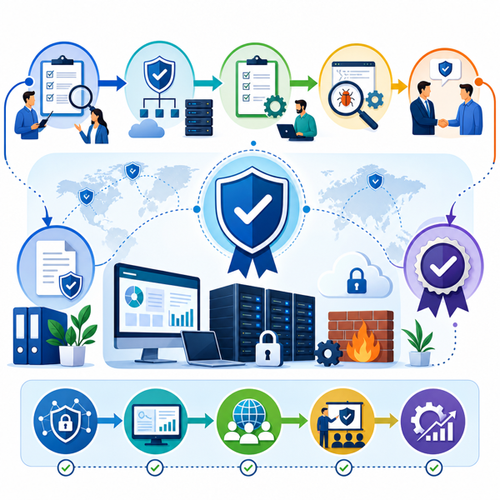
Today’s digital landscape demands rigorous, robust approaches to IT security and certification. Organizations face complex challenges—from evolving cyberthreats and regulatory changes to the demands of global commerce. By adopting international IT security standards, businesses can protect sensitive data, enhance trust, streamline compliance, and enable productive scaling. This article provides a user-friendly overview of four essential standards: ISO/IEC 18033-2:2006/Amd 2:2026, ISO/IEC 20897-2:2022, ISO/IEC 26137:2024, and ISO/IEC 27032:2023—empowering readers to navigate the certification process and optimize both productivity and security.
Overview / Introduction
Information technology underpins every sector of the economy, making IT security not just a technical concern but a business imperative. As organizations handle more data, interact with global partners, and transition to cloud or hybrid systems, the risk of cyber attacks—or regulatory penalties for data breaches—increases dramatically.
Why do these standards matter?
- They define best practices and clear requirements for critical IT security domains such as encryption, authentication, hardware security, and the broader scope of internet safety.
- International standards reduce ambiguity and set measurable targets for security, giving organizations a competitive advantage in the certification process.
- Compliance isn’t just a checkbox—for many businesses, it’s a market entry requirement, investor expectation, or legal necessity.
In this guide, you will:
- Understand the relevance, requirements, and core provisions of each standard
- Learn how standards support compliance, data protection, and business growth
- See the practical impact on certification processes and IT security posture
Detailed Standards Coverage
ISO/IEC 18033-2:2006/Amd 2:2026 - Asymmetric Ciphers in Encryption Algorithms (Amendment 2)
Information technology — Security techniques — Encryption algorithms — Part 2: Asymmetric ciphers — Amendment 2
What this standard covers and its scope: ISO/IEC 18033-2, with its Amendment 2 (2026), provides updated specifications for asymmetric encryption algorithms—essential components for protecting sensitive data in transit and at rest. Amendment 2 introduces detailed provisions for advanced Key Encapsulation Mechanisms (KEM), prominently including post-quantum cryptography approaches like Classic McEliece KEM and FrodoKEM, as well as enhancements to hybrid ciphers vital for modern cryptographic solutions.
Key requirements and specifications:
- Defines algorithms such as ECIES-KEM, PSEC-KEM, ACE-KEM, FACE-KEM, RSA-KEM, Classic McEliece KEM, FrodoKEM, and ML-KEM
- Specifies mathematical functions and algorithms for key generation (KeyGen), encapsulation (Encap), and decapsulation (Decap) for each algorithm
- Provides conformance requirements for implementing these ciphers, including parameter set selection and output consistency
- Details encoding, decoding, matrix reduction, systematic and semi-systematic form calculations for cryptographic operations
Who needs to comply:
- Organizations building or procuring encryption tools (especially for secure messaging, e-commerce, or cloud storage)
- Software vendors, IT security product developers, system integrators
- Enterprises demanding assurance of post-quantum readiness and compatibility
Practical implications:
- Enables forward-looking, quantum-resistant security measures
- Strengthens overall encryption infrastructure with verified, modern approaches
- Facilitates certification against current and future regulatory requirements
Notable features:
- Comprehensive mathematical definitions for post-quantum KEM algorithms
- Flexible parameter sets to match varying security needs
- Clear guidance for implementors and system architects
Key highlights:
- Incorporates leading-edge, quantum-resistant encryption techniques
- Offers detailed, standardized process for KEM-based encryption
- Forms foundational reference for crypto module certification
Access the full standard:View ISO/IEC 18033-2:2006/Amd 2:2026 on iTeh Standards
ISO/IEC 20897-2:2022 - Physically Unclonable Functions (PUFs) Test and Evaluation Methods
Information security, cybersecurity and privacy protection — Physically unclonable functions — Part 2: Test and evaluation methods
What this standard covers and its scope: ISO/IEC 20897-2:2022 provides the authoritative framework for testing and evaluating physically unclonable functions (PUFs)—hardware-based features that enhance cryptographic module security and device authentication without requiring stored cryptographic secrets. PUFs exploit intrinsic, microscopic differences in device fabrication, making them nearly impossible to duplicate or predict.
Key requirements and specifications:
- Evaluation methods for key PUF features: steadiness, randomness, uniqueness, tamper-resistance, mathematical and physical unclonability
- Test conditions accounting for varied operating environments (temperature, voltage, humidity)
- Application of statistical metrics (bit error rate, entropy estimation, inter/intra-Hamming distance)
- Security assessment processes addressing both statistical and model-based evaluation
- Documentation requirements for test results, evaluation rationales, and design rationale
Who needs to comply:
- Hardware security module (HSM) manufacturers
- Semiconductor and IoT device producers
- Organizations employing or procuring identity/authentication-critical hardware
Practical implications:
- Ensures cryptographic modules are resistant to advanced attacks (reverse engineering, side-channel, invasive physical attack)
- Enables the certification and commercial deployment of highly secure devices
- Enhances trustworthiness of supply chain components (vital for critical infrastructure and defense)
Notable features:
- Cross-references leading cryptographic module requirements (ISO/IEC 19790)
- Addresses both qualitative (design rationale) and quantitative (metrics testing) assurance
- Facilitates third-party validation and procurement transparency
Key highlights:
- Standardizes powerful hardware-rooted device authentication
- Improves resilience against cutting-edge physical and side-channel attacks
- Lays foundation for next-generation IoT and embedded device security
Access the full standard:View ISO/IEC 20897-2:2022 on iTeh Standards
ISO/IEC 26137:2024 - OpenID Connect Back-Channel Logout 1.0
Information technology — OpenID connect — OpenID connect back-channel logout 1.0 incorporating errata set 1
What this standard covers and its scope: ISO/IEC 26137:2024 specifies robust protocols for secure, privacy-compliant end-user session termination (logout) using the OpenID Connect Back-Channel Logout mechanism—essential for cloud applications, federated identity management, and single sign-on (SSO) ecosystems. By leveraging direct machine-to-machine (M2M) communication, it overcomes limitations associated with browser-based or "front-channel" logout.
Key requirements and specifications:
- Defines protocol for logout via secure back-channel (as opposed to user-agent/browser)
- Requirements for participation and declaration of support by both OpenID Providers (OPs) and Relying Parties (RPs)
- Structuring, signing, and verification of logout tokens (JWT-based)
- Session management metadata, security events, and error handling
- Detailed security considerations to prevent cross-session and replay attacks
Who needs to comply:
- Cloud service and SaaS providers
- Identity governance and SSO system implementors
- Enterprises deploying federated identity solutions
Practical implications:
- Enables automatic, seamless logout synchronization across all connected services when a user session ends, strengthening account hygiene
- Reduces risk of orphaned or lingering sessions, addressing privacy and compliance risks
- Supports interoperability in large, distributed environments
Notable features:
- RESTful API support; robust session event handling
- Comprehensive metadata options for dynamic environments
- Clear alignment with OAuth 2.0 and OpenID Connect standards
Key highlights:
- Ensures reliable user deprovisioning in federated/cloud contexts
- Mitigates privacy and compliance exposures in modern identity architectures
- Lays groundwork for scalable, secure access control
Access the full standard:View ISO/IEC 26137:2024 on iTeh Standards
ISO/IEC 27032:2023 - Guidelines for Internet Security
Cybersecurity — Guidelines for Internet security
What this standard covers and its scope: ISO/IEC 27032:2023 presents high-level yet actionable guidance for managing Internet security—covering everything from risk assessment to the treatment of vulnerabilities, threats, and attack vectors such as phishing, malware, and social engineering. It clarifies the relationship between web, network, Internet, and cybersecurity, ensuring organizations adopt a holistic approach.
Key requirements and specifications:
- Risk identification: threats, vulnerabilities, and attack vectors impacting Internet-connected systems
- Security guidelines for Internet-facing applications, assets, and infrastructure
- Controls in asset management, access management, privacy, malware protection, incident management, business continuity, and supplier management
- Recommendations for education/awareness campaigns and policy development
- Emphasis on cryptography, vulnerability patching, application and endpoint security, and monitoring
Who needs to comply:
- Organizations of all sizes using the Internet for critical business operations
- IT departments, incident response teams, and risk managers
- Service providers offering hosting, connectivity, or managed security
Practical implications:
- Reduces risk of reputational damage, data loss, or financial penalties from cyber-attacks
- Supports continuity and trust for clients, regulators, and stakeholders
- Aligns with best international practices and is compatible with ISO/IEC 27002 and ISO/IEC 27001
Notable features:
- Clear mapping to related standards and controls
- Practical, role-based guidance adaptable to different organizational maturity levels
- Direct applicability for planning, operations, and incident response
Key highlights:
- Comprehensive controls for Internet use, web, and network security
- Practical roadmap for developing mature, adaptive security programs
- Widely adopted foundation for demonstrating cybersecurity readiness
Access the full standard:View ISO/IEC 27032:2023 on iTeh Standards
Industry Impact & Compliance
Adopting these standards goes far beyond basic risk mitigation—it positions organizations for resilience, growth, and stakeholder trust in a competitive, regulated business environment. Here’s how:
Impact on businesses:
- Demonstrates proactive security: Adhering to established standards is increasingly a requirement from customers, partners, and regulators.
- Supports legal compliance: Many data protection and privacy laws reference international standards as benchmarks for adequate security measures.
- Builds stakeholder confidence: Certified organizations are favored by clients, investors, and the marketplace.
- Facilitates market expansion: Certification eases entry into new markets or industries with strict security requirements.
Compliance considerations:
- Systematic documentation and evidence of implementation are essential to pass audits.
- Gaps in compliance may result in denial of market access, financial penalties, or reputational damage.
- Standards-based approaches reduce subjectivity and streamline certification pipelines.
Benefits of standards adoption:
- Robust protection against evolving cyber threats
- Improved operational efficiency (less downtime, streamlined processes)
- Easier scaling with consistent, repeatable security controls
- Enhanced readiness for emerging technologies (e.g., post-quantum security, IoT)
Risks of non-compliance:
- Increased vulnerability to breaches, ransomware, or supply chain attacks
- Potential regulatory fines and loss of customer trust
- Barriers to partnerships or procurement opportunities
Implementation Guidance
To realize the benefits, organizations should approach implementation as a strategic initiative, not just a technical upgrade.
Common implementation steps:
- Gap analysis: Assess current processes, policies, and controls against each standard’s requirements.
- Stakeholder engagement: Involve IT, risk, compliance, leadership, and—where applicable—supply chain partners.
- Process and technology alignment: Update or deploy technologies (encryption suites, authentication modules, logging systems) and document operating procedures.
- Training and awareness: Ensure all relevant staff are educated on policies and best practices.
- Internal auditing: Regular self-assessments and penetration testing to identify vulnerabilities.
- Third-party certification: Work with accredited certification bodies where formal compliance is required.
Best practices:
- Prioritize high-impact controls and domain-specific standards first
- Leverage automation where possible (e.g., for monitoring, patching, session management)
- Maintain clear, accessible documentation for processes and roles
- Stay current on standard updates, emerging threats, and regulatory changes
Resources:
- iTeh Standards Platform for authoritative standards texts and change tracking
- Industry forums, cybersecurity frameworks (NIST, ENISA)
- Professional associations for peer learning and guidance
Conclusion / Next Steps
International IT security standards are the cornerstone of modern, productive, and secure businesses. Certification against these standards boosts market position, reduces risk, simplifies compliance, and fosters a secure environment for digital innovation. The four standards covered here—ISO/IEC 18033-2:2006/Amd 2:2026, ISO/IEC 20897-2:2022, ISO/IEC 26137:2024, and ISO/IEC 27032:2023—address key domains of cryptography, hardware security, identity federation, and comprehensive internet security management.
Key takeaways:
- Certification and compliance should be integral to your IT and business strategy
- Standards-based approaches are scalable, reliable, and trusted by markets worldwide
- Investing in security is also an investment in operational efficiency and business growth
Recommendations:
- Conduct a standards-based IT security review
- Develop a certification roadmap tailored to your sector and business objectives
- Leverage the resources at iTeh Standards to stay up-to-date with best practices and demonstrate leadership in IT security
Explore these standards further and position your organization at the forefront of secure, scalable, and compliant digital transformation.
Categories
- Latest News
- New Arrivals
- Generalities
- Services and Management
- Natural Sciences
- Health Care
- Environment
- Metrology and Measurement
- Testing
- Mechanical Systems
- Fluid Systems
- Manufacturing
- Energy and Heat
- Electrical Engineering
- Electronics
- Telecommunications
- Information Technology
- Image Technology
- Precision Mechanics
- Road Vehicles
- Railway Engineering
- Shipbuilding
- Aircraft and Space
- Materials Handling
- Packaging
- Textile and Leather
- Clothing
- Agriculture
- Food technology
- Chemical Technology
- Mining and Minerals
- Petroleum
- Metallurgy
- Wood technology
- Glass and Ceramics
- Rubber and Plastics
- Paper Technology
- Paint Industries
- Construction
- Civil Engineering
- Military Engineering
- Entertainment