


July 2026: Essential Updates to Public Transport IT Standards
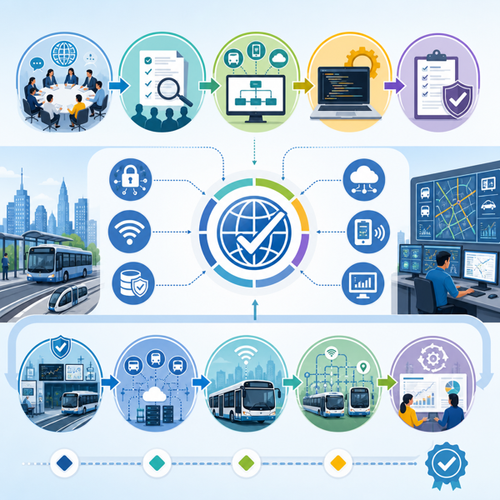
In July 2026, the landscape of Information Technology standards for public transport systems in Europe took a leap forward with the publication of five major updates in the EN 12896 series. Designed for industry professionals, these newly revised standards provide an integrated data model to enable more efficient, interoperable, and future-proof public transport IT solutions. With the emergence of digital transformation and growing demand for seamless, real-time information, these standards have never been more crucial for transport operators, IT solution providers, and procurement specialists.
Overview
Information Technology and Office Equipment are fundamental to modern public transport, underpinning everything from real-time passenger information to fare management and operational control. The EN 12896 "Transmodel" series, maintained by CEN/TC 278, establishes a harmonized conceptual data model forming the foundation for IT systems in European public transport networks. This article explores the latest updates in Parts 2, 3, 4, 5, and 6 of EN 12896, published July 2026, offering critical insights for compliance, system upgrades, and operational excellence.
After reading, you will understand:
- The evolving data model landscape for public transport IT
- Practical changes impacting daily operations and IT integration
- Industry best practices for successful adoption and compliance
Detailed Standards Coverage
EN 12896-2:2026 - Public Transport Network Data Modeling
Public transport - Reference data model - Part 2: Public transport network
This standard addresses the modeling of public transport network data—essential for backbone systems supporting route planning, real-time information, and infrastructure management. It covers:
- Network Description: Defining physical and logical components such as lines, routes, points, and timing locations.
- Fixed Object Model: Details of sites, stop places, points of interest, and accessibility features.
- Tactical Planning Components: Journey patterns, timing patterns, service connections, and passenger assignment.
- Explicit Frames: Allows segmentation and versioning of network data for different planning strategies.
Targeted at public transport operators, IT system integrators, and GIS specialists, this revision introduces improved semantic structures and compatibility with modern planning tools, as well as a comprehensive data dictionary for unambiguous integration.
Key highlights:
- Enhanced definitions for flexible and accessible network elements
- Clear mapping and change log versus EN 12896-2:2016
- Normative annexes structuring the data dictionary and technical evolution
Access the full standard:View EN 12896-2:2026 on iTeh Standards
EN 12896-3:2026 - Timing and Vehicle Scheduling Reference Model
Public transport - Reference data model - Part 3: Timing information and vehicle scheduling
Building on the common concepts of the data model, Part 3 focuses on all aspects of timing, vehicle scheduling, and operational planning at both macro and micro levels. It provides unified models for:
- Journey and Times: Concepts covering vehicle journeys, service journeys, run times, wait times, and timing patterns
- Interchanges and Coupled Journeys: For multi-modal and multi-operator integration
- Vehicle Scheduling and Assignments: Block operations, assignments of vehicles and drivers, dynamic reallocation for real-time operations
- Explicit Frames and Versioning: Keeping operational and scheduling data segmented by planning context
This standard is indispensable for scheduling software developers, operational controllers, and data analysts. The July 2026 revision integrates harmonization with SIRI, IFOPT, and NeTEx standards, supporting national and transnational journey planning and reporting.
Key highlights:
- Strong modularization with explicit UML models for clarity
- Support for advanced scheduling and real-time monitoring interfaces
- Extensions for long-distance and multi-operator scenarios
Access the full standard:View EN 12896-3:2026 on iTeh Standards
EN 12896-4:2026 - Operations Monitoring and Control
Public transport - Reference data model - Part 4: Operations monitoring and control
Part 4 is dedicated to the real-time aspects and feedback loops essential for the smooth running of public transport services. Covering data for:
- Dated Production Components: Capture of service operations, vehicle dispatch, and adjustments on day-of-service
- Control Actions & Events: Real-time commands, interventions, incident management, and operational messaging
- Monitoring & Facility Availability: Vehicle tracking, occupancy, facility status, and resource utilization
- Framework for Incidents and Situations: Modeling and reporting operational disruptions or service changes
Vital for AVM (Automatic Vehicle Management System) developers and operations managers, the 2026 edition enhances mapping with DATEX-II and SIRI protocols and details major revisions since the 2019 edition.
Key highlights:
- Real-time control action modeling for flexible response
- Integration-ready for real-time open data protocols
- Expanded models for incident handling and facility monitoring
Access the full standard:View EN 12896-4:2026 on iTeh Standards
EN 12896-5:2026 - Fare Management Data Model
Public transport - Reference data model - Part 5: Fare management
Designed for today’s complex fare environments, this part addresses how fare products, sales, validation, and revenue protection are modeled and integrated. Core areas include:
- Fare Structure: Zoning, product types, time- or quality-based pricing, and access rights
- Fare Pricing & Control: Calculation principles, price derivation, fare tables, and validation processes
- Sales and Transactions: Data models for sales, contracts, and transaction events between operators and customers
- Fare Roles & Explicit Frames: Assignment and management of all entities involved in the fare process
Whether implementing classic ticketing, account-based fare systems, or media-centric approaches, this revision equips transport authorities and solution providers for tomorrow’s multi-modal and multi-operator fare challenges.
Key highlights:
- Modular and interoperable structure supporting evolving business rules
- Robust validation and control event scenarios
- Enhanced customer and contract transaction modeling
Access the full standard:View EN 12896-5:2026 on iTeh Standards
EN 12896-6:2026 - Passenger Information Systems Data Model
Public transport - Reference data model - Part 6: Passenger information
This part addresses the backbone data required for delivering passenger information across all digital and physical channels. It covers:
- Trip Description & Planning: Modeling journey details, repeated trips, single journeys, and trip repair scenarios
- Passenger Information Queries: API-ready structures for interoperable, on-demand data provision to passenger devices
- Multi-Channel Delivery: Support for text, voice (TTS), and real-time notifications
Operators, passenger information system providers, and digital mobility platforms will benefit from the streamlined data models and modernized query structures, which empower accurate, real-time passenger communications.
Key highlights:
- Unified conceptual and logical data structures for trip planning
- Comprehensive entity definitions promoting system-wide interoperability
- Notable improvements to support distributed journey planners and next-gen mobility apps
Access the full standard:View EN 12896-6:2026 on iTeh Standards
Industry Impact & Compliance
These revisions profoundly affect how public transport systems are designed, specified, and operated.
- Seamless Integration: The updated data models ensure that systems supporting scheduling, ticketing, and real-time information can be integrated with minimal friction, greatly simplifying procurement and vendor selection.
- Enhanced Interoperability: Harmonization with standards like NeTEx and SIRI supports national and cross-border deployments.
- Compliance: While not legal requirements, adherence is rapidly becoming the "de facto" baseline for tenders and large-scale operational deployments across Europe. Organizations are advised to audit systems for conformance and design migration roadmaps accordingly.
- Timelines: Most procurement frameworks expect compliance with the latest versions within 12-24 months.
- Benefits: Early adopters can expect reduced integration costs, improved passenger experience, and future-proofed architectures. Non-compliance risks interoperability issues, increased costs, and reduced eligibility for public tenders.
Technical Insights
Many of the technical requirements and themes cut across all five standards:
- UML-Based Conceptual Modeling: All standards use unified modeling language (UML) for model clarity and tool support.
- Data Dictionary and Explicit Frames: Each standard provides a normative data dictionary, which is critical for correct IT implementation.
- Best Practices:
- Early alignment between IT integrators and public transport planners
- Use of explicit frames for versioning and staged roll-outs
- Building test cases based on the formal data structures and entity relationships defined in each standard
- Testing and Certification: Formal validation of systems requires detailed traceability to entity definitions and interface requirements described in the annexes. Integration with SIRI and NeTEx-based systems should be tested using cross-reference mapping provided in the standards.
Conclusion & Next Steps
The July 2026 updates to EN 12896-2 through EN 12896-6 offer a robust and forward-focused foundation for excelling in the digital era of public transport. Whether upgrading legacy systems, participating in international tenders, or designing innovative digital mobility solutions, organizations must prioritize these standards for compliance, integration, and future-readiness.
Key recommendations:
- Audit current systems and future projects for compliance gaps
- Engage with procurement and technology partners on migration strategies
- Stay informed on evolving standards at iTeh Standards
Next steps: Explore the detailed content of each standard, align IT projects accordingly, and ensure your organization is ready to deliver world-class, interoperable public transport services in line with the latest Information Technology and Office Equipment standards.
Categories
- Latest News
- New Arrivals
- Generalities
- Services and Management
- Natural Sciences
- Health Care
- Environment
- Metrology and Measurement
- Testing
- Mechanical Systems
- Fluid Systems
- Manufacturing
- Energy and Heat
- Electrical Engineering
- Electronics
- Telecommunications
- Information Technology
- Image Technology
- Precision Mechanics
- Road Vehicles
- Railway Engineering
- Shipbuilding
- Aircraft and Space
- Materials Handling
- Packaging
- Textile and Leather
- Clothing
- Agriculture
- Food technology
- Chemical Technology
- Mining and Minerals
- Petroleum
- Metallurgy
- Wood technology
- Glass and Ceramics
- Rubber and Plastics
- Paper Technology
- Paint Industries
- Construction
- Civil Engineering
- Military Engineering
- Entertainment