


A Comprehensive Guide to Key Software Standards: Process Assessment, Instructional Video Production & Agile Adoption
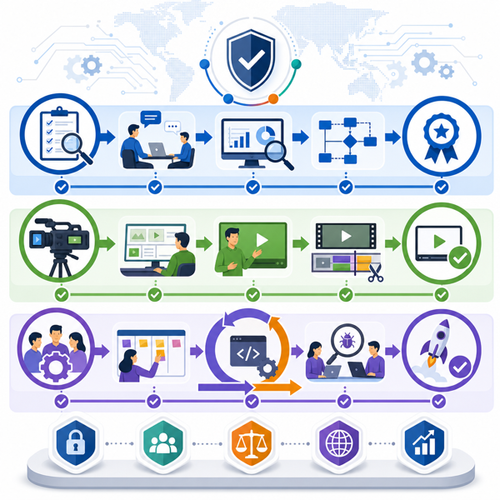
The pace of innovation in the information technology sector has never been more relentless, driving organizations to seek out robust frameworks that can guarantee quality, security, agility, and user empowerment. International software standards are vital tools to foster productivity, ensure process maturity, facilitate agile transformations, and equip users with meaningful knowledge resources like instructional videos. In this comprehensive overview, we break down four landmark software standards that are now a must-have for businesses worldwide: ISO/IEC 33003:2015, ISO/IEC 33004:2015, ISO/IEC/IEEE 26516:2026, and ISO/IEC TR 24587:2021. Each standard encapsulates best practices for software process measurement, process assessment models, instructional video development, and effective agile adoption—delivering value regardless of organization size or sector.
Overview / Introduction
Software underpins nearly every aspect of modern business, from internal operations to customer engagement and global collaboration. With rapid advances in technology, organizations need more than ad hoc procedures; they require repeatable, scalable, and auditable processes underpinned by international consensus. This is where internationally recognized IT standards come into play.
Why do these standards matter now more than ever?
- Businesses must balance innovation with risk, productivity with compliance, and speed with robust quality.
- Security, regulatory, and customer expectations continually rise, demanding structured approaches to process assessment and improvement.
- Remote and hybrid work models, the spread of agile methodologies, and new learning technologies drive the need for modern frameworks.
- High-quality instructional content including video is no longer optional—it's essential for onboarding, support, and rapid upskilling.
This guide demystifies the leading standards for software process assessment, progressive model development, multimedia instructional production, and agile transformation—offering digestible explanations equally suited to technical teams, managers, and non-specialist readers.
Here’s what you’ll discover:
- The core principles and requirements of four foundational software standards
- How implementing these standards can optimize organizational performance, security, and scalability
- The practical business benefits and compliance imperatives
- Step-by-step guidance and best practices for real-world adoption
Detailed Standards Coverage
ISO/IEC 33003:2015 – Foundation for Process Measurement Frameworks
Information technology — Process assessment — Requirements for process measurement frameworks
What does ISO/IEC 33003:2015 cover? This standard defines the requirements needed to build and validate process measurement frameworks that form the backbone of software process assessment. By establishing rules and guidance for measuring process capability, security, agility, and other quality characteristics, ISO/IEC 33003:2015 ensures that organizations can gather consistent, meaningful metrics about their software processes.
Key requirements and specifications:
- Outlines requirements from conceptualization to operationalization of measurement frameworks
- Prescribes approaches for defining constructs (theoretical process attributes), aggregation methods, and how measurements should be structured
- Addresses statistical validation, reliability, and construct validity for measurement models
- Requires frameworks to be applicable across any process quality characteristic in any application domain
Who should comply?
- Software process improvement teams
- Assessment model developers
- Quality management and IT project managers
Practical implications:
- Provides a solid foundation for building composite measures—like process capability levels—across departments or product lines
- Supports objective, repeatable process assessment for benchmarking, regulatory compliance, and continuous improvement
- Enables scalable assessments, essential as businesses grow and diversify
Notable features:
- Clear definitions of measurement concepts: constructs, scales, aggregation, and sensitivity analysis
- Guidance on both reflective and formative measurement models
- Built-in validation and verification procedures for robust frameworks
Key highlights:
- Establishes terminology and requirements for process measurement frameworks
- Enables objective, repeatable measurement of software process maturity
- Foundation for consistent software process improvement
Access the full standard:View ISO/IEC 33003:2015 on iTeh Standards
ISO/IEC 33004:2015 – Structure for Process, Assessment, and Maturity Models
Information technology — Process assessment — Requirements for process reference, process assessment and maturity models
What does ISO/IEC 33004:2015 cover? ISO/IEC 33004:2015 sets the standards for constructing and verifying process reference models, assessment models, and maturity models used in evaluating software and system process capability. It defines how these models relate and interact, ensuring assessments are consistent and meaningful across organizations—for global benchmarking or internal improvement.
Key requirements and specifications:
- Provides detailed requirements for process reference models: domain, context, process descriptions, and unique identification
- Mandates that process assessment models must map to underlying process reference models, using common sets of assessment indicators
- Specifies how maturity models derive from, and link back to, process assessment models
- Requires verification of conformance for each model type
Who should comply?
- Organizations building or using software and system process improvement models
- Process engineers, quality assurance professionals, maturity model assessors
- Managers seeking process improvement or regulatory compliance
Practical implications:
- Facilitates reliable, repeatable assessment results—enabling organizations to benchmark process capability and maturity
- Supports the integration of process measurement and reference models into comprehensive assessment frameworks
- Encourages best practices for designing clear, actionable, and industry-relevant models
Notable features:
- Emphasizes consensus-driven model development with communities of interest
- Covers both prescriptive and descriptive process models, adaptable to various industries
- Provides for mapping, reporting, and conformity checking
Key highlights:
- Framework for building process reference, assessment, and maturity models
- Enables consistent evaluation of process capability across organizations
- Facilitates mapping and integration with process measurement frameworks
Access the full standard:View ISO/IEC 33004:2015 on iTeh Standards
ISO/IEC/IEEE 26516:2026 – Best Practices for Instructional Video Production
Systems and software engineering — Development and production of instructional videos
What does ISO/IEC/IEEE 26516:2026 cover? This forward-looking standard shapes how organizations design, develop, and deliver instructional videos for software and IT systems. With the prevalence of digital transformation and hybrid learning, this standard ensures that instructional videos meet accessibility, usability, and effectiveness criteria for all user types.
Key requirements and specifications:
- Covers the full instructional video life cycle: planning, design, pre-production, production, post-production, publishing, and maintenance
- Defines content elements—titles, captions, narration, graphics—as well as structural requirements like segmentation, user navigation/control, and accessibility
- Addresses the use of video, interactive video, animations, and emerging media such as virtual/augmented reality
- Assigns roles and responsibilities for all stakeholders involved, from manager to editor to narrator
Who should comply?
- Organizations producing instructional content for software products and IT services
- Training, user experience, and customer support teams
- Technical writers, instructional designers, multimedia specialists
Practical implications:
- Delivers higher quality, user-friendly learning resources that drive adoption and reduce support costs
- Encourages inclusive design—making your instructional content accessible to users of all abilities
- Promotes scalable, repeatable video production processes
Notable features:
- End-to-end guidance for video development, not just technical production
- Includes requirements for accessibility and user engagement
- Applicable to both standalone instructional videos and video-integrated information products
Key highlights:
- Comprehensive framework for producing instructional videos in IT
- Ensures videos are accessible, usable, and aligned to user needs
- Addresses new media trends: interactivity, AR/VR, AI-driven features
Access the full standard:View ISO/IEC/IEEE 26516:2026 on iTeh Standards
ISO/IEC TR 24587:2021 – Agile Readiness and Adoption Considerations
Software and systems engineering — Agile development — Agile adoption considerations
What does ISO/IEC TR 24587:2021 cover? With agile software development dominating the industry, successful adoption hinges on readiness and cultural fit—not just technical know-how. ISO/IEC TR 24587:2021 offers a comprehensive overview of organizational, customer, team, and tooling factors critical for a successful agile transition, applicable across all agile methodologies.
Key requirements and specifications:
- Describes readiness factors for organizations, customers, projects, management, people/team, and tools/practices
- Lays out what must be evaluated before full-scale agile adoption: funding, management support, agile familiarity, communication, self-organizing teams, tool sophistication, and more
- Provides a quick-reference guide to help leaders identify gaps and readiness issues
Who should comply?
- Organizations planning or undergoing agile transformation
- Executives and project leaders tasked with managing agile rollouts
- Change managers, HR, and team leads overseeing process improvement
Practical implications:
- Helps organizations prepare systematically for agile adoption and avoid common pitfalls like premature rollouts and cultural resistance
- Supports incremental, tailored agile implementation aligned with business needs
- Fosters higher team engagement, innovation, and faster time-to-market
Notable features:
- Universal applicability to any agile methodology (Scrum, SAFe, XP, etc.)
- Prioritizes introspection on organizational culture and readiness
- Offers actionable advice, focusing on practical, feasible steps
Key highlights:
- Readiness assessment for successful agile transition
- Framework for evaluating organizational, customer, and team factors
- Actionable guide to adopt agile development methods with minimized risk
Access the full standard:View ISO/IEC TR 24587:2021 on iTeh Standards
Industry Impact & Compliance
Implementing robust international software standards is transformational for any organization seeking to enhance productivity, quality, and compliance in today's digital landscape.
Industry impact:
- Raises process maturity, unlocking productivity improvements and operational consistency across distributed or hybrid teams
- Drives continuous process improvement, supporting agile, lean, and DevOps initiatives
- Fosters innovation through safe experimentation and structured change management
- Empowers companies to deliver accessible, compelling instructional content that accelerates user onboarding and reduces support costs
Compliance considerations:
- Adhering to international standards signals reliability and trustworthiness to clients, regulators, and partners
- Provides confidence during audits, lowering the risk of regulatory fines or penalties
- Builds a culture of accountability and objective performance measurement
Risks of non-compliance:
- Disorganized or unscalable process improvement efforts
- Increased security and quality risks from unmanaged processes
- Loss of competitive advantage and slower time-to-market due to inefficiencies
- Fragmented knowledge transfer and problematic user experiences
Benefits of adoption:
- Streamlined scaling as businesses grow or diversify
- Increased workforce engagement and retention due to well-defined, collaborative processes
- Measurable improvements in software quality, customer satisfaction, and profitability
Implementation Guidance
How can organizations successfully adopt these software standards?
Common implementation approaches:
- Assessment and gap analysis: Evaluate current practices relative to the standard’s requirements; use gap analysis to plan improvements.
- Stakeholder engagement: Involve key stakeholders early—including management, technical leads, and end-users.
- Process and model development: Develop process models, measurements, and maturity assessments aligned to the standards.
- Pilot projects: Test new processes or models in select projects or departments before scaling organization-wide.
- Training and knowledge transfer: Provide targeted training on standards, roles, and documentation requirements.
- Iterative improvement: Collect performance data, solicit feedback, and refine processes using the standards as a recurring benchmark.
Best practices for adoption:
- Start with clear leadership support and cross-functional teams for implementation
- Use the standards’ built-in guidance on definitions, indicators, and validation to reduce ambiguity
- Document decisions, process changes, and lessons learned for iterative improvement
- Leverage technology for process automation, video production, and measurement wherever possible
- Integrate standards-based processes with existing quality management, compliance, and risk frameworks
- Prioritize inclusivity and accessibility, especially for user-oriented deliverables like instructional videos
Resources for implementation:
- Official iTeh Standards documentation and training materials
- Professional associations and working groups within ISO, IEC, and IEEE
- Case studies of successful standards implementation in similar organizations
- Tools and software supporting process assessment, video production, and agile readiness evaluation
Conclusion / Next Steps
The digital business landscape is defined not just by technology, but by the processes, tools, and knowledge that support sustainable innovation. Adopting international software standards such as ISO/IEC 33003:2015, ISO/IEC 33004:2015, ISO/IEC/IEEE 26516:2026, and ISO/IEC TR 24587:2021 is essential to thrive in this environment.
Embracing these standards:
- Elevates process maturity, security, and agility
- Delivers superior user engagement through high-quality instructional content
- Enables confident scaling and adaptation to new business challenges
Recommendations for organizations:
- Assess your current processes against these standards and prioritize where improvements are most needed
- Champion standards adoption across leadership and technical teams to foster a culture of quality and learning
- Utilize available resources, training, and peer learning opportunities to ensure successful rollout
- Stay informed—standards evolve with technology, so continuous education and engagement are key
Ready to move forward? Explore the full texts of each standard, access the latest guidance, and join a global community shaping the future of information technology at iTeh Standards.
Categories
- Latest News
- New Arrivals
- Generalities
- Services and Management
- Natural Sciences
- Health Care
- Environment
- Metrology and Measurement
- Testing
- Mechanical Systems
- Fluid Systems
- Manufacturing
- Energy and Heat
- Electrical Engineering
- Electronics
- Telecommunications
- Information Technology
- Image Technology
- Precision Mechanics
- Road Vehicles
- Railway Engineering
- Shipbuilding
- Aircraft and Space
- Materials Handling
- Packaging
- Textile and Leather
- Clothing
- Agriculture
- Food technology
- Chemical Technology
- Mining and Minerals
- Petroleum
- Metallurgy
- Wood technology
- Glass and Ceramics
- Rubber and Plastics
- Paper Technology
- Paint Industries
- Construction
- Civil Engineering
- Military Engineering
- Entertainment